The limit values of risk elements (RE) and persis-tent organic pollutants (POPs) concentrations in agricultural soil are defined in the current Czech legislation by Decree No. 13/1994 Coll. These limit values have a status of maximum tolerable values in agricultural soils. Nevertheless, the criteria were derived from available data in the Czech Republic at the beginning of the 1990’s and the data corre-sponded with the load of Czech agricultural soils and also of some European countries. Concerning the risk elements, the limit values stated in the Decree can be defined as rounded 90 percentile of the background values in soil (pseudototal content in extract of aqua regia). Some activities describ-ing the total content of risk elements in the Czech soils (Kulíková et al. 1989, Beneš 1993) went before the proposal of background values of risk elements
in Czech agricultural soils (Podlešáková et al. 1996). Rather different situation was in setting the limit values for persistent organic pollutants. Czech persistent organic pollutants limits were derived from available external data (especially from the Netherlands) since no relevant data for the Czech soils were available in 1994. As a result, limit values of some individual polycyclic aromatic hydrocarbons in the Decree No. 13/1994 Coll. are lower than their real background values in Czech agricultural soils proposed later (Němeček et al. 1996). This situation is often misapplied by subjects demanding appropriation of agricultural land for construction purposes because lower levies for the appropriation are assessed in the cases where the limit values are exceeded. The current limit values have a character of statistically derived
Assessment of limit values of risk elements and persistent
organic pollutants in soil for Czech legislation
R. Vácha
1, M. Sáňka
2, I. Hauptman
3, M. Zimová
4,5, J. Čechmánková
11
Research Institute for Soil and Water Conservation, Prague, Czech Republic
2Masaryk University, Brno, Czech Republic
3
Ministry of the Environment of the Czech Republic, Prague, Czech Republic
4The National Institute of Public Health, Prague, Czech Republic
5
Faculty of Environmental Science, Czech University of Life Sciences Prague,
Prague, Czech Republic
ABSTRACT
The proposal of hierarchical limit system of risk elements (RE) and persistent organic pollutants (POPs) for agricul-tural soils is presented. The system is not proposed for forest soils (limits are still missing in the Czech Republic). Two levels of limit values were proposed. The first one is the prevention limit statistically derived from the back-ground values of RE and POPs in Czech agricultural soils. The second one is indication limit derived from the risk of plant growth inhibition (RE phytotoxicity effects where the results of experimental trials were utilised), the risk of food chain contamination (RE transfer from the soil into the plants where the results of experimental trials test-ing the transfer of RE from soils into plants were used) and human health risks (RE and POPs inhalation, dermal and oral intake where the model following US EPA methodology was calculated). The limit values system should replace current version of legislative norm – Decree No. 13/1994 Coll. The principles of limit values assessment for individual levels of the limits are described.
Keywords: soil protection legislation; risk substances; agricultural soil
values and do not represent any specific risk from a scientific point of view. It is very questionable to delimit the suitability of soil for agricultural use by the existence of one value of risk substance concentration. Moreover, the specific measures that should be applied in the cases of exceeding the limit values are missing in the legislation. The current version of limit values in the Czech legislation can be considered outdated. A new version of limit values is based on the principle of hierarchical limit values, differentiated in three levels where an individual level presents specific risks. The first level of limit values is derived from the background values of risk elements (or sub-stances) in agricultural soils and the philosophy of this limit values construction follows German experience (Ruppert 1987, Regulation BGBl I, No. 36/1999). Hellmann (2002) defines the principles of the assessment of national soil background values of risk elements when the following must be processed: natural background given by the geology – risk elements contents in rocks and parent materials and risk elements contents in organic matter of soils; the diffusion load given by atmospheric deposition especially (determined the background values of organic pollutants) and the practical questions connected with soil use and its relationship to environmental protection level. The use of suitable statistical methods for the assessment of element background levels in soils (defined as the first level) and also of the higher levels of soil limits is documented by Reimann et al. (2005). The second level of limit values can be defined for specific risks (microbial activity inhibition, transfer in the plants, and transfer in the ground water). In case of setting the limits for transfer in plants the Czech, as well as the German approach (Lubben and Sauerbeck 1989) use single extraction methods (1 mol/L NH4NO3, 0.01 mol/L CaCl2) which were also verified by some other authors (Houba et al. 1990, Száková et al. 2000, Bakircioglu et al. 2011, Zhu et al. 2012). The third level of limit values is connected with an impact on human health (maximal permissible concen-trations (MPC) in the Netherlands, contaminated land exposure assessment in Great Britain) or the threat of ground water contamination (US EPA). The applications of soil decontamination tech-nologies must be used when these limit values are exceed. No unified system of risk elements and POPs soil limit values is available in the EU legislation and individual EU member countries
have to use their national systems (respecting dif-ferent geological and pedological conditions). The principles should be unified in the document called ‘soil thematic strategy’ that was proposed but not implemented in European context yet because of many disagreements among individual member countries. The proposed approach includes two main steps; the identification of contaminated sites and the elaboration of decontamination plan. Nevertheless, the limits for contaminated sites defi-nition and decontamination target values should be proposed in member countries individually (European Comission 2014).
The principles of assessment of risk elements and persistent organic pollutants limit values into one limit values system for agricultural soils that will be useful for replacement of the current ver-sion of the Czech legislation for soil protection are described in the presented article.
MATERIAL AND METHODS
Based on the described principles, two levels of soil limit values, i.e. prevention and indica-tion limits were proposed. The characterisaindica-tion of proposed limit levels is as follows: prevention limits were derived from the background values of RE and POPs in Czech agricultural soils, while the prevention of indication limits reflects the risk of increased transfer from soil into agricultural plants; in selected POPs and RE also the risk of direct impact on human health via their inhalation, dermal or oral intake on contaminated land is assessed.
Central Institute for Supervising and Testing in Agriculture for the use in agricultural practice.
The POPs background values were derived by Němeček et al. (1996) on the basis of the research of 560 soil samples of agricultural soils from the area of the Czech Republic. The background val-ues were statistically calculated as two multiples of the standard deviation of geo means or 90% percentiles – GM × GD2) for both groups (RE and POPs). The background values were assessed for every substance of all observed POPs groups, nevertheless the simplification of limit values for legislative process was needed and summary lim-its were used for some POPs groups. The sum of PAHs was calculated as the sum of 12 substances concentration (anthracene, benzo(a)anthracene, benzo(b)fluoranthene, benzo(k)fluoranthene, benzo(a)pyrene, benzo(ghi)perylene, phenan-threne, fluoranthene, chrysene, indeno(1,2,3-cd) pyrene, naphthalene, pyrene). The polychlorinated hydrocarbons include limits for sum of seven in-dication congeners of polychlorinated biphenyls – PCB7 (28 + 52 + 101 + 118 + 138 + 153 + 180) and sum of DDTs (DDT, DDE and DDD). The hexa-chlorbenzene and hexachlorhexane ((Σ α + β + γ) and polychlorinated dibenzo-ρ-dioxines and diben-zofurans (PCDDs/Fs) should be analysed only in the case of suspicion of their contents in soil. The background value of PCCDs/Fs was calculated by identical formula on the basis of 102 soil samples taken in the areas of the Czech Republic with dif-ferent source of the load (Vácha et al. 2005). The value of International Toxic Equivalent (I-TEQ PCCDs/Fs) of 17 most toxic congeners was calcu-lated (Van den Berg et al. 2006) that is considered more suitable for risk assessment than only sum of the PCDDs/Fs concentration.
The indication limit values of food chain con-tamination and plant growth inhibition. The limits were proposed only for RE on the base of the research of RE transfer from soil into selected plants (triticale, radish) in experimental condi-tions and into fodder plants (clover, alfalfa and
grass species) in field conditions (Němeček et al. 2001, 2002, Podlešáková et al. 2001, 2002). The dependency of RE mobile contents and selected soil conditions (pH, Cox, soil texture) was evalu-ated by statistical methods (factor analysis). The comparison of the selected RE total contents (As, Cd, Cu, Hg, Ni, Pb, Th, Zn) and the content in the extract of 1 mol/L NH4NO3 (As, Cd, Cu, Ni, Pb, Th, Zn) characterised as RE mobile fraction (ISO DIS 19730) is the principle of RE indication values assessment. The limit values were referred to RE critical values in eatable and fodder plants (Decree No. 305/2004 Coll.). No limits of this kind were proposed for POPs.
The indication limit values of human health protection. The limit values were derived from the direct risk of increased POPs and RE (As, Cd, Hg and Pb) contents on human health by their in-halation, dermal and oral intake on contaminated fields. The calculation corresponds with the US EPA methodology (US EPA 2002) and respects the toxicity of theselected substances or elements and the movement duration of farmers on the contaminated land (standard exposition scenario was applied). It is also supported by the experience following from the activities provided in Czech conditions (Zimová et al. 2001).
RESULTS AND DISCUSSION
[image:3.595.61.533.673.742.2]Prevention limits. The prevention limits of the RE are shown in Table 1. The values are different for two soil texture units. The light texture soils include sandy soils, loamy-sandy soils and gravel-sandy soils. All the other soil texture groups belong to the standard soils unit. The values present RE contents in the extract of aqua regia. The values were derived from the background values of RE in Czech agricultural soils – the soil geochemical background plus the average diffusion of anthro-pogenic load (Podlešáková et al. 1996). The pre-vention limits are not valid for the soils developed
Table 1. Proposed risk elements prevention limits in agricultural soils
Soil category Prevention value (mg/kg of dm)
As Be Cd Co Cr Cu Hg Mn Ni Pb V Zn Tl
Standard texture soils1 20 2.0 0.5 30 90 60 0.3 1200 50 60 130 120 0.5
on geochemically anomalous substrates. These causes including the substrates with increased RE contents of lithogenic or chalcogenic origin (Vácha et al. 2002) will be under individual evaluation.
The prevention limits for POPs are presented in Table 2. There is no differentiation of the soil texture units. Moreover, the contents of POPs can be evaluated as total POPs contents in the soil. The background values of POPs in soil depend mainly on the average diffuse anthropogenic load. The proposed POPs prevention of limits derived from the real Czech background values (Němeček et al. 1996) should replace the current maximum toler-able values in the Decree 13/1994 Coll. adopted from Dutch conditions where sandy soils (with low organic matter content) dominate. The undertaken contents of some individual PAHs from Dutch soils and assessed as limit values in the Czech Decree 13/1994 Coll. reach the values under the level of the real Czech background values. These discrepancies lead to theoccasional attempts to abuse the POPs limits in the soil (the appropria-tion of agricultural land).
Exceeding of RE or POPs prevention limits sig-nalizes the increased anthropogenic soil load (over the background values). When the prevention limits are exceeded, the precaution measure is proposed: the use of sludge, dredged sediments or biosolids on the field will be forbidden. This level of limit values has already been partially implemented in the Czech legislation, namely in the Decrees No. 382/2001 Coll. and No. 257/2009 Coll. These Decrees set the conditions for ap-plication of sewage sludge and sediments on the agricultural land, respectively. However, the in-tention is that the prevention limits are a part of comprehensive new Decree that should replace the present Decree No. 13/1994 Coll. They should be valid for all types of substances applied on the agricultural land generally.
[image:4.595.63.292.426.610.2]The assessment of RE and POPs background values is used in limit values systems of some EU countries, nevertheless the background values definition can be different. The Czech legislation follows German approach where the background values are characterised as the concentration re-sulting from geological and pedological processes, including diffuse source inputs. This approach with international relevance is described in ISO
Table 2. Proposed persistent organic pollutants (POPs) prevention limits in agricultural soils
POPs Prevention value (mg/kg of dm)
Polycyclic aromatic hydrocarbons
Σ PAHs1 1.0
Chlorinated hydrocarbons
Σ PCB2 0.02
Σ DDT3 0.075
HCB4 0.02
HCH4 (Σ α + β + γ) 0.01
PCDDs/Fs5 1.0
Petroleum hydrocarbons
Hydrocarbons C10–C40 100
1Σ PAHS – polycyclic aromatic hydrocarbons
(anthrace-ne, benzo(a)anthrace(anthrace-ne, benzo(b)fluoranthe(anthrace-ne, benzo(k) fluoranthene, benzo(a)pyrene, benzo(ghi)perylene, phenanthrene, fluoranthene, chrysene, indeno(1,2,3-cd)pyrene, naphthalene, pyrene); 2Σ PCB congeners –
28 + 52 + 101 + 118 + 138 + 153 + 180; 3Σ DDT, DDE,
DDD; 4HCB and HCH (Σ α + β + γ) – analysed only at
suspicion of their contents in soil; 5international toxic
equivalent value (I-TEQ PCDDs/Fs) (ng/kg) – analysed only at suspicion of increased PCDDs/Fs contents in soil; dm – dry matter
Table 3. Proposed indication limits of food chain con-tamination
Element textureSoil pH/CaCl2
Indication value (mg/kg of dm)
aqua regia NH1 mol/L
4NO3
As – – – 1.0
Cd
< 5 1 –
5–6.5 1.5 –
standard texture > 6.5 2.0 0.1 light texture > 6.5 2.0 0.04
Ni
< 5 90 –
5–6.5 150 –
> 6.5 200 –
– – 1.0
Pb – 300 1.5
Tl – 10 0.2
Hg* – 1.5 –
[image:4.595.303.533.462.688.2]19258 (2005) for RE and POPs. Very similar is the background value definition in France and United Kingdom. Different approach is used in Belgium, Luxembourg and Netherlands where no anthropo-genic inputs are calculated for background values (concentrations found in soil unaffected by any human activity, or in soils possibly contaminated by line/point source are exceeded). Generally, individual background values for RE and POPs can differ not only between the member countries but between the regions of individual countries (LABO 1995) because of different geological and pedological processes, anthropogenic inputs and legislation systems.
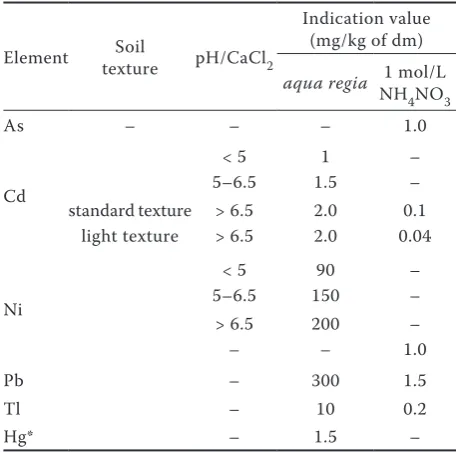
The indication limit values of food chain con-tamination and plant growth inhibition. The indication limit values are based on the com-parison of RE (pseudo) total contents and their mobile fraction analysed in the extract of 1 mol/L NH4NO3. The indication limits of food chain con-tamination for selected elements (As, Cd, Pb, Tl, Hg) considered as zootoxic elements are presented in Table 3. The indication values for Cd are most complicated when the selection on the basis of soil texture, soil pH, (pseudo) total and mobile Cd contents has to be done. The analysis of both risk element forms (pseudototal and mobile) must be done if the limit values are available. As soon as one limit value (pseudototal or mobile form) is exceeded, it is enough for indication of limit
exceeding. The values were derived from the test-ing of limited plant species number (experimental and field conditions) and the general validity of the proposed values must be accepted. The statisti-cal probabilities of the critistatisti-cal values exceeding in eatable or fodder plants can be resulted when RE indication limits in the soil are exceeded. The precaution defined in the legislation issues from this principle and the testing on individual plants in field conditions must be done.
The limit values of phytotoxic risk elements (Ni, Cu and Zn) indicating the plant growth inhibi-tion that results in significant yield reducinhibi-tion are presented in Table 4. The principle of limit values assessment is similar (tested on identical plant spe-cies) and the exceeding of indication limit values must be confirmed by testing of individual plant species in field conditions. The use of suitable remediation techniques (liming, RE immobilisa-tion) when indication limit values are exceeded will be highly recommended.
The limits for POPs were not proposed because of marginal transfer of POPs from the soil into the plants by transfer via roots into shoots of plants (Trapp 2002). Nevertheless, some countries have set ‘indication limits’ for selected POPs substances (Němeček et al. 2010) for different soil use includ-ing agriculture (for example Switzerland, PAHs – 20 mg/L, PCBs – 0.2 mg/L, I-TEQ PCDDs/Fs – 20 ng/L) or maximum tolerable values for ag-riculture soils (Netherlands, I-TEQ PCDDs/Fs – 10 ng/kg).
The indication limit values of human health protection. The indication limit values of human health protection were proposed for RE (Table 5) and POPs (Table 6) on the basis of the model calculation of exposition scenario (method US EPA 2002). The carcinogenic risk of individual elements of substances following from
inhala-Table 4. Proposed indication limits of plant growth inhibition
Element pH/CaCl2
Indication value (mg/kg of dm)
aqua regia NH1 mol/L
4NO3
Cu
< 5 150 –
5–6.5 200 –
> 6.5 300 –
– – 1.0
Ni
< 5 90 –
5–6.5 150 –
> 6.5 200 –
– – 1.0
Zn 400– 20–
[image:5.595.63.290.516.702.2]The transcendence of limit value is confirmed when ex-ceeding: (a) aqua regia extraction and (or) ; (b) 1 mol/L NH4NO3 extraction and both analyses must be done if the limit values are available. dm – dry matter
Table 5. Proposed risc elements indication limits of human health protection
Element Indication value (mg/kg of dm)
As1 40
Cd1 20
Hg2 20
Pb1 400
Tl1 60
[image:5.595.304.531.639.726.2]tion, dermal and oral intake was accepted in the proposal (non-carcinogenic risk was not calcu-lated in proposed indication values). The scenario calculates the carcinogenic effect of individual element/substance, the input into human bodies by inhalation, dermal and oral inputs and the time period of exposition (estimated number of days per year). The calculated value is maximum toler-able value and its exceeding leads to human health risk. The precaution defined in the legislation is based on the risk analysis of the site confirmed or excluded human health risk. The similar approach is applied in some EU countries, for example limit value for human health protection is defined as decontamination limit for chlorinated substances in the soils of Germany (Federal Ministry of Justice and Consumer Protection of Germany 1999).
It could be concluded that the proposed version of limit values for the legislation would funda-mentally improve the current version (Decree No. 13/1994 Coll.). The principle of maximally tolerable values that is presenting no actual risk will be replaced by the system of hierarchical limit values referred to as an individual level of the risk and followed by appropriate measures in the cases when limits are exceeded. The first version
of hierarchical limit values was proposed in 2002 (Sáňka et al. 2002). Nevertheless, its enforcement regarding the successful legislation process is made more complicated by different lobbies and the necessity of Soil Protection Act No. 334/1992 Coll. amendment (only one level of limit values is defined in the current version). The last chance of Soil Protection Act amendment was disrupted after the dissolution of the Chamber of Deputies in 2013. The legislation process is running again these days and the amendment of the Degree No. 13/1994 Coll. should follow as soon as possible.
Acknowledgements
The authors thank Mgr. Lada Hořešovská for her language correction.
REFERENCES
Bakircioglu D., Kurtulus Y.B., Ibar H. (2011): Comparison of ex-traction procedures for assessing soil metal bioavailability of to wheat grains. Clean – Soil, Air, Water, 39: 728–734. Beneš S. (1993): The Element Contents and Balances in the
Spheres of the Environment. I. part. Ministry of the Agricul-ture of the Czech Republic, Prague, 88. (In Czech)
ČSN EN 13346 (2001): Characterization of sludges – Determina-tion of trace elements and phosphorus – Aqua regia extraction methods. Czech Normalisation Institute, Prague.
DIN ISO 19730 (2008): Soil quality – Extraction of trace elements from soil using ammonium nitrate solution. German Institute for Standardization, Beuth Verlag, GmbH, Berlin.
European Commission (2014): Report of the implementation of the Soil Thematic Strategy and ongoing activities. Available at http://ec.europa.eu/environment/soil/three_en.htm
Federal Ministry of Justice and Consumer Protection of Germany (1999): Soil Protection Act. Available at http://www.gesetze-im-internet.de/bbodschg/index.html
Hellmann H. (2002): Definitions of background-concentrations – An overview. Acta Hydrochimica et Hydrobiologica, 29: 391–398.
Houba V.J.G., Novozamsky L., Lexmond Th.M., van der Lee J.J., (1990): Applicability of 0.01 M CaCl2 as a single extraction solution for the assessment of nutrient status of soils and other diagnostic purposes. Communications in Soil Science and Plant Analysis, 21: 2281–2290.
[image:6.595.65.291.115.255.2]ISO 14869-1 (2001): Soil quality – Dissolution of the determi-nation of total element content – Part 1: Dissolution with hydrofluoric and perchloric acids. International Organization for Standardization, Geneva.
Table 6. Proposed persistent organic pollutants indica-tion limits of human health protecindica-tion
Substance Indication value (mg/kg of dm)
Σ PAHs1 30
Benzo(a)pyrene 0.5
Σ PCB2 1.5
Σ DDT3 8.0
HCB4 1
HCH4 (Σ α + β + γ) 1
PCDDs/Fs5 100
1Σ PAHS – polycyclic aromatic hydrocarbons (anthracene,
benzo(a)anthracene, benzo(b)fluoranthene, benzo(k) fluoranthene, benzo(a)pyrene, benzo(ghi)perylene, phenanthrene, fluoranthene, chrysene, indeno(1,2,3-cd)pyrene, naphthalene, pyrene); 2Σ PCB congeners –
28 + 52 + 101 + 118 + 138 + 153 + 180; 3Σ DDT, DDE,
DDD; 4HCB and HCH (Σ α + β + γ) – analysed only at
suspicion of their contents in soil; 5international toxic
ISO 19258 (2005): Soil quality – Guidance of determination of background values. International Organization for Standardi-zation, Geneva.
Kubík L. (2009): Register of contaminated sites 1990–2008. Fi-nal report of Central Institute for Supervising and Testing. Available at http://www.ukzuz.cz/Folders/Articles/46660-2-Registr+kontaminovanych+ploch.aspx
Kulíková A., Hartmann V., Němeček J. (1989): Micro elements in Cambisols. Rostlinná výroba, 35: 17–28.
LABO (1995): Soil Background and Reference Values in Germany. Bavarian Environmental Ministry, Munich, 104. (In German) Lubben S., Sauerbeck D. (1989): Incorporation of heavy metals by wheat and their distribution in the plant. In: Proceedings of the 6th International Trace Elements Symposium, 1–5: 1295–1302.
Ministry of Agriculture and Ministry of Environment of Czech Republic (2009): Decree No. 257/2009 Coll., on application of sediments on agricultural land, Prague. (In Czech)
Ministry of Environment of Czech Republic (1994): Decree No. 13/1994 Coll., setting some details of agricultural soil fund protection, Prague. (In Czech)
Ministry of Environment of Czech Republic (2001): Decree No. 382/2001 Coll., setting the conditions for application of sewage sludge on agricultural land, Prague. (In Czech)
Ministry of Health of Czech Republic (2004): Decree No. 305/2004 Coll., maximum contents of contaminants in foods, Prague. (In Czech)
Němeček J., Podlešáková E., Pastuzsková M. (1996): The proposal of limits of soil contamination by persistent organic xenobiotic compounds in the Czech Republic. Rostlinná výroba, 42: 49–53. Němeček J., Podlešáková E., Vácha R. (2001): Prediction of the
transfer of trace elements from soils into plants. Rostlinná výroba, 47: 425–432.
Němeček J., Podlešáková E., Vácha R. (2002): Transfer of trace elements with low soil mobility into plants. Rostlinná výroba,
48: 45–50.
Němeček J., Vácha R., Podlešáková E. (2010): Evaluation of Soil Contamination in CR. Research Institute for Soil and Water Conservation, Prague, 148. (In Czech)
Parliament of Czech Republic (1992): The Act No. 334/1992 Coll. about agricultural soil fund protection, Prague. (In Czech) Podlešáková E., Němeček J., Hálová G. (1996): The proposal of
soil contamination limits by potentially risky elements for CR. Rostlinná výroba, 42: 119–125.
Podlešáková E., Němeček J., Vácha R. (2001): The transfer of less hazardous trace elements with high mobility from soils into plants. Rostlinná Výroba, 47: 433–439.
Podlešáková E., Němeček J., Vácha R. (2002): Critical values of trace elements in soils from the viewpoint of the transfer pathway soil-plant. Rostlinná Výroba, 48: 193–202.
Regulation BGBl I, No. 36/1999 of German government on soil protection and old burdens, based on Act BBodSchG. Reimann C., Filzmoser P., Garrett R.G. (2005): Background and
threshold: Critical comparison of methods of determination. Science of the Total Environment, 346: 1–16.
Ruppert H. (1987): Nature Background Values and Anthropo-genic Enrichment of Trace Metals in Soils of Bayerns. GLA, Fachberichte 2, 97. (In German)
Sáňka M., Němeček J., Podlešáková E., Vácha R., Beneš S. (2002): The elaboration of limit values of concentrations of risky ele-ments and organic persistent compounds in the soil and their uptake by plants from the viewpoint of the protection of plant production quantity and quality. The report of the Ministry of Environment of the Czech Republic, Prague, 60. (In Czech) Száková J., Tlustoš P., Balík J., Pavlíková D., Balíková M. (2000): Efficiency of extractants to release As, Cd and Zn from main soil compartments. Analusis, 28: 808–812.
Trapp S. (2002): Dynamic root uptake model for neutral lipo-philic organics. Environmental Toxicology and Chemistry,
21: 203–206.
US EPA (2002): Supplemental Guidance for Developing Soil Screen-ing Levels for Superfund Sites. Office Solid Waste and Emergency Response, Washington. EPA Publication OSWER 9355.4.24. Vácha R., Němeček J., Podlešáková E. (2002): Geochemical and
anthropogenic soil loads by potentially risky elements. Rostlinná výroba, 48: 441–447.
Vácha R., Vysloužilová M., Horváthová V. (2005): Polychlorinated dibenzo-ρ-dioxines and dibenzofurans in agricultural soils of the Czech Republic. Plant, Soil and Environment, 51: 464–468. Van den Berg M., Birnbaum L.S., Denison M., De Vito M., Farland
W., Feeley M., Fiedler H., Hakansson H., Hanberg A., Haws L., Rose M., Safe S., Schrenk D., Tohyama Ch., Tritscher A., Tuomisto J., Tysklind J., Walker N., Peterson R.E. (2006): The 2005 World Health Organization re-evaluation of human and mammalian toxic equivalency factors for dioxins and dioxin-like compounds. Toxicological Sciences, 93: 223–241. doi: 10.1093/toxsci/kfl055
Zhu Q.H., Huang D.Y., Liu S.L., Luo Z.C., Zhu H.H., Zhou B., Lei M., Rao Z.X., Cao X.L. (2012): Assessment of single extraction methods for evaluating the immobilization effect of amend-ments on cadmium in contaminated acidic paddy soil. Plant, Soil and Environment, 58: 98–103.
Zimová M., Ďuriš M., Spěváčková V., Melicherčik J., Lepší P., Tesařová B., Knotek P., Kubínová R., Ronen Y. (2001): Health risk of urban soils contaminated by heavy metals. International Journal of Occupational Medicine and Environmental Health,
14: 231–234.
Received on December 19, 2014 Accepted on April 3, 2014
Corresponding author:
Doc. Ing. Radim Vácha, Ph.D., Výzkumný ústav meliorací a ochrany půdy, v.v.i., Žabovřeská 250, Praha 5, 156 27 Zbraslav, Česká republika