JOURNAL OF FOREST SCIENCE, 52, 2006 (12): 547–555
Most phytophagous mites of the family Eriophyidae create species-specific leaf distortions (galls, erinea etc.) on broadleaved trees, shrubs and herbs by suck-ing on leaf tissues (Westphal, Manson 1996). Sub-species of the Sub-species Eriophyes (=Phytoptus) tiliae (Pgst.) are feeding specialists on lime (Tilia sp.) where they create distinctive galls (Fig. 1). Vaněčková-Skuhravá (1996) found three subspecies docu-mented by Keifer et al. (1982) and Schnaider (1991) on lime trees in the Czech Republic. These varieties are often classified as separate species. Bio- logy and feeding behaviour of E. tiliae tiliae (Pgst.) were described by Thomsen (1976, 1988). In Poland, Skrzypczynska (1999) noted the occurrence of 6 gall-forming insects and mites on T. cordata Mill. Most abundant species were E. leiosoma (Nal.) and Phytoptus tetratrichus tetratrichus Nal.
The occurrence and distribution of Eriophyes spe-cies are affected by a number of ecological factors.
The most important of them are climate, food supply and anthropogenic effects (air pollution). Detailed knowledge on the distribution of gall-forming mites Acalitus rudis (Can.) and Phyllocoptes lionotus (Nal.) (Acari: Eriophyidae) on birch was obtained by Kula et al. (1999, 2000) who noted the dependence of oc-currence on altitude. Their ococ-currence could be also affected by the age of trees, provenance and other traits (Kula et al. 2003). The dispersion of mites in the birch crown profile was described by Buchta et al. (2004) who noted the highest occurrence of galls in the lower part of crowns.
According to Fernandes et al. (1994), it was noted in a gall-forming fly Aciurina trixa Curr. (Diptera: Tephritidae) that the distribution of galling insects is related to habitat harshness. Most of galls were observed on extremely unfavourable xeric sites. Air pollution load can be a stress factor as well. Koricheva et al. (1996) found that the number of
Supported by the Czech Science Foundation, Project. No. 526/05/0187, and the Ministry of Education, Youth and Sports of the Czech Republic, Project No. MSM 6215648902. It was sponsored by the following companies and organizations: Netex Co. and Alusuisse Co. in Děčín, Municipal Office in Děčín, Setuza Co. in Ústí nad Labem, ČEZ Co. Prague, Cement Works Co. in Čížkovice, North-Bohemian Mines Co. in Chomutov and Dieter Bussmann Co. in Ústí nad Labem.
Occurrence variations and spatial distribution patterns
of
Eriophyes tiliae
(Pgst.) (Acari, Eriophyidae)
subspecies in the urban environment
I. Buchta, E. Kula, M. Kresťanpolová
Faculty of Forestry and Wood Technology, Mendel University of Agriculture and Forestry Brno,
Brno, Czech Republic
ABSTRACT: The occurrence of Eriophyes tiliae (Pgst.) subspecies was observed in lime trees in the urban area of Brno. Mites presence was assessed in relation to the lime species, its age and health conditions. Analysis of the occurrence of liosoma, tiliae and nervalis subspecies was carried out on leaves of 3,245 lime trees from the viewpoint of the host preference and spatial distribution of attack in the area of the city and potential effects of air pollution. Subspecies
liosoma and tiliae occurred in 13% of lime trees, the subspecies of nervalis was found only in 4 limes. Eudominant subspecies of E. tiliae preferred mature trees and young trees reaching height of mature trees in good health conditions. The distribution of Eriophyes tiliae on lime trees in the area of Brno depended on the distribution of suitable host trees and was not affected by air pollution.
galls of birch-bound Acalitus rudis (Can.) decreased with a distance from the source of emissions of heavy metals while the occurrence of mite Phyllocoptes lionotus (Nal.) forming closed globular galls was not dependent on a distance from the source of air pollution. Price et al. (1987) and Fernandes and Price (1992) confirmed the higher tolerance of phy-tophagous arthropods living in galls to unfavourable conditions as against to free-living organisms.
In urban environment, where the majority of potential host plants grows in man-influenced en-vironment and where there is no distinct altitudinal gradient, abundance of gall mites is supposed to be driven by different mechanisms. Spatial distribu-tion of host plants was regarded as a serious factor affecting the presence of Microlepidoptera in the agglomeration of St. Petersburg. It was stated that migration potential of particular species was im-portant for spreading and colonization of available habitats (Kozlov 1996). Gall mites are capable of travelling on long distances passively by means of wind (Sabelis, Bruin 1996). Spacing of lime trees in Brno does not exceed spacing of 3 km, thus forming relatively homogenous habitat. Hence the host trees have similar chance of catching travelling mites.
The performance pattern of Eriophyidae depend-ing on stress factors affectdepend-ing a host can, however, show higher importance in the urban environment. According to Larsson (1989), performance of guilds of gall-forming phytophagous arthropods decreases with the increasing level of stress.
The aim of the paper is to evaluate the occurrence of galls of Eriophyidae attacking lime trees in the urban area of Brno (Czech Republic) in relation to the species of lime, its age, health condition and air pollution stress.
MATERIAL AND METHODS
Description of research area and characteristics of host trees
The occurrence of mites was assessed in the group of 3,245 lime trees (Tilia sp.) growing in the urban area of Brno (49°12´N and 16°34´E; altitude 180–300 m a.s.l.) in 2004. Limes are distributed irregularly. The highest proportion of lime trees taken into study is situated in a dense build-up area up to 4 km from the city centre. Generally, the trees form alleys of one species, 5% limes grow as solitaires or in small groups of no more than 10 trees.
In addition to eudominant T. euchlora Koch (50.3%), T. platyphyllos Scop.(23.2%) and T. cordata Mill. (21.1%) also Tilia tomentosa Moench, Tilia × europaea, Tilia cordata Greenspire and Tilia americana L. occur there. T. tomentosa Moench ap-pears mainly in new plantings.
Data on the air pollution load (SO2, NOx, PM10, benzene, O3, Pb, Cd, As, Ni, Hg, benzo-a-pyrene, carbon monoxide) came from the model calculation of a dispersion study for the city of Brno determined on the basis of up-to-date emission sources accord-ing to SYMOS methodology (Bucek 2004).
[image:2.595.66.515.55.192.2]Kolařík (2002) characterized vitality and physio-logical age in all lime trees (Table 2). Vitality was expressed as a general characteristic to summarize tree defoliation, leaf size, occurrence of branch mal-formations, development of secondary shoots, drying up and the growth of shoots and sprouts. Regarding the host age, mature trees with manifestations of the stagnation of growth (degree 4 of physiological age) predominated in the studied group. Concerning host vitality, most represented were the trees with slightly Fig. 1. Galls of E. tiliae v. tiliae (left), v. liosoma (in the middle) and v. nervalis (right)
Table 1. Classification of the degree of attack of leaves by gall-forming mites
Category
of attack of attack (%)Degree of infestationCoefficient
No attack 0 –
Weak 1–10 0.05
Medium 11–50 0.35
[image:2.595.65.290.677.760.2]or evidently disturbed vitality (vitality degrees 1 and 2). Younger trees with various degrees of vitality were situated mainly north of the city centre (Královo Pole, Ponava and Veveří town districts) and in occasional places of the urban greenery regeneration.
Evaluation of the occurrence of mites and the statistical analysis of data
The attack of lime trees by E. tiliae (Pgst.)was clas-sified as the proportion of leaf area with galls (Table 1) in the group of 50 randomly chosen leaves from a single branch sampled from the lower part of the tree crown of each tree.
The infestation coefficient for each of the trees was determined as a sum of the number of leaves in par-ticular categories of attack multiplied by the coeffi-cient of attack. The coefficoeffi-cient of attack expresses the estimated mean value of the proportion of an area with galls in the given category of attack (Table 1). The coefficient of infestation by particular species was visualized in ArcView GIS.
Data sets did not correspond to normal distribu-tion according to the Shapiro-Wilk test of normal distribution. The data are characterized by the high proportion of zero values which caused their con-siderable skewness. The highest frequency of dam-aged leaves was noted in attacks by 10% leaf area. To compare the dependence of attack of particular species of lime, their physiological age and vigour by subspecies of E. tiliae (Pgst.) a non-parametric
Kruskal-Wallis ANOVA with Bonferroni correction p-values was used.
The occurrence of galls of E. tiliae tiliae and E. ti-liae liosoma was assessed only in eudominant species Tilia euchlora, Tilia platyphyllos, Tilia cordata. Zero hypotheses of the proposed tests determined that there were no significant differences in the attack by particular subspecies of E. tiliae (Pgst.) in relation to categories of physiological age, vigour and lime species. The statistical analysis was carried out by means of Statistica 6.0 software package.
RESULTS
On lime trees in the urban area of Brno, three sub-species of Eriophyes tiliae (Pgst.) were found: tiliae, liosoma and nervalis (Schnaider 1991). Galls were found on 436 limes of the total number of 3,245 trees. Most of trees were attacked by subspecies of liosoma (249) and tiliae (228). E. tiliae nervalis was found only on 4 trees. Its presence was not regarded as sig-nificant in the area of Brno. The highest frequency in the occurrence of mites was in T. cordata Mill.(6.5%) and T. platyphyllos Scop. (5.1%). In T. euchlora Koch 1.4% trees were attacked; number of attacked lime trees of others species did not exceed 1%.
[image:3.595.61.531.73.310.2]The proportion of attacked lime species by varie-ties of E. tiliae (Pgst.) is given in Table 3. Generally abundant subspecies tiliae was not detected in T. × europaea, subspecies liosoma attacked T. americana L. and T. cordata Greenspire. A subspecies nervalis Table 2. Categorization of the physiological age and vigour (Kolařík 2002)
Level Description
Physiological age
1 Planting in the stage of acclimation
2 Acclimated planting, plants in the period of dynamic growth 3 A young tree reaching dimensions of a mature tree
4 A mature tree with symptoms of growth stagnation 5 An old tree, the decline of a crown
Vigour*
0 A vigorous tree without evident symptoms of decreased vitality and with good conditions to preserve the state 1 Slightly disturbed vigour, conditions of a short-term variation with the high probability of return to Group 0 after
disappearing external negative effects
2 Vigour markedly disturbed (growth stagnation), however, preservation of a tree is not immediately disturbed. In young and medium-aged trees, improvement is supposed in larger or smaller extent after the restriction or removal of external negative factors
3 Markedly decreased vigour, the remedy of the condition is not virtually probable 4 Residual vigour
5 A dead dry tree
occurred only on T. cordata Mill. and T. platyphyllos Scop. Statistical evaluation of the rate of attack by sub-species of tiliae and liosoma was possible in T. euchlora Koch, T. cordata Mill. and T. platyphyllos Scop.
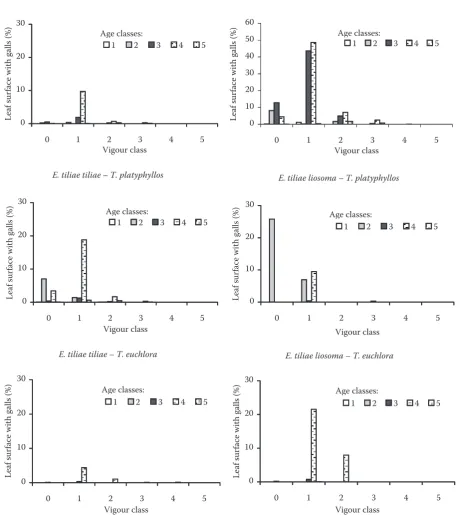
Host preference of both eudominant subspecies was different (Table 3), which was confirmed by results of the Kruskal-Wallis analysis of variance (for both subspecies p < 0.001). The E. tiliae tiliae preferred T. platyphyllos Scop. whereas the subspe-cies liosoma was most abundant on T. cordata Mill. (Fig. 2). In the subspecies tiliae, the lower degree of leaf attack was observed (Fig. 3).
The simultaneous occurrence of several subspecies of E. tiliae (Pgst.) was noted only in 1.35% of lime trees. Subspecies tiliae and liosoma attacked simul-taneously T. cordata Mill.(0.8%), T. euchlora Koch (0.27%), T. platyphyllos Scop. (0.18%) and T. tomen-tosa Moench (0.03%). Subspecies nervalis occurred on two trees accompanied by remaining subspecies.
Significant difference in the occurrence by the physiological age of trees was proved in both eu-dominant subspecies by the Kruskal-Wallis test (p < 0.0001). Mature full-grown trees (4th age
cat-egory) were attacked most independently of the subspecies of Eriophyes tiliae and the Tilia species. Difference from other age classes was approved by
post-hoc multiple comparison of p-values at α = 0.05. Only exception was the higher attack of young ac-climated planting (2nd category) of T. platyphyllos by E. tiliae liosoma (Fig. 3).
Differences in infestation in relation to the host class vigour were confirmed by Kruskal-Wallis ANOVA for liosoma and tiliae subspecies (p < 0.0001). The high-est values of the index of attack were found on sound lime trees or on trees with slightly decreased vigour (Fig. 3). Differences were also determined by the post-hoc multiple comparison of p-values (α = 0.05). The highest values were usually concentrated in the group of trees with slightly decreased vigour (Fig. 3). On the contrary, highest attack by subspecies lio-soma on T. platyphyllos Scop. was noted in the class of healthy trees.
[image:4.595.65.533.73.235.2]Although frequency of the occurrence of both dominant subspecies of E. tiliae was similar in T. cor-data, T. platyphyllos Scop. and T. euchlora Koch, the higher level of leaf area attack by the subspecies lio-soma creating a typical patchy erinea in some groups of lime trees was noted. According to the index of attack, mature trees of T. cordata Mill. with slightly disturbed vigour (weighted mean 48.6%) and young growing-up trees were most threatened (Fig. 3). Same was observed in case of subspecies tiliae, but the Table 3. The number of lime trees and the occurrence of trees with galls of E. tiliae (Pgst.) subspecies
Species Number of trees Attacked trees (%)
tiliae liosoma nervalis
T. americana L. 11 9.1 0.0 0.0
T. cordata Mill. 686 8.9 25.7 0.4
T. cordata Greenspire 22 4.5 0.0 0.0
T. euchlora Koch 1,632 1.9 1.5 0.0
T. platyphyllos Scop. 753 16.7 5.8 0.1
T. tomentosa Moench 92 3.3 2.2 0.0
T. × europaea 41 0.0 7.3 0.0
Tilia sp. 8 62.5 0.0 0.0
Total 3,245 7.0 7.7 0.1
0 1 2 3 4 5
T L LT N LN TLN
%
o
f t
re
es
T. x europaea T. tomentosa T. euchlora T. platyphyllos T. cordata
Fig. 2. The occurrence of E. tiliae (Pgst.) subspecies according to a nutritive species (T – subspecies tiliae, L – subspecies lio- soma, LT – subspecies tiliae + liosoma, N – sub-species nervalis, LN – sub- species liosoma + nervalis, TLN – subspecies tiliae + liosoma + nervalis)
[image:4.595.61.533.601.768.2]index of attack did not exceed 10%. The subspecies liosoma (index of attack 25.8%) preferred younger trees of T. platyphyllos Scop.A species T. euchlora Koch, which was most numerous in the urban area of Brno, showed the lowest occurrence of Eriophyidae and the low index of attack. Galls of the subspecies liosoma occurred most frequently (21.5%) on mature trees of slightly disturbed vigour. The subspecies tiliae with weighted mean of the index of attack 4.4% can be characterized in the same way.
No significant differences were observed in the spatial distribution of Eriophyidae on lime trees in the region of Brno. E. tiliae tiliae (Pgst.) was most abun-dant in an area with high concentration of limes north of the city centre; however, the species commonly occured throughout the city including the suburban districts (Fig. 4). The presence of subspecies liosoma was recorded in the large number of trees north of the centre, in southwestern and western parts of the city as well as in more remote alleys in southeastern parts of
E. tiliae tiliae – T. cordata
0 10 20 30
0 1 2 3 4 5
Vigour class Le af su rf ac e w ith g al ls (%)
1 2 3 4 5 Age classes:
E. tiliae liosoma – T. cordata
0 10 20 30 40 50 60
0 1 2 3 4 5
Vigour class Le af su rf ac e w ith g al ls (%)
1 2 3 4 5 Age classes:
E. tiliae tiliae – T. platyphyllos
0 10 20 30
0 1 2 3 4 5
Vigour class Le af su rf ac e w ith g al ls (%)
1 2 3 4 5 Age classes:
E. tiliae liosoma – T. platyphyllos
0 10 20 30
0 1 2 3 4 5
Vigour class Le af su rf ac e w ith g al ls (%)
1 2 3 4 5 Age classes:
E. tiliae tiliae – T. euchlora
0 10 20 30
0 1 2 3 4 5
Vigour class Le af su rf ac e w ith g al ls (%)
1 2 3 4 5 Age classes:
E. tiliae liosoma – T. euchlora
0 10 20 30
0 1 2 3 4 5
Vigour class Le af su rf ac e w ith g al ls (% )
[image:5.595.65.527.78.594.2]1 2 3 4 5 Age classes:
Brno. Subspecies nervalis was found only in the vicin-ity of the cvicin-ity centre on trees at least 1.3 km apart.
Eriophyidae nearly did not occur in the potentially rich group of street alleys east of the centre (town districts Židenice, Černovice, Trnitá). Of 700 lime trees only 12 trees were attacked in the margin of the area. Galls of E. tiliae were not found even on sporadically growing limes in northern parts of Brno and several extensive alleys in Horní Heršpice and Štýřice town districts south of the centre were also without any attack (Fig. 4).
A hypothesis has not been confirmed that the oc-currence of Eriophyidae is correlated with air pollu-tion. In the dispersal model, air pollution load was low. Higher levels of pollutants from road traffic ex-ceeding the set limits were modelled only in the close vicinity of a motorway. However, the occurrence of
Eriophyidae was not related to the level of air pollu-tion in case of not a single model harmful pollutant. Correlation coefficients R2 of linear regression of the
index of attack in relation to the air pollution concen-tration did not exceed a value of 0.2.
DISCUSSION
Properties of host species were the most impor-tant factor affecting the occurrence of gall-forming mites in the region of Brno. Spatial distribution and air pollution load did not demonstrate any effect on the occurrence of Eriophyidae. Accidental spatial distribution of attack confirms present findings on the spread of mites mentioned by Sabelis and Bru-in (1996). As demonstrated by the presence of Erio-phyidae even in relatively remote locations (Fig. 4), E. tiliae could spread throughout the studied re-gion.
[image:6.595.64.293.56.519.2]Form of galls along with imission effects did not influence the attack pattern, although the subspecies liosoma was supposed be more sensitive to impacts of the environment due to its felt-like open galls (Koricheva et al. 1996). As compared with meas-urements in selected reference points the dispersion study provided the overestimated level of air pollution concentrations (Henelová et al. 2005). Therefore, it is possible to state that the occurrence of Eriophyidae was not differentiated by the actual air pollution situ-ation. Although the local air pollution situation could affect health conditions of lime, differentiation prob-ably did not occur due to lack of acute imission loads (Bucek 2004; Henelová et al. 2005).
According to Kozlov (1996), the limited spread of Eriophyidae can occur towards remote isolated groups of host plants whereby it is not possible to explain the absence of Eriophyidae in the northern part of the city. Groups of available limes were 0.7 to 2 km apart, but the real distance could be further decreased by the occurrence of limes not recorded in the list of urban greenery. A fact that of a large number of lime trees in Židenice and Černovice was not attacked in spite of their sufficient number refers to other effects. Increased abundance of E. tiliae (Pgst.) occurred in localities with the fre-quent regeneration of green vegetation. It is not possible to entirely exclude the introduction of Eriophyidae with planting stock. From the planting stock, Eriophyidae spread to more suitable hosts as described by Sabelis and Bruin (1996).
The interpretation of above-mentioned mecha-nisms resulting in the start of migration is closely related to the quality of host which is substantial factor for the performance of phytophagous species (Larsson 1989; Fernandes et al. 1994; De Bruyn et al. 2002). The life pattern of gall-forming organ-isms conditions the preference of non-stressed trees (Larsson 1989) which corresponds with the results achieved. The nutritional value of the host leaves is probably related to preferences to mature stabilized trees as against overmature trees or new plantations (Fernandes et al. 1994). The low occurrence of E. tiliae (Pgst.)on T. euchlora Koch. is of particular interest. Food specialization on the level of the nu-trient plant genus is characteristic for Eriophyidae (Westphal, Manson 1996). Our studies have dem-onstrated that there are differences in the degree of attack on the level of subspecies tiliae and liosoma.
CONCLUSION
On lime trees in Brno, 3 subspecies of E. tiliae (Pgst.) were noted in 2004. Subspecies liosoma and tiliae occurred most frequently. The occurrence of the subspecies nervalis was insignificant. Rate of attack by dominant subspecies of the mite was dif-ferent in eudominant species of T. euchlora Koch, T. cordata Mill.and T. platyphyllos Scop.
A difference was confirmed in the attack of lime trees by Eriophyidae according to the degree of physiological age. Particularly young trees reach-ing the height of mature individuals and mature trees were preferred. The effect was noted of the health condition (the degree of vigour) of a nutri-ent species on the occurrence of both subspecies of E. tiliae tiliae (Pgst.) and E. tiliae liosoma (Pgst.) which attacked most healthy trees or trees with
slightly disturbed vitality. These results are related to the life pattern of mites in galls and their preference of a food-quality host.
The spatial distribution of attack was affected by the position of attractive hosts which occurred ir-regularly in the studied area. Attacked trees were concentrated in a region with the high number of available lime trees situated on the north not far from the city centre. Reduced attack could appear in limited rate of remote less numerous groups of limes in the northern part of the region as the reflection of passive forms of spread. The spatial distribution of mites was not affected by air pol-lution under conditions of low concentrations of pollutants without the impact of acute air pollu-tion stress. The species of lime, its age and health conditions were a critical factor for the occurrence of Eriophyidae in Brno.
Acknowledgement
We thank to Ing. Rostislav Zemek, CSc., from the Biological Centre of the Czech Academy of Sci-ences in České Budějovice for valuable suggestions related to the manuscript.
References
BUCEK J., 2004. Rozptylová studie – Program zlepšování kva-lity ovzduší statutárního města Brna. [Závěrečná zpráva.] Brno, Magistrát města Brna: 17.
BUCHTA I., KULA E., DRÁPELA K., 2004. Ecological aspects of dispersion of gall mites in the vertical profile of the birch crown. Journal of Forest Science, 50: 566–572.
DE BRUYN L., SCHEIRS J., VERHAGEN R., 2002. Nutrient stress, host plant quality and herbivore performance of a leaf-mining fly on grass. Oecologia, 130: 594–599. FERNANDES G.W., PRICE P.W., 1992. The adaptive
signifi-cance of insect gall distribution: survivorship of species in xeric and mesic habitats. Oecologia, 90: 14–20.
FERNANDES G.W., LARA A.C.F., PRICE P.W., 1994. The geography of galling insects and mechanisms that result in patterns. In: PRICE P.W., MATTSON W.J., BARANCHI-KOV Y.N. (eds.), The Ecology and Evolution of Gall-forming Insects. U.S. Department of Agriculture Forestry Service, GTR NC, 174: 42–48.
HENELOVÁ V. et al., 2005. Generel ovzduší – Program zlepšení kvality ovzduší statutárního města Brna. [Zá-věrečná zpráva.] Brno, Magistrát města Brna: 98.
KOLAŘÍK J., 2002. Analýza stresových faktorů ovlivňujících růst uličních stromořadí města Brna. [Doktorská dizertační práce.] Brno, MZLU: 208.
KORICHEVA J., LAPPALAINEN J.,VUORISALO T., HAUKIOJA E., 1996. Density patterns of gall mites (Aca-rina: Eriophyidae) in a polluted area. Environmental Pol-lution, 93: 345–352.
KOZLOV M.V., 1996. Patterns of forest insect distribution within a large city: microlepidoptera in St. Peterburg, Rus-sia. Journal of Biogeography, 23: 95–103.
KULA E., RYBÁŘ V., ZĄBECKA J., 1999. Comments on the immediate health condition of birch stands in the air pol-luted region of the Ore Mts. Journal of Forest Science, 45: 197–205.
KULA E., RYBÁŘ V., ZĄBECKA J., 2000. Změna zdravotního stavu porostů břízy ve východním Krušnohoří. Sborník z konference Výsledky a postupy výzkumu v imisní oblasti severovýchodního Krušnohoří, Teplice 4. 2. 2000. Jíloviště-Strnady, VÚLHM: 3–6.
KULA E., BUCHTA I., ZĄBECKA J., 2003. Dynamika poškození asimilačních orgánů břízy vyšších poloh východ-ního Krušnohoří. Sborník z konference Výsledky lesnického výzkumu v Krušných horách v roce 2002, Teplice 27. 3. 2003.Opočno, VÚLHM, VS Opočno: 97–111.
LARSSON S., 1989. Stressful times for plant stress – insect performance hypothesis. Oikos, 56: 277–283.
PRICE P.W., FERNANDES G.W., WARING G.L., 1987. Adap-tive nature of insect galls. Environmental Entomology, 16: 15–24.
SABELIS M.W., BRUIN J., 1996. Evolutionary ecology: life history patterns, food plant choice and dispersal. In: LINDQUIST E.E., SABELIS M.W., BRUIN J. (eds.), Erio-phyoid Mites. Their Biology, Natural Enemies and Control. Oxford, Elsevier: 329–366.
SCHNAIDER Z., 1991. Atlas uszkodzenie drzew i krzewów powodowanych przez owady i roztocze. Warszawa, PWN: 318.
SKRZYPCZYNSKA M., 1999. Studies on insects and mites causing galls on the leaves of lime tree Tilia cordata Mill. in the Ojców National Park in Poland. Journal of Pest Sci-ence, 72: 12–13.
THOMSEN J., 1976. Morphology and biology of the gall mite Eriophyes tiliae tiliae Pgst. (Acarina, Trombidiformes, Erio-phyidae). Entomologiske Meddelelser, 44: 9–16.
THOMSEN J., 1988. Feeding behaviour of Eriophyes tiliae tiliae Pgst. (Acarina, Eriophyidae) and suction track in the nutritive cells of the galls caused by the mites. Entomolo-giske Meddelelser, 56: 73–78.
VANĚČKOVÁ-SKUHRAVÁ I., 1996. Eriophyid mites (Acari: Eriophyoidea) on trees and shrubs in the Czech Republic. Acta Societatis Zoologicae Bohemicae, 60: 223–246. WESTPHAL E., MANSON D.C.M., 1996. Feeding effects
on host plants: gall formation and other distortions. In: LINDQUIST E.E., SABELIS M.W., BRUIN J. (eds.), Erio-phyoid Mites. Their Biology, Natural Enemies and Control. Oxford, Elsevier: 231–242.
Received for publication April 4, 2006 Accepted after corrections June 8, 2006
Výskyt poddruhů roztoče Eriophyes tiliae (Pgst.) (Acari, Eriophyidae) na lípách
v městském prostředí
I. Buchta, E. Kula, M. Kresťanpolová
Lesnická a dřevařská fakulta, Mendelova zemědělská a lesnická univerzita v Brně, Brno, Česká republika
ABSTRAKT: Na lípách v intravilánu města Brna byl sledován výskyt poddruhů vlnovníka Eriophyes tiliae (Pgst.) v závislosti na druhu lípy, jejím stáří a zdravotním stavu. Byla provedena analýza výskytu poddruhů liosoma, tiliae
a nervalis na listech 3 245 lip z hlediska preference hostitele a prostorové distribuce napadení v území města a mož-ného ovlivnění imisemi. Poddruhy liosoma a tiliae byly přítomny na 13 % lip, poddruh nervalis byl zjištěn pouze na čtyřech lípách. Eudominantní poddruh E. tiliae preferoval dospělé stromy a mladé stromy dorůstající velikosti dospělých jedinců v dobrém zdravotním stavu. Rozložení vlnovníků na lípách na území města Brna bylo závislé na rozmístění atraktivních stromů a nebylo ovlivněno imisemi.
Fytofágní roztoči čeledi Eriophyidae vytvářejí sáním na listnatých dřevinách, keřích nebo bylinách druhově specifické novotvary (hálky, zplstnatění apod.) (Westphal, Manson 1996). Poddruhy dru-hu Eriophyes (=Phytoptus) tiliae (Pgst.) jsou potrav-ně specializovány na lípu (Tilia sp.).
Napadení lip roztočem E. tiliae bylo klasifikováno (tab. 1) jako podíl listové plochy s hálkami v sou-boru padesáti náhodně vybraných listů z jednot-kové větve, odebrané ze spodní části koruny. Index napadení (suma součinů napadení jednotlivých lis-tů a koeficientu napadení) byl pro jednotlivé druhy vyjádřen prostorově v prostředí ArcView GIS. Pro porovnání závislosti napadení poddruhy roztoče E. tiliae jednotlivých druhů lip, jejich fyziologického stáří a vitality byla užita neparametrická Kruskal-Wallisova ANOVA. Výskyt roztočů byl hodnocen v souboru 3 245 lip (Tilia sp.), rostoucích v intravi-lánu města Brna. Lípy jsou rozmístěny nepravidel-ně, přičemž nejvyššího zastoupení dosahují v husté zástavbě do 4 km od centra města. Vytvářejí zpra-vidla aleje jednoho druhu, 5 % lip roste solitérně nebo v malých skupinách do deseti jedinců. Kro-mě eudominantních druhů Tilia euchlora Koch. (50,3 %), Tilia platyphyllos Scop. (23,2 %) a Tilia cordata Mill.(21,1 %) se zde vyskytuje několik dal-ších druhů. Údaje o imisní zátěži pocházely z mode-lového výpočtu rozptylové studie pro město Brno (Bucek 2004).
Na lípách v intravilánu Brna byly nalezeny tři poddruhy vlnovníka Eriophyes tiliae: E. tiliae tiliae, E. tiliae liosoma a E. tiliae nervalis (Schnaider 1991). Hálky byly nalezeny na 436 lípách z cel-kového počtu 3 245 jedinců. Nejvíce stromů bylo napadeno poddruhem liosoma (249 jedinců) a tiliae (228 jedinců). Poddruh nervalis byl nalezen pouze na čtyřech jedincích a není v oblasti Brna význam-ný. Podíl napadení druhů lip podruhy E. tiliae uvádí tab. 3. U dvou dominantních poddruhů se projevila odlišná preference druhu hostitele (tab. 3), potvrze-ná výsledky Kruskal-Wallisovy analýzy rozptylů (pro
oba poddruhy p < 0,001 při α = 0,05). Poddruh tiliae preferoval T. platyphyllos, zatímco poddruh lioso-ma T. cordata (obr. 2). Souběžný výskyt několika poddruhů vlnovníka E. tiliae byl zaznamenán pou-ze u 1,35 % lip. Signifikantní rozdíl ve výskytu podle fyziologického stáří a vitality stromu byl prokázán Kruskal-Wallisovým testem (p = 0,0001, α = 0,05) u obou dominantních poddruhů. Nejvíce byly na-padány dospělé plně vzrostlé stromy (4. kategorie) nezávisle na varietě vlnovníka a druhu lípy, nejvyš-ší hodnoty indexu napadení byly nalezeny u lip bez patrného narušení zdravotního stavu nebo pouze s jeho mírným zhoršením (obr. 3). Disperze vlnov-níků na lípách na území města Brna se výrazně neprojevila. E. tiliae tiliae byla nejvíce zastoupena v oblasti s vysokou koncentrací lip severně od cen-tra, ale běžně se vyskytovala po celém městě včetně jižního předměstí (obr. 4). Poddruh liosoma se vy-skytoval na velkém počtu stromů na sever od cen-tra, v jihozápadních a západních částech města i ve vzdálenějších alejích na jihovýchodě (obr. 4). Nebyla potvrzena hypotéza, že výskyt vlnovníků bude ko-relován s imisemi. Imisní zátěž byla v rozptylovém modelu nízká; lze konstatovat, že výskyt vlnovníků aktuální imisní situace nediferencovala.
Nejvýznamnějšími faktory ovlivňujícími výskyt hálkotvorných roztočů na území Brna byly vlastnosti hostitelské dřeviny, což potvrdily dosavadní poznat-ky o potravních preferencích vlnovníků (Larsson 1989), prostorové rozmístění a imisní zátěž neměly na výskyt vlnovníků vliv. V podmínkách bez akutní-ho imisníakutní-ho stresu (Buček 2004; Henelová et al. 2005) nedošlo k diferenciaci vlivem imisí. Disperzi vlnovníků mohly ovlivnit i mechanismy popsané Sabelisem a Bruinem (1996), které souvisejí s kva-litou hostitele, jež je určujícím faktorem pro vývoj fytofágů (Larsson 1989; Fernandes et al. 1994; De Bruyn et al. 2002). Odlišná úroveň výskytu pod-druhů tiliae, liosoma na různých druzích lip a nízký výskyt E. tiliae na T. euchlora byl způsoben diferen-covanou potravní atraktivitou hostitele.
Corresponding author:
Prof. ing. Emanuel Kula, CSc., Mendelova zemědělská a lesnická univerzita v Brně, Lesnická a dřevařská fakulta, Lesnická 37, 613 00 Brno, Česká republika