4-Methoxy-
N
-(1-methyl-1
H
-indazol-5-yl)benzenesulfonamide
Hakima Chicha,a* El Mostapha Rakib,aDetlef Geffken,b Mohamed Saadicand Lahcen El Ammaric
aLaboratoire de Chimie Organique et Analytique, Universite´ Sultan Moulay Slimane, Faculte´ des Sciences et Techniques, Be´ni-Mellal, BP 523, Morocco,bDepartment of Pharmaceutical Chemistry, Institute of Pharmacy, University of Hamburg, Hamburg, Germany, andcLaboratoire de Chimie du Solide Applique´e, Faculte´ des Sciences, Universite´ Mohammed V-Agdal, Avenue Ibn Battouta, BP 1014, Rabat, Morocco Correspondence e-mail: [email protected]
Received 1 August 2013; accepted 2 August 2013
Key indicators: single-crystal X-ray study;T= 296 K; mean(C–C) = 0.002 A˚; Rfactor = 0.041;wRfactor = 0.125; data-to-parameter ratio = 21.0.
The indazole ring system [maximum deviation = 0.013 (2) A˚ ] of the title compound, C15H15N3O3S, makes a dihedral angle
of 50.11 (7)with the benzene ring. In the crystal, cohesion is
provided by C—H O and N—H N hydrogen bonds, which link the molecules into chains propagating along the b-axis direction.
Related literature
For the pharmacological activity of sulfonamide derivatives, see: Bouissaneet al.(2006); El-Sayedet al.(2011); Mustafaet al. (2012). For similar compounds, see: Abbassi et al. (2012, 2013); Chichaet al.(2013).
Experimental
Crystal data
C15H15N3O3S
Mr= 317.36 Monoclinic,P21=n
a= 10.1069 (3) A˚
b= 13.6178 (3) A˚
c= 10.8530 (2) A˚ = 90.777 (2)
V= 1493.60 (6) A˚3
Z= 4
MoKradiation = 0.23 mm1
T= 296 K
0.390.330.23 mm
Data collection
Bruker X8 APEXII diffractometer Absorption correction: multi-scan
(SADABS; Bruker, 2009)
Tmin= 0.651,Tmax= 0.747
19007 measured reflections 4178 independent reflections 3232 reflections withI> 2(I)
Rint= 0.029
Refinement
R[F2> 2(F2)] = 0.041
wR(F2) = 0.125
S= 1.02 4178 reflections
199 parameters
H-atom parameters constrained
max= 0.29 e A˚3
min=0.28 e A˚
3
Table 1
Hydrogen-bond geometry (A˚ ,).
D—H A D—H H A D A D—H A
N1—H1 N2i
0.89 2.25 3.1335 (19) 176
C8—H8A O1ii
0.96 2.49 3.391 (2) 157
Symmetry codes: (i)xþ1 2;yþ
1 2;zþ
1 2; (ii)xþ
1 2;y
1 2;zþ
1 2.
Data collection:APEX2(Bruker, 2009); cell refinement:SAINT (Bruker, 2009); data reduction:SAINT; program(s) used to solve structure:SHELXS97(Sheldrick, 2008); program(s) used to refine structure: SHELXL97 (Sheldrick, 2008); molecular graphics: ORTEP-3 for Windows(Farrugia, 2012); software used to prepare material for publication: PLATON (Spek, 2009) and publCIF (Westrip, 2010).
The authors thank the Unit of Support for Technical and Scientific Research (UATRS, CNRST) for the X-ray measurements.
Supplementary data and figures for this paper are available from the IUCr electronic archives (Reference: BT6924).
References
Abbassi, N., Chicha, H., Rakib, E. M., Hannioui, A., Alaoui, M., Hajjaji, A., Geffken, D., Aiello, C., Gangemi, R., Rosano, C. & Viale, M. (2012).Eur. J. Med. Chem.57, 240–249.
Abbassi, N., Rakib, E. M., Hannioui, A., Saadi, M. & El Ammari, L. (2013).
Acta Cryst.E69, o190–o191.
Bouissane, L., El Kazzouli, S., Leonce, S., Pfeifer, P., Rakib, M. E., Khouili, M. & Guillaumet, G. (2006).Bioorg. Med. Chem.14, 1078–1088.
Bruker (2009).APEX2,SAINTandSADABS. Bruker AXS Inc., Madison, Wisconsin, USA.
Chicha, H., Kouakou, A., Rakib, E. M., Saadi, M. & El Ammari, L. (2013).
Acta Cryst.E69, o1353.
El-Sayed, N. S., El-Bendary, E. R., El-Ashry, S. M. & El-Kerdawy, M. M. (2011).Eur. J. Med. Chem.46, 3714–3720.
Farrugia, L. J. (2012).J. Appl. Cryst.45, 849–854.
Mustafa, G., Khan, I. U., Ashraf, M., Afzal, I., Shahzad, S. A. & Shafiq, M. (2012).Bioorg. Med. Chem.20, 2535–2539.
Sheldrick, G. M. (2008).Acta Cryst.A64, 112–122. Spek, A. L. (2009).Acta Cryst.D65, 148–155. Westrip, S. P. (2010).J. Appl. Cryst.43, 920–925. Acta Crystallographica Section E
Structure Reports
Online
supporting information
Acta Cryst. (2013). E69, o1398 [doi:10.1107/S1600536813021624]
4-Methoxy-
N
-(1-methyl-1
H
-indazol-5-yl)benzenesulfonamide
Hakima Chicha, El Mostapha Rakib, Detlef Geffken, Mohamed Saadi and Lahcen El Ammari
S1. Comment
Sulfonamide derivatives are well known pharmaceutical agents since this group has been the main functional part of the
most of the drug structures due to stability and tolerance in human beings. These compounds exhibit a wide range of
biological activities such as anticancer, anti-inflammatory, and antiviral functions (Abbassi et al., 2012; Bouissane et al.,
2006; El-Sayed et al., 2011; Mustafa et al., 2012). The present work is a continuation of the investigation of the
sulfonamide derivatives published recently by our team (Abbassi et al., 2013; Chicha et al., 2013).
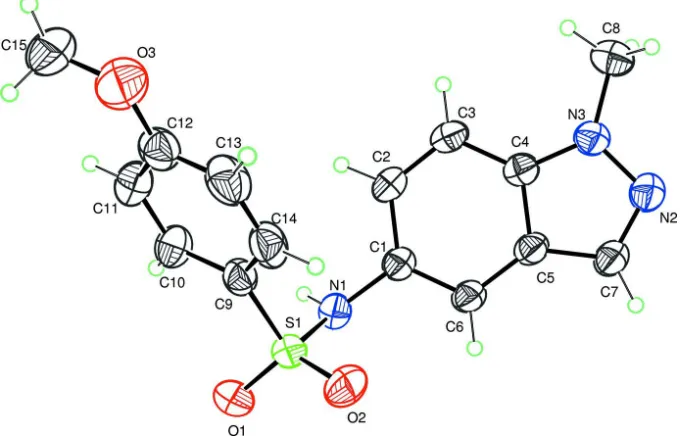
The molecule of 4-Methoxy-N-(1-methyl-1H-indazol-5-yl)-benzenesulfonamide is built up from the fused five- and
six-membered rings (N2 N3 C1—C7) linked to the benzenesulfonamide group as shown in Fig. 1. The fused rings system is
planar, with the maximum deviation of -0.013 (2) Å for N2 atom. Moreover, the dihedral angle between the indazole
system and the plan through the atoms forming the benzene ring (C9—C14) is of 50.11 (7)°.
In the crystal, the molecules are interconnected by C8–H8A···O1 and N1–H1···N2 hydrogen bonds forming a
one-dimensional chain running along the b axis as shown in Fig.2 and Table 2.
S2. Experimental
A mixture of 1-methyl-5-nitroindazole (1.22 mmol) and anhydrous SnCl2 (1.1 g, 6.1 mmol) in 25 ml of absolute ethanol
was heated at 333 K for 6 h. After reduction, the starting material disappeared, and the solution was allowed to cool
down. The pH was made slightly basic (pH 7–8) by addition of 5% aqueous potassium bicarbonate before extraction with
ethyl acetate. The organic phase was washed with brine and dried over magnesium sulfate. The solvent was removed to
afford the amine, which was immediately dissolved in pyridine (5 ml) and then reacted with 4-methoxybenzenesulfonyl
chloride (1.25 mmol) at room temperature for 24 h. After the reaction mixture was concentrated in vacuo, the resulting
residue was purified by flash chromatography (eluted with Ethyl acetate: Hexane 1:9). The title compound was
recrystallized from acetone.
S3. Refinement
H atoms were located in a difference map and treated as riding with C–H = 0.96 Å, C–H = 0.93 Å, and N–H = 0.89 Å for
methyl, aromatic CH and NH respectively. All hydrogen with Uiso(H) = 1.2 Ueq (aromatic, NH) and Uiso(H) = 1.5 Ueq for
Figure 1
Molecular structure of the title compound with the atom-labelling scheme. Displacement ellipsoids are drawn at the 50%
probability level. H atoms are represented as small circles.
Figure 2
Partial crystal packing for the title compound showing C8–H8A···O1 and N1–H1···N2 hydrogen bonds as dashed lines.
4-Methoxy-N-(1-methyl-1H-indazol-5-yl)benzenesulfonamide
Crystal data
C15H15N3O3S Mr = 317.36
Monoclinic, P21/n
Hall symbol: -P 2yn a = 10.1069 (3) Å b = 13.6178 (3) Å c = 10.8530 (2) Å β = 90.777 (2)°
V = 1493.60 (6) Å3 Z = 4
F(000) = 664 Dx = 1.411 Mg m−3
Mo Kα radiation, λ = 0.71073 Å Cell parameters from 4178 reflections θ = 2.4–29.6°
[image:3.610.137.473.350.533.2]T = 296 K Block, colourless
0.39 × 0.33 × 0.23 mm
Data collection
Bruker X8 APEXII diffractometer
Radiation source: fine-focus sealed tube Graphite monochromator
φ and ω scans
Absorption correction: multi-scan (SADABS; Bruker, 2009) Tmin = 0.651, Tmax = 0.747
19007 measured reflections 4178 independent reflections 3232 reflections with I > 2σ(I) Rint = 0.029
θmax = 29.6°, θmin = 2.4° h = −14→13
k = −18→18 l = −15→15
Refinement
Refinement on F2
Least-squares matrix: full R[F2 > 2σ(F2)] = 0.041 wR(F2) = 0.125 S = 1.02 4178 reflections 199 parameters 0 restraints
Primary atom site location: structure-invariant direct methods
Secondary atom site location: difference Fourier map
Hydrogen site location: inferred from neighbouring sites
H-atom parameters constrained w = 1/[σ2(F
o2) + (0.0694P)2 + 0.2788P]
where P = (Fo2 + 2Fc2)/3
(Δ/σ)max < 0.001
Δρmax = 0.29 e Å−3
Δρmin = −0.28 e Å−3
Special details
Geometry. All s.u.'s (except the s.u. in the dihedral angle between two l.s. planes) are estimated using the full covariance matrix. The cell s.u.'s are taken into account individually in the estimation of s.u.'s in distances, angles and torsion angles; correlations between s.u.'s in cell parameters are only used when they are defined by crystal symmetry. An approximate (isotropic) treatment of cell s.u.'s is used for estimating s.u.'s involving l.s. planes.
Refinement. Refinement of F2 against all reflections. The weighted R-factor wR and goodness of fit S are based on F2,
conventional R-factors R are based on F, with F set to zero for negative F2. The threshold expression of F2 > 2σ(F2) is
used only for calculating R-factors(gt) etc. and is not relevant to the choice of reflections for refinement. R-factors based on F2 are statistically about twice as large as those based on F, and R- factors based on all data will be even larger.
Fractional atomic coordinates and isotropic or equivalent isotropic displacement parameters (Å2)
x y z Uiso*/Ueq
C1 0.35240 (14) 0.12964 (10) 0.31509 (12) 0.0369 (3)
C2 0.32504 (16) 0.16841 (11) 0.19599 (14) 0.0411 (3)
H2 0.3091 0.2353 0.1875 0.049*
C3 0.32149 (15) 0.11009 (11) 0.09337 (13) 0.0395 (3)
H3 0.3025 0.1356 0.0156 0.047*
C4 0.34782 (13) 0.01018 (10) 0.11104 (12) 0.0341 (3)
C5 0.37682 (14) −0.02927 (10) 0.22857 (13) 0.0364 (3)
C6 0.37813 (15) 0.03159 (10) 0.33265 (13) 0.0379 (3)
H6 0.3958 0.0065 0.4108 0.045*
C7 0.39589 (17) −0.13088 (11) 0.20596 (14) 0.0452 (4)
H7 0.4174 −0.1766 0.2666 0.054*
C8 0.32417 (16) −0.06444 (13) −0.10173 (13) 0.0479 (4)
H8A 0.2402 −0.0949 −0.1185 0.072*
H8C 0.3221 0.0023 −0.1301 0.072*
C9 0.53540 (14) 0.33142 (10) 0.36119 (13) 0.0379 (3)
C10 0.46991 (15) 0.42076 (11) 0.35614 (15) 0.0437 (3)
H10 0.4051 0.4347 0.4136 0.052*
C11 0.49956 (17) 0.48930 (11) 0.26688 (15) 0.0472 (4)
H11 0.4541 0.5486 0.2632 0.057*
C12 0.59753 (18) 0.46877 (13) 0.18314 (15) 0.0494 (4)
C13 0.6648 (2) 0.37995 (15) 0.18895 (16) 0.0586 (5)
H13 0.7313 0.3667 0.1329 0.070*
C14 0.63377 (17) 0.31130 (12) 0.27713 (15) 0.0498 (4)
H14 0.6786 0.2517 0.2803 0.060*
C15 0.5734 (3) 0.62492 (16) 0.0850 (2) 0.0806 (7)
H15A 0.6100 0.6615 0.0179 0.121*
H15B 0.5874 0.6603 0.1605 0.121*
H15C 0.4802 0.6159 0.0709 0.121*
N1 0.35058 (13) 0.19331 (9) 0.42115 (11) 0.0409 (3)
H1 0.2838 0.2355 0.4224 0.049*
N2 0.37938 (15) −0.15242 (9) 0.08822 (12) 0.0469 (3)
N3 0.35107 (12) −0.06604 (9) 0.03012 (11) 0.0395 (3)
O1 0.45149 (14) 0.29493 (9) 0.58123 (10) 0.0567 (3)
O2 0.58740 (13) 0.16972 (9) 0.47644 (12) 0.0579 (3)
O3 0.63640 (17) 0.53163 (11) 0.09322 (13) 0.0755 (4)
S1 0.48793 (4) 0.24415 (3) 0.47110 (3) 0.04197 (13)
Atomic displacement parameters (Å2)
U11 U22 U33 U12 U13 U23
S1 0.0531 (2) 0.0361 (2) 0.03648 (19) 0.00611 (15) −0.00831 (15) −0.00026 (13)
Geometric parameters (Å, º)
C1—C6 1.3731 (19) C9—S1 1.7553 (15)
C1—C2 1.4199 (19) C10—C11 1.381 (2)
C1—N1 1.4415 (18) C10—H10 0.9300
C2—C3 1.368 (2) C11—C12 1.382 (2)
C2—H2 0.9300 C11—H11 0.9300
C3—C4 1.3990 (19) C12—O3 1.360 (2)
C3—H3 0.9300 C12—C13 1.388 (3)
C4—N3 1.3603 (18) C13—C14 1.377 (3)
C4—C5 1.4111 (18) C13—H13 0.9300
C5—C6 1.401 (2) C14—H14 0.9300
C5—C7 1.419 (2) C15—O3 1.423 (3)
C6—H6 0.9300 C15—H15A 0.9600
C7—N2 1.320 (2) C15—H15B 0.9600
C7—H7 0.9300 C15—H15C 0.9600
C8—N3 1.4530 (19) N1—S1 1.6370 (14)
C8—H8A 0.9600 N1—H1 0.8867
C8—H8B 0.9600 N2—N3 1.3633 (18)
C8—H8C 0.9600 O1—S1 1.4332 (12)
C9—C10 1.386 (2) O2—S1 1.4283 (12)
C9—C14 1.386 (2)
C6—C1—C2 121.47 (13) C10—C11—C12 119.26 (15)
C6—C1—N1 118.59 (12) C10—C11—H11 120.4
C2—C1—N1 119.92 (12) C12—C11—H11 120.4
C3—C2—C1 121.86 (13) O3—C12—C11 124.13 (17)
C3—C2—H2 119.1 O3—C12—C13 115.78 (16)
C1—C2—H2 119.1 C11—C12—C13 120.08 (15)
C2—C3—C4 116.75 (12) C14—C13—C12 120.46 (15)
C2—C3—H3 121.6 C14—C13—H13 119.8
C4—C3—H3 121.6 C12—C13—H13 119.8
N3—C4—C3 131.28 (13) C13—C14—C9 119.70 (15)
N3—C4—C5 106.65 (12) C13—C14—H14 120.2
C3—C4—C5 122.07 (13) C9—C14—H14 120.2
C6—C5—C4 120.21 (13) O3—C15—H15A 109.5
C6—C5—C7 135.76 (13) O3—C15—H15B 109.5
C4—C5—C7 104.01 (12) H15A—C15—H15B 109.5
C1—C6—C5 117.62 (12) O3—C15—H15C 109.5
C1—C6—H6 121.2 H15A—C15—H15C 109.5
C5—C6—H6 121.2 H15B—C15—H15C 109.5
N2—C7—C5 111.63 (13) C1—N1—S1 119.93 (10)
N2—C7—H7 124.2 C1—N1—H1 114.8
C5—C7—H7 124.2 S1—N1—H1 111.3
N3—C8—H8A 109.5 C7—N2—N3 106.21 (12)
H8A—C8—H8B 109.5 C4—N3—C8 128.21 (13)
N3—C8—H8C 109.5 N2—N3—C8 120.24 (13)
H8A—C8—H8C 109.5 C12—O3—C15 118.25 (16)
H8B—C8—H8C 109.5 O2—S1—O1 119.82 (7)
C10—C9—C14 119.61 (15) O2—S1—N1 107.85 (7)
C10—C9—S1 119.11 (12) O1—S1—N1 104.71 (8)
C14—C9—S1 121.24 (12) O2—S1—C9 108.02 (8)
C11—C10—C9 120.87 (14) O1—S1—C9 108.41 (7)
C11—C10—H10 119.6 N1—S1—C9 107.44 (6)
C9—C10—H10 119.6
Hydrogen-bond geometry (Å, º)
D—H···A D—H H···A D···A D—H···A
N1—H1···N2i 0.89 2.25 3.1335 (19) 176
C8—H8A···O1ii 0.96 2.49 3.391 (2) 157