© 2019, IRJET | Impact Factor value: 7.211 | ISO 9001:2008 Certified Journal
| Page 384
CRETEX – An Advanced and Futuristic Concrete
Mayur Gupta
B.Tech Civil, Amity School of Engineering and Technology, Amity University Chhattisgarh, Raipur, India.
---***---Abstract - This research paper presents the results of anexperimental investigation carried out to evaluate the compressive strength of an advanced and futuristic concrete which is made by the addition of the adhesive known as “Heatx” into the fresh concrete. Thus the title “CRETEX” is given by extracting the word “Crete” from the “Concrete” and “X” from the “Heatx”, where heatx is an adhesive product of Pidilite Company.
The computations of the strength of concrete and improvement in its properties have always been interesting areas of the research. The research paper focuses on the observed improvement in concrete property such as “Compressive Strength” by the addition of heatx into the fresh concrete.
“Compressive Strength” test was conducted on a total of 16 concrete cubes of grade M 20. In this experiment, 8 cubes were cast for 14 days and remaining 8 cubes for 28 days curing period having different proportions of “Heatx” like 0%, 1.25%, 2.5% and 5% of the cement quantity. The complete experimental procedure ran for approximate 2 months. The results are obtained and compared with the results of the ordinary concrete mix and also have been discussed in detail.
Key Words: Advanced Concrete, Futuristic Concrete,
Compressive Strength, Concrete Cubes, Fevicol Heatx, Adhesive Materials, Concrete Durability, Concrete Compactness.
1. INTRODUCTION
Concrete is basically a mixture of 4 constituents mainly- cement, water, sand and coarse aggregates and it is widely used as construction material. It is used for various construction works like building construction, dams, highways, bridges etc. The computations of the strength of concrete and improvement in its properties have always been interesting areas of the research. Properties like compressive strength, durability, workability etc of the concrete mainly depend on its constituents and procedure of mixing, placing, curing and compaction during casting. The compressive strength of the concrete can be modified by the alteration in its constituents during the mixing process. The compressive strength of concrete is measured at several intervals and compressive strength just after 28 days is considered as the standard strength. Various experiments have been performed on the concrete to increase its mechanical properties like workability, compressive strength, durability, tensile strength, compactness, setting
time etc. Different materials have already been tested on concrete like silica fumes, steel fibres, fly ash, brick kiln dust, rice husk and many more.
The incorporation of the heatx (Pidilite Company Product) to the fresh concrete is an innovative approach to enhance its compressive strength without any alterations in constituents of the concrete. Failure could occur from the loss of shear and torsion strength, loss of bond strength, loss of compressive strength and spalling of concrete. Now, when the heatx is incorporated into the fresh concrete in specified quantity so it makes a very strong bond due to its adhesive properties with the constituents of the fresh concrete hence as a result, we get an advanced and futuristic high strength concrete with high durability and high stability.
2. MATERIALS
2.1 Cement
It is a material with adhesive and cohesive properties which becomes active when it is mixed with the water and is capable of making the bond with the other material such as sand and coarse aggregates in the fresh concrete.
For this experiment, Ambuja Portland Pozzolana Cement was used. Before conducting the experiment, necessary laboratory tests as per IS 1489 (Part-I): 2015 for the Portland Pozzolana Cement have been performed and obtained results are tabulated below-
Table-1: Cement Tests Results
S.No NAME OF THE TEST
PERFORMED TEST RESULTS
1. Fineness 382 m2/kg
2. Initial Setting Time 146 Minutes
3. Final Setting Time 215 Minutes
4. Soundness 0.5 mm
5. Specific Gravity 2.90
© 2019, IRJET | Impact Factor value: 7.211 | ISO 9001:2008 Certified Journal
| Page 385
2.2 WaterWater is one of the important constituents of the concrete as it actively participates in the chemical reaction with the cement. Since the quality of water affects the strength therefore water used for the experiments was clean, colourless and odour free without any suspended particles in it. It was taken from the tube well having a normal temperature as of the simple room temperature.
2.3 Sand
The sand makes the concrete more compact and denser by filling the minute voids of the concrete. The sand was obtained from the nearby “Kharun River” located nearby Raipur, Chhattisgarh. The obtained river sand had been dried in the laboratory.
Before conducting the experiments, necessary laboratory tests for sand have been performed as per IS 2386 (Part-III): 1963 and sand passing through 4.75 mm sieve conforming to Zone II as per IS 383:1970 was used for the experiment. The obtained results are tabulated below –
Table-2: Sand Tests Results
S.No NAME OF THE TEST
PERFORMED TEST RESULTS
1. Fineness Modulus 2.75
2. Specific Gravity 2.65
3. Water Absorption 0.80 %
4. Silt Content 2.604 %
5. Bulk Density 1560 kg/m3
2.4 Coarse Aggregates
The coarse aggregates make the concrete movable by its rolling action. Coarse aggregates are capable to bear the high compressive loads and therefore, they are very crucial to impart the high compressive strength.
For the effective compactness and packing of the concrete, two sizes of the coarse aggregates 10 mm and 20 mm respectively were used. They were obtained from the local supplier.
Before conducting the experiments, necessary laboratory tests for coarse aggregates have been performed as per IS 2386 (Part-I): 1963 and IS 383:1970 and the obtained results are tabulated below –
Table-3: Coarse Aggregates Tests Results
S.No NAME OF THE TEST
PERFORMED TEST RESULTS
1. Fineness Modulus 7.06
2. Specific Gravity 2.75
3. Water Absorption 0.85 %
4. Aggregate Crushing Value 17.50 %
5. Aggregate Impact Value 18.65 %
2.5 Fevicol Heatx
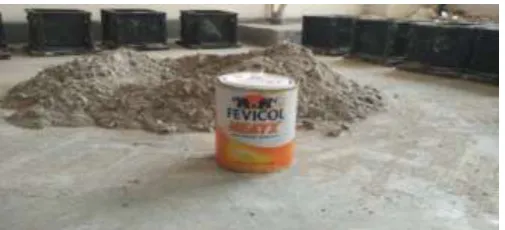
The Fevicol Heatx is a product of the “Pidilite” company which is basically a synthetic solvent borne rubber based adhesive made with a special formula for having excellent heat resistance property up-to 170°C temperature. It is an advanced version of the Fevicol SR-998 and it is available in different sizes starting from 100 ml to 5 litres in the markets.
Due to its extraordinary adhesive properties, it gets easily mixed and adhered to the concrete constituents during the mixing process. Because of continuous mixing for 2- 5 minutes, at a certain point of time, mixing becomes very rigorous and concrete becomes very thick as well as very viscous. Every constituent of the concrete gets adhered very strongly to each other hence makes it more closely packed and compacted as compared to the ordinary concrete mix.
Fevicol Heatx fills all voids or pores present in the concrete and covers all constituents completely during the mixing process and this makes a protective layer over the constituents. Therefore, its heat resistance property makes it more durable and long lasting at the regions where high temperature is found. Thus, it imparts an extraordinary strength and long life to the concrete structures.
In this experiment, the heatx is used as 0%, 1.25%, 2.5% and 5% respectively of total cement quantity (by weight) in the concrete and amazing results have been found and recorded which is discussed in further sections.
[image:2.595.309.562.634.749.2]© 2019, IRJET | Impact Factor value: 7.211 | ISO 9001:2008 Certified Journal
| Page 386
3. EXPERIMENTAL SETUP AND PROCEDURE3.1 Mix Proportioning
[image:3.595.306.560.58.304.2]For the entire experimental investigation, M20 Grade of Concrete of nominal mix 1: 1.5: 3 as per IS 456:2000 was used without any change to the quantity of cement, sand, coarse aggregates and water respectively. The w/c ratio was used as 0.45. Fevicol Heatx was added to the concrete as 0%, 1.25%, 2.5% and 5% respectively of the cement quantity (by weight) without replacing any of the constituents of the concrete.
Table-4 Mix Proportions (for 4 concrete cubes)
Mix Heatx
(%) Cement (kg) Sand (kg) C.A (kg) Water (kg)
Ordinary 0 5.50 8.25 16.50 2.50 Mix-1 1.25 5.50 8.25 16.50 2.50 Mix-2 2.50 5.50 8.25 16.50 2.50 Mix-3 5.00 5.50 8.25 16.50 2.50
3.2 Cube Casting and Curing
For the entire experimental investigation, 16 cube moulds of 150 mm x 150 mm x 150 mm each was used for casting of concrete cubes.
16 concrete cubes were cast in 4 batches. Each batch was having 4 concrete cubes where 2 cubes were for 14 days and remaining 2 were for 28 days curing period. Likewise, 4 batches of concrete cubes (total 16 cubes) were cast with 0%, 1.25%, 2.5% and 5% heatx respectively.
The constituents of the concrete were weighted using electronic balance as per the Table-4 and then mixed properly with the help of spade. The mixing process was done for 2-5 minutes so that all constituents of concrete get properly mixed.
The prepared concrete mix is then poured into the lubricated mould in 3 layers and 25 strokes were given to each layer with the help of the tamping rod for uniform compaction. After that, filled concrete moulds were covered by the wet gunny bags for 24 hours to maintain and provide moisture for sufficient initial strength gain.
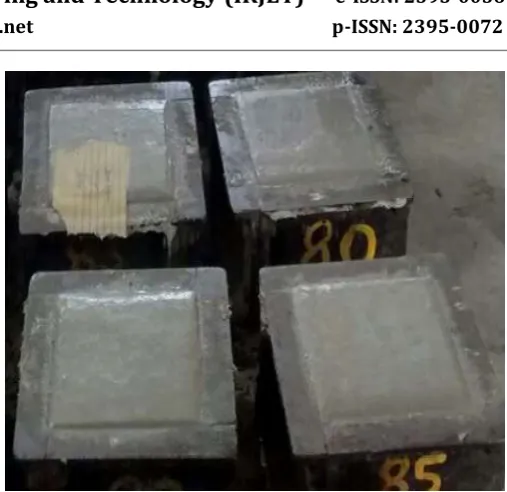
Fig. 2: Hardened concrete cubes inside the mould After 24 hours, hardened concrete cubes were removed from the moulds safely and then, they were placed inside the curing tank having fresh water for 14 days and 28 days period respectively. The water was changed once after every 7 days and the uniform temperature was maintained at 27 +/- 20 C.
Fig. 3: Hardened concrete cubes inside the curing tank
3.3 Weight and Area
[image:3.595.308.559.416.614.2]© 2019, IRJET | Impact Factor value: 7.211 | ISO 9001:2008 Certified Journal
| Page 387
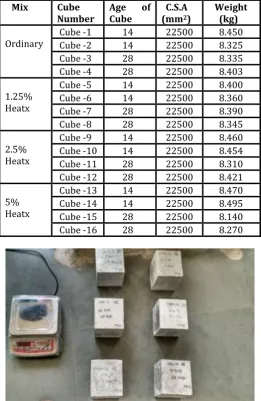
Table-5 Area and Weight Data
Mix Cube
Number Age Cube of C.S.A (mm2)
Weight (kg)
Ordinary Cube -1 Cube -2 14 14 22500 22500 8.450 8.325 Cube -3 28 22500 8.335 Cube -4 28 22500 8.403
1.25% Heatx
Cube -5 14 22500 8.400 Cube -6 14 22500 8.360 Cube -7 28 22500 8.390 Cube -8 28 22500 8.345
2.5% Heatx
Cube -9 14 22500 8.460 Cube -10 14 22500 8.454 Cube -11 28 22500 8.310 Cube -12 28 22500 8.421
5% Heatx
Cube -13 14 22500 8.470 Cube -14 14 22500 8.495 Cube -15 28 22500 8.140 Cube -16 28 22500 8.270
Fig. 4: Weighing cubes on electronic balance
3.4 Compression Test
“Compression Test” is a most important and popular test to determine the compressive strength of the hardened concrete cube using compression testing machine (CTM).
Total 16 concrete cubes were tested under the compression testing machine as per IS 516:1959. As per Table-5, concrete cubes with no. - 1, 2, 5, 6, 9, 10, 13 and 14 were tested at the end of 14 days. Similarly, concrete cubes with no. – 3, 4, 7, 8, 11, 12, 15 and 16 were tested at the end of 28 days.
For the determination of compressive strength, compression testing machine with the maximum capacity of 1000 KN was used. All concrete cubes were placed properly and centrally aligned under the compression testing machine so that
uniform load shall be applied to the opposite sides of the concrete cube.
Fig. 5: Determination of compressive strength under CTM
The compressive load was uniformly applied on the opposite sides of concrete cubes at the rate of 140 kg/cm2/minute
[image:4.595.31.293.129.531.2]until the failure of the concrete cubes. The load, at which the concrete cube fails under CTM, is called its “Maximum Compressive Load”. The value of the maximum compressive load for each concrete cube has been recorded successfully and tabulated below and the formula used for the calculation of compressive strength for each concrete cube is as follows-
Table-6 Compressive Strength of Concrete Cubes
Mix Cube
Number Age of Cube
Max. Load (N)
Comp. Strength (N/mm2)
Average Strength (N/mm2)
Ordinary Cube -1 Cube -2 14 14 355000 15.78 420000 18.67 17.22
Cube -3 28 454000 20.18 21.35
Cube -4 28 507000 22.53
1.25% Heatx
Cube -5 14 452000 20.09 19.93
Cube -6 14 445000 19.78
Cube -7 28 537000 23.87 23.04
Cube -8 28 500000 22.22
2.5% Heatx
Cube -9 14 455000 20.22 21.84
Cube-10 14 528000 23.47
Cube-11 28 618000 27.47 26.98
Cube-12 28 596000 26.49
5% Heatx
Cube-13 14 294000 13.07 13.27
Cube-14 14 303000 13.47
Cube-15 28 466000 20.71 19.51
Cube-16 28 412000 18.31
[image:4.595.306.565.484.714.2]© 2019, IRJET | Impact Factor value: 7.211 | ISO 9001:2008 Certified Journal
| Page 388
Fig. 6: Failed concrete cube samples after compressiontest
4. RESULTS AND CONCLUSIONS
From the present experimental investigation, a successful study has been carried out and the % increment of compressive strength has been determined for an advanced and futuristic concrete.
It has been found that the compressive strength was gradually increasing when the % of heatx was increased from 0% to 2.5% and on a further increment of heatx from 2.5% to 5%, the compressive strength was reduced gradually.
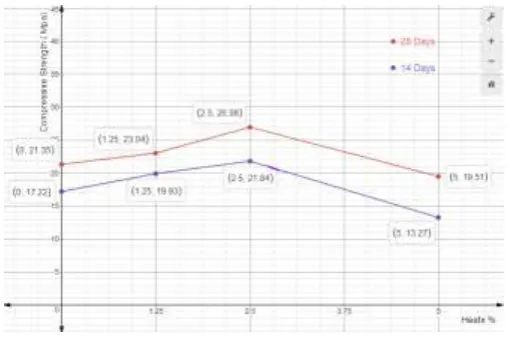
The maximum average compressive strength of cretex is found to be 21.84 N/mm2(14 days) and 26.98 N/mm2 (28 days) when 2.5% of heatx was incorporatedinto the fresh concrete. The 28 days compressive strength of the ordinary concrete mix is increased by 26.37% after the addition of 2.5% of heatx into it.
The conclusions of the entire experimental investigation are explained by means of the graph and it is given below-
Graph 1: Average Compressive Strength
For the better results, the heatx should not exceed more than the 2.5% of the cement quantity (by weight). If the heatx is further increased then the compressive strength of cretex will be reduced and it will be less than the compressive strength of an ordinary concrete mix. Thus, the compressive strength of cretex is found to be 13.27 N/mm2(14 days) and 19.51 N/mm2 (28 days) when 5% of heatx was incorporatedinto the fresh concrete and this is less than the compressive strength of an ordinary concrete mix. Here, the 28 days compressive strength of cretex is reduced by 8.61% in comparison to the ordinary concrete mix.
5. DISCUSSIONS
The entire experimental investigation was solely conducted for study and determination of compressive strength after addition of heatx to an ordinary concrete mix at various proportions. Further investigations and tests can also be conducted like slump cone test, compaction factor test, split tensile strength test, flexural strength test, water penetration test, chloride test etc for the complete information of its behaviour and mechanical properties.
Although, the cretex is less economical as compared to an ordinary concrete because it requires around 10 kg heatx for 1 m3 of cretex production that means an extra cost of Rs 3800/m3 will be required for its production.
However, in future, due to its high adhesive nature, compactness, waterproof property, heat resistant property and bond strength of heatx, the cretex may be used for the following purposes-
a. For preventing the cracks, bleeding, segregation in concrete.
b. To prevent steel reinforcement from corrosion and chemical attacks.
c. To increase the setting time in hot climate zones. d. To resist the high temperature in hot climate zones. e. To prevent water penetration in heavy rainfall zones. f. To reduce the dimensions of columns, beams and slabs. g. To bear and transfer the impact and shock in rigid
pavement works.
h. To construct high-rise buildings and long-span bridges for longer life and durability.
6. ACKNOWLEDGEMENT
[image:5.595.34.290.578.748.2]© 2019, IRJET | Impact Factor value: 7.211 | ISO 9001:2008 Certified Journal
| Page 389
7. REFERENCES1. Shetty M.S., Concrete Technology: Theory and Practice, S.Chand & Company Ltd. New Delhi, 2017.
2. Gambhir M.L., Concrete Technology, Tata McGraw Hill, 1995.
3. Punmia B.C., Building Construction, Laxmi Publications (P) Ltd., New Delhi, 2017.
4. Duggal S.K., Building Materials, Oxford & IBH Publications Co. Pvt. Ltd., New Delhi, 1998.
5. Amudhavalli N.K., Mathew Jeena, Effect of silica fumes on strength and durability parameters of concrete, International Journal of Engineering & Emerging Technologies (IJESET), Vol.-3, Issue-1, PP: 28-35, August 2012.
6. Chitra R., Chockalingam M.P., Improving strength properties of concrete using steel fibre, International Journal of Pure and Applied Mathematics, Vol.-116, No.13, PP: 217-222, 2017.
7. Daubey Saurabh, Porwal Ram Ji, Studies on the effect of cement concrete strength by using waste materials like fly ash and brick kiln dust, International Journal of Engineering Research & Technology (IJERT), Vol.-3, Issue-6, PP: 317-319, June 2014.
8. Southamirajan S., Kumar Sanjeev R., Structural behaviour of concrete with the replacement of fevicol, Global Research and Development Journal for Engineering, Vol.-1, Issue- 5, PP: 40-47, April 2016.
9. Chaudhary Manu, Patel R.D., Studies on compressive strength of cement concrete by use of asbestos cement sheet waste, International Journal of Science Engineering and Technology Research (IJSETR), Vol.-4, Issue-8, PP: 2909-2919, August 2015.
10. Kudoli B. Anand, Bobade S. Sudarshan, To study the properties of concrete by adding fevicol, International Journal for Research in Applied Science & Engineering Technology (IJRASET), Vol.-5, Issue-XI, PP: 2063-2066, November 2017.
11. Wilson Anoop, Kumar Savinth C., Study on the effect of steel dust on strength characteristic of concrete, International Journal of Engineering Trends and Technology (IJETT), Vol.-47, No.-1, PP: 66-68, May 2017. 12. Ambiga K., Meenakshi P., Studies on strength of concrete
by partial replacement of sand with sawdust, International Journal of Advanced Engineering Research and Studies, Vol.-IV, Issue-III, PP: 01-03, April-June 2015.
13. Murthy B.V.R., Rajeswari G., Study on strength improvement of pervious concrete, International Journal of Engineering Science Invention (IJESI), Vol.-7, Issue-3, Ver. 4, PP: 29-31, March 2018.
14. Kushwaha Bibekkumar, Padu Lijom, The study of compressive strength on concrete by using surkhi, International Journal for Research in Applied Science & Engineering Technology ( IJRASET), Vol.-5, Issue-XI, PP: 374-377, November 2017.
15. IS: 1489 (Part-I) - 2015, Portland Pozzolana Cement Specifications- Flyash based, Bureau of Indian Standards, New Delhi.
16. IS: 2386 (Part I) - 1963, Indian Standard Methods of test for Aggregates for Concrete, Reaffirmed 1997, Bureau of Indian Standards, New Delhi.
17. IS: 2386 (Part III) - 1963, Indian Standards Methods of Test for Aggregates for Concrete, Reaffirmed 2002, Bureau of Indian Standards, New Delhi.
18. IS: 383 - 1970, Indian Standards Specifications for Coarse and Fine Aggregates from Natural Sources for Concrete, Bureau of Indian Standards, New Delhi.
19. IS: 456 - 2000, Plain and Reinforced Concrete Code of Practice, Reaffirmed 2005, Bureau of Indian Standards, New Delhi.