1
On the Beat of the Drum:
Improving the Flow Shop Performance of the
Drum-Buffer-Rope Scheduling Mechanism
Matthias Thürer (corresponding author) and Mark Stevenson
Name: Prof. Matthias Thürer Institution: Jinan University
Address: Institute of Physical Internet
School of Electrical and Information Engineering Jinan University (Zhuhai Campus)
519070, Zhuhai, PR China
E-mail: [email protected]
Name: Prof. Mark Stevenson Institution: Lancaster University
Address: Department of Management Science Lancaster University Management School Lancaster University
LA1 4YX - U.K.
E-mail: [email protected]
2
On the Beat of the Drum:
Improving the Flow Shop Performance of the
Drum-Buffer-Rope Scheduling Mechanism
Abstract
One of the main elements of the Theory of Constraints is its Drum-Buffer-Rope (DBR) scheduling (or release) mechanism, which controls the release of jobs to the system. Jobs are not released directly to the shop floor – they are withheld in a backlog and released in accordance with the output rate of the bottleneck (i.e. the drum). The sequence in which jobs are considered for release from the backlog is determined by the schedule of the drum, which also determines the order that jobs are processed or dispatched on the shop floor. In the DBR literature, the focus is on the urgency of jobs and the same procedure is used both for backlog sequencing and dispatching. In this study, we explore the potential of using different combinations of rules for sequencing and dispatching to improve DBR performance. Based on controlled simulation experiments in a pure and general flow shop we demonstrate that, although the original procedure works well in a pure flow shop, it becomes dysfunctional in a general flow shop where job routings vary. Performance can be significantly enhanced by switching between a focus on urgency and a focus on the shortest bottleneck processing time during periods of high load.
Keywords: Drum-Buffer-Rope; Theory of Constraints; Order Release; Dispatching; Flow
3 1. Introduction
The Theory of Constraints – originating in the seminal work of Goldratt (e.g. Goldratt & Cox, 1984; Goldratt, 1990) – is a powerful production planning and control concept for shops with bottlenecks. Many successful implementations have been reported in the literature, with 80% of companies reporting improvements in lead time and due date performance (Mabin & Balderstone, 2003). One of the main elements of the Theory of Constraints is Optimized Production Technology (OPT), its scheduling (or release) mechanism, that is now more commonly known as Drum-Buffer-Rope (DBR) – a descriptor of the way order release is realized (Simons & Simpson, 1997).
Since its inception, DBR has received much research attention. A first stream of early academic literature sought to clarify the meaning of the original concept (e.g. Schragenheim & Ronen, 1990; Luebbe & Finch, 1992). A second stream has compared DBR with other production planning and control concepts, including Material Requirements Planning (MRP; e.g. Duclos & Spencer, 1995; Steele et al., 2005), infinite loading (e.g. Chakravorty, 2001), ConWIP (Gilland, 2002), and kanban systems (e.g. Lambrecht & Segaert, 1990; Chakravorty & Atwater, 1996; Watson & Patti, 2008) – for a review, the reader is referred to Rahman (1998) and Gupta & Snyder (2009). A third stream of literature has focussed on the performance impact of environmental factors such as set-up times and the percentage of non-bottleneck jobs (e.g. Chakravorty & Atwater, 2005; Golmohammadi, 2015). But despite this broad research attention, few studies have examined the performance contribution made by each component of the DBR system (Chakravorty & Atwater, 2005). As a consequence, the potential to improve performance by refining these components may have been overlooked.
DBR controls (or subordinates) the release of jobs to the system in accordance with the bottleneck (i.e. the constraint or drum). In other words, jobs are not released directly to the shop floor – they are withheld in a backlog (similar to ConWIP; see, e.g. Spearman et al., 1990) from where they are released in accordance with the output rate of the bottleneck (drum). While feedback on the output rate of the drum determines when a job is released, it does not determine which particular job is released. This latter decision is determined by the drum schedule, which also determines the sequence in which released jobs are processed on the shop floor (the dispatching decision).
4
Framinan et al., 2001; Thürer et al., 2017a). Meanwhile, it is well established that shop floor dispatching has a significant impact on performance (e.g. Panwalker & Iskander, 1977; Blackstone et al., 1982). Yet the procedure for determining the drum schedule embedded in DBR has remained largely unchanged since its introduction. Moreover, DBR uses the same procedure for backlog sequencing and dispatching. In contrast, in this study, we will explore the potential of different combinations of backlog sequencing and shop floor dispatching rules to improve DBR performance.
The remainder of this paper is organized as follows. In Section 2, we introduce DBR and develop our research question. The simulation model used is then described in Section 3 before the results are presented, discussed, and analyzed in Section 4. Finally, conclusions are drawn in Section 5, where limitations and future research directions are also outlined.
2. Literature Review
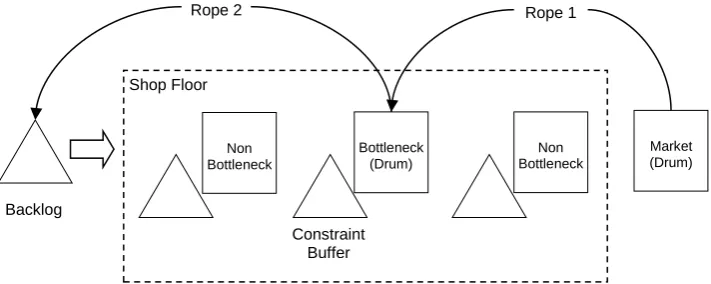
A DBR system is depicted in Figure 1 for a single bottleneck station. Its essential parts can be described as follows:
Drum: This is the constraint (e.g. the bottleneck station, the market, etc.) and its schedule. Buffer: This is both the constraint buffer (i.e. the buffer before the bottleneck) and the
shipping buffer (i.e. finished goods inventory; see, e.g. Watson et al., 2007). Buffers are time (e.g. Radovilsky, 1998; Rahman, 1998; Schragenheim & Ronen, 1990; Simons & Simpson, 1997; Chakravorty & Atwater, 2005) or a time-equivalent amount of work-in-process. Note that the shipping buffer does not exist in this study since we consider jobs to be delivered immediately upon completion.
Rope: This is the communication channel for providing feedback from the drum to the
beginning of the system, i.e. order release. Based on this feedback, order release aligns the input of work with the output rate of the bottleneck. In other words, a maximum limit on the number of jobs released to the bottleneck but not yet completed is established and a job is released whenever the number of jobs is below the limit (e.g. Ashcroft, 1989; Lambrecht & Segaert, 1990; Duclos & Spencer, 1995; Chakravorty & Atwater, 1996; Chakravorty, 2001; Watson & Patti, 2008). There are two ropes: Rope 1 determines the schedule at the bottleneck to exploit the constraint according to the organization’s goal (Schragenheim & Ronen, 1990); Rope 2 then subordinates the system to the constraint (the bottleneck station).
5
The drum schedule determines the sequence in which jobs are released to the shop floor (the backlog sequence) and the sequence in which jobs are selected for processing on the shop floor (the dispatching sequence). There are two scenarios. If production is fairly repetitive then the drum schedule is driven by the product mix (see e.g. Luebbe & Finch, 1992; Fredendall & Lea, 1997). If production is high-variety then the drum is driven by urgency considerations. In this study, we focus on a high-variety make-to-order context. A feasible drum schedule in this context is typically derived via a two-step process: backward infinite loading from the customer due date followed by levelling to resolve any overlaps. In other words, a time allowance is subtracted from the due date. Any overlap is then resolved by a simple rule; for example, Chakravorty & Atwater (2005) pushed the schedule back on a first-come-first-served basis. The sequence in which jobs are released from the backlog is then determined by backward infinite loading from the drum schedule, i.e. a second time allowance is subtracted from the bottleneck schedule.
2.1 Problem Statement: The Drum Schedule
6
Recent wider literature however has demonstrated the potential of load-based sequencing rules to improve order release performance. For example, Thürer et al. (2017a) demonstrated that load-based sequencing can enhance ConWIP’s workload balancing capabilities. While workload balancing becomes functionless when there is a strong bottleneck (Thürer et al., 2017b), the positive effect of avoiding starvation through shortest processing time effects still remains. Similar load-based dispatching rules, such as the shortest processing time rule, have long since been shown to reduce flow times (Conway et al., 1967). We therefore ask:
How is the performance of DBR affected by using alternative backlog sequencing and dispatching rules?
An exploratory study based on controlled simulation experiments will be used to provide an answer to this question.
3. Simulation Model
To improve the generalizability of the findings and to avoid interactions that might inhibit full understanding of the effects of the experimental factors, we use a stylized model of a pure flow shop and a general flow shop. The shop and job characteristics modeled in the simulations are first summarized in Section 3.1. How we model DBR and its drum schedule is described in Section 3.2. Finally, the experimental design is summarized and the measures used to evaluate performance are presented in Section 3.3.
3.1 Overview of Modeled Shop and Job Characteristics
Two different flow shops are modeled to assess the impact of shop characteristics on the performance of our backlog sequencing and dispatching rules. The two shops have different degrees of routing variability, but both are characterized by a direct flow – as is typical for DBR simulations (e.g. Lambrecht & Segaert, 1990; Duclos & Spencer, 1995; Chakravorty & Atwater, 1996). This avoids any interaction with potential re-entrant flows. A simulation model of a general flow shop and a pure flow shop has been implemented in the Python© programming language using the SimPy© simulation module. Both shops contain seven stations, where each station is a single resource with constant capacity. This means we do not consider non-identical parallel resources, which allows us to keep our study focused. There is one bottleneck station – Station 4.
7
The reduction in our study is 15%. Note that we experimented with different levels of bottleneck severity but this did not affect our conclusions. Therefore, only one level will be considered in this study. An equal adjustment was applied to all non-bottlenecks since the position of protective capacity is argued to have no effect on flow times (see Craighead et al., 2001). Operation processing times – before adjustment – follow a truncated 2-Erlang distribution with a mean of 1 time unit after truncation and a maximum of 4 time units.
For the general flow shop, the routing length of jobs varies uniformly from one to seven operations. The routing length is first determined before the routing sequence is generated randomly without replacement. The resulting routing vector (i.e. the sequence in which stations are visited) is then sorted such that the routing becomes directed and there are typical upstream and downstream stations. For the pure flow shop, all jobs visit all stations in increasing station number. The inter-arrival time of jobs follows an exponential distribution with a mean of 0.635 time units for the general flow shop and 1.111 time units for the pure flow shop. Both settings deliberately result in a utilization level of 90% at the bottleneck.
Finally, due dates are set exogenously by adding a random allowance factor, uniformly distributed between 28 and 36 time units, to the job entry time. The minimum value will be sufficient to cover a minimum shop floor throughput time corresponding to the maximum processing time (3.4 time units for non-bottleneck operations and 4 time units for the bottleneck operation, which totals 24.4 time units across the seven stations) plus an allowance for the waiting or queuing time. The simulated shop and job characteristics are summarized in Table 1. While in practice any individual high-variety shop will certainly differ from our stylized model, our model captures the high routing variability, processing time variability, and arrival variability that defines this context.
[Take in Table 1]
3.2 Drum-Buffer-Rope
8
simulation experiments. As a baseline, we also include experiments where jobs are released immediately to the shop floor.
3.2.1 The Drum Schedule
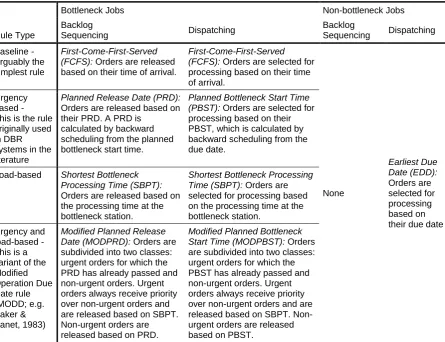
Jobs that visit the bottleneck always receive priority over jobs that do not visit the bottleneck, since this was argued to be the best policy for one-of-a-kind production and negligible set-up times (Golmohammadi, 2015). Non-bottleneck jobs are simply processed according to the earliest due date rule. The drum schedule for bottleneck jobs is determined by the different backlog sequencing and dispatching rules, as summarized in Table 2.
[Take in Table 2]
In addition to First Come First Served (FSFS), which is used as a baseline, three alternative types of backlog sequencing/dispatching rules will be considered: (i) urgency based rules, in the form of the Planned Release Date (PRD) sequencing and the Planned Bottleneck Start Time (PBST) dispatching rules; (ii) load-based rules, in the form of the Shortest Bottleneck Processing Time (SBPT) rule; and, (iii) combined urgency and load-based rules, in the form of the Modified Planned Release Date (MODPRD) and the Modified Planned Bottleneck Start Time (MODPBST) dispatching rules.
The calculation of the PBSTij for the ith operation of a job j follows Equation (1) below. A
constant allowance c for the operation throughput time is successively subtracted from the planned start time of the preceding operation beginning at the due date 𝛿j. As in Chakravorty
& Atwater (2005), this constant allowance is based on the realized operation throughput times (i.e. the waiting time plus the processing time). It is given by the cumulative moving average, i.e. the average of all operation throughput times realized until the current simulation time. The PBST of the first operation in the routing of a job – PBST1j – is equal to the PRD.
𝑃𝐵𝑆𝑇𝑖𝑗 = 𝛿𝑗− (𝑛𝑗− 𝑖 + 1) ∗ 𝑐 𝑖; 1 … 𝑛𝑗 (1)
nj – Routing length, i.e. the number of operations in the routing of job j
9
3.3 Experimental Design and Performance Measures
The experimental factors are: (i) the two different shop types (General Flow Shop and Pure Flow Shop); (ii) the four different backlog sequencing rules (FCFS, PRD, SBPT, MODPRD); (iii) the four different dispatching rules (FCFS, PBST, SBPT, MODPBST); and (iv) the twelve different buffer limit levels for our release methods (from 9 to 20 jobs). A full factorial design was used with 384 cells (2*4*4*12), where each cell was replicated 100 times. Results were collected over 10,000 time units following a warm-up period of 3,000 time units. These parameters allowed us to obtain stable results while keeping the simulation run time to a reasonable level.
The principal performance measures considered in this study are as follows: the lead time – the mean of the completion date minus the pool entry date across jobs; the percentage tardy – the percentage of jobs completed after the due date; and, the mean tardiness , with being the lateness of job j (i.e. the actual delivery date minus the due date of job j). In addition to these three main performance measures, we also measure the shop floor throughput time as an instrumental performance variable. While the lead time includes the time that an order waits before release, the shop floor throughput time only measures the time after release to the shop floor.
4. Results
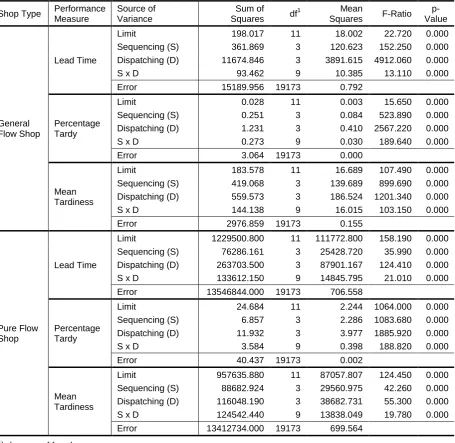
Statistical analysis has been conducted by applying ANOVA. ANOVA is here based on a block design with the buffer limit level as the blocking factor, i.e. the different levels of the DBR limit (from 9 to 20 jobs) are treated as different systems. A block design allowed the main effect of the buffer limit and both the main and interaction effects of our four backlog sequencing and dispatching rules to be captured. As can be observed from Table 3, all main effects and two-way interactions were shown to be statistically significant. Meanwhile the dispatching rule has a stronger main effect than the backlog sequencing rule.
[Take in Table 3]
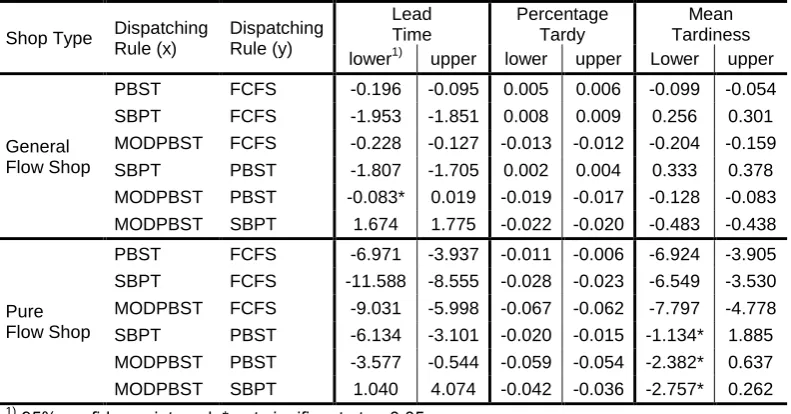
The Scheffé multiple-comparison procedure was used to further prove the significance of the performance differences. Test results, as given in Table 4 for backlog sequencing rules and in Table 5 for the dispatching rules, show significant differences for most rules for at least one performance measure. The only exceptions are the PRD and FCFS sequencing rules, which perform statistically equivalent in the pure flow shop. Detailed performance
) , 0 max( j
j L
10
results for the general flow shop are presented next in Section 4.1 before Section 4.2 presents the results for the pure flow shop.
[Take in Table 4 & Table 5]
4.1. Performance Assessment – General Flow Shop
Figure 2a to Figure 2d show the lead time, percentage tardy, and mean tardiness results over the shop floor throughput time results for FCFS, PBST, SBPT, and MODPBST dispatching, respectively. Only results for the general flow shop are shown as the results for the pure flow shop are assessed in Section 4.2. To aid interpretation, the simulation results are presented in the form of performance curves. The left-hand starting point of the curves represents the lowest DBR limit level (9 jobs). The limit level increases step-wise by moving from left to right on each curve, with each data point representing one limit level. Increasing the limit increases the level of work-in-process and, as a result, increases shop floor throughput times. Meanwhile, under immediate release, jobs are not withheld in the pool; therefore, the backlog sequencing rule is inactive, which results in all backlog sequencing rules converging on the same point. This single point is located to the far right since it leads to the highest level of work-in-process and, consequently, the longest shop floor throughput times.
[Take in Figure 2]
The following can be observed from the results on the performance of the various backlog sequencing and dispatching rules and on the performance of different combinations of rules: Backlog Sequencing Rule: The performance of the backlog sequencing rules can be
11
Shop Floor Dispatching Rule: The performance of the shop floor dispatching rules in
isolation can be evaluated by comparing the results for immediate release (IMM, the single right-hand point) across Figure 2a to Figure 2d, i.e. where no backlog sequencing rule is applied. Surprisingly, in the light of findings from balanced shops (e.g. Land et al., 2015), PBST dispatching (Figure 2b) results in a higher percentage tardy and mean tardiness than FCFS dispatching (Figure 2a). This may be explained by the fact that, for PBST, the more stations there are after the bottleneck station, the higher the priority of the job amongst jobs with similar due dates. As expected, SBPT (Figure 2c) leads to the shortest lead times while MODPBST (Figure 2d) outperforms all other dispatching rules in terms of percentage tardy and mean tardiness.
Backlog Sequencing x Dispatching Rule: The interaction effect between backlog
sequencing and dispatching rules can be evaluated by comparing the performance curves across Figure 2a to Figure 2d. Performance differences between backlog sequencing rules are similar for FCFS and PBST dispatching (Figure 2a and Figure 2b, respectively). Meanwhile, and as expected, performance differences between backlog sequencing rules diminish under SBPT dispatching (Figure 2c). Finally, we see a shift in terms of percentage tardy under MODPBST dispatching (Figure 2d), where PRD backlog sequencing becomes the worst-performing rule. Arguably the best performance in the general flow shop can be achieved by combining MODPRD backlog sequencing and MODPBST dispatching. It is therefore this combination that should be applied in general flow shops in practice.
4.2. Performance Assessment – Pure Flow Shop
Figure 3a to Figure 3d show the lead time, percentage tardy and mean tardiness results over the shop floor throughput time results for the pure flow shop for FCFS, PBST, SBPT, and MODPBST dispatching, respectively.
[Take in Figure 3]
The following can be observed from the results:
Backlog Sequencing Rule: As suggested by our statistical analysis, PRD and FCFS result
12
mean tardiness while MODPRD arguably leads to the best trade-off in terms of percentage tardy and mean tardiness performance.
Shop Floor Dispatching Rule: As for the general flow shop, SBPT (Figure 3c) leads to the
lowest lead time while MODPBST (Figure 3d) outperforms all other dispatching rules in terms of the percentage tardy. For BPST, the negative effect of prioritizing jobs with more stations downstream of the bottleneck disappears since all jobs have to visit all stations in the same sequence. As a consequence, PBST (Figure 3b) outperforms FCFS (Figure 3a) in terms of the percentage tardy and, overall, it is this rule that now leads to the best performance in terms of mean tardiness.
Backlog Sequencing x Dispatching Rule: As for the general flow shop, performance
differences between backlog sequencing rules are similar for FCFS and PBST dispatching (Figure 3a and Figure 3b respectively) and diminish under SBPT dispatching (Figure 3c). However, which combination of backlog sequencing and dispatching rule to choose to adopt in practice is less clear in the pure flow shop. While we argue that MODPRD and MODPBST is still the best choice (Figure 3d), the MODPBST backlog sequencing rule could also be substituted for the simpler FCFS rule (or even PBST).
5. Conclusions
One of the main elements of the Theory of Constraints is its Drum-Buffer-Rope (DBR) scheduling (or release) mechanism. DBR controls (or subordinates) the release of jobs to the system; jobs are not released directly to the shop floor – they are withheld in a backlog from where they are released in accordance with the output rate of the bottleneck (the drum). While feedback on the output rate from the drum determines when a job is released, it does not determine which job is released. The latter decision is determined by the drum schedule, which also creates the sequence in which jobs are to be processed on the shop floor (the dispatching decision). Since the inception of the DBR approach, the same backward infinite loading procedure has been used for both backlog sequencing and dispatching. First, a planned bottleneck start time is calculated by subtracting a time allowance from the due date. Second, the planned release date is calculated by subtracting a time allowance from the planned bottleneck start time. In contrast, we have asked: How is the performance of DBR affected by using alternative backlog sequencing and dispatching rules?
13
backlog sequencing/dispatching rules that switch from a focus on urgency – as in the original procedure – to a focus on load in the form of the shortest bottleneck processing time. This switch in focus takes place during high load periods when many jobs become urgent. Meanwhile, although the original procedure works well in a pure flow shop (i.e. where all jobs visit all stations in the same sequence) it has been shown to become dysfunctional in a general flow shop where job routings vary. Before implementing DBR, managers in practice should therefore carefully check the shop’s prevailing routing characteristics.
5.1 Limitations and Future Research
A first limitation of our study is that we have only considered one bottleneck position. The bottleneck position determines where in the routing of an order the bottleneck is located and consequently may have an impact on performance in the general flow shop. A second limitation is our focus on simple backlog sequencing and dispatching rules. While this focus is justified by our stochastic make-to-order environment, future research could consider more repetitive production contexts that allow for more advanced drum scheduling procedures, possibly including product mix considerations. A third limitation is the complexity of the environmental setting. While we considered two shop types with different degrees of routing variability, both have directed routings thus avoiding issues such as re-entrant flows. Future research could therefore examine the impact of the drum schedule in more complex contexts such as shops with re-entrant flows, non-identical parallel resources, or convergent/divergent assembly operations.
Our study has re-emphasized the importance of switching between different backlog sequencing/dispatching rules in response to a changing shop situation. The measure that determined when to switch between rules was the urgency of jobs and the set of rules that we switched between were urgency and load-based rules. However, there may be other ways to implement switching behaviour in practice. Thus, future research could explore different measures for determining when to switch and different sets of rules to switch between. Finally, while it is arguably the best known, DBR is only one type of bottleneck-oriented release method. Future research could therefore extend our study to consider other bottleneck-oriented release methods, e.g. in the context of Workload Control.
References
Ashcroft, S.H., 1989, Applying the principles of optimized production technology in a small
14
Baker, K.R., and Kanet, J.J., 1983, Job shop scheduling with modified operation due-dates, Journal of
Operations Management, 4, 1, 11-22.
Blackstone, J.H., Philips, D.T., Hogg, G.L., 1982, A state-of-the-art survey of dispatching rules for
manufacturing job shop operations, International Journal of Production Research, 20 (1), 27-45.
Chakravorty, S.S., and Atwater, J.B., 1996, A comparative study of line design approaches for serial
production systems, International Journal of Operations & Production Management, 16, 6, 91-108.
Chakravorty, S.S., 2001, An evaluation of the DBR control mechanism in a job shop environment,
OMEGA, 29, 335–342
Chakravorty, S.S., and Atwater, J.B., 2005, The impact of free goods on the performance of
drum-buffer-rope scheduling systems, International Journal of Production Economics, 95, 347-357.
Conway, R., Maxwell, W.L., and Miller, L.W., 1967, Theory of Scheduling, Reading, MA:
Addisson-Wesley.
Craighead, C.W., Patterson, J.W., and Fredendall, LD., 2001, Protective capacity positioning: impact
on manufacturing cell performance, European Journal of Operational Research, 134, 425-438.
Duclos, L.K., and Spencer, M.S., 1995, The impact of a constraint buffer in a flow shop, International
Journal of Production Economics, 42, 175-185.
Enns, S.T., and Prongue Costa, M., 2002, The effectiveness of input control based on aggregate
versus bottleneck workloads, Production Planning & Control, 13, 7, 614 - 624.
Fernandes, N.O., Land, M.J., and Carmo-Silva, S., 2014, Workload control in unbalanced job shops,
International Journal of Production Research, 52, 3, 679-690.
Framinan, J. M., Ruiz-Usano, R., and Leisten, R., 2001, Sequencing CONWIP Flow-shops: Analysis
and Heuristics, International Journal of Production Research, 39, 12, 2735–2749.
Fredendall, L. D., and Lea, B.R., 1997, Improving the product mix heuristic in the theory of
constraints, International Journal of Production Research, 35, 6, 1535-1544.
Gilland, W.G., 2002, A simulation study comparing performance of CONWIP and bottleneck-based
release rules, Production Planning & Control, 13, 2, 211 – 219.
Goldratt, E.M., and Cox, J., 1984, The Goal: Excellence in Manufacturing, North River Press: New
York.
Goldratt, E.M., 1990, Haystack Syndrome: Sifting Information Out of the Data Ocean, North River
Press: New York.
Golmohammadi, D., 2015, A study of scheduling under the theory of constraints, International
Journal of Production Economics, 165, 38-50.
Gupta, M., and Snyder, D., 2009, Comparing TOC with MRP and JIT: a literature review,
International Journal of Production Research, 47, 13, 3705-3739.
Lambrecht, M.R., and Segaert, A., 1990, Buffer stock allocation in serial and assembly type of
15
Land, M.J., Stevenson, M., Thürer, M., and Gaalman, G.J.C., 2015; Job Shop Control: In Search of
the Key to Delivery Improvements, International Journal of Production Economics, 168, 257-266.
Leu, B.Y., 2000, Generating a backlog list for a CONWIP production line: A simulation study,
Production Planning & Control, 11, 4, 409-418.
Luebbe, R., and Finch, B., 1992, Theory of constraints and linear programming: a comparison,
International Journal of Production Research, 30, 6, 1471-1478.
Mabin, V.J. and Balderstone, S.J., 2003, The performance of the theory of constraints methodology:
analysis and discussion of successful TOC applications, International Journal of Operations &
Production Management, 23, 568-595.
Panwalker, S.S., and Iskander, W., 1977, A survey of scheduling rules, Operations Research,
January-February, 45-61
Radovilsky, Z.D., 1998, A quantitative approach to estimate the size of the time buffer in the theory
of constraints, International Journal Production Economics, 55, 113-119.
Rahman, S., 1998, Theory of constraints: a review of the philosophy and its applications,
International Journal of Operations & Production Management, 18, 336-355.
Schragenheim, E. and Ronen, B., 1990, Drum-buffer-rope shop floor control, Production & Inventory
Management Journal, 31, 18-22.
Simons, J.V. and Simpson, III, W.P., 1997, An exposition of multiple constraint scheduling as
implemented in the goal system (formerly disaster), Production & Operations Management, 6,
3-22.
Spearman, M.L., Woodruff, D.L., and Hopp, W.J., 1990, CONWIP: a pull alternative to kanban,
International Journal of Production Research, 28, 5, 879-894.
Sirikrai, V., and Yenradee, P., 2006, Modified drum–buffer–rope scheduling mechanism for a
non-identical parallel machine flow shop with processing-time variation, International Journal of
Production Research, 44, 17, 3509-3531.
Steele, D.C., Philipoom, P.R., Malhotra, M.K., and Fry T.D., 2005, Comparisons between
drum-buffer-rope and material requirements planning: a case study, International Journal of Production
Research, 43, 15, 3181-3208
Thürer, M., Fernandes, N.O., Stevenson, M., and Qu, T., 2017a, On the Backlog-sequencing Decision
for Extending the Applicability of ConWIP to High-Variety Contexts: An Assessment by
Simulation, International Journal of Production Research, (in print)
Thürer, M., Stevenson, M., Silva, C., and Qu, T.; 2017b; Drum-Buffer-Rope and Workload Control in
High Variety Flow and Job Shops with Bottlenecks: An Assessment by Simulation; International
Journal of Production Economics; (in print)
Watson, K.J., and Patti, A, 2008, A comparison of JIT and TOC buffering philosophies on system
performance with unplanned machine downtime, International Journal of Production Research, 46,
16
Watson, K.J., Blackstone, J.H., and Gardiner, S.C., 2007, The evolution of a management philosophy:
The theory of constraints, Journal of Operations Management, 25, 387-402.
Wu, H.H., and Yeh, M.L., 2006, A DBR scheduling method for manufacturing environments with
17
Table 1: Summary of Simulated Shop and Job Characteristics
General Flow Shop Pure Flow Shop
Sh o p Cha ra c te ri s ti c s Routing Variability Routing Direction No. of Stations Interchangeability of Stations Station Capacities
Random routing; no-re-entrant flows directed routing
7
No interchange-ability All equal
Fixed sequence; no-re-entrant flows directed routing (PFS)
7 No interchange-ability All equal J o b Cha ra c te ri s ti c
s Operation Processing Times No. of Operations per Job
(bottleneck) Operation Processing Times (non-bottleneck) Due Date Determination Procedure Inter-Arrival Times
Discrete Uniform[1, 7] Truncated 2–Erlang; (mean = 1; max = 4) Truncated 2–Erlang
(mean = 1; max = 4) times 0.85 Due Date =
Entry Time + d; d U ~ [28, 36]
Exp. Distribution; mean = 0.635
7
Truncated 2–Erlang (mean = 1; max = 4) Truncated 2–Erlang
(mean = 1; max = 4) times 0.85 Due Date =
Entry Time + d; d U ~ [28, 36]
Exp. Distribution; mean = 1.111
Table 2: Drum Schedule – Backlog Sequencing and Dispatching Rules
Rule Type
Bottleneck Jobs Non-bottleneck Jobs
Backlog
Sequencing Dispatching
Backlog
Sequencing Dispatching
Baseline - Arguably the simplest rule
First-Come-First-Served
(FCFS): Orders are released
based on their time of arrival.
First-Come-First-Served
(FCFS): Orders are selected for
processing based on their time of arrival. None Earliest Due Date (EDD): Orders are selected for processing based on their due date Urgency
based - This is the rule originally used in DBR systems in the literature
Planned Release Date (PRD):
Orders are released based on their PRD. A PRD is
calculated by backward scheduling from the planned bottleneck start time.
Planned Bottleneck Start Time
(PBST): Orders are selected for
processing based on their PBST, which is calculated by backward scheduling from the due date.
Load-based Shortest Bottleneck
Processing Time (SBPT):
Orders are released based on the processing time at the bottleneck station.
Shortest Bottleneck Processing
Time (SBPT): Orders are
selected for processing based on the processing time at the bottleneck station.
Urgency and load-based - This is a variant of the Modified Operation Due Date rule (MODD; e.g. Baker & Kanet, 1983)
Modified Planned Release
Date (MODPRD): Orders are
subdivided into two classes: urgent orders for which the PRD has already passed and non-urgent orders. Urgent orders always receive priority over non-urgent orders and are released based on SBPT. Non-urgent orders are released based on PRD.
Modified Planned Bottleneck
Start Time (MODPBST): Orders
[image:17.595.78.524.374.716.2]18
Table 3: ANOVA Results
Shop Type Performance
Measure
Source of Variance
Sum of
Squares df
1 Mean
Squares F-Ratio
p-Value
General Flow Shop
Lead Time
Limit 198.017 11 18.002 22.720 0.000
Sequencing (S) 361.869 3 120.623 152.250 0.000
Dispatching (D) 11674.846 3 3891.615 4912.060 0.000
S x D 93.462 9 10.385 13.110 0.000
Error 15189.956 19173 0.792
Percentage Tardy
Limit 0.028 11 0.003 15.650 0.000
Sequencing (S) 0.251 3 0.084 523.890 0.000
Dispatching (D) 1.231 3 0.410 2567.220 0.000
S x D 0.273 9 0.030 189.640 0.000
Error 3.064 19173 0.000
Mean Tardiness
Limit 183.578 11 16.689 107.490 0.000
Sequencing (S) 419.068 3 139.689 899.690 0.000
Dispatching (D) 559.573 3 186.524 1201.340 0.000
S x D 144.138 9 16.015 103.150 0.000
Error 2976.859 19173 0.155
Pure Flow Shop
Lead Time
Limit 1229500.800 11 111772.800 158.190 0.000
Sequencing (S) 76286.161 3 25428.720 35.990 0.000
Dispatching (D) 263703.500 3 87901.167 124.410 0.000
S x D 133612.150 9 14845.795 21.010 0.000
Error 13546844.000 19173 706.558
Percentage Tardy
Limit 24.684 11 2.244 1064.000 0.000
Sequencing (S) 6.857 3 2.286 1083.680 0.000
Dispatching (D) 11.932 3 3.977 1885.920 0.000
S x D 3.584 9 0.398 188.820 0.000
Error 40.437 19173 0.002
Mean Tardiness
Limit 957635.880 11 87057.807 124.450 0.000
Sequencing (S) 88682.924 3 29560.975 42.260 0.000
Dispatching (D) 116048.190 3 38682.731 55.300 0.000
S x D 124542.440 9 13838.049 19.780 0.000
Error 13412734.000 19173 699.564
1
19
Table 4: Results for Scheffé Multiple Comparison Procedure: Backlog Sequencing Rules
Shop Type Sequencing
Rule (x) Sequencing Rule (y) Lead Time Percentage Tardy Mean Tardiness
lower1) upper lower upper lower upper
General Flow Shop
PRD FCFS 0.016 0.118 -0.006 -0.005 0.319 0.364
SBPT FCFS -0.343 -0.242 -0.010 -0.009 0.041 0.086
MODPRD FCFS -0.070* 0.032 -0.003 -0.002 -0.057 -0.012
SBPT PRD -0.410 -0.309 -0.005 -0.003 -0.300 -0.255
MODPRD PRD -0.137 -0.036 0.002 0.004 -0.398 -0.353
MODPRD SBPT 0.222 0.324 0.006 0.008 -0.120 -0.075
Pure Flow Shop
PRD FCFS -1.527* 1.507 -0.004* 0.001 -1.531* 1.488
SBPT FCFS 2.405 5.439 -0.049 -0.044 3.156 6.175
MODPRD FCFS 2.522 5.556 -0.021 -0.016 2.318 5.337
SBPT PRD 2.415 5.449 -0.048 -0.043 3.178 6.196
MODPRD PRD 2.533 5.566 -0.020 -0.015 2.339 5.358
MODPRD SBPT -1.400* 1.634 0.026 0.031 -2.348* 0.671
1) 95% confidence interval; * not significant at α=0.05
Table 5: Results for Scheffé Multiple Comparison Procedure: Shop Floor Dispatching Rules
Shop Type Dispatching
Rule (x) Dispatching Rule (y) Lead Time Percentage Tardy Mean Tardiness
lower1) upper lower upper Lower upper
General Flow Shop
PBST FCFS -0.196 -0.095 0.005 0.006 -0.099 -0.054
SBPT FCFS -1.953 -1.851 0.008 0.009 0.256 0.301
MODPBST FCFS -0.228 -0.127 -0.013 -0.012 -0.204 -0.159
SBPT PBST -1.807 -1.705 0.002 0.004 0.333 0.378
MODPBST PBST -0.083* 0.019 -0.019 -0.017 -0.128 -0.083
MODPBST SBPT 1.674 1.775 -0.022 -0.020 -0.483 -0.438
Pure Flow Shop
PBST FCFS -6.971 -3.937 -0.011 -0.006 -6.924 -3.905
SBPT FCFS -11.588 -8.555 -0.028 -0.023 -6.549 -3.530
MODPBST FCFS -9.031 -5.998 -0.067 -0.062 -7.797 -4.778
SBPT PBST -6.134 -3.101 -0.020 -0.015 -1.134* 1.885
MODPBST PBST -3.577 -0.544 -0.059 -0.054 -2.382* 0.637
MODPBST SBPT 1.040 4.074 -0.042 -0.036 -2.757* 0.262
[image:19.595.102.498.394.601.2]20
Figure 1: Drum-Buffer-Rope
Non Bottleneck
Bottleneck (Drum)
Non Bottleneck
Market (Drum) Shop Floor
Backlog
Constraint Buffer
21
[image:21.842.75.758.68.398.2](a) (b) (c) (d)
22
(a) (b) (c) (d)