© 2019, IRJET | Impact Factor value: 7.211 | ISO 9001:2008 Certified Journal | Page 7923
STABILIZATION OF EXPANSIVE AND WEAK SUBGRADE BY USING
WASTE GENERATED IN M-SAND INDUSTRY
Palanikumar M
1, Gouri Sankar
21
Professor, Department of Civil Engineering, PSG College of Technology, Coimbatore, India
2Former PG Student, Department of Civil Engineering, PSG College of Technology, Coimbatore, India
---***---Abstract -
Scarcity of land is the major problem confrontedby today’s world due to rapid urbanization. Due to industrialization the waste materials are piling up in the industry, confronting a large problem for its administration. The industrial waste materials can be incorporated into construction; thereby material saving as well as environmental protection can be achieved leading to accomplishment of sustainability. In this study, “Fine Quarry Dust” (FQD), a waste material from M sand industry is used for the stabilization of expansive black cotton subgrade soil. With the addition of this waste material it is found that, the properties of subgrade soil get changed. Liquid limit, plastic limit and plasticity index are found to be decreased. When 50% of fine quarry dust is mixed with subgrade, soil changes from CH to CL, hence optimum is taken as 50%. When the subgrade is replaced with 50% of waste material, the maximum dry density and soaked CBR are found to be increased. The value of CBR is increased by 136%. With the addition of fine quarry dust, there is a saving of 22% of cost of pavement. The present study suggests that satisfactory results can be achieved when the soil is replaced with 50% Fine quarry dust.
Key Words:
Subgrade stabilization, Expansive soil, Cost analysis, Fine quarry dust, Black cotton soil
1. INTRODUCTION
In today’s world, there are different modes of transportation like highways, airways, seaways, railways and new technologies like Hyperloop are developing in India. Out of these transportation modes, people commonly use highways. Highways are selected because they are economical while comparing with other transportation modes. Indian road network consists of 33 lakh km and it is second largest in the world. A huge amount of investment is made for the construction of pavements. Due to rapid urbanization, the infrastructure facilities like new pavements and railway lines need to be constructed; hence there is a need for subgrade stabilization. The service life of pavement mainly depends upon the stability of subgrade along with other factors [1, 2, 3]. A problematic subgrade is the main cause for worry during the construction of pavements all over the world. The usual approach to overcome this problem is by replacing this problematic soil with strong soils. Replacement of soil with new and strong soil takes a longer time and it is not economical [4]. Due to the non-availability of the land,
construction activities are forced to be carried out on the weak and problematic soil. The bottom most layer in a pavement is the subgrade, which is the most important layer in the design of flexible pavements. The flexible pavements are designed based on the CBR value of subgrade and traffic intensity in msa, in which CBR of the subgrade is an important parameter [5].
Due to industrialization, a huge number of industries are established throughout the world and at the same time disposal of industrial waste material produced becomes a big problem. Some of the non-biodegradable wastes cause environmental pollution. In recent years, different types of industrial wastes have been used for the stabilization of subgrade of the pavements. Industrial wastes such as rice husk ash [6], calcium carbide residue [7], Ligin based renewable energy coproduct [8], coir waste [9], pumice stone [4, 10], etc. have already been used in the stabilization of subgrade.
Presently, due to the non-availability of river sand, M sand is mainly used in the construction industry. M sand is produced by crushing aggregates such as granite stones. There are a lot of M sand industries in India. An M sand industry produces 300 m3 of M sand daily. A waste material in the
form of dust is produced during the production of M sand and is named as “Fine Quarry Dust” (FQD). It is estimated that 60 m3 of FQD is produced daily in the M sand industry.
FQD has large proportion of silt and hence cannot be used as a construction material either in concrete or mortar. Since a huge quantity is produced daily, the industry is facing a serious disposal problem.
If the subgrade soil is expansive in nature, a buffer layer with thickness ranging from 0.6-1.0 m should be provided and if CBR is less than 2%, a capping layer of thickness 150 mm with CBR not less than 10%, should be provided, which increases the cost of construction [5]. In the present study, the industrial waste FQD is used for the stabilization of black cotton soil as subgrade.
© 2019, IRJET | Impact Factor value: 7.211 | ISO 9001:2008 Certified Journal | Page 7924
Fig -1: Fine Quarry Dust sample2. EXPERIMENTAL RESULTS AND DISCUSSION
The virgin black cotton soil and FQD as well as the various mixes of these two are subjected to classification tests, differential free swell test, light compaction test and CBR test. The results are presented in this section.
2.1 Classification tests on virgin soil and Fine
Quarry Dust
The properties of the virgin soil and the waste material are shown in Table 1.
Table -1: Properties of Virgin soil and FQD
Property Virgin Soil FQD
Colour Black Grey
Fraction finer than 75
microns 87% 66%
Liquid Limit 59%
Non-Plastic Plastic Limit 29%
Plasticity Index 30% 0%
Classification
CH (Clay with High Compressibility)
ML (Silt with Low Compressibility)
Based on Indian Standard Soil Classification System, IS 1498 [11], the soil is classified as CH (Clay with High compressibility) and the waste material is classified as ML (Silt with Low compressibility).
2.2 Liquid Limit, Plastic Limit, Differential Free
Swell tests
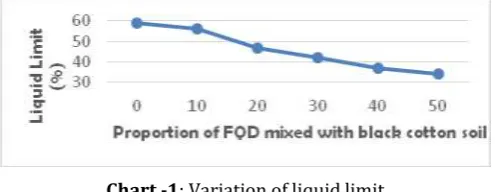
The value of Liquid limit of a soil is a good indication of its expansive nature. Experiment is conducted based on IS: 2720 (Part 5) [12]. The value of liquid limit of the soil taken for the present study is 59%, indicating that the soil is highly expansive. FQD is mixed with the soil in various proportions, i.e., 10:90, 20:80, 30:70, 40:60, 50:50 (FQD : Virgin soil). At 50:50 mix proportion, liquid limit of the mix is reduced to 34%. With this reduced liquid limit, the soil changes from CH to CL indicating that the soil has become less expansive with the replacement of soil by 50% of FQD. Chart 1 shows the variation of liquid limit of the black cotton soil mixed with various proportions of FQD.
[image:2.595.52.273.96.289.2]Chart -1: Variation of liquid limit
Table 2 shows the other properties of the virgin soil and the soil mixed with the waste material in the mix proportion 50:50.
Table -2: The other properties of Virgin soil and 50:50 FQD
Property Virgin Soil Soil mixed with FQD in the proportion 50:50
Plastic limit 29% 20%
Plasticity
Index 30% 14%
Differential
Free Swell 72% 27%
Differential free swell test is conducted based on IS: 2720-(Part XL) [13]. With the addition of waste material, it is found that there is a 62.5 % reduction in the swelling of the black cotton soil.
2.3 Results of Light Compaction test
[image:2.595.311.559.270.366.2]© 2019, IRJET | Impact Factor value: 7.211 | ISO 9001:2008 Certified Journal | Page 7925
reduces, hence the water requirement reduces, thereby theOMC decreases. With the addition of FQD, the distribution of particle sizes improves and hence MDD increases.
Chart -2: Results of Light Compaction Test
2.4 Results of CBR test
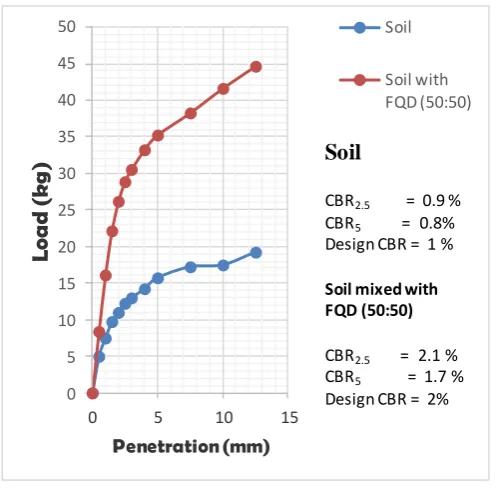
The soaked CBR test is performed on both the virgin soil sample and the mix containing 50% of soil and 50% of FQD based on IS: 2720 (Part 16) [15]. Chart 3 shows the results of CBR tests. With the addition of FQD, the CBR value increases. There is an increase of 136% for soil mixed with 50% of FQD compared to virgin black cotton soil.
0 5 10 15 20 25 30 35 40 45 50
0 5 10 15
Lo
a
d
(kg
)
Penetration (mm)
Soil
Soil with FQD (50:50)
Soil
CBR2.5 = 0.9 %
CBR5 = 0.8%
Design CBR = 1 %
Soil mixed with FQD (50:50)
CBR2.5 = 2.1 %
CBR5 = 1.7 %
Design CBR = 2%
Chart -3: Results of CBR Test
3. DESIGN OF PAVEMENT
The design of Pavement is based on IRC: 37 - 2001 [5]. The design is mainly based on the CBR value of subgrade and traffic intensity in msa. As per IRC, for a subgrade of
expansive nature and having CBR value less than 2%, the design should be based on 2% and an additional buffer layer with thickness ranging from 0.6 to 1 m should be provided. In the present study, for the virgin soil, CBR is less than 2% and the soil is expansive in nature, hence additional buffer layer is provided having CBR not less than10%. Due to the addition of Fine Quarry Dust, the CBR value increases and the expansive nature of soil reduces, hence the buffer layer can be avoided. The pavement is designed, considering traffic intensity as 2 msa on virgin soil as shown in Fig. 3 and stabilized subgrade as shown in Fig. 4
.
Fig -2: Pavement designed on virgin soil
Fig -3: Pavement designed on stabilized soil
4. COST ANALYSIS
[image:3.595.37.289.136.329.2] [image:3.595.39.288.449.694.2]© 2019, IRJET | Impact Factor value: 7.211 | ISO 9001:2008 Certified Journal | Page 7926
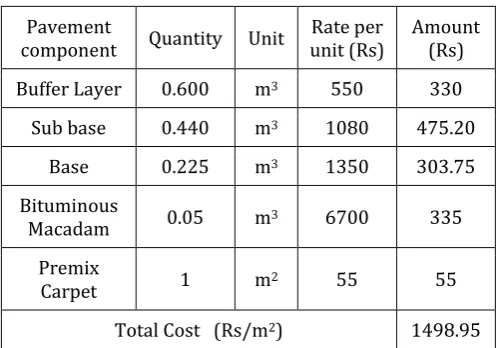
and the cost of pavement per unit area is calculated. Fromthe cost analysis, it is found that there is a 22 % reduction in cost of the pavement.
Table -3: Estimation of Quantity and Cost for the pavement designed on virgin soil
Pavement
component Quantity Unit Rate per unit (Rs) Amount (Rs)
Buffer Layer 0.600 m3 550 330
Sub base 0.440 m3 1080 475.20
Base 0.225 m3 1350 303.75
Bituminous
Macadam 0.05 m3 6700 335
Premix
Carpet 1 m2 55 55
[image:4.595.37.287.164.338.2]Total Cost (Rs/m2) 1498.95
Table -4: Estimation of Quantity and Cost for the pavement designed on virgin soil
Pavement
component Quantity Unit unit (Rs) Rate per Amount (Rs) Sub base 0.440 m3 1080 475.20
Base 0.225 m3 1350 303.75
Bituminous
Macadam 0.05 m3 6700 335
Premix
Carpet 1 m2 55 55
Total Cost (Rs/m2) 1168.95
5. CONCLUSIONS
In the present study, the suitability of using Fine Quarry Dust (FQD) as a stabilizer for improving the characteristics of black cotton soil as subgrade is analyzed. Based on the study, the following conclusions can be made.
● By the addition of FQD to expansive soil like black cotton soil, mechanical stabilization mainly takes place.
● There are no chemical products formed during the stabilization as the stabilization mainly takes place due to the variation in the particle size.
● With the addition of FQD to the black cotton soil the liquid limit reduces and at 50% of replacement of the soil with waste material, the soil changes from CH to CL, hence optimum value is taken as 50%.
● With the addition of waste material, plastic limit and plasticity index are also found to decrease. ● Based on Indian Standard Soil Classification System,
at 50:50 mix proportion, the soil is found to be CL, hence the swelling and the compressibility behavior of soil reduces.
● For the 50:50 mix proportion, Differential Free Swell reduces by 62.5% as compared to virgin soil. ● With the addition of waste material the optimum
moisture content reduces and maximum dry density increases.
● When the soil is mixed with 50% of FQD, the CBR is found to increase by 136% compared to virgin black cotton soil.
● Since the expansive nature of the soil reduces, the buffer layer can be avoided from the pavement. ● By using FQD as a stabilizer for expansive subgrade,
there is a 22% saving in the cost of pavement.
Thus it can be concluded that, fine quarry dust can be used for the stabilization of expansive subgrade soil, which is not only economical but also environmental friendly.
REFERENCES
[1] Mehmet Saltan, Yücel Kavlak, F. Selcan Ertem,
“Utilization of Pumice Waste for Clayey Subgrade of Pavements. Journal of Materials in Civil Engineering”, ASCE, 23(12), 2011, pp 1616-1623
[2] Srinath R. Iyengar, Eyad Masad, Ana K. Rodriguez,
Hassan S. Bazzi, Dallas Little, Howard J. M. Hanley, “Pavement Subgrade Stabilization Using Polymers: Characterization and Performance”. Journal of Materials in Civil Engineering ASCE, 25(4), 2013, pp 472-483
[3] Achmad Fauzia, Usama Juniansyah Fauzib, Wan Mohd
Nazmia, “Engineering Quality Improvement of Kuantan Clay Subgrade using Recycling and Reused Materials as Stabilizer”, Elsevier, Procedia Engineering 54, 2013, pp 675 – 689
[4] Palanikumar M, “ Stabilization of Weak Subgrade using
Pumice Stone, a Waste Material”, International Journal of ChemTech Research, 10(7), 2017, pp 428-439
[5] IRC: 37 – 2001, “Guidelines for the Design of Flexible
Pavements”, Indian Roads Congress, New Delhi, 2001.
[6] Agus Setyo Muntohar, “Utilization of Uncontrolled Burnt
Rice Husk Ash in Soil Improvement”, Dimensi Teknik Sipil, Vol. 4, No. 2, 2002, pp 100 - 105
[7] Yan-Jun Du, Ning-Jun Jiang, Song-Yu Liu, Suksun
Horpibulsuk, Arul Arulrajah, “Field evaluation of soft highway subgrade soil stabilized with calcium carbide residue”, Elsevier, Soils and Foundations, 56, 2016, pp 301–314
[8] Sunghwan Kim, Kasthurirangan Gopalakrishnan, Halil
Ceylan, “Moisture Susceptibility of Subgrade Soils Stabilized by Lignin-Based Renewable Energy Coproduct”, Journal of Transportation Engineering, ASCE, 2016, pp 138(11): 1283-1290
[9] Leema Peter, P K Jayasree, K Balan , Alaka Raj,
© 2019, IRJET | Impact Factor value: 7.211 | ISO 9001:2008 Certified Journal | Page 7927
With Coir Waste”, Transportation Research Procedia,Elsevier, 17, 2016, pp 558 – 566
[10] Mohammad Ali Rahgozar, Mohammad Saberian, Jie Li
“Soil stabilization with non-conventional eco-friendly agricultural waste materials: An experimental study”, Transportation Geotechnics, Elsevier, 14, 2018, pp 52– 60
[11] IS: 1498 – 1970, “Classification and Identification of
Soils for General Engineering Purposes” (First Revision), Bureau of Indian Standards, 1970
[12] IS: 2720 (Part 5)-1985, “Methods of test for soils:
Determination of liquid limit and plastic limit”, Indian Standards Institution, 1985
[13] IS: 2720 (Part XL)-1977, “Methods of test for soils: Part
XL Determination of Free Swelling Index of soils”, Bureau of Indian Standards, 1977
[14] IS: 2720 (Part 7)-1980, “Methods of test for soils: Part 7
Determination of water content-dry density relation using light compaction”, Bureau of Indian Standards, 1980
[15] IS: 2720 (Part 16)-1987, “Methods of test for soils: Part