© 2019, IRJET | Impact Factor value: 7.211 | ISO 9001:2008 Certified Journal
| Page 5694
Aditya S. Bhumre
1, Ravina R. Gaikwad
2, Akash V. Shinde
3Amruta V. Thombare
4Abhimanyu K. Chandgude
5, Shital P. Kharat
61,2,3,4,5,6
School of Mechanical and Civil Engineering, MIT Academy of Engineering, Alandi (D), Pune
---***---Abstract -
Abrasive waterjet machining (AWJM) is an emerging machining technology option for hard material parts that are extremely difficult-to-machine by conventional machining processes. And has various advantages over the other Conventional technologies and non-conventional technologies. Such as, high machining versatility, minimum stresses on the work piece, high flexibility no thermal distortion, and small cutting forces. This paper reviews the research work carried out for development of AWJM within the past few years. It reports on the AWJM research relating to improving performance measures and optimizing the process variables by Taguchi Method with grey relational analysis (GRA) and Analysis of Variance (ANOVA). A wide range of AWJM industrial applications for different category of material are reported with variations in this paper.Key Words: Abrasive waterjet machining (AWJM), ANOVA, Taguchi, Grey Relational Analysis (GRA)
1. INTRODUCTION
Abrasive Water jet machining (AWJM) is a processing conventional machine which operates materials or works on materials without producing shock and heat. It is applied for many purposes like drilling, cutting, Slotting etc. Current applications include stripping and cutting of fish, cutting of car carpets, removal of coatings from engine components, to cutting of composite fuselages for aircraft construction. The impact of the water alone is enough to machine a material, however, with the addition of abrasive, the material removal rate in the process is of higher magnitude. In these machine abrasive particles are made to impinge on the work material at high velocity. A jet of abrasive particles is carried by carrier water. The metal removal takes place by impact erosion of high pressure, high velocity of water with high velocity of abrasives on a work piece. The high velocity stream of abrasives is generated by converting the pressure energy of carrier water to its Kinetic energy and hence the high velocity jet. Nozzles direct abrasive water jet in a controlled manner onto work material. The high velocity abrasive particles remove the material by micro-cutting action. Material removal is done mechanically by erosion, which is caused due to localized compressive failure which occurs when the local fluid pressure exceeds the ultimate compressive strength of the workpiece to be machined. However, AWJM has some limitations and drawbacks. It may generate loud noise and a messy working environment. It may also create tapered edges on the kerf, especially when cutting at high traverse rates. The characteristics of surface produced and material removal rate (MRR) mainly depends on Nozzle traverse speed, abrasive mass flow rate pressure intensely, water pressure, standoff distance and abrasive grain size. Whereas Nozzle traverse speed and water pressure are major manipulating factors in case of MRR while abrasive mass flow rate and pressure intensely influences SR. Other factors such as standoff distance, abrasive grain size is sub-significant in influencing MRR or SR. The percentage contribution of water pressure for MRR is 66.69%. In case of surface Roughness Standoff distance and Transverse speed plays major significance of about 47% and 37% respectively.
2.
METHODOLOGY
© 2019, IRJET | Impact Factor value: 7.211 | ISO 9001:2008 Certified Journal
| Page 5695
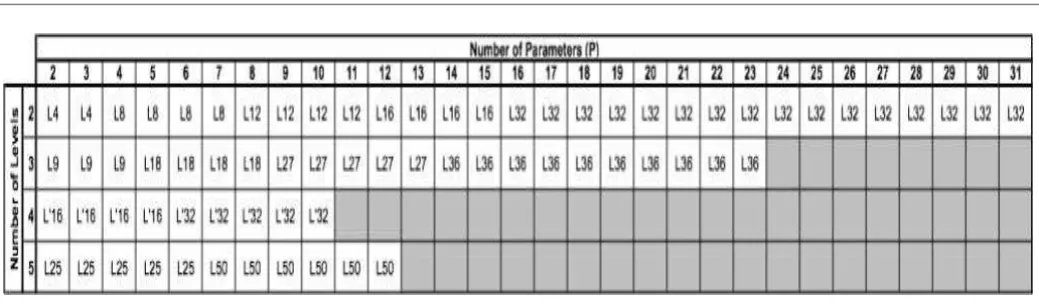
Fig. 1 Orthogonal array method
From above figure we can find that which orthogonal array we can use like L9 and L27 are common in AWJM for optimizing of parameters and to find more efficient combinations of parameters. In L9 we will get 9 such different parameters and in L27 we will get 27 such combinations of parameters. And after Orthogonal array we can get perfect optimize parameter by using any one of the following methods,
2.1 Grey relational analysis (GRA)
The first step of GRA is to normalization the data that is it will inform of 0 and 1 only, because of avoiding different units and to reduce variability. If response is to be minimize then smaller the better criteria is used. And as surface Roughness has to be lowered the lower-the-better (LB) criteria is used instead of Higher-the-better (HB). Bellow formula is used to Normalize the data,
For higher-the-better we can use formula as shown below;
Where Xi(k) is the value after the grey relational generation, Min Yi(k) is the smallest value of Yi(k)for the Kth response, and Max Yi(k) is the larger value of Yi(k)for Kth response.
After above Normalization we need to calculate Gray Relation Coefficient ξi(k) and it calculated by following formula,
Where ∆0i(k) = ‖X0(k) - X0(k) ‖ is difference of absolute value, ϛ is distinguishing coefficient 0 ≤ θ ≤ 1; ∆min is smallest value of ∆0iand ∆max is largest value of ∆0i. Now after averaging the grey relational coefficients, the Grey relational grade γi is obtained by using formula,
© 2019, IRJET | Impact Factor value: 7.211 | ISO 9001:2008 Certified Journal
| Page 5696
Chart -1: Gray relational Analysis
2.2 Analysis of Variance (ANOVA)
Analysis of variance (ANOVA) is a collection of statistical models used to analyze the differences among group means in a sample. ANOVA was developed by statistician and evolutionary biologist Ronald Fisher. Firstly, Sum of the squares of parameters is calculated by using following formula,
Where CF is Correction factor XY1, XY2 and XY3 Values of result of each level of parameter Y. And NY1, NY2 and NY3 are Repeating number of each levels of parameter Y. Now after calculating Sy we need calculate Variance Vy and that is calculated by following formula,
Where, fy= [(Number of levels of parameter Y) – 1] now next step is to calculate F-Ratio Fy is the Degree of freedom (D.O.F) of parameter of Y and it is calculated,
© 2019, IRJET | Impact Factor value: 7.211 | ISO 9001:2008 Certified Journal
| Page 5697
And here fT = [(total number of result) -1] and STby following formula;
So, finally we value of F- Ratio FY which is very important to select the parameter from set of parameters.
Higher the value of Fy the parameter is more significant and other are sub-significant values. For Easy understanding flow chart of Analysis of Variance (ANOVA) as follows,
Chart -2: Analysis of Variance
3.
IMPORTANT LITERATURE SURVEY
Zoran Jurkovic, Mladen Perinic, Sven Maricic
© 2019, IRJET | Impact Factor value: 7.211 | ISO 9001:2008 Certified Journal
| Page 5698
material Mild steel was chosen because many experimental works are done on Al, Gray cast iron, Kevlar reinforced phenolic composite, EN-8 and acrylic but researches on mild steel are very few. Experiments are performed with three set values. The optimization of the observed values was determined by comparing the standard analysis and analysis of variance (ANOVA) which is based on the Taguchi method. The surface Roughness was measured using Taylor Hobson Equipment. By this Equipment surface roughness was measured three time and their arithmetic mean is calculated to minimize the error. The Critical F value (Fcritical) was taken as 5.14 from F distribution of critical values at p=0.05 for ANOVA tests. And concluded that
water pressure and traverse speed had significant F-values and standoff distance had low F value so water pressure and standoff are significant parameters by plot S/N ratio vs Parameter Graph.
Mayur M. Mhamunkar and Niyati Raut
Mayur M. Mhamunkar and Niyati Raut studied on optimization of parameters of AWJM for Titanium, Ti6Al4V. Titanium Ti6Al4V material was selected because of its decent mechanical properties like its high strength, low weight ratio, etc. This experiment was carried because AWJM of Ti6Al4V was prevailing optimization of machining parameters didn’t receive much consideration. Taguchi method with Grey relational analysis and L9 orthogonal array was used to optimize the parameters like Transverse speed, Abrasive Flow Rate and Stand of distance with three different levels by keeping pressure constant. Orthogonal Array was used with help of Minitab Software. They also stated that Laser cutting is normally economical for cutting Ti6Al4V sheet up to 2 mm thick and beyond that AWJM is used. Surface roughness of material was measured by Mitutoyo tester.
Leeladhar Nagdeve, Vedansh Chaturvedi & Jyoti Vimal
Leeladhar Nagdeve, Vedansh Chaturvedi & Jyoti Vimal studied on implementation of Taguchi approach for optimization of abrasive water jet machining process parameters on Aluminum material by ANOVA Technique of optimization. This experiment was done because in previous investigation taper-ness of whole was not reduce. So, this attempt is made to increase MRR and to decrease the taper-ness with different chemical environment and chemical concentration. In this paper with Taguchi method ANOVA and F-test are taken to find optimal solution. In this investigation four parameters are varied they are pressure, SOD, Flow rate and Transverse speed. Different Graphs were plotted to observe main influencing parameter on MRR and SR. And with help of this graph final optimal parameter are obtained.
Vinod B. Patel and Prof. V. A. Patel
Vinod B. Patel and Prof. V.A. Patel studied on Experiment of Parametric analysis of Abrasives water jet machining for EN8 Material. Taguchi method with Analysis of Variance (ANOVA) is used to complete the optimization. It was carried out using L25 Orthogonal array by varying traverse speed, abrasive flow rate and stand of distance (SOD). EN8 material was selected because widely used for industrial application in metal forming; forging, squeeze casting and pressure die casting. For MRR the Higher the better and for SR the lower the better criteria analysis was carried out on Minitab 16 software. ANOVA was used because it is powerful analyzing tool to identify which are the most significant factor. They both concluded that MRR and SR increases with transverse speed and Mixing ratio is most significant factor to control, it is ratio of Mass flow rate of abrasive material to mass flow rate of water in AWJM.
M. A. Azmir, A.K. Ahsan, A. Rahmah, M.M. Noor and A.A. Aziz
© 2019, IRJET | Impact Factor value: 7.211 | ISO 9001:2008 Certified Journal
| Page 5699
[image:6.595.197.417.134.280.2]4.
CONCLUSIONS
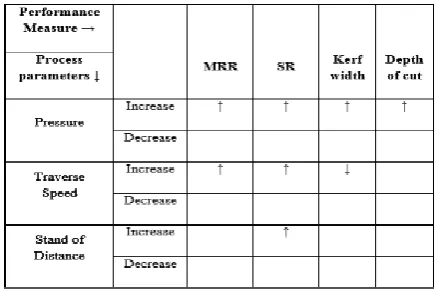
Table. 1:Effect of processing parameters on AWJM.
Above Table of Processing parameters is very useful while selecting the Final parameters in order to achieve our objectives and also help us to understand the basic effect of parameter on performance of AWJM while in working.
REFERENCES
[1] Mayur M. Mhamunkar and Niyati Raut (2017), “Process Parameter Optimization of CNC Abrasive Water Jet Machine for Titanium Ti6Al4V:”, International Journal of Advance Industrial Engineering, E-ISSN 2320 –5539, Vol-5, No.3.
[2] Leeladhar Nagdeve, Vedansh Chaturvedi, Jyoti Vimal (2012), “Implementation of Taguchi approach for optimization of abrasive water jet machining process parameters”, International Journal of Instrumentation, Control and Automation (IJICA) ISSN: 2231-1890, Vol-1 Issue-3,4.
[3] M.Sreenivasa Rao, S.Ravinder and A. Seshu Kumar (Feb 2014) “Parametric Optimization of Abrasive Waterjet Machining for Mild Steel Taguchi Approach”, International Journal of Current Engineering and Technology, Special Issue-2.
[4] Zoran Jurkovic, Mladen Perinic, Sven Maricic, Milenko Sekulic,Vesna Mandic (2012), “Application of Modelling And Optimization Methods In Abrasive Water Jet Machining, Journal Of Trends In The Development Of Machinery And Associated Technology”, Vol. 16, No. 1, ISSN 2303-4009 (Online), P.P. 59-62.
[5] Kapil Kumar Chauhan, Dinesh Kumar Chauhan (June 2013), “Optimization of Machining Parameters of Titanium Alloy for Tool Life”, Journal of Engineering, Computers & Applied Sciences (JEC&AS) ISSN No: 2319‐5606 Volume 2, No.6.
[6] P.P. Badgujar, M.G. Rathi (June2014), “Taguchi Method Implementation in Abrasive Waterjet Machining Process Optimization”, International Journal of Engineering and Advanced Technology (IJEAT) ISSN: 2249 – 8958, Volume3, Issue-5
[7] Valicek, J. Drzik, M. Hloch, S., Ohlidal, M., Miloslav, L. Gombar, M. Radvanska, A. Hlavacek, P. Palenikova, K., 2007, “Experimental analysis of irregularities of metallic surfaces generated by abrasive waterjet”, International Journal of Machine Tools & Manufacture, Vol. 47, pp. 1786-1790.
[8] M. A. Azmir1, A.K. Ahsan, A. Rahmah, M.M. Noor And A.A. Aziz (2007), “Optimization Of Abrasive Waterjet Machining Process Parameters Using Orthogonal Array With Grey Relational Analysis”, Regional Conference On Engineering Mathematics, Mechanics, Manufacturing & Architecture (Em3arc).