::-:0==0
March 31, 1972
Apple
Reference Manual
by
Fred Krull
Michael Marcotty
Mary Pickett
James Thomas
Ronald Zeilinger
Computer Science" Department
IBM I"
Research LaboratoriesAPPLE REFERENCE MANUAL
31 MARCH 1972
PREFACE
.
..
• 9CHAPTER 1 : PROGRA"t ELEMENTS
·
• 10INTRODUC'1"ION 10
LANGUAGE CHARlCT ER SET 10
Collating Sequence 12
Length of Tdentifiers 12
Keywords 12
stat.ement "Identifiers
·
• • 13Attribute Keywords • •
..
13Built-in Function Names
..
• • 13Option Keywords
·
• •..
13Conditions • 13
DELIMITERS • 14
Ar i t.hmet ic Operators • • 14
Relational Operators •
..
• • 15Bit-string Operators 15
string operator
·
•..
• 15Parentheses
.
..
15Separators and Other Delimiters
.
16CCMMENTS • • 16
'T'he Use of Blanks and Comments 16
EIEMF.NTAFY PROGRAM STRUCTURE
..
•..
17Simple Sta tements
.
• 17Compound Statements
.
..
17Prefixes •
..
17CHAPTER 2: PROGRAM STRUCTURE
..
19INTFOf)UCTION 19
STATIC PROGRAM S1'RUCTURE •
..
19Groups 19
Block Structure
·
..
• 20Use of the END Sta temen t
..
22DYNAMIC PROGRAM STRUCTURE
·
..
22Procedure References
..
23Subroutine References
..
•..
..
24Function References
.
..
'.
..
•.
24Act ivation and Termination of Blocks
..
24The Environment of a Block • • 26
APPLE REFERENCE MANUAL
31 MARCH 1972
ARGtJAENT PASSING • • 27
Parameters 28
Corres pon dence of Arquments and Parameters
..
• 29Use of Dummy Arguments 30
Entry References as Arguments
·
• • • • 31Use of the ENTRY Attribute • • 32
CHAPTER 1: DiI\TA ELEMENTS • • • 33
INTRODUCTION • 33
DATA TYPES
..
• • 33PROBLEM DATA • • • • 33
Arithmetic Data
..
34Scale
..
• • 34Precision 34
AI' i thmet ic Constants • • 36
Strinq Data
.
• • • • 36Character-string Data • • • 37
Character-string Constants
..
..
37Bit-String Data
·
• • • 38Bi t-st rinq Constants • 38
PROG RAM-CONTROL DATA
·
38Label Data • 38
Statement-Label Constants
..
• • 38Statement-Label Variables
·
39Locator Data • 39
Locator Quallf icat ion
.
• 40Interrupt Data 41
File Variable
.
41Entry Data • 42
ORGANIZATION
..
• • 43Scalar Items
·
43Scalar: Variables 43
Data 1\ggregates • • • • 43
Arrays • 43
Structures • 44
Arrays of structures • • 45
Attributes of Structures • 46
NAMIN(; • 46
Simple Names 46
Subscripted Names
.
• • 46Oualifieii Names and Ambiguous References
·
47Subscripted Qualified Names
.
• • 50CHAPTER 4: DATA PIA NIPULATION • • • • • • 52
INTRODUCTION • • • 52
APPLE REFERENCE "ANOAL
31 MARCH 1972
EXPRESSIONS • • • • • • • • • • • • • • • • • • • • • • 52
Arithmetic operations. • • • • • • • • • 54
Descriptor Arithmetic • • • • • • • • • • • • • • • • 55 Relational Operations • • • • • • • • • • • • • • 56
Bit-string Operations • • • • 57
String Operations • • • • • • • • • • • • • • 58
EVAL"~TION OF EXPRESSIONS • • • • • • • • • 59
Priority of Operators. • • • • • • • 59
Use of Parenthes~s • • • • • • • • • • • • • 60
Exam~le of Expression Evaluation • • • • 60
ARRAY EXPRESSIONS. • • • • • • • • • • 63
Operations between Arrays and Scalars • • • • 63
Operations between Arrays • • • • • • 64
DAT~ CONVERSION • • • • • • • • • • • • • • 65
ARI~HMETIC CONVERSION • • • • • • • • • 65 Results of Arithmetic Operations • • • • • • 66
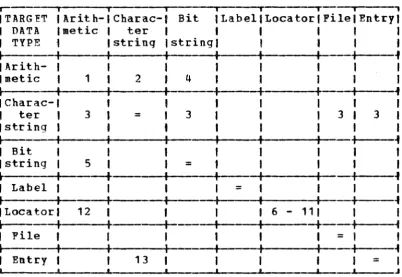
TYPE CONVERSION • • • • • • • • • • • • • • • • • • 67
1. Arithmetic Conversion • • • • • • • • • • • • 68
2. Character-string to Arithmetic • • • • 68
3. Conversions to Character-string • • • • • • • 69 4. Bit-string to Arithmetic. • • • • • • • • 69
5. Arithmetic to Rit-string • • • • • • • • • • • • • 69
6. Offset to Pointer • • • • • • • • • • • • • • • • 69
7. Pointer to Offset • • • • • • • • • • • • • • 70 8. Descriptor to Pointer • • • • • • • • • • • • 70
9. Pointer to Descriptor • • • • • • • • • • • • 70
10. Offset to Descriptor • • • • • • • • • • • • 70
11. Descriptor to Offset • • • • • • • • • • 70
12. Arithmetic to Locator. • • • • • • • • • • • 71
13. Character-string to Entry Value. • • • • • • 71
CHAPT~R ~ -- DATA DESCRIPTION • • • • • • • • • • • • 72
INTFODUCTION • • • • • • • • • • • 72
DECLARATIONS • • • • • • • • • • • • • • • • • 72
EXPLICIT DECLARATIONS • • • • • • • • • • • "73
Label Prefixes • • • • • • • • • • • • • • • • • 74
Parameters • • • • • • • • • • • • • • • • • 74
CONTEXTUAL DECLARATIONS • • • • • • • • • • 74
SCOPE OF DECLAFATIONS • • • • • • • • • • • • • • • 75
DEFAULT ATTRIBUTES • • • • • • • • • • • • 79 LIST OP ATTRIBUTES • • • • • • • • • • • • • • • • 80 AUTOMATIC, STATIC, REGISTER, and BASED • • • • • • • 81
BINARY and DECIMAL • • • • • • • • • • • • • 88 BIT and CHARACTER • • • • • • • • • • • • • • • • 89
BUIL~IN • • • • • •
.
.
. . .
.
• • • • • • 90APPLE BEF!REICE "AIUAL
CHARACTER CONSTANT CONOITION DECIr1At • DESCRIPTOR Dimension ENTITY 'ENTRY • F.VBNT •
• • • and • • • • • • • • • • • EVENT • • • • • • • •
..
• • • • • • • • • • • • EXTERNAL and INTERNAL • FtLP.FILE_SET • • • • • • FIXED and fLOAT •
• • • • • • • • • • • • • • • • • • • • • • • • • • • • • • • • • • • • • • • • • •
·
..
• INITIAL LABEL • tIKE OFfSET,REFER RETURNS
POINTER, and DESCRIPTOR
• • • • • • SET VARIABLE VARYING • • • • • • • • • • • • • • • •
CHAPTER 6: FILE HANDLING tN'TRODUCTION • •
FILES • • • • • Sequential Files structured Files File Variables
•
• • •
• SROUENTIAL FILE HANDLING
• • • • • • • • • • • • • • • • • • • nse of GET and PUT statements Data specification
Data Lists
Format Lists • • Data Format-Items Control Format-Items
•
•
•
STRUCTURED FILE HANDLING •
•
storaqe Manaqement •
Rntities • • • • •
•
• •
• •
Sets • • • • •
• • • • • • • • • • • • • • • • • • • • • • • • • • • • • •
Creating and Deletinq Associations
Searching a Set • • • • •
• • • • • • • • • • • • • • • • • • • • • • • • • • • • • • • • • • • • • • • • • • • • • • • • • •
Associative Data Built-In Punctions • CHAPTER 1 - INTERRUPT HANDLING • • • •
4
31 fUSCH 1912
• • • • • •
..
• • • • • • • • • • • • • • • • • • • • • • • • • • • • • • • • • • • • • • • • • • • • •..
• • • • • • • • • • • • • • • • • • • • • • • • • • • • • • • • • • • •...
..
.
..
..
. .
• • • • • • • • • • • • • • • • • • • • • • • • • • • • • • • • • • • • • • • • • • • • • •• q1 • 91 • 92 • 92 92 • 93 94 • 95 96 91 • 91 • 98
• 9q
APPLE REFER!WCE KAWUAL
31 KARCH 1912
INTRODUCTION . . . e .. • • • • • • • 134
CONDITIONS • • • • • .. • .. • • • • • • • .134 System Conditions. • • • • • • • • • • • • • 134 Programmer-Defined Conditions . . . 135 EVENTS .. • • • • • • • .. • • • • • • • • • 135 Event Declarations • • • • • .. • • • • • • .135 Bvent states .. • • • • • • • • • • • • • 136
Completion State • • • • • • • • • • 136
Delay state ~ • • • • • • • • • • 137
Use of the ONPTR Built-in Function • • • • • • • 137 USE O~ INTERRUPT-HANtLING STATEMENTS • • • • • • .138 Use of the ON statement. • • • • • • • • 138
Use of the REVERT statement. • • .. • • .141
Use of the SIGNAL statement . . . 142 Use of the WAIT statement. • • • • • • .. • • 142 Use of the LOCK and UNLOCK statements • • • .143
CHAPTER 8: STATEMENTS . . . .. INTRODUCTION • .. .. .. .. • • • • • .. .. • • .. • CLASSIFICATION OF STATEMENTS • • • .. • • • •
The ALLOCATE Statement • • • • • • • •
The Assignment statement • • • • ..
The BEGIN statement • • • • • • • • • • • • • • The CALL statement • • • • • • • • • • • • • • The CRRATE sta tement . . . .
• • • 144 .144 .144 • • • 145 • • .150 .154 • • • 154
The DECLARE statement . . . ..
.156 .156 The DELETE statement . . . . • 159 The DO statement • • • • .. .. • • .. • • • • • •
The END statement • • • .. • • • • • • • The F:NTRY statement.. • • • • • .. .. • • The EXIT statement . . . . .. • • . . . . The FIND Statement • .. • .. .. • • • • • • • • • The FOR EACH statement .. • • • • • • • • • The FREE statement . . . . • • • • • • • The GET statement • • • • • • • • • • ..
The GO TO statement .. .. • •
The IF statement • • • • .. • .. • •
The INSERT statement • • • • • • •
The LET statement • .. • • • • • • • .. • • • The LOCK stat.ement • .. • • • .. • • • • The null statement • • • • • • • • • • The ON statement .. • • • • • • • • • • The PROCEDURE statement. • • • • • . . . The PUT statement • • • • • • • • • • • The RBMOVE sta tement • • • • • • • • • • •
• 159 • • • 164 .164 • • • 165 .166 .169 • • • 171 .173 • • • 173 .175 .117 .178 • • • 179 .180 .180 • • • 182 • • • 183 • . . . 183
APPLE REFERENCE KANUAL The The The 'rhe The
RE'rURN statement REVERT sta tellent SIGNAL sta tellent UNLOCK statement WAIT statement
• • • •
..
• • • • • •APPENDIX 1 - BUILT-IN fUNCTIONS,
..
..
..
• • PSEUDO-VARIABLESINTRODUCTION
ARITHMETIC FUNCTIONS ABS (x) • • • •
CEIL (x) • .. • ..
fLOOR (x) •
MOD (x, d) • •
ARRAY FUNCTIONS DIK (a, d)
HBOUWD(a, t.BOUWD (a,
d)
..
• •..
.. ..
• •..
..
..
• •..
..
..
• • •..
ASSOCIATIVE d)DATA FUNCTIONS
ALL
..
..
..
e)
d)
1)
APLESET (s)APLEVAR (s)
APLINDX(e, s, e)
APLNUMB (s, e) • APLOWNI (e, s, APLOWRS(e, e, APLSNAM(e, i,
A PLTYP'E (e)
•
•
• CONVERSION FUNCTIONS
BY'rE (x[, i])
CHAR (v(, 11) • • •
• RNTRY (el
FIXF.D(x(, p) •
FLO~T (x[, p]) HEX (f[, i[, 1]])
OFFSET (p, f)
POINTER(o, f) . . .
•
..
.. ..
• • • • •..
• •..
• •..
• • • • •.. ..
..
•..
..
• • •..
..
• • • • • • •INTERRUPT HANDLING FUNCTIONS
6
COftPLRTION(e) ..
..
DELAY (e) ONFILE
ONLOC .. • • OtJPTR (e) •
•
..
• • • • MATHRMATICAL FUNCTIONSATAN (x) • •
..
• • • • • • • • • • • •..
• • • • • • • •..
..
• •..
..
• • • • •..
• • •..
• • • • PROCEDURES,..
• • • • • • • • • • • • • • • • • • • • • • • • • • •..
• • • • • •..
• • • • • •..
• • • • • • •·
...
• • • • • • • • • • • •..
·
..
• • • • • • • • • • • • • •..
• • • •..
.
• • • • •·
..
..
• • •..
• • • • • • • • • •..
• • • • • • • •·
...
• • • • • • • • • • • • • • • • • • •·
...
..
• • • •31 KARCH 1972
APPLE REFERENCE "ANUAL
31 "ARCH 1912
COS (x) • • • • . . . 199
LOG (x) • • • • • • • • • • • • .199
SIN (x) • • • .. • • • • • • .199
SQRT(x) • • • • • • • • • • • • • • • 200
TAN (x) • • • • • • • • • • • • • • .200
STORAG~ MANAGEM~NT FUNCTIONS • • • • • • .200 ADDR(v) • • • • • • • • • • • • • • • • .200
DESCR(l, a ) . • • • • • • • • • .200
FILE(g) • • • • • • • • • • • • • • • 200
NqLL • • • • • • • • • • • • • • • • • • • • • • 200
STRING HANDLING FUNCTIONS. • • • • • .201
INDEX{s, p). • • • • • • • • • • • • 201
LENGTH(s} • • • • • .201
RAL (h) • • • • • • • • • • • • • • • 201
SUBSTR (s, if, :i
J) • • • • • •
• • • • •
.201 riISC:F:LLANFOUS FUNCTIONS • • • • • • • • • • • • • • 202 DATE • • 0 • • • • • • • • • • • • • 202INLIN~(f, r, s, t.}, INLINE(f, g, x, a, y, h, z, c) .202 ~IME • • • • • • • • • • • • • • • .204
APPENDIX 2 - CONJ'lITION5 • • • • • • • • • • • • .205
INTRODqCTION • • • • • • • • • • • • • 205
CONVERSION Conil.i tion • • • • • • • • • • • • • • .205
ENDFILB Condition. • • • • • • • • • • • • • • • .206 ERROR Condition • • • • • • • • • • • • • • • • • • 206
FIND Condition • • • • • • • • • • • .206
:FINT SH Condition .. • .. • • • • • • • • • .207
OVERFLOW Condition • • • • • • • • • • • • • • • • 207
Programmer-defined Condition • • • • • • • • • • • 207
STORAGE Condition. • • • • • • • • • • • • • • • • 20A
UNDP.FINlI:DFILE Condition . . . 208 UNDER'LOW Condition • • • • • • • • • • • • • • • • • • 208 ZEROOIVIDE Condition • • • • • • • • • • • • • 209
APPENDIX 1 - KEYWORDS, ABBREVIATIONS AND SYNONYMS • • • • 210
KEYWORD ABBREVIATIONS. • • • • • • • • • • 210
KRYWORD SYNONYMS • • a • • • • • • • • • • • • • • 213
APPENDIX 4 - DATA CHARACTER SET
.
.
.
· .
APPENDIX 5 - COMPILE-TIM!. CONTROLS
. .
. · . .
• • • • APPENDIX' 6 - NOTATION • •.
.
.-
. .
.
.
.
·
.
.
.
.
. .
APPENDIX 1 - STRUCTU!E "APPING. . .
. .
.
.
.
. . .
.
APPRNDII 8 -- LITERALLY • • • • •
.
. .
.
·
.
. .
.
.
.
.214.217
.219
.221
.223
APPLE REFERENCE MANUAL
31 MARCH 1972
APPLE REFERENCE MANUAL
31 MARCH 1972
~~EFAC]
This mannal serves as a reference to the Apple Programming Lanquage as implemented for the STAR computer system. The Apple Language itself is a dialect of PL/I; that is, Apple is a superset of a subset of PL/I.
In drafting the specifications for Apple, the rules of PL/I
have been closely followed. The deviations from PL/I have been in the main to disallow certain operations, statements, data types, etc. The rules of precision have been changed to take into account the architecture of the STAR computer. Thus, as long as a program was written within the defined subset of PLII, it should compile correctly.
The supersetting of the language has been to provide snpport for systems programming and to integrate the APL (Associa-tive Programming Language) statements directly into the language. Programmers may declare and reference the new storage class REGISTER and cause any STAR machine instruc-tion to be emitted through use of the INLINE built-in procedure. The associative data manipulation statements FINn, POR EACH, INSERT, FEMOVE, and LET have been added to the language (CREATE and DELETF are synonymous with ALLOCATE and FREE). These statements may be used to manipulate two new data constructs, ENTITY and SET.
The programmer who is preparing to use Apple should give careful attention to the specifications contained in this manual. Particular attention should be given to Chapters 3, 4, and 5, where the rules differ considerably from PL/I.
APPLE REFERENCE MANUAL
31 'URCH 1972
I!IEQ:g!!£IIQ!!
An Apple program can be regarded simply as a string of characters. Chapter 1 defines the elements of the language in terms of character elements and describes special signi-ficance that has been assigned to particular characters or combinations of characters.
The Apple language is based on a 60-character set. The character set is composed of alphabetic characters, digits, and special characters. There are 2q alphabetic characters, the letters A through Z and three additional characters that are defined as and treated as alphabetic characters. These characters and the graphics by which they are represented are:
,
"'
I I
!A~ I Graphi£ I
•
.,
I I
Number symbol I t 1
I I
At symbol
,
~ 1I I
Dollar symbol
,
$ tI I
.... .J
There are ten digits. Decimal digits are the digits 0 throuqh q. A binary digit (bit) is either a 0 or a 1. The hexadecimal digits include the ten decimal digits and the alphabetic characters A through F. An alphameric character is either an alphabetic character or a decimal digit. There are 21 special characters. These characters and the
APPLE REFERENCE MANUAL
~1 MARCH 1912
phics by which they are represented in this manual are:
,.- ~-
,
I I I
,
!~!!g J Gr~.2hi£,
f--
,
---t1 J I
I Blank I ,6 I
,
I J,
Equal or Assignment symbol I=
II J
,
J Plus I + J
J
,
II Minus I I
,
I 1I Asterisk or Multiply symbol I
*
Jt I
,
,
Slash or Divide symbol I / I,
I,
I Left Parenthesis
,
( IJ I I
I Right Parenthesis I
,
,
I,
I Comma I
,
,
I I I
,
Decimal Point or Period I,
I I
,
1 Single quotation mark I J
1 f I
t Douhle quotation mark I
"
If I I
I semicolon
,
·
,
,
,
t,
I Colon I
·
·
,
t I
,
J Not symbol
,
.... II I I
,
Or symbol I II
,
1I And symbol
,
& I1
,
II Greater-than symbol
,
>
IJ t
,
I Less-than symhol I
<
JJ I
,
1 Break character
,
,
,
I J,
Percent symbol I % II J I
L - - _ I .J
APPLE REFERENCE "ANUAL
::11 "ARCH 1912
Some keywords may be written in an abbreviated form; these are listed in Appendix 3.
A statement identifier is a sequence of one or more keywords used to define the function of a statement (see "Simple 5ta tements" below).
Examples:
GO TO
OECLARE
ALLOCATE
Attribute keywords are used for the specification of some attributes.
Examples:
FLOAT
CHARACTER
A built-in function name is a keyword that is the name of an algorithm provided by the language and accessible to the
programmer (see "Function References" in Chapter 2).
Examples:
LENGTH DATE
q2tiQ!!~j!Q.{g2
An option keyword is used to influence the execution of a statement.
Examples:
SET
REMOTE
A condition is a keyword used in the ON, SIGNAL, and REVERT statements. The programmer may specify special action on
APPLE REFFRENCE MANUAL
occurence of a condition (see Chapter 7).
Examples:
OVERFLOW ZEBODIVIDE
31 MARCH 1972
Certain single characters and certain combinations of chara-cters are used as delimiters and fall into six classes:
arithmetic operators
relational operators
bit-string operators
string operators
parentheses
separators and other delimiters
The arithmetic operators are:
+ denoting addition or prefix plus
denoting subtraction or prefix minus
*
denoting multiplication/ denoting division
**
denoting exponentiationAPPLE REFERENCE "ANUAL
31 "ARCH 1972
The relational operators are:
>
denoting greater than-.>
denotinq not qreater than>=
denoting greater than or equal to:: denoting equal to
.... =
denoting not equal to<=
denoting less than or equal to<
denoting less than... <
denoting not less thanThe bit-string operators are:
... denoting not
&
denoting anddenoting or
The strinq-operator is:
!! denoting concatenation
~renth~!!
Parentheses are used in expressions. for enclosing lists. and for specifying information associated with various keywords.
( left parenthesis
) right parenthesis
APPLE FEFEBENCE MANUAL
nu
comma semicolon assignmentcolon
blank period
arrow
percent
COMMENTS
General format:
!ll:aRh!s
,
·
•
=
·
·
•
->
31 lURCH 1972
!!.§!
separates elements of a list terminates statements
used in assignment, DO, FIND, LET, and FOR EACH statements
used in label prefixes and in bound specifications
used as a separator
separates items in qualified names
qualifies a reference to based variable
a
designates compiler control
statements (see Appendix 5 for description)
comment ::= 1* comment-string *1
where "comment-strinq" contains any of the characters of the language character set except the combination "./".
Comments are use~ for documentation only and do not parti-cipate in the execution of a program.
Identifiers, constants (except character-string constants), and composite operators (e.g., ! 1) may not contain blanks. Identifiers, constants, and keywords may not be immediately adiacent. They must be separated by an operator, assignment symbol, arrow, parenthesis, colon, semicolon, COlima, period, blank, or comment. Additional intervening blanks or com-ments are always permitted. Blanks are optional between keywords of the statement identifiers GO TO and FOR EACH.
APPLE REFERENCE MANUAL
31 KA"RCR 1972
An Apple program is constructed from basic program elements
called stat~~l~. There are two types of statements,
simple and £2!e0Yn~. Statements are grouped into larger
program elements, the
gIQYE
and the bl2£!. These arediscussed in Chapter 2.
General format:
simple-statement ::=([statement-identifier] statement-body]; The "statement-identifier", if it appears as a keyword, charact€rizes the kind of statement. If it does not appear, and the "statement-body" appears, then the statement is an
!§§!gn!~_-21!~n1. If only the semicolon appears, the statement is a
BYll
st~t~~n!.A compound statement is a statement
program elements. There are two
statements:
The IF compound statement The ON compound statement
that contains other types of compound
The final statement contained in a compound sta~ement is a simple statement and thus has a terminal semicolon. Hence the compound statement will automatically be terminated by this semicolon.
Each Apple statement is described in the alphabetic list of statements in Chapter 8.
statements may be labeled to permit reference to them through the use of laQ~1-~efi~.
General format:
label-prefix ::= identifier:
Label-prefix identifiers are called labels and may be used to refer to the statement that they prefix. Labels appear-ing before PROCEDURE and ENTRY statements are special cases
APPLE REFERENCE MANUAL
31 MARCH 1972
and are known as !!ntrL!!A~'§ (see "Procedure References" in Chapter 2). All other labels are called ~!!~ent labels. A name appearing before a statement is said to be explicitly declared with the attribute of a label constant by virtue of its appearance as a label prefix. Only one label prefix may precede a single statement, and the label prefix may not be subscripted.
APPLE REFERENCE MANUAL
31 MARcn 1972
A E~Qg£~~ is composed of one or more separately compiled procedures. At execute time, those procedures that are required to solve a particular problem are dynamically
(i.e., at first reference) linked together. Thus, the
collection of procedures used to solve any problem may be data dependent and may vary from one execution to the next. This chapter describes the following:
1. The ~lic_2trY£1~~ of a program as specified at compile time.
2. The gy~~!~c_stry£!~~ of a program that is estab-lished at execute time.
3. The rules by which data may be passed between procedures at execute time.
A procedure is made up of basic elements called statements. A statement may be either a simple statement 9r a compound statement. statements may be collected together at compile time into larger units, called groYE2 and bloc~2.
A group is a collection of one or more statements that may he considered as a single statement for the purposes of control.
General format: qroup
::=
(label:] group-statement (statement] ••• END [label]; qroup-statement ::= do-statement I for-each-statement
The label following the END is the label of the group-statement (see "Use of the END group-statement" in this chapter).
APPLE REFERENCE MANUAL
31 MARCH 1912
The group-statement may specify iteration or selection (see "The DO statement" and "The FOR EACH statement" in Chapter
A) •
Each "statement" in the body of the group may be a simple-statement, compound-statement, group, or begin-block.
~!.Qck Struc1ur!!
A block is a collection of statements that defines the program region (or 2£Q£~) throughout which an identifier is established as a name with an associated set of attributes. I block is also used for control purposes.
There are two kinds of blocks, begin bl2£!§ and ~.Q~QYI~
!2.lock§.
General format: begin-block ::=
[label:] begin-statement [statement) ••• END (label]; procedure-block
::=
label: procedure-statement [statement] ••• END [label]; Each "statement" in the body of a begin-block or procedure-block may be a simple-statement, compound-statement, group, begin-block, or procedure-block.
The label following END is the label of the corresponding BEGIN statement or PROCEDURE statement. While the label of the BEGIN statement is optional, the PROCEDURE statement must have a label. The label required for the PROCEDURE statement serves as the Erocedure_D~~. The procedure name gives a means of activating the procedure at its ~~\mary
g~1~I_E.Qin1. ~~£Q~garI en1~oin1§ can also be defined for a procedure by the use of the ENTRY statement.
Although the begin block and the procedure have a physical resemblance and play the same role in delimiting scope of names (see "Scope of Declarations" in Chapter 5) and defining allocation and freeing of storage (see "Activation and Termination of Blocks" in this chapter), they differ in an important functional respect. A begin block, like a single statement, is activated by normal sequential flow
(except when used as an on-unit), and i t can appear wherever a single statement can appear. A procedure can only be
activated remotely by CALL statements or by function
APPLE REFERENCE ~ANUAL
31 MARCH 1972
references. When a program containing a procedure is executed, control passes around the procedure, from the statement before the PROCEDURE statement to the statement after the END statement of the procedure.
As the above definition of block implies, any block A can include another block B, but partial overlap is not poss-ible. Bloct B must be completely included in block A. Such nesting may be specified to any depth. A procedure that is
not included in any other block is called an ~i~!
proced.!U:~. A procedure included .in some other block is called an ini~~n~EIQced~~. Every begin block must be included in some other block. Hence, the only external blocks are external procedures. All of the text of a begin block except the label of the BRGIN statement of the block is said to be £2niaing1-!n the block. All of the text of a
procedure except the entry names of the procedure is said to be £Qn!ai~~!n the procedure. That part of the text of a block B that is contained in block B, but not contained in any other block contained in B, is said to be !n!~~1--!2
block B. The entry names of an external procedure are not internal to any procedure and are called g~te£n~!-!amg§.
Example:
A:
PROCEDU R E:
statement-1
B:
BEGIN;
statement-2 statement-3 END B;
statement-4 C: PROCEDURE: statement-5 X: ENTRY; D: BEGIN; statement-6 statement-7
END 0;
statement-8 END C;
statement-9 END A;
1
I
I - - - , I I I
, J , _ _ _ ,J ,
I f
,
J I , I
J J
I I ---.." I J
, 1 , f J I , I I I _ _ _ .J ,
I
APPLE REFERENCE MANUAL
31 MARCH 1912
In this example, statements 1 through 9 are labeled or unlabeled simple or compound statements or groups. As the brackets on the right indicate, block A contains blocks B and C, and block C contains block ~.' Block A is an external procedure. The procedure name is A, which is an external name and is the only entry name for the procedure. X is an entry name corresponding to a secondary entry point for procedure C. Blocks Band D are begin blocks. Block C is an internal procedureo
The END statement may contain an optional label. If the optional label following END is not used, the END statement terminates that unterminated group or block headed by the DO, FOR EACH, BEGIN, or PROCEDURE statement that physically precedes, and appears closest to, the END statement. If a label is used following an END statement, the action is exactly the same except that a check is made that the statement at the head of the block or group being terminated is labeled with the same label as is specified with the END statement.. If a match is not found, an e.rror message is generated.
A begin block is said to be A£t!!~!~g when control passes through the BEGIN statement for the block. A procedure hlock is said to be ~£t!!at~d when the procedure is invoked
at anyone of its entry points. A block may be ~!iY~
during certain time intervals of the execution of a prograa. A block is active if it has been activated and is not yet terminated. A ~rocedure-block may be either an internal
procedure or an external procedure. Internal procedure
references are resolved at compile time, while external procedure references are resolved at execute time. If an internal procedure is referenced, it must be internal to a block that is active at the time of invocation.
Each procedure invocation implies the activation of a new block that is a descendent of a previous block. However, the order or sequence of invocation is a function of the problem and may dynamically change from one execution to the next. At the invocation of a new block, generations of data items may be created. These data items may be referenced in descendent blocks subject to the rules of scope as described in Chapter 5. Data items declared with the STATIC attribute will be allocated and initialized once at the time the first block in which they are declared is-iCtivated.
APPLE REFERENCE MANUAL
31 MARCH 1972
At any point in a program where an entry point of a given procedure is known, either directly through its name or indirectly through the use of an entry variable, and the procedure is internal to an active block, the procedure may be i!l!..QkeQ. A reference to a procedure has the .form:
entry-expression [(argument (, argument] ••• ) 1
where "entry-expression" may be:
1. an entry constant 2. an entry variable
'P,ach entry constant or variable must be declared, either through its appearance as a label prefix in a PROCEDURE or ENTRY statement or through the use of the ENTRY attribute in a DECLAR'P. statement (see "ENTRY" in Chapter 5). Either declaration indicates the number (possibly zero) and data types of the parameters for the procedure. The number and data types of the arguments in the procedure reference must match the number and data types of the parameters indicated in the declaration. The matching is checked at compile time. When a procedure reference invokes a procedure, each argument specified in the reference is associated with its corresponding parameter in the list for the denoted entry point, and control is passed to the procedure at the referenced entry point.
There are two distinct uses of procedures, determined by one of two contexts in which a procedure reference may appear:
1. A procedure reference may appear following the keyword CALL in a CALL statement. In this case, the procedure is invoked as a 2YQ~Qytine-E£Q~= QQ~~, or simply a SuhI2Qli~~.
2. A procedure reference may appear as an operand in an expression. In this case, the reference is said to be a !yngtign £~I~~~~, and the procedure is invoked as a fun£1ion.
Any procedure may be invoked as either a function or a subroutine. However, the RETURN statement in a procedure invoked as a function must specify a return value. If a procedure is invoked as a subroutine, any value given in a RETURN statement is ignored. (See "The RETURN Statement" in Chapter 8.)
APPLE REFERENCE KANUAL
31 MARCH 1972
~.!:!.2~l!!:iruL!!.!feun!~
A subroutine reference transfers control to an entry point of a procedure and activates the procedure. Activation of the subroutine may be terminated by execution of a RETURN statement or by the END statement of the block.
A value is not returned by a subroutine, but values obtained in a SUbroUtIne may be made known in the invoking procedure either by assigning a value to a variable known in the invoking procedure or by assigning a value to a parameter which has not been passed as a dummy argument.
When a function reference appears in an expressio.n, the procedure is invoked. The result of the execution of the procedure is the value of the function, which is passed (with the return of control) back to the point of invoca-tion. This returned value is then used to evaluate the expression.
The procedure invoked by a function reference normally will t.erminate execution with a statement of the form:
RETURN (expression);
It is the value of this expression that will be returned as the function value.
Besides function references to procedures written by the programmer, a function reference may invoke one of a set of built-in functions. The set of built-in functions is an intrinsic part Of-ipple. It includes commonly used arith-metic functions, functions for manipulating strings and arrays, and other functions related to special facilities provided in the language. The identifiers corresponding to the built-in function names are not reserved; any such identifier can be used by the programmer for other purposes sub;ect to the rules of scope (see Chapter 5). The complete list of these functions and their descriptions can be found in Appendix 1.
Activation and Termination of Blocks
-Blocks can be activated in a variety of ways. A begin block is activated by normal sequential flow of control. In all cases, a begin block must be contained within an ~£!iv~
procedure block at the time of activation.
APPLE REFERENCE "ANUAL
31 MARCH 1972
Procedure blocks, on the other hand, can 2~lY be activated hy CALL statements or by function references. When a procedure containing internal procedures is executen, con-trol will pass around each internal procedure from the PROCEDURE statement to the corresponding END statement.
There are a number of ways in which a block may be terminated. A begin block is terminated when control passes through the END statement for the block. A procedure block is terminated on execution of a RETURN statement or an END statement for the block. (In this case the END statement
implies a RETURN statement.) A block is terminated on execution of a GO TO statement contained in the block that transfers control to a point not contained in the block. Any intervening blocks are also terminated.
If a block 8 is activated and control stays at points internal to B until B is terminated, no other blocks can have been activated while B was active. However, another block, B1, may be activated from a point internal to block B while B still remains active. This is possible only in the followinq cases:
1. B1 is a procedure block immediately contained in B (i. e., the label of B1 is in ternal to B) and reached through a procedure reference.
2. B1 is a begin block internal to B and reached through normal flow of control.
3. Fl1 is a procedure block not contained in B and reached through a procedure reference. (B 1, in this case, may be identical to B, i. e. , a recur-sive call. However, it is to be regarded as a dynamically different block).
4. B1 is a begin block or a statement specified by an ON statement (see "The ON statement" in Chapter 8) and reached because of an interrupt. (For present purposes, even if B1 is a statement, it can be regarded as a block; this case is dynamically similar to case 1 or case 3 above.)
In any of the above cases, while B1 is active, it is said to be an i1!!1!~diat~-.£i.!nam!£_de§~ndan! of B. Block B1 may itself have an immediate dynamic descendant B2, etc., so that a chain of blocks (8, B1, B2, ••• ) is created, where, by definition, all of the blocks are active. In this chain, each of the blocks B1, B2, etc., is said to be a 4!qam~£
APPLE REFERENCE "ANUAL
31 MARCH 1972
dynamic descendants of B are also terminated. storage for all automatic variables declared in these blocks viII be released at the time of termination. If a block a1 is a dynamic descendant of a block
a,
then block B dlnami£allyen~~§.2~ block B 1.
On activating a block, certain initial actions are per-formed, e.g., allocation of storage for automatic variables. These initial actions constitute the 2£Qlogu~. After the prologue has executed, the following are available for computation:
1. ~stablished generations of automatic and register variables declared outside the block and known within it.
2. static variables known within the block, and
register and automatic variables declared in the block.
3. Arguments passed to the block.
When several activations of B are in existence, as in recursion, it is essential to know the activation of B that holds the storage of data declared in B and known to descendant blocks. If a block B1 is statically nested within D containing blocks, the particular activation of each of the 11 blocks that. hold the generations of data known to B1 form the ~!rQn~nt of the activation of B1.
When an entry name is assiqned to an entry variable, the environment to be used in subsequent invocations is deter-mined and forms ~art of the entry value. This environment is the activation of the block that contains the procedure whose entry name is assigned. The environment of an on-unit is provided by the the block containing the ON statement establishing the on-unit.
A label constant designates a point within the text of a block, B. During execution, there may be several activa-tions of B; it is essential to know the particular activa-tion of B which is referred to by a label reference. A reference to a label constant L, made in some activation of a block Q1, is to L in the current environment of B1. When a label constant is assigned to a label variable, this environmental information is assigned as well. Subsequent GO TO statements naming the label variable will re-establish the environment assigned to the variable, and hence may
APPLE REFERENCE MANUAL
cause blocks to be terminated. When a label variable is assigned to another label variable, the environmental infor-mation is assigned as well.
A g~~~atiQ~, or allocation, of a variable is created whenever storage is allocated for the variable. A genera-tion consists of the storage for the generation together with the evaluated set of attributes for the generation. Associated with the generation is a pointer to the storage allocation; this serves as a unique identification of the generation. The evaluated set of attributes is established when the generation is allocated and enables the contents of the storage to be interpreted. In some cases, the attri-butes may have to be re-evaluated upon each reference.
In the case of static and automatic generations, the pointer to the generation can only be obtained by invoking the huilt-in function ADDR using the variable as the argument. For based variables, a locator variable is specified in the ALLOCATE statement used to create the based variable, and a value is assigned to i t so that it can be used to access the generation that is created.
The storage for a generation contains the values of the various fields in the variable. The evaluated set of attributes of a generation comprises the structuring of the variable, the data types of its components, and the bounds of arrays and lengths of strings as evaluated at the time of allocation. Offset variables may be used to identify the position of a generation within a file. If the offset and file reference are supplied as arguments of the POINTER huilt-in function, the result is a pointer identifying the generation. Similarly, if the pointer and file reference are supplied as arguments of the OFFSET built-in function, the result is the offset of the generation from the beginning of the file.
A]§UMENT PASS!NQ
When a procedure is invoked, a relationship is established between the arguments of the invoking statement and the parameters of the invoked entry point. A procedure may pass one of its parameters as an argument to another procedure
(or even to itself in a recursive call).
The ENTRY attribute must be used to specify the of all arguments of an external procedure. The dence of parameters in a parameter list with the
in an argument list is from left to right,
attributes
correspon-arguments
with the
APPLE REFERENCE MANUAL
31 MARCH 1912
left-most param,eter corresponding with the left-most argu-ment. The number of arguments and parameters must be the same. In addition, the attributes of each argument in a procedure reference must match the attributes of the corres-ponding parameter at the invoked entry point. When an argument is a subscripted variable, the subscripts are evaluated before invocation. The specified element is then passed as the argument. Subsequent changes in the subscript or the locator identifying the generation of the argument during the execution of the invoked procedure have no effect upon the corresponding parameter.
The PROCEDURE and ENTRY statements may specify a !!st-2!
~~~ter2. Parameter lists for different entries to a procedure need not be the same. A parameter may be a scalar, array, or maior structure name that is unqualified and unsubscripted. A reference within the procedure to a parameter produces an undefined result if the entry point at which the procedure is invoked does not include that paramet-er in its parameter list. Parameters are explicitly declared by their appearance in a PROCEDURE or ENTRY statement. Additional attributes must be supplied in a
DECLARE statement internal to the procedure.
Parameters cannot be declared with the storage class attri-butes STATIC, AUTOMATIC~ or BASED, or with the BUILTIN or
INITI~L attributes. However, parameters may be declared with the storage class attribute REGISTER. Scope attributes cannot be declared for parameters; a parameter has internal scope. Any bounds or lengths must be specified either by asterisks or decimal integer constants which may be signed. If a parameter is a structure, it must be a major structure. Example:
SBPRIM: PROCEDURE(X, Y, Z);
DECLARE (X,Y,.A,B) FIXED,
Z FLOAT; A = X - 1 ;
B
=
Y + 1;GO TO COMMON;
SBSEC: ENTRY(X, Z);
A = X - 2;
B
=
X - 3;COMMON: Z
=
A**2 + A*B + B**2;END SBPRIM;
APPLE REFERENCE ~ANUAL
31 MARCH 1972
In the above example, the procedure SBPRIM may be entered at its primary entry point SBPRIM, where the parameter list is
(X, Y, Z), or at its secondary ~ntry point SBSEC, where the parameter list is (X, Z).
The number and data types of the arguments in a procedure reference must be the same as the number and data types of the parameters in the correspondinq parameter list (where the parameter list is given in the PROCEDURE or ENTRY statement for internal procedures and in the ENTRY
declara-tion for external procedures). This is true even if a dummy argument is constructed. The only exception to this rule is that the REGISTER attribute may be specified for an argument without beinq specified for the corresponding parameter, or i t may be specified for a parameter without being specified for the corresponding argument. In the following example, dumm, arquments will be constructed for the last two arguments because the corresponding parameters have the REGISTER attribute. (See "Use of Dummy Arguments" for imFlications.)
P1: PROCEDURE; DECL!RE (A,
(C,
P2
.
.
.
B) FIXED REGISTER, D) PIXED AUTO~ATIC,
ENTRY (PIXED, PIXED,
FIXED REGIST~R,
PIXED REGISTRR);
CALL P2(C, A, B, D);
.
.
.
END P1;
If a parameter of an invoked entry is a scalar, the argument must be a scalar expression. The data attributes of the argument or dummy argument must agree with the corresponding attributes of the parameter. No data type conversion will be performed. Ho¥ever, arithmetic conversions may be per-formed in the invoking procedure if the scale and precision of an expression do not match the attributes declared for the referenced entry. If the bounds or lengths of parame-ters are explicitly declared, then they must match those of the correspondinq arguments; however, if they are declared with asterisks (see "Dimensionu and "BIT and CHARACTER" in Chapter S), then they will automatically match. If the argument has the VARYING attribute, then the parameter must also be declared with this attribute.
APPLE REFERENCE MANUAL
31 MARCH 1972
If a parameter of an invoked entry is an array, the argument in general must be an array expression with identical bounds and dimensionality. If constants are used to specify the bounds of the parameter in the invoked procedure, the values of the bounds of the array argument must agree with the values of these constants.
If a parameter is a structure, the argument must be a structure or substructure. The data attributes of the elements of the argument structure must match those of the associated parameter as specified in the invoked procedure. The relative structuring of the argument and the parameter must be the same, althougb the level numbers need not be identical. Contained strings and arrays with lengths and hounds specified by constants must agree. The REFER attri-hute must not be used in a parameter declaration.
If a parameter is a scalar label variable, the argument must be a scalar label expression. If a parameter is an array label variable, the argument must be an array label expres-sion. A dummy argument is always constructed when the arqument is a label constant. ~his dummy argument will also contain identification of the current invocation of the block containing the label. Any reference to the parameter is a reference to the statement label in that environment.
If a parameter is an entry parameter, the corresponding argument must be an un parenthesized entry expression. The names of built-in functions or procedures may not be passed as entry constants.
A constructed dummy arqument containing the argument value is passed to a procedure if the argument is one of the following:
an expression involving operators an expression in parentheses
a label constant an entry constant a function reference
a scalar which requires arithmetic conversion
A dummy argument is also constructed if the corresponding parameter has the REGISTER attribute.
Tn all other cases the argument as it appears is passed. The parameter becomes identical with the passed arqument, so that chanqes to the parameter are also changes to the passed
APPLE REFERENCE MANUAL
11 MARCH 1012
argument. However, if a durnmv is created, changes to the parameter are not reflected back in the original argument. Note that no dummy argument is created for an arithmetic or string constant. rf an attempt is made to modify such an argument, an execution-time er~or will occur.
When an entry reference is specified as an argument to a
procedure, one of the following applies:
1. If the name of the entry referred to in the argument is M, then, if the reference specifies an argument list of its own, it is recognized as a function reference; M is invoked and the value returned by M effectively replaces M and its argument list in the containing argument list. If the attributes of the returned value do not match
the declared attributes of the arqument, the
program is in ~rrorc
2. If the entry er~nce
list, but within an within parentheses,
function ra ce w
appears without an argument operational expression or then it is taken to be a 11 no arquments.
3. If the entry reference argument appears without an argument st and not within an operational expre-ssion or parentheses, the entry reference itself is DasBed to the function or subroutine being invoked. fn stilch casl"'S, the entry reference is not en to b~ a function reference, even if it is the name of a function that does not require
arguments. In this circumstance, the entry
reference must not appear in parentheses, or it will be treated as case 2 above.
Example:
PROCEDURE;
DECLARE B ENTRY RETURNS (FLOAT) , C E},TTRY (FLOAT) ;
..
..
..
CAlL e(CB)};
END A;
APPLE REFERENCE "ANUAL
In the CALL statement in this example, invoked and the value returnen by B is passed argument.
~~_Qi_th~_EN!E1-!ttribut~
31 MARCH 1972
the entry B is to C as an
If an ENTRY attribute without a parameter attribute list is specified for an identifier, i t indicates that the named entry noes not require any arguments. In this case, i t is an error to supply arguments in a reference to the entry_ Tf an ENTRY attribute specification with a parameter attri-bute list is supplied for an identifier, each reference to the identifier that implies an invocation of the associated
procedur~ must supply an argument list whose elements are identical in data type to those specified for the corres-ponding parameter. If there is disagreement, a compile time error message will be given. The asterisk notation may be used in the ENTRY attribute to specify that the bounds of arrays or strings are to be taken from the argument attributes.
While ~Q data type conversions will be performed as a result of a procedure CALL or function reference, arithmetic conversions will be performed when required. If the scale or precision of an argument expression does not match the attributes for the referenced entry, an arithmetic conver-sion may take place. No conversions will be performed for
data aggregates.
11 MARCH 1912
Information that is operated on during Apple ob;ect program is called 19!~.
definite type and representation. The elements presents:
APPLE REFERENCE MANUAL
the execution of an Each data item has a discussion on data
1. the typ:s of data available in Apple, 2. the var10US organizations of data, and
]. the methods by which data can be referenced.
The types of data allowed by Apple can be categorized as
H.Qb12-1at~ and ~.I.Qgil!t:.£.Qnt~l d~lg. Each category com-prises both constants and variables.
A £Qll§~n! is a data item that denotes a value that cannot change durinq the execution of a proqram. The attributes of a constant are implied by the representation of the constant itself. A siqned constant is an arithmetic constant pre-ceded by one of the prefix operators + or -. Wherever the word "constant" appears alone, and refers to an arithmetic constant, it is to be assumed to refer to an unsigned constant.
A ~AI!g~!~ is a name given to a single data a scalar variable) or a collection of data an array variable or a structure variable). of a variable are:
1. explicitly declared,
element (called elements (called The attributes
2. declared by the context in which the variable appears, or
3. assumed by default.
PROBL E
l1..1!Al!
Problem data is any data that can be classified as type arithmetic or type string.
APPLE REFERENCE MANUAt
31 .MARCH 1972
An arithmetic data item is defined to have a numeric value with attributes of scale and prec1s10n. Arithmetic data items are real values and are represented internally in a bieary format. Arithmetic constants may be expressed in decimal or hexadecimal but are internally represented as binary values. The attributes of an arithmetic data item are given by specifying §£Al~ (fixed or float) and E~isio~
(expressing the minimum number of binary or decimal digits to be maintained). These attributes determine the form of t.he internal representation of the data.
Arithmetic data may be specified as having either fixed-point or floating-fixed-point scale. Fixed-point data items are restricted to integers and have no associated scale factor. Floating-point data items are rational numbers consisting of a fractional part and an exponent part. The exponent part specifies the decimal or binary point location.
The precision of arithmetic data items is either short (23 bits of precision) or long {47 bits of precision)e The precision of arithmetic variables is specified throuqh the use of the precision (BINARY and DECINAL) attributes in the
DECLARE statement. The general rules for the declared
precision versus the internal precision are as follows:
r- - - y - -,
I Declared Precision t Resulting Precision I
t--
,
off BINARY (1 to 23) J short t
I BINARY (24 to 47)
,
long II DECIMAL (1 to 6) I short
,
I DECHIAL (7 to 14) i long
,
L_ ~ I J
31 "ARCH 1972
Example:
DECLARE A FIXED BTNARY(15), B FTXRO DECIMAL (5), C FIXED BINARY(31),
o
FLOAT DF.CI"AL (7),APPLE REFERENCE "ANUAL
Resulting Precision
short short lonq long
Note that the number of binary or decimal digits must he greater than zero. If the number of diqits specified exceeds the limit of precision stated above, the maximum is assumen and a diagnostic message is produced.
The range of values that can be represented by arithmetic data depends on the scale and precision of the data items:
FIXED short
FIXED long
FLOAT short
FLOAT long
± 8,388,607
t 140,731,488,355,321
t 10 . . 630
APPLE REFERENCE MANUAL
31 MARCH 1972
~~!!hm!~ic C2D2~~nts
The general form of arithmetic constants is as follows:
arithmetic-constant
::=
decimal-number I hexadecimal-numberdecimal-number
::=
[sign] integer. (integer](exponentJI (sign][integer]. integer [exponent]1 [sign] integer[exponent]integer
::=
decimal-digit ••• exponent ::= E [sign] inteqerhexadecimal-number ::= "hexadecimal-digit
Examples:
123
+45
"ABC"
123.4R+02
.31
-42E+3
"
...
The scale and preC1S1on of hexadecimal constants are implied by the number of hexadecimal digits represented:
1 to 6 7 to 8
q to 12
13 to 16
FIXED FLOAT FIXED FLOAT
short short long long
A string is a contiguous sequence of characters or binary digits that can be treated as a single data item. string
data can be classifie~ as ch~~~=2t~!!g or h!1~!!i~.
All strings have an associated !!ftg!h attribute which is declared for string variables and implied for string con-stants. The maximum length allowed for string data in the Apple implementation is 65,535 bits or characters.