Manuscript version: Working paper (or pre-print)
The version presented here is a Working Paper (or ‘pre-print’) that may be later published elsewhere.
Persistent WRAP URL:
http://wrap.warwick.ac.uk/112453
How to cite:
Please refer to the repository item page, detailed above, for the most recent bibliographic citation information. If a published version is known of, the repository item page linked to above, will contain details on accessing it.
Copyright and reuse:
The Warwick Research Archive Portal (WRAP) makes this work by researchers of the University of Warwick available open access under the following conditions.
Copyright © and all moral rights to the version of the paper presented here belong to the individual author(s) and/or other copyright owners. To the extent reasonable and practicable the material made available in WRAP has been checked for eligibility before being made available.
Copies of full items can be used for personal research or study, educational, or not-for-profit purposes without prior permission or charge. Provided that the authors, title and full
bibliographic details are credited, a hyperlink and/or URL is given for the original metadata page and the content is not changed in any way.
Publisher’s statement:
Please refer to the repository item page, publisher’s statement section, for further information.
Warwick Economics Research Papers
ISSN 2059-4283 (online)
ISSN 0083-7350 (print)
The Financial Alchemy that Failed
Marcus Miller
(This paper also appears as CAGE Discussion paper 398)
The Financial Alchemy that Failed
1Marcus Miller
University of Warwick
December 2018
The financial crisis [of 2008] and the economic, political and geopolitical
responses are essential to understanding the changing face of the world today.
Adam Tooze (2018)
Introduction
With his conception of successive ‘Ages of Capitalism’, Anatole Kaletsky provides a canvas broad enough to encompass the banking crisis of 2008 and much more. After briefly outlining the Four Ages he identifies, we focus on the period of the Great Moderation when Inflation Targeting seemed to have solved the problem macroeconomic management – until it ended in spectacular failure.
The rapid growth of cross-border banking – with securitized assets funded by wholesale money – evidently posed threats to financial stability that had been ignored by a regime targeting consumer prices. We look at three: the
pecuniary externalitiesexerted by asset price changes on investment banking;
information failuresleading to an exaggerated banking boom; and the risk of insolvency in the subsequent‘bank run’.
The financial system pre-crash was, it seems, flawed by two Fallacies of Composition: by regulation that reckoned making individual banks safe guaranteed systemic stability; and a business model that reckoned
securitization ensured liquidity whenever necessary. Finally, we discuss how, in different countries, the law has variously been invoked to handle reckless banking.
Section 1: The Four Ages of Capitalism
[image:4.595.63.530.310.753.2]Like Mammon, the fallen angel in Milton’sParadise Lostwhose ‘looks and thoughts were always downward bent, admiring more the riches of heaven’s pavement , trodden gold, than aught else’, economists are often blamed for focusing more on the minutiae of their models than on the wider lessons of history. With his broad-brush view of the evolution of capitalism in the West, Kaletsky (2010) offers an antidote, however. Since the origins of capitalism in the Industrial Revolution, he counts on three major crises to define Four Ages, as indicated in column three of the Table below.
Table 1 Kaletsky’s Four Ages of Capitalism
Duration Setting Economics Politics Challenges/crises
1 1830 -1914 (crises after WWI) Era of Imperialism and the Gold standard. Victorian age Laissez Faire Balanced budgets. Night watchman state
Shock of WWI; war debts & hyperinflation;
Wall Street crash
and Great Depression. 2 1934
-1960 (crises in 60s and 70s) Dollar Standard, with rule-based international economic order, with IMF, World Bank, WTO. Keynesian ageof demand management Big Government (FDR: New Deal) Post-war US leadership of world economic order.
Global Inflation: Oil price shocks of 1973/81; union power
3 1980 -2008 Free market fundamentalism; with Floating rates and Deregulation. Globalisation with Regionalism ‘Great Moderation’: Monetarism followed by Inflation Targeting
Collapse of USSR in 1990 leading to ‘Capitalist Triumphalism’ under Thatcher and Reagan
Global financial crisis of 2008:
followed by Great Recession
4 2010 - Unconventional
monetary policy. US shifts to non-cooperative behaviour
Great
Stagnationin the West - but not the East
Populism and protection.
The first of these - theVictorian Ageof Industrial Revolution in Britain - was characterised by laissez-faire governance, balanced government budgets and adherence to the Gold Standard. This period of unparalleled economic growth came to an end with the Wall Street crash, leading to banking collapse and the Great Depression.
In the era that followed, the United States emerged as the world’s leading economy. This, theKeynesian Age,was a period of big government, managing aggregate demand to reduce mass unemployment - with action led by Franklin Delano Roosevelt, theory supplied by J.M. Keynes and impetus added by
rearmament and wartime spending. It was, perhaps, a victim of its own success since, when the global economy got close to capacity and supply-side
constraints began to emerge, there came the Great Inflation. In the view of John Hicks this inflation had its origins in a real shock - the sharp fall in the real earning power of labour due to the rise in the price of primary products – oil being the obvious case in point2.
Faced with the challenge of inflation, the Bretton Woods system of pegged exchange rates ended in 1973. Thereafter many OECD countries opted for floating exchange rates together with anti-inflationary monetary policy3, guided by the view of Milton Friedman that there was no long run trade-off between output and inflation.
Economists worked on developing a ‘monetary theory of exchange rates’ to describe this brave new world4. In broad-brush terms, this asset-based
approach implied that, with each country free to choose the growth rate for its money supply, the global outcome would be an inflation rate reflecting the average of these monetary choices, and exchange rate changes that duly reflected the differences. With prudent monetary policy at the national level, stability of the global system seemed assured.
2This shock ‘we have to face in terms of traditional economics, waking up from the sweet Keynesian dreams
that have been with us so long... It is the attempt to bring about such a fall by a lag in money wages behind money prices that is the principal cause of the acceleration of inflation.’ Hicks (1975, p.19).
3With European countries later clubbing together to create the euro, delegating to the ECB the task of
conducting monetary policy for the Eurozone as a whole.
Before long, however, the monetary targets Friedman recommended were replaced by Inflation Targeting, using the Taylor rule for setting interest rates -with expectations taken to be rational rather than adaptive – leading to the
Great Moderationof 1985 -2007. Broadly speaking, the experience of OECD countries in the period of the Great Moderation seemed to support the perspective that Friedman had advanced, that floating exchange rates and anti-inflationary monetary policy would deliver financial stability. There were, it is true, successive and severe crises in ‘emerging markets’ leading to sharp falls in their exchange rates – the fall of the Mexican peso in 1996, and of East Asia currencies in 1998, for example: but these could be attributed to investor panic, inadequate financial regulation or ‘crony capitalism’ in countries that had not reached ‘advanced’ status.
There were, in addition, financial crises in the US itself – the stock market break of 1987, the collapse of LTCM in 1998, and a dot-com bubble that burst in 2001; but with Alan Greenspan as Chair of the Federal Reserve System, the US financial system seemed to be in capable hands. Widely reckoned to be one of the world’s finest central bankers, he held the post for five successive terms (1986 to 2006) and, in 2005, received an honorary knighthood from Queen Elizabeth for his ‘outstanding contribution to global economic stability’. Nonetheless, the period ended with the most severe financial crisis since the 1930s. On this occasion, policy-makers - taking to heart the lessons of history – took extraordinary measures of monetary and fiscal stabilisation to head off a repeat of the Great Depression.
Section 1. The Financial Alchemy that Failed: Three narratives
The focus in this paper is on Third Age and how to account for the Global Financial Crisis that erupted so soon after Mr Greenspan resigned in 2006. For John Taylor, the answer is self-evident – the crisis arose because the US had deviated from his policy rule: after the end of the dot-com bubble, policy rates in the US were kept ‘too low for too long’. Moreover, exchange rate objectives – such as ‘competitive devaluations’ - may have accentuated deviations from rules-based policy, Taylor (2018).
Others see deeper flaws in the way capitalism has been evolving5. From an empirical perspective, Helene Rey (2013), in her Jackson Hole presentation
Dilemma not Trilemma,challenged the basic Mundell-Fleming open economy model that offers the prospect of monetary independence for economies that float. She presents empirical evidence of a Global Financial Cycle, where
monetary conditions in the US affect other countries whether or not they float.
From a more institutional viewpoint, Tobias Adrian, Robert McCauley, Hyun Shin, and others have argued that the interlinking of economies through cross-border banking renders the framework of monetary independence associated with Friedman and Mundell/Fleming out of date. (Evidence of increasing financial inter-connectedness is provided in Annex A.) The historian Adam Tooze (2018) gives a comprehensive account of what he calls ‘the
re-globalization of banking’ with particular attention to investment banking - its transatlantic nature and its reliance on wholesale funding.
On the presumption of efficient financial markets, however, details of money and banking were absent from the DSGE models used by Central Banks to implement their Taylor Rules.
5As did Greenspan himself when “in late 2008, he admitted to Congress that the crisis had exposed a “flaw” in
To neglect the impact that investment banking was to have on Congressional plans for the provision of finance for housing was a fatal error. As Tooze (2018, pp.47, 48) argues:
American housing policy and mortgage practice since the war had systematically favoured home ownership for the white majority. In the 1990s promoting home ownership for lower-income and ‘underserved’ minority communities became a congressional priority. …
Many of the new homeowners in the 1990s and the 2000s were ethnic minority families who had been denied mortgages for decades under the regime of ‘redlining’ institutionalized by New Deal housing policy. … Fannie Mae and Freddie Mac set high minimum standards for the quality of the loans they would buy. The Government Sponsored Enterprises didn’t support the kind of low quality, subprime loans that were beginning to fail in droves in 2005-2006. Those toxic loans were the products of a new system of mortgage finance by private lenders that came into full force in the early 2000s.
Instead of taxes and subsidies to redistribute income, the idea was that those on lower incomes would borrow to get on the housing ladder so – with time and house price appreciation – they could extract equity to increase
consumption. But with the development of private label securitisation (PLS), the subprime experiment in ‘dynamic credit enhancement’ for low-income borrowers accelerated sharply: the injection of private sector finance was sufficient to upset the applecart. As Rajan (2010, p.38, 9) puts it:
Unfortunately, the private sector, aided and abetted by agency money, converted the good intentions behind the affordable housing mandate and the push towards an ownership society into a financial disaster. The beauty of the investment banking model was that mortgage lending all across the US would be funded by money at low rates: this was the financial alchemy promised and practised on Wall Street. Why did it fail? We look at three plausible narratives6.
Narrative OnePecuniary Externalities in investment banking
The basic idea is that asset price changes – which may be due to bank
behaviour - can have powerful, potentially destabilising, feedback effects on the lending capacity of the banks themselves. How this works is outlined in Shin (2010, Chapter 3) as follows.
Take two groups of investors holding a given stock of risky assets: own-money investors, with risk averse preferences on the one hand; and highly-leveraged, risk-neutral investment banks who borrow heavily to invest in risky assets on the other. That the latter are operating with ‘other people’s money’ poses problems of moral hazard: they may take on too much risk, keeping the upside and leaving the downside to their creditors. To limit this ‘agency’ problem, creditors and/or regulators can impose balance sheet rules to check excess risk–like Value at Risk (VaR) rules that ensure such Highly Leveraged
Institutions (HLIs) have some of their own ‘skin in the game’ to cover downside risk.
So far so good. But suchmicro-prudential rules,which work to check
idiosyncratic shocks, can generate significant amplification when shocks are correlated, i.e. they are macro shocks. If, for example, there is public
information to the effect that the risky assets held by both types of investors are of higher quality than previously supposed7, then this will increase
demand, and, for given supply, raise the market price and increase the equity of investment banks with monetary liabilities. Assuming that the latter are keen to grow their business, this extra equity can, under VaR rules, permit an expansion of investment bank balance sheets - and a rise in their market share
vis a visrisk averse investors without leverage.
This amplification is referred to as apecuniary externalitybecause it works through the effect of that market-clearing prices have on the balance sheet
restrictions which govern the investment behaviour of individual banks, Davila and Korinek, 2017.8
To check such externalities is the task of Macro-prudential regulation. This may involve leverage caps and cyclical capital buffers, liquidity requirements and, perhaps, Pigovian taxes on capital gains and structural changes to limit the build-up of leverage in the financial sector.
From this perspective, with cross-border banking and VaR rules –but no Macro Pru– the Western banking system was exposed to significant threats of
instability before the financial crisis.
Narrative Two: Information failures
Myopia and the leverage cycle
Shin’s Investment Banking model assumescommon knowledgeof the true quality of risk assets on the market. In analysing what they call the “Basel leverage cycle”, Aymans et al. (2016) assume banks are myopic in assessing risk, judging assets to be safe in periods of calm even though their stochastic properties have remained unchanged. In their model of investment banking -rather like the Shin model discussed above, but with a dynamic framework where non- banks are ‘noise traders’ and banks get recapitalised if they lose equity - they obtain a Minsky-style cycle, where asset prices rise steadily for a while as investment banks expand, before crashing as risk assets are dumped in fire-sales.
This analysis claims to describe forces operating at the time of the Great Moderation - a dramatic challenge to the glib assumption that price and output stability are sufficient for Financial Stability.
8They base their discussion on the “Credit Cycles” model of Kiyotaki and Moore (1997) where the borrowers
Asymmetric information and cheating
InPhishing for Phools, Akerlof and Shiller (2015, p.36) stress the role of
information asymmetries and the temptation to cheat that they provide. They argue that the degree of risk involved in subprime assets was initially grossly understated, as credit rating agencies (CRAs) – skilled in assessing repayment prospects for the debt of corporations and sovereigns – were paid by the banks to give favourable ratings to complex financial products whose properties defied the type of analysis they were used to. (Such an allegation has been
substantiated by subsequent findings in the law courts against Standard and Poors and Moodys, see Annex C.)
It is not only through inflated ratings that investment banks were able to mislead regulators and their creditors. According Haldane et al. (2010, p. 89) ‘Those banks with the highest leverage are the also the ones who have reported the largest write-downs. That suggests banks may have invested in riskier assets, which regulatory weights failed to capture.’ It seems that banks could - and apparently did - assign deliberately low risk weights in calculating the capital requirements of Basel II.i This meant more profits, but much greater vulnerability.
With the world’s most trusted rating agencies misleading investors and the biggest banks misleading regulators, how long could Finance remain Stable?
Narrative three: A Bank Run
That a fractional reserve bank is exposed to collapse following a ‘run’ by depositors is a familiar tale. In the classic Diamond-Dybvig (1983) paper, for example, banks provide ‘liquidity insurance’ for depositors: but panic that leads to unpredicted depositor withdrawals can induce collapse as the bank is forced to sell illiquid assets at a loss - unless the Central Bank steps in as lender of last resort (LOLR), as Bagehot had recommended.
sheet. While this logic may be true for shocks affecting an individual bank ( as suchidiosyncratic shocks will tend to wash out in aggregate), it fails when shocks are correlated across many banks. Aggregateshocks will lead to
collectiveselling, i.e. they will generate adverse pecuniary externalities. In the Diamond-Dybvig story, the involuntary deleveraging forced upon an individual bank which loses its funding may lead to its insolvency; with aggregate shocks, the adverse price effects associated with fire-sales can cause insolvency on a systemic scale.
How relevant such pecuniary externalities proved is a key element in Adam Tooze’s account of the financial crisis and its aftermath. So great was the threat of fire-sales by banks facing funding freezes, he argues, that the Fed had to act as ‘Global Lender of Last Resort’ to avoid systemic collapse.
If the Fed did not act, what threatened was a transatlantic balance sheet avalanche, with the Europeans running down their lending in the United States and selling off their dollar portfolios in a dangerous fire-sale. It was to hold those portfolios of dollar-denominated assets in place that from the end of 2007 the Fed began to provide dollar liquidity in
unprecedented abundance not only to the American but to the entire global financial system, and above all to Europe. Tooze (2018, p. 206 )
Section 2: Two Fallacies of Composition
The twenty-first century financial alchemy - where subprime lending would be financed by liquid funds from Wall Street - was too good to be true: it involved fallacies of composition both by the regulators and by the banks. Here’s why.
Regulators who were captured
The Basel Committee on Banking Supervision ( BCBS), established in 1975, came to see its mission as devising bank regulations - to be applied country by country - so as to ensure financial stability in the economies of the West.
step in coordinating financial regulation among independent sovereign states. But, as Charles Goodhart (2011, p.581) puts it in concluding his comprehensive study of the BCSB over the years 1974-97, ‘the key question is: why the
apparatus of financial regulation failed to prevent a systemic failure’.
The view of national bank regulators and the BCBS was, Goodhart notes, that their duty lay in ‘improving the risk management practices ofindividualbanks’,
leaving out of account the potentialexternalities,that can threaten financial stability at a global level. To suppose, as did the Basel Committee, that balance sheet restrictions (such as Value-at-Risk rules) designed to check risk-taking at the level of the individual banks would ensure the safety of the global financial system, is, he argues, an example of the Fallacy of Composition.
Why did the Committee fall into the error of ignoring such externalities? Goodhart suggests it was ‘intellectually captured’ by the industry it was regulating. Adam Tooze (2018, pp. 86,7) puts it more strongly:
The regulators were utterly subservient to the logic of the businesses they were supposed to be regulating. The draft text of what would become the Basel II regulations was prepared for the Basel Committee by the Institute for International Finance, the chief lobby group for the global banking industry …. The FDIC estimated that the introduction of Basel II would permit big banks to reduce their capital by 22%.
The business model that failed
The essence of the investment banking model was to finance mortgage lending across the US by raising funds at low rates on Wall Street. Adam Tooze
sketches the mechanics as follows.
On the asset side, the secret was securitization:
The end of the refinancing boom of 2003 in conventional mortgages triggered the push into unconventional lending…. What the private securitizers discovered was that if securitizing conventional mortgages was profitable, subprime was even more so. Tooze (2018 p.60).
Building a big balance sheet of Mortgage Backed Securities didn’t just involve risk on the asset side. It also involved expanding the liabilities of the bank on the funding side. This was the truly lethal mechanism at the heart of the crisis. Funds from money market cash pools were channelled into financing the holding of large balance sheets of MBS. Tooze (2018 p.60)
One mechanism used by investment and commercial banks to fund this
lending was to transfer substantial amounts of risk assets ‘off balance sheet’ to their associated SPVs who would in turn issue commercial paper (repayable between three months and as little as a few days) backed by the name of the parent bank. As the capital requirements on the SPVs were far less than would be required ‘on balance sheet’, this enhanced the return on capital: but by keeping risky assets effectively inside the banking system, this exposed the latter to solvency shocks and liquidity runs.
A second mechanism was borrowing directly from the market via repos: As with commercial paper, repo was exposed to serious funding risk. You might not be rolled over. Specifically, the risk was that if an investment bank like Lehman or Bear was thought to have suffered major losses on some big part of its portfolio it would suffer a general loss of confidence. It would then … find itself shut out from critical funding. At Lehman at the end of fiscal year 2007, of its balance of $691b , 50% was funded through repo. At Goldman Sachs, Merrill Lynch and Morgan Stanley, the share was 40%. If any of these investment banks was to lose access to the repo market, at a stroke its business model would collapse. Tooze (2018, p.62) The downside of this business model was that the ending of mortgage boom would pose an existential threat. And the writing was on the wall:
From 2004, fully half the mortgage loans being fed into the system had incomplete or zero documentation, and 30% were interest only loans to people who had no prospect of making basic repayment [and] many of the subprime mortgages were on balloon rates that would rapidly
Section 3: What about the law?
How law courts have handled banking failures differs markedly from country to country. From this diversity, as Benediktsdottir et al. (2017) politely hint, there may be lessons to be learned.
In the US: “Deferred Prosecution Agreements”
US courts imposed heavy ‘fines’ on banks and rating agencies for mis-selling and mis-rating, as reported in Annex C. But the courts have been criticised because, in contrast to what happened in previous crises – that of Savings-and-Loan
associations in the 1980s and the accounting frauds of the 1990s, for example – ‘not a single high-level executive has been successfully prosecuted in connection with the recent financial crisis’, Rakoff (2014).
In the article cited, retired Judge Rakoff notes that there has, in fact, been a shift from prosecuting high-level individuals to prosecuting companies. In order to change ‘corporate culture’, the policy pursued is to secure Deferred Prosecution Agreements (DPAs) in which the company, under threat of criminal prosecution, agrees to pay a fine and to take remedial measures to prevent future wrong-doing.
As John Kay (2017) observes, however, ‘the very prevalence of such [DPA]
settlements is an indication that their deterrent effect is small. Senior executives appear not to mind paying out large amounts of shareholders’ money to escape any personal liability for their actions, or the actions of those whom they
ostensibly supervise’.
The Icelandic approach: transparency and punishment
In Iceland, by contrast, decisive steps were taken to determine what happened and who was responsible. As reported in Benediktsdottir et al. (2017, pp. 193, 197):
After the 2008 global financial crisis, the Icelandic parliament (Alþingi)
established the Special Investigation Commission (SIC), which was composed of a supreme court judge, a parliamentary ombudsman, and an economist to address the basic questions of “What just happened?” and “Were any public officials responsible for mistakes or negligence?” The investigation was unique, in that Alþingi lifted all laws on bank secrecy in the public
power over bankers and any other relevant parties, such as politicians, business partners, and regulators. …
Furthermore, Alþingi appointed a special prosecutor to investigate the failed banks, which resulted in several charges, including against chief executives of all three of the major banks, all of whom were either sentenced to serve jail time or still have cases pending.9
Though no evidence of bribery emerged and no corruption charges were issued by the special prosecutor (with one exception, for insider trading), the extent of malpractice uncovered by the SIC was daunting, including the purchase of own shares, illegal lending, breach of trust, and borrowing substantial sums money from the ECB and the Central Bank of Icelandic without meaningful collateral10.
As a result, ‘crash-related’ sentences handed down by the Supreme Court between 2012 and 2015 amounted to 87 prison years for 38 individuals, including a Deputy Minister of Finance, four Board Chairs, and ten CEOs ( with some of these senior bank officials getting sentences of 5 to 6 years each), Akaerur Serstaka spes (2017). There are further sentences handed down by the District Court, involving 26 prison years for 16 people, still subject to appeal at the time of writing.
In the UK – a Parliamentary Commission on Banking Standards
Legal penalties in the UK could hardly provide a starker contrast: no senior executives have been prosecuted. In his Reith Lectures, the historian Niall Ferguson (2013, p. 75) asserted, with only a little exaggeration: ‘the harshest punishment meted out to a banker was the ‘cancellation and annulment’ of the former Royal Bank of Scotland CEO Fred Goodwin’ s knighthood’!
For the future, however, he stressed the importance of ensuring that those who fall foul of regulatory authority pay dearly for their transgressions.
All the detailed regulation in the world will do less to avert a future financial crisis than the clear and present danger in the minds of today’s bankers that, if they transgress in the eyes of the authority on whom their
9For more detail seeJonsson and Sigurgeirsson (2017)
10“It was common practice in Iceland for two banks to swap their debt securities with each other and for each
business ultimately depends, then they could go to prison. Ferguson (2012, pp. 78)
A year after these words were published, however, the Parliamentary Commission on Banking Standards issued a Report –Changing banking for good- outlining radical reforms to improve standards across the banking industry11. Key recommendations include:
• A new Senior Persons Regime to ensure that the most important responsibilities within banks are assigned to specific, senior individuals so they can be held fully accountable for their decisions and the standards of their banks in these areas;
• A new licensing regime underpinned by Banking Standards Rules to ensure those who can do serious harm are subject to the full range of enforcement powers;
• A new criminal offence for Senior Persons of reckless misconduct in the management of a bank, carrying a custodial sentence;
• A new remuneration code better to align risks taken and rewards received in remuneration, with much more remuneration to be deferred and for much longer;
• A new power for the regulator to cancel all outstanding deferred remuneration, along with unvested pension rights and loss of office or change of control payments, for senior bank employees in the event of their banks needing taxpayer support, creating a major new incentive on bankers to avoid such risks.
Parliament has recommended that ‘reckless misconduct’ should lead to imprisonment of senior managers; but the standards of proof required to establish criminal liability for executives – with funding doubtless available to marshal top lawyers in their defence - could well stymie this innovation. In which case, it will be left to ‘clawback’ and other financial penalties that reduce the private benefits of risk-taking to change managers’ behaviour. Time will tell.
Conclusion
Failure to bring reckless bankers to justice is likely to have serious political consequences. Indeed, according to Michael Lewis, in the US it already has. When interviewed by Gary Silverman for theFinancial TimesMichael Lewis expressed the view that the Trump phenomenon was ‘an unfortunate
11Subsequently, the Prudential Regulatory Authority and Financial Conduct Authority have been developing
aftershock’ of the financial blunders of the last decade. He went on to elaborate:
The collapse of the US mortgage market and the subsequent bailout of the banks left Americans of varying political views feeling that the system was rigged. I think of this as echoing the 2008 financial crisis. The
marketplace for politicians just did something as weird as the marketplace for securities did, and it did it in part because of what the market did. (Gary Silverman, 2016)
References
Akaerur Serstaka spes (2017),Prison Year Tally, Excel file (accessed September, 2018). Akerlof, G. A. and R. J. Shiller, (2015)Phishing for Phools: The Economics of Manipulation and Deception.Princeton, NJ: Princeton University Press
Avdjiev S., R. McCauley, H. S. Shin (2016) “Conceptual challenges in international finance”. voxEU,28 September
Aymanns, C., F.Caccioli, J.D. Farmer, V.W.L. Tan (2016). “Taming the Basel leverage cycle”.Journal of Financial Stability,http://dx.doi.org/10.1016/j.jfs.2016.02.004
Benediktsdottir, S., G. Eggertsson and E. Thorarinsson (2017) “The Rise, Fall, and
Resurrection of Iceland: A Post mortem Analysis of the 2008 Financial Crisis”.Brookings Papers on Economic Activity, Fall, pp.191- 288.
Bilson, J. F. O. (1978) “The Monetary Approach to the Exchange Rate: Some Empirical Evidence”,IMF Staff Papers, Vol. 25, No. 1 pp. 48-75
Davila, E. and A.Korinek (2017) “Pecuniary Externalities in Economies with Financial Frictions”.Review of Economic Studies0, 1–44
Ferguson, N. (2012)The Great Degeneration: How institutions decay and economies die.
London: Penguin Books
Frenkel, Jacob A., "A Monetary Approach to the Exchange Rate: Doctrinal Aspects and Empirical Evidence,"Scandinavian Journal of Economics, Vol. 78, No. 2 (1976), pp. 200-224. Goodhart, C. (2011)The Basel Committee on Banking Supervision: a history of the early years 1974-1997. Cambridge: Cambridge University Press
Greenspan, A. (2013)The map and the territory: risk, human nature and the future of forecasting.London: Penguin Books
Jonsson, A. and H. Sigurgeirsson (2017)The Icelandic Financial Crisis: A Study Into the World’s Smallest Currency Area, NY,NY: Palgrave Macmillan
Kaletsky, A. (2010)Capitalism 4.0. NY, NY: Public Affairs.
Kay, J. (2017) ‘Justice has settled for second best in the Rolls-Royce scandal’. Financial
Times(January 21)
Kiyotaki, N. and J. Moore (1997) ‘Credit cycles’,Journal of Political Economy, 105(2):211-48
Miller, M., S.Rastapanaand L. Zhang (2018) “The blind monks and the elephant: contrasting narratives of financial crisis”The Manchester School.86 ( S1): 83–109 September
Milne, A. (2009)The Fall of the House of Credit: What Went Wrong in Banking and What Can Be Done to Repair the Damage?Cambridge: Cambridge University Press.
Rajan, R. G. (2010)Fault Lines. Princeton NJ: Princeton University Press.
Rakoff, J. S. (2014) “The Financial Crisis: Why Have No High-Level Executives Been Prosecuted?”The New York Review of Books(January 9)
Rey, H. (2013) ”Dilemma, Not Trilemma: the Global Financial Cycle and Monetary Policy
Independence,"Economic Policy Symposium Proceedings:Global Dimensions of Unconventional Monetary Policy, pp. 285-333. Kansas City, MO: Federal Reserve Bank of Kansas City.
Shin, H.S (2010)Risk and Liquidity, Oxford: Oxford University Press
Sibert, A. (2010) ‘Love letters from Iceland’, VoxEU.org, (May 18 )
Silverman, G. (2016) “American psyche: Michael Lewis on the triumph of irrational thinking”.
Financial Times( December 9).
Sorkin, A. R. (2009)Too big to fail.NY, NY: Viking Penguin
Taylor, J.(2018 ) “Towards a Rules-Based International Monetary System.” Presentation at University of Warwick (March)
Tett, G. (2013) “An interview with Alan Greenspan”Financial Times(October 25)
Tooze, A. (2018)Crashed: How a Decade of Financial Crisis Changed the World.London: Allen Lane
Annex A : cross-border finance - a snapshot
to the United States through purchases of securities built on subprime mortgages’.
The fact that the gross exposure of foreign banks was hedged on a currency basis (by short-term $ borrowing) did not mean that non-US banks were
[image:20.595.88.534.281.505.2]protected from the US financial crisis. Given the maturity mismatch, they were seriously exposed to a funding crisis – a demand for dollars that could have led to firesales and insolvency had the Fed not acted as Global Lender of Last Resort, see Annex B.
Figure A1 US dollar-denominated cross-border claims (billions of US dollars)
Note: arrows directed from region A to region B indicate lending from banks located in region A to borrowers located in region B.
Source:Avdjiev et al. (2016)
Annex B Emergency Liquidity and Capital support provided to US banks
Liquidity provision
US and outside US boundaries too; and madeswapsavailable to other Central Banks12.
To put the size of intervention in perspective, it is worth beginning with a brief summary of the exposure of leveraged institutions to subprime mortgages.
Percent of exposure Approx value ($b)
Total of Subprime assets 100% 1,400
Non Leveraged institutions 35% 490
Total leveraged institutions 65% 910
Of which : US 50% 700
Non US 15% 210
[image:21.595.74.469.156.301.2]Source Shin (2010 p. 153, Table 9.1)
Table B1: Subprime exposure by type of institution
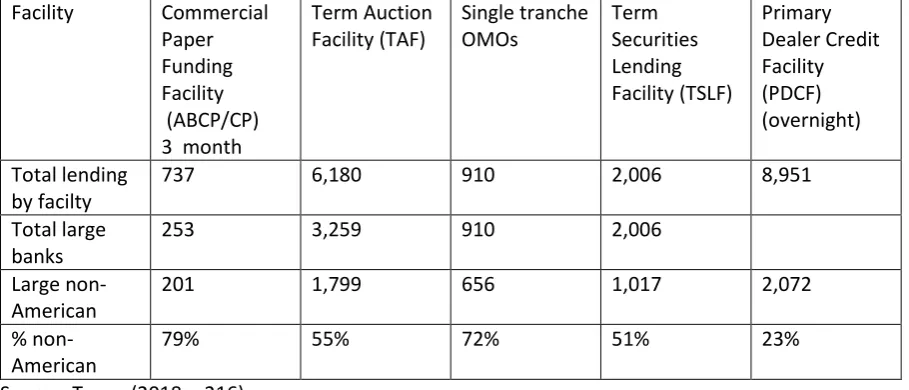
Five facilities provided substantial liquidity to banks, many non-American.
Facility Commercial Paper Funding Facility
(ABCP/CP) 3 month
Term Auction
Facility (TAF) Single trancheOMOs TermSecurities Lending Facility (TSLF)
Primary Dealer Credit Facility (PDCF) (overnight)
Total lending by facilty
737 6,180 910 2,006 8,951
Total large banks
253 3,259 910 2,006
Large
non-American 201 1,799 656 1,017 2,072
%
non-American 79% 55% 72% 51% 23%
Source: Tooze (2018,p.216)
Table B2 Fed Liquidity Facilities and Their Users (in $ billions)
The Fed also provided swap lines to other Central Banks
Counter party central bank Raw swap amount Standardised to 28-day swap
ECB 8,011 2,527
Bank of England 919 311
Swiss National Bank 466 244
12With QE, the Fed also stepped in as ‘market maker’ to buy some of the risk assets the private sector was
[image:21.595.72.527.368.563.2]Bank of Japan 387 727
Other Central Banks … …
Total 10,057 4,450
[image:22.595.76.526.72.116.2]Source (Tooze (2018, p.214)
Table B3 Fed as Global LOLR: Central Bank Liquidity Swap Lines, Dec 2007to August2010 (in $ b.)
Treasury support to US BanksAlongside losses and write-downs totalling $344b incurred in 2007/8, Table B4 provides details of the principal capital injections made by the US Treasury using TARP funds, running to a total of almost $100b for the banks in the table.
Table B4 Big Five Investment banks and survivors of the Big Eight: losses, capital injections, fines
The ‘Big Five’ US
Investment Banks (as of early 2008) Assets, Leverage, and equity end 2007 Fate after crisis ‘Big Eight’ Banks (Current Survivors)
[image:22.595.72.538.366.762.2]Credit losses and write downs 2007-8 Capital injections October 2008 Subsequent fines for Mis-selling of MBS Goldman Sachs $1,120b (26; $43b)* Became a Bank H Co
in Sep 2008
Goldman Sachs
$10b ( 0.7 )** $10b $5b
Morgan Stanley
$1,045b
(33; $32b)
Became a Bank H Co in Sep 2008
Morgan Stanley
$19b (2.1 ) $10b $3b
Merrill Lynch $1,020
(32; $32b)
T/O by Bank of America, Sep, 2008
Bank of America
ML: $73b (7.5)
BoA: $57b (1.8)
$25b $17b
(+$37b set aside)
Lehman Bros $691b
(31; $22b)
Liquidation, Sep 2008
_ $30b (5.0 ) _ _
Bear Sterns $396b
(33; $12b)
T/O by J P Morgan, Mar 2008
J P Morgan $41b (2.8 ) $25b $13b
Totals $4,272b
IBs only
$344b $95b $45b
Notes: *Figures in brackets are leverage, Assets / Equity, followed by Equity. ** Figure in brackets shows ratio of losses and write downs to 2006 pre-tax earnings. Sources: Losses: Milne (2009, p.249); Injections: Sorkin (2009, p.524); Fines: (DoJ web reports)
Annex C Legal penalties imposed on US Investment banks and CRAs
Fines for mis-selling of MBS
The final column of Table B4 indicates the ‘fines’ on the Investment Banks themselves - settlements agreed to with Federal and/or State prosecutors for having misled other investors as to the quality of the MBS they sold. The sums paid by investment banks and the big commercial banks such as Bank of
America, J P Morgan and Citigroup amount to $45b (of which $8b was levied on the two surviving investment banks, and $20b on the big banks that had taken over Bear Sterns and Merill Lynch). The largest fines come from the case against Bank of America which, in addition to acquiring Merill Lynch, had earlier taken over Countrywide Financial, the largest lender of subprime mortgages in the US.
Fines on CRAs
The allegation of collusion between Credit Rating Agencies and investment banks has also been the subject of court proceedings. In February, 2015 S&P settled for a fine of $1.5b – and it was reported that ‘S&P executives admitted that they made decisions about testing and rating CDOs based at least partly on the effect they might have on relationships with the banks issuing them’. In January of 2017, Moody’s settled for a sum of $0.9b.