warwick.ac.uk/lib-publications
Manuscript version: Author’s Accepted Manuscript
The version presented in WRAP is the author’s accepted manuscript and may differ from the
published version or Version of Record.
Persistent WRAP URL:
http://wrap.warwick.ac.uk/117544
How to cite:
Please refer to published version for the most recent bibliographic citation information.
If a published version is known of, the repository item page linked to above, will contain
details on accessing it.
Copyright and reuse:
The Warwick Research Archive Portal (WRAP) makes this work by researchers of the
University of Warwick available open access under the following conditions.
Copyright © and all moral rights to the version of the paper presented here belong to the
individual author(s) and/or other copyright owners. To the extent reasonable and
practicable the material made available in WRAP has been checked for eligibility before
being made available.
Copies of full items can be used for personal research or study, educational, or not-for-profit
purposes without prior permission or charge. Provided that the authors, title and full
bibliographic details are credited, a hyperlink and/or URL is given for the original metadata
page and the content is not changed in any way.
Publisher’s statement:
Please refer to the repository item page, publisher’s statement section, for further
information.
Communicating or Computing Over the MAC:
Function-Centric Wireless Networks
Li Chen, Nan Zhao,
Senior Member, IEEE,
Yunfei Chen,
Senior Member, IEEE,
F. Richard Yu,
Fellow, IEEE,
and Guo Wei
Abstract—Distributing data aggregation through multiple ac-cess channel (MAC) has been challenging in large wireless networks. In order to tackle the challenge, computing over the MAC (CP-MAC) scheme has been proposed as a promising communication-computation integrated way for function-centric networks. In this paper, we analyze the performance of the CP-MAC scheme, compared with the traditional communication-computation separated way, i.e., communicating over the MAC (CM-MAC) scheme. Function-centric wireless networks are con-sidered, where the fusion center (FC) does not need the individual data of each node but only the target function. We begin with the ideal uniform-MAC scenarios, where the CP-MAC scheme is always better than the CM-MAC scheme. Then, practical non-uniform MAC scenarios are studied for both homogeneous networks with Rayleigh fading and heterogeneous networks with different path loss. Closed-form expressions of the achievable function rate are provided using the asymptotic theory of ordered statistics. It is found that the CP-MAC scheme is not always superior to the CM-MAC scheme. Simulation results are provided to verify and illustrate our derived results.
Index Terms—Achievable rate, data aggregation, data-centric, function-centric, multiple access channel, ordered statistics, wire-less networks.
I. INTRODUCTION
Future wireless networks are expected to connect an increas-ing number of nodes. For example, the 5G cellular system could provide Internet of Things (IoT) connections for up to 1 trillion devices, with a million connections per square kilometer [1]. In order to tackle this challenge, high-efficient data aggregation technologies are required in wireless multiple access channel (MAC) [2].
To improve the efficiency of data aggregation in wireless networks, most previous works have focused on two aspects.
This research was supported by National Natural Science Foundation of China (Grant No. 61601432), the Fundamental Research Funds for the Central Universities, and the open research fund of National Mobile Communications Research Laboratory, Southeast University (No. 2018D03). (Corresponding author: Nan Zhao)
L. Chen and G. Wei are with CAS Key Laboratory of Wireless-Optical Communications, University of Science and Technology of China. (e-mail:
{chenli87, wei}@ustc.edu.cn).
N. Zhao is with the School of Information and Communication Engineering, Dalian University of Technology, Dalian 116024, China, and also with the National Mobile Communications Research Laboratory, Southeast University, Nanjing 210096, China (e-mail: [email protected]).
Y. Chen is with the School of Engineering, University of Warwick, Coventry CV4 7AL, U.K. (e-mail: [email protected]).
F.R. Yu is with the Department of Systems and Computer Engi-neering, Carleton University, Ottawa, ON, K1S 5B6, Canada (email: [email protected]).
One is to reduce the data traffic through compression [3]–[6]. For example, sampling compression was studied in [3], [4] to reduce the number of sampling operations, where spatial and temporal sparsity properties were utilized to enhance the spectrum efficiency and energy efficiency of the networks. By converting the input data stream into another one with fewer bits, data compression was discussed in [5], [6] to obtain a more compact representation of the data. The other aspect is to improve the communication capacity through effi-cient resource allocation [7]–[9]. For example, non-orthogonal multiple access (NOMA) technique was explored in [7] to improve the throughput of the networks. Throughput-optimal problem of nodes scheduling for NOMA was tackled in [8] for a multi-carrier network. Considering the fairness between different nodes, the work in [9] investigated a fair opportunistic scheduler based on probabilistic scheduling.
The above mentioned works considered data-centric net-works that require the individual data of each node. On the other hand, future networks become function-centric due to the development of various applications. The fusion center (FC) of these networks does not need the individual data of each node but only the target functions. For examples, in alarm detection of IoT networks [10], statistical data analysis for multi-sensor networks [11], and machine learning based on distributed data [12], only certain functions of the data are needed. The target function can be computed by using the individual data from each node at the FC. This is the traditional communication-computation separated way. In order to avoid inter-node interference, multi-access scheme will be used to incur excessive latency, especially for large networks. Thus, its performance is limited by the communicating over the MAC (CM-MAC) scheme.
A more intelligent scheme is computating over the MAC (CP-MAC), which utilizes the superposition property of wire-less channel to compute the summation in the target function. It harnesses the inter-node interference rather than avoiding it. This leads to a communication-computation integrated way, where the target function with a summation structure can be directly received by the FC with all nodes’ concurrently transmission. Some common functions such as arithmetic mean and geometric mean can be efficiently computed over the MAC.
was merely a scaled version of its noisy observation. In order to combat synchronization errors, a robust analog function computation scheme was proposed by adopting random syn-chronization sequences in [14]. Considering that each node only has imperfect CSI, the worst-case MSE for analog CP-MAC was formulated and solved in [15]. Some experimental platforms were built to verify the idea of analog CP-MAC in [16], [17]. In order to obtain reliable functions, channel coding has been adopted to combat additive white gaussian noise (AWGN) for CP-MAC. The problem of reliably reconstructing a function of sources was first discussed in the seminal work [18], where linear source coding was adopted for the function computation over Gaussian MAC. Using nested lattice coding to compute the noisy modulo sum was investigated in [19], where each relay decoded linear combination of the sources in compute-and-forward relay. In [20], M. Goldenbaum et al. proposed a general form of functions, i.e., Nomographic functions, which could be computed over the MAC efficiently due to their summation structure. Considering the channel fading, transceiver design for CP-MAC has been further dis-cussed. In [21], a uniform-forcing transceiver was designed to compensate the non-uniform fading of different nodes to a uniform level. Furthermore, transceiver designs for multiple functions computed over the MAC were discussed in [22], [23] utilizing antenna arrays at the FC and the nodes.
Both the CM-MAC scheme and the CP-MAC scheme have their own virtues and faults. For the CM-MAC scheme, multiple nodes can be scheduled in an opportunistic way to achieve multi-node diversity, but orthogonal radio resources are required to avoid inter-node interference. For the CP-MAC scheme, the inter-node interference is harnessed for computa-tion, but the non-uniform MAC should be compensated to the uniform level, which is determined by the node with the worst channel gain. It incurs a vanishing computation rate when the number of nodes goes to infinity [24], [25]. Although it is important, the performance difference between the CM-MAC scheme and the CP-MAC scheme has never been studied for function-centric wireless networks.
Motivated by the above observations, in this paper we derive and compare the achievable function rates for both the CM-MAC scheme and the CP-MAC scheme in function-centric networks. The ideal scenarios with the uniform MAC are first discussed with/without additive white gaussian noise (AWGN). Furthermore, non-uniform MAC scenarios are inves-tigated, where both homogeneous networks and heterogeneous networks are studied. A summary of main contributions are as follows.
• Function-centric wireless network: A function-centric
wireless network is formulated where the FC does not need the individual reading of each node but the target function thereof. The CM-MAC scheme and the CP-MAC scheme are used to recover the target function at the FC.
• Exact achievable function rate: The exact achievable function rates are derived for both the CM-MAC scheme and the CP-MAC scheme. We begin with the discussion of the ideal uniform MAC, and then the non-uniform MAC for both homogeneous networks and heterogeneous networks are discussed.
Table I
SOME COMMONNOMOGRAPHIC FUNCTIONS
Name ϕk ψ f
Arithmetic Mean ϕk=sk ψ=K1 f=K1 K
P
k=1
sk
Weighted Sum ϕk=ωksk ψ= 1 f= K
P
k=1
ωksk
Geometric Mean ϕk= log(sk) ψ= exp(·) f= K
Q
k=1
sk
!K1
Polynomial ϕk=ωkskβk ψ= 1 f= K
P
k=1
ωkskβk
Euclidean Norm ϕk=sk2 ψ= (·)
1
2 f=
s
K
P
k=1
sk2
• Asymptotic closed-form expression: The exact achiev-able function rate is complicated without closed-form expression, which lacks insights. Adopting the asymptotic theory of ordered statistics, the asymptotic closed-form expressions for achievable function rate are given to provide more insights.
The remainder of the paper is organized as follows. Section II presents the system model of function-centric networks. Section III derives and compares the achievable function rate for uniform MAC scenarios. Practical non-uniform MAC scenarios are studied in Section IV for both homogeneous networks and heterogeneous networks. Simulation results are provided in Section VI, followed by concluding remarks in Section VII.
II. FUNCTION-CENTRICWIRELESSNETWORKS
We consider a network with an FC and K nodes indexed by k∈ {1,2,· · · , K}. The reading of the node k is denoted as sk.
The network is assumed to be function-centric, i.e., the FC does not need the individual reading of each node {sk} but the target functionf(s1, s2,· · · , sK). Furthermore, the target function of the FC is assumed to be nomografic which is defined as follows.
Definition 1. The Nomografic function is given by [20]
f =ψ
"K X
k=1
ϕk(sk)
#
, (1)
whereψ(·)is the post-processing function of FC, and ϕk(·) is the pre-processing function of node k. Some common Nomografic functions are shown in TableIwith differentψ(·) andϕk(·).
At nodek, the data processing flow can be given as
sk →ϕk(sk)→wk →xk, (2)
where the readingsk is first processed by the pre-processing function ϕk(·), the pre-processed reading ϕk(sk) is then quantized into a length N binary vector wk ∈ BN, and the quantized vector wk is encoded into a length M codeword
Ort hogonal t ransmis sion FC
..
.
(a) Com municati on over-the-MAC Node
(b) Computat ion over-the-MAC Concurrent trans mission
FC
..
.
Node
Target functi on
Target functi on 1
w
2
w
K
w
{
w
k,
"
k
}
1 K
k k=
å
w
1
w
1
w
2w
[image:4.612.56.280.58.411.2]K
w
Figure 1. the CM-MAC scheme versus the CP-MAC scheme
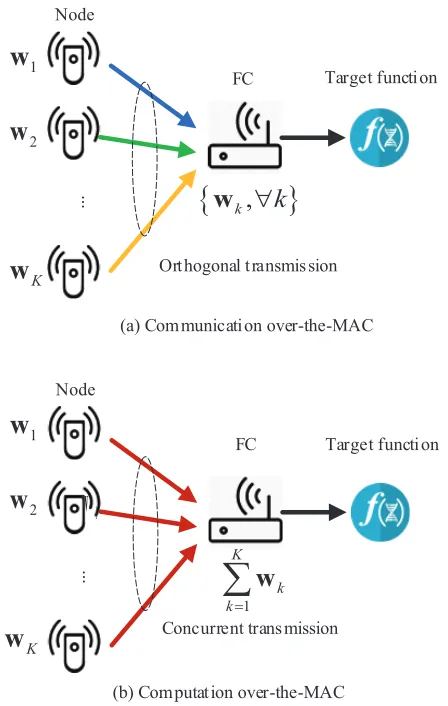
At the FC, there are two multiple access schemes to recover the target function, which are illustrated as follows.
1. CM-MAC: As illustrated in Fig. 1(a), the CM-MAC scheme is a communicating and computing separated scheme, where the FC first recovers the individual messages {wk} of all nodes through orthorgonal MAC, and then computes the target functionf thereof.
The corresponding data processing flow at the FC is
{yk} → {wk} → K
X
k=1
wk→
K
X
k=1
ϕk(sk)→f, (3)
where{yk}is the received signal with each node’s orthogonal transmission, and {wk} is the decoded quantized vector of each node.
When all nodes’ vectors are decoded, the FC computes
PK
k=1wk, andP K
k=1ϕk(sk)is then obtained by quantization recovery. Finally, the target function f is recovered after the post-processing function ψ(·). In order to avoid inter-node interference, orthogonal multiple access, e.g., TDMA, should be adopted, which incurs a high latency especially for a large number of nodes.
2. CP-MAC: As illustrated in Fig. 1(b), the CP-MAC scheme is a communicating and computing integrated scheme,
where the FC utilizes the superposition property of wireless channel to compute the summation part of the target function with all nodes’ concurrent transmission.
The corresponding data processing flow of the FC is
y→
K
X
k=1
wk→
K
X
k=1
ϕk(sk)→f, (4)
where y is the received signal when all nodes transmit simultaneously. The sum of the quantized vector PK
k=1wk is decoded fromydirectly without recovering the message of each nodewk.
Then, PK
k=1ϕk(sk) is obtained by quantization recovery,
and the target functionf is recovered after the post-processing functionψ(·)finally. Although CP-MAC can avoid individual message collection, the challenge is the computation error caused by the non-uniform fading of MAC and the AWGN.
In this work, we adopt the achievable function rate as the performance metric of function-centric networks, which can be defined as follows.
Definition 2. (Achievable function rate) Let f be the target function, and fˆ be the corresponding recovered function at the FC. The corresponding function error probability is ε = Prfˆ6=f. Without considering the quantization error, the function rate R = 1/M (functions per channel use) is said to be achievable, if an arbitrary ε > 0 can be satisfied with sufficiently large channel uses M.
In the following, we will derive and compare the achiev-able function rate of the CM-MAC scheme and the CP-MAC scheme for different scenarios inculding uniform CP-MAC without AWGN, uniform MAC with AWGN, non-uniform MAC in homogeneous networks and non-uniform MAC in heterogeneous networks as shown in Fig. 2.
III. ACHIEVABLEFUNCTIONRATE FORUNIFORMMAC
In this section, we discuss the uniform MAC scenario. First, the MAC without AWGN will be discussed followed by the MAC with AWGN.
A. Uniform MAC without AWGN
As shown in Fig. 2(a), the uniform MAC without AWGN is the most ideal scenario, where a reliable communication can be realized through each node’s orthogonal transmission or a reliable summation can be realized through concurrent transmission from all nodes.
For the CM-MAC scheme, each node transmits messages in turn, and the received signal at the FC is
yk =
√
µwk, (5)
whereµ is the uniform channel power gain.K channel uses are required to avoid inter-node interference and aggregateK nodes’ messages. The corresponding achievable function rate isRCM= 1/K (functions per channel use).
m
m
m
m
m
m z
1 m
2 m
K m
z
噯 噯
噯
(a) uniform MAC without AWGN (b) uniform MAC with AWGN
(c) Nonuniform MAC Ho-network (d) Nonuniform MAC He-network FC
[image:5.612.55.283.54.271.2]Node
Figure 2. The illustration of different scenarios
y=õ
K
X
k=1
wk, (6)
where only one channel use is required to computePK
k=1wk, and the target function can be further recovered using the post-processing function at the FC. The corresponding achievable function rate isRCP = 1 (functions per channel use).
The achievable function rate gain of the CP-MAC scheme over the CM-MAC scheme can be expressed as
G1=
RCP RCM
=K, (7)
which linearly increases with the number of nodes.
B. Uniform MAC with AWGN
As shown in Fig. 2(b), when AWGN is also considered, channel coding should be adopted to combat the AWGN and achieve reliable communicating or computing.
For the CM-MAC scheme, the received signal at the FC with orthogonal transmission is
yk =
p
P0µxk+z, (8)
where z is the AWGN vector with each element distributed as N 0, σ2
z
. The total number of bits of K nodes is N K. Consider M channel uses, and the message rate in each channel use should not exceed the channel capacity, which can be expressed as
N K M ≤log2
1 +P0µ σ2
z
, (9)
whereP0 is the transmit power constraint of the node, andµ
is the uniform MAC power gain. Thus, the achievable function rate of the CM-MAC scheme for uniform MAC with AWGN is
RCM = 1 N Klog
1 + P0µ σ2
z
. (10)
For the CP-MAC scheme, nested lattice coding is adopted to combat the AWGN. By encoding the message vector wk into a length M nested lattice coding vector xk ∈ LM, the received signal with all nodes concurrently transmitting is
y=pP0µ
K
X
k=1
xk+z. (11)
The most attractive property of nested lattice coding is its linear property [26] as
XK
k=1xk mod Λc∈ L
M
, (12)
where LM is a M-dimensions nested lattice codebook, and a summation of nested lattice codewords xk ∈ LM modulo the coarse latticeΛc only takes values on the codebookLM. Thus, the nested lattice coding can be adopted to protect a modulo-qsum of the length-N vectors, i.e.,v=LK
k=1wk.
Lemma 1. (The achievable rate to decode modulo-q sum) Given the received signal of the uniform MAC with AWGN in (11), the modulo-q sum is decoded as ˆv = D(y). The corresponding decoding error is ε= Pr (ˆv6=v). With suffi-ciently large number of channel useM, the following rate is achievable for an arbitraryε >0 with nested lattice coding
Rmod= 1
M ≤log2
+P0µ
σ2
z
, (13)
wherelog2+(·) = max{log2(·),0}
Proof. The proof follows from Theorem 3 in [19].
If qis large enough, modulo-q sum will not wrap around, which is equivalent to sum. That is LK
k=1wk = PK
k=1wk.
Thus, we can achieve reliable sum with sufficiently large q, and the achievable function rate of CP-MAC can be provided as follows.
Proposition 1. (The achievable function rate of CP-MAC) The achievable function rate of the CP-MAC scheme for uniform MAC with AWGN is
RCP = 1 N+ log2K
log2+
P 0µ
σ2
z
. (14)
Proof. PK
k=1wk is a sum ofKlength-N binary vectors, and its maximum value isK2N. In order to avoid wrapping around for modulo-qsum,qshould satisfiesq≥K2N. Assuming the number of channel uses is M, the message rate of modulo-q sum in each channel use satisfies
log2q
M ≥
log2(K2N)
M . (15)
0 5 10 15 20 25 30 35 40 45 50
The number of nodes
0 5 10 15 20 25 30 35 40 45 50
The achievable rate gain
without AWGN with AWGN
[image:6.612.65.285.65.247.2]N=20,10,5
Figure 3. The achievable function rate gain versus the number of nodes and different length of message vector.
log2+
P 0µ
σ2
z
≥ log2q
M ≥
log2(K2N)
M . (16)
The achievable function rate of CP-MAC is RCP = 1/M, which completes the proof.
According to (10) and (14), the achievable function rate gain of the CP-MAC scheme over the CM-MAC scheme can be approximated as
G2=
RCP RCM
≈ N K
N+ log2K, (17)
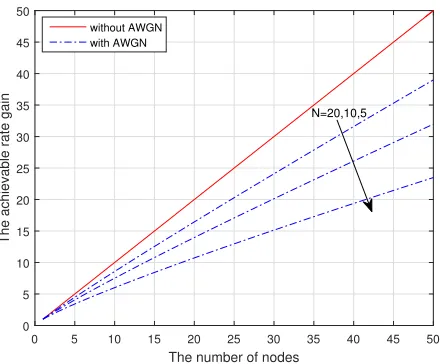
which is compared to the achievable function rate gain for uniform MAC without AWGN G1 in Fig. 3 for different
numbers of nodes K and different lengths of message vector N.
Remark 1. WhenK >1, one hasG1>1andG2>1. In this
case, the CP-MAC scheme is always superior to the CM-MAC scheme. Both G1 andG2 increase with the number of nodes
K. The increasing rate of G2 is smaller than that ofG1 due
to channel coding. The increasing rate of G2 increases with
the length of the message vectorN. This means the increase of the length of the message vector will increase the benefit of using the CP-MAC scheme.
IV. ACHIEVABLEFUNCTIONRATE FORNON-UNIFORM MAC
In this section, we discuss the non-uniform MAC scenarios. We begin with the homogeneous networks, where all nodes experience i.i.d. fading. Then heterogeneous networks will be studied, where the nodes have different path loss.
A. Homogeneous Networks
We first focus on homogeneous networks where all nodes experience i.i.d. fading. The channel fading hk between the node k and the FC is assumed to be Rayleigh fading. The
corresponding channel power gainµk =|hk|
2
is exponentially distributed with PDF and CDF given by
fµk(x) =
1 ¯ µexp −x ¯ µ
, x≥0, (18)
Fµk(x) = 1−exp
−x
¯ µ
, x≥0, (19)
whereµ¯ is the average channel power gain.
For the CM-MAC scheme, the received signal at the FC with orthogonal transmission is
yk =
p
P0µkxk+z, (20)
and the achievable data transmission rate of the node kis
Ck(µk) = log2
1 + P0µk σ2
z
. (21)
In order to obtain multi-node diversity, we select the node m as m = arg maxkµk in each channel use. The channel power gain between the selected nodemand the FC isµm= maxkµk, and the channel capacity of the selected nodem is
Cm(µm) = max
k Ck(µk) = log2
1 + P0µm σ2
z
. (22)
The messages of K nodes are composed of N K bits. AssumingM channel uses, the average message rate in each channel use should not exceed the ergodic channel capacity as
N K M ≤E
log2
1 + P0µm σ2
z
. (23)
The PDF ofµmcan be derived as
fµm(x) =
K ¯ µ exp −x ¯
µ 1−exp
−x
¯ µ
K−1
. (24)
Thus, the achievable function rate for the CM-MAC scheme in homogeneous networks can be denoted as
RCM = 1 N KE
log2
1 + P0µm σ2 z = 1 N K Z ∞ 0 log2
1 + P0x σ2
z
fµm(x)dx
(a)
= 1 ¯ µNln 2
K−1 X
i=0
CKi −1(−1)i
Z ∞ 0
ln
1 +P0x σ2
z
exp
−(i+ 1)x
¯ µ
dx
(b)
= 1 ¯ µNln 2
K−1 X
i=0
CKi −1(−1)i
µ¯
i+ 1
exp
(i+ 1)σ2
z ¯ µP0
E1
(i+ 1)σ2
z ¯ µP0 . (25)
where fµm(x) is given in (24), the procedure (a) is due to binomial expansion, the integral in procedure (b) is calculated according to [27, 4.337.2], andE1(·)is the exponential integral
function defined asE1(x) = R∞
x (e
The exact achievable function rate for the CM-MAC scheme in homogeneous networks is complicated without closed-form expression. Therefore, we will provide the following results through asymptotic analysis.
Lemma 2. (The domain of attraction for maxima) Let Xmax= maxkXk whereXk, k∈ {1,· · ·, K}is a set of i.i.d. random variables with CDFFX(x). If the following condition holds
lim K→∞K
1−FXX1−1/K+x X1−1/(Ke)−X1−1/K = exp (−x),
(26) FX(x)lies in the domain of attraction of Gumbel distribution for maximma. That is there exists constants aK andbK such that
lim K→∞
Xmax−aK
bK d
→Gumbel distribution, (27)
where →d means converging in distribution. And aK andbK can be given by
aK =FX−1
1− 1
K
, (28)
and
bK =FX−1
1− 1
Ke
−FX−1
1− 1
K
, (29)
respectively.
Proof. The proof follows from Theorem 3.3 in [28]
According to Lemma 1, an approximated closed-form ex-pression ofRCM can be provided for a large number of nodes K.
Proposition 2. (Asymptotic achievable function rate for CM-MAC) The CDF of Ck lies in the domain of attraction of the Gumbel distribution for maxima. That is
Cm(µm)−log2
1 +P0µ¯σln2 K
z
log2 P
0µ¯lnK σ2
z +
P0µ¯ σ2
z + 1
d
→Gumbel distribution.
(30) Thus, the achievable function rate of the CM-MAC scheme in homogeneous networks can be approximated as
RCM = 1 N Klog2
1 + P0µ¯lnK σ2
z
, (31)
for a large number of nodesK.
Proof. Refer to Appendix A.
For the CP-MAC scheme, a uniform-forcing transmitterbk should be adopted to compensate the non-uniform MAC into a uniform level. Also, the message vectorwk should be encoded into a length M nested lattice coding vector xk ∈ LM to combat the AWGN. Then, the received signal at the FC with all nodes’ concurrent transmission is
y=
K
X
k=1 p
P0µkbkxk+z=
p
P0µ
K
X
k=1
xk+z (32)
where bk ∈ C is the uniform-forcing transmitter designed as bk =
√
µ√
µk. Considering the transmit power constant
|bk| ≤ 1,∀k, the uniform power level µ depends on the minimum channel power gain, i.e.,
µ= min
k µk, (33)
whose PDF can be calculated as
fµ(x) = K ¯ µ
exp
−x
¯ µ
K
. (34)
According to the achievable function rate of the CP-MAC scheme for uniform MAC with AWGN in Proposition 1, the achievable function rate of the CP-MAC scheme in homoge-neous networks can be calculated as
RCP = E
1
N+ log2Klog2
+P0µ
σ2
z
= 1 N+ log2K
Z ∞
σ2
z/P0
log2
P 0x
σ2
z
K
¯ µ
exp
−x
¯ µ
K
dx
(a)
= 1
ln 2 (N+ log2K)E1
σ2
zK P0µ¯
(35) where the integral in procedure (a) is calculated according to [27, 4.331.2].
According to (31) and (35), the achievable function rate gain of the CP-MAC scheme over the CM-MAC scheme can be approximated as
G3≈
N K N+ log2K
E1 Kσ2
z
P0µ¯
ln1 + P0µ¯σln2 K
z
. (36)
When x is large, E1(x) ≈ exp (−x)/x. Thus, for a large
number of nodes K,G3 can be approximated as
G3≈G2
γ
ln (1 +γlnK)exp
−K
γ
, (37)
where G2 is the achievable function rate gain for uniform
MAC with AWGN in (17), and γ = P0µ¯
σ2
z is the average received SNR at the FC.
Remark 2. Compared with the achievable function rate gain for uniform MAC with AWGN G2, the non-uniform MAC
will incur an exponential decrease with the increase of the number of nodes K. This means that the CP-MAC scheme is not always superior to the CM-MAC scheme, especially when the number of nodesK is large.G3 increases with the
B. Heterogeneous Networks
We further extend the results to heterogeneous networks where the nodes are assumed to be randomly distributed in a circular network, and the distance between nodekand the FC is rk, whose PDF is given by
frk(x) =2x r2
c
,0≤x≤rc, (38)
wherercis the radius of the network. The channel power gain between the nodek and the FC can be modeled as
βk= Φµk rn
k
, (39)
whereΦ is a constant that captures the effects of carrier fre-quency, antenna gain, antenna height and other power factors, ndenotes the path loss exponent, andµkis the Rayleigh fading component. Thus, the PDF and CDF of βk can be calculated as
fβk(xk) = 2Φ 2
n
nr2
c
x−n2−1γ 2
n+ 1, rn
cx Φ
, (40)
Fβk(βk) = 1−
2Φn2
nr2
c βk−
2
nγ 2
n, rn
cβk Φ
. (41)
.
For the CM-MAC scheme, we adopt normalized channel power gain scheduling considering both multi-node diversity and multi-node fairness. In each channel use, we select the node as
m= arg max
k µk. (42)
The fast fading component of the channel power gain of the selected node isµm= arg maxk µk. Thus, the PDF ofµmcan be also calculated according to the distribution of the maxima of i.i.d. variables as (24). The PDF ofrmis the same as that of the node k in (38). Given the fast fading component µm and the distance rm, the channel capacity of the nodemcan be expressed as
Cm(µm, rm) = log2
1 +P0Φµm σ2
zrnm
. (43)
The messages of K nodes are composed of N K bits, and the message rate in each channel use should not exceed the ergodic channel capacity. Thus, the achievable function rate for CM-MAC in heterogeneous networks can be obtained as
RCM = 1 N KE
log2
1 + P0Φµm σ2
zrmn
= 1 N K
Z rc
0 Z ∞
0
log2
1+P0Φx σ2
zyn
fµm(x)frm(y)dxdy,
(44) wherefµm(x)andfrm(y)are given in (24) and (38),
respec-tively.
Then, we will provide the following asymptotic analysis. For a large number of nodes K, the achievable function rate
of the CM-MAC scheme in heterogeneous networks can be approximated as
RCM(≈a) 1
N K
Z rc
0
log2
1 + P0Φ lnK σ2
zyn
2y
r2
c dy
= 1 N Klog2
1 +γP0Φ lnK σ2
zyn
y2 r2 c rc 0 − 1
N Kln 2
Z rc
0 2y r2 c dln
1 + P0Φ lnK σ2
zyn
= 1 N Klog2
1 +P0Φ lnK σ2
zrcn
+ 1 N Kln 2
Z rc
0
2 r2
c
P0nΦ lnK
σ2
zrnc +P0Φ lnK
dy
(b) ≈ 1
N Klog2
1 +P0Φ lnK σ2
zrcn
+ 2n ln 2N Kr2
c ,
(45)
where the procedure (a) is due to the approximation in Proposition 1, and the procedure (b) is obtained by using P0Φ lnKσz2y
n for a large number of nodesK.
For the CP-MAC scheme, the uniform-forcing transmitterbk in (32) should also be adopted to compensate the MAC to the uniform level, which is designed asbk =pβ/βk. Considering the transmit power constant|bk| ≤1, the uniform power level β depends on the minimum channel power gain as
β = min
k {βk}. (46)
Then, according to the distribution of the minima of i.i.d. variables, the PDF ofβ can be calculated as
fβ(x) =Kfβk(x) [1−Fβk(x)]
K−1
, (47)
wherefβk(x)andFβk(x)are given in (40) and (41), respec-tively.
Based on the achievable function rate of the CP-MAC scheme for uniform MAC with AWGN in Proposition 1, the achievable function rate of the CP-MAC scheme in heteroge-neous networks can be calculated as
RCP = E
1
N+ log2Klog2
+P0β
σ2
z
= 1 N+ log2K
Z ∞
σ2
z/P0 log2 P 0x σ2 z
fβ(x)dx, (48)
wherefµ(x) is given in (47). It is also complicated without closed-form expression. We provide the asymptotic analysis as follows.
Lemma 3. (The domain of attraction for minima) LetXmin=
minkXk whereXk, k ∈ {1,· · ·, K} is a set of i.i.d. random variables with CDFFX(x). If, and only if,
Γ (Fβk) = inf{x:Fβk(x)>0} (49)
and the function
FX∗(x) =FX
Γ− 1
x
Table II
ACHIEVABLE FUNCTION RATE AND RATE GAIN
Scenarios Rate of CM-MAC Rate of CP-MAC Rate gain Uniform MAC without AWGN RCM = 1 RCP= 1/K G1=K Uniform MAC with AWGN RCM in (10) RCP in (14) G2in (17) Homogeneous non-uniform MAC RCM in (31) RCP in (35) G3in (36) Heterogeneous non-uniform MAC RCM in (45) RCP in (56) G4in (57)
satisfies
lim t→−∞
FX∗(tx) FX∗(t) =x
−γ, γ >0. (51) FX(x)lies in the domain of attraction of Weibull distribution for minima. That is there exists constants cK and dK such that
lim K→∞
Xmax−cK
dK d
→Weibull distribution, (52)
where→d means converges in distribution. ThecKanddKcan be given by
cK= Γ, (53)
and
dK =FX−1
1
K
−Γ, (54)
respectively.
Proof. The proof follows from Theorem 3.4 in [28].
Proposition 3. (Asymptotic achievable function rate for CM-MAC) The CDF of β lies in the domain of attraction of Weibull distribution for minima with the shape parameter 1 as follows
2rn cK (n+ 2) Φβ
d
→Weibull distribution. (55)
The ergodic achievable function rate of the CP-MAC scheme in heterogeneous networks can be expressed as
RCP =
1
ln 2 [N+ log2(K)]
E1
2
n+ 2 rn
cKσ2z ΦP0
(56)
Proof. Refer to Appendix B.
According to (45) and (56), the achievable function rate gain of the CP-MAC scheme over the CM-MAC scheme can be approximated as
G4≈
N K ln 2 [N+ log2(K)]
E1 h 2Krn
cσ
2
z (n+2)P0Φ
i
log21 +P0Φ lnK rn
cσ2z
, (57)
When x is large, E1(x) ≈ exp (−x)/x. Thus, for a large
number of nodes K,G4 can be approximated as
G4≈G2
(n+ 2) 2
γ0
ln (1 +γ0lnK)exp
− 2K
(n+ 2)γ0
, (58)
Table III SIMULATIONPARAMETERS
Parameter Value
The number of nodes K= 100
The length of the message vector N= 50
The average channel power gain µ¯= 0dB The transmit power to noise ratio P0σz2= 30dB
The scale of the network rc= 3m
The path loss constant Φ = 0.023568
The path loss exponent n= 3
where G2 is the achievable function rate gain for uniform
MAC with AWGN in (17), andγ0 =P0Φ
rncσz2is the average received SNR of the node at the edge of the network.
Remark 3. Similar to homogeneous networks, the non-uniform MAC will incur an exponential decrease of the achievable function rate gain with the increase of the number of nodes K. This also verifies that the CP-MAC scheme is not always superior to the CM-MAC scheme, especially when the number of nodes K is large. And G4 increases with the
average received SNR for the node at the edge of the network γ0. This means the increase of the scale of the networkrcwill decrease the benefit of using the CP-MAC scheme.
In conclusion, the achievable function rate and the rate gain of the CM-MAC scheme and the CP-MAC scheme for differ-ent scenarios are summarized in Table II. For uniform MAC scenarios, the CP-MAC is always superior to the CM-MAC scheme. The achievable rate gain of the CP-MAC scheme over the CM-MAC scheme of the uniform MAC with AWGN is smaller than that of the uniform MAC without AWGN. For non-uniform scenarios, the CP-MAC is not always better than the CM-MAC scheme. The achievable rate gain of the CP-MAC scheme over the CM-MAC scheme exponentially decreases with the number of nodes.
V. NUMERICALRESULTSANDDISCUSSION
In this section, we provide some simulation results to illustrate the performance of the CM-MAC scheme and the CP-MAC scheme. Both homogeneous networks and heteroge-neous networks are discussed. The parameters are set as Table
IIIunless specified otherwise.
A. Homogeneous Networks
200 210 220 230 240 250 260 270 280 290 300 The number of the nodesK
0 0.2 0.4 0.6 0.8 1 1.2 1.4 1.6 1.8 2
Achievable function rate
×10-3
CM-MAC Simulated CP-MAC N=30
N=50
N-100 cross point
(a) Achievable function rate
210 215 220 225 230 235 240 245 250 255 260
The number of the nodesK
0.7 0.8 0.9 1 1.1 1.2 1.3 1.4
Achievable function rate gain
N=30 N=50 N=100 Simulated
[image:10.612.331.553.70.250.2](b) Achievable function rate gain
Figure 4. The achievable function rate and the rate gain versus the number of nodes
analysis used in the derivation. The achievable function rate decreases with the number of nodes for both the CP-MAC scheme and the CM-MAC scheme. The decreasing rate of the CP-MAC scheme is larger than that of the CM-MAC scheme. There is a threshold on the achievable function rate between the CP-MAC scheme and the CM-MAC scheme. When the number of nodes is larger than the threshold , the CM-MAC scheme is better than the MAC scheme. Otherwise, the CP-MAC scheme is better. The achievable function rate decreases with the length of the message vectorNfor both the CP-MAC scheme and the CM-MAC scheme. Also, it can be seen the threshold of the number of nodes increases with N, which means that adopting the CP-MAC scheme is more beneficial when the length of the message vectors is large.
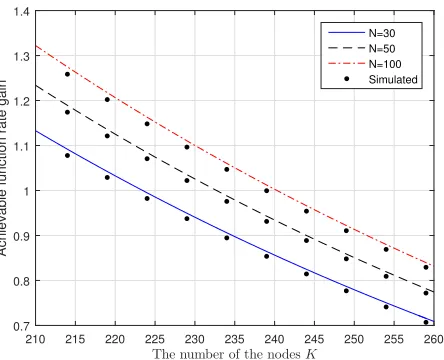
The achievable function rate gain versus the number of nodes K is shown in Fig. 4(b). The achievable function rate gain of the CP-MAC scheme over the CM-MAC scheme deceases with the number of nodes. When the number of nodes increases and the rate gain is smaller than 1, the CM-MAC scheme is superior to the CP-CM-MAC scheme. While, the achievable function rate gain increases with the length of the message vector N, which also verifies that adopting the CP-MAC scheme is more beneficial when the length of the message vectors is large.
The achievable function rate versus the transmit power to noise ratio γ is illustrated in Fig. 5(a). When the transmit power to noise ratio increases, the achievable function rate linearly increases for the CM-MAC scheme and exponentially increases for the CP-MAC scheme. There is also a threshold on the achievable function rate between the CP-MAC scheme and the CM-MAC scheme. When transmit power to noise ratio is larger than the threshold, the CP-MAC scheme is better than the CM-MAC scheme. Otherwise, the CM-MAC scheme is better. The achievable function rate decreases with the number of nodesKfor both the CP-MAC scheme and the CM-MAC scheme. Also, it can be seen the threshold of the transmit power to noise ratio increases withK, which means
that adopting the CM-MAC scheme is more beneficial when the number of nodes is large.
The achievable function rate gain versus the transmit power to noise ratio γ is illustrated in Fig. 5(b). The achievable function rate gain of the CP-MAC scheme over the CM-MAC scheme increases with the transmit power to noise ratio. When the transmit power to noise ratio increases and the rate gain is larger than 1, the CP-MAC scheme is superior to the CM-MAC scheme. While, the achievable function rate gain decreases with the number of nodesK, which also verifies that adopting the CM-MAC scheme is more beneficial when the number of nodes is large.
B. Heterogeneous Networks
In Fig.6(a), the achievable function rate versus the scale of the network rc is illustrated. When the scale of the network increases, the achievable function rate linearly decreases for the CM-MAC scheme and exponentially decreases for the CP-MAC scheme. There is also a threshold on the achievable function rate between the CP-MAC scheme and the CM-MAC scheme. When the scale of the network is larger than the threshold, the CM-MAC scheme is better than the CP-MAC scheme. Otherwise, the CP-MAC scheme is better. We also consider different path loss exponent of the networkn, whose value is normally in the range of 2 to 4 1. The achievable function rate decreases with the path loss exponentnfor both the CP-MAC scheme and the CM-MAC scheme. Also, it can be seen the threshold of the scale of the network decreases with the path loss exponent n, which means that adopting the CP-MAC scheme is more beneficial when the path loss exponent is small.
In Fig. 6(b), the achievable function rate gain versus the scale of the network rc is illustrated. It decreases with the scale of the network. When the scale of the network increases and the rate gain is smaller than 1, the CM-MAC scheme
15 15.5 16 16.5 17 17.5 18 18.5 19 19.5 20 The transmit SNRγ(dB)
0 1 2 3 4 5 6 7 8 9
Achievable function rate
×10-3
CM-MAC Simulated CP-MAC
K=100
K=150 cross point
(a) Achievable function rate
15 15.5 16 16.5 17 17.5 18 18.5 19 19.5 20
The transmit SNRγ(dB)
0 0.5 1 1.5 2 2.5 3
Achievable function rate gain
K=100 K=150 simulated
[image:11.612.78.551.71.256.2](b) Achievable function rate gain
Figure 5. The achievable function rate and rate gain versus the transmit power to noise ratio
2 2.5 3 3.5
The scale of the networkrc(m)
0 0.005 0.01 0.015 0.02 0.025 0.03
Achievable function rate
CM-MAC Simulated CP-MAC
CP-MAC with n=2,3,4
CM-MAC with n=2,3,4
(a) Achievable function rate
2 2.5 3 3.5
The scale of the networkrc(m)
0 0.5 1 1.5 2 2.5 3 3.5 4 4.5
Achievable function rate gain
n=2 n=3 n=4 Simulated
[image:11.612.60.550.307.501.2](b) Achievable function rate gain
Figure 6. The achievable function rate and the rate gain versus the scale of the network
is superior to the CP-MAC scheme. While, the achievable function rate gain decreases with the path loss exponent n, which also verifies that adopting the CP-MAC scheme is more beneficial when the path loss exponent is small.
VI. CONCLUSION
In this work, we have studied the achieve function rate of function-centric wireless networks for two schemes. One is the CM-MAC scheme where data is aggregated first and then the target function is computed. The other is the CP-MAC scheme where the summation part of the target function is computed utilizing the superposition property of wireless channel. The exact achieve function rate and the asymptotic closed-form expression have been provided for both schemes. We have first analyzed ideal uniform MAC scenarios, where the CP-MAC scheme is always superior to the CM-CP-MAC scheme. Then practical non-uniform MAC scenarios have been further
studied for both homogeneous networks and heterogeneous networks. It has been found that the CP-MAC scheme is not always superior to the CM-MAC scheme with different network parameters.
APPENDIXA PROOF OFPROPOSITION2
The CDF ofCk(µk)is
FCk(x) =Fµk
(2x−1)σ2
z P0
= 1−exp
−(2
x−1)σ2
z P0µ¯
.
(59)
AndX1−1/K andX1−1/(Ke)in (26) can be given by
FC−1
k
1− 1
K
= log2
1 +P0µ¯lnK σ2
z
and
FC−1
k
1− 1
Ke
= log2
1 +P0µ¯ σ2
z
+P0µ¯lnK σ2
z
. (61)
Then, we have that
1−FCK
FC−1
k
1−1
K
+x
FC−1
k
1− 1
Ke
−FC−1
k
1−1
K
=1−FCK
log2
1+P0µ¯lnK σ2
z
+log2
P
0µ¯lnK+P0µ¯+σz2 P0µ¯lnK+σ2z
x
= exp − P0µ¯lnK+σ 2
z
P0µ¯
P
0µ¯lnK+P0µ¯+σz2 P0µ¯lnK+σz2
x
−σ 2
z P0µ¯
!
.
(62) For a largeK, the above equation can be further approximated as
exp − P0µ¯lnK+σ 2
z
P0µ¯
1 + P0µ¯ P0µ¯lnK+σz2
x
− σ 2
z P0µ¯
!
≈exp
−lnK
1 +x P0µ¯ P0µ¯lnK+σ2z
≈1
Kexp (−x).
(63) Thus, the condition (26) in Lemma 1 is satisfied, and the CDF of Ck lies in the domain of attraction of the Gumbel distribution for maxima. That is
Cm(µm)−log2
1 +P0µ¯lnK σ2
z
log2 P
0µ¯lnK σ2
z +
P0µ¯ σ2
z + 1
d
→Gumbel distribution.
(64) And we have that
E [Cm(µm)](= loga) 2
1 +P0µ¯lnK σ2
z
+ξlog2
1 +P0µ¯ σ2
z
+P0µ¯lnK σ2
z
≈log2
1 +P0µ¯lnK σ2
z
,
(65)
where the procedure (a) is due to the expectation of Gumbel distribution, and ξ is EulerMascheroni constant. The achiev-able function rate for CM-MAC is
RCM=
E [Cm(µm)]
N K , (66)
which completes the proof.
APPENDIXB PROOF OFPROPOSITION3
According to (41), we have
Γ (Fβk) = inf{x:Fβk(x)>0}= 0>−∞ (67)
Whenx→0 we have
Fβk∗(x) =Fβk
−1
x
= 1−2Φ
2 n nr2 c −1 x
−n2
γ
2
n,− rn
c Φx
(a)
≈ 2
2 +n rcn
Φx,
(68)
where the procedure (a) is due to the Taylor expansion of incomplete gamma function. Then
lim t→−∞
Fβk
∗(tx)
Fβk∗(t) =x
−1.
(69)
cn = 0, dn =Fβk−1
1
K
≈ n+ 2
2 Φ rn
cK
(70)
Thus, we have
2rcnK (n+ 2) Φβ
d
→Weibull distribution, (71)
with the shape parameter 1. The PDF of β can be approxi-mated as
fβ(x) = 2 n+ 2
rn cK
Φ exp
− 2
n+ 2 rn
cKx Φ
. (72)
Thus, the achievable function rate can be derived as
RCP = 1
N+ log2(K)E
log2+
P 0β σ2 z = 1 N+ log2(K)
2 n+ 2
rn cK
Φ
Z ∞
σ2
z/P0
log2 P 0x σ2 z exp − 2
n+ 2 rn
cKx Φ
dx
(b)
= 1
ln 2 [N+ log2(K)]
E1
2
n+ 2 rn
cKσ2z ΦP0
(73)
where the procedure (b) can be calculated according to [27, 4.331.2]. It completes the proof.
REFERENCES
[1] N. Yang, H. Zhang, K. Long, C. Jiang, and Y. Yang, “Spectrum man-agement scheme in fog IoT networks,”IEEE Commun. Mag., vol. 56, no. 10, pp. 101–107, Oct. 2018.
[2] Y. Liu, Z. Qin, M. Elkashlan, Z. Ding, A. Nallanathan, and L. Hanzo, “Nonorthogonal multiple access for 5G and beyond,”Proc. IEEE, vol. 105, no. 12, pp. 2347–2381, Dec. 2017.
[3] Z. Zhang, Y. Xu, J. Yang, X. Li, and D. Zhang, “A survey of sparse representation: Algorithms and applications,”IEEE Access, vol. 3, pp. 490–530, 2015.
[4] Z. Qin, J. Fan, Y. Liu, Y. Gao, and G. Y. Li, “Sparse representation for wireless communications: A compressive sensing approach,”IEEE Signal Process Mag., vol. 35, no. 3, pp. 40–58, May 2018.
[5] Y. Liang and Y. Li, “An efficient and robust data compression algorithm in wireless sensor networks,”IEEE Commun. Lett., vol. 18, no. 3, pp. 439–442, Mar. 2014.
[6] W. Zhang, R. Fan, Y. Wen, and F. Liu, “Energy optimal wireless data transmission for wearable devices: A compression approach,” IEEE Trans. Veh. Technol., vol. 67, no. 10, pp. 9605–9618, Oct. 2018. [7] Y. Liu, Z. Qin, M. Elkashlan, A. Nallanathan, and J. A. McCann,
[8] W. Xu, X. Li, C. Lee, M. Pan, and Z. Feng, “Joint sensing duration adaptation, user matching, and power allocation for cognitive OFDM-NOMA systems,”IEEE Trans. Wireless Commun., vol. 17, no. 2, pp. 1269–1282, Feb. 2018.
[9] Y. Guo, Q. Yang, and K. S. Kwak, “Quality-oriented rate control and resource allocation in time-varying OFDMA networks,”IEEE Trans. Veh. Technol., vol. 66, no. 3, pp. 2324–2338, Mar. 2017.
[10] P. Kolios, C. Panayiotou, G. Ellinas, and M. Polycarpou, “Data-driven event triggering for IoT applications,”IEEE Internet of Things J., vol. 3, no. 6, pp. 1146–1158, Dec. 2016.
[11] B. C. Csji, Z. Kemny, G. Pedone, A. Kuti, and J. Vncza, “Wireless multi-sensor networks for smart cities: A prototype system with statistical data analysis,”IEEE Sensors J., vol. 17, no. 23, pp. 7667–7676, Dec. 2017. [12] S. Wang, T. Tuor, T. Salonidis, K. K. Leung, C. Makaya, T. He, and K. Chan, “When edge meets learning: Adaptive control for resource-constrained distributed machine learning,” in IEEE INFOCOM 2018, Apr. 2018, pp. 63–71.
[13] M. Gastpar, “Uncoded transmission is exactly optimal for a simple gaussian sensor network,”IEEE Trans. Inf. Theory, vol. 54, no. 11, pp. 5247–5251, Nov. 2008.
[14] M. Goldenbaum and S. Stanczak, “Robust analog function computation via wireless multiple-access channels,”IEEE Trans. Commun., vol. 61, no. 9, pp. 3863–3877, Sep. 2013.
[15] J. Huang, Q. Zhang, Q. Li, and J. Qin, “Robust parallel analog function computation via wireless multiple-access MIMO channels,”IEEE Signal Process Lett., vol. 22, no. 9, pp. 1297–1301, Sep. 2015.
[16] A. Kortke, M. Goldenbaum, and S. Staczak, “Analog computation over the wireless channel: A proof of concept,” in IEEE SENSORS 2014 Proceedings, Nov. 2014, pp. 1224–1227.
[17] O. Abari, H. Rahul, and D. Katabi, “Over-the-air function computation in sensor networks,” CoRR, vol. abs/1612.02307, 2016. [Online]. Available:http://arxiv.org/abs/1612.02307
[18] B. Nazer and M. Gastpar, “Computation over multiple-access channels,”
IEEE Trans. Inf. Theory, vol. 53, no. 10, pp. 3498–3516, Oct. 2007. [19] ——, “Compute-and-forward: Harnessing interference through
struc-tured codes,”IEEE Trans. Inf. Theory, vol. 57, no. 10, pp. 6463–6486, Oct. 2011.
[20] M. Goldenbaum, H. Boche, and S. Staczak, “Nomographic functions: Efficient computation in clustered gaussian sensor networks,” IEEE Trans. Wireless Commun., vol. 14, no. 4, pp. 2093–2105, Apr. 2015. [21] L. Chen, X. Qin, and G. Wei, “A uniform-forcing transceiver design for
over-the-air function computation,”IEEE Wireless Commun. Lett., pp. 1–1, 2018.
[22] L. Chen, N. Zhao, Y. Chen, F. R. Yu, and G. Wei, “Over-the-air computation for IoT networks: Computing multiple functions with antenna arrays,”IEEE Internet of Things J., pp. 1–1, 2018.
[23] G. Zhu and K. Huang, “MIMO over-the-air computation for high-mobility multi-modal sensing,” IEEE Internet of Things J., pp. 1–1, 2018.
[24] S. Jeon, C. Wang, and M. Gastpar, “Computation over gaussian networks with orthogonal components,”IEEE Trans. Inf. Theory, vol. 60, no. 12, pp. 7841–7861, Dec. 2014.
[25] S. Jeon and B. C. Jung, “Opportunistic function computation for wireless sensor networks,”IEEE Trans. Wireless Commun., vol. 15, no. 6, pp. 4045–4059, Jun. 2016.
[26] R. Zamir, “Lattices are everywhere,” in 2009 Information Theory and Applications Workshop, Feb. 2009, pp. 392–421.
[27] A. Jeffrey and D. Zwillinger,Table of Integrals, Series, and Products, Fifth edition. Elsevier Science, 2007.
[28] E. Castillo, “Chapter 3 - asymptotic distributions of maxima and minima (i.i.d. case),” in Extreme Value Theory in Engineering, E. Castillo, Ed. San Diego: Academic Press, 1988, pp. 97 – 125. [Online]. Available: http://www.sciencedirect.com/science/article/ pii/B9780080917252500087
Li Chenreceived the B.E. in electrical and informa-tion engineering from Harbin Institute of Technol-ogy, Harbin, China, in 2009 and the Ph.D. degree in electrical engineering from the University of Science and Technology of China, Hefei, China, in 2014. He is currently a faculty member with the Department of Electronic Engineering and Information Science, University of Science and Technology of China. His research interests include wireless IoT communica-tions and wireless optical communicacommunica-tions.
Nan Zhao(S’08-M’11-SM’16) is currently an Asso-ciate Professor at Dalian University of Technology, China. He received the Ph.D. degree in informa-tion and communicainforma-tion engineering in 2011, from Harbin Institute of Technology, Harbin, China.
Dr. Zhao is serving or served on the editorial boards of 7 SCI-indexed journals, including IEEE Transactions on Green Communications and Net-working. He won the best paper awards in IEEE VTC 2017 Spring, MLICOM 2017, ICNC 2018, WCSP 2018 and CSPS 2018. He also received the IEEE Communications Society Asia Pacific Board Outstanding Young Researcher Award in 2018.
Yunfei Chen(S’02-M’06-SM’10) received his B.E. and M.E. degrees in electronics engineering from Shanghai Jiaotong University, Shanghai, P.R.China, in 1998 and 2001, respectively. He received his Ph.D. degree from the University of Alberta in 2006. He is currently working as an Associate Professor at the University of Warwick, U.K. His research interests include wireless communications, cognitive radios, wireless relaying and energy harvesting.
F. Richard Yu (S’00-M’04-SM’08-F’18) received the PhD degree in electrical engineering from the University of British Columbia (UBC) in 2003. From 2002 to 2006, he was with Ericsson (in Lund, Sweden) and a start-up in California, USA. He joined Carleton University in 2007, where he is cur-rently a Professor. He received the IEEE Outstanding Service Award in 2016, IEEE Outstanding Leader-ship Award in 2013, Carleton Research Achievement Award in 2012, the Ontario Early Researcher Award (formerly Premiers Research Excellence Award) in 2011, the Excellent Contribution Award at IEEE/IFIP TrustCom 2010, the Leadership Opportunity Fund Award from Canada Foundation of Innovation in 2009 and the Best Paper Awards at IEEE ICNC 2018, VTC 2017 Spring, ICC 2014, Globecom 2012, IEEE/IFIP TrustCom 2009 and Int’l Conference on Networking 2005. His research interests include wireless cyber-physical systems, connected/autonomous vehicles, security, distributed ledger technology, and deep learning.
He serves on the editorial boards of several journals, including Co-Editor-in-Chief for Ad Hoc& Sensor Wireless Networks, Lead Series Editor for IEEE Transactions on Vehicular Technology, IEEE Transactions on Green Communications and Networking, and IEEE Communications Surveys &