warwick.ac.uk/lib-publications
Manuscript version: Author’s Accepted ManuscriptThe version presented in WRAP is the author’s accepted manuscript and may differ from the published version or Version of Record.
Persistent WRAP URL:
http://wrap.warwick.ac.uk/108658
How to cite:
Please refer to published version for the most recent bibliographic citation information. If a published version is known of, the repository item page linked to above, will contain details on accessing it.
Copyright and reuse:
The Warwick Research Archive Portal (WRAP) makes this work by researchers of the University of Warwick available open access under the following conditions.
© 2018 Elsevier. Licensed under the Creative Commons Attribution-NonCommercial-NoDerivatives 4.0 International http://creativecommons.org/licenses/by-nc-nd/4.0/.
Publisher’s statement:
Please refer to the repository item page, publisher’s statement section, for further information.
Quasi
in-situ analysis of geometrically necessary dislocation density in
α
-fibre and
γ
-fibre
during static recrystallization in cold-rolled low-carbon Ti-V bearing microalloyed steel
Ishwar Kapoora,*, Yongjun Lanb, Arjan Rijkenbergc, Zushu Lia and Vit Janika, d
a WMG, University of Warwick, Coventry, CV4 7AL, UK;
b Tata Steel, Coventry Technology Centre, Coventry, CV4 7EZ, UK;
c Tata Steel, 1970 CA IJmuiden, The Netherlands;
d Institute for Future Transport and Cities, Coventry University, Coventry, CV1 5FB, UK
*Corresponding author at: WMG, University of Warwick, Coventry, CV4 7AL, UK
E-mail addresses: [email protected] (I.Kapoor), [email protected] (Y.Lan), [email protected] (A. Rijkenberg), [email protected] (Z.Li) and
[email protected] (V.Janik)
Abstract
In the present study, cold-rolled low-carbon steel is annealed at three different conditions: 700 oC for 0 s, 800 oC for 0 s and 800 oC for 2 min at the heating rate of ~10 oC/s. Recrystallization behaviour on sample surface is studied using a heated stage Scanning Electron Microscopy and Electron Backscattered Diffraction. For the lower annealing temperature of 700 oC with no dwell, almost no recrystallization is observed and microstructure resembles the as-received deformed material with the exception of occasional sub-micron sized nuclei. For the annealing conditions of 800 oC 0 s and 800 oC 2 min, onset and evolution of recrystallization is observed in-situ as a function of the initial as-cold rolled texture. Slower recovery rate of alpha fibre than gamma fibre is observed and confirmed by lower drop in average geometrically necessary dislocation (GND) density for un-recrystallized alpha fibres (1.1E+14 m-2 for 700 oC 0 s , 1.4E+14 m-2 for 800 oC 0 s and 4.5E+14 m-2 for 800 oC 2 min) than for un-recrystallized gamma fibre grains (3.0E+14 m-2 for 700 oC 0 s , 6.2E+14 m-2 for 800 oC 0 s and 9.8E+14 m-2 for 800 oC 2 min) during annealing. Strong gamma texture in recrystallized matrix is found for annealing conditions of 800 oC 0 s and 800 oC 2 min. From TEM characterisation it was shown that sub-grain boundaries are decorated with fine precipitates (diameter d < 15 nm) of titanium-vanadium carbides (Ti,V)C for the annealing condition of 700 oC 0 s, which suggests that these precipitates play a major overall role in retardation of the recrystallization kinetics.
Keywords: annealing; recovery; recrystallization; grain growth; geometrically necessary dislocations
1. Introduction
time [1,2]. Complete control of the kinetics of recrystallization and of the recrystallized texture during the production of steel is desired to balance strength and ductility, the two parameters critical in areas such as automotive light-weighting [3–6]. In interstitial-free high-strength steels (IFHS) the development of a strong {111} fibre parallel to the normal direction (so called gamma fibre) is favourable during annealing since it leads to an increase in deep drawing ability which enhances manufacturing capability and design freedom [7]. In low carbon steels, fine recrystallized grains [8] with a strong gamma texture are also considered beneficial [3,9]. However, because of the non-homogeneity of the thermal and strain distribution during industrial-scale steel manufacturing and due to different responses of the polycrystalline material to the external load, various textural components with different stored energies emerge, causing heterogeneous recrystallization, variation in final grain size, and deviations from the ideal optimal texture [10,11].
With the advancement of hot stage Electron Back-Scattered Diffraction (EBSD) it is possible to study instantaneously the microstructural changes during annealing [12–20]. Kerisit et al. studied microstructural evolution in Ta-alloy to evaluate nucleation rate, grain growth rate and grain boundary velocity by generating EBSD scans at certain time intervals during in-situ annealing [21]. By comparing the EBSD IPF maps taken from the same sample location and at the same magnification before and after the annealing, so called quasi in-situ EBSD [22] allows us to understand the role of particular microstructural components upon the kinetics of the ongoing microstructural changes. The role of twins [23] or shear bands [22] on the development of recrystallized texture during annealing has been recently studied in Mg-alloy WE43. The role of strain-induced boundary migration (SIBM) on the amount of recrystallization for Al-alloy deformed at low (strain, e < 0.7) and high (strain, e > 1.4) strains have been previously analysed using in-situ EBSD [24]. Therefore, from hot stage quasi in-situ EBSD investigation, it is possible to locate nucleation sites and understand further development of fully recrystallized grains which is not feasible in case of ex-situ post-mortem EBSD analysis on the microstructure of muffle furnace annealed bulk samples [12].
Since stored energy (SE) is linearly dependent on the dislocation density, the difference in the stored energy of the alpha and gamma fibres is reflected in the difference in the recrystallization rate of both fibres during annealing [7,14,28–30].
Dislocations are comprised of geometrically necessary dislocations (GND) and statistically stored dislocation (SSD); GNDs are dislocations with the same signs which are formed in the strain gradient region and satisfy the geometrical constraints with a net non-zero Burgers vector, whereas SSDs constitutes random dislocations formed by mutual trapping process with a net zero Burgers vector during plastic deformation [26,31–34]. According to Ashby’s model for homogenous deformation of a single crystal, SSD have dominant role in work hardening. While in the case of non-homogenous deformation of polycrystalline materials, both SSD and GND are generated but the rate of GND generation is high which makes the density of GND higher than the density of SSD and thus has a significant role in work hardening phenomena [31,34]. Calculation of SSD density is possible using Transmission Electron Microscopy (TEM), but it is a time consuming process with limited statistical significance and reduced accuracy due to artefacts created during TEM sample preparation [26,34–36]. One the other hand, from the local average misorientation map obtained from EBSD data, GND density can easily be evaluated [35] using the relation given by Kubin and Mortensen [37] relating misorientation angle ‘Θ’ and GND density based on strain gradient model as proposed by Gao et al. [38].
This paper aims to apply correlative and quasi in-situ material characterisation techniques to investigate recrystallization behaviour and evolution of alpha and gamma fibres by analysing geometrically necessary dislocation (GND) density in respective fibres during annealing of cold-rolled steel microalloyed with Titanium (Ti) and Vanadium (V). FIB-lift out TEM is utilised to investigate specifically precipitate size and distribution along subgrain and grain boundaries and inside recrystallized grains. Three hypotheses are explored in this paper:
Recrystallization kinetics is higher in the gamma fibre as compared to the alpha fibre during annealing due to higher initial stored energy during deformation.
After annealing, drop in the GND density is more significant in case of gamma fibre as compared to the alpha texture because of higher initial driving force for nucleation of recrystallization.
During annealing at 700 oC and 800 oC the precipitates are fine, decorating sub-grain and grain boundaries and delaying further kinetics of recrystallization; with increase in dwell time to 2 min at 800 oC, precipitate size is increased and precipitates are found inside the recrystallized grains.
2. Experiment Procedures
2.1. Hot Stage quasi in-situ EBSD of cold rolled microalloyed steel
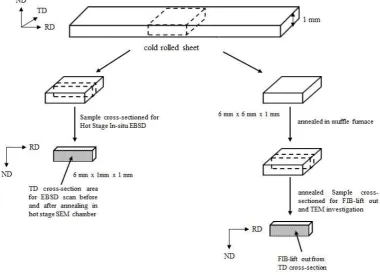
Cold rolled low carbon steel microalloyed with vanadium and titanium containing 0.05 C, 0.008 Si, 0.34 Mn, 0.001 P, 0.0007 S, 0.032 Al, 0.15 V, 0.078 Ti, 0.0022 N and rest Fe (all wt. %) was provided by Tata Steel Europe. During cold rolling sheet material was deformed to a 70% reduction, leading to a final sheet thickness of 1 mm. Samples for hot-stage quasi in-situ EBSD were cut parallel to the Rolling Direction (RD) - Normal Direction (ND) plane from the central part of the rolled sheet, machined to the size of 6 x 1 x 1 mm (Fig. 1) and mounted in Bakelite. Samples were polished using standard metallographic techniques. After polishing, the samples were extracted from Bakelite and placed onto a Gatan Murano 525 heating stage [44] with the Rolling Direction (RD) parallel to X-axis, Transverse direction (TD) parallel to Z-axis and Normal direction (ND) parallel to Y axis of the sample holder coordinate axis system inside of the chamber of a FEG-SEM Carl Zeiss Gemini fitted with NordlysNano EBSD camera by Oxford Instruments [45]. Samples were annealed at three different conditions: 700 oC for 0 s, and 800 oC for 0 s and 800 oC for 2 min at the heating rate of ~10 oC/s and then cooled down to ambient temperature inside the SEM chamber.
minimise the thermal drift [14]. For post processing of the EBSD results, files were exported into HKL Channel 5 software of Oxford Instruments. Normal direction Inverse Pole Figure (ND-IPF) maps were obtained from channel 5 software representing the crystal orientation alignment with respect to the normal direction, ND of the sample. Local average misorientation (LAM) maps with kernel size of 7x7 (n=3) were used to quantify fraction of recrystallized grains and GND density by exporting .ctf files to MTEX texture analysis toolbox, MTEX-4.5.0 available in MATLAB R2016b (http://mtex-toolbox.github.io/.) [46]. Average GND density is calculated from local average misorientation to further evaluate stored energy (contribution from GND density only) on the same methodology as mentioned by Wauthier-Monnin et al., Betanda et al. and Huang et al. [26,32,47] to understand the difference in rate of recrystallization of respective fibres during annealing at different conditions [7,14,28–30]. To evaluate a noise free GND density, the LAM value of all points were calculated and plotted based on a kernel size of 11x11 (n=5) to 3x3 (n=1) as described by Moussa et al. [48]. The LAM value for 0th neighbour (n=0) was evaluated after extrapolation and used as an average measurement for the noise. For a deformed matrix, the average measurement noise is about 0.71o whereas for a recrystallized matrix this is about 0.25o [48,49]. The average measurement for the noise were used to eliminate noise from the average GND values [48].
Fig. 1. Sample geometry for Hot Stage quasi In-situ EBSD (left) and FIB-lift out TEM (right) investigation.
2.2. FIB-lift out and TEM investigation of furnace-annealed steel
were annealed in a muffle furnace under the same annealing conditions as in the hot-stage quasi in-situ EBSD. Samples with dimensions of 6 x 6 x 1 mm were cut from the centre of the as-received sheet and annealed in a muffle furnace for three conditions, 700 oC for 0 s, 800 oC for 0 s and 800 oC for 2 min at a heating rate of ~10 oC/s as mentioned previously. After annealing, the samples were cut in half parallel to the RD-ND plane and polished using the same procedures as mentioned above and then used for FIB lift-out TEM sample preparation. Fig. 1 schematically shows the sample geometry for hot-stage quasi in-situ EBSD and furnace-annealing experiments.
Site-specific FIB lift-outs from recrystallized and un-recrystallized regions were carried out to prepare thin samples with dimension of 6 μm x 6 μm and 0.15 μm to 0.2 μm thickness for TEM precipitate investigation. A modified FIB-lift out method was implemented using initial ion milling at 30 kV by Gallium (Ga) ions followed by ion milling at 500 V at an angle of 12o on both sides of the FIB-lift out samples to minimise Ga ion damage and re-deposition [51,52]. Thinned samples were attached to a Copper grid and moved to the FEG-TEM FEI Talos F200X operating at 200 kV. Complex precipitates of Titanium-Vanadium carbides (Ti,V)C were identified from high-resolution scanning-transmission electron microscopy (STEM) imaging and chemical maps were obtained using four EDS Super-X Silicon Drift Detectors (SDD) fitted inside the TEM Talos at a collection angle of 0.9 srad [52]. For image analysis, STEM-EDS chemical maps were imported into the ImageJ software [53] for quantitative analysis of precipitates [54]. For this quantitative analysis, a minimum of 500 precipitates were analysed from 10 different STEM images taken from two different FIB-lift out samples for each annealing condition [52]. Precipitates were assumed to be circular (in 2D) for quantitative analysis [39,55].
2.3. Texture study of bulk furnace-annealed sample using EBSD
Muffle furnace-annealed bulk samples were also used to study the alpha and gamma fibre texture before and after annealing. In order to study texture at large, statistically significant microstructural area, EBSD scans at low magnification of x250 were taken on the RD-ND plane of as-received and annealed samples for three different annealing conditions using the same EBSD data acquisition parameters as mentioned in section 2.1. To achieve representative texture analysis, at least 1000 recrystallized grains in partially recrystallized samples were analysed [56]. EBSD files were exported into HKL Channel 5 software of Oxford Instruments to evaluate Orientation Distribution Function (ODF) on the section
φ
2samples to analyse the hardness contribution from solid solution strengthening of ferrite matrix, precipitation strengthening, dislocation strengthening and grain size strengthening by carrying out 20 indents randomly across the surface using Wilson® VH3300 Automatic Hardness Tester by applying 1000 g load for dwell time of 10 s.
3. Results
3.1. As-received cold-rolled state
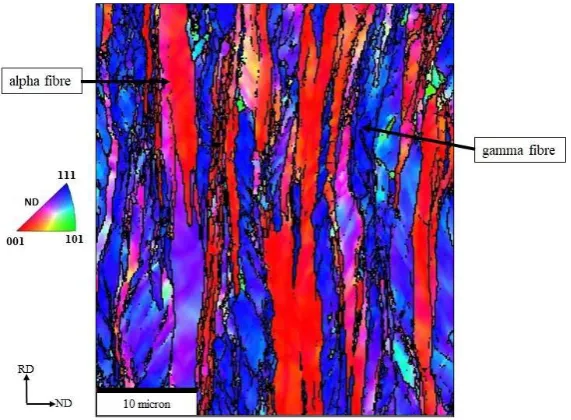
[image:8.595.156.442.521.731.2]Fig. 2. Normal Direction Inverse Pole Figure (ND-IPF) map of cold-rolled low-carbon microalloyed steel (as-received) for the TD cross-section of the sample. Arrows mark the alpha and gamma fibres in the cold-rolled state.
3.2. Hot stage quasi in-situ EBSD at annealing conditions of 700 oC 0 s; 800 oC 0 s and 800 oC 2 min
Hot-stage EBSD technique is performed to understand the effect of the heating temperature and dwell time on the development of recrystallized texture and recrystallized grain morphology after annealing of cold-rolled low-carbon microalloyed steel. During annealing at a low temperature of 700 oC with no dwell, the microstructure of the annealed sample resembles that of the cold-rolled sample and there are no significant changes in the microstructure and texture. Initiation of nucleation of recrystallization has started in few places as indicated by arrows A, B and C in IPF map of Fig. 3b. The arrow marked A has grain orientation {112}<110> of the alpha fibre texture and nucleation occurred from a deformed matrix with similar orientation. The arrow marked B has grain orientation {111}<110> of the gamma fibre texture and nucleation is expected to be linked with the gamma fibre orientation due to its higher initial stored energy. Apart from nucleation of grains with alpha and gamma fibre orientations, some other grains with different orientations such as grain orientation {313}<031> marked as C have also nucleated from the deformed region surrounded by high-angle grain boundaries. The above grain nucleation characteristics are consistent with the results of Thomas et al. [10] obtained after annealing of IF steel.
At a higher magnification, the bulging of alpha fibre texture grain boundary to the deformed matrix of gamma fibre texture is observed. The average GND density has been calculated for the regions 1, 2 and 3 in Fig. 3 by capturing the average misorientation value from about 50 pixels. It was found that the average GND density value of region 1 is less than that of region 2 and that the difference in average GND density value between both the regions is about 1.4E+14 m-2. Because of the difference in average GND density and stored energy, high-angle grain boundaries from low average GND regions of the deformed alpha fibre have migrated to the high average GND density regions of deformed gamma fibre, decreasing the average GND density value from 1.4E+15 m-2 to 1.1E+15 m-2 in region 3. In a previous study on carbon steels by H. Réglé, bulging of subgrain boundaries into gamma grain boundaries has been observed and related to differences in recovery rate and subgrain size [60,61]. In the magnified ND-IPF images of regions 1, 2 and 3 in Fig. 3 black dots are non-indexed points due to the noise which results from the heavy cold-rolling deformation (about 70 % thickness reduction) and possibly the minor damage of the sample during preparation. The black lines correspond with high-angle grain boundaries (> 10o) separating the alpha and gamma fibres.
observed from ND-IPF maps in Fig. 4c and Fig. 4d that the alpha fibre is still in recovery stage while grains belonging to the gamma fibre are fully recrystallized and the stored energy is released lowering the GND density. Site specific local average misorientation, GND density and Stored Energy (SE) maps are shown from the matrix of alpha, gamma, and other orientations. After annealing at 800 oC 0s, average GND density values in region 1’ (grain orientation spread around {001}<110>) and 2’ (grain orientation spread around {112}<110>) of the un-recrystallized alpha fibre are 6.1E+14 m-2 and 2.0E+14 m-2 respectively, which decreased as compared to the as-received average GND values in region 1 and 2 of 6.2E+14 m-2 and 2.3E+14 m-2, as shown in Fig. 4a and Fig. 4c respectively. While in the case of recrystallized grain 3’ (grain orientation {111}<110> of gamma fibre texture), recrystallized grain 4’ (grain orientation {123}<121>) and recrystallized grain 5’ (grain orientation {313}<031>) the average GND density values are 2.3E+13 m-2, 3.2E+13 m-2 and 4.0E+13 m-2 respectively. Qualitatively and from the average GND values, drop in the stored energy has not taken place much in the un-recrystallized alpha fibre matrix and therefore un-un-recrystallized grains belonging to alpha fibre have potential for further recrystallization during increment of dwell time by 2 min for 800 oC.
Fig. 3. Normal Direction Inverse Pole Figure (ND-IPF) maps of low-carbon micro-alloyed steel before annealing (a) and after annealing at 700 oC 0 s (b). In Fig. 3a, the alpha fibre region is marked as 1 and the gamma fibre
region is marked as 2 for the cold-rolled state. In Fig. 3b, a bulged portion of the alpha fibre region is marked as
Fig. 4. Normal Direction Inverse Pole Figure (ND-IPF) maps for two annealing conditions: before (a) and after (c) annealing at 800 oC 0 s, and before (b) and after (d) annealing at 800 oC 2 min. For 800 oC 0 s annealing
condition, site specific local average misorientation (LAM), log of geometrically necessary dislocation (GND) density and log of stored energy (SE) map is shown for the un-recrystallized and recrystallized matrix of annealed sample.
3.3. Precipitation study
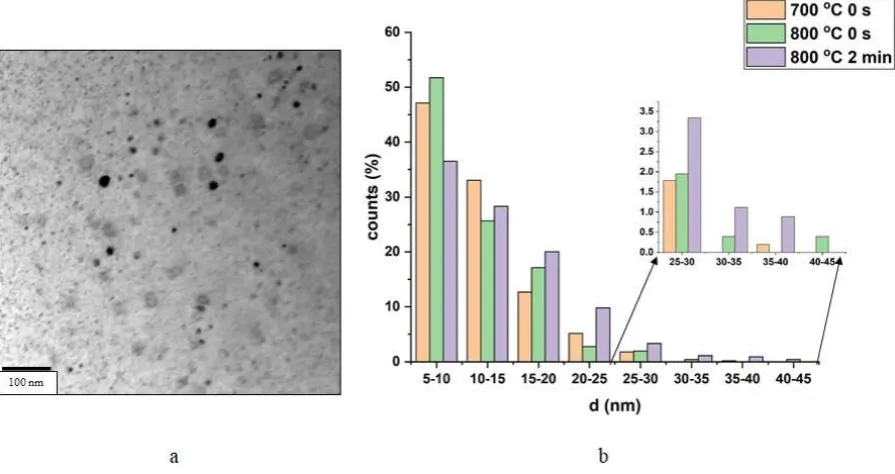
precipitates of 700 oC 0 s, 800 oC 0 s and 800 oC 2 min are 11.2 ± 5.2 nm, 12.0 ± 5.5 nm and 13.6 ± 6.4 nm respectively.
Fig. 5. STEM bright field (BF) image and EDS chemical map of carbides of Titanium and Vanadium (Ti,V)C precipitates pinned to a sub-grain boundary at 700 oC 0 s for low-carbon micro-alloyed steel at two different
FIB-lift out samples after bulk-furnace annealing.
Fig. 6. STEM bright field (BF) image (a) of carbides of Titanium and Vanadium (Ti,V)C precipitates present inside recrystallized grains for annealing condition of 800 oC 2 min and counts (%) versus precipitate size plot (b)
for three different annealing conditions for low carbon micro-alloyed steel.
3.4. Role of alpha and gamma fibres during annealing
in un-recrystallized portion as compared to recrystallized region. For annealing condition of 700 oC 0 s, decrease in average GND density is higher in un-recrystallized gamma fibre texture (3.0E+14 m-2) as compared to un-recrystallized alpha fibre texture (1.1E+14 m-2). With further increase in temperature to 800 oC and dwell time from 0 s to 2 min, average GND density decreases due to static recovery. The drop in average GND density is higher for un-recrystallized gamma fibre grains (6.2E+14 m-2 for 800 oC 0 s and 9.8E+14 m-2 for 800 oC 2 min) than for un-recrystallized alpha fibre grains (1.4E+14 m-2 for 800 oC 0s and 4.5E+14 m-2 for 800 oC 2 min). The smaller drop in the mean GND density of un-recrystallized alpha fibre from cold rolled state to annealed state at 700 oC 0 s , 800 oC 0 s and 800 oC 2 min in Fig. 7a indicates that the extent of static recovery is negligible in this fibre. But the results of larger drop in mean GND density for un-recrystallized gamma fibre imply that static recovery is much faster and readily occurred even at annealing state 700 oC 0 s. For recrystallized grains of alpha and gamma fibre orientation, average GND density value is about 4.5E+13 m-2, which is as expected considerably lower than for un-recrystallized matrix.
Fig. 7. Average GND density plot for cold-rolled alpha and gamma fibres and recrystallized and un-recrystallized matrix (grains) of alpha and gamma fibres at different annealing conditions (a). Fig. 7b shows recrystallization (%) of alpha and gamma matrix (grains) at different annealing conditions for low-carbon micro-alloyed steel.
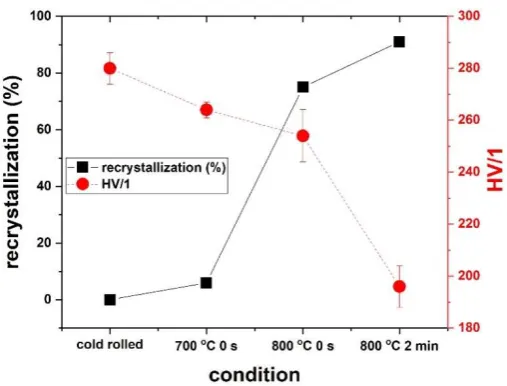
[image:14.595.79.507.253.562.2]Further, overall recrystallization for three different annealing conditions, 700 oC 0 s, 800 oC 0 s and 800 oC 2 min is evaluated using local average misorientation (LAM) map with an example shown in Fig.8. With an increase in temperature and dwell time, recrystallization (%) increases (6 % for 700 oC 0 s; 75 % for 800 oC 0 s; 91 % for 800 oC 2 min), and because of softening, average hardness (HV/1) decreases from 280 to 190 HV number as shown in Fig.9. With increase in temperature and dwell time dislocation density (in present case GND density) decreases and leads to softening [63].
Fig. 9 Fraction recrystallized (%) and Vickers hardness (HV at force of 1 kgf) plots for cold-rolled state and annealed samples obtained at different annealing conditions.
3.5. Texture analysis of bulk annealed samples
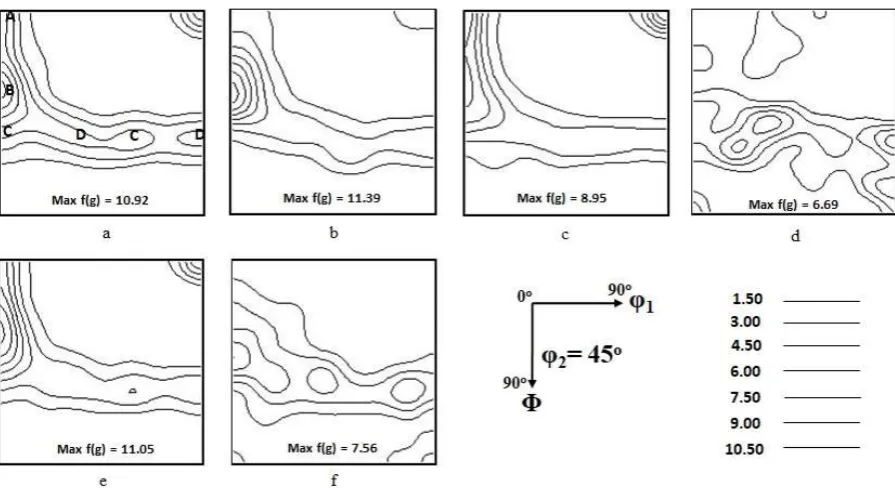
Fig. 10. ODF on the section φ2 = 45o: cold rolling texture for as-received state (a), complete texture for both un-recrystallized and un-recrystallized matrix after annealing at 700 oC 0 s (b), texture for un-recrystallized matrix after
annealing at 800 oC 0 s (c), texture for recrystallized matrix after annealing at 800 oC 0 s (d), texture for
un-recrystallized matrix after annealing at 800 oC 2 min (e) and texture for recrystallized matrix after annealing at
800 oC 2 min (f). A = {001}<110>; B = {121}<110>; C = {111}<110> and D = {111}<121> grain orientation.
4. Discussion
4.1. Reliability of surface microstructural observation for hot stage quasi in-situ EBSD sample
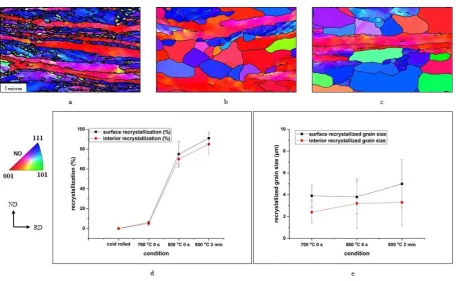
surface but also inside the bulk. Samajdar et al. [67,68] and Sinclair et al. [61] had defined the recrystallization behaviour of alpha fibre grains as “sluggish”. Samajdar investigated IF steel and Sinclair investigated ferritic stainless steel and both of them observed the slow kinetics of recrystallization in case of alpha fibre grains. Grain {001}<110> and {112}<110> belong to alpha fibre and have less stored energy as compared to grain {111}<110> and grain {111}<112> which belong to gamma fibre [9,30]. This difference in stored energy gives the advantage to gamma fibre for higher nucleation kinetics which further leads to the preferential growth of gamma fibre subgrains and to higher recrystallization fraction as compared to alpha fibre grains [67]. Another reason for the slower recrystallization kinetics of alpha fibre grains is related to the lattice curvature. Regions of sharp lattice curvature facilitates nucleation for recrystallization due to higher misorientations (>15o). In cold-rolled low carbon steel, alpha fibre grains lack the sharp lattice curvature as compared to gamma fibre grains and therefore form much less potential sites for nucleation during annealing [69,70].
microstructural development on the surface and in the interior of the annealed sample, which is consistent with the observations from other researchers [14,21].
Fig. 11. Normal Direction Inverse Pole Figure (ND-IPF) maps of interior microstructure of hot stage quasi in-situ samples for three annealing conditions: 700 oC 0 s (a), 800 oC 0 s (b) and 800 oC 2 min (c). Fraction recrystallized
(%) (d) and recrystallized grain size (μm) (e) quantified on surface and interior microstructure of hot stage quasi
in-situ samples for cold-rolled state and annealed states obtained at different annealing conditions.
4.2. Development of texture in bulk annealed samples
From above results and discussions, it could be found that hot stage quasi in-situ EBSD is an important tool for studying recrystallized texture development and the microstructure of the annealed steel sample. Also evaluating the initial stored energy from the contribution of GND density for alpha and gamma fibre grains gives a clear indication of the difference in kinetics of recrystallization in respective fibres. In future, neutron diffraction methodology [77] could be implemented to study the contribution of SSD and GND for complete evaluation of stored energy in respective fibres [32]. Additional high resolution TEM/STEM study coupled with EBSD to study the preferential growth of precipitates on respective alpha and gamma fibres and to understand interaction with dislocations during annealing is currently in progress and will be published separately.
5. Conclusions
Evaluating average GND density from same region indicates a slower recovery rate in alpha fibre than in gamma fibre for the annealing conditions of 700 oC 0 s, 800 oC 0 s and 800 oC 2 min.
In this study, there is no significant difference in microstructure on surface and interior of hot stage quasi in-situ EBSD annealed samples, but average recrystallized fraction is slightly higher on sample surface than in sample interiors.
At the lower annealing temperature of 700 oC with no dwell, nucleation of recrystallization has initiated both on surface and interior of hot stage quasi in-situ annealed sample but the temperature and dwell time are not sufficient for full recovery and recrystallization. With longer dwell time (> 2 min) at 800 oC recrystallization has progressed with higher recrystallization fraction in gamma fibre grains as compared to alpha fibre grains. The minor increase in the recrystallized fraction of alpha fibre from 0s to 2 min at 800 oC implies that fine precipitates probably pinned recrystallized grains. The pinning force however did not stop the recrystallization behaviour of gamma fibre grains. Moreover due to lower stored energy and lack of sharp lattice curvature in alpha fibre, recovery and recrystallization time is longer for alpha fibre than for gamma fibre.
Cold-rolled low carbon micro-alloyed steel has strong alpha and gamma fibres in the as-received state. During annealing, the un-recrystallized region resembles cold-rolled texture while the recrystallized region has strong gamma fibre due to preferential nucleation of higher stored energy gamma fibre grains.
Acknowledgements
in WMG for guidance in usage of MTEX-4.5.0 toolbox available in MATLAB 2016b. Financial assistance from WMG departmental scholarship for Mr Ishwar Kapoor is gratefully acknowledged and Dr Zushu Li would like to thank the financial support from EPSRC (EP/N011368/1).
Data availability
The raw/processed data required to reproduce these findings cannot be shared at this time due to technical or time limitations.
References