C()NTROLDATAANNOUNCES
the Disk Drive that
surpasses
the 3350;
andneeds·no 3330-11
software conversion!
ule "Winchester"-Technology Drives.
Why install a 3350 and spend money reblocking and ·retuning your software-: when CDCcan .. offer you 25% greater . capacity (400 MBytes)· with no·software
conversion cost.
The CDC 33801 operates under OS and gives you 100,000 bytes more than the DOS systems as well as VS systems. You equivalent 3350 option.
protect your software investment - and Before you decide on a 3350, find out get better cost-per-byte - all atthe same about the. 33801. Compare. D.iscov. er .the time!
What's more, CDC's new 33801 Data less costly, more flexible growth path of Module Drive provides 100% greater this expandable 33801 system. See how it enhances both 3330 and 3350 storage capacity than the 3350 when used in the and can serve asa staging device forthe 3330':'11 mode .. The CDC .Sealed
Mod-ule.incorporates.a fixed head (zero seek CDG, 38500 Mass Storage·.System. time) option. And,Control.Qata's optional Check out the CDC 33801 ,andyou'li 1.24-million-byte Jixedhead capacity. know it makes abetter business decision.
, ' . ,'" ' "
---
----~--~----For the price-per-byte and performance you need today plus a more logical growth path for3330 users call (612) 553-4158 or mail the coupon to: Ronald L Kamps, Sales Manager, Pe-ripheral Product Sales, Control Data Corporation, Box 1980, Twin Cities Airport, St. Paul, MN 55111. Dept. 0-96.
Name Title _ _ _ _ _ _ _ _
C o m p a n y ' A d d r e s s -City _ _ _ _ _ _ _ _ _ _ _ _ _ _ _ ~ _ _ _ _ State _ _ _ _ _ L 7 i p -Area Code _ _ _ _ _ _ Phone _ _ _ _ _
Ask the CDC Peripherals People
&l
E::\
CONTl\.OL DATA
\::I
r::!I
COI\PORl\TION
~---~
UelD~~ ~@
MSa a a
't"J6
@@1ITfilM
M!i1)H
@~~<a
So do aU our
&(eyProcessin~r
Systems
.' ..
I'.~:a
.. · ... ·:.· .... • ...\jf
...
;fr~
1I~~~
JD I
00
~nl]BB
.. lJ
_
~
~
--:.;,;;;;;;;::::;
I· ... · .. :···:
···.··.·::···1~@)
[ '.' 11
I
I
I
~;
~WII·
Talk to us,
Signaling a new era
in data entry communications, CMC's . TeleBatchTM option does it all - remote
data entry, remote job entry, and remote printing - all concurr~nt with a full complement of active keystations.
The KeyProcessing Family offers the widest range of data entry systems available today. With features and options that will serve you tomorrow too. Like TeleBatch, and the industry's most comprehensive array of manage-ment control reports.
TeleBatch
provides decentralized data entry with-out sacrificing centralized control over quality and procedures. TeleBatch is fast, with speeds up to 19,200 bps. And it's simple to operate - with unique Communications Control Batches auto-matically performing all operator and remote batch terminal functions.
Our customers say
that CMC's Management Control Reports are outstanding. The TeleBatch Log, for example, improves the effec-tiveness of communications by provid-ing an audit trail of important com-munications statistics.
CMC KeyProcessing Systems are installed and communicating throughout the world.
you'll be pleased you did. Call or write . today for more information.
KeyProcessing and TeleBatch are trademarks of
C
HJ1 :
~
PERTEC COAPOImTIOn
[
~1
m-]
a division of2500 Walnut Avenue, Marina del Rey, P.O. Box 92300 Los Angeles, CA 90009 Telephone: (213) 390-8411
IN COMPUTER PERIPHERALS,
THERE IS ONLY ONE ALTERNATIVE
TO ITEL.
And that's no exaggeration, either.
It's something we can back up with fact after fact.
For instance: Did you know that we supply more plug-compatible
monolithic main memory and 3330-type disk drives than any-one else?
Moreover, when you dea I with Itel the savings are enormous.
It's this kind of all-out creative effort that has put us right up there with IBM. Not only in computer peripherals. But in field engineer-ing. In systems and software. In financial packaging. In total computer capability.
CIRCLE 55 ON READER CARD
When it comes to experience and reputation, it's either IBM. Or Itel.
When you get to price/
performance, however, there is no alternative.
There is only Itel.
ITEL
CORPORATION
VOLUME 22 NUMBER 9
This issue 138,500 copiesSEPTEMBER 1976
FEATURES
56 THE INTERNATIONAL COMPUTER INDUSTRY
Angeline Pantages. The community of computer manufacturers is an inter-national one, with sufficient alliances and complications to make international poli-tics look rather straight-forward.
58 THE U.S. MULTI-NATIONALS
Angeline Pantages and Nancy Foy. The computer competition is often the least of their worries.
63 WESTERN EUROPE'S COMPUTER INDUSTRY
Angeline Pantages, Nancy Foy, and Andrew Lloyd. Propped by their governments, supported by the EEC, and tied to U.S. and multinationals, united they stum-ble and divided they often fall.
79 COMPUTERS FROM COMMUNIST COUNTRIES
Bohdan O. Szuprowicz. Removing the effects of national borders and capitalistic competition makes some things easier., Finding markets is not one of those things.
NEWS IN PERSPECTIVE
160 DISTRIBUTED PROCESSING
It's a question of experience and 31/2-day seminar in San Francisco shows that experience is lacking.
162 MEDICAL
Computerized scanners: nearly all larger hospitals are prospects.
163 ELECTRONIC FUNDS TRANSFER
Control Data tries to cash in on electronic funds trans-fer as do hundreds of others.
168 MAINFRAMERS
Control Data is big in services-but also in systems.
168 RETAILING
First it was the UPC. Now it's UP dollars.
171 SPACE EXPLORATION
Viking's exploration of Mars: Impossible without com-puters.
DEPARTMENTS
7 LETTERS 13 PEOPLE
C. H. "Pete" Link: hates a boring job; John Brackett: it was April 1; Robert Arthur: a business started by IBM.
17 LOOK AHEAD 22 CALENDAR 27 SOURCE DATA
Harlan Mills on Dijkstra, and David Gardner on Malik, plus other books; reports, references, vendor literatUre.
55 EDITOR'S READOUT 204HARDWAR'E
A Tektronix-compatible graphics system, hybrid comput-ing, communications buffer, interfaces.
September, 1976
91 JAPAN'S COMPUTER INDUSTRY
Edward K. Yasaki and Angeline Pantages. They import the world's steel and send back Datsuns. Can they im-port enough technology to do the same with mainframes?
107 THE INTELLIGENT WAREHOUSE
James R. Benson. The ability to keep track of all goods at all times by computer allows for Levi Strauss' most accurate inventory control ever.
131 FRAGMENTS OF COMPUTER HISTORY
Edward K. Yasaki. The British Colossus, th'e German Z3, the Atlas, EDVAC, BINAC, and the Whirlwind-pieces of the past.
140 DECENTRALIZING DATA ENTRY WITH OCR
Dennis A. McMullen. Increased accuracy and reduced costs are the big results.
151 GOING CARDLESS
Vince Heiker. It sounds like heresy, but not even JCL shou Id be on cards.
235 THE FORUM
Sander Rubin. The Computer Industry Association may not be right about a consent decree, but it's running the only game in town.
David M. Weiss. Those projections for public rapid tran-sit systems are "blue sky" in more ways than one.
172 COMMUNICATIONS
Vendors and users lean to international packet-switched protocol.
176 TRAINING
S/3 programmers anyone?
176 COMPANIES
What's in a name?
178 CREDIT REPORTING
Data on business now offered by TRW.
180 FI NANCIAL
There's a new financial world out there.
186 BENCHMARKS
End of a dream; It's fair says the judge; Counterclaim filed; A week late, $5 less; Canadian connection; A French connection; United buys Standard; Itel acquisi-tion; Torrance re-ups; Mergers hold even; SDC orders from STC; New president at NCR; $19 million sale; New name, place; Univac closes plant; Honeywell organizes group; New life at Stanford; Bright outlook.
216 SOFTWARE & SERVICES
Data security for IBM MVS users. Also, a teleprocessing monitor for PDP-Us, and an interesting data access tool.
225 MARKETPLACE
228 ADVERTISERS' INDEX
About the Cover
The international computing industry is changing every-one's view of the world. The isometric terrain height plot was produced by Warren Yogi and Howard Straus of Ocean Data'Systems, Inc., Monterey, California, with the ODSI proprietary 3-D plot SUbroutines, using a Ver-satec raster plotter. Design is by Barbara Benson.
4
WHATISA
DIGITIZER?
A digitizer converts, in a highly accurate manner, the position of a stylus or cursor on a graphic surface into a digital output suitable for communication, processing, and display.
Digitizers are sometimes called data tablets when used in lower accuracy applications. Higher accuracy applications in graphic systems include mapping and computer aided design.
Early digitizers (data tablets) used cumbersome mechanical arms and gears to determine coordinate points, while later digitizers employed sound transmission and even magnetic propagation.
These methods have been outdated by the introduction of the "Active Inch" digitizer by Talos Systems, Inc. The digitizer is so unique, it is called ...
.. . CYBERGRAPH
Truly a Digitizer
For more information on THE DIGITIZER, contact: TALOS SYSTEMS, INC. CYBERGRAPH
7419 East Helm Drive Scottsdale, AZ 85260 Phone: (602) 948-6540
CIRCLE 147 ON READER CARD
CRTRMRTICN~
EDITORIAL STAFF Editor
Articles Editor International Editor European Editor Industry Editor Products Editor Source Data Editor Calendar Editor News Editor Bureau Managers
San Francisco Los Angeles New Vork New England Washington, D.C. Correspondents
Minneapolis Southwest Australia Editorial Advisor Technical Advisor Contributing Editors
EDITORIAL OFFICES
John L. Kirkley Richard A. McLaughlin Angeline Pantages Nancy Foy W. David Gardner Michael Cashman Daniel P. Schlosky Gloria Tidstrand Tom McCusker Edward K. Vasakl Edith D. Myers Angeline Pantages W. David Gardner Linda J. Flato James K. Johnson Robert F. Alexander Ken McGregor Robert L. Patrick Lowell Amdahl Paul Armer, Howard Bromberg, Philip H. Dorn, Louis B. Marienthal, Carl Reynolds F. G. Withington Headquarters: 1801 S. La Clenega Blvd., Los An· geles, CA 90035. Phone (213) 559·5111. Eastern: 35 Mason St., Greenwich, CT 06830, (203) 661· 5400. 134 Mt. Auburn St., Cambridge, Mass. 02138, (617) 354·2125; 6605 Burlington PI., Springfield, VA 22152, (703) 569-3383. Southwestern: 2711 Cedar Springs, Dallas, TX 75201. (214) 744·0161. Welt· ern: 2680 Bayshore Frontage Rd., Suite 401, Moun· tain View, CA 94043, (415) 965·8222. Foreign: 8 Pellerin Rd., London N. 16; (01) 249·1177; 24 Staf· ford Road, Artarmon, Sydney, NSW 2064, Australia, 41·5748.
GRAPHIC DESIGN & PRODUCTION Art & Production
Director Cleve Marie Boutell Advertising
Production Manager Marilee Pitman Production Assistant Alberta R. Maliln CIRCULATION
35 Mason Street, Greenwich, CT 06830 Circulation Manager Suzanne A. Ryan Marketing Research
Manager Publisher Assistant Publisher Circulation audited
Deborah Dwelley James M. Morris F. Douglas De Carlo by Business Publications
Audit
-Member ~ABP American Business Press, Inc.
DATAMATION Is pub·
1-1 __ 1
lished monthly on orat='
about the first day of every month by Tech-nical Publishing Company, 1301 South Grove Ave., Barrington, Illinois 60010; Arthur L. Rice, Jr., Chairman of the Board; James B. Tafel, President: Gardner F. Landon, Executive Vice President. Executive, Circulation and Advertising offices, 35 Mason Street, Greenwich, CT 06830, (203) 661· 5400. Editorial offices, 1801 S. La Cienega Blvd., Los Angeles, CA 90035. Published at Chicago, III. DATAMATION is circulated without charge by name and title to certain qualified individuals in the Ul)ited States and Canada who are employed by companies involved with automatic information handling equipment. Available to others by sub-scription at the rate of $24. Reduced rate for qualified students, $14. Foreign subscriptions are available for £20.00 or for the equivalent of $40 U.S. in most West European currencies. Sole agent for all subscriptions outside the U.S.A. and Canada is J. B. Tratsart, Ltd. 154 A Greenford Road, Harrow, Middlesex HA13QT, England. No subscription agency is authorized by us to solicit or take orders for subscriptions. Controlled circu· latio'ns paid at Columbus, OH and Form 3579 to be sent to TeChnical Publishing Company, P.O. Box 2000, GreenWich, CT 06830. © Copyright 1976 Technical Publishing Company. ® "Datamation" registered trademark of Technical Publishing Company. Microfilm copies of DATAMATION may be obtained from University Microfilms, A Xerox Company, 300 No. Zeeb Road, Ann Arbor, Michi· gan 48106. Printed by Beslow Associates, Inc.For Conversational
On-Line Programming, Compare
COMPARE COSTS.
What does it really cost to install and operate an on-line system for program development? Terminals and other hardware costs are dwarfed by the cost of integrating and continuously operating the software. These expenses can exceed the savings resulting from improved turn-around and increased programmer productivity.
Carefully analyze the additional resources required to maintain an acceptable level of batch production when the on-line system is operating ... larger CPU, more core, more direct-access devices. Dedicating an entire CPU to program development, as is usually done with TSO or VM/CMS, is a very expensive alternative to running production and development work concurrently on the same
machine. A remote programming
system should operate effec;tively in a. multi-job environment, and maintain a high degree of terminal responsiveness without degrading background operations or reducing overall system throughput. ROSCOE does just that. But that's not all ...
TM
COMPARE FACILITIES.
By the time you pay ·for all the TSO And proven in use for over six years
facilities you need, ROSCOE will cost at 360/370 sites all over the world.
you far less. After paying to install You, too, can benefit from ROSCOE.
TSO, you pay, and pay and pay. Just mail the coupon or contact one of
ROSCOE is far more cost-effective ADR's offices.
than TSO. And ROSCOE provides ,- _ _ _ _ _ _ _ _ _ _ _ _ _ _
versatile services to applications and I
systems programmers, to operations,
I
APPLIED DATA RESEARCH, INC.d esign, an c erica personne. d I I I I Software Products Division Route 206 Center, Princeton, New Jersey 08540
ROSCOE contains data entry and I Telephone: (609) 924-9100
editing facilities, compressed self- . T ..
.. I'b t d t i D Please send information on ROSCOE
reorganizing I rary s orage an remo e
job entry and output retrieval functions. I
Plus ... syntax checkers for JCl, COBOL, I-N-am· e T i t l e
-FORTRAN, and PLl1. Another unique 1
-capability of ROSCOE is its command 1 Company
procedure language which supports I A d d r e s s
-terminal
110
operations and includes1 _ _ _ _ _ _ _ _ _ _ _ _ _ _ _
_
decision making, branching, and 1 City State Zip
iterative types of instructions. 1 I h
Te ep one
You don't need another CPU to run 1. _ _ _ _ _ _ _ _ _ _ _ _ _ _ _ _
ROSCOE. You don't need more memory 1 Computer Configuration
or disks. Your daily batch production 'I am also interested in
will not be reduced to a trickle. , 0 MetaCOBOL® for increased productivity
ROSCOE costs much much less, in 10 AUTOFLOW® II for maintenance and debugging
both direct and indir~ct costs. And as
,0
The LlBRARIAN®.for security and protection. . ' I 0 LOOK'" for real-time performance measurement
IS the case with all ADR software 0 PI SORTT .. 2 for faster sorting
products, ROSCOE is fully field tested.
L ___ _ _
--,:.' APPLIED DATA RESEARCH
THE SOFTWARE BUILDERS®ADR software products: in use at over 5,000 installations worldwide.
U.S. offices in Boston (617) 245-9540, Chicago (312) 694-2244, Cleveland (216) 228-0880, Houston (713) 526-3188, Los Angeles (213) 826-5527, New York (212) 986-4050, Pittsburgh (412) 885-2822, Princeton (609) 924-9100, Washington (703) 281-2011.
Foreign offices in Australia, Austria, Belgium, Brazil, Canada, Denmark, England, Finland, France, Israel, Italy, Japan, Korea, Mexico, Netherlands, New Zealand, Norway, Philippines, Puerto Rico, Republic of South Africa, Singapore, Spain, Sweden, Switzerland, Taiwan, Thailand, West Germany.
"We'll sell you
the best, lowest
priced 132-column
. printer
ilable
. a
re!'
Bob Howard, President, Centronics
But the low initial
price for the Centronics 700 Series
132-column printer isn't the whole story.
It's the lower cost of ownership based on the 700's
inherent reliability and simplified construction.
The 700's unique modular construction using four different modules -
print-ing, electronics, forms handling and keyboard - and less moving parts mean easier
maintenance, lower cost and a smaller spares inventory.
'
Write for the full details of this tremendous offer . . . and information on the
rest of the printers and teleprinters in the new Centronics 700 Series.
Centronics means more than low price.
And more than hardware. It's the widest range of models, features, options
• Financially strong· Proven delivery response •
Over
70,000
printers installed • 109
world-wide sales/service locations • Stringent quality control· Advanced R&D and
manufacturing • Long-term spare parts availability • Customizing for specific needs.
I:EnTROnII:S® IS PRinTERS
CentroniC'> Data Computer Corp., Hudson, N.H. 03051, Tel. (603) 883-0111, Twx. 710-228-6505, Tlx. 94-3404; Eastern Region: (617) 272-8545 (MA); Central Region: (513) 294-0070, Twx. 810-459-1784 (OH); Western Region: (714) 979-6650, Twx. 910-595-1925 (CA) CentroniC'> Data Computer (Canada) Ltd., Ontario, Tel. (603) 883-0U1,Twx.
710-228-6505; CentroniC'> Data Computer (UK) Ltd., Cheam, Surrey, England, Tel. 6430821-4, Tlx. 851945756; CeiltroniC'> Data Computer, GmbH, 6 Frankfurt/Main., West Germany, Tel. 663321/22, Tlx. 841413224; CentroniC'> of Puerto Rico, Dorado, Puerto Rico, Tel. (809) 796-1881. Tlx. 3859349
letters
Language for communications
We were appreciative of the article "Compatibility or Chaos in Communi-cations" by Sanders and Cerf (March, p.50).
The implication for those installing or upgrading major computing instal-lations is clear: they should specify X-25 and the associated standards as a necessary part of their system, if there is any intention to attach their
installa-tion to a network. If users make X-25
a tendering requirement, manufac-turers ,and software houses will support it and public networks in all countries
will adopt it.
N ow that CCITT (International Tele-graph and Telephone Consultative Committee) has formally adopted the X-25 protocol, the major unresolved problem area, as pointed out in the article, is the application level protocol. We cannot agree that the most serious aspect of this is that of terminals with idiosyncratic features. The aspect that
. concerns us most is the lack of any standard for job control or commands for the interactive computing environ-ment.
To make networks useful to pro-grammers there is a clear and urgent need for a standard machine-indepen-dent command language. Such a lan-guage, if powerful enough, could by its own nature provide ',a complete .appli-cation-level protocol (exclusive of ter-minal idiosyncrasies). Such a language needs to be sufficiently flexible to cope with all reasonable user requirements, sufficiently extensible to cope with un-known future requirements, and sim-ple enough for any programmer to learn rapidly.
To those who believe that these three requirements are incompatible, we suggest they study SCL, the com-mand language for ICL'S 2900 series operating system. We are planning to use an sCL-compatible command
lan-guage over an X-25--compatible
September, 1976
prototype network, initially linking Burroughs B6700's.
We. are confident that SCL has the technical potential to become a stan-dard if wide support can be found for it. We urge your readers to press their representatives on national and inter-national standards organizations to-wards the adoption preferably of SCL, but certainly of some machine-inde-pendent command language.
C. R. BOSWELL, B. E. CARPENTER,
E. A. DRA WNEEK, K. HOPPER
Computer Science Departm.ent Massey University Palmerston North, New Zealand
R.M.GoRDON
Computing Services Centre Victoria University of Wellington Wellington, New Zealand
Woand
men-as managers
I would like to express unqualified ad-miration for Gonnie Siegel's June
Forum, "The Best Man for the Job MayBea Woman" (p.196) ....
I particularly appreciated Ms.
Siegel's insight into the inner conflict in those who find that their emotions learn more slowly than their intellects.
Her sympathetic recognition that
learning to treat employees and appli-cants without regard to sex is a painful and slow process, is yet not inconsis-tent with her firm rejection of those who will not attempt to learn, or with her clear-eyed recognition of the stupendous amount of sex bias to be found at all levels of management.
MICHAEL W. HAM
Director, General Systems The American College Testing Program Iowa City, Iowa
Ms. Siegel spoke eloquently of the business world's expectations concern-ing the characteristics which are sup-posed to lead to success. Business lead-ers, she reports, look for toughness,
coolness, strength, ruthlessness-in
short, qualities historically (and incor-rectly, I think) associated with mascu-linity.
Whether or not such traits assure business success, I won't debate here, but my point is that it is, not only women who are discriminated against by this "masculine" way of thinking. Many men who do not subscribe to this "business macho" are also passed over at promotion time. Ironically, men who excel in the more humanistic qualities such as warmth, empathy, and sensitivity, are thought incapable of managing people!
What course is left to the man in business who doesn't buy the conven-tional view of what constitutes a good businessman? He has two choices. He
can sublimate his natural humanistic tendencies in favor of his ambition, or he can reassess what is important to him and perhaps content himself with less of what is looked upon in the business world as "success." The first course cannot help but put a psycho-logical strain on him, a strain which often pays off in ulcers, heart attacks, and other dysfunctions. In the long run, the second course is wiser, but often reveals itself too late in life, after much of the damage has been done and the behavior patterns have been set.
I applaud the women's mov~ment
and its leaders like Ms. Siegel. A sec-ond irony is that eventually men may profit from women's success. Maybe someday men who don't fit the mold of the "tough SOB" whom the, business world so assiduously courts will be considered for the top spots along with their more "masculine" colleagues and with women,. I think it would be good for everybody, including possibly busi-ness itself.
PETER MARTIN
Mountain Lakes, New Jersey
Compounding errors
Several readers brought to our atten-tion an error made by management consultant Steven R. Levine in our July Forum ("Another Parker Game," p. 155). In presenting a tabulation of the sources of dp errors, Mr. Levine himself made an error (which we also missed) and ended up with a "total" of only 99.1 %. The following should give the flavor of the reader response:
In reference to Mr. Levine's comment on Parker's game: What happened to the remaining 0.9 %? Errors due to poor advice from management con-sultants?
Those long lines
GIO WIEDERHOLD
Woodside, California .
The news article in your July issue reporting on the 1976 NCC (p. 98) refers to the attendees standing in line to register. It attributes the length of the lines to the use of plastic badges.
The system used is the same system used last year when NCC was held in Anaheim, under more favorable cir-cumstances in every respect. And no problems arose there when the total attendance was only slightly less.
Stop watch test-timing indicated that making plastic badges took an average of one and one-half minutes each, versus one minute for paper badges. The plastic badge was not the problem.
The New York Coliseum was the first culprit. Its lobby is not large enough to accommodate sufficient equipment to handle such a large crowd. To compound . the problem,
letters
another show (NEPCON) held in the same building on the, same dates sent their attendees to the NCC registration area for badges.
A third problem had to do with the amount of data to be collected. As many as 130 to 150 characters of data per attendee had to be keyed to the computer tape for NCC record pur-poses.
Jacquard Registration Service has, over the past five years, handled con-ventions with registration as high as 95,000 without problems. The system has the capability and it should not be blamed for the length of the lines. After all, it is the only computerized
registration system in existence today,
and certainly a computer conference
8
Structured Cobol
The rules Dr. Mize states ("Struc-tured Programming in COBOL," June p. 103) would allow orderly and modular code to be produced, but it would not be structured. In my judg-ment, this is caused by two facts be-ing ignored or not understood.
1. One of the most beneficial aspects of top-down design is the nat-ural separation of control stucture . from the functional doing in a
pro-gram. The top level modules specify
what has to be done and the
condi-tions under which it is done. Lower level modules will accomplish the functional doing. This natural separa-tion should be encouraged as it assists the designer since the problem has been parsed into two smaller prob-lems-control and functional-and it assists the maintainability of the code since the novice reader of the pro-gram can concentrate first on the control structure and then on the functional doing. (Just try identi-fying the control structure and func-tional doing parts in a flowchart and you will see the advantages of top-down design. )
2. The second missing ingredient is the proper understanding of the pur-pose of the IF statement. The IF state-ment is quite different from the ADD,
MOVE and READ verbs in that it does
not, in itself, do anything toward solving the problem at hand except to determine the conditions under which certain other statements are to be executed. To understand a mod-ule, it is necessary to understand what it does, how it does it, and
under what conditions it is entered.
Often, multiple conditions must be met before certain modules are to be executed. For example, in a
transac-should use computerized registration. Furthermore, let's say those long lines may have been an indication of the health of the computer industry.
LARRY D. DALLEN
Jacquard Registration Service Long Beach, California
Our Bicentennial Entry
You win the prize-and you were such an unlikely entrant! It's for the most completely asinine and tasteless grab-onto-the-Bicentennial-no-matter-what item in any medium. I refer to Jackson Granholm's "Great Moments in the History of Computing: December 12,
1777" (July, p. 71).
K. A. MOODY
Pittsburgh, Pennsylvania
Since essentially all the non-dp gags in
Mr. Granholm's article were plagia-rized from Stan Freberg's album, "The United States of America," I feel
Fre-tion edit program, it may take dozens or hundreds of conditions to identify a valid transaction. Often the condi-tions are related. Often there are multiple sets of conditions which sat-isfy the requirements for theexecu-tion of a given module.
Consequently, Dr. Mize's rule on GO TO'S is incorrect. GO TO'S cannot be used to reexecute a module; that is control structure and belongs in a higher level module. Secondly, often
it will take multiple IF statements
(and compound conditionals) to identify the conditions which must be satisfied to execute certain modules. To hide the relationships of these conditionals by not allowing nesting, is detrimental to maintainability and readability; hence, the rule against nested IF'S is incorrect. This is one place in which the original designer must sacrifice to achieve the goals of maintainability. The relationships of conditionals are vivid in the mind of
Professor Mize replies: Mr. Tucker's points are both valid and relevant. However, the intent of the article was to provide simple guidelines that would derive most of the benefits of structured programming without forCing unnatural structures on the COBOL language as it-exists today. If COBOL provided an in-line PER-FORM option, I would agree com-pletely with the total separation of the control and dOing functions-not allowing any backward bran,ching GO TO's. However, in COBOL, the control paragraph is physically sep-arated from the doing paragraph. Prohibiting this use of the GO' TO results in more communication flags or switches between paragraphs and in deeper nesting of PERFORM's. I admit that this use is a compromise, but no one has cla.imed that the con-trol constructs in COBOL lend
them-berg should at least have been listed as coauthor.
WAYNE HATHAWAY
Sunnyvale, California
Mr. Granholm replies: This piece was actually done for a private, inebriated performance at a Digital Computer Assn. meeting. Whoever it is supposed to be patterened after should be in-sulted. Having been guilty of doing too many DCA programs already, I am doubtless gui!ty of making this effort as bad as possible. Why the editors of Big-D wanted it, I don't know, but there is no predicting editorial tastes.
Disputed origins
As regular readers of DATAMATION, we were surprised by the inaccuracy of comments made in the May issue (p. 182) referring to privacy and security in· the Data Management Center, The Office of the Secretary, HEW. The facts are as follows:
(Continued on page 194)
the designer the day the code is gen-erated, but unless those relationships are preserved in code, the mainte-nance task is increased. The nesting of IF statements must adhere to the rules of modular size; thus, modules of great IF-depth might need to be shortened to be comprehended.
. These two rules are interrelated for if one cannot nest IFS, he must
simu-late with GO TO'S. If GO TO'S are
re-stricted, nesting of IF'S are necessary. Modular code is good code. It pre-vents programs from being globally chaotic, and code that is only locally chaotic can be figured out. Struc-tured code is modular, and
addition-ally, it prevents code from being
locally chaotic as well.
JAMES L. TUCKER
Department of Public Administration Department of the Army
u.s.
Army Management Engineering Training Agency Rock Island, Illinoisselves naturally to formal structured programming.
The article does not prohibit the use of compound conditional state-ments. The suggested discretion in the use of nested IF's is due to the confusion and necessary redundan-cies in nested IF's, since there is no ENDIF delimiter to mark the scope of the logic to be invoked under various combinations of circum-stances. Used properly nested IF's can reduce the fragmentation of the . program and the levels of
PER-FORM's required. However, their use opens a Pandora's Box for the bugs and modification headaches to be-gin creeping in.
Hopefully, someday soon the pro-gramming language to allow the nat-ural writing of structured programs for business applications will be available and compromises such as these will no longer be necessary. ~'/:
THIS IS THE
GENERAL LEDGER SYSTEM
VOUAND YOUR ACCOUNTING
DEPARTMENT HAVE BEEN
DREAMING OF .
*
Here's exactly what will happen when you call .. One of our staff will take your name and address and immediately send you a brochure explaining exactly what the UCC General Ledger/Financial Control System is all about. ( In Texas, call214-638-5880
collect.)When you've seen how UCC-FCS meets your financial reporting requirements, call this number again. We'll arrange a presentation at your convenience.
Here are some reasons why UCC-FCS has made
the Accounting and Data Processing Departments happy in over
150
IBM360/370
or mid-size Burroughsinstallations.
• Quick and efficient implementation .
. • Easy-to-use report writer requiring virtually no EDP assistance.
• Full general ledger accounting, plus budgeting, costing,
profit center reporting. And much more. • Optionally generates over
100
standard reports.We're going to
be the
IBM
of
software
.
companIes.
University Computing Company • P.O. Box 47911 • Dallas. Texas 75247 • A Wyly Company
The emergence
01
a new
thinking machine.
The
SEL
~Z/~S.
Twice the power for half
the price.
If your computing nee,ds
could be answered by such
machines as Data General's
Eclipse, or DEC's PDP Ilseries
or Interdata's 7/32, consider
the SEL 32/35.
Rather than get into bits and
bytes, there's really only one
thing you need to know about
the SEL 32/35: You get two to
four times the power for every
"compute" dollar spent. Period.
That's a pretty powerful
statement. But the SEL 32/35
is a very powerful machine.
Extra power can go a long
way to maintain the balance
you need in your computer
system, so essential for ,reliable,
peak performance.
And extra power, for fewer
dollars, can do wonders when
you're trying to balance a
corporate budget.
For more information about
the new arrival in our family of
computers, just circle our
number on the Reader Service
Card. Or, for faster action, call
us direct.
Either way, we'll see that you
get all the vital statistics on our
new baby.
SYSIEMS
ENGINEERING LABORATORIES6901 West Sunrise Boulevard
Fort Lauderdale, Florida 33313
(305) 587-2900
European Inquiries: 85 bis Avenue Albert ler 92500/ Ruei!. France
CIRCLE 50 ON READER CARD
. / ... ,.
\
,/
, j
\,
~ ' ..
/r)(r" {i!i"!i( . .'.<j· /l;.f'} ~Vor(; s:~!non/rnC)Us' t/~}rD2j(7h()i~'/
people
Computer Aided
Manufacturing
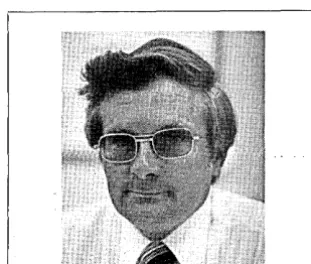
C. H. "Pete" Link hates a boring job. "It seems I've worked at a little bit of everything," said Link, who has toiled in such diverse areas as account-ing, pattern makaccount-ing, carpentry and welding. But as soon as the challenge in each job left, so did Link.
,This seemingly innate desire for leaping high vocational hurdles is no doubt what will keep the 47 year old manager indefinitely content at his current job as executive secretary and ,general manager of Computer Aided Manufacturing-International, Inc. in Arlington, Texas. He has held this job
since CAM-I was formed in 1972.
As the· chief paid officer of CAM-I,
Link said he has the opportunity to organize a new international associa-tion of industrial, governmental and educational groups for the joint de-velopment of computer aided manu-facturing applications. This position makes Link responsible for the legal and financial dealings of the non-profit corporation as well as, for administer-ing its eight-member staff, interna-tional representatives and contractors.
Since CAM-I concentrates on
soft-ware development, Link said he deals with some of the most intelligent and productive innovators in this field from
each of CAM-I'S 91 member companies
in North America, Western Europe and Japan. Therefore, one of the most demanding challenges of his job is stay-ing current with the rapid changes in the computer industry.
Link said, he does this mainly by reading a lot of books while in flight to meetings throughout the world. "I spend about six weeks each year in jets," he added, "and this gives me time
to read 40 to 50 books, mostly
con-cerning my work."
Computer aided ma,nufacturing, Link noted, is often misdefined as a factory with machinery totally con-trolled by computers. "I think the term has been a little ovel1used and people tend to think that it means eliminating the workers," he said. "That's not my view at all."
Studies show the major inefficiencies in manufacturing are not found in the employees who operate machinery, but rather develop from the lengths of time raw materials must sit idle, said Link.
September, 1976
"Ninety-five per cent of the time a product is in a factory is spent in waiting to be worked on," he noted. "So the most important aspect of con-trolling factory production is not auto-mating the equipment, but rather con-trolling the flow of information on the production floor.
"For at least 15 years there have been adequate simulation systems for management to use in attempting to schedule production," he continued. "But one of the biggest problems with these is that once the majority of the information has been simulated, the plan deteriorates in practice. It reports what has happened after the fact. No one has yet developed a system where manufacturing could be practically monitored on the factory floor."
Controlling this information as it
happens is what CAM-I is trying to do
with programs such as CAM -I
Auto-mated Process Planning (CAPP), Link
contends. "By cutting'down the wait-ing time by 10, 15 or 20 per cent you reduce the large investment in inven-tory, shorten the lead time for produc-tion and keep costs competitive."
Link said he expects automated planning systems will be available dur-ing 1977 to generate production schedules for machined and sheet-metal parts, castings and forgings as well as for electrical components and assemblies. By 1978 he sees advanced automated planning in use by large companies, with medium and small manufacturers joining by 1980. Link anticipates the use of minicomputers dedicated to line and management
functions in a hierarchical structure by 1985.
To help prepare himself for this in-ternational growth of automated pro-cess planning, Link is studying the spoken languages of many of the in-dustrial countries where he expects these development to occur. For in-stance, he already knows enough Ger:" man and Italian "to get by" and he is currently studying Japanese with the assistance of a portable cassette player. Despite his computer-age schedule, Link plans in time to spend with his wife, Marilyn, and their two sons,
C. H. "PETE" LINK " ... The term has been misused."
Peter Michael,S, and Jameson Todd, 1. Link said he also tries to spend several hours each month picking out bluegrass tunes on his guitar in duet with a banjo-playing friend. It's breaks like these that no doubt keep him re-freshed for the challenge of his work.
April Fool's Appointment
John Brackett could have been excused if he thought that it was all a practical joke when the president of his com-pany-SofTech, Inc.-resigned, and he was appointed to replace him. The date was April 1.
But Cornelius Peterson was serious
about leaving to personal
busi-JOHN BRACKETT He didn't get an M.B.A.
ness interests, and SofTech's Board meant it when. they named the 38 year old Brackett president.
The appointment of Brackett was not a complete surprise. He had served in key technical management posts for the Boston-area firm since joining founder Doug Ross and three others in forming SofTech in 1969.
And as early as his senior high school year, he had surprised a CalTech re-cruiter by announcing his plan to follow up a B.S. degree in chemistry with an M.B.A.
That plan never quite worked out. He didn't go to CalTech, and 'he didn't get an M.B.A. Instead, after getting his
bachelor's in chemistry at MIT, he went
on to get a Ph.D. in physical chemistry from Purdue. During that time he be-came deeply involved in the use of
computers, then returned to MIT where
he' worked on Project MAC
(Multi-Ac-cess Computer) for five years.
And he got what might be called on-the-job management training at Sof-Tech by "looking over the shoulders of
people
Doug Ross and Pete Peterson for seven-plus years." He also headed up several large projects for sophisticated customers. One friend, unimpressed,. asked him, "What is a guy with a Ph.D. in chemistry who spent five
years at MIT, doing running a software
company?"
Brackett, who grins a lot, laughed. Then he got serious. "A technical man such as myself can only manage an enterprise if it has a sound manage-ment structure and able, experienced financial and marketing management. Thanks to Pete and Doug, SofTech has just that."
One of Brackett's first moves as president was to name Justus F. Lowe, Jr., treasurer and chief financial of-ficer. Lowe, who does have an M.B.A.
(from the Harvard B School), served as general manager of two divisions of Control Data Corp. -before joining Sof-Tech in 1973. He will continue to serve as general manager of the Federal Sys-tems Div. of the firm.
Brackett also feels that technical management is important in a com-pany that deals, as does SoITech, at the leading technical edge of the industry. Finally, he feels, "One soon learns what it is important to ask of the
com-pany's business executives. If you ask
the right questions, you learn a lot of
interesting things. If you ask the wrong
questions, you don't learn anything." How does Brackett-an interna-tionally recognized authority on com-puter graphics, software engineering, and structured programming-hope to manage a company and keep abreast of his specialties?
He plans to spend one-third of his time being directly involved in SQf-Tech's contract work. "That's billable time." He'll also attend conferences and read.
Brackett is not a narrow specialist. He has· a broad view of industry trends and needs ... and of SofTech's role in matching them.
The overwhelming problem in large companies right now, he feels, is the development of the incredibly complex systems that are critical to an organiza-tion's profitability .and to its ability to function in the face of continually changing requirements.
"A lot of systems shouldn't be built with more than 10 people," he says, "but many can't be built with that few. And the new software engineering and programming productivity techniques come into their own-pay big divi-dends-on big systems requiring big teams."
It's clear that although he was ap-pointed president on April 1 st, John Brackett is no fool.
Litigation Service Built for IBM
14
ROBERT S. ARTHUR Computer is a necessity in many of today's large suits
In its celebrated antitrust settlement with International Business Machines Corp., Control Data Corp. destroyed 10 tons of documents as part of the out-of-court agreement. But it retained the method in which it organized the data base. Now, a 40-person organization
within CDC is marketing an improved
version of its legal preparation service and in the past three years has provided it to some 50 large clients involved in big antitrust, patents and civil rights suits.
The head of the organization selling the service, Robert S. Arthur, general manager Qf Information Services, says computer services for lawyers in large suits almost is a necessity today. "Lawyers tell me today that 10 years ago using a computer service in sup-port Qf complex massive civil litigation would have provided a unique
advan-tage against the adversary. Today it
merely WQuid keep it even." That is because- in the U.S. the vQlume of liti-gation is increasing exponentially, says Arthur, and the computer industry is being dragged into the business, pro-viding such things as text storage and retrieval of documents, abstracts of the documents and indexing capability.
Control Data, which reduced 30
million pages of IBM documents to'
abQut a million selected indexes and abstracts on microfilm and tape in their suit against the giant, began sell-ing the system on its Cybernet network a few months after the suit was settled Qut Qf court in January, 1973. It has been prQfitable ever since, says Arthur. The key to its success, he once said, "is cross referencing. When lawyers use manual filing systems in complex cases, they only can cross reference evidence on one or two subjects. With the com-puter, we have the capability to index and cross reference evidence by a vir-tually infinite number of subjects."
"Weare a dedicated sweat shop," said Arthur of his 40-man organiza-tion. Law is like the church and medi-cine. "The mass starts at 11 a.m. The operation begins at 2 p.m. And the court CQnvenes at 10. Lawyers haven't the time to have a service say to them, 'give us another 48 hours and
we'll have the bugs out. It must be
available now.'
"A lot of l>~ople have dabbled in
trying to provide computer services for lawyers and have failed," says Arthur. Their failure is due "to' having only provided a small piece of the spec-trum." As an example, he notes that in a recent case involving several law firms, ContrQI Data will field a crew of 600 part-time persons to' collect and analyze 250 million pages Qf docu-ments. It's much like a construction job where there's a convulsion Qf peo-ple, later replaced by a handful doing maintenance. Maintenance can gO' on for several months or years, he says.
Arthur, a tall balding man with the stern countenance of . a judge and whose diction betrays signs of his Brit-ish heritage, isn't a lawyer. He's an Oxford trained historian (American history) who later became a market researcher with the Gallup organiza-tion. He joined Control -Data in 1965
as a market researcher for CDC'S Data
Centers Div. when CDC acquired
Com-putek, a New York service bureau which specialized in market research.
He was on the CDC corporate
market-ing staff in the late· '60s when CDC
asked him to start building a data base
to support its attorneys in the IBM
anti-trust suit that it filed in 1968.
Since the January 1973 settlement, the system has been enhanced so that it "doesn't offer pre-packaged standard solutions that may limit the attorney's options." AmQng the enhancements is
MRI Systems Corp. 's System 2000 data
management system and a series of statistical and other information re-trieval systems. These are five or six other firms offering computer services to lawyers and Arthur envisions these services as a "multi million donar"
business before too long. 0
BRIGHT,
F SHING,
BAUOY,
ON
What a beauty!
The new OMRON 8030 CRT Terminal is the one you've been
dreaming about. It has an 8080 IQ - smart enough for the most demanding
applications,. 9600 [3aud, and multiple page refresh memory. And wait 'til
you see the other features!
It's a very classy
pacl~agefor a very
reason-able figure. Get properly introduced by OMRON.
Call or write for all the
specifications to:
OMRON Corporation of America
Information Products Division
432 Toyama Drive, Sunnyvale,
California 94086 (408) 734-8400
Loveot
first sight
CIRCLE 64 ON READER CARD
For OEM & Distributor pricing Info~mation
\bur mother needs help.
At one time, people were willing to wait around
for your big computer to get around to them.
No more.
Now they're demanding more work, faster than
your mother can possibly do it.
Which has put you in a rather difficult position.
You've either had to put them off, or put your
mother through an upgrade so expensive it's unreal.
Neither of which you have to do any more.
Because now you can get your mother a little
help. A
computer~that can do the jobs she's too
busy to do.
An ECLIPSE C/300.
The C/300 is smaller than the big, computers
you may be used to using. But it has the
things big computers have. A
compre-hensive commercial instruction set that
even has an EDIT function, for example.
And large memory configurations.
The C/300 also has an incredibly
sophisticated data management system
with multilevel keyed access called .
INFOS. It supports the languages anyone
could ever want: COBOL, RPG II,
Real-time FORTRAN. And INFOS runs under RDOS,
our real-time multitasking operating system.
And the C/300 has intercomputer
com-munications ability that lets you interface to your
mother. Directly via channel connect, or via
communication lines so it can emulate 2780's or
HASP. Or be itself. And, wherever you put an
ECLIPSE C/300 you can hang terminals off it
with synchronous or asynchronous lines.
The COBOL that comes with the C/300 is the
highest level implementation of ANSI 74 COBOL
standards. It's a complete language system that
comes with features like an interactive debugger.
And an integrated SORT/MERGE.
And you can get
all
your peripherals at '
Data General. Because Data General has
all kinds of discs, tape drives and printers.
In all sizes. Discs for' example, come in
anything from a floppy to 3330-type 90
megabyte drives.
Write for more information.
That way, you'll be able to spend more
time with your mother. Because you'll be
spending less time making up excuses.
ECLIPSE C/300: BECAUSE YOUR MOTHER NEEDS A LITTLE HELP.
DataGeneral
INFOS is a trademark of Data General Corporation, ECLIPSE is a registered trademark of Data General Corporation.
t.Data General. Route 9, Southboro, Mass. 01772 (617) 485-9100. Data General (Canada) Ltd., Ontario.
Data General Europe, 15 Rue Le Sueur, Paris 75116, France. Data General Australia, Melbourne (03) 82-1 361/Sydney (02) 908-1366.
. /
I
IMSA18080: THE COMPLETE COMPUTER SYSTEM
I
- Computer with 16K bytes of memor
8-/evel interrupt and interval cI k Y' - Programmer's front panel !
- 2 floppy disk drives with int II" oc and software
interface/controller e Igent $- All peripherals interfaced _ _ _ - - -. . . ~ ..
• 300 LPM printer 10.493 UNIT PRICE" - 24-line by 80-column CRT with 'Quantity discounts available.
keyboard
OPMEN-r SYS-rEM
OMPLE-rE DEVEL rogrammer's
IMSAI 8080: 'THE C 'emory. power
SUPf~~~
software\
. h 16K bytes Ol m k I front pane RICE·
• Computer ""J\t t nd interval c\oc $5 856 UNI-r P ny discounts
. 8-\eve\ interrup . a with inte\\\gent ' e r n bled $4.444 Quan I
l~ _""~v' • 2 HopPY disk dnves toner ·Unaavailable ss
~
N-";""::""'_ . . "1!!("
inted~ce/~~~232 orllYports . ~~ .; - 2 senc:\l/ .
h 22 card s\ots1 • ChasS\S W\t
calendar
SEPTEMBER
8th Annual International Micrographic Congress, Sept.
28-30, Stockholm. This conference will feature semi~ars .on
information handling in government, standards, engmeermg 'documentation, retrieval systems, and high speed filming, among others. Other application areas will include transpor-tation, education, banking, health care, financing,
account-ing, and manufacturing. Fee: U.S. $161 (approx.). Co~
tact: Gustav Bujkovsky, IMC, P.O. Box 484, Del Mar, CalIf.
92014, (714) 453-8112, or Programme Committee, IMC
76, Box 5512 S-11485, Stockholm, Sweden.
OCTOBER
Electronic Computing Health Oriented Conference, Oct.
3-·6, Los Angeles. The fall meeting of ECHO, which is
com-prised of more than 550 hospitals and other h.ealt~ care
oriented institutions, will concentrate on the applIcatIons of computer technology to· benefit these services. Fee: $85, individual and associate member; $100, nonmember guests
of members. Contact: Bill Russell, UCLA Univ. Hospital and
Clinics, Los Angeles, Calif. 90024, (213) 825-7576.
Computer-Assisted Test Construction Conference, Oct. 11-13, Chicago. This is the third in a series of annual events on the construction of conventional tests through the use of computers. The content includes a discussion of item banks, statistics, classification, administrative considerations and
exchanging information. Fee: $35. Contact: CATC
Confer-ence, 960 Grove St., Evanston, Ill. 60201, (312)869-7700.
1976 Biennial Display Conference, Oct. 12-14, New York. The IEEE, Society for Information Display, and the
Ad-visory Group on Electron Devices are sponsors of this event, which concentrates on research and development of electronic display devices and systems. Invited papers will be presented on cathode ray tubes, electroluminescent displays, light emitting diodes, liquid crystal displays, and plasma displays. Fees: $35, members; $40, nonmembers; add $5
after Oct. 1. Contact: Thomas Henion, Palisades Inst., 201
Varick St., New York, N.Y. 10014.
Euromicro, Oct. 12-14, Venice. This second symposium on micro architecture of computer systems (the first was held in Nice in 1975) will feature papers and discussions on
microprogramming and microprocessor systems. An
indus-trial exhibition will be held, and equipment will be demon-strated. A tutorial on Oct. lIon bit slice microprocessor systems will feature detailed concepts and techniques of design. Fees (approx) :$140, Euromicro members; $154, nonmembers; '$72, students. Tutorial fee: approx. $,145. Contact: Second Euromicro Symposium, Dr. Pierre
Le-Beaux, UTC, BP 233, 60206 Compiegne, France.
National Micrographics Assn. Mid-year Meeting, Oct. 13-15, Denver. The program will emphasize unique applica-tions· of micrographic techniques for information manage-ment in business, governmanage-ment and industry. Discussions w.i1l include computer output microfilm, color microfiche for self instruction, and micropublishing in professional journals. Fee: $95, member; $120, nonmember. Contact:
Confer-ence Director, NMA, 8728 Colesville Rd., Silver Spring, Md.
20910.
22
Micro a~d Minicomputer Equipment Exhibition, Oct.
12-15, Frankfurt, Germany. Sponsored" oy the U.S. Dept. of Commerce, this exhibit is expected to attract 2,000 repre-sentatives from Germany, Austria, Switzerland, France, and the United Kingdom to the U.S. Trade Center. Contact:
Dwight L. Umstead, U.S. Dept. of Commerce, Ofc. of In1'l.
Marketing, (202) 377-2177/4414.
On-Line Systems, Oct. 18-20; Data Base Systems, Oct. 20-22 San Francisco. These government-industry conferences
ar~
presented by the American Institute of IndustrialEngi-neers. The first meeting will cover impact of miniaturiza-tion, hardware configuration trends, and new software tech-niques and services. Data Base Systems will concentrate on the special problems in design and administration. Fees (single conference): $295, teams $195; both conferences:
$445, teams $330. Contact: Dept. DTM, AIlE Seminars, P.O.
Box 25116, Los Angeles, Calif. 90025 (213) 826-7572.
Assn. for Computing Machinery Annual Conference, Oct.
20-22, Houston. ACM '76 will feature panel discussions,
tutorials, and special papers by the special interest groups. Sample titles include operating systems for minicomputers, data base design, multinational information systems, pros-pects and problems with electronic funds transfer systems, and ·operating system command languages. Interpreting ser-vices will be available for the deaf. A two-day workshop on computer graphics on Oct. 18 and 19 is directed to pur-chasers of graphics equipment, managers of graphics proj-ects, and others interested in the topic. There will be an exhibit of minicomputers and technical books. The 7th U.S. Computer Chess Championship will be held Oct. 19-21 in conjunction with the conference. Conference fees: $45, member; $70, nonmember ($25 of this may be applied to the membership fee); $10, student. ·After Sept. 20 add $10
for ·nonstudent registration. Contact: ACM '76, P.O. Box
670\ Houston, Texas 77005, (212) 265-6300.
'DPMA Info/Expo 76, Oct. 24-27, Las Vegas. This 25th anniversary conference o·f the Data Processing Management Assn. will feature 50 seminar sessions by dp experts. In addition, one of the eight sessions on "Issues of Impact" will include an update on the privacy issue. Seminar topics include how to cost and charge for dp· services, long range planning, data base administration, and dp career paths. Fee (includes meals and all special events): $150, member;
$190, nonmember. Contact: DPMA, 505 Busse Hwy., Park
Ridge, Ill. 60068, (312) 825-8124.
CALL FOR PAPERS
IEEE International Solid State Circuits Conference, Feb. 16-18, 1977, Philadelphia. Papers on design, performance, testing or application of solid state circuits and systems are solicited for presentation at this forum. North American authors should send 20 copies of both a 35 word program abstract and a 300 to 500 word review summary by Oct. 4 to Lewis Winner, 152 W. 42nd St., New York, N.Y. 10036 (212) 279-3125. A limited number of post-deadline papers
will
be considered.ON THE AGENDA . . . .
IEEE Eascon '76, Sept. 26-29, Arlington, Va. 10th Annual Conference, Canadian Micrographic Society, Oct. 13-15, Toronto. (416) 534-9511, Ext. 772.
Conference information submitted to Calendar should include registration fees, phone number and name of contact. Items for consideration should be received by DATAMATION three months prior to the event.
!
I
I
I
I
I
!
If,--....
I
l
NETWORKING THE TSP* SYSTEMS
When it comes to computer
networks, MOOCOMP offers you
a big advantage.
At MODCOMP, we were
pioneers in making the
con-cept of resource-sharing
computer networks a prQ9:-:
tical reality. The tieing
together of multiple com-:
puters in distributed
'.
processing systems whE1reby
several computers work
together, sharing the work
load.
' . "
Putting the computing
power out where the work is,
yet allowing each computer
in the network to do not only
its own job, but also draw
upon the resources of every
other computer in the system.
We developed MAXNET
as a standardized operating
system exclusively for this
purpose. And MODCOMP
systems using our network
. software have been in
operation for more than two
years.
We now have over forty
network systems in the field,
with another fifteen or so
being readied for early
de-livery. Which means that we
have more
experience-both in length of time and in
numbers of systems installed
-than all our competitors
combined.
24