warwick.ac.uk/lib-publications
Original citation:Ray, Debraj and Robson, Arthur. (2017) Certified random : a new order for co-authorship. American Economic Review.
Permanent WRAP URL:
http://wrap.warwick.ac.uk/97298
Copyright and reuse:
The Warwick Research Archive Portal (WRAP) makes this work by researchers of the University of Warwick available open access under the following conditions. Copyright © and all moral rights to the version of the paper presented here belong to the individual author(s) and/or other copyright owners. To the extent reasonable and practicable the material made available in WRAP has been checked for eligibility before being made available.
Copies of full items can be used for personal research or study, educational, or not-for-profit purposes without prior permission or charge. Provided that the authors, title and full
bibliographic details are credited, a hyperlink and/or URL is given for the original metadata page and the content is not changed in any way.
Publisher’s statement:
Permission to make digital or hard copies of part or all of American Economic Association publications for personal or classroom use is granted without fee provided that copies are not distributed for profit or direct commercial advantage and that copies show this notice on the first page or initial screen of a display along with the full citation, including the name of the author. Copyrights for components of this work owned by others than AEA must be honored. Abstracting with credit is permitted.
The author has the right to republish, post on servers, redistribute to lists and use any component of this work in other works. For others to do so requires prior specific permission and/or a fee. Permissions may be requested from the American Economic Association Administrative Office by going to the Contact Us form and choosing "Copyright/Permissions Request" from the menu.
Copyright © 2017 AEA A note on versions:
The version presented here may differ from the published version or, version of record, if you wish to cite this item you are advised to consult the publisher’s version. Please see the ‘permanent WRAP URL’ above for details on accessing the published version and note that access may require a subscription.
Certified Random:
A New Order for Co-Authorship
1Debraj Ray ® Arthur Robson
August 2016, revised September, 2017
Forthcoming,American Economic Review
Contact information:
Debraj Ray, Department of Economics, New York University, 19 W. 4th Street, New York, NY
10012, USA, and Department of Economics, University of Warwick, Coventry CV4 7AL, UK.
Phone (212) 998-8906. Email [email protected].
Arthur Robson, Department of Economics, Simon Fraser University, 8888 University Drive,
Burn-aby, BC, Canada V5A 1S6. Phone 604 682 4403. Email [email protected].
ABSTRACT
Alphabetical name order is the norm for joint publications in economics. However,
alphabet-ical order confers greater benefits on the first author. In a two-author model, we introduce and
studycertified random order: the uniform randomization of names made universally known by a
commonly understood symbol. Certified random order (a) distributes the gain from first
author-ship evenly over the alphabet, (b) allowseitherauthor to signal when contributions are extremely
unequal, (c) will invade an environment where alphabetical order is dominant, (d) is robust to
de-viations, (e) may be ex-ante more efficient than alphabetical order, and (f) is no more complex than
the existing alphabetical system modified by occasional reversal of name order.
1Ray thanks the National Science Foundation for support under grant numbers SES-1261560 and SES-1629370.
1. BACKGROUND
Our last names above appear in alphabetical order, but a coin was tossed to determine name
place-ment. The symbol ® between our names is a signal that the names are inrandom order. Certified
random order — randomization that is institutionally marked by a commonly understood symbol
such as ® — is the topic of this paper.
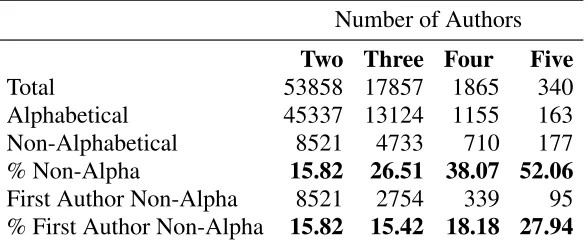
Alphabetical order is the norm for name order in joint research in economics. Table 1 reports the
prevalence of this norm. Around 85% of two-author economics papers are written with the authors
listed in alphabetical order.2
That percentage falls with more authors, possibly capturing the fear
of et al oblivion, or there could be research assistants involved.3
Compare this to the physical
sciences, in which first authorship is given — presumably not without occasional disagreement —
to the lead contributor, while other not-so-subtle signals such as lab leadership are sent through
ancillary ordering conventions. Possibly the civility of the alphabetical norm lends itself to more
joint work, as the possible rancor in settling on a name order at publication time is thereby avoided.
And yet, there are serious issues with alphabetical order:
1. Psychologically, names that appear first are more likely to be given “extra credit.” This order
effect is certainly in line with research on marketing: products presented earlier exhibit higher
probabilities of selection, as the aptly ordered article by Carney and Banaji (2012) observes. Even
stocks with earlier names in the alphabet are more likely to be traded; see another aptly ordered
paper by Jacobs and Hillert (2016), or Itzkowitz, Itzkowitz and Rothbort (2016).
2. Earlier names appear bunched together on a bibliographical or reference list, promoting the
citation of the paper. Haque and Ginsparg (2009) — aptly ordered again — note that article
po-sitioning in the ArXiv repository is correlated with citations of that article. Feenberg, Ganguli,
Gaule, and Gruber (2015) demonstrate that the same bias exists in the downloading and citation of
NBER “New This Week” Working Papers, which led to a change in NBER Policy.4
2Certainly, alphabetical order is occasionally overturned (see Table 1 again) and when it is, it is a clear signal that the
author who now appears first has done the bulk of the work. This option is central to the theory we develop.
3The influence of the et alpossibility is possibly captured better by papers in which only the first author is out of
alphabetical order; this percentage is, inevitably, lower as Table 1 reveals.
4An email from James Poterba dated September 2, 2015, states that “beginning next week, the order of papers in each
of the more than 23,000 “New This Week” messages that we send will be determined randomly. This will mean that roughly the same number of message recipients will see a given paper in the first position, in the second position, and so on.”
Number of Authors
Two Three Four Five
Total 53858 17857 1865 340
Alphabetical 45337 13124 1155 163
Non-Alphabetical 8521 4733 710 177
% Non-Alpha 15.82 26.51 38.07 52.06
First Author Non-Alpha 8521 2754 339 95
[image:4.612.161.455.75.196.2]% First Author Non-Alpha 15.82 15.42 18.18 27.94
Table 1. Alphabetical Order in Peer-Reviewed Journals in Economics. Sources and Notes. EconLit, 1969–2013, using the list of 69 leading economics journals in Engemann and Wall (2009).
3. There is at least one major journal in economics (the Review of Economic Studies) which
publishes articles in alphabetical order (using the last name of the first author). Because many
other journals use the convention that the lead article is special, and because many do not know
that the Review of Economic Studies follows this policy, this confers a potential advantage on
earlier names.
4. The et al convention, which is widely used in citations and especially on slides in seminars,
obscures the identity of later authors. Even if et al were to be banned in journal publications,
it cannot be banned from slides. In addition, it is widespread practice in verbal presentations
to mention the name of the first author and then add “and coauthors”: an understandable but
inequitable shortcut.
There is good evidence that these considerations matter. In a paper published in the Journal of
Economic Perspectives, Einav and Yariv (2006) write (we quote their abstract in full):
“We present evidence that a variety of proxies for success in the U.S.
econom-ics labor market (tenure at highly ranked schools, fellowship in the Econometric
Society, and to a lesser extent, Nobel Prize and Clark Medal winnings) are
correl-ated with surname initials, favoring economists with surname initials earlier in the
alphabet. These patterns persist even when controlling for country of origin,
eth-nicity, and religion. We suspect that these effects are related to the existing norm
in economics prescribing alphabetical ordering of authors’ credits. Indeed, there
psychology, where authors are credited roughly according to their intellectual
con-tribution. The economics market participants seem to react to this phenomenon.
Analyzing publications in the top economics journals since 1980, we note two
con-sistent patterns: authors with higher surname initials are significantly less likely to
participate in projects with more than three authors and significantly more likely to
write papers in which the order of credits is non-alphabetical.”
There are other papers that buttress the Einav-Yariv empirical findings; see, for instance, the
im-peccably hedged Chambers, Boath and Chambers (2001), or the unavoidably unordered van Praag
and van Praag (2008). Going beyond Einav and Yariv (2006), this last article finds “significant
effects of the alphabetic rank of an economist’s last name on scientific production, given that an
author has already a certain visibility in academia . . . Being anAauthor and thereby often the first
author is beneficial for someone’s reputation and academic performance.” Moreover, as they go on
to observe, the recognition accorded to earlier authors appears to cumulate over time: “Professor
A, who has been a first author more often than Professor Z, will have published more articles and
experienced a faster productivity rate over the course of her career as a result of reputation and
visibility.” A recent survey by Weber (2016) summarizes the literature thus: “there is convincing
evidence that alphabetical discrimination exists.”
2. NAME-ORDER CONVENTIONS ANDINSTITUTIONS
Social conventions — name-order norms here — may be viewed as equilibria that are immune to
deviations by individuals (or segments of the population). For instance, can private randomization
arise as a deviation from alphabetical order? Suppose that Jane Austen and Lord Byron, working
together,5 contemplate the randomization of their joint authorship, perhaps over a sequence of
papers. There are difficulties. Givenan “alphabetical society,” an order reversal is a clear signal
that the newly christened first author has done the bulk of the work. That is, “Byron and Austen”
would be a statement that Byron has done most of the research on the paper, whereas “Austen and
Byron” would indicate very little, any such signal being swallowed in most part by the naming
convention. Therefore Austen gains nothing over alphabetical order when her name comes first,
5This stretches realism a bit. Although Austen and Byron were contemporaries, there is no evidence of their
meet-ing, let alone collaborating. A key advantage of this pairing of coauthors is that it makes the use of “he” or “she” unambiguous.
while Byron gains a lot when his does.6Byron will agree to theex-anterandomization, but Austen
will not. This is true even when their randomization is recorded in the publication itself; say in
a lead footnote. After all, research often becomes visible through written citations and verbal
references rather than direct persual; see Section 7.1 for more discussion. We will formalize these
remarks by showing that alphabetical order is robust to deviations — deterministic or random —
given the set of alternatives available to authors today (Theorem 1).
But institutions can change that. Here is a simple variant of the randomization scheme which will
set it apart from private randomization. Suppose that any randomized name order is presented with
the symbol ® between the names; e.g., Ray ® Robson (2016) is the appropriate reference for this
paper. Suppose, moreover, that such a symbol is certified by theAmerican Economic Association,
for example, simply acknowledging that this alternative is available.
It is unclear that this “mutant” would successfully take over the population. But we are going
to argue that it will. The key point that makes this argument possible is that economics does
notentirelyfollow alphabetical order. There are exceptions, which occur when the author who is
lower down the alphabetical food chain has really contributed disproportionately. These exceptions
are made quite often. Table 1 shows that over 15% of two-author publications in the 69 leading
economics journals identified by Engemann and Waall (2009) have their names reversed. That
percentage rises significantly for three or more authors.
How are these exceptions made? Presumably the first author concedes the reversal in
circum-stances where the second author has made a much larger contribution. The exact source of the
concession is unimportant. It may be a sense of fair play or guilt. It may be an aversion to an
unpleasant conversation. It might be the result of a rational calculation made by the first author
when agreeing or disagreeing to reverse name order. For instance, the second author might refuse
to collaborate again with the first author if he feels he has been treated unfairly. We summarize
6Engerset al(1999) emphasize this point, arguing that alphabetical order candisadvantage“early authors,” because
a reversal can be used to signal a higher contribution by the late author, but there is no comparable signal for the early author. That may well be true, but on the other hand Engerset alhave no counterpart to the direct premium from first-authorship that we will posit. The empirical literature that we’ve discussed suggests that such a premium is a first-order consideration, and indeed it is the central motivation for our paper. The Engerset almodel does not generate the advantage to first authorship seen in the data, because the authors’ payoffs are only the Bayesian rational assignment of credit. For example, if authors are always listed alphabetically, then the credit assigned in their model will be equal.
all this by introducing a suitable loss function that is experienced by the first author if the second
author has a high contribution relative to the credit he publicly receives.
It will turn out that this capacity for name reversal also facilitates certified random order, but not
private randomization. The key reason that ® outperforms private randomization is that the
nota-tion ® is permanently attached to all subsequent references to the paper, whereas private
random-ization is not.7 Once certified random order is introduced, it breaks the alphabetical order
equilib-rium, even though this equilibrium is robust to the possibility of private randomization (Theorem
2). The reverse is not true: random order is robust to invasion by alphabetical order or by reverse
order (Theorems 3 and 4).
The possibility of successful invasion doesnotimply that the replacement is “socially better.” There
is a constant-sum component of the payoffs— if, for example, Austen achieves a higher credit
based on the social perception of her contribution, that necessarily reduces the social credit share
for Byron. However, the cost that is generated by a gap between an author’s actual contribution and
that imputed to him or her by society introduces a nonzero sum component to the payoffs. The two
conventions considered here can therefore differ in terms of the sum of expected payoffs. Theorem
5 illustrates this by comparing the new ® convention and the current convention for the tractable
special case in which the distribution of contributions is uniform. Here, ® achieves a higher sum
of expected payoffs than the Economics convention.8 In this example, then, any quasiconcave
Bergson-Samuelson welfare function defined over author payoffs would prefer random order to
alphabetical order.
To summarize, ® can be introduced not as a requirement but as a nudge, because our results predict
that it will invade alphabetical order in a decentralized way. It may provide a gain in efficiency.
But, more importantly, it is fairer. Random order distributes the gain from first authorship evenly
over the alphabet. Moreover, it allows “outlier contributions” to be recognized in both directions;
7Even if a lead footnote details the randomization, this information is lacking in subsequent references.
8There are other efficiency arguments. For instance, individuals put effort into doing research. Unequal division of the
credits from that research might be surplus-dominated — even Pareto-dominated — by equal division, as efforts adjust to the more equitable distribution of credits. This approach to team production with moral hazard is not followed here. Engerset al(1999) derive the contributions of authors from endogenous effort choices. They show that alphabetical order prevails over meritocracy in equilibrium, despite the greater efficiency of the latter (in their model). There are also possible efficiency losses from the strategic choice of co-authors when it is feared that lexicographic relegation to the end of the name order (or even to the anonymity ofet al) might lead to a decreased payoff. Einav and Yariv (2004) provide evidence that individuals further down the alphabet are more averse to writing with multiple co-authors. See Ray (2013) for notes on strategic choice of co-authors.
that is, given the convention that puts “Austen ® Byron” (or “Byron ® Austen”) on center-stage,
both “Austen and Byron” and “Byron and Austen” would acquire entirely symmetric meanings.
Finally, except for the addition of a simple symbol, random order is no more complex than the
existing alphabetical convention.
Now for the details.
3. A MODEL OF NAME-ORDERCONVENTIONS
Suppose a paper is worth a total credit of 1 unit. There are two authors: Austen and Byron.9Their
contributions are x and 1−x respectively, where x is distributed on [0,1] with strictly positive
density given byf. Ex post,(x,1−x)is observed by the authors but not by the public, who must
infer these shares from the social convention in force and the particular name order followed.
We allow for a general class of distributions, including those that are asymmetric. Asymmetry may
stem from co-author characteristics that are publicly observable, such as professor-student pairs,
or the presence of a particularly eminent co-author.
3.1. Conventions and Defaults. Letnbe a naming scheme—that is, alphabetical order (n=α),
reverse-alphabetical order (n = ρ), or certified random order (n = ®). We assume that, in each
naming scheme, names must be presented sequentially.10 There is some set of available naming
schemes. For the Economics convention, this set is formally {α, ρ}; for the certified random
order convention, it is enlarged to{α, ρ®}. We also permit private randomization across naming
schemes.
The use of a particular scheme sends signals about the contributions(x,1−x). But these signals
also depend on the namingconventionin place in society: a map from contributions(x,1−x)to
allowable naming schemes. For instance,pure meritocracyis the convention that choosesαwhen
x >1/2, andρwhenx <1/2. Pure alphabetical orderis the convention that choosesαno matter
what the contributions are.
A convention is associated with adefault action, one that either party can insist on. The Economics
convention is close to pure alphabetical order, with the occasional reversal of name order to signal a
9The analysis of three or more authors is an interesting open question.
10That is, in every scheme, one name is stated first, then the other. This is certainly true of any spoken scheme.
significant imbalance in contributions. We therefore suppose that the default under the Economics
convention is alphabetical order, which is invoked in the event of disagreement, and can be insisted
upon by either party.
3.2. Credit. LetA(n, C) andB(n, C)denote the socially imputed credits to Austen and Byron
respectively under convention C when the naming scheme n is followed. These social credits
are respectively the conditional expectations ofx and 1−xentailed by n under the convention
C. (These are not overall payoffs, which will include two other components to be described.)
Economics uses what might be described as a modified alphabetical convention Et with name
reversal when Austen’s contribution drops below some thresholdt. Then the use ofn = αyields
a credit of
(3.1) A(α, Et) = h(t)andB(α, Et) = 1−h(t)
to Austen and Byron respectively, whereh(t) stands for the expectation of Austen’s contribution
conditional on that contribution exceedingt. Likewise, ifρis observed, the corresponding credits
are
(3.2) A(ρ, Et) = l(t)andB(ρ, Et) = 1−l(t),
wherel(t)is the expectation of Austen’s contribution conditional on that contribution falling short
oft.11
Of course,A(n, C) +B(n, C) = 1; that is, a total credit of1is always being divided.12
3.3. Reputational Payoff. We suppose that each name order yields a gainδ >0in the reputation
of thefirstauthor in the order. This is due to visibility, bunching in reference lists, theet aleffect
and so on, and it accrues over and above the “direct credits”A(n, C)andB(n, C)that the public
will estimate. This reputational payoff is central to our model.
11By convention,l(0) = 0andh(1) = 1, whileh(0) =l(1)is the unconditional mean of Austen’s contribution. 12It is possible that name order also affects total credit. For instance, “Byron and Austen” will garner lessoverall
attention than “Austen and Byron” in a reference list. As Nageeb Ali pointed out to us, that could tilt both Austen and Byron towards “Austen ® Byron” over “Byron ® Austen”, so that, conceivably, Austen and Byron might add ® without actually randomizing. Whether Byron agrees to such a ploy depends on whether the “bibliography effect” dominates the even shot at having his name first. We are therefore assuming that the former effect is small relative to name arrangement. This issue could be addressed by requiring that all randomizations be carried out by the publishing outlet.
3.4. Loss Function. Our final component of the payoffs incorporates the disutility or loss
gener-ated when the imputed credit departs substantially from relative contributions. We summarize this
loss by a functionΓ, which is experienced by the author if her co-author has been treated badly. It
has as its argument thedifferencez between the true credit due to the co-author, and the inferred
credit that the co-author obtains in the public eye from the announced name order and the going
convention.13
For example, consider the Economics convention with thresholdt. Suppose that(x,1−x)are the
true contributions, whereas the inferred contribution from alphabetical order underEtis{h(t),1−h(t)}.
Then the shortfall for Byron iszB = [1−x]−[1−h(t)] =h(t)−x, and the resulting loss that
Austen experiences isΓ(h(t)−x).
We impose the following restrictions onΓ. First,Γ(z) = 0whenz ≤0. Second,Γis continuously
differentiable everywhere, strictly increasing and strictly convex forz ≥ 0.14 Finally, we impose
two conditions that concern extreme outcomes. Let mA and mB be the unconditional expected
contributions of Austen and Byron—that is, ofxand1−x, respectively. We assume that
(3.3) Γ (mA)> mA+δandΓ (mB)> mB+δ,
and
(3.4) Γ
1 2
≤1.
Condition (3.3) can be interpreted as follows. Suppose, for example, that Byron has doneallthe
work, and Austen none, so that(x,1−x) = (0,1). Austen is then offered a binary choice between
conceding full credit to Byron, thereby obtaining a payoff of 0, or taking the net payoff from
alphabetical order evaluated at her expected contribution, which is mA+δ−Γ(mA). Inequality
(3.3) states that Austen will wish to reverse authorship in this case. (A similar argument for Byron
13As mentioned above, there are multiple potential sources of such a loss. It could arise from a sense of fair-play,
for example, or it could instead serve as reduced-form expression for the future consequences of short-changing a co-author.
14The strict convexity ofΓmeans that each author is increasingly intolerant of a greater divergence between the actual
and imputed contribution of a coauthor. This implies that an author wants to concede first authorship to a co-author if the contribution of the latter exceeds a certain threshold, but not otherwise. See (4.3) below and the analysis around it. It might well be possible to require only thatΓbe convex beyond a certain point.
yields the second inequality in (3.3).) Without some such limitation on Γ, the co-existence of
alphabetical order and reversal, as in Table 1, would not be observed.
To understand (3.4), suppose that each author makes an equal contribution, so that x = 1/2, and
that there is noδ-premium to name order. Now Austen is offered the purely hypothetical choice
between being assigned full social credit for herself, with payoff 1−Γ(1/2), or conceding full
credit to Byron, which yields her0. Inequality (3.4) asserts that Austen would then weakly prefer
her name to go first, rather than reverse names. This assumption serves to limit the impact of the
loss term.
3.5. Overall Payoffs from a Convention. Consider any conventionCthat maps realized
contri-butionsxto a naming schementhat will be used in publication. Austen’s overall payoffs atxare
thenuA(C, x, n), which is
(i) her socially imputed credit fromn, which isA(n, C)plus
(ii)δif her name comes first undern,or0if it comes second;minus
(iii) the lossΓ(A(n, C)−x)generated bynatx, as described above.
A parallel formulation holds for Byron’s overall payoffuB(C, x, n). Note that a convention could
also include randomizations over name order for some realizations of x, in which case we take
expected values over the above payoffs.
3.6. Equilibrium Conventions. We now describe anequilibrium convention. We do not need to
specify the strategic interaction between the authors explicitly. We only require that it have the
following properties. Consider anyx∈[0,1]whereC(x) = n, say. Then:
[I] It cannot be that either author strictly prefers d to n, where d is the default naming scheme
under C. That is, if ui(C, x, d) > ui(C, x, n) for either i = A or i = B, then C(x) 6= n.
This requirement formalizes the favored role of the defaultd. In particular, given x, if for every
allowable non-default naming scheme, n0, some author strictly prefers dto n0, then dis the only
equilibrium naming scheme.
[II] It cannot be that both authors strictly prefer a scheme n0 to the implemented n. That is, if
Anequilibrium conventionis a convention satisfying [I] and [II] for everyx∈[0,1]. The existence
of such an equilibrium convention is established by construction in each of the cases examined
below. Here is a specific non-cooperative game with outcomes that satisfy [I] and [II].
Contributions(x,1−x)are revealed, and then Austen and Byron simultaneously propose an
out-come from the set of naming schemes available in the convention. If the same action is chosen by
both authors, this is implemented. If the two authors take differentnon-default actions, then the
default is implemented. Finally, if one author chooses the default, and the other another actionn,
then the author who chose the default naming scheme as the action is given the opportunity to agree
ton, or make a new proposaln0 of her own. If the counterproposal is accepted, it is implemented.
If not, the default is implemented.
3.7. Rational Disruption of a Convention. Suppose a new action is added to the set of allowable
actions in an equilibrium convention. For instance, suppose that ®, which does not exist in the
Economics convention, makes an appearance. We will model the payoffs from the use of ® as
arising from an accurate social perception of author contributions when this new action is taken.
More precisely, suppose that ® is available only to a vanishingly small group of coauthors, so that
the social assessment of all existing actions is undisturbed. This vanishingly small group has all
types(x,1−x)in it, with the same distribution as that in the population at large. On seeing ®,
suppose social credits of(a∗,1−a∗)are assigned. With credits assigned to all outcomes, suppose
that there is a non-negligible setP of types (within the negligible “mutant” group of coauthors) that
choose the new action in equilibrium; that is, for whom the the new action satisfies the equilibrium
conditions [I] and [II] of Section 3.6. Suppose moreover that (a∗,1−a∗)is the expectation of
(x,1−x), conditional on (x,1−x) ∈ P. Then we say that there has been arational disruption
of the existing equilibrium convention, and moreover, that the types inP haverationally deviated
from that convention.
3.8. Rational Disruption: A Discussion. Our notion of a rational disruption embodies the
ra-tional use of social expectations about the identity of “deviators.” This is captured by two
require-ments: the deviators see their deviation as “equilibrium play” in the situation with a new action,
and the public computes the expectation over all such deviator types to assign social credit.15
Rational disruption might be viewed as an equilibrium refinement. However, it differs importantly
from standard refinements, which trim beliefs emanating from unplayed but universally available
actions. We have here an action that is not available (initially at least) to most author pairs, but is,
nevertheless, correctly interpreted by the academic public who assess credit. A rational disruption
is then an equilibrium of a modified situation in which only a vanishingly small set of agents have
access to the new action. This small set retains the full type distribution. They will deviate if and
only if the public assessment of the new action makes it profitable to do so.16
The conceptual basis of the approach here is then different from that for standard refinements,
but it may still be illuminating to contrast the two approaches. To do so, we proceed informally,
supposing that there is a single player, Austen, in the first stage.17 For simplicity, we restrict
attention to the limiting case thatδ = 0, so that the signals are payoff-irrelevant.
In the Economics convention, where onlyα andρare used, Austen can readily be deterred from
adopting the new action ® by the accompanying belief that she made no contribution at all, so that
x = 0. What implications would the “intuitive criterion” of Cho and Kreps (1987, p. 202) have
here?18Does it rule out such “extreme” beliefs?
Consider then the set S(®)of Austen’s types who could not possibly gain from using ® relative
to the current equilibrium. However,anytypex ∈[0,1]could possibly gain from deviation, if the
15Our concept is therefore related to neologism-proofness (Farrell 1993), in that it permits certain types of author
pairs to profitably choose a fresh action, where the social evaluation of that action derives from the set of types who rationally deviate to that action.
16Hence a rational disruption is related to the notion of stability from evolutionary game theory. The definition of a
rational disruption assumes that the size of the mutant group isvanishinglysmall. This simplifies the argument, but it could be replaced by the requirement that the size of mutant group is positive butsufficientlysmall, at the cost of greater complexity.
17After all, in the Economics convention with alphabetical default, it is Austen’s preferences that are pivotal in
de-termining the name order chosen in equilibrium. A more general analysis, one that allows for other conventions as well, would have to account for Byron’s presence.
18The intuitive criterion is one of the best known equilibrium refinements. Cho and Kreps also provide a brief but
clear survey of the entire literature.
social assignment of credit following ® is favorable enough.19 HenceS(®) = ∅. Cho and Kreps
then ask if any type notin S(®)inevitably gains from using ®, where the support of the beliefs
involved excludesS(®). However,anytype can be made worse off after choosing ®, if the beliefs
this generates are unfavorable enough.20 The intuitive criterion is therefore satisfied, and it has no
effect in trimming relevant extreme beliefs here.
Our notion of “rational disruption” significantly restricts out-of-equilibrium beliefs relative to the
intuitive criterion. Out-of-equilibrium beliefs that will dissuade Austen from deviating are not
ruled out here by the intuitive criterion, as discussed. However, our requirement that there be a new
equilibrium where ® is available to a vanishingly small mutant group generates less unfavorable
beliefs, derived from the set of types who actually choose ®, and such a mutant group prospers.
4. THE ECONOMICSCONVENTION AS ANEQUILIBRIUM
In this section, we analyze theEconomics conventionEt, which is alphabetical order, modified by
name-reversal whenx < t, for some thresholdt > 0. Under this convention, using (3.1) applied
to realized credits(x,1−x), Austen’s utility fromαis
(4.1) A(α, E) +δ−Γ (zB) =h(t) +δ−Γ (h(t)−x),
while, using (3.2), her utility fromρis
(4.2) A(ρ, E)−Γ (zB0 ) = l(t)−Γ (l(t)−x).
The only options available are alphabetical order α or reverse-alphabetical order ρ (and private
randomizations over these schemes). We establish:
Theorem 1. There ist∈(0,1)such that the Economics conventionEtis an equilibrium.
We relegate proofs to the appendix, but we include this particular proof in the text as it helps to
understand the subsequent results.
19More precisely, Austen’s payoff in the Economics convention isl()−Γ(l()ifx≤andh()−Γ(h()−x)if
x > . Either of these payoffs is less than or equal tomaxb∈[0,1][b−Γ(b−x)].
20That is, Austen’s payoff in the Economics convention isl()−Γ(l()ifx≤andh()−Γ(h()−x)ifx > .
Proof. We solve for the value of x ∈ [0,1] at which Austen’s preferences between α and ρ
re-verse, and then use a simple fixed point argument to ensure it coincides with society’s anticipated
threshold,t. From (4.1) and (4.2), observe that Austen will weakly prefer to reverse when
(4.3) Γ (h(t)−x)−Γ (l(t)−x)≥∆(t) +δ,
where∆(t) ≡ h(t)−l(t). By strict convexity ofΓ, the left hand side is strictly decreasing in x,
and so there exists a uniquex∗ ≥ 0such that Austen will strictly prefer to reverse if and only ifx
is smaller thanx∗. In equilibrium,x∗ =t, so using (4.3),tmust solve
(4.4) Γ (h(t)−t)−Γ (l(t)−t) = Γ (h(t)−t) = ∆(t) +δ,
whenever it is strictly positive. Noting thatmA=h(0), Eq (3.3) guarantees such antexists.
We claim thatEtis an equilibrium convention. Whenx∈(t,1], Austen strictly prefersαtoρ(and
all randomizations overαandρ) because
Γ (h(t)−x)−Γ (l(t)−x) = Γ (h(t)−x)<Γ (h(t)−t) = ∆(t) +δ.
Thereforeαis the equilibrium outcome, by [I] of Section 3.6.
Whenx∈[0, t), Austen strictly prefersρtoαbecause
Γ (h(t)−x)−Γ (l(t)−x)>Γ (h(t)−t)−Γ (l(t)−t) = Γ (h(t)−t) = ∆(t) +δ.
When x ∈ [0, t], Byron also strictly prefers ρ to α, despite the possibility that he will now feel
he is treating Austen unfairly. It is sufficient to consider the case in which Austen has contributed
x = tbut only receives a credit ofl(t), in which case Byron receives the overall payoffδ+ [1−
l(t)]−Γ (t−l(t))on reversal. Underα, he gets1−h(t). Consequently, Byron will strictly prefer
reversal atx=tprovided that
(4.5) Γ (t−l(t))<∆(t) +δ.
Given (4.4) andΓincreasing, this condition holds if
(4.6) h(t)−t > t−l(t).
So proving (4.6) completes the argument.21Suppose, on the contrary, thath(t)−t ≤t−l(t). Then
t≥[h(t) +l(t)]/2soh(t)−t≤[h(t)−l(t)]/2 = ∆(t)/2. Using (4.4), we must conclude that
(4.7) Γ
∆(t) 2
≥∆(t) +δ.
Now, the functionΩ(z) ≡ Γ(z/2)−z is convex, with Ω(0) = 0. It follows that if Ω(z) > 0for
somez ∈(0,1], thenΩ(1)>0. It then follows from 4.7) that
Γ
1 2
>1,
but this contradicts (3.4).
So, when x ∈ [0, t), ρ is strictly preferred by both authors to α and therefore is the equilibrium
outcome, by [II] of Section 3.6.22
The same result holds if private coordinated randomization is allowed. That is, suppose Austen
and Byron agree to randomize name order by tossing a (possibly biased) coin at some(x,1−x).
The expected utility (to Austen) of such a coin flip is sandwiched between the two utilities fromα
andρ, so that if, say, the expected utility beats that fromα, it must in turn be bettered by the utility
fromρ. Generically (inx), such private randomization can never then occur.
Notice how the strict convexity of Γand the conditions (3.3) and (3.4) are necessary to get what
we see in practice. For instance, ifΓis linear, then Austen simply trades off units of her credit for
Byron’s. She will want to either always reverse, or never reverse. We see neither, which suggests
that the “marginal loss” climbs as Byron’s contribution climbs, for a fixed name order.
However, as already noted, the mere fact of being an equilibrium convention does not guarantee
robustness to rational disruptions. We now turn to an examination of this question.
21The argument that follows is needed repeatedly in the Appendix, where it is given as Lemma 3.
22Ifx= t, Austen is indifferent betweenαandρ, while Byron prefers reversal. This zero-probability case can be
resolved either way.
5. DISRUPTING EtWITHCERTIFIEDRANDOMORDER®
Certified random order ® is an option that is institutionally provided, say by a consortium of the
leading journals, so that the meaning of ® is commonly known. The question is whether such
certification can disrupt the Economics convention that utilizes αas the default but also involves
the occasional reversal toρ.
Given that the Economics convention is in effect, credits from the choice ofαorρwill continue to
be given by (3.1) and (3.2), wheretis pinned down by (4.4).23 Should Austen and Byron employ
random order for some realizations ofx? If they do, a new pair of payoffs will be generated. These
will consist ofδ/2to each (in expected value), plus possibly asymmetric socially assigned credits,
and any relevant loss terms. Of these three components, assigned credits will depend on society’s
view of just when the authors are agreeing to randomize. If, for instance, it is believed that they
are doing so on an interval of x-realizations that is symmetric around 1/2, and the densityf is
symmetric, then the credit will be split equally. The assignment of credit to previously unused
strategies is restricted as in the notion of a rational disruption, as described in Section 3.7.
Theorem 2. The equilibrium conventionEt is rationally disrupted by certified random order,®,
once this option is introduced. Almost all the author pairs in this rational disruption who have®
available and actually choose it are thereby made strictly better off.
The Appendix provides a complete proof of this central result. This proof is involved, but we
outline it here. Fix the equilibrium conventionEt, wheret is given by (4.4). Suppose that society
assigns an arbitrary social credit pair(a,1−a)to random order. For each such assignment, we find
two thresholds defined on the domain of Austen’s actual credit. One, which we callxα(a), is such
that Austen strictly prefers random order to alphabetical order if and only if her realized credit falls
below xα(a); (see Lemma 1). Another, calledxρ(a), is such that Austen strictly prefers random
order to reverse order if and only if her realized credit lies above xρ(a) (see Lemma 2). Over a
subdomain of thea’s, the former threshold lies above the latter, so there is a zone in which Austen
strictly prefers random order to both alphabetical and reverse order. Moreover, by an intermediate
value argument, there is a particular assignment of credita=a∗for which the conditional expected
value of Austen’s credit over this zoneequalsa∗.
23Recall that any rational disruption is adopted, at first, by a “small” fraction of the population of author pairs, so the
Definex∗1 ≡xρ(a∗)
andx∗2 ≡xα(a∗)
. The proof is completed by showing that in the zone(x∗1, x∗2),
® is a rational deviation, as in Section 3.6, while it cannot be a rational deviation outside the zone
[x∗1, x∗2].24 Recall that ® is Austen’s favorite outcome in(x∗1, x∗2). Moreover, we will also show that
Byron strictly prefers random order in this range to alphabetical order (see Lemma 4). Therefore
® strictly dominates the default and cannot be strictly dominated itself. Hence it is a rational
deviation in (x∗1, x∗2), in the light of [I] and [II] of Section 3.6. In contrast, forx > x∗2, Austen
strictly prefers the default to ®, so ® cannot be a rational deviation, by [I] of Section 3.6. And for
x < x∗1, Austen strictly prefers ρto ®, and it can be shown that Byron does too (see Lemma 5).
So ρstrictly Pareto dominates ®, so that the latter cannot be an “equilibrium choice,” by [II] of
Section 3.6. We therefore have a rational disruption of the conventionEt.
6. EQUILIBRIUM FOR THE RANDOM ORDER CONVENTION
We now analyze thecertified random order convention, in which the action ® is the default choice
for either author. The set of available actions is now{d, α, ρ}, where the default isd=®. The new
option entails the two players randomizing with equal probability over the name ordersα andρ,
with the ® symbol attached to each realized outcome.25
Formally, a certified random order conventionis described by two thresholds t andµ, such that
0 ≤ t < µ ≤ 1. If x ∈ [t, µ], the order of names is randomized, with the ® symbol invoked
for certification. The assumptions we have made will ensure that the randomization zone [t, µ]
is nontrivial. The other two zones [0, t) and (µ,1] may or may not be nonempty. These are the
“exception zones.” In the first of these, Austen’s contribution is small, andρis used. In the second,
Austen’s contribution is large, andαis used. Below, we show that at least one of these exception
zones is nonempty.
If the distribution of contributions is symmetric, it will turn out that there is a symmetric
equilib-rium convention; that is, there is t ∈ (0,1/2)such that (i) ifx < t then the outcome isρ, (ii) if
x >1−t ≡µthen the outcome isα, and (iii) ifx∈[t, µ]then ® is the outcome. Because at least
one exception zone is nonempty, both exception zones are now nonempty, by symmetry.
24The end-pointsx∗
1andx∗2have zero probability.
25Private correlated randomizations are also available, but they will never be used, and so we ignore them.
But there could be publicly observed situations — adviser-advisee pairs, research assistants, or the
presence of a particularly reputable scholar — in which that symmetry is not to be had. In such
situations we impose the following additional restriction. Recall thatΓ is strictly increasing and
continuously differentiable. Define:
G= inf
z>0
Γ0(z)z
Γ(z) .
Because Γ is strictly convex, G ≥ 1. (For instance, if Γ(z) = zk for z > 0 and some k > 1,
then G = k.) We assume that the density function of contributions f is such that the following
condition is satisfied: for every pair(t, t0)witht < t0,
(6.1) l(t0)−l(t)≤G[t0− e]andh(t0)−h(t)≤G[t0−t].
It is not hard to see that there exists a non-empty set off for which these conditions hold.26
6.1. Equilibrium With Certified Random Order. We maintain the description of co-author
in-teraction from Section 3.6. Specifically, contributions(x,1−x)are first revealed. Next, Austen
and Byron interact. It is presumed that no outcome to which either player strictly prefers the
de-fault can be an equilibrium. Further, if any outcome is strictly Pareto-dominated, it cannot be an
equilibrium outcome.
Theorem 3. Iffsatisfies(6.1), there exists an equilibrium random-order convention with thresholds
(t, µ), where t < µ, so that ®is always used over a range of relative contributions. Moreover,
eithert >0orµ <1or both, so that at least one of the exception zones is nonempty.
Iff is symmetric, there exists a symmetric equilibrium random-order convention where 0 < t <
µ= 1−t < 1, so randomization, alphabetical order and reverse alphabetical order are all used
under the convention.
26The simplest example is that of a uniform density: f(x) = 1 for all x ∈ [0,1]. In this case, l(t0)−l(t) =
(1/2)(t0 −t) < G(t0−t), sinceG ≥ 1. Similarly, h(t0)−h(t) = (1/2)(t0 −t) < G(t0−t). This condition suggests that density functions that are sufficiently close to uniform will also work. More precisely, consider (6.1) as it applies tol; the argument forhis analogous. Sincelis differentiable, it is sufficient to show thatdtdl ≤G. We have
l(t) =
Rt 0xf(x)dx
F(t) so that
dl dt =
f(t)
F(t)2
h
tF(t)−Rt
0xf(x)dx
i
. Suppose that the density function is bounded above and
below so thatf(x)∈[f , f], for allx∈[0,1], wheref ≥1 ≥f >0. SinceF(t)≤f tandR0txf(x)dx≥f t2/2, it
follows that dtdl ≤y2−y/2, wherey = f f. Hence
dl dt ≤Gif
f
f ≤1/4 +
p
G+ 1/16.That is, Eq (6.1) is satisfied
for all distributions whose density functions are suitably bounded above and below. The range of bounds is always non-empty, and becomes larger, with largerG.
The Appendix contains a detailed proof of existence; here is an outline of the argument. Suppose
that certified randomization carries the credits(m,1−m), where mcan be shown to be the
con-ditional expectation of x over a non-empty interval that containsm. For all contributions, x, by
Austen that are smaller thanm, define a functiontwheret(m)is Austen’s indifference threshold
for reverse orderρ(sett(m) = 0if she never wishes to switch). Likewise, for all contributions by
Austen larger thanm, letµ(m)be the analogous threshold for Byron for switching to alphabetical
orderα. Our assumptions on f guarantee thattandµare uniquely defined and continuous inm.
Therefore the mapping
m7→m0 ≡E(x|x∈[t(m), µ(m)])
is well-defined and continuous and so admits a fixed pointm∗. Lett∗ =t(m∗)andµ∗ =µ(m∗).
To prove that such a convention is an equilibrium, consider first the exception zone[0, t∗), provided
it is nonempty. By construction of our fixed point, Austen strictly prefersρ to ® in this region.
But we show this is true of Byron as well. Indeed, ρ is Byron’s favorite outcome whenx ≤ t∗.
Thusρstrictly Pareto-dominates the default and cannot be strictly Pareto-dominated itself, so it is
an equilibrium outcome in this range, by [I] and [II] of Section 3.6. By an analogous argument,α
is an equilibrium outcome whenxlies in the exception zone(µ∗,1].
To complete the argument, consider the randomization zone[t∗, µ∗]. In the sub-region(t∗, m∗], the
default ® is Austen’s favorite outcome, so it is the equilibrium outcome, by [I] of Section 3.6. (At
t∗, it remains a possible equilibrium outcome.) A similar argument involving Byron holds in the
sub-region[m∗, µ∗].
6.2. Do Rational Disruptions Exist? Consider now the possibility of rational disruptions from
the equilibria established in Theorem 3. By the definition of equilibrium, it is clear there can be
no rational disruption involving a name-order that is already in use. What if an exception zone is
empty? Suppose, for example, that0 =t < µ <1, so that the name orderρis not used for Austen
and Byron. Could there be a rational disruption based onρ? The following theorem describes the
possibilities:
Theorem 4. There can be no rational disruption of the equilibrium random-order convention
involving a name scheme already in use. Furthermore, ift = 0, there can be no rational disruption
toρ that involves any x < m∗; similarly if µ = 1, there can be no rational disruption toα that
uses anyx > m∗.
Theorem 4 states that ® is robust to rational disruptions that retain the “natural meaning” of the
name order used in the disruption. First, if both exception zones are nonempty — this is true in
the symmetric case — stability of the equilibrium to all disruptions is guaranteed, since all name
orders have established equilibrium meanings.
Now suppose that one of the exception zones — say the one that involves ρ — is empty. That
is, the order Byron-Austen is never observed, owing to some asymmetry in f. However, it is
reasonable to suppose there are other author pairs with a similar asymmetry but in the reverse
order. Suppose Charlotte Bronte and W.H. Auden are such a reversed pair. That is, Bronte’s1−x
in the Bronte-Auden pair is distributed the same way as Austen’sxin the Austen-Byron pair. Since
the order Austen-Byronis observed, so too must the order Bronte-Auden be observed, since the
random-order convention here has no intrinsic alphabetical bias. The Bronte-Auden order implies
that Bronte contributed the lion’s share. That is, a reversal of the alphabetic order has the “natural
meaning” that the author who is now first did most of the work. Hence, although the name order
ρdoes not arise for Austen and Byron, it arises elsewhere (for Bronte and Auden) and so it has an
established meaning. We restrict the meaning of the unused ρfor Austen and Byron to be thatx
(Austen’s contribution) is small relative to1−x.
Indeed, Theorem 4 states that no rational disruption by ρcan involve any x < m∗, where m∗ is
the mean contribution for Austen, conditional on being in the randomization zone. Hence
Aus-ten’s contribution cannot be small relative to that of Byron when such a surprise deviation toρis
observed.27
6.3. Efficiency Gain From the Random Order Convention: An Example. So far, we have
shown that the Economics convention is an equilibrium with the action set {α, ρ} but is subject
to rational disruption using the name order ®, once this option is introduced. On the other hand,
the random order convention is an equilibrium and is not subject to rational disruption from the
27The reason that there is no rational disruption by ρ that preserves the natural meaning ofρ is that the original
equilibrium was constructed allowing a role forρto signal a disproportionate contribution by Byron, but this role was not needed. Interestingly, we cannot rule out a rational deviation toρthat givesρa completely new interpretation— signaling that the contributions are intermediate between those for ® and those forα.
set {®, α, ρ}, if these orders are already used. If α or ρ is not used, there cannot be a rational
disruption that respects the natural meanings of these orders. Put another way, no intervention is
necessary to break out of the equilibriumEt convention or to remain in the ® convention. In this
section, we show further that the equilibrium ® convention may generate higher aggregate welfare
and is not simply fairer.
There is a clear basis for an efficiency advantage of ® over the Economics convention. The social
credit and the pure gain from first authorship, δ, are both constant-sum components of the two
players’ payoffs. The loss function terms, however, are not constant-sum. Certified random order
may then reduce loss on average since it uses three signals instead of two, permitting signals for
exceptional contributions for both Austen and Byron. That could then reduce the extreme values of
loss, and hence the average values as well. But this intuition is incomplete: it isa prioripossible
for the three ranges under ® to be so badly situated that the total expected payoff under Et is
greater. We therefore explore the issue further by considering, as an example, the analytically
tractable case of a uniform density of contributions.
Theorem 5. Assume thatf is uniform on[0,1]. Then a symmetric random order convention using
® is more efficient than the Economics conventionEt, in the sense of having a strictly higher sum
of expected overall payoffs for the two agents.
In this special case, at least, the case for ® does not rely on considerations of fairness. The sum of
the two agents’ expected utilities is higher under ® than underE, so thatanysymmetric
quasicon-cave welfare criterion (including Bentham’s additive utilitarianism) would strictly prefer ® toE.28
7. REMARKS AND EXTENSIONS
7.1. Private Versus Certified Randomization. The mechanism ofprivaterandomization is not
a novel one. In the simplest case, this involves two researchers flipping a coin to decide the order
of names and — in its most effective form — including a lead footnote to that effect. This has
been used previously on a number of occasions. The present mechanism of certified randomization
differs from such private randomization. In particular, the exact comparison of the two mechanisms
depends on the channel through which published papers come to the attention of other researchers.
28We assume that such a welfare criterion is defined on theexpectedutilities of the agents. This is appropriate if the
The present paper is motivated by the key channel of written citations to the paper in the
sub-sequent literature. In this case, certified randomization outperforms private randomization. What
is important here is that the symbol ® is maintained in subsequent references, whereas the lead
footnote with private randomization is not. This implies that private randomization can generate
only two permanently observed configurations for Austen and Byron—α or ρ, which limits its
effectiveness.
But there are other channels. The most obvious is direct viewing of the paper by another
re-searcher. Given that there is a lead footnote indicating private randomization, presumably noted
by the researcher, as is the symbol ® under our mechanism, the two mechanisms are essentially
equivalent, if direct viewing is the only channel. That is, there are four possible outcomes of a
collaboration between Austen and Byron under private randomization: α, ρ, αF or ρF , where
ρF , for example, means that the authors are listed as first Byron, then Austen, and there is a lead
footnote. These possibilities correspond precisely to the four possibilities under the ® mechanism,
with only notational differences. But the correspondence is weakened as written citations to the
paper co-exist with direct readings.
The last channel that seems worthy of mention concerns verbal and written allusions to the
pub-lished paper in seminars. What happens here depends on how exactly this citation is made. If the
symbol ® is retained (e.g., on slides), whereas the lead footnote escapes attention, the advantages
of our mechanism over private randomization remain. If no mention is made of ®, the effectiveness
of our mechanism — at least along this one dimension — will be reduced to match that of private
randomization. Certified randomization is always, then, at least as effective as private
random-ization, and, for at least one important channel, that of written citations in subsequent literature,
strictly more effective.
7.2. Partial Adoption by Journals. Our model shows that a small group of coauthors can
suc-cessfully invade theEt convention. What if adoption by journals were also incomplete to begin
with? What if theAmerican Economic Association, for instance, threw its weight behind this new
scheme, but other journals did not? If articles that were published in the American Economic
our analysis would apply with minimal reinterpretation. That is, partial adoption in these
circum-stances by journals would simply serve to scale down the effective size of the group using the new
convention, without changing the payoffs.
If other journals declined to print the symbol ® in their references, payoffs to an invading group
would be modified. These payoffs would now reflect a combination of the payoffs from a correct
interpretation of the symbol ®, and the old Economics equilibrium convention, since ® is
sub-sequently lost. If Austen knows that nobody will reproduce the ® in their citations, use of this
option is tantamount to her randomizing across αand ρ. Such randomization could occur at the
reversal thresholdt, and nowhere else. If more generally, a small fraction of citations respects the
new symbol in citations, then the fixed point argument used to obtain a rational disruption zone
should work much as it did before. This could generate a smaller disruption zone, but one that will
still overlap the thresholdt.
It would be useful if the AEA not merely adopted this new convention, but also used their influence
to pressure other journals adopt it as well, or at least to respect the new style by including ® in
references to AEA papers. However, the effect of the AEA using its influence like this would
merely be to speed up the evolution towards the new system; wider acceptance does not seem
crucial to ultimate success.
7.3. Other Conventions And Actions. In a world where contributions (x,1−x)are common
knowledge to the two authors, there are alternative conventions that can achieve higher degrees of
efficiency, and mutants built along those lines could invade the random order convention.
Indeed, there is a formal mechanism that attains full efficiency, as follows. Suppose that for each
x < 1/2, ρis used and x is appended to the names, whereas, if x ≥ 1/2, α is used and x is
appended. Neither agent then ever experiences any loss, so that overall expected payoffs are1 +δ,
which is the upper bound. Moreover, there can be no disruption of this convention that both authors
would participate in.
But such a mechanism pushes very hard the assumption that the agents have common knowledge
ofx. Presumably, agreement would be elusive and there would be endless bitter arguments about
the exact value ofx. Consider, on the other hand, a solitary pair of authors who disagree about the
disagree about the exact value ofx, it is enough that they agree it is in the range where a particular
name order is chosen. It is, furthermore, helpful that, in the random order convention, the default
can only be overturned by mutual consent. That is, even if Austen, for example, believes that x
warrants the naming schemeαwhereas Byron believes thatxwarrants the scheme ®, it is at least
clear to both authors that ® will be chosen.
7.4. Randomizing Citations. An alternative to our proposed mechanism would be to keep
pub-lished papers with the authors names’ listed alphabetically, but to randomize 50-50 each time a
citationis made.29 Such a randomization might be strictly socially optimal even with social
indif-ference between the two name orders. This would reflect randomization being assessed as a fair
means for allocating an indivisible item, as with “Machina’s Mom” (Machina 1989). We believe
that the ® mechanism has advantages over this scheme.
In the first place, as a practical matter, it would be hard to ensure that all researchers citing the paper
diligently randomize, as might be especially true in seminar presentations. Although it might be
possible to cite the famous paper as Douglas-Cobb instead of Cobb-Douglas, for example, it seems
it would be difficult to cite it sometimes as Cobb-Douglas and sometimes as Douglas-Cobb.30
Moreover, this alternative mechanism does not allow co-authors to indicate the infrequent (but
by no means exceptional) situation in which one of them has done the lion’s share of the work.
For example, the order of names describing the Stolper-Samuelson theorem signalled the greater
contributions of Stolper, as graciously acknowledged by Samuelson. This possibility would be lost
under the randomization of citations but is preserved — and made symmetric — under the certified
random order convention.
7.5. Strategic Authorship Decisions. Authors may choose whom to co-author with, given the
going convention. For instance, later authors may be more reluctant to engage in projects with
multiple co-authors, for fear of falling into et al oblivion. One might also make the converse
argument: that under alphabetical order, early authors are more willing to offer co-authorship to
late authors, knowing that this will have only a small effect on their payoffs, being listed first
29Leeat Yariv proposed this device, perhaps as a supplement to the mechanism here.
30However, it would be useful to find some way of equalizing credit forpastpublications, where ® cannot be
retro-actively imposed.
anyway.31 Indeed, Austen might be excessively eager to offer co-authorship to Zeno, anticipating
that “Austen and Byron” would now be transformed into “Austenet al.” Einav and Yariv (2006) find
some evidence for both these effects: late authors are more likely to be involved in publications
that involve non-alphabetical orderings; the effect is particularly strong when there are three or
more authors. It is also the case that early authors are more likely to be involved in four- or
five-author projects. A full accounting of these and other strategic factors in the selection of co-five-authors
demands a model; one of us has indeed written down a set of notes to this effect; Ray (2013).
7.6. Three Or More Authors. The entire analysis in this paper has been for the case of two
authors. While we foresee no great difficulty in extending the analysis to the case of three or
more authors, there are additional complications that will need to be addressed. For instance, one
possible choice would be partial randomization of the form:
[Zeno ® Byron] and Austen.
The best initial approach might be to rule out such possibilities and restrict attention to
randomiz-ation over the entire list; e.g.,
Zeno ® Austen ® Byron.
The extension of the analysis in this paper to such conventions should then be relatively
straight-forward.
8. CONCLUSIONS
In this paper we describe a scheme — certified random order — for assigning credit to papers
with two coauthors. We first characterize the current system of joint authorship as
modified-alphabetical, where the author who is earlier in the alphabet can offer first authorship to the other,
if the contributions are very unequal. This is motivated by a loss term for the earlier author.
The new scheme involves flipping a coin to determine first authorship and adding the notation
® to the list of the two authors when this has been done. In addition, we allow either author to
offer first authorship to the other, without the ® notation, again motivated by a loss term when the
contributions have been extremely unequal.
31We are grateful to Sahar Parsa and Phil Reny, both lexicographically challenged and clearly on the lookout for such
dangers, for this point.
We show that if such a scheme is made available, then it will enter into existing society via a
“rational disruption” of the existing convention based on alphabetical order. On the other hand,
there is no possibility of reverting to alphabetical order once in the new convention comes to
dominate. In short, we do not seek to impose such a system. We only claim that if it is offered, it
will be adopted. Moreover, we show that the new equilibrium convention may generate a higher
sum of expected utilities than does the old. The new mechanism would then be strictly preferred
on the basis of efficiency criteria, in addition to the core principle of fairness across authors.
The beauty of the mechanism ® is that it does not demand any more of the agents than does the
present Economics conventionE. The convention ® simply allows eitherplayer to concede first
authorship, instead of allowing only the first author to have this option, as in the conventionE.
Although such an option can lead to arguments, it is indeed exercised on occasion in reality.32
The analysis in this paper focuses on equilibrium conventions, ones where the alphabetical order
prevails or where certified random order prevails. A more complete analysis would examine the
full dynamical system in which both systems could co-exist. In the transition from an old to a new
convention, the default choice would have to switch at some point from the old convention default
to the new. The key issue is to model how this transition might occur.
In summary, certified random order: (a) distributes the gain from first authorship evenly over the
alphabet, (b) allows either author to signal credit when contributions are extremely unequal, (c)
will be willingly adopted even in an environment where alphabetical order is the default, (d) is
robust to deviations, (e) may dominate alphabetical order on the grounds of ex-ante efficiency, and
(f) with the minor exception of a simple symbol, it is no more complex than the old system.
REFERENCES
Carney, D. R. and Banaji, M. R. (2012), “First is Best,”PLoS ONE7(6), e35088.
doi:10.1371/journal.pone.0035088
Chambers, R., Boath, E., and Chambers, S. (2001), “The A to Z of Authorship: Analysis of
Influence of Initial Letter of Surname on Order of Authorship,”British Medical Journal323(22-29
Dec.), 1460–1461. doi:10.1136/bmj.323.7327.1460
32Flipping a coin and adding ® to the list of authors also entail costs, but these seem trivial.
Cho, I.-K. and D. Kreps (1987), “Signaling Games and Stable Equilibria” Quarterly Journal of
Economics102, 179-221.
Einav, L. and L. Yariv (2006), “What’s in a Surname? The Effects of Surname Initials on Academic
Success,”Journal of Economic Perspectives20, 175–188.
Engemann, K. and H. Wall (2009), “A Journal Ranking for the Ambitious Economist,” Federal
Reserve Bank of St. Louis Review91, 127–39.
Engers, Maxim; Gans, Joshua S.; Grant, Simon; and King, Stephen P. (1999) “First-Author
Con-ditions,”Journal of Political Economy107, 859-883.
Farrell, Joseph. (1993). “Meaning and Credibility in Cheap-Talk Games,”Games and Economic
Behavior5, 514-531.
Feenberg, Daniel R., Ganguli, Ina, Gaule, Patrick and Jonathan Gruber (2015) “It’s Good to be
First: Order Bias in Reading and Citing NBER Working Papers,” NBER Working Paper No.
21141.
Haque, A., and Ginsparg, P. (2009), “Positional Effects on Citation and Readership in arXiv,”
Journal of the American Society for Information Science and Technology 60 (11), 2203–2218.
doi:10.1002/asi.21166
Itzkowitz, J., Itzkowitz, J., and Rothbort, S. (2016), “ABCs of Trading: Behavioral Biases Affect
Stock Turnover and Value,”Review of Finance20, 663–692.
Jacobs, H. and Hillert, A. (2016), “Alphabetic Bias, Investor Recognition, and Trading Behavior,”
Review of Finance20, 693–723.
Machina, M. (1989), “Dynamic Consistency and Non-Expected Utility Models of Choice under
Uncertainty,”Journal of Economic Literature27, 1622-1668.
Ray, D. (2013), “All the Names: Some Strategic Consequences of Alphabetical Order in Joint
Research,” mimeo., New York University.
van Praag, C. M. and van Praag, B. M. S. (2008), “The Benefits of Being Economics Professor A
(Rather than Z),”Economica75, 782–796. doi:10.1111/j.1468-0335.2007.00653.
Weber, Matthias (2016) “The Effects of Listing Authors in Alphabetical Order: A Survey of the
Empirical Evidence.”
SSRN: http://ssrn.com/abstract=2803164, or http://dx.doi.org/10.2139/ssrn.2803164