Burton
A.
Cohen
1Charles F. Lanzieri
David S. Mendelson
Michael Sacher
George Hermann
John S. Train
Jack G. Rabinowitz
Received March 6, 1985; accepted after revision June 27,1985.
1 All authors: Department of Radiology, Mount
Sinai Hospital and School of Medicine of the City University of New York, New York, NY 10029. Address reprint requests to B. A. Cohen, Mount Sinai Medical Center, 1 Gustave L. Levy PI., New York, NY 10029.
AJNR 7:337-342, March/April 1986 0195-6108/86/0702-0337
© American SOCiety of Neuroradiology
337
CT Evaluation of the Greater
Sciatic Foramen in Patients
with Sciatica
Sciatic and lower extremity neurologic symptoms may be from pathologic involvement of the sacral plexus or sciatic nerve in the region of the greater sciatic foramen. Twenty-five patients were reviewed who presented consecutively over a 4 year period with sciatic symptoms secondary to pathologiC changes in the greater sciatic foramen. Malignant neoplasm alone (18 patients) and malignant neoplasm associated with infec-tion (two patients) account for most of these cases. Neurogenic tumors (three patients), both benign and malignant, and infection alone (three patients) were less frequent. Although sciatic symptoms usually derive from spinal abnormalities, the evaluation of sciatic symptoms should not be considered complete without CT scanning of the greater sciatic foramen.
The importance of computed tomography (CT) of the spine and sacrum in the evaluation of patients with sciatica and lower extremity neurologic symptoms has been well described [1-10]. Pathologic processes may involve the sacral plexus or sciatic nerve, causing lower extremity neurologic or sphincter symptoms by irritation of the long lumbar or sacral nerves. These processes may be occult to plain film or myelographic examination.
CT provides an accurate means of evaluating the sacrum and parasacral spaces including the greater sciatic foramen (GSF)
[1-3].
Therefore, it is an extremely important technique in the evaluation of sciatic symptoms in those patients with a negative workup for spinal pathology. In the absence of sciatic symptoms, CT is also quite helpful in evaluating the GSF and its structures and in determining thenature and extent of pelvic inflammatory and neoplastiC processes.
We retrospectively reviewed CT scans of 25 patients whose sciatic symptoms were demonstrated by CT to be caused by pathologic involvement of the GSF. We shall discuss the CT findings in these pathologic cases after briefly reviewing the
normal anatomy of this region.
Anatomic
Considerations
The GSF is an oval space in the posterolateral aspect of the pelvis. It is bordered by the ilium superiorly, the sacrum posteriorly, the ischium anteriorly, and the
sacrospinous ligament inferiorly. The GSF is traversed by several important struc-tures including the piriform muscle, the sciatic nerve, and vessels and nerves to
the internal obturator, quadratus femoris, and gluteal muscles.
On CT scanning, the piriform muscle and the sacrospinous ligament serve as
useful landmarks in evaluating the GSF. The piriform muscle originates on the
ventral surface of the sacrum and passes through the upper part of the GSF to
insert on the greater trochanter (fig. 1 A). It is the largest structure within the GSF
and serves as an easily identifiable landmark for the superior part of the GSF. The
sacral plexus resides on the anterior surface of the piriform muscle.
A
Fig. 1.-Normal greater sciatic foramen, axial images. A, Patient with bladder tumor and diverting colostomy for colon carcinoma. Piriform muscle (arrow) originating on lateral angle of sacrum passes through GSF. Sacral plexus (arrowhead) rests on anterior surface of piriform muscle.
e,
Caudad section in another patient. Sacrospinous ligament (large arrow), thin, gracilethe inferior
part of the
GSF (fig
.
1 B).
It
has a wide origin on
the inferolateral aspect of the sacrum and a narrow insertion
on the
ischial spine
.
The sciatic nerve can often be
identified
as a circular structure posterior to the ischial spine and lateral
to the anterior insertion of the sacrospinous ligament (fig
.
1 B)
.
Materials and Methods
The CT scans of 25 patients who presented consecutively over a
4 year period with a history of sciatic or lower extremity neurologic
symptoms and were found by CT to have pelvic pathology involving
the GSF were reviewed. The scans were obtained on a Pfizer 200
FS and a GE 8800 scanner in the axial plane using 13 and 10 mm
slice thicknesses, respectively. Scans were viewed at window
set-tings appropriate for soft tissue and bone detail. Intravenous contrast
material was used in all cases.
Pathologic proof was obtained in 17 patients by either
percuta-neous or surgical biopsy. Two of the other eight patients had
neuro-fibromatosis with other lesions noted, and six had well documented
malignancy.
Results
In a retrospective study
,
25 patients with sciatic or lower
extremity
neurologic
symptoms
and examined by CT were
found to have involvement of the
GSF by
tumor (neural and
non neural) or infection or a combination of both as an etiology
for their symptoms
(table
1)
.
In
most instances there was
clinical
suspicion
that the
cause of the
sciatic pain arose in
the
pelvis
;
thus, much of the traditional
workup was
elimi-nated
.
CT of
the
lumbar
spine
and/or myelography were
performed in cases 2, 4
,
11
,
24,
and 25 and were normal. Of
the 25 patients in our study
,
three suffered from
neurofibro-matosis with involvement of the GSF
.
In case 3 (fig
.
2)
,
a right
B
structure originating on inferolateral aspect of sacrum and inserting on ischial spine. Sciatic nerve (small arrow) can often be identified as circular structure posterior to ischial spine and lateral to anterior insertion of sacrospinous ligament.
foot drop and enhancing fullness of the right sciatic nerve
seen on multiple CT images was presumed to have
repre-sented a neurofibroma in a patient with known
neurofibro-matosis
.
One patient (case 1) presented with bilateral lower
extremity pain and weakness
.
On CT (fig. 3), she was noted
to have bilateral, large low-attenuation masses growing
through the GSF and displacing the gluteal muscles; biopsy
revealed that these low-attenuation masses represented
li-posarcomas.
Involvement of the GSF secondary to tumor was noted in
19 patients without history of neurofibromatosis
.
Tumor alone
was the cause in 17 patients and tumor with secondary
infection was noted in two. These diagnoses were confirmed
by biopsy in 13 patients and were presumed to represent
tumor recurrence or metastasis in six
.
Four patients suffered from diffuse bone metastasis with
involvement of the GSF
.
Case 5 had a right nephrectomy for
an adult Wilms tumor
.
CT (fig
.
4) demonstrated diffuse
de-structive bone metastasis with involvement of the left GSF
and sacral plexus by an enhancing soft-tissue mass
.
In a
patient (case 4)
who presented with right-sided sciatic
symp-toms,
CT demonstrated a mass destroying the
right side of
the bony pelvis growing into the right GSF. Further evaluation
by CT demonstrated a previously unknown hypernephroma
that was proven to represent the primary lesion in this patient.
Three patients presented with masses destroying the
sac-rum
.
In case 9
,
with right buttock and lower extremity pain,
CT (fig
.
5) demonstrated a large soft-tissue mass destroying
the sacrum and
filling
almost
the
entire
right
GSF. Surgical
biopsy demonstrated this to represent a primary
lipofibrosar-coma
.
AJNR:7, March/April 1986
CT OF GREATER SCIATIC FORAMEN IN SCIATICA
339
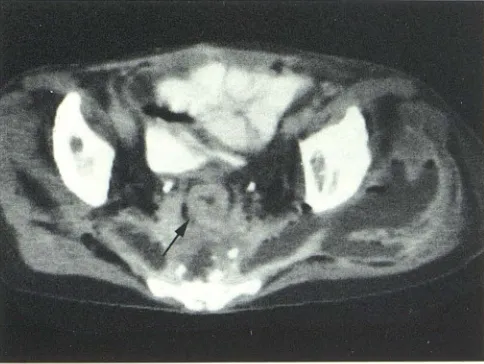
Fig. 2.-Case 3: neurofibromatosis and right-sided leg pain. CT demon-strates marked enlargement of right sciatic nerve (arrow).
Fig. 3.-Case 1: neurofibromatosis and bilateral leg pain and weakness. CT demonstrates bilateral, large, low-attenuation pelvic masses extending through GSF. Surgical biopsy revealed these to represent bilateral liposarcomas.
were noted to have tumor recurrence involving the GSF. In
one patient (case
11),
this represented direct extension of
tumor into the left GSF. In two cases, recurrent presacral
tumors were complicated by abscesses extending into the
GSF, bilaterally in case
12
(fig. 6) and into the right GSF in
case 13.
Four patients had involvement of the GSF due to
metas-tases to the iliac chain lymph nodes with encroachment on
the GSF
.
Cases 15 and 17 had lymph node involvement
caused by adenocarcinoma of unknown primary and prostatic
carcinoma, respectively
.
Case 14 (fig
.
7), status post total
abdominal hysterectomy and bilateral salpingo-oopherectomy
for endometrial carcinoma, was noted to have encroachment
on the left GSF from metastases to the left iliac node chain
.
Fig. 4.-Case 5: left-sided sciatica after nephrectomy for Wilms tumor. CT demonstrates mass destroying left side of sacnum and extending into GSF (arrow) to involve sacral plexus.
Case
16
presented with a large rectal mass with metastatic
involvement of the right obturator nodes extending into the
right GSF.
Four patients presented with masses in the gluteal muscles
extending into the GSF
.
Cases
20
and
21
had mass
involve-ment secondary to metastatic colon carcinoma and
liposar-coma, respectively
.
Cases 18 and 19 (fig
.
8) presented with
huge masses
,
in both cases representing melanoma involving
the gluteal muscles and extending into the GSF
.
Three patients presented with infection alone involving the
GSF. In two, cases 23 and 25, the abscesses originated from
the sacroiliac joint. In the third patient
,
case 24, the abscess
was secondary to tuberculous spondylitis with a psoas
ab-scess extending through the right GSF and involving the
gluteal muscles.
Discussion
Evaluation of the GSF is important when searching for the
causes of sciatica and essential when evaluating the pelvis in
patients with neoplastic and/or inflammatory disease
.
A
knowledge of the anatomy of the GSF is necessary for the
evaluation of this area and has been discussed
.
Distinct and well defined fascial planes surround the pelvic
and parapelvic structures
.
These planes may serve as
ave-nues of communication between the presacral and parapelvic
spaces
,
the retropsoas region, and the subgluteal regions (via
the GSF). There are reports
,
primarily in the surgical and
obstetric literature, that demonstrate that infectious
proc-esses involving the pelvic soft tissues have direct and easy
access to and through the GSF [8
,
11-16]
.
Kobak et al.
[15]
,
using radiopaque contrast material
,
demonstrated that
fluid injected into paracervical and parauterine tissues spreads
posteriorly into the presacral space and disperses laterally
.
Hibbard et al. [13] postulated that a pelvic infection can travel
[image:3.612.314.557.83.264.2] [image:3.612.55.297.83.264.2] [image:3.612.55.298.329.512.2](37, F) Neurofibromatosis; bilat- Bilateral low attenuation pelvic Biopsy Bilateral liposarcomas;
eral lower extremity masses growing through GSF neurofibromatosis pain and weakness
2 (35, F) Neurofibromatosis; right Multiple soft-tissue masses; mass in- Presumed Neurofibromatosis foot drop volving right GSF; bony
abnormal-ity
3 (62, F) Neurofibromatosis; right- Multiple neurofibromatous masses in- Presumed Neurofibromatosis sided leg pain cluding involvement of right sciatic
nerve
4 (64, M) . Right-sided sciatica Destruction of right ilium with mass Biopsy Hypemephroma; metas-growing into right GSF; scan of ab- tases to right ilium ex-domen demonstrated right hyper- tending into right GSF nephroma
5 (46, F) SIP right nephrectomy for Metastases involving both sides of Presumed Presumed metastases; adult Wilms tumor; left- bony pelvis; bone metastases on chemotherapy and im-sided sciatica left side of sacrum extends into munotherapy
GSF
6 (50, M). Hypernephroma; diffuse Soft-tissue masses destructive of Presumed Metastases; hyperne-bone pain; right-sided bone throughout pelvis; soft-tissue phroma primary sciatica masses extending into right GSF
7 (65, F) Bilateral hip pain; right Multiple masses destroying bone; Biopsy Adenocarcinoma,
un-foot drop mass in right GSF known primary
8 (62, M) . Severe left sciatica; SIP Destruction of sacrum extending into Biopsy Metastatic rectal cancer abdominal perineal re- left GSF
section
9 (70, F) Right buttock and lower Large mass destroying sacrum, in- Biopsy Lipofibrosarcoma extremity pain volving rectum, extending into right
GSF and right gluteal muscles
10 (40, F) Left-sided sciatic pain Enhancing mass destroying sacrum, Surgical biopsy and Chordoma involving left GSF partial resection of
sacrum
11 (73, F) SIP low anterior resec- Metallic clips posterior to bladder; Treated empirically Presumed metastatic co-tion; left-sided sciatica mass in left GSF with radiotherapy; Ion carcinoma
did well symptomat-ically
12 (53, M). SIP anterior resection for Recurrent tumor; abscess extending Bilateral percutaneous Bilateral trans-GSF ab-colon carcinoma; left- through right GSF; abscess ex- drainage, producing scesses; recurrent tu-sided sciatica; right- tending through left GSF purulent material mor
sided sciatica
13 (53, M) . Rectal carcinoma; SIP Recurrent mass in presacral space; Percutaneous drain- Recurrent tumor abscess abdominal perineal re- abscess in right buttock extending age and biopsy
section; right-sided through GSF; SIP percutaneous sciatica; point tender- drainage with catheter extending
ness through GSF
14 (57, F) SIP TAHBSO for endo- Mass involving left iliac lymph nodes, Presumed Presumed metastases;
metrial carcinoma; left- extending into GSF chemotherapy
sided sciatic pain
15 (44, F) Left-sided sciatica; SIP Enlargement of left iliac nodes ex- Surgical biopsy Adenocarcinoma;
un-T AHBSO for benign tending into GSF known primary
disease
16 (66, F) Right-sided SCiatica; large Massive lymphadenopathy; large rec- Surgery Rectal carcinoma; meta-pelvic mass tal mass; soft tissue fullness in re- static lymphadenopathy
gion of right obturator nodes in-volving piriform muscles
17 (52, M). Prostatic carcinoma; Large, irregular prostate; soft-tissue Presumed Metastatic prostatic carci-right -sided sciatica fullness in region of sacral plexus noma
most likely representing obturator nodes; bony abnormality
18 (68, M) . Bilateral lower extremity Bilateral masses in upper abdomen Biopsy Melanoma pain and weakness involving left gluteal muscles and
left GSF
19 (60, M) . Melanoma; right sciatic Intraabdominal masses; large mass Surgical biopsy Melanoma symptoms involving right gluteal muscles
ex-tending into right GSF
20 (74, F) Left-sided sciatica; history Intraabdominal masses and Iymphad- Presumed Metastatic colon carci-of colon carcinoma enopathy; mass in left gluteal mus- noma
[image:4.612.56.557.93.735.2]AJNR:7, March/April 1986 CT OF GREATER SCIATIC FORAMEN IN SCIATICA 341
TABLE 1: continued
Case No.
Clinical History CT Findings Diagnostic Procedures Diagnosis
(age, gender)
21 (40, M). Severe right -sided sci- Soft-tissue mass in right gluteal mus- Surgery Liposarcoma
atica cles involving right GSF
22 (59, F) Severe right-sided sci- Large, irregular low-attenuation mass Percutaneous biopsy Adenocarcinoma of un
-atica; adenocarcinoma involving right GSF known primary
of unknown primary in liver
23 (28, F) Right-sided sciatic pain Low attenuation process involving Surgery Sacroiliac abscess
right iliopsoas and obturator mus
-cles extending to right GSF
24 (73, F) Low back pain 2 years; Destruction of L4; psoas abscess Percutaneous aspira- Tuberculous abscess
right thigh pain 2 communicating with large right glu- tion
months teal abscess via GSF
25 (46, F) Left thigh pain and sci- Osteomyelitis sacroiliac joint with as- Percutaneous aspira- Staphylococcal abscess
atica sociated abscess involving GSF tion
Fig. 5.-Case 9: right buttock and lower extremity pain. CT demonstrates large pelvic mass destroying sacrum and extending through GSF into right
buttock. Surgical biopsy demonstrated lipofibrosarcoma.
Fig. 6.-Case 12: severe bilateral sciatic symptoms. CT demonstrates rectum (arrow) to be anteriorly displaced by partly necrotic mass. Calcified densities in region of mass. Fluid collections extend into GSF bilaterally with air-fluid levels noted on left. Bilateral trans-GSF abscesses and recurrent tumor were diagnosed. Treatment was by percutaneous abscess drainage.
downward along the sciatic nerve roots through the GSF, or upward below the border of the psoas muscle to cause a retropsoas abscess. Spread of infection through the GSF via the fascial planes of either the pudendal nerves and vessels [12], the gluteal vessels, or the piriform muscle [8] has also been suggested. Hermann et al. [16] reported a case (included in our series) in which CT demonstrated a psoas abscess secondary to tuberculosis at
L4-L5
.
This inflammatory pro c-ess descended along the psoas muscle through the GSF to the gluteal region and extended to the posterolateral aspect of the upper thigh. [image:5.612.57.563.264.455.2] [image:5.612.57.299.508.690.2]malig-Fig. 7.-Case 14: left-sided sciatica. After total abdominal hysterectomy
and salpingo-oopherectomy for endometrial carcinoma, CT demonstrates met -astatic involvement of left iliac lymph node chain extending to left GSF.
Fig. B.-Case 19: severe pain in right leg in melanoma patient. CT
demon-strates huge mass involving right gluteal muscles and extending into GSF.
nant
,
may arise within the GSF
.
When benign
,
these are often
of neural origin
.
Woolfitt et al. [19] have reported the CT
demonstration of primary neurofibrosarcoma involving the
femoral nerve. We have noted bilateral primary liposarcomas
and presumed benign neurofibromas involving the GSF and
diagnosed by CT in patients with neurofibromatosis
.
Such
tumors probably arise from the sacral plexus or sciatic nerves.
We have demonstrated primary tumors of the sacrum
involv-ing the GSF
.
In our series the most common cause of GSF
i
nvolvement by tumor has been metastatic disease.
The role of CT in the examination of the pelvis
,
especially
the GSF
,
in patien
t
s complaining of sciatica must be stressed
.
Our cases indicate that a variety of inflammatory and neo
-plastiC processes may
involve
the GSF and can be
demon-strated to best advantage by CT. All of our patients had a
history of lower extremity neurologic symptoms that were
f
rom
i
nvolv
e
ment of the sciatic nerve or sacral plexus by a
aspiration is often a definitive treatment. We maintain that a
negative workup of the patient with sciatica should not be
considered complete without CT of the pelvis and GSF.
We recommend that patients with sciatica who have normal
lumbar myelography and CT scans or in whom there is clinical
suspicion of pelvic pathology have a CT evaluation of their
greater sciatic foramen.
ACKNOWLEDGMENT
We thank Louisa Haigler for assistance in manuscript preparation.
REFERENCES
1. Lanzieri CT, Hilal SK. Computed tomography of the sacral plexus
and sciatic nerve in the greater sciatic foramen. AJNR 1984;
5:315-318
2. Whelan MA, Gold RP. Computed tomography of the sacrum: 1.
Normal anatomy. AJNR 1982;3:547-554
3. Gilula LA, Murphy WA, Tailor CC, Patel RB. Computed
tomog-raphy of the osseous pelvis. Radiology 1979;132: 107-114
4. Whelan MA, Gold RP. Computed tomography of the sacrum: 2.
Pathology. AJNR 1982;3:555-559
5. Batnitzky S, Soye I, Levine E, Price HI, Hart KZ. Computed
tomography in the evaluation of the lesions arising in and around
the sacrum. Radiographics 1982;2:500-528
6. Turner ML, Mulhern CB, Dalinka MK. Lesions of the sacrum.
JAMA 1981;245:275-277
7. Soye I, Levine E, Batnitzky S, Price HI. Computed tomography
of sacral and presacral lesion. Neuroradiology 1982;24:71-76
8. Meshkov SL, Seltzer SE, Finberg HJ. CT detection of
intraab-dominal disease in patients with lower extremity signs and
symptoms. J Comput Assist Tomogr 1982;6:497-501
9. Carrera GF, Williams AL, Haughton VM. Computed tomography
in sciatica. Radiology 1980;137:433-437
10. Federle MP, Moss AA, Margolin FR. Role of computed
tomog-raphy in patients with sciatica. J Comput Assist Tomogr 1980;4: 335-341
11. Wolverson MK, Jagannadharao B, Sundaram M, Heiberg E,
Grider R. Computed tomography in the diagnosis of gluteal
abscess. J Comput Assist Tomogr 1981;5:34-38
12. Wenger DR, Gitchell RG. Severe infections following pudendal
block anesthesia. J Bone Joint Surg 1973;55:202-207
13. Hibbard LT, Snyder EN, McVann RM. Subgluteal and retropsoal
infection in obstetric practice. Obstet Gyneco/1972;39: 137-150
14. Svancarek W, Chirino 0, Schaefer G, Blythe JG. Retropsoas and
sUbgluteal abscesses following paracervical and pudendal anes
-thesia. JAMA 1977;237:892-894
15. Kobak AJ, Sadove MS, Mazeros WT. Anatomic studies of
trans-vaginal regional anesthesia. Obstet Gyneco/1962;19 :302-31 0
16. Hermann G, Mendelson DS, Cohen BA, Train JS. Role of
com-puted tomography in the diagnosis of infectious spondylitis. J
Comput Assist Tomogr 1983;7:961-968
17. Kelvin FM, Forobkin M, Breiman RS, et al. Recurrent rectal
carcinoma in an asymptomatic patient. J Comput Assist Tomogr
1982;6: 186-188
18. Husband JE, Jodson NJ, Parsons CA. The use of computed
tomography in recurrent rectal tumors. Radiology 1980;
134:677-682
19. Woolfitt RA, Brantly PN, Neal RK. CT demonstration of
neurofi-brosarcoma causing femoral neuropathy. J Comput Assist