In insects, juvenile hormone (JH) plays a decisive role in regulating a multitude of physiological processes (for a review, see Kumaran, 1990). In Schistocerca gregaria and other locusts, which by definition are able to occur in two distinct phases, research has been focused on phase-related differences in JH titre (for reviews, see Applebaum et al., 1997; Pener, 1991; Pener and Yerushalmi, 1998). Juvenile hormone affects a number of aspects of behaviour in desert locusts, including phase behaviour (Wiesel et al., 1996), sexual behaviour (Amerashinge, 1978) and spontaneous locomotor activity (Odhiambo, 1966). Although the aggregation behaviour of gregarious locusts has attracted attention over recent years, with emphasis on its behavioural significance (Obeng-Ofori et al., 1993; Obeng-Ofori et al., 1994; Torto et al., 1994) and the central nervous integration of aggregation pheromones (Anton and Hansson, 1996; Hansson et al., 1996; Ignell et al., 1998; Ignell et al., 1999; Ochieng’ and Hansson 1999), nothing is known about the endocrine regulation of this behaviour (Pener, 1991). The aggregation of locusts, long known to be a crucial stage in the gregarisation process, i.e. the transition between the solitary and gregarious phases (Hassanali and Torto, 1999; Pener, 1991; Roffey and Popov, 1968), is fundamental to our understanding of the behavioural ecology and physiology of these species.
In the present study, we evaluated age-dependent changes
in the behavioural response of adult gregarious desert locusts to the major aggregation pheromone component phenylacetonitrile, which has been reported to be intrinsically the most potent component in eliciting the aggregation response in adult locusts (Obeng-Ofori et al., 1994; Torto et al., 1994). Previous data reporting age-dependent changes in the rate of JH biosynthesis by the corpora allata (CA), the retrocerebral gland producing JH (Avruch and Tobe, 1978; Dale and Tobe, 1986; Tawfik, 1995; Tobe and Pratt, 1975), enable us to postulate a link between JH and behavioural changes. The rate of JH biosynthesis in both male and female adult locusts is low during the first 2 days following adult emergence but increases gradually during the first week (Avruch and Tobe, 1978; Dale and Tobe, 1986; Tobe and Pratt, 1975). During the second and third weeks, the daily rate of JH biosynthesis displays significant fluctuations but remains high in both males and females. Reflecting changes in the rate of JH biosynthesis, haemolymph JH titre also increases during the first 2 weeks following emergence (Couillaud et al., 1985). Although daily JH titre measurements are lacking, it seems that the JH titre remains high until at least 4 weeks of age because a high JH titre has been reported in 30-day-old locusts (Tawfik, 1995).
To measure possible behavioural changes induced by the naturally fluctuating JH titre, we employed a simple Printed in Great Britain © The Company of Biologists Limited 2001
JEB3022
In desert locusts Schistocerca gregaria, aggregation behaviour is elicited by aggregation pheromones. In this study, we show that the behavioural response to the major and most potent adult aggregation pheromone component, phenylacetonitrile, is age- and juvenile-hormone-dependent. Furthermore, we show that juvenile hormone influences the responsiveness of olfactory interneurons in the antennal lobe to aggregation pheromone, whereas the responsiveness of antennal receptor neurons is not changed. Old locusts and locusts injected with juvenile hormone, in contrast to young locusts and locusts deprived of juvenile hormone through allatectomy, i.e. after surgical removal of the gland producing this hormone, do not
display any aggregation behaviour, as indicated by long-term behavioural observations. The lack of positive olfactory-guided behaviour coincides with an impairment of the central olfactory system, which displays a lower number of neurons responding to aggregation pheromone. Indirect and direct actions of juvenile hormone at different levels of the central nervous system may thus contribute to the regulation and modulation of behavioural responsiveness in the locust.
Key words: Schistocerca gregaria, juvenile hormone, behaviour, electrophysiology, antennal lobe, olfactory processing.
Summary
Introduction
JUVENILE-HORMONE-MEDIATED PLASTICITY OF AGGREGATION BEHAVIOUR
AND OLFACTORY PROCESSING IN ADULT DESERT LOCUSTS
RICKARD IGNELL1,*, FRANCK COUILLAUD2 ANDSYLVIA ANTON1
1Department of Ecology, Lund University, SE-223 62 Lund, Sweden and 2Institut François Magendie, Laboratoire de
Neurobiologie Fonctionelle, Unité INSERM 378, 1 rue Camille Saint Saens, 33077 Bordeaux Cedex, France
*e-mail: [email protected]
classification of locust behaviour suggested by previous studies (Obeng-Ofori et al., 1993; Roessingh et al., 1993). Behavioural tests were also performed on allatectomized locusts (i.e. locusts deprived of the corpora allata) and JH-injected locusts to establish the direct and indirect effects of JH on their aggregation behaviour.
The aggregation behaviour of adult locusts is elicited by aggregation pheromones emitted by sexually mature males. These pheromone components are detected by antennal receptor neurons (RNs) (Hansson et al., 1996; Ochieng’ and Hansson, 1999) and integrated by interneurons in the antennal lobe (Anton and Hansson, 1996; Ignell et al., 1998; Ignell et al., 1999). Electrophysiological studies in other species have emphasised the age- and JH-dependent plasticity of antennal RNs (Diptera, Bowen, 1991; Crnjar et al., 1990; Hymenoptera, Masson and Arnold, 1984; Sigg et al., 1997; Vetter and Vissher, 1997; Lepidoptera, Seabrook et al., 1979) or of antennal lobe interneurons (Lepidoptera, Anton and Gadenne, 1999), thereby regulating the behavioural responsiveness of the insect.
To evaluate the influence of JH on the central nervous integration of aggregation pheromones, we examined both the antennal response and the response characteristics of antennal lobe interneurons in adult gregarious locusts of different ages and of different hormonal status.
Materials and methods Animals
Fifth-instar gregarious desert locusts Schistocerca gregaria (Forskål) originating from Blades Biological, Cowden, Edenbridge, UK, were reared as described previously (Ignell et al., 1998). After adult emergence, locusts were marked with number tags enabling the identification of individuals throughout the experiments. For behavioural experiments, adult male and female locusts were divided into four experimental groups: (i) control; (ii) allatectomized; (iii) sham-operated; and (iv) JH-injected. Surgical removal of the corpora allata (Strong, 1965) and sham operations were performed 2 days after adult emergence. Juvenile hormone III, the JH type identified in S. gregaria (JHIII; racemic mixture, Sigma; 50µg in 1µl of olive oil), was injected into the abdomen of the locusts on days 1, 2 and 3 after adult emergence.
Behavioural assay
Bioassays were performed in a single-chamber two-choice olfactometer (Obeng-Ofori et al., 1993). Compressed air, after purification through a charcoal filter, was split into two streams, with each stream passing through a 2 l round-bottomed flask before being directed into either the control or the treatment area of the olfactometer (60 cm×30 cm×30 cm) through perforations in its floor. The flow rate was 120 ml min−1 for each stream. The test stimulus, 1 mg of phenylacetonitrile (Sigma), was dissolved in 2 ml of paraffin oil (Merck) in a 3.7 ml vial (Torto et al., 1994) and placed in
one of the flasks of the olfactometer. Paraffin oil, acting as the control, was placed in a similar vial in the other flask. The position of the two flasks was changed randomly between trials, and connector tubings and flow meters were flushed with clean air and changed regularly to minimise contamination. In addition, the olfactometer was cleaned with acetone, and the metal top and bottom were heated at 300 °C for 2 h to prevent contamination effects.
Shortly (1–2 h) prior to the experiments, locusts were placed individually in 250 ml plastic jars and transferred to the room in which the experiments were performed, which was kept under the same conditions as the rearing room. Single locusts were introduced into the olfactometer by tilting the jar a few centimetres above the non-perforated central part of the olfactometer. This procedure did not seem to affect the behaviour of the locusts.
Aggregation behaviour was assayed 1, 8, 15, 22 and 29 days after adult emergence for control locusts, with each day representing a trial period, and at 8, 15, 22 and 29 days after adult emergence for allatectomized locusts. To disregard any effects of the operation per se, sham-operated locusts were also assayed at the same times as allatectomized locusts. JH-injected locusts were assayed only at day 8 after adult emergence. The experiments were performed on 30 individuals per trial period for both male and female locusts. To assess behavioural changes in individuals over a longer period, we assayed half the locusts in each experimental group throughout the treatment period. The remaining locusts in each experimental group were assayed only once within one trial period and then discarded. No significant behavioural differences, tested using a two-way analysis of variance (ANOVA) without cell replication, were found between these groups, and we therefore considered each behavioural observation as independent.
location of the insect, which was used to calculate an aggregation index.
Analysis of behavioural data
The aggregation index (AI) (Obeng-Ofori et al., 1993; Obeng-Ofori et al., 1994; Torto et al., 1994) was calculated as 100(T−C)/N, where T is the number of locusts found in the treatment area, C is the number of locusts found in the control area and N is the total number of locusts tested. Differences between experimental groups were analysed using the χ2-test on raw data, applying the Bonferroni correction to limit the overall experiment-wise error rate (Obeng-Ofori et al., 1993). The net behavioural response to phenylacetonitrile was calculated by subtracting the frequency of each behavioural variable exhibited in the control area from the frequency of each behavioural variable exhibited in the treatment area. The behaviour displayed in the control area was generally found to be constant throughout the trial period. Differences in behavioural variables between experimental groups and between sexes were analysed using the χ2-test on raw data, applying the Bonferroni correction to limit the overall experiment-wise error rate.
Electroantennograms
Electroantennograms (EAGs) were recorded from excised antennae of (i) 8- and 29-day-old control and allatectomized locusts and (ii) 8-day-old JH-injected locusts using standard procedures (e.g. Hansson et al., 1991). Stimulation was performed as described previously (Ignell et al., 1998): a random application of stimuli with a minimum interstimulation period of 1 min. Representative behaviourally significant compounds were used as stimuli: (i) a blend resembling the adult aggregation pheromone (phenylacetonitrile:guaiacol:phenol:benzaldehyde:veratrole in the proportion 80:3:3:5:4); (ii) a possible S. gregaria sex pheromone (E,Z)-2,6-nonadienal, which is also a minor component of a preferred host plant Tribulus terrestris (Zygophyllaceae) and (iii) an oviposition aggregating pheromone component, acetophenone. Each compound was prepared as a serial dilution in diethyl ether in increasing concentrations from 1 ngµl−1 to 100µgµl−1. For each stimulus dosage, a 10µl sample was applied to a filter paper. A green leaf volatile, E-2-hexenal (100µg), was used to check the responsiveness of the antennae. Differences in EAG amplitude between experimental groups and between sexes were tested using repeated-measures ANOVAs (Ochieng’, 1997).
Intracellular electrophysiology
Intracellular recordings from antennal lobe neurons were performed on 8- and 29-day-old controls, on 29-day-old allatectomized and on 8-day-old JH-injected male and female locusts. Responses of antennal lobe neurons were recorded in at least 20 locusts for each experimental group and trial period, with the total number of recorded neurons ranging from 93 to 130 in each case. Standard intracellular recording methods
were used (Christensen and Hildebrand, 1987). The preparation and stimulation procedure have been described in detail elsewhere (Anton and Hansson, 1996; Ignell et al., 1998). As stimuli, we used behaviourally active blends resembling adult- and nymph- (guaiacol:phenol 60:40) produced aggregation pheromones and their single components, as well as acetophenone, (E,Z)-2,6-nonadienal and plant volatiles (hexanoic acid, E-2-hexenal). The responses of antennal lobe neurons to this range of compounds were tested using 1 mg of each component on the filter paper in the stimulating pipette. Up to seven antennal lobe neurons were tested in each individual locust.
A neuron was defined as non-responding if its spike frequency over the 600 ms after the onset of stimulation did not exceed its spontaneous spike frequency over the 600 ms before stimulation by more than 10 % for any of the stimuli tested. Only neurons for which at least all blends and all single components not present in the blends had been tested were taken into account. A locust was defined as non-responding if at least three neurons had been tested and none of them responded to any stimulus. Differences in the number of non-responding neurons and locusts between experimental groups were analysed using the
χ2-test on raw data, applying the Bonferroni correction to limit the overall experiment-wise error rate.
Results
Behavioural responses of control and sham-operated locusts Control and sham-operated locusts displayed no significant differences in their behavioural response to phenylacetonitrile, and the results were therefore combined. Male and female locusts displayed different age-dependent changes, as shown by their aggregation indices (Fig. 1), and in four of the observed behavioural variables: the frequency of inactivity, of walking, of leg movement and of antennal movement (Fig. 2). Aggregation indices and behavioural variables of control and sham-operated male locusts displayed age-dependent changes. The AI increased between day 1 and day 8 and then decreased stepwise to reach values close to zero at the end of the observation period, i.e. male locusts were initially attracted by the aggregation pheromone and later did not show any preference for either of the experimental areas (Fig. 1). The frequency of walking and of leg and antennal movements in the treatment area increased up to day 15 and decreased after day 22 (Fig. 2).
The behavioural responses of control and sham-operated female locusts were similar to those of male locusts. We observed some sex-dependent differences, but they were not significant. In female locusts, the decrease in the AI was not evident until day 22 (Fig. 1), and females had a generally lower behavioural activity than males, with a peak in their behavioural activity between days 8 and 15.
Their behavioural activity did, however, show clear age-dependent changes (Fig. 2).
Allatectomized males displayed AIs (Fig. 1) and behavioural activities (Fig. 2A–D) at day 8 similar to those of control males during the same period. The aggregation indices and behavioural activity of allatectomized males in the treatment area were generally significantly higher than the AIs and behavioural activity of control animals at corresponding times from day 15 onwards (Figs 1, 2). In allatectomized males, behavioural activity reached a peak at day 15 (Fig. 2A–D), and walking and leg movement frequencies decreased over the subsequent trial periods (Fig. 2B,C), with corresponding changes in the frequency of inactivity (Fig. 2A). However, no changes were found in the frequency of antennal movement after day 15.
Allatectomized females displayed lower AIs than allatectomized males up to day 22 and lower AIs than control females at day 8 (Fig. 1), whereas the AIs of day 22 and day 29 females resembled those of day 1 females. The behavioural activity (Fig. 2E–H) of allatectomized female locusts up to day 15 resembled the behavioural activity of control females during the same period, whereas older allatectomized females were significantly more active (Fig. 2E–H).
The behavioural observations showed that allatectomized male and female locusts displayed sex-dependent differences in their response to the tested stimulus at day 15 (Figs 1, 2). These differences decreased as a result of a decrease in behavioural activity in males and an increase in behavioural activity in females, so that both sexes had similar levels of activity by the end of the experimental period (Fig. 2).
Behavioural responses of JH-injected locusts
Day 8 male and female JH-injected locusts did not display any preference for either the treatment or the control area, i.e. they had AI values close to zero, resembling the AI of control locusts at 22 and 29 days of age (Fig. 1).
The behavioural activity of JH-injected locusts at day 8 was similar to that of control locusts at day 29 (Fig. 2). A difference in the AI of JH-injected locusts compared with control locusts at day 8 was present in both males and females, although the difference was only significant for females (Fig. 1). No significant differences were found in the measured behavioural activity between JH-injected and control locusts at day 8 (Fig. 2).
Electroantennograms
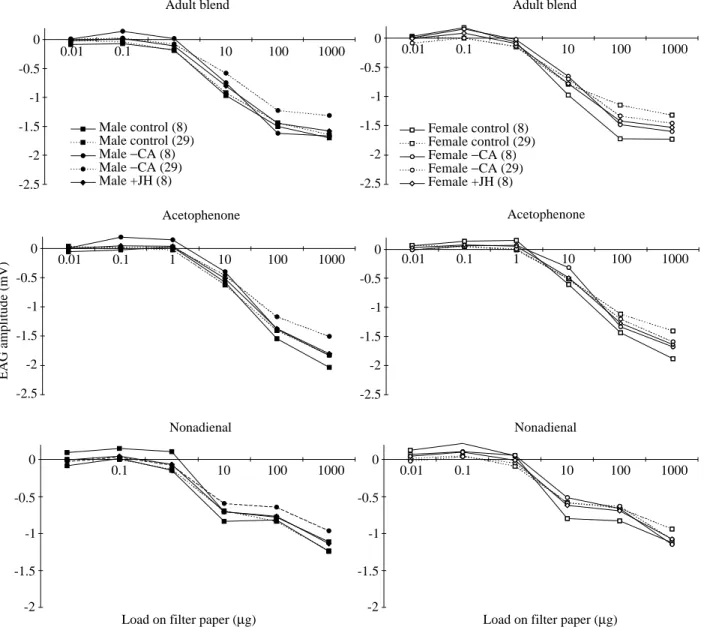
A clear dose–response relationship was found in EAGs for all stimuli tested in males and females. No significant differences were observed in EAG amplitude, either between sexes or among the different experimental groups (Fig. 3).
Central nervous processing
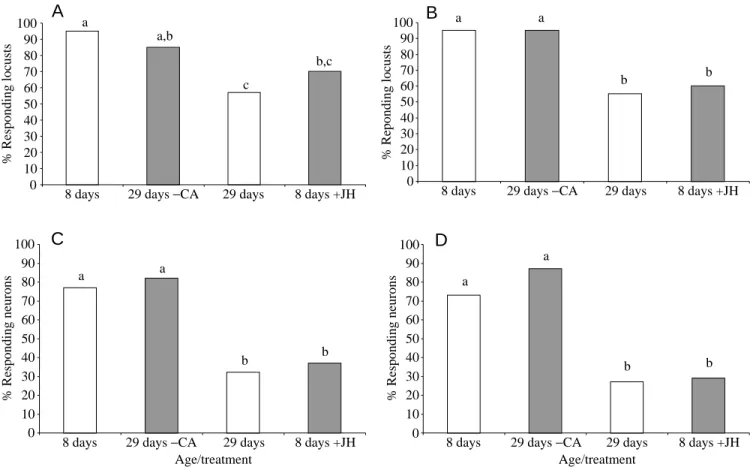
Intracellular recordings were made from 898 antennal lobe neurons in 161 adult locusts. The proportion of responding neurons and of responding control locusts decreased significantly with age. At day 8, more than 90 % of the locusts had responding neurons (Fig. 4A,B), of which more than 70 % of those tested responded to aggregation pheromones (Fig. 4C,D). In 29-day-old locusts, fewer than 60 % of individuals displayed responding neurons (Fig. 4A,B) and -40
-20 0 20 40 60
1 8 15 22 29
Aggregation index
Male control Male −CA Male sham Male +JH
-40 -20 0 20 40 60
1 8 15 22 29
Time after adult emergence (days)
A
B
NS NS
NS NS
**
,b**
,c*
,‡Female control Female −CA Female sham Female +JH NS,a
Fig. 1. Aggregation indices (AIs; see Materials and methods) of male (A) and female (B) control, sham-operated (sham), allatectomized (−CA) and juvenile hormone (JH)-injected (+JH) locusts in response to phenylacetonitrile, assayed weekly after adult emergence, in a two-choice olfactometer. Aggregation indices were calculated after 30 min. Significant differences (aP<0.001, bP<0.01 and cP<0.01) are indicated between
male and female allatectomized locusts. ‡ indicates a significant difference (P<0.01) between control and JH-injected females. Significant differences between experimental groups are indicated: NS, not significant; *P<0.05; **P<0.01 (χ2-test). Values are means ±S.E.M. (N=30).
Fig. 2. Net behavioural responses of male (A–D) and female (E–H) control, sham-operated (sham), allatectomized (−CA) and juvenile hormone (JH)-injected (+JH) locusts to phenylacetonitrile, assayed weekly after adult emergence. High frequencies of observed behavioural variables indicate a high behavioural activity in the treatment area compared with the control area and vice versa. Significant differences between male and female allatectomized locusts are indicated (aP<0.01, bP<0.5). Differences between
allatectomized locusts and other experimental groups are indicated: NS, not significant; *P<0.05; **P<0.01; ***P<0.001 (χ2-test).
-0.40 -0.30 -0.20 -0.10 0 0.10 0.20
1 8 15 22 29 -0.40
-0.30 -0.20 -0.10 0 0.10 0.20
1 8 15 22 29
Inactive
-0.05 0 0.05 0.10 0.15
1 8 15 22 29
-0.05 0 0.05 0.10 0.15
1 8 15 22 29
Walking
-0.10 0 0.10 0.20 0.30
1 8 15 22 29 -0.10
0 0.10 0.20 0.30
1 8 15 22 29
-0.10 0 0.10 0.20 0.30
1 8 15 22 29 -0.10
0 0.10 0.20 0.30
1 8 15 22 29
Leg movement
Antennal movement
NS
NS NS
NS
NS
NS
NS NS
NS
NS
NS NS,b
NS
NS NS
***
***
***
***
***
***
***
***
***
***
***
***
,a*
**
**
**
Frequency
Frequency
Frequency
Frequency
Time after adult emergence (days)
A
E
B
F
C
H
D
G
Male control Male −CA Male sham Male +JH
Female control Female −CA Female sham Female +JH
***
, aonly approximately 30 % of the tested neurons responded to aggregation pheromones (Fig. 4C,D). The proportion of neurons responding to aggregation pheromone and the proportion of locusts with responding neurons in 29-day-old allatectomized locusts did not differ from those in 8-day-old control locusts (Fig. 4). The proportion of responding neurons and of locusts with responding neurons in 8-day-old JH-injected individuals was not significantly different from those in 29-day-old control locusts (Fig. 4). Differences in the proportion of non-responding locusts and non-responding neurons between locusts with different JH levels were more pronounced in females (Fig. 4B,D) than in males (Fig. 4A,C). The responses of antennal lobe neurons to the range of compounds tested varied among experimental groups for some stimuli only. Note, however, that the number of responding neurons was very low in 29-day-old control and in 8-day-old
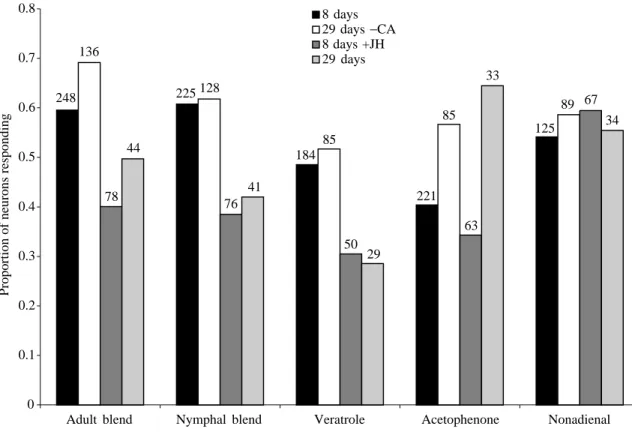
JH-injected locusts (Fig. 4C,D). For JH-injected locusts, there was a tendency for fewer neurons to be responsive to aggregation pheromones than in 8-day-old control and in allatectomized individuals (Fig. 5). This effect was found to be less pronounced in 29-day-old locusts, probably because of the extremely low number of responding neurons (Fig. 5). For the plant volatile nonadienal, no difference in the proportion of responding neurons was found among treatments (Fig. 5).
Discussion
In the present study, we present data that demonstrate age-dependent plasticity of olfactory-guided aggregation behaviour and of the central nervous processing of olfactory cues. In addition, we show that changes in the central olfactory processing and subsequent changes in behavioural
EAG amplitude (mV)
Adult blend
0.01 0.1 10 100 1000
Female control (8) Female control (29) Female −CA (8) Female −CA (29) Female +JH (8) Adult blend
-2.5 -2 -1.5 -1 -0.5 0
-2.5 -2 -1.5 -1 -0.5 0
-2 -1.5 -1 -0.5 0
-2 -1.5 -1 -0.5 0
0.01 0.1 10 100 1000
Male control (8) Male control (29) Male −CA (8) Male −CA (29) Male +JH (8)
Acetophenone
0.01 0.1 1 10 100 1000 Acetophenone
0.01 0.1 1 10 100 1000
Nonadienal
0.01 0.1 10 100 1000
Nonadienal
0.1 1 10 100 1000
Load on filter paper (µg) Load on filter paper (µg) -2.5
-2 -1.5 -1 -0.5 0
-2.5 -2 -1.5 -1 -0.5 0
responsiveness and activity are JH-mediated. Our data suggest that an experimentally increased JH titre in young locusts ages them artificially and that depriving locusts of JH keeps old locusts ‘young’ with respect to their olfactory-guided behaviour and central olfactory processing.
Juvenile hormone has previously been reported to stimulate sexual behaviour (Amerashinge, 1978; Loher, 1960; Pener, 1965; Pener, 1967), spontaneous locomotor activity (Odhiambo, 1965; Odhiambo, 1966) and the excitability (Cassier, 1963) of adult locusts. An increased JH titre induced a ‘solitarization’ effect, i.e. a significant reduction in social aggregation, and stimulated the marching behaviour of S. gregaria, both important characteristics of the phase behaviour (Wiesel et al., 1996). The observed increase in behavioural activity and decrease in AIs of untreated locusts, up to day 22, coinciding with an age-dependent increase in JH biosynthesis during this period (Avruch and Tobe, 1978; Couillaud, 1986; Dale and Tobe, 1986; Injeyan and Tobe, 1981; Tawfik, 1995; Tobe and Pratt, 1975) conforms with previous observations of a JH-mediated change in behavioural activity and in social aggregation. Behavioural observations of untreated locusts at day 29, previously reported to have a high haemolymph JH titre (Tawfik, 1995), of JH-injected locusts and of allatectomized locusts, however, indicate that JH may
modulate the behavioural activity not only directly but also indirectly in combination with other hormones (see below).
The observed behavioural activity of locusts with high levels of JH (JH-injected and 29-day-old locusts) may be explained by the impairment of the olfactory system discussed below. However, the changes in antennal lobe neuron responses cannot explain the observed sex-dependent differences in behavioural activity of allatectomized locusts. Furthermore, they cannot explain the observed differences in behavioural activity of untreated and allatectomized locusts. We postulate, therefore, that aggregation behaviour may be regulated indirectly by JH via other hormones or neuroactive substances expressed differentially in the two sexes.
One possibility for such modulators are the ecdysteroids, which have been shown previously to induce a reduction in the flight activity of S. gregaria (Michel, 1972) and in the marching behaviour of the migratory locust Locusta migratoria (Carlisle and Ellis, 1963). Biosynthesis of ecdysteroids is JH-dependent to different extents in the two sexes of different locust species (females, Lagueux et al., 1977; Glass et al., 1978; Goltzene et al., 1978; Kappler et al., 1986; Koeppe et al., 1985; Romana et al., 1995; males, Loher, 1960; Pener, 1965; Cantacuzène, 1967). The differential effects of JH on ecdysiogenic tissues may therefore explain the observed 0
10 20 30 40 50 60 70 80 90 100
8 days 29 days −CA 29 days 8 days +JH
% Responding locusts
b,c
0 10 20 30 40 50 60 70 80 90 100
8 days 29 days −CA 29 days 8 days +JH Age/treatment
% Responding neurons
0 10 20 30 40 50 60 70 80 90 100
8 days 29 days −CA 29 days 8 days +JH
% Reponding locusts
0 10 20 30 40 50 60 70 80 90 100
8 days 29 days −CA 29 days 8 days +JH Age/treatment
% Responding neurons
a
a,b
c
a
b b
a
a
a a
a
b b
b b
A
B
D
C
differences and changes in behavioural activity of treated compared with untreated locusts. Furthermore, the differential ecdysteroid titre of male and female locusts may explain the observed sex-dependent differences in behavioural activity.
Age- and JH-dependent plasticity of RNs has been shown previously to regulate the behavioural responsiveness of insects (Bowen, 1991; Crnjar et al., 1990; Masson and Arnold, 1984; Seabrook et al., 1979; Sigg et al., 1997; Vetter and Vissher, 1997). Electroantennograms from the antennae of untreated, allatectomized and JH-injected locusts, however, were unable to differentiate any age- or JH-dependent plasticity of locust RNs. Although we are unable to exclude a JH-dependent effect at this level using EAGs alone, single-cell recordings from sensory neurons of young and old locusts (S. A. Ochieng’, personal communication) did not reveal any age-dependent effects. However, age- and JH-age-dependent plasticity in the proportion of responding antennal lobe neurons was observed. These observations coincided with changes in the aggregation behaviour of both male and female locusts. Old (29-day-old) locusts, known to contain a high haemolymph JH titre (Tawfik, 1995), and locusts with an artificially increased level of JH contained a high proportion of non-responding neurons.
Thus, behavioural observations and electrophysiological
data emphasise that locusts containing high levels of JH may not display a positive olfactory-guided behaviour as a result of an impairment of the central olfactory system. In contrast, locusts containing low levels of JH (8-day-old or allatectomized locusts) were behaviourally responsive and had a highly functional central olfactory system. The somewhat higher number of responding neurons and locusts in the JH-injected group compared with the 29-day-old control group, in spite of a high dose of injected JH, might be due to the following causes: either the amount of active JH reaching the effectors does not attain the same level as in 29-day-old locusts because of transport problems or degradation or there is a developmental factor involved that prevents 8-day-old locusts reaching the same low response level as 29-day-old locusts, even with high doses of JH.
Age- and JH-mediated plasticity of olfactory-guided behaviour, related to changes in the responsiveness of the central olfactory system, has been reported previously in the black cutworm Agrotis ipsilon (Anton and Gadenne, 1999; Gadenne et al., 1993) and was suggested to control host-seeking behaviour in female mosquitoes Culex pipiens (Bowen, 1991). In the black cutworm, in contrast to locusts, central olfactory neurons are dependent on JH as a ‘switch’ to reach a high sensitivity (Anton and Gadenne, 1999), suggesting 0
0.1 0.2 0.3 0.4 0.5 0.6 0.7 0.8
Adult blend Nymphal blend Veratrole Acetophenone Nonadienal
Proportion of neurons responding
8 days 29 days −CA 8 days +JH 29 days
248 136
78 44
34 67 89
125 33
63 85
221
29 50 85 184
41 76 128 225
a differential modulation of the two systems. Whether JH acts directly on central olfactory neurons or indirectly via other neuroactive substances is, however, unknown. Previous studies have demonstrated age-dependent plasticity in insect brain and neuronal morphology (Fahrbach and Robinson, 1996; Gronenberg et al., 1996; Strambi et al., 1999; Winnington et al., 1996; Withers et al., 1995). Juvenile hormone has been shown to induce neuronal plasticity, including neuronal reorganisation, changes in morphology and sensitivity, synaptic plasticity and neurogenesis (for a review, see Strambi et al., 1999). An age-dependent decrease in the number of neuronal side branches and varicosities (Corfas and Dudai, 1991) and in the number of receptor synapses (Fröhlich and Meinertzhagen, 1982) and changes in the dendritic and axonal morphology (Strambi et al., 1999) may explain the observed differences in central olfactory processing. In vertebrates, olfactory-guided behaviour is believed to be influenced by steroids that may regulate synaptic transmission in central olfactory areas (Kawata, 1995; Stumpf and Sar, 1982; Swann, 1997). Juvenile hormone may, therefore, like steroids (Kawata, 1995; Wood et al., 1992), act directly via membrane receptors (Ilenchuk and Davey, 1985; Yamamoto et al., 1988) on central olfactory neurons. Juvenile hormone may also act indirectly via other neuroactive substances, e.g. serotonin, which has been shown to modulate the growth and the response of olfactory neurons in the sphingid moth Manduca sexta (Hildebrand, 1995; Kloppenburg and Hildebrand, 1995, Mercer et al., 1995; Kloppenburg et al., 1999). A third possible mode of action of JH might be a nuclear effect: in crickets, blocking of transcription or translation factors abolishes the effect of JH on auditory interneurons (Stout et al., 1998).
Our long-term behavioural observations and examinations of the central olfactory responsiveness of adult desert locusts indicate that JH plays an important role in mediating changes and differences in the aggregation behaviour of male and female locusts. The present study suggests that JH acts indirectly or directly at different levels of the central nervous system to regulate or modulate behavioural responsiveness and behavioural activity following exposure to aggregation pheromones.
We thank Christophe Gadenne, Bill S. Hansson and Sandy Dickson for valuable comments on the manuscript. This study was supported by grants from Swedish and French Research councils SAREC, SJFR, NFR and INRA to S.A. and F.C.
References
Amerashinge, F. P. (1978). Effects of J.H.I and J.H.III on yellowing, sexual activity and pheromone production in allatectomized male
Schistocerca gregaria. J. Insect Physiol. 24, 603–611.
Anton, S. and Gadenne, C. (1999). Effect of juvenile hormone on the central nervous processing of sex pheromone in an insect. Proc.
Natl. Acad. Sci. USA 96, 5764–5767.
Anton, S. and Hansson, B. S. (1996). Antennal lobe interneurons in the desert locust Schistocerca gregaria (Forskål): Processing of
aggregation pheromones in adult males and females. J. Comp.
Neurol. 370, 85–96.
Applebaum, S. W., Avisar, E. and Heifetz, Y. (1997). Juvenile hormone and locust phase. Arch. Insect Biochem. Physiol. 35, 375–391.
Avruch, L. I. and Tobe, S. S. (1978). Juvenile hormone biosynthesis by the corpora allata of the male desert locust, Schistocerca
gregaria, during sexual maturation. Can. J. Zool. 56, 2097–2102.
Bowen, M. F. (1991). The sensory physiology of host seeking behaviour in mosquitoes. Annu. Rev. Ent. 36, 139–158.
Cantacuzène, A-.M. (1967). Effets compares de l’allatectomie sur l’activite des glandes annexe males et le comportement sexuel de deux Acridiens: Schistocerca gregaria et Locusta migratoria (Souches migratorioides et ‘Kazalinsk’). C.R. Acad. Sci., Paris 265D, 224–227.
Carlisle, D. B. and Ellis, P. E. (1963). Prothoracic gland and gregarious behaviour in locusts. Nature 200, 603–604.
Cassier, P. (1963). Action des implantations de corps allates sur la reactivite phototropique de Locusta migratoria migratorioides (R. & F.), phase gregaria (Insecte Orthopteroide). C.R. Acad. Sci.,
Paris 257, 4048–4049.
Christensen, T. A. and Hildebrand, J. G. (1987). Male-specific, sex pheromone-selective projection neurons in the antennal lobes of the moth Manduca sexta. J. Comp. Physiol. A 160, 553–569. Corfas, G. and Dudai, Y. (1991). Morphology of a sensory neuron
in Drosophila is abnormal in memory mutants and changes during ageing. Proc. Natl. Acad. Sci. USA 88, 7252–7256.
Couillaud, F. (1986). Influence of sexual organs on corpora allata biosynthetic activity in Locusta migratoria. Physiol. Ent. 11, 397–403.
Couillaud, F., Mauchamp, B. and Girardie, A. (1985). Regulation of juvenile titer in African locust. Experientia 41, 1165–1167. Crnjar, R., Yin, C.-M., Stoffalolano, J. G., Jr, Tomassini
Barbarossa, I., Liscia, A. and Angioy, A. M. (1990). Influence of age on the electroantennogram response of the male blowfly (Phormia regina) (Diptera: Calliphoridae). J. Insect Physiol. 36, 917–921.
Dale, J. F. and Tobe, S. S. (1986). Biosynthesis and titre of juvenile hormone during the first gonadotropic cycle in isolated and crowded Locusta migratoria females. J. Insect Physiol. 32, 763–769.
Fahrbach, S. E. and Robinson, G. E. (1996). Juvenile hormone, behavioural maturation and brain structure in the honey bee. Dev.
Neurosci. 18, 102–114.
Fröhlich, A. and Meinertzhagen, I. A. (1982). Synapotogenesis in the first optic neuropile of the fly’s visual system. J. Neurocytol. 11, 159–180.
Gadenne, C., Renou, M. and Sreng, L. (1993). Hormonal control of pheromone responsiveness in the male black cutworm Agrotis
ipsilon. Experientia 49, 721–724.
Glass, H., Emmerich, H. and Spindler, K. D. (1978). Immunohistological localization of ecdysteroids in the follicular epithelium of locust oocytes. Cell Tissue Res. 194, 237–244. Goltzene, F., Lageaux, M., Charlet, M. and Hoffman, J. A. (1978).
The follicle epithelium of maturing ovaries of Locusta migratoria: a new biosynthetic tissue for ecdysone. Z. Phys. Chem. 359, 1427–1434.
Gronenberg, W., Heeren, S. and Hölldobbler, B. (1996). Age-dependent and task-related morphological changes in the brain and the mushroom bodies of the ant Camponotus floridanus. J. Exp.
Hansson, B. S., Ochieng’, S. A., Grosmaitre, X., Anton, S. and Njagi, P. G. N. (1996). Physiological responses and central nervous projections of antennal olfactory neurons in the adult desert locust, Schistocerca gregaria (Orthoptera: Acrididae). J. Comp.
Physiol. A 179, 157–167.
Hansson, B. S., Van der Pers, J. N. C., Högberg, H.-E., Hedenström, E., Anderbrant, O. and Löfkvist, J. (1991). Sex pheromone perception in male pine sawflies, Neodiprion sertifer (Hymenoptera: Diprionidae). J. Comp. Physiol. 168, 533–538. Hassanali, A. and Torto, B. (1999). Grasshoppers and locusts. In
Pheromones of Non-Lepidopteran Insects Associated with Agricultural Plants (ed. J. Hardie and A. K. Minks), pp. 305–328.
New York: CABI Publishing.
Hildebrand, J. G. (1995). Analysis of chemical signals by nervous systems. Proc. Natl. Acad. Sci. USA 92, 67–74.
Ignell, R., Anton, S. and Hansson, B. S. (1998). Central nervous processing of behaviourally relevant odours in solitary and gregarious fifth instar locusts, Schistocerca gregaria. J. Comp.
Physiol. A 183, 453–465.
Ignell, R., Anton, S. and Hansson, B. S. (1999). Integration of behaviourally relevant odours at the central nervous level in solitary and gregarious third instar locusts, Schistocerca gregaria. J. Insect
Physiol. 45, 993–1000.
Ilenchuk, T. T. and Davey, K. G. (1985). The binding of juvenile hormone to membranes of follicle cells in the insect Rhodnius
prolixus. Can. J. Biochem. Cell Biol. 53, 102–106.
Injeyan, H. S. and Tobe, S. S. (1981). Phase polymorphism in
Schistocerca gregaria: reproductive parameters. J. Insect Physiol.
27, 97–102.
Kappler, C., Goltzene, F., Lagueux, M., Hetru, C. and Hoffmann, J. A. (1986). Role of the follicle cells and the oocytes in ecdysone biosynthesis and esterification in vitellogenic females of Locusta
migratoria. Int. J. Invert. Reprod. Dev. 9, 17–34.
Kawata, M. (1995). Roles of steroid hormones and their receptors in structural organization in the nervous system. Neurosci. Res. 24, 1–46.
Kloppenburg, P., Ferns, D. and Mercer, A. R. (1999). Serotonin enhances central olfactory neuron responses to female sex pheromone in the male sphinx moth Manduca sexta. J. Neurosci. 19, 8172–8181.
Kloppenburg, P. and Hildebrand, J. G. (1995). Neuromodulation by 5-hydroxytryptamine in the antennal lobe of the sphinx moth
Manduca sexta. J. Exp. Biol. 198, 603–611.
Koeppe, J. K., Fuchs, M., Chen, T. T., Hunt, L. M., Kovalick, G. E. and Briers, T. (1985). The role of juvenile hormone in reproduction. In Comprehensive Insect Physiology, Biochemistry
and Pharmacology, vol. 8, Endocrinology II (ed. G. A. Kerkut and
L. I. Gilbert), pp. 165–203. New York: Pergamon Press.
Kumaran, A. K. (1990). Modes of action of juvenile hormones at cellular and molecular levels. In Morphogenetic Hormones of
Arthropods (ed. A. P. Gupta), pp. 179–227. New Brunswick:
University Press.
Lagueux, M., Hirn, M. and Hoffman, J. A. (1977). Ecdysone during development in Locusta migratoria. J. Insect Physiol. 23, 109–120. Loher, W. (1960). The chemical acceleration of the maturation process and its hormonal control in the male of the desert locust.
Proc. R. Soc. Lond. B 153, 380–397.
Masson, C. and Arnold, G. (1984). Ontogeny, maturation and plasticity of the olfactory system in the workerbee. J. Insect
Physiol. 1, 7–14.
Mercer, A. R., Kirchof, B. S. and Hildebrand, J. G. (1995).
Enhancement by serotonin of the growth in vitro of antennal lobe neurons of the sphinx moth Manduca sexta. J. Neurobiol. 29, 49–64.
Michel, R. (1972). Etude experimentale de l’influence des glandes prothoraciques sur l’activite de vol de criquet pelerin Schistocerca
gregaria. Gen. Comp. Endocr. 19, 96–101.
Obeng-Ofori, D., Torto, B. and Hassanali, A. (1993). Evidence for mediation of two releaser pheromones in the aggregation behavior of the gregarious desert locust, Schistocerca gregaria (Forskal) (Orthoptera: Acrididae). J. Chem. Ecol. 19, 1665–1676.
Obeng-Ofori, D., Torto, B., Njagi, P. G. N., Hassanali, A. and Amiani, H. (1994). Fecal volatiles as part of the aggregation pheromone complex of the desert locust, Schistocerca gregaria (Forskal) (Orthoptera: Acrididae). J. Chem. Ecol. 20, 2077–2087. Ochieng’, S. A. (1997) Odour detection in the desert locust,
Schistocerca gregaria: antennal structure and function. Doctoral
thesis, Svenska Lantbruks Universitetet, Alnarp, Sweden. Ochieng’, S. A. and Hansson, B. S. (1999). Responses of olfactory
receptor neurones to behaviourally important odours in gregarious and solitarious desert locust, Schistocerca gregaria. Physiol. Ent. 24, 28–36.
Odhiambo, T. R. (1965). Metabolic effects of the corpus allatum hormone in the desert locust, Schistocerca gregaria. Nature 207, 1314–1315.
Odhiambo, T. R. (1966). The metabolic effects of the corpus allatum hormone in the male desert locust. II. Spontaneous locomotor activity. J. Exp. Biol. 45, 51–63.
Pener, M. P. (1965). On the influence of corpora allata on maturation and sexual behaviour of Schistocerca gregaria. J. Zool., Lond. 147, 119–136.
Pener, M. P. (1967). Effects of allatectomy and sectioning of the nerves of the corpora allata on oocyte growth, male sexual behaviour and colour change in adults of Schistocerca gregaria. J.
Insect Physiol. 13, 665–684.
Pener, M. P. (1991). Locust phase polymorphism and its endocrine relations. Adv. Insect Physiol. 23, 1–79.
Pener, M. P. and Yerushalmi, Y. (1998). The physiology of locust polymorphism: an update. J. Insect Physiol. 44, 365–377. Roessingh, P., Simpson, S. J. and James, S. (1993). Analysis of
phase-related changes in behaviour of desert locust nymphs. Proc.
R. Soc. Lond. B 252, 43–49.
Roffey, J. and Popov, G. (1968). Environmental and behavioural processes in a desert outbreak. Nature 219, 446–450.
Romana, I., Pascual, N. and Belles, X. (1995). The ovary is a source of circulating ecdysteroids in Blattella germanica (Dictyoptera: Blattellidae). Eur. J. Ent. 92, 93–103.
Seabrook, W. D., Hirai, K., Shorey, H. H. and Gaston, L. K. (1979). Maturation and senescence of an insect chemosensory response. J. Chem. Ecol. 5, 587–594.
Sigg, D., Thompson, C. M. and Mercer, A. R. (1997). Activity-dependent changes to the brain and behaviour of the honey bee,
Apis mellifera (L.). J. Neurosci. 17, 7148–7156.
Stout, J., Hao, J., Kim, P., Mbungu, D., Bronsert, M., Slikkers, S., Maier, J., Kim, D., Bacchus, K. and Atkins, G. (1998). Regulation of the phonotactic threshold of the female cricket
Acheta domesticus: juvenile hormone III, allatectomy, L1 auditory
neuron thresholds and environmental factors. J. Comp. Physiol. A 182, 635–645.
Strong, L. (1965). The relationship between the brain, corpora allata and oocyte growth in the Central American locust, Schistocerca sp. I. The cerebral neurosecretory system, the corpora allata and oocyte growth. J. Insect Physiol. 11, 135–146.
Stumpf, W. E. and Sar, M. (1982). The olfactory system as a target organ for steroid hormones. In Olfaction and Endocrine Regulation (ed. W. Breipohl), pp. 11–21. London: IRL Press Limited. Swann, J. M. (1997). Gonadal steroids regulate behavioural
responses to pheromones by actions on a subdivision of the medial preoptic nucleus. Brain Res. 750, 189–194.
Tawfik, A. I. (1995). Interaction between pheromones and hormones in phase dynamics of the desert locust, Schistocerca
gregaria (Forskål). Doctoral thesis, Assiut University, Assiut,
Egypt.
Tobe, S. S. and Pratt, G. E. (1975). Corpus allatum activity in vitro during ovarian maturation in the desert locust, Schistocerca
gregaria. J. Exp. Biol. 62, 611–627.
Torto, B., Obeng-Ofori, D., Njagi, P. G. N., Hassanali, A. and Amiani, H. (1994). Aggregation pheromone system of adult gregarious desert locust Schistocerca gregaria. J. Chem. Ecol. 20, 1749–1762.
Vetter, R. S. and Vissher, P. K. (1997). Influence of age on antennal response of male honey bees, Apis mellifera, to queen mandibular pheromone and alarm pheromone component. J. Chem. Ecol. 23, 1867–1880.
Wiesel, G., Tappermann, S. and Dorn, A. (1996). Effects of juvenile hormone and juvenile hormone analogues on the phase behaviour of Schistocerca gregaria and Locusta migratoria. J.
Insect Physiol. 42, 385–395.
Winnington, A. P., Napper, R. M. and Mercer, A. R. (1996). Structural plasticity of identified glomeruli in the antennal lobes of the adult worker honey bee. J. Comp. Neurol. 365, 479–490. Withers, G. S., Hahrbach, S. E. and Robinson, G. E. (1995).
Effects of experience and juvenile hormone on the organisation of the mushroom bodies of honey bees. J. Neurobiol. 26, 130–144. Wood, R. I., Brabec, R. K., Swann, J. M. and Newman, S. W.
(1992). Androgen and estrogen concentrating neurons in chemosensory pathways of the male Syrian hamster brain. Brain
Res. 596, 89–98.
Yamamoto, K., Chadarevian, A. and Pellegrini, M. (1988). Juvenile hormone action mediated in male accessory glands of