Master Thesis
The Development of Psychological Flexibility in
Chronic Pain Patients during Acceptance and
Commitment Therapy
How do acceptance, values-based action and application of learned principles
develop during an eight-week inpatient treatment in five patients?
Laura A. Weiss
09 February 2011
First Supervisor: Dr. K.M.G. Schreurs
ABSTRACT
Background.
Chronic pain is remarkably common. It causes problems for both the suffering individual and society. Common treatments, like pharmacological treatment, do not always help when it comes to chronic pain. The pain cannot be managed anymore and the experience of pain cannot be avoided. In fact, persistent attempts to avoid the pain can lead to maintenance and often even an increase in pain. Therefore, Acceptance and Commitment Therapy (ACT) does not lean on pain control, but on a valuable life with pain and limitations. ACT aims to increase psychological flexibility.Aims.
In this study, the aim was to examine the development of pain patients during an eight-week, ACT-based treatment. We wanted to take a closer look at the development of acceptance, values-based action and application of learned principles during this treatment to see how psychological flexibility develops. Another subject was to examin if patients experience a crisis during the treatment, as often seen by therapists.Method.
Five intensive single case studies were conducted to get a better understanding of how ACT works. The participants were chronic pain patients who took part in a three days a weekinpatient treatment in the Roessingh Rehabilitation Center in the Netherlands. Starting in the second treatment week, interviews were conducted weekly during the eight treatment weeks. The
interviews were taken accordingly to an interview scheme, with open questions. Follow up interviews were taken six weeks after the last treatment week. The interviews were scored on acceptance, values-based action and application on a scale from 1 to 5. The average of the three scales taken together was taken as measure for psychological flexibility.
Results.
A positive development in psychological flexibility and all three subscales has been found for all five patients. Each patient progressed in a unieque pattern, each development being different from the other. Three of the five patients went through a ‘crisis’ during treatment, all at different moments. The crisis had a postitive impact on the end result. Within four patients, psychological flexibility decreased in the follow-up interview compared to the interview in the last treatment week.SAMENVATTING
Achtergrond.
Chronische pijn komt veel voor. Het veroorzaakt problemen voor zowel degene die eraan lijdt, als ook voor de maatschappij. Gebruikelijke behandelingen, zoals pharmacologische behandelingen, helpen niet altijd bij chronische pijn. De pijn kan niet beheerst worden en het voelen van pijnprikkels kan niet meer worden voorkomen. Het is zelfs zo dat constante pogingen om de pijn te vermijden de pijn in stand houden of zelfs verergeren. Acceptance and Commitment Therapy (ACT) is daarom niet gebaseerd op pijn beheersing, maar op een waardevol leven met pijn en de bijkomende beperkingen. Het hoofddoel van ACT is om de psychologische flexibiliteit te verhogen.Doelen.
Het doel in deze studie was het om de ontwikkeling van pijnpatiënten gedurende een achtweekse, op ACT gebaseerde behandeling in kaart te brengen. We wilden het verloop van acceptatie, op waarden gebaseerd gedrag en toepassing van geleerde principes tijdens debehandeling onderzoeken om de ontwikkeling van psychologische flexibiliteit te meten. Een tweede doel was het om te kijken of patiënten gedurende de behandeling een crisis ervaren, zoals vaak door behandelaars van het RRC wordt geobserveerd.
Methode.
Er zijn vijf intensieve single case studies uitgevoerd om een beter begrip te verkrijgen over de werking van ACT. De proefpersonen waren chronische pijnpatiënten die deelnamen aan een semi-klinische behandeling in het revalidatiecentrum het Roessingh in Nederland. Vanaf de tweede behandelweek werden er wekelijks interviews afgenomen tijdens de achtweeksebehandelingsperiode. De interviews waren gebaseerd op een interviewschema, bestaand uit open vragen. Follow up interviews werden zes weken na de laatste behandelweek afgenomen. De interviews werden op een vijfpuntsschaal op acceptatie, waarden gebaseerd gedrag en toepassing gescoord. Het gemiddelde van de drie schalen werd genomen als maat voor psychologische flexibiliteit.
Resultaten.
Er werd een positieve ontwikkeling in psychologische flexibiliteit en de drie subschalen gevonden. Elk patiënt doorliep een eigen, unique ontwikkeling; alle patiënten lieten verschillende ontwikkelingen zien. Drie van de vijf patiënten hadden een crisis tijdens hun behandeling, alle op een ander tijdstip. De crisis had een postief effect op het eindresultaat. Bij vier patiënten was depsychologische flexibiliteit in het follow-up interview lager dan bij het interview in de laatste behandelweek.
T
O MY SISTERF
RAUKE,
WHO IS GOING THROUGH TOUGH TIMES BUT STAYS1 Chronic pain is extremely common (Blyth, March, & Cousins, 2003). It can have devastating effects like social isolation (Cowan, Kelly, Pasero, Covington, & Lidz, 1998) and shows a high comorbidity with psychiatric disorders (Ohayon, 2006). Additional to the personal problems, chronic pain reduces the capacity for work and thereby forms a financial stain on society (Van Tulder, Koes & Bouter, 1995). Conventional therapies such as behavioral procedures do not always help and the chronic pain patients keep suffering. Different from the more conventional therapies, which concentrate on reducing pain, Acceptance and Commitment Therapy (ACT) helps people to deal with their suffering by focusing on a valuable life with pain and limitations. This study will take a closer look at the development of chronic pain patients during an eight-week ACT treatment. But first of all, we will turn to the question: ‘What exactly is chronic pain?’
Chronic pain. Almost everyone is familiar with some form of pain. Pain is probably the most universal of medical complains (Malloy & Milling, 2010), as can be seen in the fact that in more than 50% of all doctor visits pain, is the reason for the consultation.
Pain is a broad term which can have many different manifestations. The International Association of the Study of Pain gives a definition: ‘Pain is an unpleasant sensory and emotional experience
associated with actual or potential tissue damage, or described in terms of such damage.’ (IASP, 1986).This widely excepted definition does not only describe the physical nature of pain, but also takes into account that pain has a psychological aspect and is a subjective experience, as well. There are different forms of pain. Pain is called acute when the duration is not longer than three to six months. But also a long-term disorder as migraine is described in terms of episodes of acute pain which come back on a regular basis. When the pain lasts longer than three to six months, it is described as chronic pain. Chronic pain can be differentiated into two forms: chronic benign pain (not associated with progressive illness) and chronic malignant pain (associated with progressive illness). So pain can have an organic cause, but often, there is lack of a clearly identifiable biomedical cause. Research has shown that the experience of pain is not only moderated by physical factors, but also by psychological factors. The degree of attention paid to the pain, the mood and personal beliefs about the nature of pain, including its cause and controllability, are important aspects that can have an impact on pain.
As unpleasant as pain might feel, it also has an important function: It warns us of potential damage to the body. Our reflex to pain is to pull away from its cause or try to reduce the pain. Pain can also be a signal to the onset of a disease. When we feel pain, we are likely to seek (medical) help. In the future, we try to avoid the situation that has caused us pain in the past. Although pain has survival benefits, when pain lasts for a long period, it is likely to cause long-term problems.
Prevalence. Chronic pain is remarkably common: About 20 % of the population has some degree of chronic pain (Blyth, March, & Cousins, 2003; Eriksen et al., 2003). For certain types of chronic pain, like lower back pain, the numbers are even larger. 50 % of the population complains of lower back pain in any one year (Louw, Morris, & Grimmer-Somers, 2007). Joint disorders, especially back and neck pain, are the most often occurring forms of chronic pain.
2 Their pain intensity during the last episode of pain was on average 5 on a 10-point numeric rating scale. 59% had suffered pain from two up to 15 years. In the Netherlands, 17,4 % of the population suffers of back and neck pain longer than a year (Demyttenaere et al., 2007). But not only in Europe is chronic pain common. Chronic back and neck pain which lasts longer than a year varies from 9,7 % among Colombians up to 42,1 % among Ukrainians.
Causes. The causes of chronic pain are only partially understood. Neurofysiolocial studies point to a disruption of the central nervous system and increased sensitization (Gatchel, Peng, Peters, Fuchs & Turk, 2007). What is well known is that psychological factors play a role when pain becomes chronic and that they are sustaining factors of chronic pain. Psychological factors can be behavioral reactions to the pain, like avoidance of activity or the opposite reaction - an increasing activity level
(Asmundson, Vlaeyen & Crombez, 2004; Hasenbring, Hallner, & Klasen, 2001). Both are pain coping strategies which can be helpful in acute pain, but are maladaptive in chronic pain. Furthermore, emotional reactions can influence the pain, like anxiety of or anger about the pain. Social consequences and reactions from the environment can also affect the level and intensity of pain (Gatchel et al., 2007).
Impact. Chronic pain can have a large impact on the life of the person who suffers from it. Cowan, Kelly, Pasero, Covington and Lidz (1998) described this impact. The suffering person has to deal with the fact that often, pain that does not show, and with the fluctuating activity levels that come with pain. The individual with pain often shows unpredictable mood swings, a lack of interest and sometimes they doubt the reality of the pain. Chronic pain can mean a loss of job, friends and productivity and therefore often cause social isolation.
Chronic pain seriously affects the quality of the social and working live. 61 % of the respondents of a large study in European countries were less able or unable to work outside the house, 19 % had lost their job and 13% had changed their job because of their pain (Breivik et al., 2005). The quality of life is affected by the limitations that chronic pain brings along. Most of the patients sleep worse and are affected in their mobility and in the performing of household activities. Participation in social
activities is constricted and 20% of the patients feel that they cannot fulfill their role as partner as they wish. In short, an independent lifestyle is often heavily constricted(Breivik et al., 2005). Chronic pain is not only a strain for the affected individual but also for the society. It is a substantial contributor to costs of health care utilization and a major cause of disablement and work
absenteeism. In the Netherlands, the costs of just chronic low back pain are estimated around € 4 billion per year. Most of the costs are due to the reduced capacity to work (Van Tulder, Koes & Bouter, 1995). Rehabilitation for chronic pain, on the other hand, has been proven to be effective not only for the individual, but also in terms of financial gain. Kok, Houlens & Nissen (2008) estimated that rehabilitation for chronic pain and fatigue yields € 33.000 of social benefits per patient.
3 reports to also suffer from depression (Breivik et al., 2006). Chronic pain patients also have an
increased chance of getting addicted to alcohol or other drugs (Demyttenaere et al., 2007). Impaired sleep quality is also common in people with pain (Ohayon, 2005). The relation is bi-directional; poor sleep exacerbates pain, while greater pain adversely affects sleep. Furthermore, sleep deprivation leads to increased sensitivity to pain (Lautenbacher, Kundermann & Krieg, 2006). Chronic fatigue complains can often be seen in combination with chronic pain.
Raymond, Nielsen, Lavigne, Manzini and Choiniere (2001) investigated patients with burn injuries. They found that the subjective quality of sleep predicted pain intensity on the following day. There is also evidence that pain impairs sleep. Up to 55 % of the patients suffering from chronic pain, such as headache and musculoskeletal pain, also suffered from reduced sleep (Paiva, Farinha, Martins, Batista & Guilleminault, 1997; Roehrs & Roth, 2005). The bi-directional relation between poor sleep and increased pain was also found in younger adults (Brand, Gerber & Pühse, 2010).Children with persistent abdominal pain were considerably more likely to suffer from psychiatric disorders in adulthood (Hotopf, Carr, Mayou, Wadsworth & Wessely, 1998).Children with recurrent headaches have a risk of developing additional physical and mental problems when they are adults, like anxiety disorders and depression (Fearon & Hotopf, 2001). Fichtel and Larsson (2002) found that adolescents with frequent headaches had higher levels of anxiety or depressive symptoms, in addition to
functional disability.
Treatment. There are two broad types of treatment against pain: pharmacological and non-pharmacological treatment. The first type, mainly painkilling medication, has a short-term effect. Non-pharmacological treatments can be physical treatments, like massage and physiotherapy, or can focus on psychological aspects of pain. There are a number of treatments that help people to cope with acute pain, which are relatively easy to learn and use. Most approaches to acute pain focus on increasing the patient’s sense of control over the pain experience, teaching coping skills, like distraction and relaxation. Hypnosis has also proven to have a positive effect in reducing pain (Patterson & Jensen, 2003). Distraction has been shown to be considerably effective (Blount, Piira & Cohen, 2003).Typical distraction interventions are deep breathing, listening to soothing music, or watching a favorite video. The effect might be due to the fact that human have a finite attention. A distraction task that consumes someportion of those resources probably leaves less cognitive capacityavailable for processing pain (McCaul & Malott, 1984). But for people with chronic pain, both these treatments and medication have been shown to be only of short help.
4 rather than in a reduction of the disabilities (Eccleston, Williams & Morley, 2009). There are also findings that not all patients profit from these treatments (Ostelo, van Tulder, Vlaeyen, Linton, Morley & Assendelft, 2005; Hoffman, Papas, Chatkoff & Kerns, 2007). Accordingly, some researchers argue that the current standard treatments have to be improved. Greater attention should be placed on therapeutic processes. Furthermore, they ask for a better selection of methods and processes which are known to produce improvements. Treatment integrity should also be considered (Eccleston, Williams, & Morley, 2009).
ACT. Within cognitive behavioral therapy (CBT), some approaches can be found that are attempting to meet these challenges. These include Acceptance and Commitment Therapy, abbreviated as ACT (Hayes, Strosahl, & Wilson, 1999). Accordingly, there seem to be a growing interest for acceptance oriented treatment strategies. Mindfulness Based Cognitive Therapy and ACT are among these treatments, which found wide recognition and acception over the last years (Hayes, Strohsal & Wilson, 1999), partly due to the mentioned short-comings of the other treatments. The theory behind acceptance oriented treatments is that suffering is a natural part of life. Therefore, suffering has to be accepted. This is especially relevant for the treatment of chronic pain, as chronic pain and the accompanied avoidance cause suffering.
ACT is a third generation behavioral therapy, based on insights from behavioral therapy, cognitive behavioral therapy and mindfulness-based therapies. As typical for third wave behaviour therapies, ACT aims at enhancing acceptance of negative experiences instead of reducing symptoms. The most crucial goal in ACT is the promotion of psychological flexibility, the ability to act effectively in
accordance with personal values in the presence of negative private experiences (Hayes, Luoma, Bond, Masuda & Lillis, 2006). The central principle of ACT is that much of the suffering we experience is caused by attempts to avoid painful experiences and emotions. That makes ACT a powerful form of therapy for chronic pain. It lies in the nature and definition of chronic pain, that it is not possible to avoid the pain. Through the efforts to avoid the pain, the chronic pain is actually maintained or even worsens. To improve their functioning, it is necessary that patients give up these avoiding strategies and instead focus on the valuable things in their lives. Thereby, it is important that they regain the feeling that they can determine their lives instead of letting the pain control their lives. Here, the term agency is important.
5 have small to medium effects on mental and physical health in patients with chronic pain. The effects are comparable to effects of CGT. Accordingly, ACT can be a good alternative to CGT.
Although a great number of studies have been conducted on ACT and chronic pain, there are very few case-studies on this issue. This is a huge shortcoming in the research on ACT, as qualitative research is important to gain insights in the processes, the patients’ experiences during therapy and insights in the content of the therapy, not only the effects. To our knowledge, there are only three studies with a qualitative approach so far. Luciano, Visdómine, Gutiérrez and Montesinos (2001) demonstrated that ACT leads to less pain, less avoidance responses and an emphasis of life values. Wicksell, Dahl, Magnusson and Olsson (2005) found improvements in valued activities, less pain and achievement of individual goals in an adolescent female. Psychological and behavioral improvements also have been found (Kleen & Jaspers, 2007).
ACT in the RRC. In the Netherlands, the pain clinic of the Roessingh rehabilitation center (RRC) was one of the first clinical settings that fully implemented ACT in 2007. Measures, comparing the effect sizes from the old treatment to the new ACT approach, show that the new program is more effective (Roessingh, n.d.). The implementation of ACT in inpatient group treatments decreased the impact of pain on the daily life and improved the degree to which the patients experience that they can cope with stress. These are also the aspects ACT focuses on. Interestingly, the intensity of the pain also decreased, even though this is not the aim of the program. It seems that the pain decreased because the patients reached more acceptance of their pain en focused more on the important aspects in their lives. On average, people who followed the program experienced that the pain got less intense and had less impact on their daily life after treatment. They were able to deal better with daily hassles and their mood improved. Therapists of the RRC often see that patients experience a relapse, some form of personal crisis, during the treatment. Interestingly, such a crisis often has a positive effect on the final outcome of the therapy.
The found effects sizes were medium to high. In follow-up measures three to six months after the end of the treatment, the effects were still substantial, but smaller. The program has become more effective with the years. Since the introduction of ACT in 2007, a clear improvement took place. Although not significant, these outcomes are promising.
6 five chronic pain patients, who attended an eight-week, ACT-based treatment.Three objectives were identified for assessing the individual development. The first was to assess the personal development of the patients and thereby the efficacy of the ACT treatment for them. Secondly, we wanted to investigate if the patients developed differently from each other, in their own, personal way, or if a general pattern could be found. The third objective was to find out if patients experienced a crisis during the treatment, as often observed by practitioners in the RRC.
Answers to these objectives can give valuable insights into the treatment processes, which can be used to further develop and optimize ACT, in a way that helps patients the most. Analyzing therapy stories can help to gain insight in the patient’s experiences during therapy. This can help to get more insight in the realization of the intended ACT processes and therefore can help to improve weak points and get to know more about the mechanisms that took place. This research on the patient’s point of view on the treatment can give new ideas and impulses in the treatment practice, especially in the RRC, but also in ACT treatments of people with chronic pain in general. Last, but not least, the interviews can also help the patients. As Adler and McAdams (2007) pointed out, when patients construct stories about their therapy experiences, it helps them to get better insight and
understanding of the therapy and give them the feeling that their lives are more purposeful. It also helps to maintain the in the course of therapy achieved growth, when therapy had already stopped. In short, the aim of the study is to gain more insight in the vision and experience of the patients. To address the three objectives, we based our study on the method of Pablowski’s (2010) and
Middelink’s (2010) study. They examined the development of patients in the same treatment for chronic pain patients in the RRC by measuring agency. In the following part, we will explore if agency is a concept that can answer our research questions as well.
Agency. In research with similar objectives, the effects of treatments were often measured with ageny. Pablowski (2010) and Middelink (2010) based their research on a study of Adler and McAdams (2007), who used the concept of agency. They asked people about their therapy after it had ended, and scored the stories about the experiences people made during therapy. Within the therapy stories, it was found that people got more and more control on their lives (Adler & McAdams, 2007). This process is called agency. McAdams (1992) defined it as the existence of an organism as an individual. Related themes are self-mastery, victory, achievement, responsibility and empowerment. Self-mastery is linked to reaching strength and control. With victory, McAdams means the pursuit of achievement and a high status. Adler and McAdams (2007a) describe agency as overcoming a problem.
Agency is widely recognized as good means to conceptualize therapy success (Williams & Levitt, 2007), especially in narrative construction of psychotherapy. Agency is also an important indicator on positive psychological functioning within different psychotherapeutic traditions (Adler & McAdams, 2007). Adler and colleagues (2007) found that patients high on well-being and ego development emphasized their personal agency throughout their story.
7 live with the pain. They cannot and should not overcome their pain, but instead learn to gain
acception. In contrast, a heroic overcoming of ones problems lies at the basic of the Adler and McAdams’ (2007) definition of agency. Of course, ACT aims to give back control to the patients instead of letting the pain control their lives. But ACT also implies that wanting to control the pain excessively causes suffering. Contrary to this principle, control is one of the core concepts of agency. Therefore, agency does not seem to fit well to the theory of ACT.
Furthermore, agency also isn’t a good fit to our target group of chronic pain patients. The patients in Adler’s and McAdams’s (2007) study had problems which were possible to overcome. Chronic pain, on the opposite, is a problem that cannot be beaten. That shows that agency, as Adler and McAdams define it, is not a good measure for the therapy success of the target group of this study, as it is impossible for them to overcome their problem, which is chronic in nature. The participants in the study of Adler and McAdams (2007a) experienced problems that could be solved with therapy, like suffering of anxiety disorder or having problems with adjusting to a new environment after moving again to a different area. Unlike chronic pain, the disorders the participants had could be treated and the problems could be worked out. This is not true for the participants in our study, as their problem in of chronic nature. Accordingly, ageny does not seem to be a correct measure for the aim of our study to examine the effectiveness of ACT, as it differs in some important points from the concepts of ACT and even contradicts it in some ways. Instead, we will look at the processes that underlie ACT.
Psychological flexibility. The ultimate goal witin ACT is to strengthen the psychological flexibility, a theory-based and well integrated set of processes, which can be applied to chronic pain (Hayes, Luoma, Bond, Masuda, & Lillis, 2006). Psychological flexibility is defined as „the ability to contact the present moment more fully as a conscious human being, and to change or persist in behavior when doing so serves valued ends.“ Hayes, Luoma, Bond, Masuda & Lillis (2006) also describe it as the ability to act effectively in accordance with personal values in the presence of negative private experiences. McCracken and Velleman (2009) showed that by improving the psychological flexibility, the impact of chronic pain on the patient’s life decreases. These positive outcomes seem to be mainly a result of the processes of acceptance and values-based action. These processes have been showed to be important for reducing suffering and disability arising from chronic pain in several studies.
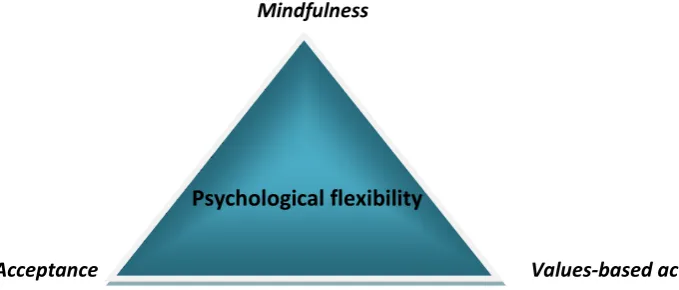
8 Figure 1
Harris’ (2009) ACT triflex of psychological flexibility
Mindfulness
Psychological flexibility
Acceptance Values-based action
Mindfulness is for this study of less importance. It is seen as an aspect of acceptance and as a technieque which helps to perceive things in an accepting way, respectively. In the interviews, it was of importance to measure the application of the ACT principles in a practical way, to capture how participants deal with ACT in their daily lives. As this is not captured in the triflex, we adapted the trifelx to this study. Figure 2 shows this altered triflex, where mindfulness has been replaced with application (of the learned principles).
Figure 2
The ACT triflex of psychological flexibility
Acceptance
Psychological
flexibilityApplication Values-based action
The three subconcepts of the triflex are used to operationalize and thus being able to measure psychological flexibility and its development in this study.
[image:12.595.83.438.451.605.2]9 experiential avoidance, as they can help to restore functioning and quality of life for people with chronic pain (Keogh, Bond, Hanmer & Tilston, 2005;McCracken & Eccleston, 2005; Viane et al., 2003).
Acceptance is a part of a broader therapeutic process of changing influences on behavior. Methods aiming to reach these goals include prevent purposes from being dominated by experiences to avoid pain and pain related symptoms. Instead, the purpose should be to engage in an activity with openness. These different purposes seem to make a great difference to the social, physical and emotional functioning of people who suffer of chronic pain (Vowles, McCracken, McLeod & Eccleston, 2008). Acceptance has a key role in the well-being and daily functioning of people with chronic pain (Nicholas & Asghari, 2006; Viane et al, 2003) and a good quality of life (Mason, Mathias & Skevington, 2008). Even when acceptance is the only process that is worked on, positive resultants have been found. When patients are willing to experience pain and taking part in activities despite their pain, they are found to function in a healthier way (McCracken, Vowles & Eccleston, 2004a; McCracken & Eccleston, 2005; Viane et al., 2003). McCracken and Zhao-O’Brien (2010) point out that acceptance is important in a broader perspective, not only for the acceptance of pain. Therefore, we apply acceptance in a broader meaning in our scoring scheme.
Values-based action is also a process which plays an important role when it comes to the impact of chronic pain (McCracken & Vowles, 2008; McCracken & Yang, 2006). Hayes and colleagues (2006) define values as ‘chosen qualities of purposive action that can never be obtained as an object but can be instantiated moment by moment’.
One of the processes of psychological flexibility is committed action. This proces ressembles our term application of the learned principles. Hayes and colleagues (2006) described the value of committed action.ACT encourages the development of larger patterns of action that have a positive effect for the patient. Concrete goals can be set and achieved. In the therapy, the patients get homework which aim to change behavior, also outside the save therapy setting.
Research questions. Based on this background, we have four research questions. The main research question in this study is:
How does psychological flexibility develop during an eight week long ACT-based pain- treatment at the Roessingh rehabilitation center within the pain patients? How do acceptance, values-based action and application develop? Can we conclude that ACT is effective for the participants?
We also want to know how the developmental courses of the five patients interact with each other. We wonder if their developmental show the same pattern at all:
Is there a recurrent pattern or do the subjects develop differently, in their own, individual way?
We also want to find out if the experience of the therapist in the RRC can be found back in the scores:
Is there a measurable relapse, a crisis, in the development of psychological flexibility? What is the influence of a possible crisis on the end-level of development?
10 How can the development of the participants be found back in their description of what they
learned and experienced and the situations they describe? How do they describe their growth and experiences during therapy, as well as possible pitfalls and the progress they made?
Hypotheses. Based on the literature, the primary hypothesis is that there will be a positive development in psychological flexibility, given that ACT is directed to increase psychological
flexibility. Accordingly, we expect that all three submeasures will be higher at the last measure. This expectation is based on the fact that the treatment aims to reach more acceptance, that is helps patients examine their values and how to base their actions on it and that it helps them to use the ACT principles in their daily lives.
Secondly, we expect that the individual development of the five subjects will differ from each other. We expect these differences because Middelink (2010) and Paplowski (2010) found that the patients developed in individual patterns, different from each other.
Thirdly, based on the experience of the therapist in the pain rehabilitation of the RRC, we expect that the majority of the participants will experience a crisis in their development of psychological
flexibility and that they will finally end up at a higher level after the crisis, compared to the highest level before the crisis. Therapist often sees that patients have a low point, do not feel well, and sometimes even think about stopping the treatment, mostly in the middle of the treatment. When they overcome this crisis, they often had good results at the end of the treatment. No research has been conducted so far about this interesting pattern, other than the study by Middelink and Paplowski. We expect that this described crisis can be found back in the measures of psychological flexibility (and therefore in all of the three subscales).
Method
Participants
Five chronic pain patients that took part in an eight-week impatient treatment in the pain
revalidation of the RRC in Enschede, the Netherlands, participated in this study. The treatment took place internally every week from Wednesday till Friday. The participants were assigned tasks to do during the days they stayed home. The program was multidisciplinary; the patients were treated by a team of rehabilitation physicians, psychologists, social workers, physiotherapists, occupational therapists, sport therapists and creative therapists. The team worked with the protocol ‘Leven met pijn’ (Living with pain), based on ACT.
11 lies between the age of 18 and 70, with a mean age of 40 years. Fibromyalgia, back complaints and whiplash complaints are most common (Roessingh, n.d.).
Three of the participants participated in all of the eight interviews. One of the participants, patient E, experienced that the interviews were an additional burden on top of the general program and stopped after the third interview. She rejoined in the seventh and eights interview. One of the patients, patient B, informed the interviewers in the beginning that she would stop the treatment two weeks earlier because of personal circumstances. Therefore she did not participate in the last two interviews of the treatment but was interviewed again in the follow-up interview.
[image:15.595.68.522.281.503.2]In exchange for their participations, all patients received a personal report on their development.
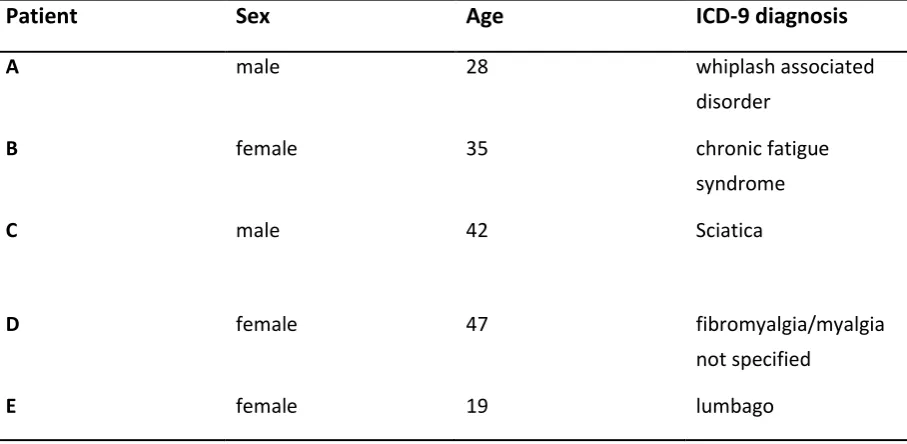
Tabel 1
Characteristics of the participants
Patient
Sex
Age
ICD-9 diagnosis
A male 28 whiplash associated
disorder
B female 35 chronic fatigue
syndrome
C male 42 Sciatica
D female 47 fibromyalgia/myalgia
not specified
E female 19 lumbago
Material
The interviews were taped using a voice recorder, with permission of the participants. The
interviewers had an interview scheme which they used (see Appendix 1). An interview always started with an opening question asking about how it is going with the patient. This question was asked with the aim that the patient could tell what kept him busy at the moment. Then, the main question was asked: “What did you learn and experience last week?” When a patient experienced difficulties to come up with something, a couple of cue questions could be asked to help:
1.) What was new for you in the last week?
2.) Have you learned something during the treatment which you were not able to apply? 3.) Did anything happen that you are likely to still remember after the treatment? 4.) What was different last week in comparison with the week before?
12 The following questions were always asked to further examine the situation:
Can you give a concrete example and describe the situation? Can you tell about the thoughts you had in that situation? Can you tell about the feelings you had in this situation? Why was it important for you to do it / don’t do it? What let you to decide to do it / don’t do it?
Can you indicate how well you succeeded to apply what you have learned to this situation on a scale from 1 to 10 (1= not at all, 10=very good)?
Did you also apply what you learned or experienced in other situations? The order in which the questions were asked was not prescribed, except from the first question (“Can you give a concrete example?”), which always has been asked first. At the end of every interview, the interviewer asked the patient if he or she had any questions or comments about the interview and the patients were thanked for the participation.
The interview scheme was the same in every interview, except for the first one and the last two ones (see Appendix 2). The first interview differed from the normal scheme in the way that it began with a short introduction of the interviewer, the aim of the research, an explanation of the procedure and what will be done with the data. Furthermore, the participants were asked to give a short description of themselves. In the seventh interview, the participants were asked how they perceived the
interviews and if they had any suggestion for improvement. In the follow-up interview, they were asked what they have learned and experienced since the end of the treatment. They were also asked how they would describe their own development and whether they changed during treatment and in which manner. Furthermore, they were asked about the most important thing they learned during the treatment.
The interview tapes were used to transcribe the interviews. To score the interviews, the transcripts were analyzed using a scoring scheme (see Appendix 2). After the study was finished, every
participant received a summary of his own development and the transcripts of their interviews via e-mail.
Procedure
To address the research questions, a qualitative study with five single-case studies has been
conducted. The six patients of an inpatient pain group in the RRC have been approached in their first week of treatment. The group was one out of two newly started groups and was chosen randomly. The aim and procedure of the interviews were explained to the group members. Then they were asked if they want to participate. Five out of the six patients agreed to participate.
13 because of holidays. Therefore, no interviews were conducted during in this week. Six weeks after the last interviews, a follow-up interview was conducted.
The interviews have been conducted in Dutch. The interviews were face-to-face and were conducted in the pain clinic, individually planned in the therapy-scheme. So every participant had the interviews every week at the same day and time. A quiet room was chosen, where the interviewer and the patient could sit alone.
The interviews were semi-structured and took maximal thirty minutes. In the seventh interview, the maximum time was set to 45 minutes. The aim was to discuss at least three different situations in one interview. The follow-up interviews were also face to face. With two patients, these interviews were conducted in the RRC. The other three patients were interviewed someplace else, in a quiet environment, depending on what was practical for the participants. The last interview was set to a maximum of 45 minutes.
Data analysis
First of all, all 35 interviews were transcribed. Secondly, the situations had to be determined in terms of where they started and where they ended in the text. Then, a name was given to every situation. The name was chosen accordingly to the aim the patient had in the specific situation, like ‘taking a break during sport’. Finally, every situation was scored on three scales: acceptance, values-based action and application. The transcripts were scored accordingly to a scoring scheme (see Apendix 3). For examples for every score, see Appendix 4. The scores were compared and discussed, to finally coming to a shared decision.
Used variables. We scored the interviews on the three subscales of psychological flexibility on a five point scale, where 1 meant that the patient used the concept ‘not good at all’ and 5 meant that he did it ‘very well’:
Acceptance: With the subscale acceptance, we measured if someone tried to avoid negative
sensations through experiential avoidance or saw negative sensations as an inevitable part of life and thereby accepted it. We measured the avoidance/ acceptance of physical and emotional pain and other negative sensations, memories, experiences etc.
Values-based action: With this concept it was examined why someone acted in a special way. Were the reasons externally or internally motivated, by thoughts, feelings, pain or social factors like social pressure, or based on personal values?
Application: This subscale measured the extent of the application of learned principles of the ACT treatment. We measured how well a patient succeeded in applying something he or she learned in the described situation. It measures how well a patient was able to use the concepts of ACT in his daily life.
14 place and the most appropriate name was chosen. Thereby, the rule was handled that it should be something concrete and applicable, and where possible an action. Here, the content of the names was also often the same, but the exact phrasing differed oftenly.
2nd round. In the second round, scores on the three concepts acceptance values-based action and application were given for each single situation on a 5-point scale and were then compared. This was done in four steps. In the first three steps, three randomly chosen interviews were individually scored and then discussed. After the first step, the three interviews were discussed with experts. In the forth step, the last 27 interviews were scored individually. The difference between the scores of the two interviewers very often differed one point on the 5-point scale. As the interrater reliability was 0.329 within all 35 interviews, which is poor, it was decided to discuss every single situation of all 35 interviews and to choose a final score together. In case of disagreement, an expert could be asked. In the end, no expert opinion was needed, as a 100% agreement on the scores was achieved. We calculated the mean value of the scores of the three subscales for all situations per interview. This overaal mean value was the score for psychological flexibility in every interview.
Description of the interviews. In the results part, we described how the patients changed during the course of the treatment by means of the interviews. Descriptions of situations or citations from the interviews, which were translated from Dutch to English as literally as possible, are used for this aim. Firstly, a short description is given of all patients. Information from the intakes in the RRC was used for this aim. Secondly, we used graphs to visualize their development. The graphs depict the final scores in every interview. One graph shows the development of acceptance, values-based action and application and a second graph shows the overall development of psychological flexibility.As it would have been too extensive to describe all five patients in great detail, it was decided to describe three randomly chosen patients detailed (patient A, C and E). Here, the beginning situation was described first with help of the first three interviews. Typical situations with a theme that often came back within the stories of this patient were used to illustrate his development. Citations have been chosen accordingly to the presence of one of the three concepts. Citations, in which a patient clearly explained why he or she did certain things, where acceptance or the refuse to accept was strongly expressed, or where it became clear if someone succeded in realizing something he learned in his daily life, were used to elucidate the scores they got.
The development in the middle of the treatment is described by means of interviews four, five and six. This was not possible for patient E, as she did not attended interview 4 to 6. The end situation is derived from the seventh interview and the follow up interview. In the last two interviews, the patients were not only asked about certain situations, but they were also asked to give a description of their own development. They had to sum up the most important things they have learned and tell about how they think about the treatment and the changes they made. We decided to use these descriptions, instead of the situations, to describe the end situation. We also did that for patient B and D, which were otherwise only described shortly. After this individual description of the stories of all five patiens, a comparision was made between the five patients.
15 citation is taken from (third number). When a citation came from the first interview, from the second situation, and was said at approcimatily 3 minutes and 39 seconds, it was indicated in cursive letters as follows: (1.2, 3:39).
Results
In the results part, the following research questions are answerd:
- How do psychological flexibility and its thre subscales develop during the eight week long, ACT-based treatment within the five patients?
- Is there a recurrent pattern or do the subjects develop differently?
- Do the patients go through a crisis and what is the influence of such a relapse? - How can development found back in the stories of the patients?
Patient A
[image:19.595.72.445.515.682.2]Patient A was a 28-year-old man, who suffered of chronic headache. Two years ago, he graduated as an industrial product designer and found a job as a design engineer. He lived on his own and had a girlfriend. His parents lived nearby. A year ago, he had a bike accident and fell on his face. The complaints didn’t vanish. Instead, the complaints got worse, but no physical or neurological causes could be found. He was diagnosed with whiplash associated disorder (WAD). One of his main complaints was his problem with processing stimuli, especially in crowed environments. First, he worked less, but finally, he had to quit his job. He already attended a two week observation period in the RRC. He had a mental approach and thinked, argued and analyzed a lot. His coping method used to be just going on. A sustaining factor was his tendency to rationalize. He had a great sense of responsibility, needed confirmation and had problems communicating his needs.
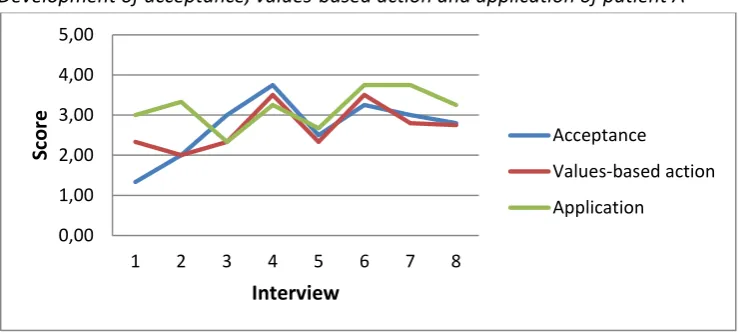
Figure 3
Development of acceptance, values-based action and application of patient A
0,00 1,00 2,00 3,00 4,00 5,00
1 2 3 4 5 6 7 8
Sc
o
re
Interview
Acceptance
Values-based action
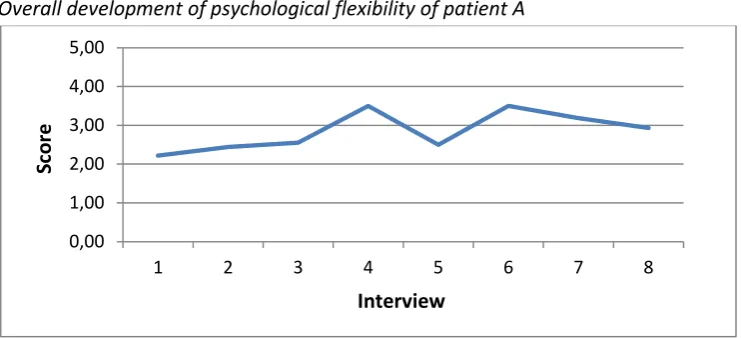
16 Figure 4
Overall development of psychological flexibility of patient A
A clear development can be seen when looking at the difference in interview 1 and interview 7. The development was less high when comparing the first with the last interview. A clear crisis can be seen in interview 5, which is the sixth treatment week. The crisis was due to a decline in all three subscales. Then, the score was almost as low as in the beginning.
The acceptance began as the lowest of the three evaluation points. It increased rapidly from the second to the forth week. The application began as the highest of the three ratings. It did not only have a peak in week 6, but also in week 4. It ended as the highest of the three ratings. The score was as high as it was in interview 4 and in interview 6 at the end of the treatment. That means that the crisis did not have a positive, nor a negative effect on the final score. There were different themes that were important to him. Strategically dealing with stimuli was probably the most important one, as it came back in different forms throughout all the interviews. Others issues of importance were taking enough rest, dealing with fatigue, apply mindfulness, base his live on his values, and deal with worrying thoughts.
Beginning situation. In the first interview, patient A described his situation as the following: “… that I find it difficult sometimes, because I take it very serious what is happening now. And it is serious that I find it hard sometimes to life now with it and not let my whole analysis mechanism start.” (1.1, 07:27). From the beginning on, he struggled with acceptation that his life had changed because of his pain: “Also because I don’t do things or have to let be small things, have to do things less intensive. Less abundant. I think that is a pitty. So I could accept that a little more that it is as it is. But still, I find it, sometimes I have difficulity with it.” (1.1, 10:17). Het got two points for acceptance in this
situation, as he realized that he should accept his situation, but found it very difficult. His acceptance had the lowest startpoint from the three scales. Values-based behavior started a little higher, but still quite low. In the beginning, the reasons for why he did things were stongly externally motivated, instead of values-based. A good example for this could be found in the first interview. When he was asked why he made the decision to go to a birthday party, even though he knew that it would be hard for him, he said: “Yes, what decided what I do? Good question. How I feel, indeed, so if I feel already overstrung or not. My environment also plays a role I have to say. What they want from you (interviewer)? Yes, what they want from me indeed and if I am familiar with my environment or not. So a bit what I except what they want from me. Also a little experience from what I learned here and
0,00 1,00 2,00 3,00 4,00 5,00
1 2 3 4 5 6 7 8
Sc
o
re
17 from the times that it went well or bad.” (1.1, 12:31). Here, expectations from others played the biggest part in his decision to go to the party. In the first interview in the second situation, he got one point for values-based action. Reasons he gave for why he did and didn’t do certain things were avoiding a restless feeling and his headache: “No, than I can’t keep my eyes open and can’t sit anymore and then I get restless and then I notice that I fastly go do something. What is that? Yes, I think to have a little distraction. *…+ Then I clean up the house or something like that. It is on a low level, but then I get enough distraction so that I do not feel that I got a really bad headache.” (1.2, 16:40). When it comes to application of the learned principles, although he started relatively high, his greatest struggle was how to deal with impulses from his environment. In the third week, he went to his old work: “… I got caught in the moment. *…+ And what happens then was that this thing doesn’t come up, this ‘Hey, wait a second, what can I do about this?’ That happens a little, but stays too much on the background. I suppress it a little. And then I go on too long. Talking too long with a couple of different people and this and that and so on. And before I know, it is three kwarters later and than I take a little break. *…+ And then I think ‘I don’t feel so well’ at this moment. More like ‘I should have stopped earlier.’ (2.2,12:46).
Middle of the treatment. In the fifth week, there was clearly an improvement visible with regard to his habit of analzing everything. Normally, it even hindered him to take a decision: “In general, the problem is that I want to think things over and over again, then decide, and then look again, to take my final decision, while I could have taken a decision earlier. *…+ Maybe the outcome is different, but is it worth all the trouble to think it over all the time?” (4.2, 07:21). An example for this new way of taking decicsions was the offer of the RRC to take part in an optional communication module. First, patient A decided to take part, as “maybe, this will bring something. So I look a little how it goes. *…+ And then I will look at the end if it had brought something or not. Then I will find out if it costs too much energie to do it along.” (4.2, 8:29). So he started to wonder: “Isn’t that too much? Isn’t it at the expence of other things, which are really important for me. Because communication, about
assertiveness and things like that, that is going well.” (4.2, 8:29). So he realized that his initial plan to take part and only then decide if he should take part regularily, is not the best way: “That is
nonsense, because if I think of it in advance: ‘Is it worth the effort?’, I also can say directly that I will stop with it. *…+ So I already took the decision that I will stop.” (4.2, 8:29). This decision felt good for him: “That is a positive feeling. Also a little like letting things go. That you don’t want to control everything. Look if you can make a decision and if it is good or bad, left or right, doesn’t matter that much in the end. With a lot of things. So I think that I have to consider fewer things can give me peace of mind.” (4.2, 10:24). He concluded that like this, he could put his energie into other things that he finds valuable and worth the effort. By removing unnecessary things, he was able to put his energie in other things he considered worth it.
18 excercises, than you are busy with not judging about what you feel for example, or what you think. Then you are busy with your body and your mind, you are observing in fact. *…+ And that is not to do something with it, but just look at yourself. And that is not the case in normal life, at least I don’t do it. I have unlearned it in all the years, because you are so busy with all external things, in fact.” (4.4, 21:55). When asked what made it important to do this, he said that he found it important to be in balance with his body and mind. He also finds considered it important for his complaints: “Look, I have a painfull neck now, and I have a headache and I have a numb feeling in my face, and I am very tired. But in fact, I feel relaxed. I feel mentally relaxed now.” (4.4, 21:55).
In interview 5, the patient had a crisis, which is clearly visible in the graphics of his development (see figure 3 and 4). This crisis also came back in the interview. He had been on a vacation with his girlfriend and her parents: “What did I learned? I found out that, and that is part of it of course, you get out of your rhythm, as I was already afraid of.“ (5.1, 1:18). He described how he got into the crisis: “You think, we are sitting in a positive spiral and that is really fine. And when you go away, you are not working [on yourself] anymore. And you forget a couple of things and you got out of your rhythm. I kept trying a couple of things which costs a lot of energy. What I noticed then is that I get fysically tired, I also suffer from it mentally. That I get more depressed. For example, when I was three days in Bergen, I got back, then I don’t see everything so positive as I did before. And that is because I am so tired. So you have to see to get out of it.” (5.1, 1:54). He described the viscious circle het got in: “At the moment I get overstimulated I also feel bad. I get worried. And because of that I get more overstimulated. I don’t have enough energy to move, what I seem to need. So you went down the stairs really quickly, while you was standing so high a short time ago.” (5.1, 4:6). The patient worried about his situation: “The thoughs in this mechanism are: ‘I knew how I had to deal with things.’ and ‘It is going so bad suddenly.’ And everything becomes less transparent in fact. At once. How you got everything under control and how you have to do it all, that all disappears a little.” (5.1, 05:08). He was also concerned about the future: “And this also brings a little fear along with it. Because I think: How am I going to do all of this? How is this going further?’ *…+ It is
19 Endsituation. During the follow-up interview, patient A was happy with his situation and
development: “It is going well. Between the last time I spoke with you and now, I can be really satisfied with how it goes. Much happened, but it was a gradual change, I have to say.” (8.1, 00:1).
During the last weeks in the RRC, he planned to restart work where he can do something for society. At the time of the follow-up, he worked as a postman for a couple of hours every day. He was happy with it and wanted to keep the work a couple of months. Afterwards, he wanted to take the next step and work for example in an office. He had a very good picture of his values: “That I feel good about the things I do. That I do things that are important to me. That I am healthy. That I surround myself with the people I love en the people who inspire me.” (8.3, 13:39). He came up for himself and it became easier for him to do so (8.3, 12:59). He was satisfied about his new gained ability to take some distance: “I am able to reflect on myself and how it is going and to look at things from above for a moment, like: ‘I am doing this now. Is it going well? Do I feel well? What do I see happen afterwards?” (8.3, 14:46). He saw a huge progress: “Last weekend, I had a really nice day. I did so much that I thought: ‘Unbelievable!’ A couple of months ago, all of the things I did would have been impossible on their own. And now, I do it all in one day.” (8.4, 19:30). He named the reasons why he was able to do all these things now: “It seems that I have done things differently than I normally did.”(8.4, 21:01). For example, he went to a birthday party and while most guests stayed the whole day, he only stayed two hours, and it was fine for him. Here, we could see that social pressure is not a motivation for him anymore to do certain things. He accepted that he couldn’t do the same things in the same way as his friends. Doing things differently also meant: “that I limit things a little. *…+ Also in how I do them. *…+ It is important that I stay calm, for myself, and unconsciously, I am doing a lot of things strategically.” (8.4, 21:41). By doing things in a different way, he gained a lot: “So as you see, I became very aware of how I can do things. And how I can organize my life so that I am not burden myself too much. To give myself the chance to get better, in fact.” (8.3, 23:45). He
summarized the greatest changes he made during treatment in the 7th interview: “I have of course stayed myself. But how I deal with myself has changed. *…+ Looking at what I’m doing now, do I want to do that or not? And that does not only have to do with the complaints but also with the direction that I want to give to my life and my carreer. *…+ It has given me a lot of clearity to look at my values. *…+ Concerning the whiplash, I have really learned to dose. *…+ When doing something, to look at: ‘What do I gain on long term? What do I gain when I structure my life?’ Even if I do not feel well, I go and do something.” (7.6, 28:01).
Conclusion. Patient A, the ‘thinker’, developed with ups and downs. In week 6, he clearly went through a crisis, which was at a late point of time, compared with the other patients. He came out of the crisis stronger than he was before. His main problems had a cognitive character: he thought too much about everything and pondered on every little decision, analyzed everything and worried intesivly. Mindfulness helped him a lot and he found ways to deal with the worrying thoughs. Another importand point was dealing with signals from his environment. He often felt
20 weeks after the treatment, he even had a job as postman, where he had to do tasks which were very challenging for him, but he saw the job as a good training. In the course of time, he became clearer and clearer about his values. At the end, he had a detailed picture about his aims and about what is important to him and what is not.
Patient B
Patient B was a 35 year old woman. She was married and had two children of the age of 2 and 3,5 years. She worked 24 hours per week in the service sector. For circa three days in the month, she also helped in the business of her husband; she did a part of the administration and bookkeeping. She was diagnosed with a chronic fatigue syndrome. She took part in a rehabilitation day treatment because of dorsal pain in 2002.
[image:24.595.73.443.381.537.2]Sustaining factors were the anxiety and uncertainty about her medical condition, frustration about inabilities and about missing acknowledgement in her environment and fighting against her complains, which produced stress. She also tended to demand a great deal of herself. These were risks to go beyond borders. She had a good understanding of the situation and a great willingness to deal with it from the beginning on.
Figure 5
Development of acceptance, values-based action and application of patient B
Figure 6
[image:24.595.71.445.583.736.2]21 Patient B participated only in the first five interviews and the follow- up interview. She stopped with the treatment two weeks earlier, as she got married. Up to week 6, a positive development could be seen. She started with an overall score of 2,42 had a score of 3,33 in week 6. In the follow-up interview, the score of psychological flexibility was a little lower than in her last treatment week (3,00). Here, the scores of acceptance and application decreased, but values-based action increased. Acceptance and application roughly developed the same, whereas values-based action developed differently. Values-based action clearly decreased in week 3, but then increased again in the last interview. It was finally higher than in the week before the decrease. Important themes for patient B were listening to the signals of her body, taking time for herself, letting go of her perfectionism, dealing with work stress, planning her daily duties, doing nice things again and taking breaks. When asked about her development in the follow-up interview, patient B also looked back at her situation in the time before the treatment: “Really positive. I think that my eyes really got opend. Because you were in the negativity. Because you got pain. And things you normally did, you couldn’t do anymore. And I got stucked in it. *…+ And I hoped for a long time: ‘When I wake up tomorrow, than it will be over.’ There will be a day, when it will be over. This day is still not there. And the negativity costed me a lot of energy. Also I forgot to enjoy the things I still was able to do. *…+ You forgot that the things you got happy about earlier, still can make you happy. You know, you are so buzy with all the things that are impossible. And you do not appreciate the things that are still possible and you don’t even see them.” (8.5, 31:13). Then she went on with the things she has learned: “At the Roessingh, I learned what I represent. *…+ The Roessingh gave me back the pleasure in the small things that I had. I see things from the sunnier side now. Even though I still got moments when I’m fed up with this headache. *…+ I accepted it in the way that it is part of me. I am that far now.” (8.6, 32:46). When asked about the most importend things she leaned, she said: “To take time to listen to the signals of my body.” (8.5, 34:41). She described how she experienced this in the beginning of the treatment: “After two weeks, I understood that it would be useful to listen to your body. Anyhow, I still was convicted that I never heard anything. *…+ But I didn’t take the time to let my body shout. (8.5, 34:41). She summarized her time in the RRC as follows: “It helped me a lot, especially on long term.” (8.5, 40:48). She expected that she is still in a proces of growing.
Conclusion. Patient B, the ‘perfectionist’, was hinderd by her own high standards when she began therapy. She was not able to listen to her body and often went beyond her limits, both at work and at home. At therapy, she learned to recognize the signals of her body and acting accordingly to it. She learned to let go and let things be unperfect, especially in the household. She felt less stressed by putting less pressure to herself at the end of the treatment. She had put her life on the hold. During treatment, she accepted step by step that the pain will not go away and she learned to appreciate life again with the pain. Therby, she also got happier. She made a steady development, without great ups or downs.
Patient C
22 work to 50 % because of his complains. When he came home, he had to rest an hour of one or two. A high tempo and perfectionism were typical for him, as well as a lot of stress, fear of movement and fear of the future. He had a hard time relinquishing tasks. He was diagnosed with back pain (sciatica). He also had pain and reduced strength in his leg. He used to be in good health, until a stressful period at work a couple of years ago. Shortly after this period, his complains started. He had difficulties to deal with the loss of health. He had a somatic approach and interpretation of his complaints and was disappointed about the failure of all medical interventions.
Figure 7
Development of acceptance, values-based action and application of patient C
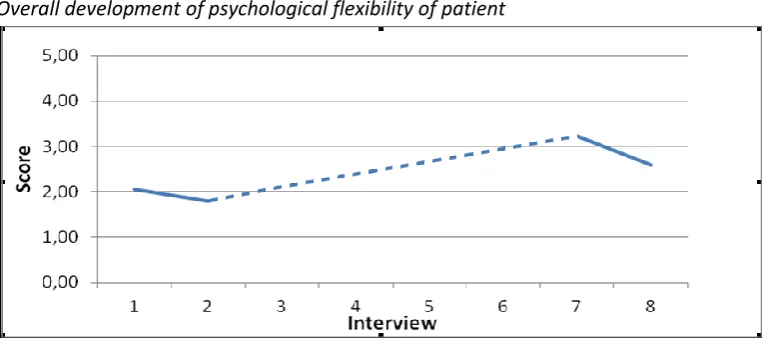
Figure 8
Overall development of psychological flexibility of patient C
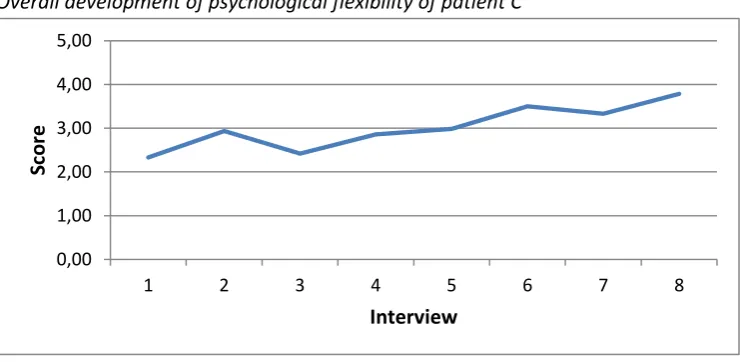
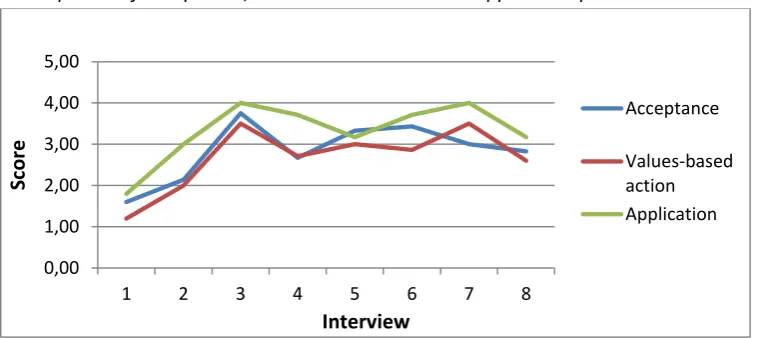
Patient C started with score of 2,33 and then made a big step in development from the first to the second interview with a decrease of one point. In interview 3, a clear crisis can be seen. Then, a steady development took place, up to the eight interview. Only the application differed in the way that it had its highest point in interview 6 and sank down to a lower score in interview 7, just to rise again in the last interview. The highest developmental score could be seen in the follow-up interview with a score of 3,78. Important topics for patient C were accepting boundaries, stopping and taking breaks, planning before beginning with something, choosing for himself, making choices more consciously, letting go responsibility, working less, communicate boundaries at work, find a balance
0,00 1,00 2,00 3,00 4,00 5,00
1 2 3 4 5 6 7 8
Scor
e
Interview
Acceptance
Values-based action Application
0,00 1,00 2,00 3,00 4,00 5,00
1 2 3 4 5 6 7 8
Sc
o
re
[image:26.595.73.444.444.625.2]23 between work and private life and accepting that he is not able to work as much as he used to do. His pitfall was that he worked so much that he needed to rest at home a significant amount of time before his pain was bearable again.
Beginning situation. The development that can be seen in the graphics, can also be found in the interviews. In the first interview, the application was still difficult for the patient. In two out of the three situations, he had low scores in the adaptation. He realized his mistakes afterwards and wanted to make a change. He had learned new things, but could not adapt them yet. One example was that he went beyond his limits in swimming therapy. This situation was also a good example for the reasons why he did things his way. He realized: “There is nobody here who demands that you go up to a certain level. But then you find out that you demand it from yourself.” (1.1, 3:39).
Furthermore, he did certain things because he wanted to lessen the pain. When he was asked why it was important for him to do act like he did, he answered: “You can smooth *…+ the pain with it.” (1.2, 9:06). The reasons he gave for being open for the things they learnt in therapy were that he “*…+ maybe by approaching things differently in the future or thinking differently, can influence the pain.” That meant that his score on values-based action started at a quite low level.
In the second interview – the third treatment week - a clear improvement could be seen. This peak was caused by the great increase in application and values-based action. In the application, in the six situations that patient C described, four of them went well or very well (score 3 up to score 5). The values-based action was still pain directed (2.1), influenced by social acceptance (2.2) and other external reasons (2.6). Others, like his father, were still more important than he was: “In this sense, he is more important than I am.” (2.5, 18:27). But differently from the first interview, his behavior was also based on his values, like “being able to do others things” (2.2, 05:05) at home. Acceptance remained on the same level.
In the third interview, a crisis can be seen. Here, he fell back to the level of the first interview. The crisis took place in all three areas. In terms of acceptance, he avoided to disappoint others. He couldn’t accept that he did not say anything to the others during an exercise in occupational therapy, where the others inadvertently made the task harder for him: “Yes, I see it happen, it is an allergy of mine. That I think: ‘Gosh, do it now!’, but I do not say anything about it.” (3.4, 24:12) and later on: “It is stupid. Because I feel annoyed then. *…+ That must be an enormous irritation, I think, when even someone else sees it.” (3.4, 26:07). He also did not accept the pain, as he based his behavior on the aim to prevent the pain, because “otherwise, the pain becomes unbearable.” (3.3, 21:02).
Concerning the application, the fourth week was apparently a fallback. In the four situations, three situations had a low score in the application (1 or 2). He learned things in the RRC, but couldn’t convert them at home. This lack of generalization could be seen, for example, in his astonishment that at the RRC, he did not have rest or sleep, like he does at home: “That is really strange. I cannot find a negative effect in this.” He was not able to generalize it: I don’t know how I can place this.” Therefore, he still rested at home. There was an inner battle whenever he had to choose between helping someone or doing something that is good for him: “On the one hand it gives a good feeling that you can help somebody.” (3.1, 7:25). Concurrently, he asked himself: “Is this the smartest way?”
24 important.” (3.1, 08:01). Regarding the values-based action, he realized that his motives are not value-directed: “That I think: ‘What is so important about it?” (3.1, 2:54). The reasons for his actions were to not disappoint anyone: “To not disappoint someone, I disappoint myself.”, automatism, being persuaded by a colleague to stay longer, stress and things that have to be done and the satisfaction he got out of helping others and pain reduction. In this interview, especially the social motives, like doing anything just to avoid disappointing others, became clear: “*…+ because I do not disappoint others, but actually myself. And yes, maybe there lies one of the big problems.” (3.1, 4:11).
Middle of the treatment. After the low point of the third interview, all three areas rose again slowly. His level of acceptance was difficult to measure, as he barely talked about aspects of acceptance. This was different from the other four patients who were interviewed. There was still a contradiction in his feelings when he stood up for his rights, like leaving work early. He did something good for him, but fell badly about it. He did not know how to deal with these negative feelings that came along with doing something that is good for him, but maybe disappointing to others: “*…+ on the one hand it is very, very positive. On the other hand, there is still a negative side. I have to try slowly to, if it is banishing or accepting I don’t know yet exactly, but that the positive side will predominate.” (4.1, 6:48). He was still in an adaptation-stage: “And one time it feels better than another time.” (4.4, 15:25). He succeeded in giving up responsibility to other group members. He realized that it is not always the best way to do things automatically. He applied the principles he learned in treatment, especially in occupational therapy, more and more. Still, pain relief stayed his most important motivation to do things differently.
In the adaptation, he still needed an external aid to accomplish certain things, like making an
appointment with the hairdresser to leave work early: “I know that I would have been at work till ten or eleven o’ clock.” (4.1, 02:35). It helped him to have a reason, which he could tell his colleagues and thereby create clarity. A very important theme for him was awareness. He lived and planned in a more aware way, he asked himself why he does the things how he does them and he thought about it in advance.
For patient C, the sixth week, thus interview 5, felt like a low mark, especially in the application, because he had to rest in bed. He realized that his learning process did not worsen. However, this cannot be seen back in the application-scores, because he told about situations where he was feeling better and was not so sick anymore. In these situations it was striking that he was able to realize and especially to indicate his boundaries, at home and at work. Another important theme in the fourth interview was the difference between long term and short term effects. He was able to make an explicit difference between these two and act accordingly. This also improved his way of planning things beforehand and to be able to make a thought-out choice.
25 that I am doing the things that are really important to me. *…+ That is not only at work, but also at home. That you are doing your choices really consciously. What I do and what I don’t do.” (8.6, 29:47). Finding this limit was clearly one of the most important things that patient C had learned. He answered the question about the main point the treatment did for hem as follows: “This is seeing that the expectations I always had for myself were ridiculously high.” (7.4, 15:16)