Team
Performance
The Relationship between
Interdependence and the
Outcome of Decision Making
Hayo C. Baarspul MSc
Interdependence is considered to be one of the defining team characteristics that influen-ce group performaninfluen-ce. Existing studies show that the relationship between both task and outcome interdependence and performance is influenced by the interaction among group members. This study adds to the literature by testing the hypothesis that three process-related variables (cohesion, decision making behavior and team coping style) mediate the relationship between task and outcome inter-dependence and group decision making. Using data of 302 individuals organized into 47 teams, multilevel regression analysis shows that cohesion, integrative behavior and the problem-solving team coping style act as mediators. The results of this study suggest that the relationship between perceived team effectiveness and task interdependence is only mediated by effective (and, consequent-ly, not by ineffective) team attitudes and behavior.
University of Twente, 1 December 2009
1
1. Introduction
The fact that work groups and teams are taking an increasingly prominent place in organizations (Sundstrom, De Meuse & Futrell, 1990), resulted in more scientific attention for the role of groups in organizations, especially with regard to team effectiveness (e.g., Campion, Medsker & Higgs, 1993; Campion, Papper & Medsker, 1996; Cohen & Bailey, 1997; Farmer & Roth, 1998; Mathieu, Maynard, Rapp & Gilson, 2008). The interaction between group members is vital to organizational work (Van der Vegt, Emans & Van de Vliert, 1999), as it could have a significant impact on individual and/or team performance (e.g. Guzzo & Dickson, 1996). A prominent characteristic of teams that relates to this interaction, and that influences team outcomes, is interdependence; theory and research suggest that both task and outcome interdependence are positively related to various team or organizational outcomes, such as performance, effectiveness or decision-making outcomes (e.g., Allen, Sargent & Bradley, 2003; Campion et al., 1993; Campion et al., 1996; Gully, Incalcaterra, Joshi & Beaubien, 2002; Janssen, Van de Vliert & Veenstra, 1999; Saavedra, Earley & Van Dyne, 1993; Shaw, Duffy & Stark, 2000; Van der Vegt, Emans & Van de Vliert, 1996, 1999; Wageman, 1995; Wageman & Baker, 1997).
2
3
2. Theoretical background and hypotheses
2.1. Interdependence: task and outcome
Although different definitions and operationalizations exist (Van der Vegt & Van de Vliert, 2001), the concept of interdependence can be described as the extent to which the input of several individuals is required to complete a certain task, reach a specific goal or obtain a certain output, i.e. to “complete work” (Wageman, 1995). It can be considered a “defining characteristic of a group” (Allen, Sargent & Bradley, 2003, p. 717). Members of work groups that are interdependent are expected to “facilitate others’ task performances by providing each other with information, advice, help and resources” (Van der Vegt et al., 1999, p. 202). The level of interdependence among individuals organized in teams originate from a number of sources (Wageman, 1995): task inputs (e.g., the distribution of skills), work processes (i.e. how is work organized: interdependent or independent), goal definition and achievement, and, lastly, the way performance is rewarded. Although more forms are acknowledged (Campion et al., 1993), two different types of interdependence are generally distinguished (Van der Vegt & Van de Vliert, 2001; Wageman, 1995): task interdependence and outcome interdependence.
Task interdependence can be defined as the level in which “group members interact and
depend on one another to accomplish the[ir] work” (Campion et al., 1993). Typically, task interdependence increases when work itself becomes more difficult and employees require a higher level of assistance from each other in terms of, for instance, materials, information or expertise (Van der Vegt, Emans & Van de Vliert, 2001). It describes the degree to which a task requires collective action (Wageman, 1995), and has reported effects on individual motivation and group effectiveness (Campion et al., 1993). In summary, task interdepen-dence can be seen as a “structural feature of the instrumental relations that exist between team members” (Van der Vegt & Van de Vliert, 2001).
Outcome interdependence can be described as the extent to which team members “are
4
interdependence, different levels of outcome interdependence can be observed within teams and between teams. For instance, the overall level of outcome interdependence between sales representatives is low, while that of blue collar workers at an assembly line is relatively high.
Interdependence is considered to be a concept that can be used to “accurately predict interactions among and effectiveness of team members” (Van der Vegt et al., 1999, p. 202). Within teams, employees depend on each other for the successful completion of their tasks. Both task and outcome interdependence influence the personal work outcomes of employees who contribute to the work of the team (Van der Vegt, Emans & Van de Vliert, 1998). Furthermore, the two forms of interdependence relate positively to (direct antecedents of) team effectiveness and performance (e.g., Campion et al., 1993; Molleman, 2009; Saavedra et al., 1993; Shaw, Duffy & Stark, 2000; Van der Vegt & Van de Vliert, 2001, 2005; Van der Vegt et al., 1999, 2000). It follows from the results of these studies that both task and outcome interdependence are positively associated with performance. It is therefore hypothesized that:
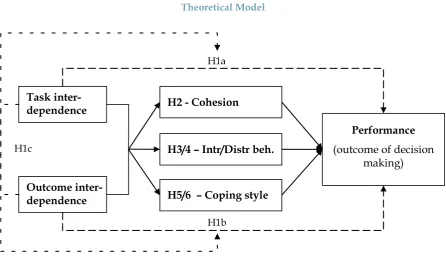
Hypotheses 1a and b: There is a positive relationship between task (H1a) and outcome (H1b) interdependence and decision making.
Although the two concepts are mutually independent (Wageman, 1995), there is a profound relationship between outcome and task interdependence. Authors have repeatedly found the different forms of interdependence to interact with one another. While there are some exceptions (e.g., Allen et al., 2003), most studies show that the positive and/or detrimental effects of one type of interdependence can be moderated by the other type (e.g., Saavedra et al., 1993; Wageman & Baker, 1997; Van der Vegt et al., 1996, 1999, 2001, 2003). For instance, Wageman and Baker (1997) found that groups performed better when both types of interdependence were either high or low; in turn, hybrid or mixed groups, with low task and high outcome interdependence or vice versa, had a detrimental result on performance. Similar results are reported by Saavedra et al. (1993), who tested the interaction between three types of interdependence. Therefore, it is postulated that the relationship between interdependence and perceived team performance is influenced by the interaction effect of task and outcome interdependence.
5
2.2. Interdependence, performance and the process in-between: mediation
Group performance, however, depends on more than work organization alone. Although interdependence affects team effectiveness (e.g. Van der Vegt et al., 1996), the processes by which group members interact have an impact on the outcomes of the decision making process as well (Alper, Tjosvold & Law, 1998). Moreover, previous research continuously showed process-related variables, such as task strategy (Saavedra et al., 1993), team conflict management (Somech et al., 2009) or behavioral processes of decision making (Janssen et al., 1999), to interfere in the interdependence-performance relationship. In other words, the organization of work, in terms of task and outcome interdependence, determines the behavior and attitudes in groups, which in turn determine the perceived group outcomes in terms of decision making effectiveness.
In this study, attention will be given to three such process-related variables that are proposed to mediate the relationship between interdependence and team effectiveness in decision making contexts: (1) cohesion, accounting for a group member’s sense of belonging to his/her team, (2) integrative and distributive behavior, accounting for the behavioral interaction among individuals within a group, and (3) the team coping style, referring to the behavioral strategy of the team when team problems emerge.
Cohesion
6
2005) and higher collective responsibility for performance outcomes (Tjosvold & Deemer, 1980).
It is proposed that cohesion mediates the relationship between interdependence and the outcome of decision making. Beal et al. (2003), for instance, found that when the team workflow increased (i.e. more work and activities came into the team and members had to increasingly cooperate with each other as a team), the relationship between cohesion and performance became stronger. As been stretched by Wageman (1995), highly interdepen-dent groups exhibit processes and behavior associated with cohesion, such as a high degree of high-quality social processes. Cohesion involves personal engagement in tasks and pleasure from working together (Wech et al., 1998). In other words, the organization of work in terms of interdependence is a premise for group members’ sense of belonging, which in turn leads to a certain level of team effectiveness. Hence, it was hypothesized that:
Hypotheses 2: The relationship between task (H2a) and outcome (H2b) interdependence and decision making is mediated by the cohesion of the team.
Process of Behavior
7
Previous authors have found evidence for the mediation by integrative and/or distributive behavior of the relationship between forms of interdependence and (measures of) team performance (e.g., Janssen et al., 1999; Somech, 2008; Somech et al., 2009). The type of elicited behavior (i.e., integrative or distributive) will affect team effectiveness: integrative behavior (i.e., working together) will show a positive influence on performance, while the display of distributive behavior (i.e., working independently in a non-cooperative way) will negatively affect perceived team effectiveness in decision making contexts (e.g., Blake & Mouton, 1964, 1970; Janssen et al., 1996; Janssen et al., 1999; Thomas, 1992; Tjosvold & Deemer, 1980; Van de Vliert, Euwema & Huismans, 1995). It was therefore hypothesized that:
Hypotheses 3: The relationship between task (H3a) and outcome (H3b) interdependence and decision making is mediated by integrative behavior within a team.
Hypotheses 4: The relationship between task (H4a) and outcome (H4b) interdependence and decision making is mediated by distributive behavior within a team.
Coping style
Where the behavioral strategies discussed in the previous paragraph focused on behavior between team members under more or less ‘neutral’ (i.e. non-stressful) circumstances, the coping style refers to the behavioral strategies of the whole team when the team and its members are faced with problematic situations. Coping can be defined as the ‘cognitive and behavioral efforts made to master, tolerate, or reduce external and internal conflicts among them’ (Folkman & Lazarus, 1980). Specifically, it is about the use of strategies handling potentially stressful situations (problem-focused coping), and dealing with the (negative) emotions that accompany these situations (see Aldwin & Revenson, 1987; Carver, Scheier & Weintraub, 1989). An example of such a stressful situation could, for instance, be the occurrence of conflict with another individual. In general, individuals have a number of possibilities to ‘cope’ with unwanted situations. It could be argued that the same applies at a higher level, as teams can come across similar team-related situations as well, such as the dysfunctioning of the whole team or one of its members, or the reorganization or even dissolution of the team. The team coping style is, in other words, about the team strategies used when team members collectively solve team-related problems.
8
problem-solving behavior: the team devotes all its resources to solving the problem. By creating a plan, identifying possible solutions and gradually working towards a solution, the problem is being handled. Previous research has shown that this rational, problem-focused style is the most effective, if there are sufficient possibilities to control the situation (Terry, Tonge & Callan, 1995). In contrast to the confronting coping style, in which team members try to actively solve the problem at hand, a second style can be identified in which the opposite behavior can be observed: the avoiding coping style. This dimension is characterized by the solitary attitude of team members, and detachment or keeping at distance of the problematic situation (e.g., Latack & Havlovic, 1992). The team stops operating as a whole when problems arise and will turn its attention elsewhere, while individual team members focus their attention on other work, or engage in problem-solving behavior. Therefore, it was hypothesized that:
Hypotheses 5: The relationship between task (H5a) and outcome (H5b) interdependence and decision making is mediated by the confronting coping style.
Hypotheses 6: The relationship between task (H6a) and outcome (H6b) interdependence and decision making is mediated by the avoiding coping style.
2.3. The research model
Based on the extensive theoretic elaborations in the previous paragraphs, the
[image:9.595.74.521.519.775.2]expectations that have been presented are summarized in the following model.
Figure 1 Theoretical Model
H2 - Cohesion
H5/6 – Coping style
Performance
(outcome of decision making)
Outcome inter-dependence
H3/4 – Intr/Distr beh. Task
inter-dependence
H1c
9
3. Method
3.1. Sampling: participants and procedure
A total of 32 public-, hybrid- and private-sector organizations based in the Netherlands participated in this study, including (but not limited to) manufacturing organizations (e.g., electronics), construction firms, government agencies and service organizations, such as insurance, telecommunications or health care. Data were collected from 302 randomly chosen, full-time employees from 47 teams; the types of teams under study comprised work teams, management teams, project teams and participation councils. Teams ranged in size from 3 to 16 employees; on average, a group contained 6.43 members (SD = 2.92). Each team was asked by management to complete the survey; respondents were assured confidentiality and anonymity by the researchers. The sample comprised of 47.2% males, with respondents’ mean age being 39.31 (SD = 9.49). Individual members had been part of their current team for an average of 3.25 years (SD = 3.19) and had an average work experience of 14.92 years (SD = 9.14).
3.2. Measures
Considering the sample size, separate factor analyses were run for all variables, with the conventional .30 loading used as the cut-off point. All items were rated on a 5-point Likert scale ranging from 1 (strongly disagree) to 5 (strongly agree).
Predictors – Task interdependence (four items) and outcome interdependence (three
items) was assessed using measures developed by Van der Vegt et al. (1996). Factor analysis with varimax rotation and principal component of the seven items revealed the expected two-factor structure. For task interdependence, participants were asked to report the extent to which they needed information, material and other resources from team members to perform their tasks. An example of one of the selected items for task interdependence is: “We need each other in order to achieve our goals”. For outcome interdependence, participants were asked to report the extent to which getting team results was dependent on the joint efforts of the individual team members. For example, “If my colleagues do their work properly, I will benefit greatly from their efforts.” Cronbach’s alpha for task interdependence was .76; for outcome interdependence it was .72.
Cohesion – For cohesion, participants were asked to report their feelings of belonging
10
example of an item used is “I’m satisfied that I am part of this team.” Cronbach’s alpha for cohesion was .92.
Integrative and distributive behavior – Integrative (six items) and distributive (four
items) decision-making behavior was assessed using measures derived from Janssen et al. (1996). Factor analysis with varimax rotation and principal component of the ten items of conflict behavior revealed the expected two-factor structure. Examples of items that were used for the conflict behavior scales are “we collect various ideas and integrate these in the best solution possible” (integrative) and “we try to force our own opinion on others” (distributive). Cronbach’s alpha for integrative behavior was .76, for distributive behavior it was .77.
Coping style – To assess the preferred coping style that was used by a team,
participants were presented a scenario and were asked to report how their team would deal with situations like the one that was described in the scenario. In order to select a scenario team members could identify with, a pilot study was conducted in which four scenarios
simulating four team-related problems1
Dependent variable – The outcome of decision making (11 items) was assessed using a
scale that is adapted from Janssen et al. (1996). Examples of the selected items were “the were presented. In this pilot, 28 team members from four different teams were asked to evaluate the four scenarios in terms of recognisability, intensity and impact if the prescribed situations were to become reality. Based on the results, one scenario was selected and then used in the questionnaire that was provided to the members of all the teams incorporated in this study. In order to measure the team’s coping style, 12 new items were developed that were derived from measures on individual coping (e.g., Folkman & Lazarus, 1980; Latack & Havlovic, 1992). The items encompassed two different coping styles: to confront (i.e. to solve the problem) and to avoid (i.e. to evade or ignore the problem as a team, or to solve the problem on an individual basis). The confronting style (four items) was measured using items like “the team focuses all its attention on solving the problem” and “the team will try to change the situation step by step.” The tendency to avoid problems (eight items) was measured using items like “as soon as the problem is brought up, the team will talk about something else” and “most team members will try to change the situation on their own.” Cronbach’s alpha for the confronting coping style was .87, for the avoiding coping style it was .85.
1 The four scenarios that were used encompassed (1) a dysfunctioning team member, (2) a new team
11
quality of the decisions is of the highest level this team can ever possibly reach” and “team members are fully behind the decisions that have been taken.” Cronbach’s alpha for this measure was .89.
3.3. Analyses
Hierarchical multilevel regression analysis was used to test the all hypotheses. In the first model, the two types of interdependence were entered. Subsequently, the two-way interaction term of both forms of interdependence was added in the second model. As suggested by Cohen, Cohen, West and Aiken (2003), the conventional method of ‘mean centering’ was applied in order to avoid problems concerning multicollinearity (Cohen, Cohen, West & Aiken, 2003). In the third model, one of five mediators was entered each time: cohesion (M3a), integrative (M3b) and distributive (M3c) behavior, and the confronting (M3d) and the avoiding (M3e) coping style respectively. In assessing the proposed mediator effects, the three-step procedure proposed by Baron and Kenny (1986) was followed. The first step prescribes that the predictor variables (task and outcome interdependence) should be significantly related to the mediator variable (e.g. cohesion). In the second step, the predictors should be related to the dependent variable (outcome of decision making). The third step stipulates that the mediator should be related to the dependent variable, under the condition that the predictor is included in the equation. For mediation to occur, however, the relationship between the predictor and the dependent variable in the third step should be (1) significantly reduced (for partial mediation) or should be (2) zero (for complete or perfect mediation). In order to assess whether the indirect effect decreases significantly in the case of partial mediation, a method suggested by Sobel (1982) was conducted.
To assess whether it was valuable or not to give attention to the group level, the intraclass correlations (ICC, Bliese, 1998, 2000; Bliese & Halverson, 1998) were calculated in order to determine which part of the total variance could be explained by differences within teams compared to differences between teams. ICC(1) for all variables revealed scores
between .22 (cohesion) and .35 (outcomes of decision making)2
2 The exact ICC(1)’s are as follows: task interdependence (.33), outcome interdependence (.30),
cohesion (.22), integrative behavior (.29), distributive behavior (.34), confronting coping style (.28), avoiding coping style (.29), outcome of decision making (.35).
12
4. Results
4.1. Common Method Variance
Since all variables are self-reports and collected from single respondents, results can be potentially influenced by the occurrence of common method variance. To diminish or control the extent to which the common method can occur, a number of statistical procedures were implemented: (1) Harman’s single-factor test, (2) confirmatory factor analysis and (3) what is referred to as the single-latent-method-factor approach (Podsakoff, MacKenzie, Lee & Podsakoff, 2003).
Harman’s single-factor test revealed ten factors when factor analyses with an eigenvalue greater than 1 cut-off criterion and a variety of both extraction methods and rotation options were conducted on all items (cf. Podsakoff & Organ, 1986; Podsakoff, Todor, Grover & Huber, 1984; Schriesheim, 1979). These results indicate that common method bias has limited influence on the data used in this study, since no general factor was apparent. Subsequently, a confirmatory factor analysis (CFA) was conducted in order to determine whether or not each of the proposed factors fitted their associated questionnaire items. The
results of this CFA showed a good fit of the proposed model to the data: χ2(874) = 2677.66,
RMSEA = .085, CFI = .94, SRMR = .066, GFI = .70. Cut-off criteria for these fit indexes are
(with a preferable sample size of ≥ 250): a value close to .08 for SRMR; a value close to .06 for
RMSEA and a value close to .95 for CFI (Hu & Bentler, 1999). A single-latent-method-factor
approach revealed a good fit to the data as well: χ2
4.2. Descriptive statistics
(822) = 2332.93, RMSEA = .080, CFI = .95, SRMR = .063, GFI = .67. In both analyses, all items retained significant loadings on their associated factors. The results of the three analyses conducted showed that the influence of common method variance is statistically not substantial, and that the answers respondents gave on the items reflected the underlying constructs these items were intended to measure.
13
[image:14.595.71.527.176.298.2]significantly relate with either task interdependence (r = –.06, n.s.) or outcome interdependence (r = –.07, n.s.), while the relationship between outcome interdependence and the avoiding coping style is not significant either (r = –.07, n.s.).
Table 1
Means, Standard Deviations, and Correlations – Individual-Level Data (n = 302)
Variable
a b
M SD 1 2 3 4a 4b 5a 5b 6
1. Task interdependence 3.76 .85 (.76) 2. Outcome interdependence 3.34 .91 0.58** (.72)
3. Cohesion 4.04 .87 0.45** 0.35** (.92)
4a. Integrative behavior 3.34 .72 0.23** 0.12* 0.30** (.76)
4b. Distributive behavior 2.29 .85 –.06 –.07 –.30** –.40** (.77)
5a. Confronting coping style 3.59 .89 0.20** 0.17** 0.43** 0.42** –.41** (.87)
5b. Avoiding coping style 2.21 .72 –.13* –.07 –.44** –.38** 0.51** –.69** (.85)
6. Decision making outcomes 3.34 .70 0.21** 0.21** 0.52** 0.51** –.50** 0.61** –.52** (.89)
*p < .05. **p < 0.01.
aThe reliabilities of the scales are reported on the diagonals between brackets. b
4.3. Tests of Hypotheses
Problems concerning multicollinearity are avoided given the fact that all correlation coefficients are below .70.
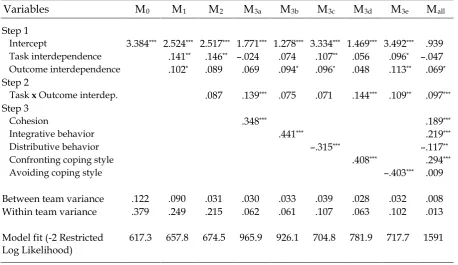
The results of the multilevel regression analysis are presented in Table 2 (step 2 and 3 of Baron and Kenny); Table 3 gives an overview of the b values of task and outcome interdependence when regressed on each of the mediators (step 1 of Baron and Kenny). The first column (M0) shows the null model, indicating that 24 percent of the total variance of the dependent variable is explained at the higher level and 76 percent at the employee level.
In the second column (M1), attention is given to the first set of hypotheses, which related to the positive relationship between interdependence and decision making. When the two forms were entered in the first step of the regression equation (see Table 2, Model 1), both task interdependence (b = .141, p < .01) and outcome interdependence (b = .102, p < .05) related significantly to the outcome of decision making. Therefore, both H1a and H1b are supported. Furthermore, it was proposed that outcome interdependence was a possible interaction of the relationship between task interdependence and the dependent variable, or vice versa (H1c). As can be seen in Table 2, this proposition was tested by entering the main effects in the first model and adding the interaction effect in the second model. The proposed interaction effect could not be confirmed, however, since the interaction term of both types of interdependence was not significant when added into the equation (b = .087, n.s.).
14
[image:15.595.70.529.341.606.2]task interdependence relates significantly to both cohesion (see Table 3; b = .456, p < .001) and the outcome of decision making (see Table 2: b = .141, p < .01). Step 3 is also satisfied (see Table 2, Model 3a): after cohesion (b = .349, p < .001) is entered into the equation, task interdependence becomes non-significant (b = –.024, n.s.). Therefore, complete mediation is in order, and H2a was accepted. For outcome interdependence only steps 2 and 3 can be fulfilled: outcome interdependence relates significantly to the dependent variable (b = .102, p < .05) and this effect becomes non-significant when controlled for cohesion (b = .069, n.s.). As can be seen in Table 3, step 1 is not satisfied, however, since the b value of outcome interdependence when regressed on cohesion is not significant (b = .114, n.s.). Therefore, H2b was not accepted. Given these results, cohesion only fully mediates the relationship between task interdependence and decision making.
Table 2
Multilevel Regression Analysis (fixed effects) – Individual-Level Data (n = 302)
Variables M0 M1 M2 M3a M3b M3c M3d M3e Mall
Step 1
Intercept 3.384*** 2.524*** 2.517*** 1.771*** 1.278*** 3.334*** 1.469*** 3.492*** 0.939
Task interdependence 0.141** 0.146** –.024 0.074 0.107** 0.056 0.096* –.047
Outcome interdependence 0.102* 0.089 0.069 0.094* 0.096* 0.048 0.113** 0.069*
Step 2
Task x Outcome interdep. 0.087 0.139*** 0.075 0.071 0.144*** 0.109** 0.097***
Step 3
Cohesion 0.348*** 0.189***
Integrative behavior 0.441*** 0.219***
Distributive behavior –.315*** –.117**
Confronting coping style 0.408*** 0.294***
Avoiding coping style –.403*** 0.009
Between team variance 0.122 0.090 0.031 0.030 0.033 0.039 0.028 0.032 0.008 Within team variance 0.379 0.249 0.215 0.062 0.061 0.107 0.063 0.102 0.013
Model fit (-2 Restricted
Log Likelihood) 617.3 657.8 674.5 965.9 926.1 704.8 781.9 717.7 1591
*p < .05. **p < 0.01. ***p < 0.001
15
hypothesis 3b was not accepted, as (1) step 1 was not fulfilled, because outcome interdepen-dence did not significantly relate to integrative behavior (see Table 3; b = .003, n.s.) and (2) the b value of outcome interdependence stayed significant (b = .094, p < .05), while the indirect effect turned out not to be significant according to Sobel’s (1982) test, thus not satisfying step 3. Therefore, it can be concluded that integrative behavior only mediates the relationship between task interdependence and the outcome of decision making.
Hypotheses 4a and 4b proposed that distributive behavior would mediate the relationship between task or outcome interdependence and the outcome of decision making. Table 1 already showed the non-significant zero-order correlation between task and outcome
interdependence and distributive behavior (rTi = –.06, n.s.; rOi = –.07, n.s.). Table 3
further-more shows the non-significant b values of task and outcome interdependence when
regressed on distributive behavior (bTi = –.051, n.s.; bOi = –.059, n.s.), therefore failing to
satisfy step 1. In Table 2, significant values are moreover reported when controlling for
[image:16.595.70.525.423.478.2]distributive behavior (see Table 2: bTi = .107, p < .01; bOi
Table 3
= .096, p < .05), thus not fulfilling the requirements for step 3. Therefore, neither hypothesis was accepted.
Interdependence Regressed on Mediators (b values) – Individual-Level Data (n = 302)
Variables cohesion integrative distributive confronting avoiding
Task interdependence 0.456*** 0.149* –.051 0.188** –.105
Outcome interdependence 0.114 0.003 –.059 0.075 –.042
*p < .05. **p < 0.01. ***p < 0.001
16
Hypotheses 6a and 6b postulated a mediating effect of the avoiding coping style in the relationship between task and outcome interdependence and the outcome of decision making. Table 3 demonstrates that the b values of task and outcome interdependence are not
significant when regressed on the avoiding coping style (bTi = –.105, n.s.; bOi = –.042, n.s.);
hence, step 1 is not fulfilled. Furthermore, as can be seen in Table 2 (Model 3e), multilevel regression analysis revealed that both task and outcome interdependence still significantly
related to the outcome of decision making (bTi = .096, p < .05; bOi
When all mediators were entered into the third equation (see Table 2), 62 percent of the variance in the outcomes of decision making can be explained through the proposed model at the individual level, and 38 percent at the group level. This can be compared to the null model, in which 24 percent of the total variance of the dependent variable is explained at the higher level and 76 percent at the lower, employee level. Also, the intercept became insignificant in the last model, indicating that the variables in the proposed model account for a solid explanation of the performance indicator. It should be noted however that the –2 Restricted Log Likelihood increased, indicating less fit compared to the initial model.
= .113, p < .01) after controlling for the avoiding coping style (b = –.403, p < .001); Sobel’s (1982) test revealed that the indirect effect was not significant, therefore not satisfying step 3. Hence, both hypotheses 6a and 6b were not accepted. Overall, these results show that the relationship between either form of interdependence and decision making is not mediated by the avoiding coping style.
4.4. The interaction effect of task and outcome interdependence
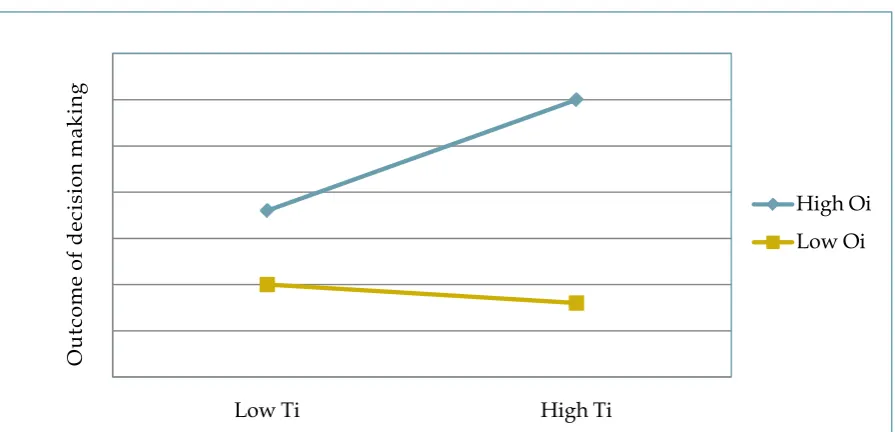
17 Figure 2
Interaction Effect (Task Interdependence x Outcome Interdependence)
The interaction effect in the case of cohesion as a mediator is depicted above; in both cases of mediation the effect developed a similar pattern. As can be seen in Figure 2, there is no difference between combinations of low outcome interdependence with either high or low task interdependence on the performance indicator. There is, however, an increased effect on the outcome of decision making under the condition of high task and high outcome interdependence; combinations of both high task and outcome interdependence yield the best results on perceived team performance in terms of the outcome of decision making.
0 0,05 0,1 0,15 0,2 0,25 0,3 0,35
Low Ti High Ti
Ou
tc
om
e
of
d
ec
is
io
n m
ak
ing
18
5. Discussion
5.1. Findings
Building on the extensive theory of interdependence, it was hypothesized in this study that the relationship between task and outcome interdependence and performance – in terms of the outcomes of decision making – was mediated by several characteristics that would be involved in the interaction process between employees: cohesion, integrative and distributive behavior, and team coping style. Although prior research has given attention to some of these interaction-related variables in relation to performance, this study is the first that combined these variables into one research design, and subsequently tested them using multilevel regression analysis. The results indicate that the propositions regarding the extent to which the relationship between different forms of interdependence and the outcomes of decision making is mediated by the three team-level attributes, are partially confirmed.
Support was found for the proposition that the relationship between task interdepen-dence and the outcomes of decision making is completely mediated by cohesion (H2a), integrative behavior (H3a) and the confronting coping style (H5a). Based on the results that have been found in this study regarding task interdependence, one could conclude that within groups, the outcomes of decision making are largely based on the way effective or constructive behavior is shown. Feelings of belonging to the team, integrative behavior and the confronting coping style aimed at solving collective team problems all appear to be of primary importance in the extent to which these outcomes are perceived as being positive (i.e. to what extent more commitment, perceived quality, understanding and acceptance are observed by the respondents). The mediating influence of cohesion is particularly conspicuous, since earlier studies primarily identified high levels of task interdependence to
moderate the relationship between cohesion and performance (see e.g. Gully et al., 1995). A
high level of task interdependence led to a stronger relationship between cohesiveness and performance (Beal et al., 2003). This effect can be partially located in the significant two-way interaction term of interdependence: high task and high outcome interdependence leads to higher performance. The results in this study indicate, however, that the feeling of belonging to and being part of a team in decision making contexts are also determined by the level of task interdependence.
19
relatively absent, considering the reasonably low ratings they received in this study, with a mean score close to two (i.e., ‘disagree’). Task interdependence did correlate somewhat substantially with the avoiding coping style, but the zero-order correlations between task interdependence and distributive behavior, and between outcome interdependence and both distributive behavior and the avoiding coping style, moreover, revealed no significant relationship. Ineffective behaviors and attitudes do affect performance (as the analyses in this study have shown), but interdependence is not their antecedent in decision making contexts. Interdependence can possibly moderate the relationship between these ineffective behaviors and attitudes, and decision making outcomes. For instance, earlier studies have established such a relationship between integrative and/or distributive behavior and interdependence (see e.g. Janssen et al., 1999; Somech, 2008); these are effects that have not been tested for in this study.
Furthermore, no support was found for the thesis that the relationship between outcome interdependence and the outcomes of decision making is mediated by either cohesion (H2b), integrative behavior (H3b), or the confronting coping style (H5b). Outcome interdependence does, however, significantly relate to the outcome of decision making. Besides this direct effect on team decision making effectiveness, outcome interdependence does play a role (albeit minor) in the interaction effect between task and outcome interdependence. The significant two-way interaction term of interdependence acts as a suppressor variable when cohesion and the confronting coping style were entered into the regression equation. The perceived effectiveness of decision making is in that case the highest under the condition of high task and high outcome interdependence. This result is not very surprising, given the fact that this level of interdependence implies that team members are forced upon each other. Therefore, frustrating the decision making process or each other, or avoiding team related problems altogether, is not an option given the effects this has on team performance.
20
interaction condition did not lead to higher perceived performance. In fact, it made no difference if low outcome interdependence was combined with either high or low task interdependence; high outcome interdependence turned out to have a positive effect on performance nonetheless, even in the low task interdependence condition. Somech (2008) reported the same interaction effect between high task and high goal interdependence when studying school teams: high-high combinations elicited higher team performance, while low-low or high-low-low did not lead to higher performance. It seems as if the interaction effect is dependent on the context in which it is studied, considering the varying number of theoretical models (and variables) that are being tested, as well as the relatively large variety in performance indicators (e.g., job satisfaction (Van der Vegt et al., 2001); supervisory effectiveness ratings (Alper, Tjosvold & Law, 2000; Somech, 2008); decision quality (Janssen et al., 1999); self reports on team effectiveness (Van der Vegt et al., 1999); measuring actual output (Campion et al., 1993); etc.). Task interdependence moderates the relationship between outcome interdependence and another variable under some conditions, while the effect is reversed in other instances. For decision making, under the condition of effective team behaviors and attitudes, high-high combinations of interdependence yield the best results.
5.2. Strengths & Limitations
21
specifically used in this study to assess the different coping styles. Although the selected scenario was carefully chosen based on a pilot-study procedure, it is not unimaginable that other scenarios (e.g., involving internal rather than external team related problems) would elicit different responses, thus resulting in slightly different outcomes, for example with regards to the selected team coping style or the perceived decision making effectiveness.
5.3. Theoretical implications and future research directions
The finding that the relationship between task interdependence and the perceived effectiveness of decision making is mediated by cohesion, integrative behavior and the way team members cope with difficult situations, has important theoretical implications. The relationship between interdependence and decision making has been further unraveled, thereby further sophisticating the empirical evidence. As the results in this study have shown, the process and circumstances in which team members engage in decision making explain a lot more variance at the group level than a mere work characteristic, such as interdependence, does by itself. Although work organization and dependability are important predictors of perceived team effectiveness in decision making contexts, this causal relationship is inferior to the more sophisticated model introduced in this study. This implies the use of an integral perspective, thereby including team dynamics in future research when looking at perceived team effectiveness in decision making contexts.
22
With regard to effective attitudes and behavior, it is only the relationship between task interdependence and decision making that is mediated. In this study, outcome inter-dependence only plays a minor role; in two instances (i.e. with cohesion and the confronting coping style) the combination of high task and high outcome interdependence leads to better outcomes of decision making in terms of increased efficiency, commitment and quality. An explanation for these findings could be that the selected process-related mediators in decision making contexts are mainly based on task organization (i.e. the level of task inter-dependence). The two-way interaction term already revealed that outcome interdependence only affects the outcome of decision making under some conditions, indicating that outcome interdependence seems of secondary importance in those work processes. An explanation for this could be that outcome interdependence is more affected by individual input and not so much by team-related processes. For instance, Wageman (1995) reported that task interdependence influenced variables related to (team) cooperation, while outcome interdependence related to effort. Future research could further address the relationship between perceived team effectiveness and outcome interdependence.
23
6. References
Aldwin, C. M. & Ravenson, T. A. (1987). Does Coping Help? A Re-Examination of the Relation between Coping and Mental Health. Journal of Personality and Social
Psychology, 53, 337-348.
Allen, B. C., Sargent, L. D. & Bradley, L. M. (2003). Differential Effects of Task and Reward Interdependence on Perceived Helping Behavior, Effort, and Group Performance.
Small Group Research, 34(6), 716-740.
Alper, S. Tjosvold, D. & Law, K. S. (1998). Interdependence and Controversy in Group Decision Making: Antecedents to Effective Self-Managing Teams. Organizational
Behavior and Human Decision Processes, 74(1), 33-52.
Alper, S. Tjosvold, D. & Law, K. S. (2000). Conflict Management, Efficacy, and Performance in Organizational Teams. Personnel Psychology, 53(3), 625-642.
Amason, A. C. & Schweiger D. (1997). The Effect of Conflict on Strategic Decision Making Effectiveness and Organizational Performance. In C.K.W. de Dreu & E. van de Vliert (eds.), Using Conflict in Organizations (pp. 101-115). London: Sage.
Andrews, M. C., Kacmar, K. M., Blakely, G. L. & Bucklew, N. S. (2008). Group Cohesion as an Enhancement to the Justice Affective Commitment Relationship. Group &
Organization Management, 33(6), 736-755.
Baron, R. M. & Kenny, D. A. (1986). The Moderator-Mediator Variable Distinction in Social Psychological Research: Conceptual, Strategic, and Statistical Considerations. Journal
of Personality and Social Psychology, 51(6), 1173-1182.
Barrick, M. R., Bradley, B. H., Kristof-Brown, A. L. & Colbert, A. E. (2007). The Moderating Role of Top Management Team Interdependence: Implications for Real Teams and Working Groups. Academy of Management Journal, 50(3), 544-557.
Beal, D. J., Burke, M. J., McLendon, Ch. L. & Cohen, R. R. (2003). Cohesion and Performance in Groups: A Meta-Analytic Clarification of Construct Relations. Journal of Applied
Psychology, 88(6), 989-1004.
Blake, R. R. & Mouton, J. S. (1964). The Managerial Grid. Houston: Gulf.
Blake, R. R. & Mouton, J. S. (1970). The Fifth Achievement. Journal of Applied Behavioral
Science, 6(4), 413-426.
Bliese, P. D. (1998). Group Size, ICC Values and Group-Level Correlations: A Simulation.
24
Bliese, P. D. (2000). Within-Group Agreement, Non-Independence, and Reliability: Implications for Data Aggregation and Analysis. In K.J. Klein & S.W.J. Kozlowski (eds.), Multilevel Theory, Research, and Methods in Organizations: Foundations, Extensions,
and New Directions (pp. 349-381). San Francisco: Jossey-Bass.
Bliese, P. D. & Halverson, R. R. (1998). Group Size and Measures of Group-Level Properties: An Examination of Eta-Squared Values and ICC Values. Journal of Management, 24(2), 157-172.
Bollen, K. A. & Hoyle, R. H. (1990). Perceived Cohesion: A Conceptual and Empirical Explanation. Social Forces, 69(2), 479-504.
Campion M. A., Medsker G. J., & Higgs C. A. (1993). Relations between Workgroup Characteristics and Effectiveness: Implications for Designing Effective Work Groups.
Personnel Psychology, 46, 823-850.
Campion, M. A., Papper E. A., & Medsker G. J. (1996). Relations between Team
Characteristics and Effectiveness: A Replication and Extension. Personnel Psychology,
49, 429-452.
Carver, Ch. S., Scheier, M. F. & Weintraub, J. K. (1989). Assessing Coping Strategies: A The-oretically Based Approach. Journal of Personality and Social Psychology, 56(2), 267-283. Chang, A. & Bordia, P. (2001). A Multidimensional Approach to the Group Cohesion-Group
Performance Relationship. Small Group Research, 32, 379-405.
Cohen, S. G. & Bailey, D. E. (1997). What Makes Teams Work: Group Effectiveness Research from the Shop Floor to the Executive Suite. Journal of Management, 23(3), 239-290. Cohen, J., Cohen, P., West, S. G. & Aiken, L. S. (2003). Applied Multiple Regression/ Correlation
for the Behavioral Science. Mahwah, NJ: Lawrence Erlbaum Associates.
Evans, Ch. R. & Dion, K. L. (1991). Group Cohesion and Performance: A Meta-Analysis.
Small Group Research, 22(2), 175-186.
Farmer, S. M., & Roth, J. (1998). Conflict-Handling Behavior in Work Groups: Effects of Group Structure, Decision Processes, and Time. Small Group Research, 29(6), 669-713. Folkman, S. & Lazarus, R. S. (1980). An Analysis of Coping Behavior in a Middle-Aged
Community Sample. Journal of Health and Social Behavior, 21(3), 219-239.
Gully, S. M., Devine, D. J. & Whitney, D. J. (1995). A Meta-Analysis of Cohesion and Performance. Small Group Research, 26(4), 497-520.
25
Guzzo, R. A. & Dickson, M. W. (1996). Teams in Organizations: Recent Research on Performance and Effectiveness. Annual Review of Psychology, 47(1), 307-338.
Hu, L. & Bentler, P. M. (1999). Cutoff Criteria for Fit Indexes in Covariance Structure Analysis: Conventional Criteria Versus New Alternatives. Structural Equation
Modeling, 6(1), 1-55.
Janssen, O., Van de Vliert, E. & Veenstra, Ch. (1999). How Task and Person Conflict Shape the Role of Positive Interdependence in Management Teams. Journal of Management,
25(2), 117-142.
Janssen, O., Veenstra, Ch. & Van de Vliert, E. (1996). Conflict Decision Making Management Teams. Gedrag en Organisatie, 9(6), 368-384.
Jehn, K. A. (1995). A Multimethod Examination of the Benefits and Detriments of Intragroup Conflict Administrative Science Quarterly, 40(2), 256-282.
Jehn K. A. (1997). Affective and cognitive conflict in work groups: increasing performance through value-based intragroup conflict. In C.K.W. de Dreu & E. van de Vliert (eds.),
Using Conflict in Organizations (pp. 87-100). London: Sage.
Jehn, K. A. & Mannix, E. (2001). The Dynamic Nature of Conflict: A Longitudinal Study of Intragroup Conflict and Group Performance. Academy of Management Journal, 44(2), 238-251.
Latack, J. C., & Havlovic, S. J. (1992). Coping with Job Stress: A Conceptual Evaluation Framework for Coping Measures. Journal of Organizational Behavior, 13(5), 479-508. MacKinnon, D. P., Krull, J. L. & Lockwood, Ch. M. (2000). Equivalence of the Mediation,
Confounding and Suppression Effect. Prevention Science, 1(4), 173-181.
Mathieu, J. M., Maynard, T., Rapp. T., & Gilson, L. (2008). Team Effectiveness 1997-2007: A Review of Recent Advancements and a Glimpse Into the Future. Journal of
Management, 34, 410-476.
Molleman, E. (2009). Attitudes Towards Flexibility: The Role of Task Characteristics. Group &
Organization Management, 34(2), 241-268.
Mullen, B. & Copper, C. (1994). The Relation Between Group Cohesiveness and Performance: An Integration. Psychological Bulletin, 115(2), 210-227.
Ng, K. Y. & Van Dyne, L. (2005). Antecedents and Performance Consequences of Helping Behavior in Work Groups: A Multilevel Analysis. Group & Organization Management,
30(5), 514-540.
26
Podsakoff, P. M., Todor, W. D., Grover, R. A. & Huber, V. L. (1984). Situational Mediators of Leader Reward and Punishment Behaviors: Fact or Fiction? Organizational Behavior
and Human Performance, 34, 21-63.
Podsakoff, P. M., MacKenzie, S. B., Lee, J. Y. & Podsakoff, N. P. (2003). Common Method Biases in Behavioral Research: A Critical Review of the Literature and Recommended Remedies. Journal of Applied Psychology, 88(5), 879-903.
Prein, H. C. M. (1976). Stijlen van Conflicthantering (Styles of Conflict Management),
Nederlands Tijdschrift voor de Psychologie, 31, 321-346.
Rahim, M. A. & Magner, N. R. (1995). Confirmatory Factor Analysis of the Styles of Handling Interpersonal Conflict: First-Order Factor Model and Its Invariance Across Groups.
Journal of Applied Psychology, 80(1), 122-132.
Saavedra, R., Early, P. Ch. & Van Dyne, L. (1993). Complex Interdependence in Task-Performing Groups. Journal of Applied Psychology, 78(1), 61-72.
Schippers, M. C., Den Hartog, D. N., Koopman, P. L. & Wienk, J. A. (2003). Diversity and Team Outcomes: The Moderating Effects of Outcome Interdependence and Group Longevity and the Mediating Effect of Reflexivity. Journal of Organizational Behavior,
24(6), 779-802.
Schriesheim, Ch. A. (1979). The Similarity of Individual Directed and Group Directed Leader Behavior Descriptions, The Academy of Management Journal, 22(2), 345-355.
Shaw, J. D., Duffy, M. K., & Stark, E. M. (2000). Interdependence and Preference for Group Work: Main and Congruence Effects on the Satisfaction and Performance of Group
Members.Journal of Management, 26(2), 259-279.
Sobel, M. E. (1982). Asymptotic Confidence Intervals for Indirect Effects in Structural Equation Models. In S. Leinhart (ed.), Sociological Methodology (pp. 290-312). San Francisco: Jossey-Bass.
Somech, A. (2008). Managing Conflict in School Teams: The Impact of Task and Goal Interdependence on Conflict Management and Team Effectiveness. Educational
Administration Quarterly, 44(3), 359-390.
Somech, A., Desivilya, H. S., & Lidogoster, H. (2009). Team Conflict Management and Team Effectiveness: The Effects of Task Interdependence and Team Identification. Journal of
Organizational Behavior, 30(3), 359–378.
27
Tekleab, A. G. Quigley, N. R., & Tesluk, P. E. (2009). A Longitudinal Study of Team Conflict, Conflict Management, Cohesion, and Team Effectiveness. Group & Organization
Management, 34(2), 170-205.
Terry, D. J., Tonge, L. & Callan, V. J. (1995). Employee Adjustment to Stress: The Role of Coping Resources, Situational Factors, and Coping Responses, Anxiety, Stress and
Coping
Thomas, K. W. (1992). Conflict and Conflict Management: Reflections and Update. Journal of
Organizational Behavior, 13(3), 265-274.
, 8(1), 1-24.
Tjosvold, D. & Deemer, D. K. (1980). Effects of Controversy Within a Cooperative or Competitive Context on Organizational Decision Making. Journal of Applied
Psychology, 65(5), 590-595.
Tzelgov, J. & Henik, A. (1991). Suppression Situations in Psychological Research: Definitions, Implications, and Applications. Psychological Bulletin, 109(3), 524-536.
Van de Vliert, E. (1990). Sternberg’s Styles of Handling Interpersonal Conflict: A Theory-Based Reanalysis, The International Journal of Conflict Management, 1(1), 69-80.
Van de Vliert, E., Euwema, M. C. & Huismans, S. E. (1995). Managing Conflict With a Subordinate or a Superior: Effectiveness of Conglomerate Behavior. Journal of Applied
Psychology, 80(2), 271-281.
Van der Vegt, G. S., & Van de Vliert, E. (2001). Intragroup Interdependence and Effectiveness: Review and Proposed Directions for Theory and Practice. Journal of
Managerial Psychology, 17(1), 50-68.
Van der Vegt, G. S. & Van de Vliert, E. (2005). Effects of Perceived Skill Dissimilarity and Task Interdependence on Helping in Work Teams. Journal of Management, 31(1), 73-89. Van der Vegt, G. S., Emans, B. J. M., & Van de Vliert, E. (1996). The Effects of
Interdependence in Project Teams. Gedrag en Organisatie, 9(6), 416-428.
Van der Vegt, G. S., Emans, B. J. M., & Van de Vliert, E. (1998). Motivating Effects of Task and Outcome Interdependence in Work Teams. Group & Organization Management,
23(2), 124-143.
Van der Vegt, G. S., Emans, B. J. M., & Van de Vliert, E. (1999). Effects of Interdependencies
in Project Teams.The Journal of Social Psychology, 139(2), 202-214.
Van der Vegt, G. S., Emans, B. J. M., & Van de Vliert, E. (2000). Team Members’ Affective Responses to Patterns of Intragroup Interdependence and Job Complexity. Journal of
28
Van der Vegt, G. S., Emans, B. J. M., & Van de Vliert, E. (2001). Patterns of interdependence in work teams: A two-level investigation of the relations with job and team satisfaction. Personnel Psychology, 54, 51-69.
Van der Vegt, G. S., Van de Vliert, E. & Oosterhof, A. (2003). Informational Dissimilarity and Organizational Citizenship Behavior: The Role of Intrateam Interdependence and Team Identification. Academy of Management Journal, 46(6), 715-727.
Wageman, R. (1995). Interdependence and Group Effectiveness. Administrative Science
Quarterly, 40(1), 145-180.
Wageman, R. & Baker, G. (1997). Incentives and Cooperation: The Joint Effects of Task and Reward Interdependence on Group Performance. Journal of Organizational Behavior,
18(2), 139-158.