Original Article/Research
BIM-based deconstruction tool: Towards essential functionalities
Olugbenga O. Akinade
a, Lukumon O. Oyedele
a,⇑, Kamil Omoteso
b, Saheed O. Ajayi
c,
Muhammad Bilal
a, Hakeem A. Owolabi
d, Hafiz A. Alaka
e, Lara Ayris
f,
John Henry Looney
gaBristol Enterprise, Research and Innovation Centre (BERIC), University of the West of England Bristol, United Kingdom bSchool of Economics, Finance and Accounting, Coventry University, Coventry, United Kingdom
cSchool of the Built Environment and Engineering, Leeds Beckett University, UK dFaculty of Business and Law, University of Northampton, UK
eFaculty of Computing, Engineering and The Built Environment, Birmingham City University, UK f
Waste Plan Solutions, Northampton, UK
g
Sustainable Directions Ltd, Gloucestershire, UK
Received 8 June 2016; received in revised form 30 November 2016; accepted 20 January 2017
Abstract
This study discusses the future directions of effective Design for Deconstruction (DfD) using BIM-based approach to design coordi-nation. After a review of extant literatures on existing DfD practices and tools, it became evident that none of the tools is BIM compliant and that BIM implementation has been ignored for end-of-life activities. To understand how BIM could be employed for DfD and to identify essential functionalities for a BIM-based deconstruction tool, Focus Group Interviews (FGIs) were conducted with professionals who have utilised BIM on their projects. The interview transcripts of the FGIs were analysed using descriptive interpretive analysis to identify common themes based on the experiences of the participants. The themes highlight functionalities of BIM in driving effective DfD process, which include improved collaboration among stakeholders, visualisation of deconstruction process, identification of recov-erable materials, deconstruction plan development, performance analysis and simulation of end-of-life alternatives, improved building lifecycle management, and interoperability with existing BIM software. The results provide the needed technological support for devel-oping tools for BIM compliant DfD tools.
Ó2017 The Gulf Organisation for Research and Development. Production and hosting by Elsevier B.V. All rights reserved.
Keywords: Building deconstruction; Building Information Modelling (BIM); Functionality framework; Focus Group Interviews; Descriptive interpretive analysis
1. Introduction
The recent wide adoption of Building Information Mod-elling (BIM) has revolutionised the approach to timely pro-ject delivery across the world (Eastman et al., 2011). The benefits accruable from BIM have stimulated several nations to set a deadline for its adoption. For example,
http://dx.doi.org/10.1016/j.ijsbe.2017.01.002
2212-6090/Ó2017 The Gulf Organisation for Research and Development. Production and hosting by Elsevier B.V. All rights reserved.
⇑ Corresponding author.
E-mail address:[email protected](L.O. Oyedele).
Peer review under responsibility of The Gulf Organisation for Research and Development.
H O S T E D BY
Gulf Organisation for Research and Development
International Journal of Sustainable Built Environment
the UK government has stipulated that from April 2016, all procurement in public sector work must adopt BIM approach. This deadline has forced most companies in the UK to integrate BIM into their activities in order to sustain their competitive advantage. Due to the rise in BIM adoption, the implementation of BIM has experi-enced diverse innovation especially for building design, cost estimation, 3D coordination, facility maintenance, building performance analysis, etc. In addition, there is progressive improvement on the capabilities of BIM and its integration with technologies such as RFID, GIS, big data, Internet of Things (IoT), and others (Bilal et al., 2016a). Despite the benefits accruable from the use of BIM and the steep rise in the adoption of BIM, the use of BIM for end-of-life scenarios is often neglected (Akinade et al., 2015). This is because most BIM imple-mentations focus on the planning to the maintenance stages of the building and only few works have been done on BIM for end-of-life scenarios.
It is important to give additional attention to the end-of-life of building, especially in terms of waste generation, because evidence shows that demolition activities account for over 50% of the total Construction and Demolition Waste (CDW) output of the construction industry (Kibert, 2003). Diverting this amount of waste could lead to a cost saving of over £1.3 billion on landfill tax and haul-age. Therefore, ensuring adequate management of waste at the end-of-life of building is imperative since the current rate of construction suggests that building renovation and demolition activities would grow substantially. The need to reduce waste at the end-of-life therefore requires that demolition, as the traditional method of building dis-posal, be replaced with building deconstruction. Decon-struction is a building end-of-life scenario that favours the recovery of building components for the purpose of building relocation, component reuse, recycling or reman-ufacture (Kibert, 2008). Design for Deconstruction (DfD) is not just concerned with the recovery of building compo-nents at the end-of-life but processes that make building to be easily assembled and disassembled. Despite efforts in mitigating demolition waste through deconstruction (Akinade et al., 2015; Phillips et al., 2011), there has not been a progressive increase in the level of DfD. Evidence shows that DfD is still far from reaching its waste minimi-sation potentials since less than 1% of existing buildings are fully demountable (Dorsthorst and Kowalczyk, 2002).
Considering the foregoing, the use of BIM for building deconstruction management would be an effort channelled in the right direction. This is because literature reveals that design decisions have high impact on waste generation and end-of-life performances of buildings (Faniran and Caban, 1998; Osmani et al., 2008). Based on the identified gap in knowledge, this study seeks to identify key BIM function-alities that could provide effective decision-making mecha-nisms for DfD at the design stages. Therefore, the specific objectives of the study include:
(1) To assess the effectiveness and limitations of existing DfD tools.
(2) To understand opportunities accruable from the adoption of BIM for DfD.
(3) To identify essential functionalities of a BIM-based tool for DfD.
In order to identify inefficacies of current DfD practices and tools, this study starts with a review of existing works on DfD and the discussion of the role of BIM in DfD. Afterwards, a descriptive interpretive research was con-ducted using multiple Focus Group Interviews. This approach allows the investigator to set aside all presuppo-sitions about the phenomenon in the search of true mean-ings and to have in-depth understanding of the phenomenon as experienced by experts. This is important to understand why the use of BIM for deconstruction is not common practice in the industry and to unravel the expectations of the participants on how BIM functionali-ties could be leveraged for DfD.
2. Building deconstruction and BIM
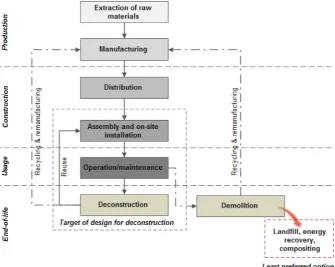
Deconstruction is a building end-of-life scenario that allows efficient recovery of building components (Kibert, 2008) for the purpose of reuse, recycling or remanufactur-ing. The recycling and remanufacturing of building compo-nents is now common practice; however, a more beneficial and challenging task is the ability to relocate a building or reuse its components without reprocessing. This is because building relocation and components reuse require minimal energy compared to recycling and remanufacturing (Jaillon and Poon, 2014). In addition, the reuse of building compo-nents guarantees a closed material loop condition where request for new resources and the generation of CDW is minimised. Fig. 1 shows how deconstruction enables a closed material loop condition at the end-of-life of build-ings. The closed material loop eliminates the linear pattern of material movement in demolition to a circular economy model, which is more sustainable.
The aim of building deconstruction is to eliminate demolition as an end-of-life building disposal option. Apart from favouring the recovery of building components and diversion of waste from landfills, deconstruction is more beneficial than demolition in other ways. First, deconstruction eliminates environmental pollution and CDW generation that is characteristics of demolition (Akbarnezhad et al., 2014). Other benefits include reduc-tion in harmful emission (Chini and Acquaye, 2001), preservation of the embodied energy (Thormark, 2001), reduction in site disturbance (Lassandro, 2003), etc.
and use of materials must be harmless; (e) material gener-ated as a result of the recycling process must be harmless. The main assertion from these rules is that construction materials must be recoverable and reuseable/recyclable to reduce waste generation at the end of the useful life of a facility. These rules uphold the reports by Egan (1998)
and Latham (1994), which highlight the need to improve design and construction processes in order to improve effi-ciency and sustainability.
2.1. Existing Design for Deconstruction tools
Considering the impacts of design on how buildings are constructed, it is necessary to understand how design deci-sions affect how buildings are assembled and disassembled.
Akinade et al. (2015) highlighted that tackling this chal-lenge requires the knowledge of the intertwined relation-ships among design practice, DfD techniques and DfD tools. This therefore calls for a holistic approach to how the interplay among these key areas could ensure successful building deconstruction. Accordingly, the impact of com-puter tools for DfD and assessing the sustainability of building cannot be overemphasised in this regard. In order to access the effectiveness and limitations of existing DfD tools as presented in several studies, a thorough review of extant literature was carried out. The review reveals that DfD tools cover life cycle assessment tools, environmental sustainability tools and life cycle costing tools. The tools and how they match up with DfD related criteria are pre-sented inTable 1.
[image:3.595.125.461.69.336.2]Table 1
Existing DfD tools and their features.
Nos Tools BIM
compliant
Embodied energy estimation
Carbon footprinting
End-of-life impact estimation
Estimation of building deconstructability
Deconstruction process simulation
Deconstruction plan generation
Material recovery assessment
Lifecycle costing
Whole-life environmental impact assessment
Optimisation of material selection
1 Building deconstruction assessment tool (Guy, 2001)
✗ U U U ✗ ✗ ✗ ✗ ✗ U ✗
2 Building end-of-life analysis tool (Dorsthorst and Kowalczyk, 2002)
✗ U U U ✗ ✗ ✗ ✗ ✗ U ✗
3 Construction Carbon Calculator (Buildcarbonneutral, 2007)
✗ U U ✗ ✗ ✗ ✗ ✗ ✗ ✗ ✗
4 SMARTWaste (BRE, 2008) ✗ U U U ✗ ✗ ✗ U ✗ U U
5 Building for Environmental and Economic Sustainability (BEES) (BEES, 2010)
✗ U U U ✗ ✗ ✗ ✗ U U ✗
6 Design-out Waste Tool for Buildings (DoWT-B) (WRAP, 2011)
✗ U U U ✗ ✗ ✗ U ✗ U U
7 IES IMPACT Compliant Suite
(IES, 2012)
U U U U ✗ ✗ ✗ U U U ✗
8 Sakura (Tingley, 2012) ✗ U U U ✗ ✗ ✗ ✗ ✗ ✗ U
9 eTool life cycle design (LCD) (ETools, 2013)
U U U U ✗ ✗ ✗ ✗ ✗ U U
10 Demolition and Renovation Waste Estimation (DRWE) (Cheng and Ma, 2013)
U U U U ✗ ✗ ✗ U U U ✗
11 Integrated Material Profile and Costing Tools (IMPACT, 2015)
U U U U ✗ ✗ ✗ ✗ U U U
12 BIM-DAS (Akinade et al., 2015)U ✗ ✗ U U ✗ ✗ U ✗ ✗ U
13 Athena environmental impact estimator (Athena, 2015)
✗ U U U ✗ ✗ ✗ U ✗ U U
14 SimaPro 8 (SimaPro, 2015) ✗ U U U ✗ ✗ ✗ ✗ ✗ U ✗
15 Umberto NXT LCA (Umberto,
2016)
✗ U U U ✗ ✗ ✗ ✗ ✗ U ✗
16 GaBi – Building lifecycle assessment software (Gabi, 2016)
✗ U U U ✗ ✗ ✗ ✗ ✗ U ✗
O.O.
Akinade
et
al.
/Internation
al
Journal
of
Sustainable
Built
Environme
nt
6
(2017)
260–271
functionalities. Based on the foregoing, this paper therefore seeks to unravel how BIM could complement DfD pro-cesses and to identify the essential functionalities that a BIM-based tool for deconstruction must have.
3. Methodology
After identifying the limitations of existing DfD tools, a descriptive interpretive study was carried out to understand how effective deconstruction process could be achieved by employing current capabilities of BIM. According to
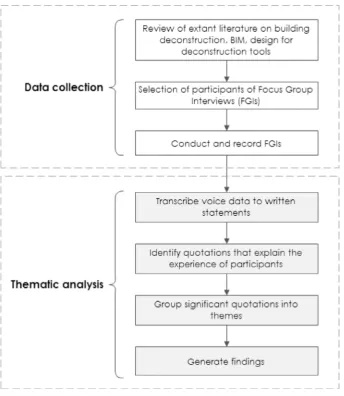
Creswell (2014), descriptive interpretive methodology seeks to qualitatively exhume common meaning from the experi-ences of several individuals. In this way, it allows deep understanding of individuals’ experience about a phe-nomenon. This is based on the belief that a poorly concep-tualised phenomenon could only be addressed if the researcher is in active correspondence with the participants (Holloway and Wheeler, 1996). Van Manen (1990) also highlights that being interested in the story of others is the basic underlying assumption of descriptive interpretive study. The investigators therefore try to set aside their experience to have a fresh perspective in exploring a phe-nomenon. In this regard, this study seeks to explore the experiences of the participants in terms of the use of BIM for DfD. The methodological flowchart for the study is shown inFig. 2.
According to Moustakas (1994), two data collection methods dominate descriptive interpretive studies, which are in-depth interviews and Focus Group Interviews (FGIs). In-depth interview is conducted with individuals to elicit their perspective of a phenomenon, while FGIs particularly involve discussion among selected group of participants regarding a common experience (Hancock et al., 1998). In this study, FGIs are employed over individ-ual interviews because FGIs allow participants to build on responses of others while discussing their personal experi-ence. This approach provides deeper insights into a wide range of perspectives within a short time and it also helps to confirm group thinking and shared beliefs.
Multiple FGIs were therefore conducted with partici-pants selected from the UK construction companies who have partially or fully implemented BIM on their projects. The sampling was done in a way that individuals who are directly involved in building design and BIM were chosen. The FGIs provide a forum for practitioners within the AEC industry to share their views and expectations on BIM usage for DfD. Although the practitioners are not specialists in tool development, understanding their views and expectation could help to uncover and analyse the industry requirement of BIM in DfD across different disci-plines. In addition, end users are key in the engineering of any useful innovation development and their views and expectations need to be taken into consideration (Oyedele, 2013). Accordingly, 20 professionals were selected based on suggestion of Polkinghorne (1989) who recommended that FGI participants should not exceed
25. The distribution and the range of years of experience of the participants of the focus groups are shown inTable 2. The distribution of year of experience of participants across all focus groups is as shown inFig. 3.
Participants of the FGIs were encouraged to discuss openly on the limitations of existing DfD practices and their expectations of BIM concerning DfD. This was done with the aim of understanding the possibilities of address-ing limitations of DfD tools with the current capabilities of BIM. Discussion and interactions among participants were recorded on a digital recorder and later compared with notes taken. This is to ensure that all important and valuable information to the study were captured. After-ward, the voice recordings were transcribed and segmented for thematic analysis. These tasks were conducted to develop clusters of meanings by themes identification.
4. Analyses and results
In a descriptive interpretive research, data analyses follow structured methods, which starts with the description of researchers’ own experiences followed by the description of textual and structural discussions of participants’ experi-ences (Creswell, 2013). This allows the researcher to move from a narrow unit of analysis to broader units. According toMoustakas (1994), descriptive interpretive research fol-lows a concise analytical approach as summarised inTable 3. Thematic analysis was carried out using appropriate coding scheme to identify units of meaning from significant statement and to classify them into recurring themes. The coding scheme employs four tags, which are discipline, con-text, keywords, and theme category. Discipline coding clas-sification shows the job role of the participant that provided a transcript segment. Context coding depicts the circumstances informing a transcript segment. The context coding classification include: (i)New– marks the start of a new subject of discussion; (ii) Response – signifies a response to a question; (iii)Build-up– shows when a contri-bution to an ongoing discussion is made; and (iv) Modera-tor– marks a control segment provided by the moderator. Keyword coding classification depicts a summary of the main issue raised within a segment. This helps to identify prevalent issues and concerns across the transcript. The keywords are underlined within the quotation segments. The theme category shows the principal theme under which the issue discussed in the transcript segment falls. Example of quotation classification based on this coding scheme is shown inTable 4.
A major breakthrough in the construction industry is the use of BIM packages to model, visualise and simulate building forms and performances. In fact, any useful inno-vation in the AEC industry must embrace BIM. . .
‘‘We all understand that the usability of building compo-nents is influenced by various decisions made throughout
the life of the building. In order to ensure that a building is fit for disassembly, it is important that tools [design for deconstruction tools] are accessible within current BIM design tools used throughout the lifecycle of buildings. . .”
[image:6.595.130.475.65.462.2]‘‘We know that end-of-life activities are influenced by decisions made at all building stages. As such, to ensure Fig. 2. Methodological flowchart for the study.
Table 2
Overview of the focus group discussions and the participants.
FG Categories of participants No of experts Years of experience
FGI1 Architects and design managers 5 12–20
3 design architects 1 site architect 2 design managers
FGI2 M&E engineers 5 9–22
2 design engineers 3 site engineers
FGI3 Construction project managers 5 12–22
FGI4 Civil and structural engineers 5 8–18
1 design engineer 3 site based engineers
Total 20
[image:6.595.42.566.503.641.2]that buildings are demountable at the end-of-life, project teams must use tools that are relevant from the design stage throughout the entire building cycle . . .”
These assertions imply that the future DfD tools must be BIM compliant considering the current rate of BIM adoption in the industry. The participants echoed that inte-grating DfD with BIM would offer greater flexibility to influence end-of-life performance of buildings at a stage where design change is cheaper.
Thematic data analysis reveals seven key BIM function-alities to be leveraged for DfD. These key functionfunction-alities include: (i) improved stakeholders’ collaboration, (ii) visu-alisation of deconstruction process, (iii) identification of recoverable materials, (iv) deconstruction plan develop-ment, (v) performance analysis and simulation of
end-of-life alternatives, (vi) improved building whole end-of-life manage-ment, (vii) interoperability with existing BIM software. Thereafter, these key functionalities are developed into a functionality framework for BIM-based DfD tools as shown in Fig. 4. The framework highlights the potentials of BIM in driving effective DfD and it provides a basis for the development of BIM-based DfD tools.
5. Functionality framework for BIM-based Design for Deconstruction tools
This section discusses the functionality framework for BIM-based DfD tools. The identified functionalities would exploit existing BIM key functionalities through BIM soft-ware Application Programming Interface (API) (Akinade et al., 2016; Bilal et al., 2016b). The key components of functionality framework are as follows.
5.1. Improved collaboration among stakeholders
[image:7.595.35.283.67.234.2]The extent to which project teams collaborate and com-municate is critical to the success of building construction projects (Oyedele and Tham, 2007). DfD takes no excep-tion to this because it is important that continued justifica-tion should be provided for deconstrucjustifica-tion at all life cycle stage and all stakeholders must be committed to it. In this regard, BIM can play a major role in ensuring that all stakeholders are actively involved in taking deconstruction related decisions right from planning through the entire building life cycle. In keeping with the foregoing fact, the participants of FGI3 suggest that adopting BIM on pro-jects allows every member of the project teams to focus on the success of the project. It was stressed that:
[image:7.595.33.562.507.647.2]Fig. 3. Distribution of year of experience of participants across all focus groups.
Table 3
Descriptive interpretive analysis process.
Step Analytical method Activity
1. Describe personal experience with phenomenon This is important to set aside personal experiences and to focus on participants’ experiences
2. Develop a list of significant statements from interview transcripts
Transcribe voice data to written statements.
Identify quotations that explain participants’ experiences with phenomenon 3. Develop coding scheme for thematic analysis Identify units of meaning using thematic analysis
Group significant statements into themes using coding scheme 4. Describe ‘‘what”participants experience with phenomenon Carry out a textual description of participants’ experiences with verbatim
quotations
5. Describe ‘‘how”the experiences happened Carry out a structural description of the setting and context in which phenomenon was experienced
6. Synthesise ‘‘what”the participant experienced and ‘‘how” they experienced it
Carry out a composite description that contains the textual and structural descriptions
Table 4
Example of classification based on the coding scheme.
No. Quotation Source Discipline Context Theme category
1 ‘‘. . .We can then use the tools to determine the type andvolume of materials that can be reused after deconstruction”
FGD 2 Design engineer
New Quantification of recoverable material 2 ‘‘. . .BIM can allow thevisualisation of building demolition and
deconstruction processduring the design”
FGD 1 Design architect
Build-up
[image:7.595.34.550.687.748.2]‘‘Taking the right decisions for this [design for decon-struction] requires using appropriate tools from the design stages. Such tools will help all teams to contribute to pro-ject decisions and to the success of the propro-ject. . .”
Collaborative stakeholders’ relationship approach encourages ‘shared risk and shared reward’ philosophy, which engenders process efficiency, harmony among stake-holders and reduced litigation (Eadie et al., 2013). As such, BIM provides a robust platform for communication and information sharing amongst all stakeholders. BIM also engenders design coordination, task harmonisation, clash detection, and CDW management process monitoring. The participants of FGI3 echoed that incorporating DfD functionality into BIM would encourage effective participa-tion of all projects teams. Adopting BIM would therefore facilitate transparent access to shared information, con-trolled coordination, and monitoring of processes (Eastman et al., 2011).
5.2. Visualisation of deconstruction process
A common thread runs through all BIM software and it is parametric modelling functionality that enables visuali-sation of the aesthetics and functions of buildings (Sacks et al., 2004). According toTolman (1999). Parametric mod-elling employs an object-oriented approach that enables the
reuse of object instances in building models, while sustain-ing object attributes, behaviour and constraints. This fea-ture has aided the adoption of BIM across the AEC industry to improve project delivery and building perfor-mance. However, parametric modelling has not been lever-aged for visualising building deconstruction process at the design stage and before the actual deconstruction takes place. This belief was shared by the participants of FGI1 who agreed that:
Visualising forms and performances of buildings has reduced the need for rework that serves as the major source of construction waste. Likewise, BIM can allow the visualisation of building demolition and deconstruction process during the design. . .However, no BIM tool cur-rently offers this capability . . .
[image:8.595.132.470.79.398.2]This excerpt suggests that a BIM platform that allows deconstruction process visualisation would assist to opti-mise the DfD process in order to benchmark and miniopti-mise the impact of end-of-life alternatives. In addition, enabling this feature in BIM software will help to prepare ade-quately for the actual deconstruction at the end-of-life of buildings. This will help to develop appropriate pre-deconstruction audit report and to put in place strategies for site, transport, and waste management.
Fig. 4. Functionality framework for BIM-based Design for Deconstruction tools.
5.3. Quantification of recoverable materials
BIM implementation goes beyond 3D computer mod-elling and visualisation (Eastman et al., 2011). A key fea-ture that make BIM stands out is Intelligent modelling that provides the ability to embed key asset and process information into building models right from the early planning stage and throughout the life of the building (Xu-dong and Jie, 2006). The information is preserved within a federated model to improve decision making dur-ing construction, maintenance of builddur-ings and at the end-of-life of buildings. Accordingly, information about building materials could be enriched to support the whole life performance prediction of the materials. This will therefore empower BIM to be employed in the identifica-tion of recoverable material types and quantity through-out the entire life of buildings. Participants from FGI2 suggest that:
Design for Deconstruction practice will be taken seriously if it is possible to predict the amount of recoverable ele-ments at the end-of-life of buildings. . .
. . .This [design for deconstruction tool] will be usable if it is accessible within BIM platforms. We can then use the tools to determine the type and volume of materials that can be reused after deconstruction.
The above assertions suggest that apart from the visual-isation of deconstruction process, a key feature that BIM-based DfD tools must have is the ability to predict the amount of recoverable and non-recoverable materials at the end-of-life of buildings. This feature will allow stake-holder to be able to predict types and volume of materials that are reusable, those that could be recycled, and those that must be disposed. Achieving this will enable the provi-sion of empirical evidence in support of DfD.
5.4. Deconstruction plan development
In agreement with earlier studies, the participants of the FGIs agreed that another benefit of BIM is automatic cap-ture of design parameters for report generation. It was highlighted during the FGIs that employing BIM during design would eliminate human error during data entry. For example, existing DfD require practitioners to manu-ally transfer design parameters from the bill of quantity. This approach therefore makes these tools susceptible to errors in waste estimation. It was highlighted in FGI2 that this feature could be harness in the development of decon-struction plans and other documents such as pre-demolition audit reports and pre-refurbishment audit reports:
‘‘One would appreciate the use of BIM when its potential is fully utilised especially when design documents are gen-erated on the fly. . .”
‘‘. . .In terms of design for deconstruction, I believe BIM could be used to prepare the deconstruction plans and end-of-life audit reports at varying level of details”
In support of the above excerpts,Davison and Tingley (2011)argue that the development of a deconstruction plan is an important requirement for a successful DfD. How-ever, no tool exists with the capability of generating decon-struction plans from building models. The participants also argued that BIM features that enable on-demand genera-tion of design documents (such as plan drawings, secgenera-tions, schedules, etc.) from the model of the buildings could be leveraged for deconstruction plan development. This there-fore will improve design coordination, time management, and engineering capabilities of DfD activities and documentation.
5.5. Performance analysis and simulation of end-of-life alternatives
Another functionality of BIM that aids its wide accept-ability is the accept-ability to analyse and simulate buildings’ per-formance such as cost estimation, energy consumption, lighting analysis, etc. (Manning and Messner, 2008). According toEastman et al. (2011), building performance analyses provide a platform for functional evaluation of building models before the commencement of construction. This allows comparison of alternative design options in selecting the most cost-effective and sustainable solution. The increasing popularity of BIM in the AEC industry has strengthened the development of various tools for design analyses and performance evaluation. Performance evalua-tion capability of BIM could be employed in DfD tools to identify possible design and operational errors that can ham-per deconstruction. The participants of FGI1 highlighted that despite the availability of BIM based tools for the anal-yses of various building performances such as airflow, energy, seismic analyses, etc., no tool exists for DfD:
‘‘A major breakthrough we have experienced in the con-struction industry is the ability to carry out performance analysis on building models. Numerous performance anal-yses are available to identify potential design errors and operational issues at a stage where design changes are cheaper. . .”
‘‘Despite the benefits of building performance analysis and the environmental/economic impacts of construction waste, none of the existing BIM software has capabilities for design for deconstruction. This gap calls for a rethink of BIM functionalities towards capacity for end-of-life simulation of building performance and disposal options right from early design stages.”
deconstruction. This is because evidence shows that build-ing deconstruction may be the most environmentally bene-ficial; however, it may not be the most economically viable option (Hamidi and Bulbul, 2012). As such, BIM can be used to simulate the cost benefit performance of decon-struction in order to decide on the appropriate design and end-of-life options.
5.6. Improved building lifecycle management
While discussing the role of BIM in whole-life perfor-mance of buildings, the participants agreed that the use of BIM encompasses all project work stages from the plan-ning stage to the end-of-life of buildings. BIM allows infor-mation on building requirements, planning, design, construction, and operations can be amassed and used for making management related decisions on facilities. This feature allows all teams to embed relevant project tion into a federated model. For instance, project informa-tion such as bill of quantity, project schedule, cost, facility management information, etc., is incorporated into a single building model. The information thus enables a powerful modelling, visualisation and simulation viewpoint that helps to identify design, construction and operation related problems before they occur. This distinguishing feature makes BIM applicable to all work stages by accumulating building lifecycle information (Eadie et al., 2013). The par-ticipants of FGI1 suggest that:
‘‘Many practitioners in the AEC industry understand the benefits of adding more information into models, which could extend parametric BIM into 4D, 5D, 6D, etc. Pre-serving information throughout the lifecycle of buildings is important for effective facility management. In addition, the information could be accessed to make useful end-of-life decisions for buildings.”
In addition, improved lifecycle management of building offered by BIM encourages data transparency, concurrent viewing and editing of a single federated model, and con-trolled coordination of information access (Grilo and Jardim-Goncalves, 2010). In this way, BIM helps to address interdisciplinary inefficiency (Arayici et al., 2012) within the fragmented AEC industry. This will certainly improve team effectiveness while reducing project cost and duplication of effort. The participants agreed that although more time is required to create a federated model, its benefits surpass the cost. The participants highlighted that since waste is generated at all project work stages, adopting BIM for waste management will allow effective capturing of waste related data from design to the end-of-life of buildings.
5.7. Interoperability with existing BIM software
Although one could argue that the adoption of BIM is on the rise (Arayici et al., 2011), a major challenge
con-fronted by construction companies is software interoper-ability (Steel et al., 2012). In view of this, project teams expend much effort in carefully selecting appropriate BIM software for effective collaboration and communica-tion. This view was also shared among the participants of the FGIs. The participants highlighted that the use of IFC standard has improved model exchange among BIM software for design analyses. It was agreed among the par-ticipants of FGI1 that future DfD tools must embrace IFC open schema for model exchange with BIM software:
‘‘While BIM software have diverse schema for model rep-resentation, the IFC open standard has allowed seamless exchange of models among them. One can now easily share building models with other project teams with differ-ent BIM software. Future DfD tools must therefore be BIM compliant and must support the use of IFC. . .”
It is worth noting that IFC schema allows the extension of its tags to capture various parameters for building objects. Despite this opportunity, IFC schema has not been equipped with adequate mechanism to streamline construc-tion waste analysis and deconstrucconstruc-tion process. This gap calls for a closer look into how IFC could be extended to support data exchange between DfD tools and BIM soft-ware. As such, information exchange requirement of DfD processes needs to be identified and captured within exist-ing BIM and IFC models.
6. Conclusion
It is evident that despite the benefits accruable from the use of BIM, its use for end-of-life scenarios is often neglected. Giving more attention to the end-of-life of build-ing is important because demolition activities accounts for over 50% of the total CDW output of the construction industry. This shows that a more sustainable approach to CDW would be demolition avoidance through efficient DfD. Although architects and design engineers are aware of DfD, existing DfD tools cannot support them effec-tively. Based on the foregoing, this study therefore seeks to identify essential functionalities of a BIM-based DfD tools. This is because evidence shows that design decisions have high impact on the entire life cycle of buildings (Faniran and Caban, 1998; Osmani et al., 2008) and that design based philosophy offers flexible and cost-effective approach to building life cycle management.
DfD tools. The key functionalities include (i) improved col-laboration among stakeholders, (ii) visualisation of decon-struction process, (iii) identification of recoverable materials, (iv) deconstruction plan development, (v) perfor-mance analysis and simulation of end-of-life alternatives, (vi) improved building lifecycle management, and (vii) interoperability with existing BIM software. The key func-tionalities were then developed into a BIM functionality framework for integrating existing DfD tools with BIM platforms.
The study suggests that the adoption of BIM could sig-nificantly increase the performance of DfD tools. To achieve this, the BIM functionality framework for DfD tools highlights the potentials of BIM in driving effective DfD and it provides a basis for the development of BIM-based DfD tools. The study therefore shows that BIM is key to improve the collaborative capabilities of DfD tools. This is especially required as the industry is far shifting towards a fully collaborative digital workflow and the building deconstruction industry can benefit from this. In addition, this study implies that visualisation capability of BIM could be employed to simulate and visualise build-ing deconstruction process durbuild-ing the design stage. This will enable for the detection of possible site operational or management issues, such as transportation logistics, waste management, scaffolding requirements, health and safety considerations, that could hinder building decon-struction. Achieving this will help to identify recoverable materials during simulation of deconstruction process and to compare end-of-life alternatives.
Furthermore, BIM will empower DfD tools for improved document management and improved lifecycle management. Deconstruction plan could therefore be developed and embedded within a BIM federated model to support end-of-life deconstruction of the building. In addition, BIM will enable software interoperability between DfD tools and existing BIM platforms. This will enable DfD tools and BIM software to exchange data seamlessly without any loss of information. The study therefore reveals the need to explore how IFC could be extended to support data exchange between DfD tools and BIM software. This therefore necessitates the identifi-cation of information exchange requirements and format that capture DfD needs within existing BIM and IFC models.
In a summarised discussion, this study presents dual contributions: (i) the results of this study improves the understanding of BIM functionalities and how they could be employed to improve the effectiveness of existing DfD tools, and (ii) the BIM functionalities framework will sup-port the implementation of BIM-based software proto-types for DfD management. These contributions have significant implications for DfD research and industrial practices. The BIM functionalities framework highlights the potentials of BIM in driving effective DfD process and providing a basis for the development of BIM-based DfD tools. BIM software and DfD tools developers would
benefit from the results of this study by providing deeper understanding of what is required to enable a BIM-based DfD. The capabilities of BIM for visualisation and analysis could thus be leveraged to simulate deconstruction pro-cesses from the design stage.
Despite the contributions of this study, there are some limitations. First, the study was carried out using qualita-tive methods to explore depth rather than breadth obtain-able with quantitative methods. As such, further studies could investigate the generalisation of the findings from this study using a quantitative approach such as question-naire survey. This is necessary to understand whether the findings from the small sample FGIs could be generalised to a larger sample. Second, the participants of the FGIs were drawn from the UK only. The results should therefore be interpreted and used within this context. Other studies can explore transferability of findings from this study to other countries. In this way, the result of this study could provide a basis for comparative study with other countries.
Acknowledgement
The authors would like to express their sincere gratitude to Innovate UK (Grant application No. 54832 – 413479 and File No 102473) and EPSRC (Grant Ref: EP/ N509012/1) for providing the financial support for this study.
References
Akbarnezhad, A., Ong, K.C.G., Chandra, L.R., 2014. Economic and environmental assessment of deconstruction strategies using building information modeling. Autom. Constr. 37, 131–144.http://dx.doi.org/ 10.1016/j.autcon.2013.10.017.
Akinade, O.O., Oyedele, L.O., Bilal, M., Ajayi, S.O., Owolabi, H.A., Alaka, H.A., Bello, S.A., 2015. Waste minimisation through decon-struction: a BIM based Deconstructability Assessment Score (BIM-DAS). Resour. Conserv. Recycl. 105, 167–176. http://dx.doi.org/ 10.1016/j.resconrec.2015.10.018.
Akinade, O.O., Oyedele, L.O., Munir, K., Bilal, M., Ajayi, S.O., Owolabi, H.A., Alaka, H.A., Bello, S.A., 2016. Evaluation criteria for construc-tion waste management tools: towards a holistic BIM framework. Int. J. Sustain. Build. Technol. Urban Dev. 7, 3–21.
Arayici, Y., Coates, P., Koskela, L., Kagioglou, M., Usher, C., O’Reilly, K., 2011. BIM adoption and implementation for architectural prac-tices. Struct. Surv. 29, 7–25.
Arayici, Y., Egbu, C., Coates, P., 2012. Building information modelling (Bim) implementation and remote construction projects: issues, challenges, and critiques. Electron. J. Inf. Technol. Constr., ISSN 1874-4753
Athena, 2015. Athena Sustainable Materials Institute Homepage [WWW Document]. URLhttp://www.athenasmi.org/(accessed 10.28.15). BEES, 2010. Building for Environmental and Economic Sustainability
[WWW Document]. URL http://www.nist.gov/el/economics/ BEESSoftware.cfm(accessed 4.25.16).
Bilal, M., Oyedele, L.O., Akinade, O.O., Ajayi, S.O., Alaka, H.A., Owolabi, H.A., Qadir, J., Pasha, M., Bello, S.A., 2016a. Big data architecture for construction waste analytics (CWA): A conceptual framework. J. Build. Eng. http://dx.doi.org/10.1016/j. jobe.2016.03.002.
evaluation of BIM software: towards a plug-in for construction waste minimization using big data. Int. J. Sustain. Build. Technol. Urban Dev., 1–18
BRE, 2008. SMARTWASTE [WWW Document]. URL http://www. smartwaste.co.uk/index.jsp(accessed 4.25.16).
Buildcarbonneutral, 2007. Construction Carbon Calculator [WWW Doc-ument]. URLhttp://buildcarbonneutral.org/(accessed 4.24.16). Cheng, J.C.P., Ma, L.Y.H., 2013. A BIM-based system for demolition and
renovation waste estimation and planning. Waste Manage. 33, 1539– 1551.http://dx.doi.org/10.1016/j.wasman.2013.01.001.
Chini, A.R., Acquaye, L., 2001. Grading and mechanical properties of salvaged lumber. In: Proceedings of the CIB Task Group 39-Deconstruction Meeting, pp. 138–162.
Creswell, J.W., 2013. Qualitative Inquiry and Research Design: Choosing Among Five Approaches, third ed. Sage Publications, London.http:// dx.doi.org/10.1111/1467-9299.00177.
Creswell, J.W., 2014. Research Design: Qualitative, Quantitative, and Mixed Methods Approaches. Sage Publications, London.
Davison, B., Tingley, D.D., 2011. Design for deconstruction and material reuse. Proc. ICE - Energy 164, 195–204. http://dx.doi.org/10.1680/ ener.2011.164.4.195.
Dorsthorst, B., Kowalczyk, T., 2002. Design for recycling. Design for deconstruction and materials reuse. In: Proceedings of the International Council for Research and Innovation in Building Construction (CIB) Task Group 39 – Deconstruction Meeting, Karlsruhe, pp. 70–80. Eadie, R., Browne, M., Odeyinka, H., McKeown, C., McNiff, S., 2013.
BIM implementation throughout the UK construction project lifecy-cle: An analysis. Autom. Constr. 36, 145–151. http://dx.doi.org/ 10.1016/j.autcon.2013.09.001.
Eastman, C., Teicholz, P., Sacks, R., Liston, K., 2011. BIM Handbook: A Guide to Building Information Modeling for Owners, Managers, Designers, Engineers and Contractors. John Wiley & Sons.
Egan, J., 1998. Rethinking Construction. Department of the Environment, Transport and the Regions, London.
ETools, 2013. eToolLCD [WWW Document]. URL http://etool-global.com/about-etoollcd/(accessed 4.25.16).
Faniran, O., Caban, G., 1998. Minimizing waste on construction project sites. Eng. Constr. Ellipsis 5, 182–188.
Gabi, 2016. GaBi – Building Life Cycle Assessment software [WWW Document]. URL http://www.gabi-software.com/international/solu-tions/building-lca/(accessed 4.24.16).
Grilo, A., Jardim-Goncalves, R., 2010. Value proposition on interoper-ability of BIM and collaborative working environments. Autom. Constr. 19, 522–530.http://dx.doi.org/10.1016/j.autcon.2009.11.003. Guy, B., 2001. Building deconstruction assessment tool. Deconstr. Mater.
Reuse Technol. Econ. Policy, 125–136.
Hamidi, B., Bulbul, T., 2012. A comparative analysis of sustainable approaches to building end-of-lifecycle: underlying deconstruction prin-ciples in theory and practice. In: ICSDEC 2012. American Society of Civil Engineers, pp. 155–162.http://dx.doi.org/10.1061/9780784412688.018. Hancock, B., Ockleford, E., Windridge, K., 1998. An Introduction to
Qualitative Research. Trent Focus Group, Nottingham.
Holloway, I., Wheeler, S., 1996. Qualitative Research for Nurses. Blackwell Science, Oxford.
IES, 2012. IMPACT Compliant Suite [WWW Document]. URLhttp:// www.iesve.com/software/ve-for-engineers/module/IMPACT-Compli-ant-Suite/3273(accessed 4.25.16).
IMPACT, 2015. Integrated Material Profile and Costing Tools [WWW Document]. URL http://www.impactwba.com/index.jsp (accessed 4.25.16).
Jaillon, L., Poon, C.S., 2014. Life cycle design and prefabrication in buildings: a review and case studies in Hong Kong. Autom. Constr. 39, 195–202.http://dx.doi.org/10.1016/j.autcon.2013.09.006.
Kibert, C.J., 2003. Deconstruction: the start of a sustainable materials strategy for the built environment. Ind. Environ. 26, 84–88.
Kibert, C.J., 2008. Sustainable Construction: Green Building Design and Delivery: Green Building Design and Delivery. John Wiley & Sons. Lassandro, P., 2003. Deconstruction Case Study in Southern Italy:
Economic and Environmental Assessment. CIB Publication. Latham, M., 1994. Constructing the team: joint review of procurement
and contractual arrangements in the United Kingdom construction industry: final report. Available fromhttp://www.cewales.org.uk/cew/ wp-content/uploads/Constructing-the-team-The-Latham-Report.pdf. Manning, R., Messner, J., 2008. Case studies in BIM implementation for
programming of healthcare facilities 13 (Special Issue – Case Studies of BIM Use). In: ITcon – IT in Construction. ITcon.
Moustakas, C., 1994. Phenomenological Research Methods. Sage Publications.
Osmani, M., Glass, J., Price, A.D.F., 2008. Architects’ perspectives on construction waste reduction by design. Waste Manage. 28, 1147– 1158.
Oyedele, L.O., 2013. Analysis of architects’ demotivating factors in design firms. Int. J. Proj. Manage. 31, 342–354.http://dx.doi.org/10.1016/j. ijproman.2012.11.009.
Oyedele, L.O., Tham, K.W., 2007. Clients’ assessment of architects’ performance in building delivery process: Evidence from Nigeria. Build. Environ. 42, 2090–2099. http://dx.doi.org/10.1016/j. buildenv.2005.06.030.
Phillips, P.S., Tudor, T., Bird, H., Bates, M., 2011. A critical review of a key waste strategy initiative in England: Zero waste places projects 2008–2009. Resour., Conserv. Recy. 55 (3), 335–343.
Polkinghorne, D.E., 1989. Phenomenological research methods. In: Existential-Phenomenological Perspectives in Psychology. Springer, pp. 41–60.
Sacks, R., Eastman, C.M., Lee, G., 2004. Parametric 3D modeling in building construction with examples from precast concrete. Autom. Constr. 13, 291–312.
SimaPro, 2015. SimaPro 8: Sustainability Life Cycle Assessment Carbon Footprinting [WWW Document]. URL http://www.simapro.co.uk/ index.html(accessed 4.24.16).
Steel, J., Drogemuller, R., Toth, B., 2012. Model interoperability in building information modelling. Softw. Syst. Model. 11, 99–109. http://dx.doi.org/10.1007/s10270-010-0178-4.
Thormark, C., 2001. Assessing the recycling potential in buildings. In: CIB Task Group 39: Deconstruction and Materials Reuse: Technology, Economic, and Policy, University of Florida, pp. 78–86.
Tingley, D.D., 2012. Design for Deconstruction: An Appraisal. The University of Sheffield.
Tolman, F.P., 1999. Product modeling standards for the building and construction industry: past, present and future. Autom. Constr. 8, 227–235.
Umberto, 2016. Umberto NXT LCA [WWW Document]. URL http:// www.umberto.de/en/versions/umberto-nxt-lca/(accessed 4.25.16). Van Manen, M., 1990. Researching Lived Experience: Human Science for
an Action Sensitive Pedagogy. Suny Press.
Wang, J., Li, Z., Tam, V.W.Y., 2014. Critical factors in effective construction waste minimization at the design stage: A Shenzhen case study. China. Resour. Conserv. Recycl. 82, 1–7. http://dx.doi.org/ 10.1016/j.resconrec.2013.11.003.
WRAP, 2011. Designing-out Waste Tool for Buildings. Available from http://dowtb.wrap.org.uk/.
Xu-dong, Z., Jie, T., 2006. BIM based on intelligent parametric modeling technology. J. Chongqing Univ. (Nat. Sci. Ed.) 6, 27.