Towards a Generalised e-Learning Business Process Model
Rawad Hammad, Mohammed Odeh and Zaheer Khan
Software Engineering Research Group, Faculty of Environment and Technology University of the West of England
Bristol, United Kingdom
[email protected], [email protected], [email protected]
Abstract— Modelling learning scenarios is central for e-learning domain. This has been manifested in the proliferation of the different Educational Modelling Languages, as well as in developed e-learning models. However, the existing modelled scenarios are deficient as they lack flexibility, agility to respond to the dynamic nature of a learning process that is suitable to answer learners’ needs. This paper proposes a novel approach to develop a generalised business process model from a set of related business processes sharing the same goals and associated objectives. The proposed approach has been applied in e-learning domain, which demonstrated its ability to develop a generalised e-learning business process model that is derived from the existing pedagogical models and technology-enhanced learning artefacts. Moreover, the proposed approach has been evaluated to test its effectiveness in generalising a set of business processes, which paves the ground to apply it in different contexts. The generalised e-learning business process model has been modelled using the industrial standard Business Process Modelling Notations (BPMN 2.0) so that processes can be dynamically enacted in service-oriented environments and at the same time being adaptive to answering e-learners’ learning requirements.
Keywords- e-learning processes; business process models for e-learning; e-learning; technology-enhanced learning; process-based e-learning; business process generalisation.
I. INTRODUCTION
Various educational organisations are increasingly adopting e-learning/Technology-Enhanced Learning (TEL) due to their ability to meet different e-learners’ needs and work with newly innovative e-learning models such as connectivism and self-regulated learning [1]. This application of e-learning technologies differs from one organisation to another, which necessitates having a well-specified and generalised e-learning model. In this context, learning is the act by which behavioural change, knowledge, skills and attitudes are acquired [2], which can be described as a learning process. A process, from a computational perspective, involves activities which are performed by certain roles (i.e., human and/or machine) working in collaborative groups to achieve specific business goals [3]. However, evolved e-learning models rarely adopt the business process concept, which negatively impacts their agility and capability to respond to e-learners’ demands. Thus, this paper is an attempt to understand widely published models of e-learning business processes, classify these processes, and then generalise them to form a generic e-learning business process that is pedagogically sound and can
adapt to different learning paths/processes based on e-learners’ context.
The rest of this paper is organised as follows: Section II discusses related work; Section III describes the proposed approach to deriving a generalised business process model from a set of related business processes having the same goal; Section IV applies and demonstrates the generalisation approach/process in e-learning domain; Section V discusses the proposed approach; and then Section VI concludes the paper with future research directions.
II. RELATED WORK
There exist various e-learning/TEL models such as the Learning Management Systems and Learning Objects where the emphasis is on the role of technology in supporting learning and teaching. Such models are practice models; henceforth, they are considered as e-learning artefacts, mainly to distinguish them from pedagogical models underpinning e-learning. This section reviews both types (i.e., e-learning artefacts and pedagogical models) in order to form a better understanding of e-learning processes and potentials to improve these processes. Therefore, this section is divided into the following two sub-sections: (i) e-learning artefacts and (ii) e-learning pedagogy.
A. e-Learning/TEL Artefacts
The continuously changing learning contexts (e.g., learners’ demands, institutional settings, subjects taught, etc.) have led to the proliferations of diverse e-learning artefacts. These artefacts stretch from simple ones, such as Learning Object (LO) through complex ones, such as IMS Learning Design (IMS LD). This section reviews three e-learning artefacts and reflects on their process-related concerns. First, LO is the most essential elements that exists in all other artefacts. LO usually refers to: (i) instructional contents developed to address certain learning objectives, (ii) assessment activity, and (iii) metadata to describe this LO and make it discoverable [4]. In spite of LO strengths such as reusability and interoperability, it is content-oriented and lacks the well-structured representation of learning concerns, which limits its pedagogical value [5].
EML; and therefore, it has been standardised by the IMS Global Learning Consortium1 under the title “IMS LD”. IMS
LD embodies a containment framework of elements that can formally describe the design of any teaching-learning process/scenario [7]. It is the only interoperability specification that allows designers to describe Units of Learning (UoL), where UoL is the smallest unit providing learning events for learners, satisfying one or more interrelated learning objectives [8]. However, IMS LD has shortcomings that include: (i) lack of flexibility (e.g., tiny changes to contents are not possible unless essential modifications to the activity structures, act, role-part, method, properties and conditions are done), (ii) interoperability-oriented concerns (e.g., cannot save or retrieve information to/from external sources) [9], (iii) dynamic grouping for users is not possible, (iv) user behaviour is not recorded, (v) adaptation is limited (i.e., no adaptation based on previous user behaviour), and (vi) complexity since it works as an integrative layer with other specifications [10] with further limitations discussed in [11].
Third, the above-mentioned limitations have led to the development of more process-oriented e-learning artefacts such as Workflow-based e-Learning Platform (WeLP) [12]. WeLP aims at facilitating and enhancing the performance of e-learning systems through separating processes (i.e., activities, roles, conditions, etc.) from other e-learning ecosystem components, such as e-learning contents and other technical components. To do so, e-learning procedures have been divided into the following four aspects: (i) teaching that targets lecturers, (ii) learning that targets students, (iii) administrator that targets administration and personnel, and (iv) infrastructure that targets infrastructure, technical experts and technicians. These four aspects represent four sub-processes that will be used to plan and design the process of various e-learning activities. Each process represents a list of activities that ensure its successful implementation. However, WeLP remains at the very high level of abstraction, leans toward design and lacks real evaluation that can prove its impact in terms of developing better e-learning platforms. It intuitively analyses the relationships between the proposed sub-processes and activities but lacks detailed specification of activities. For instance, material delivery is a process by itself and cannot be squeezed into one simple activity.
To conclude, process-based approaches are either: (i) not adopted in e-learning artefacts systems (e.g., LO), (ii) semi adopted (e.g., IMS LD) but in a very complicated approach where the e-learning process is cemented into the system, (iii) adopted in a superficial way where underpinning pedagogy is ignored, or (iv) remains at the concept/abstract level (e.g., WeLP).
B. e-Learning Pedagogy
As stated above, all e-learning artefacts are underpinned by certain pedagogical models or theories. Therefore, significant analysis for the available pedagogical strands is necessary to inform the e-learning processes derivation.
1https://www.imsglobal.org/
Constructing a proper understanding of e-learning pedagogy enables us to: (i) formally specify available e-learning models, (ii) understand how these e-learning models can be used by stakeholders, (iii) generalise these process models, and (iv) better decide what contextual information is needed to customise the generalised model for each learner based on his/her needs. There exist two schools of thoughts regarding understanding pedagogy. The first school does not believe in theory because learning phenomenon cannot be explained by simple theories [13]. While the second school, adopted in this research, believes that learning theories are essential to understand pedagogy [14]. Being the proponent of the second school of thought, it is worth recalling the little agreement on one single classification for pedagogical strands. In addition, this research embraces Greeno et al’s classification [15] where learning can be understood through the following three broad perspectives.
First, the associationist perspective where learning is the process of connecting the elementary mental or behavioural units through series of activities. Various learning theories/processes fall in this perspective, such as instructional design and direct instructions [16]. Second, the cognitive/constructive perspective where learning is about achieving understanding. Learning here is interpreting and constructing meanings, while knowledge acquisition is the consequences of interaction between learner’s previous structures and understanding and new experiences. Learning by doing and problem-based learning fall in this perspective. Third, the situative perspective where learning is situated in various social practices and contexts. The e-learners’ relationship with their community shape their knowledge, learning outcomes and ability to learn by participation [17]. Connectivism and community of practice learning theories fall in this perspective [18]. As explained-above, each perspective encompasses various learning theories but more detailed discussion remains beyond the scope of this research. The next section proposes a method to develop a generalised business process model from a set of related business processes having the same goal.
III. THE PROPOSED APPROACH TO DEVELOP A GENERALISED BUSINESS PROCESS MODEL FROM A SET OF RELATED BUSESINESS PROCESSES HAVING THE SAME GOAL
principles adopted in authoring tools. Second, lessons learnt from business process management domains have been analysed and considered, especially Riva method. Riva is a methodological approach proposed by Ould [19] to derive business process architectures for a certain organisation from its essential business entities. Although Riva and BPMN work on two different levels, the former targets the process architecture (i.e., more abstract level), while the latter targets the activities implemented to achieve process goals, yet some useful aspects have been used in the proposed approach. For instance, (i) classifying the Essential Business Entities to identify Units of Work and (ii) considering different analytical perspectives/abstraction levels (e.g., Case Process and Case Management Process) to deal with the domain concerns. This section proposes the following generic method to generalise such business processes throughout the following steps:
1- Analyse all available business processes in relation to their goals, activities, models/theories influencing them and determine the boundary of these processes. This allows getting further insights into each e-learning processes, their scopes and whether they can be formally modelled by BPMN elements along with its serialisation formats e.g., XMI and XSD.
2- If necessary, classify the early-identified business processes based on domain-specific concerns to bring further coherence to the proposed processes/activities (e.g., as depicted in Fig. 1: e-Learning Process (LP1) to LP 9 have been classified in three different categories). This classification opens the doors for the best way to capture the semantics of various e-learning processes. 3- Identify all processes elements which include: (i) flow
objects (events, activities and gateways), (ii) data (data objects, data inputs, data outputs and data stores), (iii) connecting objects (sequence flows, message flows, associations and data associations), (iv) swimlanes (pools and lanes) and (v) artefacts (group and text annotation). Some of these elements (e.g., text annotations) enhances process semantics capture which will useful later on during business process execution in Service-Oriented Architecture (SOA)-enabled environments
4- Decide the common process elements and the special/unique ones from the early-identified process elements (i.e., the outcome of step 3). For instance, user login and set profile might be common while plan your e-learning process might be not.
5- Generalise the special/unique process elements (e.g., the following two activities: (i) “study a particular learning lesson” and (ii) “perform the following instructions” can be generalised in the following activity: “participate in the specified learning activity”). Careful considerations for the terms used is needed as they reflect different underpinning learning approaches (e.g., “perform” usually entails participatory learning while “study” does not).
6- Define and specify the rules and the conditions that are essential to customise the generic e-learning process for a certain e-learner (i.e., generate a specialised business process from the generic one). For instance, define the
following rule: e-learning process combines Self-Regulated Learning (SRL) elements for those e-learners who have metacognitive skills. Such rules allow selecting the suitable process elements from the generalised business process elements. Specifying this rule requires adopting certain specification/standard that is suitable for this research context (i.e., capturing the semantics of e-learning processes). Semantic Web Rule Language (SWRL) has been selected due to its expressiveness, automated reasoning capabilities and its compatibility with Web Ontology Language (OWL) used for contextualising e-learning processes, as will explained later. The above rule has been translated to the form of “if then rule”, which produces the following rule: If a particular e-learner has SRL skills then suggests SRL elements for his/her e-learning process. Then, this rule has been specified using SWRL specifications, which is explained in Fig.1. SWRL rule is composed of: (i) antecedent and (ii) consequent, that are separated by “->”. Both antecedent and consequence are composed of Atoms connected with conjunctions, where conjunction is represented as “,”. Once the antecedent atoms are true the SWRL rule fires and execute the atoms on the left hand side. Executing SWRL rules requires adopting a reasoner that is compatible with specifications used.
Figure 1: SWRL Rule syntax
7- Make the information required to execute the early-specified rules available (i.e., types of e-learner skills should be modelled in the e-learner behavioural model in order to make the above-mentioned rule executable). This is expressed in Fig. 1 by the atom matchLax(?str, “Metacognitive”).
8- Identify, if any, potential conflicts between process elements (e.g., SRL e-learning processes contradict with Direct Instruction especially in selecting learning goals. This has essential consequences on the process’s roles and their actions).
9- Resolve the discovered contradictions through introducing intermediate process elements, further rules or making assumptions necessary to accurately specify the business process. For instance, “Decide Learning Approach” activity has been added to the generic e-learning process model, where this activity is backed by certain SWRL rules.
Process (ULP1) and similarly LP4 to LP7 have been generalised and led to ULP2 and so on).
11- Perform another level of generalisation for the outcome of the previous step (i.e., the early-generalised processes) using steps 4 to 10. For instance, ULP1, ULP2 and ULP 3 have been generalised and led to the generalised e-Learning Business Process.
12- Check whether the generalised e-learning process model can adapt all different detailed process models and their activities.
In the next section, the above-proposed approach will be applied in e-learning domain to check its effectiveness in generalising an e-learning process model that could meet various e-learners’ requirements.
IV. APPLYING THE PROPOSED APPROACH TO DEVELOP A GENERALISED E-LEARNING BUSINESS PROCESS MODEL
This section covers the following three concerns: (i) applying the early-proposed approach in e-learning domain to develop a generalised e-learning business process, (ii) the nine detailed e-learning business processes and (iii) the generalised e-learning business process model.
A. The Proposed Approach to Develop a Generalised e-Learning Busines Processes
This sub-section demonstrates how the early-proposed approach is applied in the e-learning domain. As previously-mentioned, e-learning processes have not been properly identified which necessitates carrying out a thorough analysis for pedagogical theories and models underpinning e-learning artefacts as indicated in the first step. This has led to identify nine e-learning processes, as described in the next sub-section. Second, the nine e-learning processes have been classified, as depicted in Fig. 2, based on domain-specific (i.e., pedagogical) concerns and scoped to cover learning-oriented aspects only. Third, all process elements have been identified. Fourth, common and unique elements have been identified. Fifth, various unique elements have been abstracted using generic terms such as participate in assessment activities where assessment can take different forms stretching from simple quizzes through project-based approaches.
[image:4.612.319.552.69.244.2]Sixth, rules have been defined to explain which form will be chosen for a certain e-learner. Seventh, all constructs (e.g., feedback score, previous learning styles, etc.) required to execute the early-defined rules have been made available. Eighth, some contradictions (e.g., self-regulated e-learning processes versus instructor-directed ones) have been identified and resolved, as indicated in step nine, by introducing intermediate process elements. Tenth, three generalised e-learning processes have been developed. Eleventh, a final generalised e-learning process has been developed out of the outcome of the previous step. Twelfth, the final generalised e-learning process has been evaluated to ensure the inclusion of all detailed e-learning process elements as will be explained later. Detailed descriptions for the nine e-learning process and the generic one are listed in the two consequent sub-sections.
Figure 2: The Generalised and Detailed eLearning Processes
In this way, the generalised e-learning process is driven by pedagogy and informed by practice e-learning models. In the next two sub-sections the nine, e-learning processes will be briefly described under their classification as depicted in Fig. 2. Then, the generalised e-learning process will be introduced.
B. The Detailed e-Learning Business Processes
This section covers nine detailed e-learning processes according to their pedagogical perspectives as follows.
Associationist e-Learning Processes which consists of the following three e-learning processes. First, Instructional Design (ID) e-learning process, which is a typical behavioural/associationist e-learning process. Like any other e-learning process, ID e-learning process starts with common login activities. Successful candidates will be able to explore the learning space provided by the e-learning system to the learners to interact with contents/activities and perform all the tasks to accomplish their goals. Then, the e-learners will be able to select the topic required to study, perform the learning activity (e.g., read the learning objectives and proceed to the lesson if they wish). To check e-learners’ understanding, they are supposed to participate in the assessment activity specified by the instructor, which will usually lead to useful feedback. This feedback is automated and is quite generic - not specific for each e-learner. Well-designed ID processes embody remedial contents for those who were not able to accomplish their objectives. e-learners are allowed to seek support from academic staff or initiate collaborative activities with their peers.
learning to each e-learner based on his/her model as well as the mechanism provided to provide feedback to e-learners.
Third, Direct Instruction (DI) e-learning process offers more emphasis on the practice and consequently acting up on this practice via feedback. Therefore, the e-learner behaviour is observed by instructor in order to provide the relevant feedback that is suitable for the e-learner progress towards the attainment of the learning objectives. Observation can take different forms and similarly feedback as well. Feedback is composed of: evaluative part, which is related to the learning outcome and indicates the performance level achieved and the informational component, and consists of additional information relating to the concept, task, mistakes or how to proceed [21].
Cognitive Constructive e-Learning Processes which
includes many processes. Below are some of the most used processes in current artefacts. First, Problem-Based e-learning process (PBL). PBL is not problem solving, but it ensures that learning happens in the context of problem solving or real world scenario. It is composed of the following steps [22]: (i) identify concepts of the problem that needs clarification, (ii) define the problem, (iii) analyse the problem, brainstorm about solutions or causes, (iv) structure solutions or causes, (v) state learning objectives, (vi) self-study directed towards learning objectives, and (vii) report things learned and application to the problem. Usually
assessment is measured against competencies acquired to show mastery in the field.
Second, Self-Regulated e-Learning (SRL) process occurs when the e-learner takes the initiative with or without the help of others to diagnose their learning needs, formulate learning goals, identify resources for learning, select and implement learning strategies and evaluate their learning outcomes [23]. The SRL process is composed of the following activities [24]: (i) plan, e-learner provides input regarding goals, preferences (e.g., profile-setting), (ii) prepare, e-learner finds and selects learning resources (e.g., explore or find contents), (iii) learn, e-learner works to attains knowledge, skills and competences using learning strategies and techniques (e.g., time management), and (iv) reflect, e-learner reflects and reacts on strategies, achievements and usefulness (e.g., self-evaluating).
[image:5.612.55.559.369.687.2]Third, Recommender Systems (RecSys) e-learning process. RecSys is applied in various domains however its application in learning significantly varies because of e-learning particularities (e.g., long terms educational goals) [25]. RecSys internal process focuses on two main aspects, either recommending learning resources or finding peers who share interests, goals and characteristics with the e-learner. Each type has different sequence of activities (e.g., finding peers RecSys check the learners’ history to identify e-learners with similar learning patterns). In contrast,
resources’ recommendations RecSys require further check for the learning model, the domain model and the previous feedback.
Fourth, Adaptive Systems e-learning process varies from one system to another, but generally consists of extracting the e-learner model, checking which learning goal, objectives or tasks need to be accomplished, checking the domain model to capture the proper content suitable for that learner, as well as proper presentation techniques, presenting contents and finally updating learner model based on feedback.
Situated e-Learning Processes which covers two main processes. First, Communication/Participation-based situated e-learning process that is dominated by the learner participation and communication with peers and instructor to learn new concepts. It shows how interactions can be done in situated learning environments. In such learning processes, instructor is mainly facilitator rather than instructor. Connectivism learning theory is an active example on this category because it shows the roles of the non-human appliances in learning processes [18]. Second, Virtual-Enhanced e-learning (VEL) or Game-Virtual-Enhanced e-Learning (GEL) processes, which represent the use of virtual world and game-enhanced e-learning systems. Such models establish an identity for each e-learner, allow e-learner to explore the whole environment, plan for progress, work according to plan, gain some achievements as a result of understanding the concepts or the knowledge presented and proceed for next steps [26]. Generalising the above-mentioned e-learning business processes is introduced in the next section.
C. The Generalised e-Learning Business Process
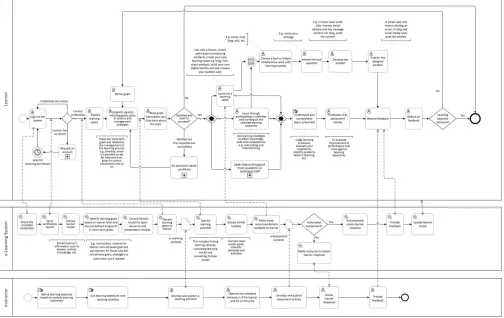
Fig. 3 shows the final outcome of applying the early-proposed approach to develop a generalised e-learning process that can lead to different e-learning processes based on the hybrid input captured from the e-learner’s context. This context must have different behavioural information about the e-learner (e.g., his/her knowledge and learning preferences) as well as other contexts, such as topics, programme, peers, institutions, etc. This generalised e-learning process affirms that e-learning can take different forms as will be explained next. It includes the following three roles: the e-learner, the instructor and the e-learning system. Generally, this e-learning process model consists four key activities as follows.
First, the e-learner needs to login to the system. This include certain seamless activities (e.g., check the e-learner’s credentials) to be carried out by the system. Then successful login leads to initiating the early-specified “learning space” where the e-learner sees whatever available on the system (e.g., modules and courses). Learning Space provides contents/activities (e.g., learning or assessment activities) designed by instructors. However, learning space and other activities in the business process model are quite adaptive, dynamic and responsive as it differs from one e-learner to another. This is due to the fact this e-learning business process model is backed by a comprehensive ontological model that capture the semantics of the e-learning process to meet the demands of the e-learner. This ontological model
has been developed based on detailed survey of e-learning models and artefacts. It is challenging to explain such a comprehensive model in details due to space limitations and this research purpose. Yet generally it is composed of the following eight main constructs: (i) eActor: models roles interact with the software system for certain purposes, (ii) e-Learning Facilitating Tool: models the wide range of software tools (e.g., wiki, e-mail, etc.) used in e-learning context to facilitate and support e-learners, (iii) Pedagogy: models different pedagogical strands/classification of various e-learning processes, (iv) Learning Process: involves activities which are performed by stakeholders to achieve specific goals, (v) eActivity: models actions done by a specific actor (e.g., e-learner) using a facilitating tool or combination of them to achieve a goal, (vi) eContext: models information that characterises the situation of an entity (e.g., location of learning, environmental attributes, etc.), (vii) eContent: models subject domain contents available for e-learners and (viii) Presentation: models the way chosen by a specific actor (e.g., instructional designer) to deliver contents.
A large number of classes, properties and relations between various ontological attributes exist under the umbrella of the above-mentioned eight main constructs. Such details provide the necessary information to the generalised e-learning process model to tailor certain e-learning process for a specific e-learner. Basically, it makes this model speaks differently to different e-learners based on the e-learner behavioural model, in addition to other ontological constructs, that provides substantive contextual of information about the e-learner, his/her skill, knowledge, preferences, etc. Second, the learner initiates his/her e-learning process and performs the specified activities accordingly. This includes various variations based on the captured contextual information as explained above. Third, an assessment step is needed either by quick quiz, project or other formative assessment tools in order to assess the e-learner understanding for the presented topic and update his/her model accordingly. Four, a decision needs to be made whether the goal of the early-initiated e-learning process has been met or not. If so, the process will be terminated, otherwise the goal or other process elements (e.g., learning contents) need to be further refined to achieve the overall goal of the e-learning process. Further detailed process model exist under the previously-discussed four key activities, as shown in Fig. 3.
processes might be used interchangeably by some of the e-learners, while they are not. To resolve this issue, we have broken them into more obvious sub-tasks (e.g., identifying management strategies and refining goals) to make the e-learning process more traceable and achievable. Finally, it is worth mentioning the scope of the above-developed generalised e-learning process since it only reflects fine-grained learning-oriented processes that occur as part of module. Coarse-grained processes that can cover module or programme scale or non-learning-oriented processes are not covered in this research and will remain for future work.
V. DISCUSSION
The proposed generalisation approach is a bottom-up approach, where various e-learning processes have been reviewed from the literature and underpinning theories. The proposed approach to develop a generalised business process from a set of related business processes comprises practice (i.e., how the work is done) and theory (i.e., models/theories underpinning business logic). In this case, the generalised e-learning business process model can be described as driven by pedagogy and is informed by various e-learning practice models. This comes in agreement with lessons learnt from the educational domain where e-learners rarely follow one learning theory/approach to achieve their learning objectives [27]. They usually combine elements from different e-learning processes which can be achieved by the proposed hybrid and generic e-learning process model.
Incorporating pedagogy in various stages of developing the generalisation approach is essential since pedagogy explains the added value of using technology in education. For instance, wiki can be used for various purposes, but proper use of pedagogy (i.e., careful consideration for: (i) planning for learning process including the e-learner goals, preferences, knowledge, etc., (ii) the goal of the e-learning process, (iii) the overall settings of the organisation, etc.) can make the use of wiki educationally effective. The adopted classifications of the nine e-learning process models according to their pedagogical strands illuminates further reflections on understanding how different e-learning processes are driven and how they can be assessed against the attainment of their final goals. It also shows the role that Business Process Modelling Notation can play in documenting such rich and dynamic processes and to what extent these technologies can capture the semantics of learning domain. Additional feedback on the modelled e-learning processes is expected to be gained from domain experts and other stakeholders (e.g., instructors, e-learners, institutions, etc.) because modelling processes in BPMN allows them to be understood by non-technical audience, and therefore pave the ground for process improvement.
Various evaluation methodologies have been used to evaluate similar artefacts such as: dataset-driven evaluation, user studies and real life testing or case studies. Dataset-driven or offline experiment evaluation approaches are widely used in evaluating e-learning artefacts [28]. Datasets used in such experiments can be: (i) extracted from a real system interaction history or (ii) artificially constructed to test the validity of the proposed approach [29]. Real case
studies are challenging to adopt due to: (i) the comprehensiveness of information required about pedagogy, learning style, learner knowledge, etc. which means that current e-learning systems do not have such a comprehensive set of data, (ii) time restrictions, (iii) the need for a mature system instead of a prototype and so on. Therefore, the early-proposed generalisation approach has been evaluated bottom-up by designing a hypothetical case study to test its effectiveness. In this case study, representative and sufficient enough cases have been devised which are based on certain assumptions to check whether the generalised e-learning business process can adapt different e-learning processes/paths. In other words, it tests that whether it is possible for a certain e-learner to receive a tailored e-learning business process based on his/her learning profile?
To realise the above-mentioned data-driven approach, the following experimental hardware and software settings have been defined as follows: (i) Machine with Ms Windows 7, service pack 1, 64 bit OS, 4.00 GB RAM, (ii) Eclipse Java EE IDE for web developer version: MARS.1, release 4.5.1, (iii) BPMN 2.0, (iv) Protégé Ontology Editor to develop the e-learning ontological model, specify and instantiate it using Web Ontology Language (OWL 2.0), (v) Pellet Reasoner and (vi) SWRL (Semantic Web Rule Language). On the top of that, a set of testing cases/scenarios acceptance criteria, derived from requirements, have been identified, as well. As a result, the proposed approach demonstrates its ability to deliver behavioural, cognitive or situated e-learning processes based on the e-learner’s contextual information. It also confirms its ability to construct a hybrid e-learning approach via combining elements from different categories (e.g., self-regulated e-learning and game-based e-learning processes) based on the e-learner information.
This work paves the ground for developing a more mature prototype, where real case study and real users are involved to test the validity of this approach in meeting various e-learners’ demands through a flexible process-based approach. Enacted business processes will be orchestrated over cloud or SOA-enabled environment so that stakeholders or e-learners’ demands can be met through a set of software services. Also, the proposed approach and the generalised e-learning business process model is technology independent and have no restrictions if compared to other solutions such as IMS Learning Design. It is also more detailed in terms of covering several e-learning scenarios that could be applied in different disciplines. Additionally, it handles the e-learning processes in more comprehensive approach than other approaches used in various Adaptive e-Learning Systems or Recommender Systems.
VI. CONCLUSION AND FUTURE WORK
e-learning models and technology-enhanced learning artefacts. The proposed hybrid and generalised process model is computational and pedagogical independent, which makes it more flexible and capable to respond to the dynamic nature of the e-learning processes. Additionally, it has been evaluated to prove its effectiveness. Further two research directions are being accomplished; first is the development of
a comprehensive ontological model to effectively contextualise the proposed process models, and hence resolving semantic e-learning heterogeneities. And, second is the enactment of these process models and orchestrating their activities over SOA-enabled environment.
REFERENCES
[1] R. Hammad, M. Odeh and Z. Khan, "Towards A generic
requirements model for hybrid and cloud-based e-learning systems," in
The IEEE 5th International Conference on Cloud Computing Technology and Science (CloudCom), Bristol, UK, 2013, pp. 106-111.
[2] R. D. Boyd and J. W. Apps. Redefining the Discipline of Adult Education 1980.
[3] M. Ould A. Business Processes: Modelling and Analysis for Re-Engineering and Improvement (1st ed.) 1995.
[4] D. A. Wiley. Connecting learning objects to instructional design theory: A definition, a metaphor, and a taxonomy. 2003. Available: http://186.113.12.12/discoext/collections/0309/0001/02740001.pdf.
[5] N. Friesen, "Three objections to learning objects and e-learning standards," in Online Education using Learning Objects, 1st ed., R. McGreal, Ed. London: Routledge, 2004, pp. 59-70.
[6] A. Rawlings, P. Van Rosmalen, R. Koper, M. Rodriguez-Artacho and P. Lefrere, "Survey of educational modelling languages (EMLs) version 1," CEN/ISSS WS/LT Learning Technologies Workshop, Netherland, 2002.
[7] C. M. Stracke, "Interoperability and quality development in e-learning. overview and reference model for e-learning standards," in
Proceedings of the Asia-Europe E-Learning Colloquy (E-ASEM), Seoul, 2006, pp. 2-26.
[8] M. Derntl, S. Neumann, D. Griffiths and P. Oberhuemer. The conceptual structure of IMS learning design does not impede its use for authoring. IEEE Transaction on Learning Technologies 5(1), pp. 74-86. 2012.
[9] J. Torres, J. M. Dodero, I. Aedo and P. Diaz, "Designing the execution of learning activities in complex learning processes using LPCEL," in Sixth International Conference on Advanced Learning Technologies, Netherland, 2006, pp. 415-419.
[10] S. Neumann, M. Klebl, D. Griffiths, D. Hernández-Leo, L. De la Fuente-Valentin, H. Hummel, F. Brouns, M. Derntl and P. Oberhuemer. Report of the results of an IMS learning design expert workshop.
International Journal of Emerging Technologies (iJET) 5(1), pp. 58-72. 2009.
[11] D. Burgos, "What is wrong with the IMS learning design specification? constraints and rec-ommendations," in Proceedings of Lernen Wissen Adaption (LWA) Conference, Germany, 2010, pp. 281-288.
[12] J. Yong, "Workflow-based e-learning platform," in Proceedings of the Ninth International Conference on Computer Supported Cooperative Work in Design, 2005. 2005, pp. 1002-1007.
[13] R. Gagné Mills., The Conditions of Learning. New York: Holt, Rinehart and Winston, 1965.
[14] D. H. Schunk, Learning Theories: An Educational Perspective.
Massachusetts USA: Pearson, 2012.
[15] J. Greeno, A. Collins and L. Resnick, "Cognition and learning," in
Handbook of Educational Psychology, D. Berliner and R. Calfee, Eds. NY: Simon & Schuster Macmillan, 1996, pp. 189-198.
[16] J. B. Watson, "Psychology as the behaviorist views it,"
Psychological Review, vol. 20, pp. 158-177, 1913.
[17] E. Wenger, "Learning in landscapes of practice: recent developments in social learning theory," 2013.
[18] S. Downes, "Places to go: Connectivism & connective knowledge,"
Innovate: Journal of Online Education, vol. 5, pp. 6, 2008.
[19] M. A. Ould, Business Process Management: A Rigorous Approach.
UK: BCS, The Chartered Institute, 2005.
[20] W. Ma, O. O. Adesope, J. C. Nesbit and Q. Liu, "Intelligent tutoring systems and learning outcomes: A meta-analysis." Journal of Educational Psychology, vol. 106, pp. 901-918, 2014.
[21] S. Narciss, "Feedback strategies for interactive learning tasks," in
Handbook of Research on Educational Communications and
Technology , 3rd ed., J. M. Spector, D. M. Merrill, J. v Merrienboer and M. Driscoll P., Eds. New York: Lawrence Erlbaum Associates, 2008, pp. 125-143.
[22] York Law school, "Guide to problem-based learning," The University of York, UK, 2007.
[23] M. S. Knowles, Self-Directed Learning. New York: Association Press, 1975.
[24] A. Nussbaumer, "ROLE project: Common psycho-pedagogical framework," Responsive Open Learning Environments, EU, Tech. Rep. Deliverable D 6.1, 31/01/2013. 2013.
[25] J. Lu, D. Wu, M. Mao, W. Wang and G. Zhang. Recommender system application developments: A survey. Decis. Support Syst. 74pp. 12-32. 2015.
[26] M. Gil-Ortega and L. Falconer. Learning spaces in virtual worlds: Bringing our distance students home. Journal of Applied Research in Higher Education 7(1), pp. 83-98. 2015.
[27] T. Mayes and S. De Freitas. Review of e-learning theories, frameworks and models. JISC. UK. 2004.
[28] K. Verbert, H. Drachsler, N. Manouselis, M. Wolpers, R. Vuorikari and E. Duval, "Dataset-driven research for improving recommender systems for learning," in Proceedings of the 1st International Conference on Learning Analytics and Knowledge, 2011, pp. 44-53.
[29] M. Erdt, A. Fernandez and C. Rensing. Evaluating recommender systems for technology enhanced learning: A quantitative survey.