1 TITLE PAGE 1
2
Title: Development and initial validation of the Bristol Impact of Hypermobility (BIoH) 3
questionnaire 4
5
Authors: Palmer Sa, Cramp Fa, Lewis Rb, Gould Gc, Clark EMc 6
7
Author affiliations:aDepartment of Allied Health Professions, University of the West 8
of England, Bristol, UK. [email protected], [email protected] 9
bDepartment of Physiotherapy, North Bristol NHS Trust, Bristol, UK. 10
cMusculoskeletal Research Unit, University of Bristol, Bristol, UK. 12
[email protected], [email protected] 13
14
Corresponding author: Professor Shea Palmer, Department of Allied Health 15
Professions, University of the West of England, Blackberry Hill, Bristol, BS16 1DD, 16
UK. Tel. +44 117 3288919, [email protected] 17
18
Word count: 3 303 19
2 ABSTRACT 24
25
Objectives: Stage 1: Identify the impact of Joint Hypermobility Syndrome (JHS) on 26
adults; Stage 2: Develop a questionnaire to assess the impact of JHS; Stage 3: 27
Undertake item reduction and establish the questionnaire’s concurrent validity. 28
Design: A mixed methods study, employing qualitative focus groups and interviews 29
(Stage 1); a working group of patients, clinicians and researchers, and ‘think aloud’ 30
interviews (Stage 2); and quantitative analysis of questionnaire responses (Stage 3). 31
Setting: Stages 1 and 2 took place in one secondary care hospital in the United 32
Kingdom (UK). Stage 3 recruited members of a UK-wide patient organisation. 33
Participants: A total of n=15, n=4, and n=615 participants took part in Stages 1, 2 34
and 3 respectively. Inclusion criteria were: ≥18 years; a diagnosis of JHS; no other 35
conditions affecting physical function; able to give informed consent; and able to 36
understand and communicate in English. 37
Interventions: None. 38
Main outcome measures: The development of a questionnaire to assess the 39
impact of JHS. 40
Results: Stage 1: A wide range of impairments, activity limitations and participation 41
restrictions were identified. Stage 2: A draft questionnaire was developed and refined 42
following ‘think aloud’ analysis, leaving 94 scored items. Stage 3: Items were 43
removed on the basis of low severity and/or high correlation with other items. The 44
final ‘Bristol Impact of Hypermobility’ (BIoH) questionnaire has 55 scored items and 45
correlated well with the Physical Component Score of the Short Form 36 health 46
3
Conclusions: The BIoH questionnaire demonstrated good concurrent validity. 48
Further psychometric properties need to be established. 49
50
Key words: Hypermobility, joint; Joint laxity, familial; Questionnaires; Interview; 51
Focus Groups; Validity of results. 52
4
MANUSCRIPT 56
57
TITLE 58
Development and initial validation of the Bristol Impact of Hypermobility (BIoH) 59
questionnaire 60
61 62
INTRODUCTION 63
Joint Hypermobility Syndrome (JHS) is a heritable connective tissue disorder 64
characterised by excessive joint range of motion and pain [1]. It has been reported to 65
affect up to 5% of women and 0.6% of men [2], although there is a lack of good-66
quality epidemiological evidence for the true prevalence of JHS in the general 67
population. The prevalence in musculoskeletal practice contexts is likely to be very 68
high, however, with 30% of those referred to a Musculoskeletal Triage Clinic in the 69
United Kingdom (UK) meeting the Brighton diagnostic criteria [3,4]. 70
71
JHS is associated with a wide range of problems including pain, fatigue, 72
proprioception deficits and repeated cycles of injury, anxiety and catastrophizing [5]. 73
It may also be associated with a range of autonomic and gastrointestinal symptoms, 74
and functional difficulties indicative of developmental coordination disorder/dyspraxia 75
[6]. Empirical data has shown that, when compared with healthy controls, JHS has a 76
significant impact on outcomes such as exercise endurance, gait, pain, 77
proprioception, strength, function and quality of life both in children [7,8,9,10] and 78
5
impact of JHS on a range of psychological variables such as fear, agoraphobia, 80
anxiety, depression and panic disorders [15]. 81
82
Physiotherapy, particularly exercise, is a mainstay of treatment for JHS, although 83
recent systematic reviews highlighted the lack of research evidence [16,17]. The 84
trials in adults included in those reviews used a range of patient reported outcome 85
measures (PROMs), including the Short-Form 36 (SF-36) [18], the Arthritis Impact 86
Measurement Scales 2 (AIMS-2) [13] and a questionnaire developed by Barton and 87
Bird [19]. Of those, only the SF-36 captured improvements following exercise [18]. 88
Only one of the five AIMS-2 subscales changed with exercise [13] and there were no 89
changes evident in Barton and Bird’s questionnaire [19]. So, if exercise is effective 90
(which has yet to be convincingly demonstrated [16]), only the SF-36 seemed to 91
demonstrate sufficient measurement sensitivity. Closer inspections of these PROMs 92
identify a lack of face, content and construct validity [20] for many issues reported by 93
people with JHS [5]. For example Barton and Bird’s questionnaire [19] focused on 94
lower limb activity (such as going up and down stairs, squatting, standing up and 95
walking), failing to reflect upper limb functional difficulties. Neither the process of 96
development nor the psychometric properties of the questionnaire were reported. A 97
recent survey of physiotherapy practice in the UK [21] highlighted a lack of 98
congruence between the aims of physiotherapy management for JHS and the tools 99
used to assess the effectiveness of management. There is therefore a need to 100
develop a condition-specific, psychometrically sound, outcome measure to underpin 101
future research and clinical practice in this area. 102
6
This project had a number of related aims. Stage 1: To identify the impact of JHS on 104
adults with the condition to inform initial patient-specific questionnaire items; Stage 2: 105
To develop a questionnaire to assess the personal impact of JHS; Stage 3: To 106
reduce the number of questionnaire items and establish the concurrent validity of the 107
new questionnaire against the SF-36. 108
109 110
METHOD 111
Ethical approval was obtained from the South West 5 NHS Research Ethics 112
Committee (10/H0107/46). The research was conducted in three stages as follows. 113
Stage 1 – Identification of questionnaire items. Methods: focus groups and 114
telephone interviews with people with JHS. 115
Stage 2 – Development of the initial questionnaire. Methods: working group of 116
patient research partners and researchers; ‘think aloud’ evaluation. 117
Stage 3 – Item reduction and validation of the questionnaire. Methods: 118
administration of the initial questionnaire and SF-36 to members of the 119
Hypermobility Syndromes Association (HMSA), a UK-based patient organisation; 120
item removal; assessment of the concurrent validity of the final questionnaire 121
items against the SF-36; production of the final questionnaire. 122
123
Participants 124
Inclusion criteria (Stages 1-3): Diagnosed with JHS; ≥18 years old; no other formally 125
diagnosed conditions affecting physical function (such as inflammatory arthritis, 126
7
understand and communicate in English. Stage 2 also recruited all five members of 128
the research team. 129
130
The sources of recruitment at each stage were as follows. 131
Stages 1-2: Patients who met the Brighton criteria [3] for JHS (confirmed by a 132
physiotherapist) who had been seen by the physiotherapy service at North Bristol 133
NHS Trust in the previous two years were sent an invitation letter, participant 134
information sheet and a reply slip. All participants completed informed signed 135
consent. Two patient research partners (people with JHS who advised on the design 136
and conduct of all aspects of the research, including the wording of patient 137
information sheets and consent forms, and sat as equal members of a study steering 138
group), and one further person with JHS who contributed to the working group during 139
Stage 2 were recruited from the same cohort. 140
Stage 3: Adult members of the HMSA were sent an invitation letter, participant 141
information sheet and a copy of the questionnaires. Diagnosis of JHS was self-142
declared. Completion and return of the questionnaires was taken as implied consent. 143 144 Procedure 145 Stage 1 146
Two focus groups with people with JHS were conducted to explore the impact of the 147
condition. An option to undertake a telephone interview was provided for those who 148
were unable or unwilling to attend a focus group. A loose topic guide was used to 149
steer the focus group and interview discussions. The same researcher (GG) 150
conducted all focus groups and interviews, with another researcher (SP) taking notes 151
8
audio-recorded, transcribed verbatim and anonymised. Open coding of the 153
transcripts was used to identify individual questionnaire items, and codes were 154
discussed in detail and verified by two researchers (GG and SP). Thematic analysis 155
of the data did not progress beyond this first level of coding as the aim was limited to 156
identification of individual items. 157
158
Stage 2 159
A working group was convened to develop the initial questionnaire. The group 160
comprised three people with JHS (including two patient research partners) and five 161
researchers. The researchers included clinical and academic expertise in 162
physiotherapy and medical rheumatology and expertise in outcome measure 163
development. Meetings were supplemented by e-mail and telephone 164
correspondence and two researchers (GG and SP) took the lead in developing and 165
revising draft questionnaires between meetings based on working group feedback 166
and discussion. The working group initially discussed in detail the items developed 167
from Stage 1 and agreed the specific wording of individual questions and response 168
options, and the overall design of a first draft questionnaire. The three Bristol 169
Rheumatoid Arthritis Fatigue Numerical Rating Scales (BRAF-NRS) [22,23] were 170
included with permission. The BRAF-NRS assess intensity of, effect of and coping 171
with fatigue and, although developed for Rheumatoid Arthritis, have generic wording. 172
This first draft questionnaire was then subjected to ‘think aloud’ analysis (also known 173
as cognitive interviewing [24]) where people with JHS were asked to verbalise their 174
thoughts whilst completing the questionnaire. This method was used to explore 175
patients’ understanding of the questions and their responses to them. Interviews 176
9
question by question to identify any salient points and a report was produced for the 178
working group. Further refinements were then made and the initial JHS 179
questionnaire agreed with the working group. 180
181
Stage 3 182
An invitation letter, participant information sheet, a copy of the questionnaires (the 183
initial JHS questionnaire, SF-36 and a demographics questionnaire) and a pre-paid 184
return envelope were distributed by mail to all 1 502 adult members of the HMSA 185
(identified by the membership secretary). No reminders were sent. Completed 186
questionnaires were systematically entered into an IBM SPSS Statistics spreadsheet 187
by a research associate employed on the project. Data accuracy was audited and 188
verified by the lead author (SP). SF-36 scoring software v4.5 (Optum Insight) was 189
used to calculate SF-36 component and subscale scores. Descriptive statistics and 190
Kolmogorov-Smirnov tests for normality of data distributions were calculated for all 191
items. A correlation matrix using Spearman’s Rank Correlation coefficients was 192
produced to investigate the relationships between all scored items on the JHS 193
questionnaire. Two criteria were then employed to inform decisions on whether to 194
remove or retain individual items (although the BRAF-NRS were retained unaltered). 195
1. Median score ≤40% severity. This criterion helped to identify items that were 196
considered relatively less important. 197
2. Strong correlations (r≥0.7) between individual items. This criterion helped to 198
identify items that were potentially redundant (i.e. multiple items may have been 199
measuring similar things). The wording of strongly correlated items were looked 200
at closely and an iterative process was used to inform which questions should be 201
10
The scores for the final JHS questionnaire items were then added to give a total 203
score and this was correlated against the component and subscale scores of the SF-204
36 to test concurrent validity. 205
206
Given the pragmatic design of the questionnaire, including incorporation of the 207
BRAF-NRS and the range of different response categories employed, it was 208
considered inappropriate to try to identify separate domains within the JHS 209
questionnaire using exploratory factor analysis. 210 211 212 RESULTS 213 Stage 1 214
Stage 1 recruited 15 people with JHS and they contributed to two focus groups (both 215
n=6/15) and telephone interviews (n=3/15). 13/15 (86.7%) were women. 2/15 216
(13.3%) were aged 18-25 years, 7/15 (46.7%) 26-35 years, and 6/15 (40.0%) 36-45 217
years. A wide range of issues related to the impact of JHS were raised, 218
encompassing impairment, activity limitations and participation restrictions [25]. The 219
issues identified included items common to many other long term musculoskeletal 220
conditions, such as pain and fatigue and difficulties with standing, walking and 221
negotiating stairs. However there were other more specific issues identified such as 222
balance and coordination problems, unexpected pain, joints giving way and 223
weakness. It was also clear that participants commented on both the intensity and 224
frequency of issues. 225
226
11
The working group devised a draft questionnaire relatively easily, using a mixture of 228
numerical rating scales (similar to the BRAF-NRS) and Likert scales. It was decided 229
that questions with common response options should be grouped together to 230
facilitate navigation and completion and that larger scores should equate to greater 231
impact. Four participants (all women, aged 19-40 years) took part in the think aloud 232
analysis and the draft questionnaire was generally very well received, with the 233
questions and response options generally clear. Participants stated that there was 234
some repetition, with similar questions asked in slightly different ways, but the 235
working group decided to keep all questions as part of Stage 3 was designed to 236
identify closely correlated questions. The findings of the think aloud analysis 237
informed a few minor changes to wording but was otherwise useful in confirming the 238
face validity of the draft questionnaire. The individual questionnaire items and 239
response options are evident from the final ‘Bristol Impact of Hypermobility’ (BIoH) 240
questionnaire (supplemental material) and from Table 3 (those items that were later 241
excluded). The resultant draft questionnaire contained 94 scored items (and a further 242
10 identifying area of pain). 243
244
Stage 3 245
A total of 636/1 502 responses were received (42.3% response rate), of which 21 246
were excluded (reasons for exclusion: 12 aged <18 years; 9 omitted at least one 247
section of the JHS questionnaire meaning that a total score could not be calculated). 248
The remaining 615 were included in analysis. 249
250
Kolmogorov-Smirnov tests revealed that the data for age, individual JHS 251
12
p<0.001). The only exception was the SF-36 Physical Component Score (p=0.200). 253
Non-parametric analyses were therefore employed throughout. 254
255
The median (IQR) age of participants was 39 (17) years. 81/599 (13.5%) were aged 256
18-25 years, 156/599 (26.0%) 26-35 years, 186/599 (31.1%) 36-45 years, 100/599 257
(16.7%) 46-55 years, 56/599 (9.3%) 56-65 years, 18/599 (3.0%) 66-75 years, and 258
2/599 (0.3%) 76-85 years. Other participant characteristics are presented in Table 1. 259
The majority were women (582/614, 94.8%) of white ethnicity (602/614, 98.0%). 260
Participants were generally well educated (292/519, 56.3% had a university degree 261
or equivalent) and a slight majority were in paid employment (339/600, 56.5%). 262
263
Insert Table 1 here. 264
265
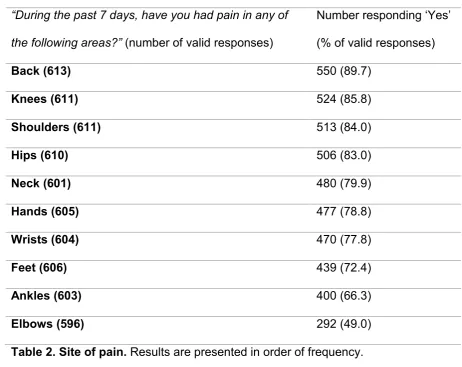
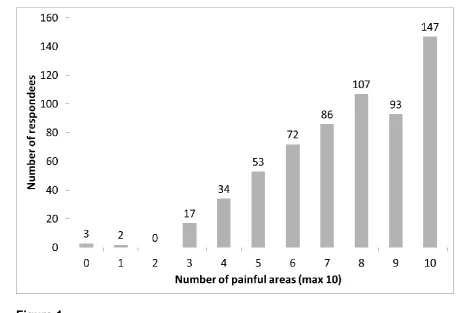
Participants complained of pain in a wide range of painful areas (Table 2). Figure 1 266
illustrates the total number of painful areas reported by participants. The median 267
(IQR, range) number of painful areas was 8.0 (3.0, 0-10). 268
269
Insert Table 2 here. 270
271
Insert Figure 1 here. 272
273
A total of 39 questions were removed on the basis of a median score ≤40% and/or a 274
strong correlation with other questions (r≥0.7) (supplemental information 1). 275
13
The remaining 55 questionnaire items comprised the final ‘Bristol Impact of 277
Hypermobility’ (BIoH) questionnaire and gave a single composite score of 360, with 278
higher scores representing more severe impact (please see supplemental 279
information 2 and 3). It takes approximately 10 minutes to complete. The median 280
(IQR, range) BIoH score was 234 (81, 55-355). The total BIoH scores were 281
correlated against the SF-36 scores to investigate concurrent validity and the results 282
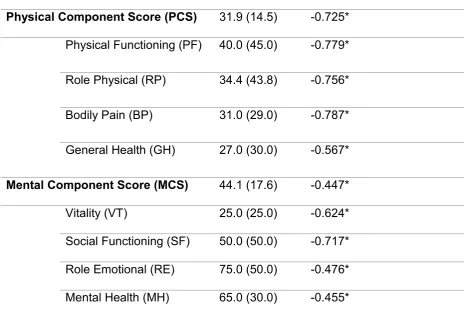
are presented in Table 3. 283
284
Insert Table 3 here. 285
286
The BIoH questionnaire correlated most closely with the Physical Component Score 287
(PCS) (r=-0.725), reflecting less the Mental Component Score (MCS) (r=-0.447). 288
This was also reflected in the subscales, with high correlation coefficients (r≥-0.7) for 289
physical function, role physical and bodily pain. The only MCS subscale that had a 290
strong correlation with the BIoH questionnaire values was social functioning. 88% 291
(541/615) and 52% (320/615) of the cohort were below general population norms for 292
the SF36 PCS and MCS respectively. There was no correlation between age and 293
total BIoH score (Spearman’s Rank Correlation Coefficient r=-0.070, p=0.085). 294
295
The median (IQR) BRAF-NRS scores for severity, effect and coping were 7.0 (2.0), 296
7.0 (4.0) and 4.0 (4.0) respectively, indicating that people with JHS experience a 297
high level of fatigue, it has a strong effect on their lives, but that they cope with 298
fatigue relatively well. The mean (SD) values were 6.8 (2.1), 6.6 (2.6) and 4.1 (2.4) 299
respectively. 300
14 302
DISCUSSION 303
The new BIoH questionnaire is the first condition-specific tool validated for JHS. It 304
was developed in close collaboration with people with JHS and seems 305
comprehensive in reflecting items of importance. Scores correlate strongly with the 306
PCS of the SF-36, with the strongest relationship being evident with Bodily Pain (BP) 307
domain scores. Correlation with the MCS of the SF-36 was much more modest. This 308
suggests that the BIoH questionnaire predominantly captures information about 309
physical function rather than psychological function. Given the predominance of 310
physical function items identified by focus group and interview participants, this 311
seems an appropriate finding. It may be that further one-to-one interviews may have 312
elicited further participation-level outcomes of importance to individuals, as such 313
issues may be more difficult to discuss in a focus group context. 314
315
There was a very high prevalence of pain in a wide range of body areas, many of 316
which are not reflected in the current Brighton diagnostic criteria [3], such as the 317
shoulders and neck. It should be noted that the wording of the BIoH questionnaire 318
does not distinguish between unilateral and bilateral pain and therefore the actual 319
number of areas is likely to be higher than reported here. However there was a clear 320
trend towards participants reporting a high number of affected body areas, with the 321
highest reported prevalence being of pain in all ten areas. Self-reported tender joint 322
counts are used in other conditions such as rheumatoid arthritis (RA) and have been 323
found to correlate well with clinician assessment [26]. It is difficult to directly compare 324
data due to differing methodologies but Scott and Scott [27] reported that only 25% 325
15
joints assessed. This threshold equates to just over 20% of the joints assessed. By 327
way of comparison, 99.2% (609/614) respondents in the current study reported pain 328
in 20% (two or more) of the 10 body areas assessed. In fibromyalgia the mean 329
‘tender point’ count has been reported as 14.7 out of 18 [28], although these no 330
longer form part of the diagnostic criteria and they include a mixture of joint and 331
muscle points. Nevertheless the prevalence is akin to that identified for JHS in the 332
present study. Clark et al [6] identified that 19% of people with JHS reported a 333
concomitant diagnosis of fibromyalgia and therefore some overlap is to be expected. 334
What is clear is that pain in multiple body areas seems to be a very significant issue 335
in the JHS population described here. 336
337
Terry et al [5] identified fatigue as one of the major factors associated with JHS. The 338
BIoH questionnaire therefore included the three BRAF-NRS questions which assess 339
fatigue severity, effect and coping. In RA the mean (SD) BRAF-NRS scores have 340
been reported as follows (n=229): severity 6.8 (1.8), effect 6.5 (2.2), and coping 5.7 341
(2.3) [22]. The present study has found that people with JHS seem to experience 342
fatigue levels that are very similar to people with RA, certainly in terms of severity 343
and effect. Interestingly, the coping with fatigue question is reverse scored, with 344
patients choosing a lower score to represent worse coping. Many respondents in the 345
present study seem to have scored this question inappropriately, choosing a high 346
score when they had also chosen a high score for severity and effect (and vice-347
versa). Our addition of a note on how to score this item may have caused some 348
confusion for respondents. For the purpose of analysis the scores for this item were 349
16
appropriateness of some responses. The very small contribution of this one item to 351
the overall BIoH score is unlikely to have affected the findings. 352
353
Although the results of the initial validation of the BIoH questionnaire are promising, 354
it should be noted that other psychometric properties such as test-retest reliability, 355
sensitivity to change and the minimum clinically important difference have yet to be 356
established. Given its condition-specific focus, it is anticipated that the BIoH 357
questionnaire will be sensitive to changes in physical function which is a key aim of 358
physiotherapy management [21]. However this requires future verification. 359
360
Limitations and strengths 361
The response rate in Stage 3 (636/1 502, 42.3%) might have been improved through 362
strategies such as sending reminders or providing an online response option. 363
Respondents to Stage 3 included a slightly older age range than those who 364
contributed to the Stage 1 development of the questionnaire items, although 71% 365
were in the same 18-45 year age range (423/599) and no relationship was observed 366
between age and total BIoH score. The proportion of women was largely similar 367
between Stage 1 and Stage 3. Validation has therefore been conducted on a 368
generally similar group to that which generated the questionnaire items. Members of 369
the HMSA who responded to the questionnaire self-declared a diagnosis of JHS and 370
this was not confirmed clinically. It should therefore be acknowledged that some 371
respondents might have had other conditions. The questionnaire was not subjected 372
to factor analysis to inform item reduction and questionnaire structure. The pragmatic 373
design of the questionnaire, including the use of a range of different response 374
17
factor analysis for these purposes. In hindsight, a more standardised approach to 376
response options might have facilitated further refinement of the questionnaire. The 377
range of response options has also resulted in some items that attract a maximum 378
score of 5 and others a maximum score of 10. The appropriateness of the relative 379
weighting of questions is currently unknown, although the median total BIoH scores 380
were almost identical when these items were scored out of 10 (median score 381
234/360, 65.0%) as opposed to out of 5 (180.5/275, 65.6%). This is therefore 382
unlikely to be a significant issue unless those items were to be affected differentially 383
by an improvement or deterioration in the condition and this would need to be 384
determined in future research. On a positive note, a very inclusive development 385
process was employed which worked well. Initial validation has also been conducted 386
on a very large sample size (n=615), although it should be noted that the sample 387
lacked diversity with regards ethnicity, gender and educational attainment. 388
389
Conclusion and future directions 390
The new BIoH questionnaire has demonstrated initial potential to inform future 391
research and clinical practice in this under-recognised and poorly managed 392
condition. Future research needs to be conducted to determine other psychometric 393
properties such as test-retest reliability, sensitivity to change, the minimum clinically 394
important difference, and other aspects of validity, including Rasch analysis. 395
396
Ethical Approval: Ethical approval was obtained from the South West 5 NHS 397
18
Funding: This work was supported by funding from the North Bristol NHS Trust 399
Flexibility & Sustainability Fund and from the University of the West of England, 400
Faculty of Health & Life Sciences. 401
Conflict of Interest: None declared. 402
Acknowledgements: We would like to acknowledge the assistance of the 403
Hypermobility Syndromes Association in recruiting people with JHS and to thank all 404
of the participants for taking part in the research. Thank you to our patient research 405
partners Alison Cossons and Jennifer Elvin. Thank you to Shahid Muhammad for 406
completing questionnaire data entry. The Short-Form 36 questionnaire was used 407
under license from OptumInsight (license number QM013824). 408
409 410
REFERENCES 411
[1] Grahame R. Hypermobility and hypermobility syndrome. In: Keer R, Grahame R, 412
editors. Hypermobility syndrome. Recognition and management for physiotherapists. 413
Edinburgh: Butterworth-Heinemann; 2003. 414
[2] Simpson MR. Benign joint hypermobility syndrome: evaluation, diagnosis and 415
management. J Am Osteopath Assoc Clin Pract 2006;106(9):531-6. 416
[3] Grahame R, Bird HA, Child A. The revised (Brighton 1998) criteria for the 417
diagnosis of benign joint hypermobility syndrome (BJHS). J Rheumatol 2000; 418
27:1777-9. 419
[4] Connelly E, Hakim A, Davenport HS, Simmonds JV. A study exploring the 420
prevalence of joint hypermobility syndrome in patients attending a musculoskeletal 421
19
[5] Terry R, Palmer S, Rimes K, Clark C, Simmonds J, Horwood J. Living with joint 423
hypermobility syndrome: Patient experiences of diagnosis, referral and self-care. 424
Fam Pract 2015;32(3):354-8. 425
[6] Clark C, Khattab A, Carr E. Chronic widespread pain and neurophysiological 426
symptoms in joint hypermobility syndrome (JHS). Int J Ther Rehabil 2014;21(2):60-7. 427
[7] Engelbert RH, van Bergen M, Henneken T, Helders PJ, Takken T. Exercise 428
tolerance in children and adolescents with musculoskeletal pain in joint hypermobility 429
and joint hypomobility syndrome. Pediatrics 2006;118:e690-6. 430
[8] Fatoye F, Palmer S, Macmillan F, Rowe P, van der Linden M. Proprioception and 431
muscle torque deficits in children with hypermobility syndrome. Rheumatology 432
2009;48:152-7. 433
[9] Fatoye F, Palmer S, Macmillan F, Rowe P, van der Linden M. Gait kinematics 434
and passive knee joint range of motion in children with hypermobility syndrome. Gait 435
Posture 2011;33:447-51. 436
[10] Fatoye F, Palmer S, Macmillan F, Rowe P, van der Linden M. Pain intensity and 437
quality of life perception in children with hypermobility syndrome. Rheumatol Int 438
2012;32(5):1277-84. 439
[11] Mallik AK, Ferrell WR, McDonald A. Impaired proprioceptive acuity at the 440
proximal interphalangeal joint in patients with the hypermobility syndrome. Brit J 441
Rheumatol 1994;33:631-7. 442
[12] Hall MG, Ferrell WR, Sturrock RD, Hamblen DL, Baxendale RH. The effect of 443
the hypermobility syndrome on knee joint proprioception. Br J Rheumatol 444
20
[13] Sahin N, Baskent A, Cakmak A, Salli A, Ugurlu H, Berker E. Evaluation of knee 446
proprioception and effects of proprioception exercise in patients with benign joint 447
hypermobility syndrome. Rheumatol Int 2008;28:995-1000. 448
[14] Sahin N, Baskent A, Ugurlu H, Berker E. Isokinetic evaluation of knee 449
extensor/flexor muscle strength in patients with hypermobility syndrome. Rheumatol 450
Int 2008;28:643-8. 451
[15] Smith T, Easton V, Bacon H, Jerman E, Armon K, Poland F, et al. The 452
relationship between benign joint hypermobility syndrome and psychological 453
distress: a systematic review and meta-analysis. Rheumatology 2014;53:114-22. 454
[16] Palmer S, Bailey S, Barker L, Barney L, Elliott A. The effectiveness of 455
therapeutic exercise for joint hypermobility syndrome: a systematic review. 456
Physiotherapy 2014;100:220-7. 457
[17] Smith TO, Bacon H, Jerman E, Easton V, Armon K, Poland F, et al. 458
Physiotherapy and occupational therapy interventions for people with benign joint 459
hypermobility syndrome: a systematic review of clinical trials. Disabil Rehabil 460
2014;36(10):797-803. 461
[18] Ferrell WR, Tennant N, Sturrock RD, Ashton L, Creed G, Brydson G, et al. 462
Amelioration of symptoms by enhancement of proprioception in patients with joint 463
hypermobility syndrome. Arthritis Rheum 2004;50:3323-8. 464
[19] Barton LM, Bird HA. Improving pain by the stabilization of hyperlax joints. J 465
Orthop Rheumatol 1996;9:46-51. 466
[20] Keszei AP, Novak M, Streiner DL. Introduction to health measurement scales. J 467
21
[21] Palmer S, Cramp F, Lewis R, Muhammad S, Clark E. Diagnosis, management 469
and assessment of adults with joint hypermobility syndrome: a UK-wide survey of 470
physiotherapy practice. Musculoskelet Care 2015;13(2):101-11 471
[22] Nicklin J, Cramp F, Kirwan J, Greenwood R, Urban M, Hewlett S. Measuring 472
fatigue in rheumatoid arthritis: A cross-sectional study to evaluate the Bristol 473
Rheumatoid Arthritis Fatigue Multi-Dimensional questionnaire, visual analog scales, 474
and numerical rating scales. Arthrit Care Res 2010;62:1559-68. 475
[23] Dures EK, Hewlett SE, Cramp FA, Greenwood R, Nicklin JK, Urban M, et al. 476
Reliability and sensitivity to change of the Bristol Rheumatoid Arthritis Fatigue 477
scales. Rheumatology 2013;52(10):1832-9. 478
[24] Drennan J. Cognitive interviewing: verbal data in the design and pretesting of 479
questionnaires. J Adv Nurs 2003;42(1):57-63. 480
[25] World Health Organization. Towards a common language for functioning, 481
disability and health: ICF (The International Classification of Functioning, Disability 482
and Health). Geneva: World Health Organization; 2002. 483
[26] Radner H, Grisar J, Smolen JS, Stamm T, Aletaha D. Value of self-performed 484
joint counts in rheumatoid arthritis patients near remission. Arthritis Res Ther 485
2012;14:R61. 486
[27] Scott IC, Scott DL. Joint counts in inflammatory arthritis. Clin Exp Rheumatol 487
2014;32(Suppl. 85):S7-S12. 488
[28] Lindell L, Bergman S, Petersson IF, Jacobsson LTH, Herrström P. Prevalence of 489
fibromyalgia and chronic widespread pain. Scand J Prim Health Care, 490
2000;18(3):149-53. 491
22 FIGURE CAPTION
493 494
Figure 1. The total number of painful areas reported by individuals (n=614 valid 495
responses). Participants were asked “During the past 7 days, have you had pain in 496
any of the following areas?” and were given response options of ‘yes’ or ‘no’ to 10 497
areas. 498
23 1
Characteristic
(number of valid responses)
Response
(number of responses)
% of valid responses
Sex (614) Women (582) 94.8
Men (32) 5.2
Ethnicity (614) White (602) 98.0
Mixed (5) 0.8
Asian (2) 0.3
Black (1) 0.2
Chinese (1) 0.2
Other (3) 0.5
Relationship status (612) Single (177) 28.9
Married/partner (378) 61.8
Divorced/separated (48) 7.8
Widowed (7) 1.1
24
Living arrangements (595) Alone (96) 16.1
With husband/ wife/ partner (356) 59.8
With somebody else (143) 24.0
Education* College diploma or equivalent (302/482) 62.7
University degree or equivalent (292/519) 56.3 Postgraduate degree (e.g. PhD) (76/392) 19.4 Currently in paid employment
(600)
Yes (339) 56.5
No (261) 43.5
Hours of paid employment (324) Part-time (160) 49.4
Full-time (159) 49.1
Not applicable (5) 1.5
Employment status (302) Self-employed (49) 16.2
Employee (248) 82.1
Self-employed and employee (1) 0.3
25
Table 1. Characteristics of responders to Stage 3. * More than one response could be selected so total n not reported and total 1
26 1
“During the past 7 days, have you had pain in any of
the following areas?” (number of valid responses)
Number responding ‘Yes’ (% of valid responses)
Back (613) 550 (89.7)
Knees (611) 524 (85.8)
Shoulders (611) 513 (84.0)
Hips (610) 506 (83.0)
Neck (601) 480 (79.9)
Hands (605) 477 (78.8)
Wrists (604) 470 (77.8)
Feet (606) 439 (72.4)
Ankles (603) 400 (66.3)
[image:26.595.61.524.92.459.2]Elbows (596) 292 (49.0)
Table 2. Site of pain. Results are presented in order of frequency. 2
27 1
Question Reason for removal
Median score ≤40%
Correlation ≥0.7
C. Please tick the box which best describes how much, during the past 7 days, hypermobility has affected…
the clothing you have worn
D. How often…
have your hands seized up during the past 7 days?
have you had difficulty getting comfortable in bed during the past 7 days?
have you had trouble sleeping due to hypermobility during the past 7 days?
has hypermobility kept you from your usual activities during the past 7 days?
have you had difficulty walking a distance that would usually be OK for you during the
past 7 days?
has it been difficult to do your usual work activities (including unpaid work such as housework) during the past 7 days?
28
E. How much difficulty have you had with the following tasks during the past 7 days due to hypermobility?
Holding a mug or cup
Doing up buttons
Picking up a coin
Washing dishes
Using a door handle or lever
Putting on socks
Getting out of a car
Making sharp turns while walking or running
Pushing a shopping trolley or pushchair
Getting dressed
Raising your hands above your head repeatedly, e.g. to straighten hair or change a light bulb
Turning over in bed
Brushing or combing hair
29
Holding a frying pan
Using a computer mouse or keyboard
Getting out of bed without assistance
F. How much discomfort would you have had after the following activities during the past 7 days?
Climbing one flight of stairs
Going down one flight of stairs
Going up or down a flight of stairs without a handrail
Walking at your own pace for 5 minutes
Walking briskly for 5 minutes
G. Please circle the number which best indicates…
how able you have felt to cope with pain during the past 7 days
thinking about what you are usually able to do, how much you have felt in control of your ability to do your usual activities during the past 7 days
how much pain has interfered with your ability to take part in social or family activities
during the past 7 days
30
I am concerned about tripping or falling over when I am out and about
I feel unsteady on my feet
I feel anxious about falling or tripping
I can control the position of my limbs
I am able to cope with my pain
I am able to manage my pain
Supplemental information 1. Details of the removed questionnaire items and reasons for their exclusion. = Met this 1
31 1
SF36 Domains Median (IQR) Spearman’s Rank
Correlation Coefficient (r) Physical Component Score (PCS) 31.9 (14.5) -0.725*
[image:31.595.66.535.146.458.2]Physical Functioning (PF) 40.0 (45.0) -0.779* Role Physical (RP) 34.4 (43.8) -0.756* Bodily Pain (BP) 31.0 (29.0) -0.787* General Health (GH) 27.0 (30.0) -0.567* Mental Component Score (MCS) 44.1 (17.6) -0.447* Vitality (VT) 25.0 (25.0) -0.624* Social Functioning (SF) 50.0 (50.0) -0.717* Role Emotional (RE) 75.0 (50.0) -0.476* Mental Health (MH) 65.0 (30.0) -0.455*
Table 3. Median SF-36 component scores and correlation against the total 2
BIoH score. * All p<0.001. 3
32 1
[image:32.595.56.515.92.405.2]2
33
Supplemental information 2. The Bristol Impact of Hypermobility (BIoH) 1
questionnaire. 2
36 1
37
Supplemental information 3. The Bristol Impact of Hypermobility (BIoH) 1
questionnaire scoring guidance. 2