• No results found

TROUBLESHOOTING CHALLENGES IN SOCIAL MEDIA THROUGH COMBINATION OF STATISTICAL METHODS AND VISUALIZATION TECHNIQUES

N/A
N/A
Protected

Academic year: 2020

Share "TROUBLESHOOTING CHALLENGES IN SOCIAL MEDIA THROUGH COMBINATION OF STATISTICAL METHODS AND VISUALIZATION TECHNIQUES"

Copied!
9
0
0

Loading.... (view fulltext now)

Full text

(1)

TROUBLESHOOTING CHALLENGES IN SOCIAL MEDIA THROUGH COMBINATION OF STATISTICAL METHODS AND

VISUALIZATION TECHNIQUES

Mahesh Kumar Sharma

1

, Dr.Om Prakash

2

Department of Computer Science

1,2

OPJS University, Churu (Rajasthan) – India ABSTRACT

Social media brings people together in numerous inventive courses, for instance users are playing, tagging, working, and socializing online, demonstrating new types of joint effort and correspondence that were not really imaginable only a brief timeframe prior. In addition, social networks assume a significant job in the enterprising procedure and additionally help reshape business models and feelings, and open up various conceivable outcomes to think about human interaction and aggregate conduct on an unparalleled scale. These days, the Internet assumes an increasingly important job and it has slowly infiltrated into each part of our lives in light of its rich and shifted resources. An ever increasing number of people might want to invest their energy in the Internet particularly in request to construct some kind of huge social entertainment community and then attempt to speak with one another as much of the time as practicable to empower the connection between them to wind up nearer. The growing ubiquity and assorted variety of social network applications present new open doors and new difficulties. The resulting social networks have high value to business intelligence, sociological investigations, organizational examinations, epidemical thinks about, and so forth. The capacity to investigate and separate information of interest from the networks is along these lines urgent. Be that as it may, these networks are frequently extensive and made out of multi-downright nodes and edges, making it hard to imagine and prevail upon traditional methods. In this paper, we demonstrate to combine factual methods with representation to address these difficulties, and how to organize designs diversely to all the more likely bring out various parts of the networks. We connected our methods to a few social networks to show their viability in characterizing the networks and clarifying the structures of interest, leading to new findings.

I. INTRODUCTION

Social network research is one of the fastest growing scholastic areas and it continues to expand within a variety of social, physical, and biological sciences.

One key component of this field of research is social network representation, which alludes to the utilization of "socio-

grams," or illustrative diagrams of the ties that associate performing artists in social networks. The utilization of graphical representations is one of the main defining

properties of the field of social networks.

While factual measurements can

(2)

increasingly succinct, the correct measurement must be connected. It very well may be hard to know from the earlier what metric will create the correct outcome, and it tends to be hard to check that the results are right. Researchers utilize pictorial images of social networks to help effectively convey and understand the substance of the network and likewise to help in uncovering novel, structural patterns within social networks, and in addition to control and affirm measurable measurements. By and by, visual diagrams of social networks regularly experience the ill effects of a scope of issues, the most well-known of which being the high thickness of edges and complex structures in vast networks, yielding socio-grams that frequently show up as indecipherable clouds of nodes and edges.

1.1 Social Network versus Computer Networks

Networks can be classified according to the topology, which is the geometric course of action of a PC system. Normal topologies include a transport, star, and ring, protocol which defines a typical set of guidelines and signs that PCs on the network follow. Network architectures can be comprehensively classified as either a shared or client/server engineering. PCs on a network are now and again called nodes.

PCs and devices that assign resources for a network are called servers. It is contended that social networks contrast from most different types of networks, including technological and biological networks, in two important ways. To start with, they have non-unimportant clustering or network transitivity and second, they demonstrate positive connections

between's the degrees of contiguous vertices. Social networks are regularly isolated into groups or networks, and it has as of late been proposed that this division could represent the watched clustering.

Besides, group structure in networks can likewise represent degree connections.

Subsequently, assortative mixing in such networks with a variety in the sizes of the groups gives the anticipated dimension and contrasts well and that saw in certifiable networks.

1.2 Social Network Sites

Social network sites are web sites that allow users to enroll, make their very own profile page containing information about themselves (genuine or virtual), to build up public 'Friend' associations with different individuals and to speak with different individuals. Correspondence commonly appears as private messages, public remarks composed on every others' profile pages, blog or pictures, or instant messaging. SNSs like Facebook and MySpace are among the ten most well- known web sites in the world. SNSs are extremely well known in numerous nations and include Orkut (Brazil), Cyworld (Korea), and Mixi (Japan). The development of SNSs appears to have been driven by the adolescent, with Facebook originating as a school site and MySpace having an average age of 21 for individuals in mid-2008. Be that as it may, an increasing extent of more seasoned individuals is likewise using these sites.

The key motivating variable for using SNSs is amiability; be that as it may, this recommends a few types of people may never utilize social network sites widely.

In addition, it appears that extraversion is

(3)

gainful in SNSs and that female MySpace users appear to be increasingly extraverted and more willing to self-reveal than male users, which recommends they might be progressively compelling communicators in this environment. SNSs are exceptionally interesting in light of the fact that they bolster public discussions among friends and acquaintances.

In the investigation of aggression network, we distinguished representation techniques that can deliver issues run of the mill to social network perception, and upgraded the techniques to enhance lucidity and highlight key structural components of aggression network. Specifically, we considered social networks made out of nodes that can be grouped completely (i.e., understudies can be classified by sexual orientation, review, and so on.).

Correspondingly, the edges in a social network can frequently be isolated according to classes (e.g. a friendship is not the same as an aggression relationship). We utilized the most widely recognized type of perception, which specifically speaks to relationships between performing artists as a node-link chart. That is, the resulting socio-grams speak to performing artists with the utilization of points, or vertices, and the relationships between these on-screen characters with the utilization of lines, or edges that associate these points. In this paper, we present a few representation techniques custom-made to additionally break down such social networks. We demonstrate how we incorporate factual estimates, for example, affectability examination to channel nodes/edges from a node-link chart leading to succinct perceptions, and how unique format plans

help bring out structures of interest that would some way or another covered up.

We show a few improved representation techniques that empower us to all the more likely understand and explain our exact social network data, and additionally determine new findings.

II. ANALYSIS TECHNIQUES To lessen mess and deliver cleaner network representations, we apply two logical approaches. To start with, we demonstrate the utilization of centrality affectability investigation, which estimates the significance of one node concerning another. The point of this strategy is to streamline a network based on centrality metrics, which would then be able to be spoken to using traditional chart designs and node-link diagrams. Second, we use seclusion based clustering, which separates nodes into groups based on the intra and inter group associations. This makes a progressive deliberation of a network that we can use to delineate higher dimension structures all the more plainly.

2.1. Sensitivity Analysis

Sensitivity analysis estimates a vertex's

significance to the structure of the network

with respect to different vertices in the

graph]. This measurement is basically the

subordinate of centrality, and in that

capacity can be determined comparably for

a centrality. In this work, we utilized

Eigenvector sensitivity. Eigenvector

centrality is a proportion of the

significance of a node in a network, and is

(4)

utilized by the PageRank and Hyperlink- Induced Topic Search algorithms.

Eigenvector centrality sensitivity stretches out this idea to infer the significance of nodes in respect to one another. While centrality gives one value for each node, sensitivity gives a value for each conceivable combine of nodes in a network. To figure a reference node's sensitivity to an objective node, the reference node's initial centrality is determined, each edge of the objective node is expelled each one in turn, and the centrality of the reference node is recalculated after every evacuation. The negative changes in centrality of the reference node give a proportion of how important the objective node is to the reference node – as such, how touchy the reference node's centrality is to the objective node. For instance, if removing an objective node's edges results in expansive declines in the reference node's centrality, at that point the reference node is said to be highly delicate to the objective node – that is, the objective node has high significance with respect to the reference node. This can be outlined in the following equation:

πœ•π‘‹

πœ•

𝑑𝑖

= βˆ’π‘„ + πœ•π‘„

πœ•

𝑑𝑖

π‘₯

where x is eigenvector centrality, ti is the level of vertex I, Q is the subtraction of the character grid from the nearness lattice of the network (Q = An I), and Q

+

is the pseudoinverseof Q.

2.2. Modularity Clustering

Another approach to improve huge, complex networks is to bunch firmly

associated groups of nodes together and consider the resulting disconnected super- network. Be that as it may, unimportant application of this methodology would totally expel the finer subtleties of the network. Along these lines, instead of using a single dimension of clustering, we utilize various leveled clustering. With various leveled clustering, the dimension of clustering can be balanced powerfully, or multiple clustering levels can be appeared in the meantime. We utilize the

"Quick Modularity" clustering algorithm of Clauset, Newman, and Moore, as it is a progressive clustering algorithm that has been appeared to be successful on true networks, and equivalent to drive coordinated vitality functions. Seclusion is a metric that assesses an explicit proposed clustering of a network by measuring the thickness of bunch interiors and the sparsity of inter-group associations. In particular, given a network with a proposed clustering, the measured quality Q is defined as:

𝑄 = 1

2|𝐸| 𝐴

𝑖,𝑗

βˆ’ π‘˜

𝑖

π‘˜

𝑗

𝑖,𝑗

2|𝐸|

𝛿

𝑖,𝑗

where k

i

, k

j

are the degrees of nodes I and j, A

i,j

is 1 if there is an edge between nodes I and j and 0 generally, and Ξ΄

i,j

is 1 if nodes I and j are in a similar bunch and 0 generally.

III. VISUALIZATION TECHNIQUES

Direct visualization of extensive, complex

networks using power directed layouts

regularly prompts the outstanding "hairball

issue." That is, the resulting visualization

comprises of a tangled chaos of

incomprehensible lines. We address this

(5)

issue by introducing upgrades to normal visualization techniques. Initially, we combine the utilization of particularity clustering and edge bundling to group edges to coax out high-level patterns.

Second, we use centrality sensitivity to expel less important edges, at any rate for the layout procedure. We additionally show a radial layout based structure that can successfully isolate a diagram into sub-groups for correlation, and a n-partite layout that allows examination between multiple networks.

3.1. Edge Bundling

Progressive edge bundling is presently a notable way to deal with make cleaner

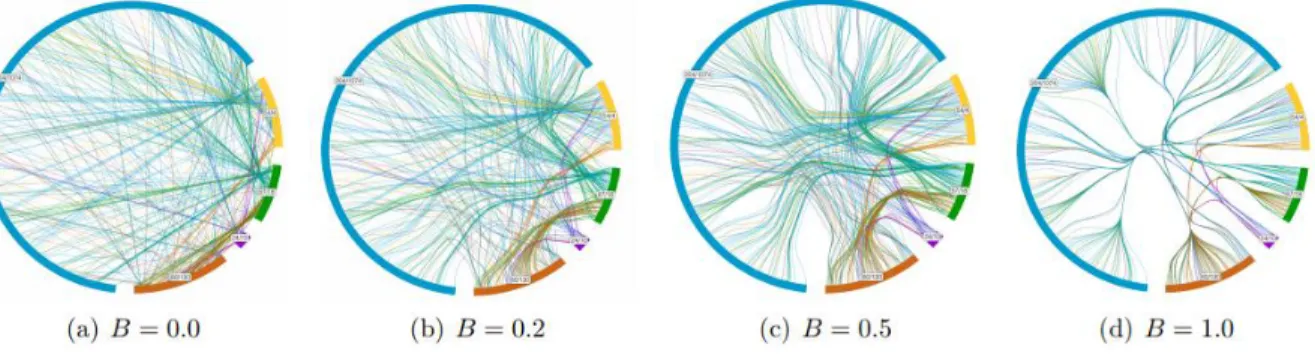
network visualizations that pass on high- level patterns without totally sacrificing low-level subtleties. This methodology courses edges according to the clustering progressive system, using bunch centroids

as control points for spline curves. The control points that define an edge between two nodes involve a path in the clustering pecking order tree from the first to the second node, passing through their minimum basic predecessor. In this work, we apply this methodology using the measured quality clustering to build the tree.

Figure 1: As the bundle strength increases, the lines interpolate from straight position to the control points. The ideal B is usually somewhere between 0.8 and 1 where the lines

can be followed and discerned through the bundles.

3.2. Sensitivity Based Layout

In numerous networks, there are a few nodes and edges that are especially important to the structure of the network, yet numerous that are less so. At the point when a layout algorithm utilizes the majority of the edges, the resulting visualization can resemble a fowl's home, with no clear structure past straightforward center fringe pattern, as appeared in Figure 2(a). By filtering edges based on

sensitivity analysis, we can consider a

disentangled skeleton network that retains

the structural properties of the original

network. Since this skeleton network is a

lot sparser than the original network, it

very well may be viably spread out and

pictured using a traditional nodelink chart,

as appeared in Figure 2(b). The layout of

this skeleton network is frequently much

superior to anything a layout defined by

the entire network, so we can utilize the

(6)

skeleton network’s layout and reintroduces the original edges to deliver an enhanced node-link outline of the whole diagram, as appeared in Figure 2(c). This new skeleton network can likewise be utilized to enhance both particularity clustering by adding weights to the figuring, and edge bundling by routing edges through the more focal paths.

3.3. Radial Representation

In some cases, simply improving the layout algorithm is insufficient for showing specific parts of a network. In particular, social networks can be partitioned into groups according to discrete properties other than connectivity, for example, sexual orientation, race, school review, or others. In any case, the thickness of ties in most traditional node- link diagrams makes it hard to distinguish in inter-group patterns from intra-group patterns. Hence, we introduce upgrades to a radial portrayal that orchestrate nodes according to extra properties and also connectivity, as appeared in Figure 3.

Nodes are put around a circle, grouped into discrete circular segments based on the chose data trait, and requested within each group by connectivity with the utilization of seclusion clustering. This new portrayal likewise designates the two kinds of associations with independent locales of room: intra-group edges are shown outside the circle while intergroup edges are attracted the center. The name on each group demonstrates the quantity of inter-group and intra-group associations, individually.

To register a valuable ordering for the nodes, we first develop a clustering progression using the particularity of the whole network, as appeared in Figure 4.

This tree does not consider the data quality

of interest, and in this way could be pre-

determined. Notwithstanding, nodes that

are alongside one another in the tree may

be in distinct groups based on the property

of interest. Consequently, we reproduce

the clustering tree, creating one for each

group, and continue to channel each tree

with the goal that it just contains one

group. This is finished by traversing the

tree and removing any bunch that does not

contain somewhere around one leaf node

from the ideal group. This makes trees that

have numerous nodes with just a single

tyke. To decrease the depth of the tree, we

trim the tree by likewise removing

intermediate bunches which just have one

kid (along these lines reducing the quantity

of control points needed for the spline

code). When every one of the trees are

trimmed, we link them all together with

one root node to make a single tree where

each branch from the root speaks to a sub-

tree for an individual group. It would on

the other hand be conceivable to run

particularity clustering on each group

independently to enhance the game plan

within groups, however this would

overlook inter-group edges and

subsequently hinder the capacity to

examine inter-group relationships. When

this clustering is finished, we cross the tree

to generate an ordering which would then

be able to be utilized to organize nodes

around the circle.

(7)

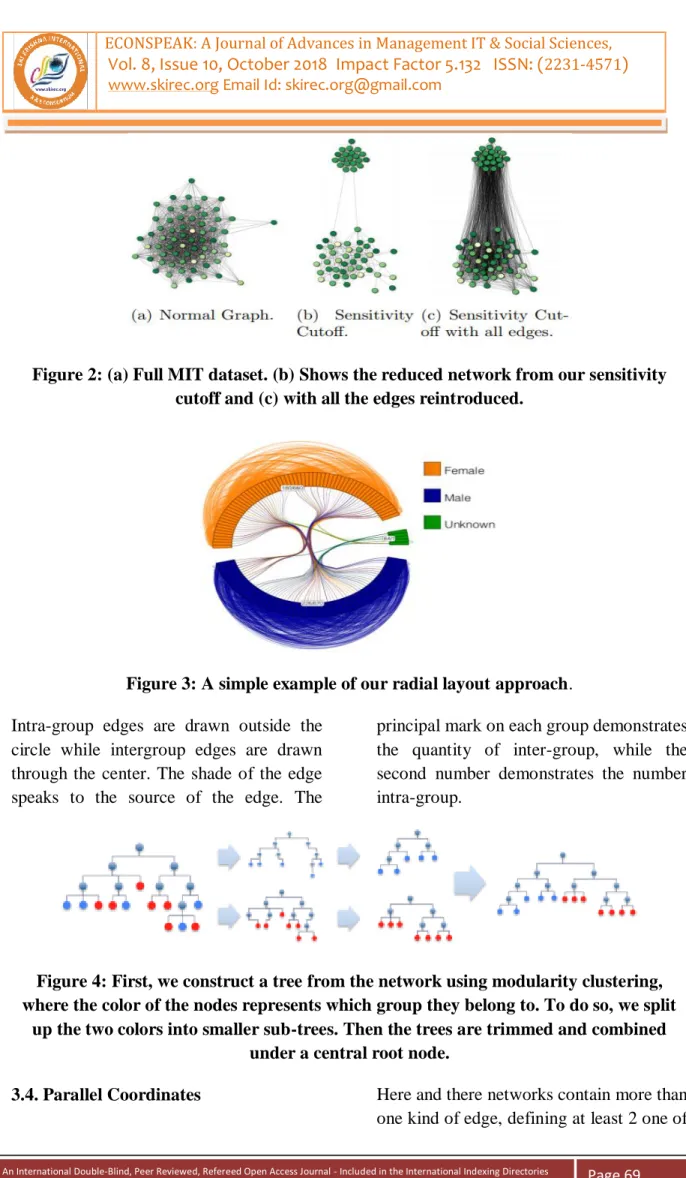
Figure 2: (a) Full MIT dataset. (b) Shows the reduced network from our sensitivity cutoff and (c) with all the edges reintroduced.

Figure 3: A simple example of our radial layout approach.

Intra-group edges are drawn outside the circle while intergroup edges are drawn through the center. The shade of the edge speaks to the source of the edge. The

principal mark on each group demonstrates the quantity of inter-group, while the second number demonstrates the number intra-group.

Figure 4: First, we construct a tree from the network using modularity clustering, where the color of the nodes represents which group they belong to. To do so, we split

up the two colors into smaller sub-trees. Then the trees are trimmed and combined under a central root node.

3.4. Parallel Coordinates Here and there networks contain more than

one kind of edge, defining at least 2 one of

(8)

a kind networks on a similar set of nodes.

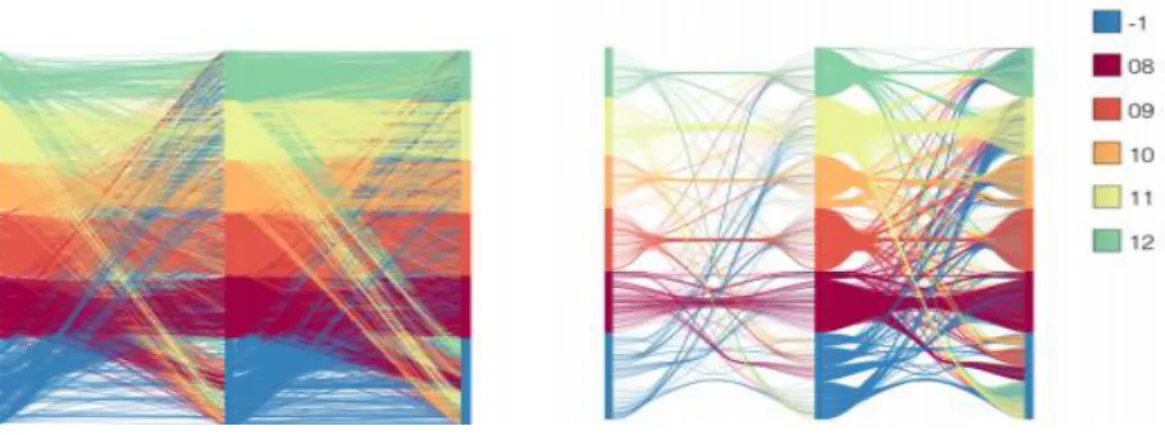
In such cases, a layout that is beneficial for one set of edges probably won't be useful for another. On the other hand, with one bound together layout, sparser networks may get lost inside denser ones. Here, we depict a portrayal based on npartite network layouts, where groups of nodes are spread out parallel to one another. As appeared in an application of this system

in Figure 5(a), the quantity of edges between every section can turn out to be very thick. Hence, we apply edge bundling to illuminate the outcome, as appeared in Figure 5(b). A similar measured quality clustering that defines the ordering can be used, however as in the radial layout, control points need to be processed. Here, the y values of the control points are defined by weighted centroids, yet the x coordinates are defined by level. As in the radial view, a dimension cutoff is utilized;

generally all edges would experience the focal point of every district.

Figure 5: Both parallel coordinates diagrams show aggression network on the left and friendship network on the right.

Each of the three tomahawks are requested the equivalent and are grouped by review level. By bundling the edges, the chart on the privilege is simpler to read. It experiences less visual mess than the unbundled adaptation. By looking at the chart on the correct we can see that the two networks look fundamentally the same as, indicating that aggression copies friendship.

IV. CONCLUSION

The ubiquity and usability of social networking services have energized

institutions with their potential in an assortment of areas. Be that as it may, viable utilization of social networking services represents various difficulties for institutions including long haul sustainability of the services; user worries over utilization of social devices in a work or study setting; an assortment of specialized issues and lawful issues, for example, copyright, privacy, accessibility;

and so on. We have depicted how to apply

visualization approaches to social network

issues, and in addition how to upgrade

them by incorporating factual measures

and tailor diverse layout methods to

(9)

specific analysis assignments. Specifically, we have exhibited visualization that can use standard factual metrics, as well as which can be utilized to choose fitting measurable metrics, assess or affirm their results, or sometimes even enhance them (e.g. for the situation of missing data).

These approaches have been connected to the analysis of networks with multiple clear cut breakdowns, both in node classifications and edge classifications.

Social networks of all assortments are patterned by the downright distinctions among their individuals, the most outstanding being homophily according to statistic qualities. These visualization techniques readily uncover patterns that are hard to recognize with traditional visualization approaches.

REFERENCES

[1]. Boyd, D., Ellison, N.: Social network sites: definition, history and scholarship. J. Comput.

Mediat. Commun. 13(1), 210–230 (2007)

[2]. Araujo, F., Ribeiro, B., Rodrigues, L.: A neural network for shortest path computation. IEEE Trans.

Neural Netw. 12(5), 1067–1073 (2001)

[3]. Abadie, A., Gardeazabal, J.:

Terrorism and the world economy.

Eur. Econ. Rev. 52(1), 1–27 (2008) [4]. Linton C. The Development Of Social Network Analysis: A Study in the Sociology of Science.

Booksurge, 2004.

[5]. T. Cox and M. Cox.

Multidimensional Scaling.

Chapman & Hall, London, 2001.

[6]. Bender S. Demoll and D.

Mcfarland. The Art and Science of Dynamic Network Visualization.

JoSS: Journal of Social Structure, Volume 7, 2005.

[7]. Tim Dwyer and Yehuda Koren.

Dig-cola: Directed graph layout through constrained energy minimization. In IEEE Symposium on Information Visualization, pages 65–72, 2005.

[8]. Peter Eades. A Heuristic for Graph Drawing.

CongressusNumerantium, 42:149–

160, 1984.

[9]. Robert Faris and Diane Felmlee.

Status struggles network centrality and gender segregation in same- and cross-gender aggression.

American Sociological Review, 76(1):48–73, 2011.

[10]. Diane Felmlee and Robert Faris.

Toxic Ties: Networks of

Friendship, Dating, and Cyber

Victimization presented at the

Annual Meetings of the American

Sociological Association, 2013.

Figure

Figure 1: As the bundle strength increases, the lines interpolate from straight position to  the control points
Figure 2: (a) Full MIT dataset. (b) Shows the reduced network from our sensitivity  cutoff and (c) with all the edges reintroduced
Figure 5: Both parallel coordinates diagrams show aggression network on the left and  friendship network on the right

References

Related documents