1 introduction
The Franconian Karst in Germany is one of the most im- portant regions for megafaunal and palaeoclimatic research of the Middle/Late Pleistocene in Europe due to its multi- ple archaeo-biological-archives. The extremely Pleistocene bone-rich caves, which also contain important sedimentary sequences, allow landscape and erosion modeling which is potentially important for comparisons within other regions of central Europe.
E & G Quaternary Science Journal
Volume 63 / number 1 / 2014 / 78-98 / DOi 10.3285/eg.63.1.05 www.quaternary-science.net
GEOzOn SCiEnCE MEDiA iSSn 0424-7116
holotype skulls, stratigraphy, bone taphonomy and excavation history in the Zoolithen Cave and new theory about Esper’s
“great deluge”
Cajus Diedrich
how to cite: Diedrich, C. (2014): Holotype skulls, stratigraphy, bone taphonomy and excavation history in the Zoolithen Cave and new theory about Esper’s “great deluge”. – E&G Quaternary Science Journal, 63 (1): 78–98. DOI: 10.3285/eg.63.1.05
Abstract: The Zoolithen Cave, in the Wiesent River Valley of Upper Franconia, Bavaria, South Germany, has a very long excavation history.
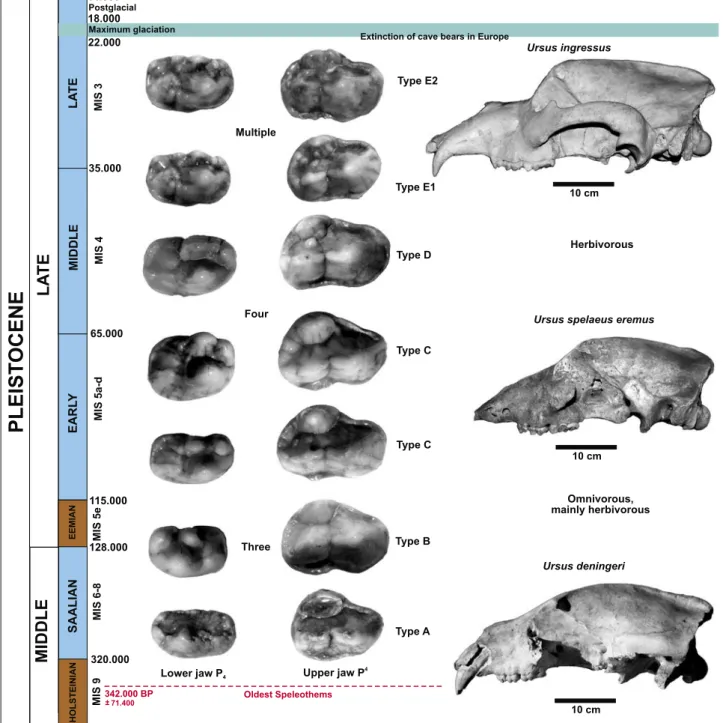
The site is of international paleobiological importance as the Type site for five Pleistocene top predators (cave bear, Ice Age hyena, lion, wolf, dhole). This large cave system has developed in three elevations and preserves three fluvial sedimentary sequences in- cluding two speleothem genesis phases representing changing ponor, dry and wet stages from the Oligocene/Miocene (Neogene), over the Pliocene/Early Pleistocene to Late Pleistocene. The cave bear Ursus deningeri used the cave as den during the MIS 6–9 (Holsteinian interglacial-Saalian glacial). Single P4 tooth and skull shape analyses (“= cave bear clock”) date different cave bear species (U. spelaeus eremus/spelaeus, U. ingressus) within the Late Pleistocene (MIS 3–5d). Finally the bones of other Pleistocene megamammals were washed from two former cave entrances at elevations of about 455 m a.s.l. up to 30 meters deep into lower elevation cave parts, during the Last Glacial Maximum (Post-U. deningeri times or Postglacial), -historically believed to be the result of the “great deluge”. The young “river terrace dolomite gravels” which occur as relic sediments at elevations of about 455 a.s.l in several caves around Muggendorf cannot be explained by natural erosion/river terrace stratigraphy, and must relate to an uncertain glacial context. Finally Iron Age (La Tène) humans left secondary burials (human skulls and long bones with pottery and after-life food animal donations) only in the first deep vertical shaft (Aufzugsschacht) similar to the situation in the nearby Esper’s Cave.
holotypen-schädel, stratigraphie, Knochen-taphonomie und Ausgrabungs-historie in der Zoolithenhöhle und eine neue theorie über Esper’s „biblische sintflut“
Kurzfassung: Kurzfassung: Die Zoolithenhöhle liegt entlang des Wiesenttals (Oberfranken, Bayern, Süd-Deutschland) und hat eine lange
„Spatenforschungs“-Historie. Die Fundstelle ist von internationaler Bedeutung aufgrund ihrer fünf validen Holotypen-Eiszeittier- Schädeln des „Höhlenbären“ sowie Top-Prädatoren (Eiszeit-Löwe, -Hyäne, -Wolf und -Rotwolf). Das große Höhlensystem entwi- ckelte sich auf drei Etagen und hat drei fluviale Haupt-Sedimentsequenzen inklusive zwei Haupt-Speleothem-Genesephasen unter wechselnden Ponor-, Trocken- und Nassphasen während des Oligozän/Miozän (Neogen) über das Pliozän/Frühpleistozän bis hin zum Spät-Pleistozän. Die ersten Höhlenbären-Populationen Oberfrankens mit Ursus deningeri nutzen die Höhle als Horst bereits im MIS 6–8 (Holstein-Interglazial/Saale-Glazial). Isolierte P4 Zahn- sowie die Schädelmorphotypen (= “Höhlenbären-Uhr”) datie- ren verschiedene Höhlenbären-Arten/Unterarten (U. spelaeus eremus/spelaeus, U. ingressus) in das Spät-Pleistozän (MIS 3–5d).
Ihre Knochen wurden in etlichen Fällen zuerst durch Top-Prädatoren beschädigt. Letztendlich wurden die Knochen aller pleistozä- nen Großsäuger während des Hochglazials (= Last Glacial Maximum, Post-U. deninger-Zeit oder Postglazial) von zwei ehemaligen Eingangsbereichen in Höhenlagen um 455 m NHN bis zu 30 Meter in tiefere Höhlenbereiche besonders über die Vertikalschäfte durch Hochflutereignisse verschwemmt. Dieses wurde in historischer Zeit als „biblische Sintflut“ interpretiert. Die jüngsten „Fluss- terrassen-Dolomitkiese“ in Höhlenlagen um 455 m NHN werden als Reliktsedimente in verschiedenen Höhlen um Muggendorf angetroffen und können in solchen extremen Höhenlagen 130 Meter über der heutigen Wiesent nicht mehr mit „natürlicher Erosi- on/Flussterrassenstratigraphie“ erklärt werden. Sie müssen im noch unklaren glazialen Kontext stehen. Letztendlich hinterließen Eisenzeit-La Tène-Menschen Sekundärbestattungen (Schädel, Langknochen, Keramik und Jenseits-Nahrungs-Haustier-Beigaben) nur im ersten tiefen Vertikalschaft (= Aufzugschacht), ähnlich wie in der nahegelegenden Esperhöhle.
Keywords: Holotype skulls, stratigraphy, bone taphonomy, excavation history of the Zoolithen Cave, new theory about Esper's "great deluge"
Address of author: C. Diedrich, PaleoLogic Research Institute, Petra Bezruce 96, CZ-26751 Zdice, Czech Republic, www.paleologic.eu, [email protected]
Upper Franconia (Bavaria) along the Wiesent and tribu- tary valleys has the highest density of caves in the Franconi- an Alb (e.g. Kaulich & Schaaf 1993, Groiss et al. 1998) and is one of the most cave–rich regions of Europe, worthy of
“speleopark” designation in the future. The caves are eroded into the massive Upper Jurassic reef and lagoon/inter-reef dolomites (Meyer & Schmidt-Kaler 1992, Groiss et al.
1998), which additionally are famous climbing areas. Most
of the caves are only small clefts or cavities, with only a few
larger caves are present.
a half million of remains. This and other larger bone-rich caves in Upper Franconia (Fig. 3A) are all in higher eleva- tions between 550 to 400 m a.s.l. (Zoolithen Cave former en- trance 455 m NHN, Sophie’s and Große Teufels Cave former entrances 410 m NHN) and contain mainly Late Pleistocene megafaunas in the Große Teufels Cave, Sophie’s Cave, or Geisloch Cave such as the herein discussed Zoolithen Cave, which will be demonstrated to have been used by early cave bears even earlier already in the Middle Pleistocene. At min- imum four larger Pleistocene cave bear dens are known to- day (Fig. 3A). Smaller and fewer cave bear remain contain- ing caves are the Zahnloch Cave, Neideck Cave, Moggaster Cave, König-Ludwigs-Cave, Wunder Cave and Esper Cave (Diedrich 2013a, Fig. 3B).
1774–1794 – Esper to Rosenmüller – “surface collect- ing times”
The reports of Heller (1972) do contain a compilation of the history, but do not reflect the real situation. After the first reports of the cave fauna by Esper (1774), he collected, de- scribed and figured “bones of extinct animals” (= cave bears and others) from the Zoolithen Cave. These bones were not found in the Entrance Hall (455 a.s.l.), but in the area of the Those caves, and especially the Zoolithen Cave, was one
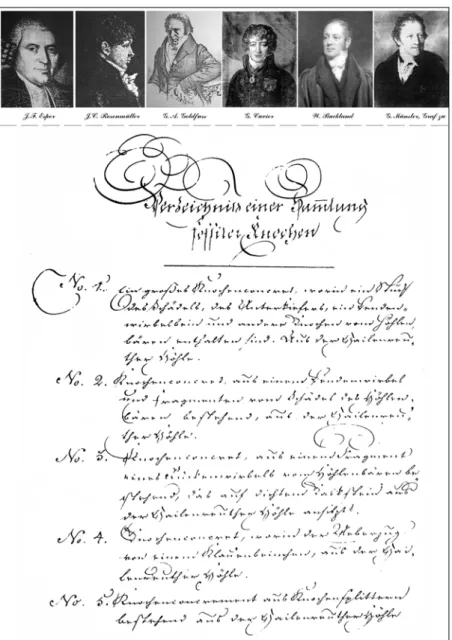
of the first and most famously targeted fossil cave bear local- ities, where many famous German, French and English pio- neering researchers excavated or studied material, includ- ing Esper, Rosenmüller, Goldfuss, Cuvier, Buckland &
Graf zu Münster (Fig. 1). The most famous and largest fos- sil collection assembled by Rosenmüller (labeled in 1797) that contains several of the famous skulls, was thought to be lost, but has been relocated by the current author, in the Preußische Geologische Landesanstalt (see Rosenmüller catalogue, Fig. 1). During the DDR socialist Republic times this collection was forgotten but is now recognized to be of international importance. Further important researchers in- cluded Goldfuss & Buckland who provided the first illus- trations of the cave and excavation areas (Fig. 2A). Sadly, in more recent times (after the Second World War), large newly discovered parts and old areas were emptied with old-style methods by Groiss (Fig. 2B).
Mainly cave bear remains have been found from the Pleistocene layers in the Zoolithen Cave as the first and most well-known and one of the richest cave bear bone site of Eu- rope (Esper 1774, Rosenmüller 1794, Goldfuss 1810, 1818, 1821, 1823, Buckland 1823), which herein estimated has/had
Fig. 1: The first Zoolithen Cave researchers of the
„early spade research time: J.F. Esper, J.C. Rosen- müller, A. Goldfuss, G. Cuvier, W. Buckland and Graf zu Münster. Below: First page of the catalogue of the selling contract of the Rosen- müller-1794 collection (former times Preußische Geologische Reichsanstalt Berlin, today Natur- kundemuseum der Humboldt-Universität Berlin).
Abb. 1: Die ersten Zoolithenhöhlen-Erforscher während der „frühen Spatenforschungszeit“:, J.F.
Esper, J.C. Rosenmüller, A. Goldfuss, G. Cu-
vier, W. Buckland und Graf zu Münster. Un-
ten: Erste Seite der Kataloges des Kaufvertrages
der Rosenmüller-1794-Sammlung (damals Preu-
ßische Geologische Reichsanstalt Berlin, heute
Naturkundemuseum der Humboldt-Universität
Berlin).
“Aufzugsschacht”, which was a 2 m bone filled shaft, de- scribed as resulting from a “biblical flooding event” (Esper 1774). Initially, bones were easy to collect from the surfaces, starting in the Aufzugssschcht Shaft area. The cave bear, li- on and dhole holotype skulls must have been collected by Rosenmüller from the surfaces in those first two larger shafts in the cave system before 1797, because the other cave parts (2/3 of the today’s known cave) behind the Aufzugssch- acht had not been discovered at that time (cf. Rosenmüller 1794, Buckland 1823, Niggemeyer & Schubert 1972).
1810–1823 – G oldfuss to B uckland – “first excavation pe- riod”
The sketch of Buckland (Fig. 2B) demonstrates the main bone excavation areas around 1823. Groiss (1979) believed this illustration not to be correct, but it is (see reidentifica- tions in Fig. 2A), even the last shaft can be demonstrated to be the Museumsschacht (after illustrations with two spele- othem layers, old ladder material and dump) and not the Wühlschacht. Even today preserved historical ladder mate- rial and dumps in the last shaft (Museumsschacht) prove the
deep and extensive excavations at that time, being well fig- ured by Buckland (1823). Those areas can be seen well un- til today in the cave. Buckland’s excavations began in the Entrance Hall, which can be seen in his illustrations (Buck- land 1823, Fig. 2B). The bones are there in primary posi- tions (not water transported) in a silty medium brown and dolomite ash sediment (cf. section in Fig. 4), which miner- als gave the bones a typical medium-to dark brown colour.
Two preservation and bone colour types Goldfuss (1823) are known, the brown form and the more abundant “white yellowish” form. This old excavation area was partly reo- pened during the own studies (Fig. 4) and some bones (large proportions) and teeth (multiconed enamel surfaces) of U.
ingressus were found, which are important for dating. The Entrance Hall was not – as wrongly believed – fully exca- vated, because the sections demonstrate autochthonous and dark-brown coloured cave bear bones, which form a loose bonebed. Furthermore larger speleothems still cover most of the hall, which is only overlain by few Iron Age period and Holocene sediments (Fig. 4). This Hall was less of inter- est, because in the first shafts (Wühlschacht/Aufzugsschacht/
Fig. 2: A. Cross section of the historical excava- tion areas of W. Buckland (from Buckland 1823). This section Dieser Aufriss-Querschnitt shows the historic discoveries of the anterior cave parts and excavation areas in the Entrance Hall, Wühlschacht Shaft (= Iron Age secondary burials) and the Aufzugs-/Museumsschacht Shafts (sections cf. Fig. 4) of the “early spade research time”. In the Museumsschacht-Shaft partly the herein illustrated wooden planks of the ladders are preserved until today in the Museumsschacht Saft.. B. Not time-adequate and sadly useless “finding map sketch” of the bonebed surface in the „Bärenkammer“ of the Löwengruben Hall of the “late spade research time” (from Groiss 1971). The removed material can not be relocated today anymore to the places (lacking documentation due to quick-emptying action), nor were the nones osteologically deter- mined.
Abb. 2: A. Querschnitt der historischen Gra- bungsbereiche von W. Buckland (aus Buck- land 1823). Dieser Aufriss-Querschnitt zeigt die damaligen Entdeckungen des vorderen Höhlenbereiches und Grabungsstellen in der Eingangshalle, dem Wühlschacht (= eisenzeit- licher Sekundär-Bestattungsschacht) und dem Aufzugs-/Museumsschacht (Profile vgl. Abb. 4) in der „frühen Spatenforschungszeit“. Im Muse- umsschacht sind noch heute Balken der Leitern vorhanden, die hier teilweise eingezeichnet sind.
B. Nicht zeitgemäße unbrauchbare „Befundplan-
Skizze“ der Bonebed-Oberfläche in der „Bären-
kammer“ der Löwengruben-Halle in der „späten
Spatenforschungszeit“ (aus Groiss 1971). Die
geborgenen Funde können heute weder zugeord-
net werden (fehlende Dokumentation aufgrund
einer Schnell-Entleerungs-Aktion), noch sind die
Knochen osteologisch bestimmt worden.
Museumsschacht) the bone beds were extremely dense and material was easy to obtain. The material was found in the
“bonebed breccias” (= cemented doloash sand-dolomite peb- ble layers cemented by speleothems) below the upper spe- leothem layer. Also Graf zu Münster collected there in the 19 th century (Weiss 1937), with his collections now curated in the Urweltmuseum Oberfranken Bayreuth. The sediment of those excavations and further ones of the 19 th century was back-filled into the Wühlschacht (pers. com. M. Conrad).
This shaft was closed again after 1823 already historically with reworked sediments. These first discovered areas of the anterior cave separated for long the deeper cave parts which were discovered in 1971 after removal of the sediments (cf.
Niggemeyer & Schubert 1972). The many hundreds of cu- bic meters of material protected the deeper parts of the cave and were reworked 25–20 years ago (pers. com. M. Conrad).
1971 – “second research period”
The second chimney (Wühlschacht) was also filled up with densely packed bones and was the key to today’s much larg- er known cave system, the middle part of which was dis- covered in 1971 (cf. Groiss 1971, 1979). After the reopening of the Wühlschacht about 25 years ago, a new cave part and thousands (e.g. the University Erlangen collection of 100,000 bones) of untouched bonebeds were quickly removed. Those bones were taken without adequate documentation in the Knochenschacht and partly in the Bärenkammer (cf. Fig.
2B). The Guloloch and Wolfskammer shafts produced mainly cave bear bones, and many new skulls, but also other Pleis- tocene carnivore faunal remains (cf. Groiss 1979). From those excavations a perfectly preserved hyena skull subse- quently became a paratype skull (Diedrich 2011a, 2014).
Some thousands of other bones have been dumped after
?
Große Teufels Cave Wunders
Cave
400 m 500 m
5 km
Hasenloch Cave Sophie's
Cave
?LGM-valey glaciers Late Late Pleistocene
(High glacial = LGM) Study
area 1
Study area 2
D
B
Basel
Bavaria
CZECH REPUBLIC
AUSTRIA SWITZERLAND
FRANCE North Sea
100 km
Berlin
GERMANY
?
MUGGENDORF
Große Teufels Cave
König-Ludwigs Cave Sophie's
Cave
Cave bears (
and )
Ursus spelaeus spelaeus/eremus Ursus ingressus Steppe lion ( Panthera leo spelaea )
Ice Age spotted hyena ( Crocuta crocuta spelaea ) Ice Age wolve ( Canis lupus spelaeus )
Ice Age marten ( Martes sp.) Mouse weasel ( Mustela erminea subsp.)
BURGGAILENREUTH EBERMANNSTADT
Zoolithen Cave Neideck
Cave STREITBERG
Wunders Cave Geisloch
Cave
400 m 500 m
W ie s e n t
GÖSSWEINSTEIN
POTTENSTEIN KIRCHAHORN Rabenstein
Castle
Neideck Castle
5 km Esper
Cave
Zahnloch Cave
Moggaster Cave Study area
Munich Nuernberg
A
Ice Age wolverine ( Gulo gulo )
Porcupine ( Hystrix (A.) brachyura )
Castle Burggaillenreuth
?Snow field accumulation area
Study area 3 Zoolithen
Cave
410 m
Esper's
Cave 455 m Neideck
Cave
LGM/Post-LGM terraces LGM/Post-LGM terrace sediments, also in cave entrances (dolomite gravels)
410 m
?
?
?
?
? Snow fields (on plateau depresions) Hasen-
loch Cave
LGM
LGM/Post-LGM terrace sediments in cave entrances (glauconite clay/sandy gravels)
Fig. 3: A. Late Pleistocene cave bear, hyena, wolf, marten and weasel den cave sites in Upper Franconia (northern Bavaria). B. Three sedimentological studied areas in Upper Franconia (Große Teufels Cave, Sophie’s Cave and Zoolithen Cave) with questionable “valley glacier situation” explaining best the high elevation of the Wiesent River terrace on 455 a.s.l. elevations and large gorges along during the late Late Pleistocene (high glacial) and terrace relict sediments (especially glauconite till sediments) explaining the possibilities of the flooding situation. The problem is the correlation of the different elevated Sophie’s/Große Teufels caves (410 m a.s.l.) elevation and similar old different terrace sediments in the Muggendorf area (Neideck/Wunders/Zoolithen caves about 455 m a.s.l.).
Abb. 3: A. Spät-Pleistozäne Höhlenbären, Hyänen, Wolf, Marder und Wiesel-Horst-Höhlen in Oberfranken (Nord-Bayern). B. Drei sedimentologisch untersuchte Regionen in Oberfranken (Große Teufelshöhle, Sophienhöhle und Zoolithenhöhle) mit fraglicher „Tal-Vergletscherungs-Situation“, die am besten die hohe Wiesent-Flussterrassenlage auf 455 m ü. NHN und tiefen Schluchten während des späten Ober-Pleistozäns (Hochglazial) und Terrassen- Reliktsedimente (besonders Glaukonit-Tillsedimente) und Flutung der Zoolithenhöhle erklären könnte. Das Problem ist die Korrelation der unterschiedlich hoch gelegenen Sophien-/Großen Teufelshöhle (410 m NHN) und gleichaltrige unterschiedliche Terrassensedimente in der Muggendorf-Region (Neideck-/
Wunders-/Zoolithenhöhle ca. 455 m NHN).
0,5%
C. c. spelaea (?C. c. praespelaea)
Entrance Hall 1
-30 -20 -10 0 Meter
s
Level 1
Entrance Hall 1 Wühlschacht
Shaft Museumsschacht
Shaft
Säulenhalle Chamber
Entrance Hall 2
Microtectonics Mud cracks
Red clay
Sediment below eroded by floo ds Older speleo them layer
Dipping speleothem block
Older stalagmites Y ounger stalag
m ites
Y ounger candle stalagmites
Older stalagnat
es
Auftstiegshalle Shaft
Level 2 Level 3
Reef-Dolomite Fine dolomite ash sand, lamination, clay layers
Bonebeds Valley river
floods (intermediate)
Holocene
UPPER JURASSIC
PLEIST OCENE LA TE
Red clay (with concretions)
Candle-stalagmites
13.720 BP - + 125
342.000 BP 71.400 - + Mud cracks
Carbonate concretions Microtectonic structures
Broken speleothems
Grey clay Speleothem phase1
(vadose)
II I
Bones Rounded limestone pebbles, with few rounded speleothems, and loess sand matrix La Téne -Iron Age human bones, ceramics
Bonebed-Breccias
Early-Middl e Lat e
Bats
Bones Bones
Thick speleothems Speleothem phase 2
(vadose)
Underground river (ponor) Cave genesis
3,4%
91%
1,6%
0,2%
2,5%
0,2%
P. p. spelaeus P. l. spelaea (?P. l. fossilis)
C. antiquitatis
R. tarandus, C. elaphus G. gulo
C. lupus spelaeus
1%
P. eversmanni
U. ingressus/U. spelaeus subsp./
U. deningeri and M. martes
Zoolithen Cave Pleistocene bone asamblage
NISP = 6.200
U. ingressus
U. spelaeus subsp.
"24.000" BP V. vulpes/ lagopus
In valleys migrating steppe fauna (imported prey)
Boreal forest karst fauna (carnivore and cave bear den)
NEOGENE MIDDLE I Sequence II
?EARL Y
Entrance Hall 2 Legend, see standard
section below
A
B
C D E F
G
H
I
Wühlschacht Shaft
Auftstiegshalle Shaft
Museumsschacht Shaft
Vertically dropped mixed sediments Dolomite ash/red clay series
Bon ebe ds
U. deningeri
Doloash sand
Sections, see above
C. alpinus cavernalis 0,1%
50 cm
Floods
Säulenhalle Chamber
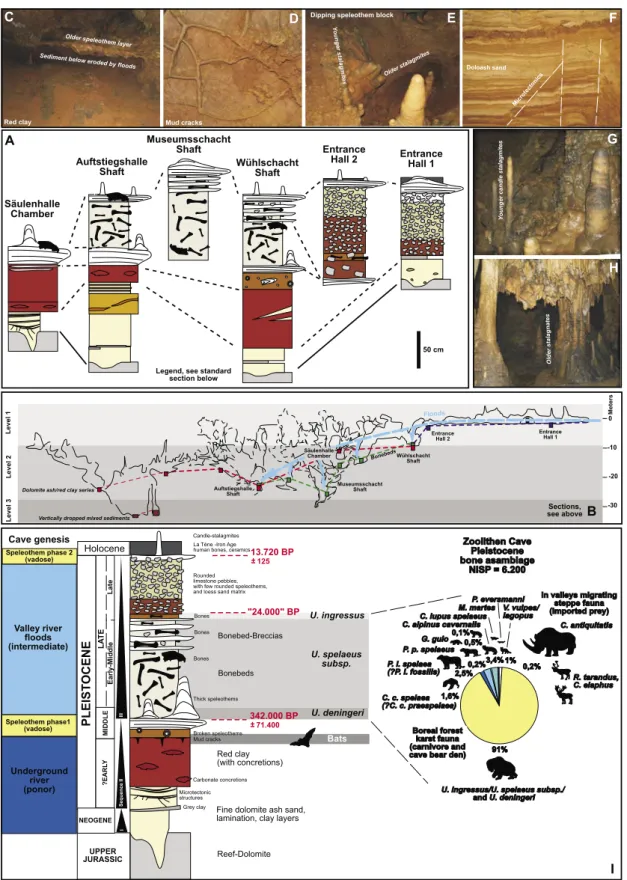
Fig. 4: Sections in the Zoolithen Cave, dating and interpretation of main sedimentary fluvial (underground river and valley river) series (absolute data from Kempe et al. 2002, Rosendahl & Kempe 2004). A. Important sections. B. Cave levels and similar elevated sedimentary sequences. C. Collapsed main speleothem layer, below eroded clay and present red clay of the sequence 2 in the Lehmhalle. D. Mud-crack negatives on the base of the main speleothem layer in the Löwengrube. E. Tipping speleothem layer in a vertical shaft, which moved downwards, and on which candle stalagmites with different angles developed. F. Dolomite ash sands/red clay layers of the sequence 2 with microtectonic horst structures. G. Candle stalagmites of the Alleröd humid phase (second speleothem generation) in the Löwengrube. H. Large stalagnates from the first speleothem phase in the Säulenhalle. I. Compiled generalized sec- tion, and faunal composition of the Late Pleistocene bonebeds.
Abb. 4: Profile in der Zoolithenhöhle, Datierung und Interpretation von fluvialen (Untergrundfluss und Talfluss) sedimentären Hauptzyklen (Absolut-Dat-
en nach Kempe et al. 2002, Rosendahl & Kempe 2004). A. Wichtige Profile. B. Höhlen-Etagen und in gleichen Höhenlagen vorhandene Sediment-Sequen-
zen. C. Eingestürzte Sinterdecke, unterhalb erodierter Lehm und vorhandener roter Lehm der Sequenz 2 in der Lehmhalle. D. Trockenriss-Negative auf der
Unterseite der ersten Hauptspeläothem-Lage in der Löwengrube. E. In einem Vertikalschacht verkippte Sinterdecke, die sich gravitativ nach unten bewegte
und auf der sich mehrere Kerzenstalagmiten-Generationen mit unterschiedlichen Winkeln entwickelten. F. Dolomite-Aschen/rote Lehm-Lagen der Sequ-
enz 2 mit Mikrotektonik-Horststrukturen. G. Kerzenstalagmiten der humiden Alleröd-Zeit (zweite Speläothem-Generation) in der Löwengrube. H. Große
Stalagnaten der ersten Speläothem-Generation in der Säulenhalle. I. Generalisiertes Gesamtprofil und Faunenkomposition der spätpleistozänen Bonebeds.
1971 due to the continuing excavations (FHKF = Forschungs- gruppe Höhle und Karst Franken e.V., Nürnberg) in the “Mu- seum” in the cave, and still remain there. This bone material is from the approximately two meter thick bonebeds of Auf- zugsschacht/Wühlschacht and the Museumsschacht vertical shafts. Most of the sediment was simply transported in front of the cave, whereas the teeth were taken by the spelunkers, who dumped the “bad bones” in the Museums area. The new
“old” reworked bone material is still of high importance in the reconstruction of the exact locations of lion and hyena
remains (Fig. 14), to the understanding of the cave bear bone taphonomy, and to the compilation of the rare non-cave bear skeletons necessary to obtain complete faunal accounts.
2000–2010 – Modern Research
The descriptions of Heller (1966) do not fit this cave or oth- er caves, where he believed, that those sites were “emptied”.
After the new discoveries of untouched bonebeds which are luckily still intact in at least some areas (Fig. 15), the cave was explored further in the past decade leading to the dis- CAVE BEAR TOOTH AND SKULL MORPHOLOGY AND DATING
LA TE
PLEIST OCENE MIDDLE
14.000
Multiple
Four
EEMIAN
Maximum glaciation
Extinction of cave bears in Europe
65.000
115.000 35.000 Postglacial 18.000 22.000
EARL Y
Omnivorous, mainly herbivorous
10 cm
10 cm
10 cm
MIDDLE LA TE SAALIAN HOLSTEINIAN
128.000
Ursus ingressus
Ursus spelaeus eremus
Ursus deningeri Herbivorous
Upper jaw P 4 Lower jaw P 4
Three
Type A Type B Type C Type C Type D Type E2
Type E1
320.000
MIS 9 MIS 6-8
342.000 BP 71.400
- + Oldest Speleothems
MIS 5e MIS 4 MIS 5a-d MIS 3
Fig. 5: “Cave bear clock” – dating the cave bears by P4 and skull shape morphologies. The tooth material is from the dump infront of the cave but dem- onstrate a cross-section through all primitive deningeri to ingressus cave bear tooth morphotypes sensu Rabeder (1999). All teeth in occlusal view. U.
ingressus skull Graf zu Münster-coll. Urweltmuseum Oberfranken Bayreuth; U. spelaeus eremus skull Buchhaupt-coll.; U. deningeri skull Rosenmüller 1794-coll. MB).
Abb. 5: „Höhlenbären-Uhr“ – Datierung der Höhlenbären mit Hilfe der P4 und Schädel-Morphotypen. Das Zahnmaterial stammt aus der Halde vor der
Höhle, zeigt aber den Querschnitt durch alle primitiven deningeri bis ingressus-Höhlenbärenzahn-Morphotypen sensu Rabeder (1999). Alle Zähne in Oc-
clusalansicht. U. ingressus-Schädel Graf zu Münster-Slg. Urweltmuseum Oberfranken Bayreuth; U. spelaeus eremus-Schädel Buchhaupt-Slg.; U. deningeri-
Schädel Rosenmüller 1794 Slg. MB).
covery of another extension to the south (= Dreyerhalle ar- ea, pers. com. M. Conrad, Fig. 14). Also, a few more bones and skulls were found even deeper in the cave system, ob- viously in secondary (carnivore caused scattering) or even third (floods, gravity-driven transport) positions. The Mu- seums area dump was sorted by the author in 2010. During this preliminary collections management, all non-cave bear material was extracted (together with human remains, and pottery, and Holocene fauna). The hyenas and lion material has already been published, together with the accessible his- torical finds (cf. Diedrich 2011a/b, 2014).
The international important forgotten Pleistocene hol- otype skull collection
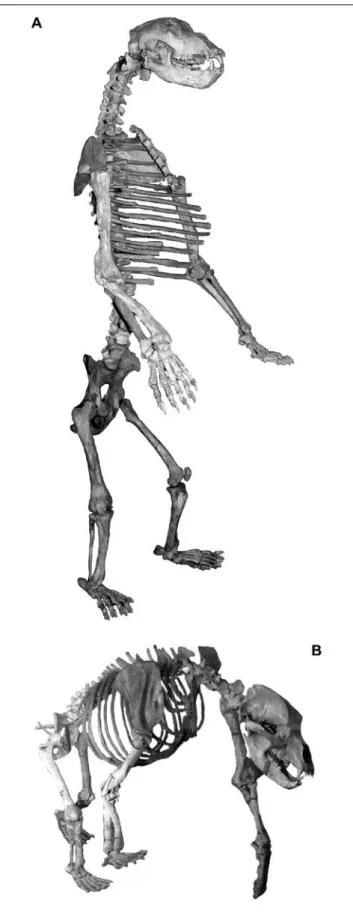
Two “cave bear” skeletons were compiled of bones from dif- ferent individuals and even cave bear subspecies/species as known today (Fig. 5, 6A–B). In total five Pleistocene spe- cies (Figs. 7–13) were named based on the Zoolithen Cave skulls – which make this site to the most important Pleis- tocene cave megafauna locality in Europe. Today only five of the six holotype skulls remain as valid Pleistocene species.
The holotype of the “cave bear Ursus spelaeus” described by Rosenmüller (1794) was identified in his collection (Die- drich 2009, Fig. 7). Newly identified here is the Ursus de- ningeri Reichenau 1904 skull (Fig. 8) of the Rosenmüller collection, which was historically believed to represent a
“brown bear”. A larger bone collection including most of the known large lions remains and the holotype of Panthera leo spelaea (Goldfuss 1810) (Fig. 9) from the Zoolithen Cave was collected/excavated by Rosenmüller himself since the end of the 18 th century. Also the rediscovered hyena Cro- cuta crocuta spelaea (Goldfuss 1823) (Fig. 10) holotype skull (Diedrich 2008, 2014), revalidated wolf Canis lupus spelaeus (Goldfuss 1823) (Fig. 11), the new rediscovered dhole skull of Cuon alpinus cavernalis (Rosenmüller 1797) (Fig. 12), and the subsequently invalidated Gulo gulo spe- laea (Goldfuss 1818) (Fig. 13) must have been found in the first two vertical shafts (Aufzugs-/Wühlschacht). However, the invalid “cave tiger Panthera tigris spelaea (Goldfuss)”
holotype material described by Groiss (1996) was revised to represent subadult individual remains of P. l. spelaea (cf.
Diedrich 2011b).
2 material and methods
To understand the cave bear bone taphonomy and distribu- tion of the “bone breccias” (= bone beds), and to document two articulated skeletons (Fig. 14), a new cave survey was made in spring of 2010, in parallel with a History Channel film project. Open sections in the cave, that resulted from historical digs (cf. Buckland 1823, Fig. 2B) and also the digs of the FHKF since 1971, were studied sedimentologically and stratigraphically to allow the presentation of a general- ized overview section for the currently known cave system (Fig. 4). The most complete Middle to Late Pleistocene (MIS 3–9) section was found in the “Aufzugsschacht”. Some thin- ner sections at other places allow the reconstruction of three main fluvial sedimentary cave filling sequences and two main speleothem genetic phases in three cave levels (Fig. 4).
The bone material in the “Museum” (= sorted bones from the 1971 and later reworked sediments from FHKF activities)
Fig. 6: A. Compiled cave bear skeleton of different individual remains and species of the Zoolithen Cave (exhibition of the Museum für Ur- und Orts- geschichte Bottrop). B. Compiled cave bear skeleton of different individual remains of the Zoolithen Cave (skeleton exhibition of the Museum Tüch- ersfeld).
Abb. 6: A. Höhlenbären-Skelett-Komposit verschiedener Individuen und
Arten aus der Zoolithenhöhle (Skelette-Ausstellung Museum für Ur- und
Ortsgeschichte Bottrop). B. Höhlenbären-Skelett-Komposit verschiedener
Individuen aus der Zoolithenhöhle (Ausstellung Museum Tüchersfeld).
was sorted and protected against further trampling damage by spelunkers. Non-cave bear bone material was extracted (Pleistocene carnivores, Holocene fauna, human bones).
About 2,000 bones remain until today there behind a locked door. Furthermore the dump in front of the cave was checked for its contents with a smaller trench. From this about 1,500 finds (Pleistocene bones, pottery and human teeth) were res- cued from the illegal excavation activities of private collec- tors.
The 1971 and later excavated and already twice rede- posited bones and fragments of the non-cave bears are in the Ziegler-collection (former owner of the cave at that time) of the Forschungsgruppe Höhle und Karst Franken e.V., Nürnberg (= FHKF). The collection of Esper cannot be relocated. The most famous and largest collection, that of Rosenmüller, who labelled the site as “Gaylenreuther Höh- le, 1797” (cf. Fig. 1B) was formerly stored in the collection of the “Preußische Geologische Landesanstalt”, and then in the “Bundesanstalt für Geowissenschaften und Rohstoffe”,
Berlin (= BGR). These collections were recently moved to the “Museum für Naturkunde der Humboldt-Universität Berlin” (= MB). The Goldfuss collection, which was taken from the cave between 1810–1823, is partially housed in the Goldfuss-Museum Bonn (e.g. hyena holotype skull, possi- bly also “lost wolf skull” there). The Graf zu Münster collec- tion which containing well preserved hyena, lion and wolf material is in the Urweltmuseum Oberfranken Bayreuth (=
U-OB). A composite skeleton was studied in the Museum Ur- und Ortsgeschichte Bottrop (= MUOB), and the Museum in Tüchersfeld (= MT). One hyena skull and several cave bear skulls are in the British Museum (Natural History), London (= BMNHL). The Buckland collection was not relocated in Oxford in the University Museum after requests, but might be hidden somewhere. The largest collection (estimated at 100,000 bones after pers. com. Ministry of Culture of Bavar- ia) is housed in the University Erlangen (= UE, 1971 Groiss
“excavations” = cave owner property of R. Ziegler until to- day).
Fig. 7: Ursus ingressus Rabeder & Hofreiter 2004 holotype skull of “the cave bear Ursus spelaeus” of an early adult male. Latest Late Pleistocene (which seems to be a subadult Ursus ingressus; coll. MB, from Diedrich 2009).
Abb. 7: Ursus ingressus Rabeder & Hofreiter 2004 Holotyp-Schädel „des Höhlenbären Ursus spelaeus“ eines frühadulten männlichen Bären, späteres
Spät-Pleistozän (Ursus spelaeus spelaeus Rabeder & Hofreiter 2004, vermutlich ein subadulter Ursus ingressus; Slg MB, aus Diedrich 2009).
Fig. 8: A-E. Early Deninger cave bear Ursus deningeri Reichenau 1904 skull, Middle Pleistocene (“Ursus arctoideus” in the Rosenmüller 1794-coll.
MB).
Abb. 8: A-E. Früher Deninger-Höhlenbär Ursus deningeri Reichenau 1904 Schädel “Ursus arctoideus”, Mittel-Pleistozän (“Ursus arctoideus” Rosen- müller 1794-coll. MB).
Fig. 9: A-E. Steppe lion Panthera leo spelaea (Goldfuss 1810) holo- type skull “Felis spelaeus”, Late Pleistocene (Rosenmüller 1794-coll.
MB,drawing from Goldfuss 1810, original from Diedrich 2011b).
Abb. 9: A-E. Steppenlöwe Panthera leo spelaea (Goldfuss 1810) Holotyp-
Schädel “Felis spelaeus”, Spät-Pleistozän (Rosenmüller 1794-Slg. MB,
Zeichnung aus Goldfuss 1810, Original aus Diedrich 2011b).
3 results and discussion
River terrace relicts in caves and valley genesis in Up- per Franconia
Neischl (1904) remarked first, that sediments in caves along Upper Franconia river valleys are important for the land- scape and glacial dewatering system reconstruction. The first identifications of river terraces and their possible elevations were discussed by Spöker (1952) for the Franconia Pegnitz valley. Problems of the valley genesis and dating including micromammal fauna containing caves (e.g. Brunner 1933, 1954) were reviewed (Habbe 1989). Only coarse karst evolu- tion models were presented, especially for the earlier “Cre- taceous to Tertiary” periods, but not in detail for the Pleis- tocene valley genesis (cf. Groiss et al. 1998). A new discus- sion about Plio-/Pleistocene river terraces in the valleys of Upper Franconia appeared with the new sedimentological research at Sophie’s Cave of the Ahorn Valley (Diedrich 2013a). At Zoolithen Cave along the Wiesent Valley, the entrance is 130 m above modern river level and must have been flooded postglacially in the Late Pleistocene, as dated by cave bear tooth morphology and stratigraphy (Diedrich 2011a, 2013a; Fig. 2). This presented a new idea in the un- derstanding of the much more rapid valley genesis which is
further discussed here, but can be completed only with fur- ther studies of the many caves along the river valleys. A first model for the Wiesent Valley branching Ahorn Valley has al- ready demonstrated the exact elevation estimates of Middle (one terrace) to Late Pleistocene (three terraces, Diedrich 2013a) Ailsbach River terraces, whereas the different cave bear species/subspecies are highly important for the sedi- ment dating. Those cave sections cannot yet be correlated herein simply to the Wiesent Valley terraces, but both have similar sedimentary sequences in the Late Pleistocene. Im- portant for the understanding of the valley genesis in Upper Franconia are the bonebeds (and different cave bear species/
subspecies) and faunal remains in general with their tapho- nomic record, found especially in caves along the valleys.
Cave genesis, refill stages and animal den use
After a new systematic exploration of the cave in the spring of 2010, its sedimentology/morphology, cave history and ge- ology can be reconstructed including former speleothem and micromammal age determinations, starting with its develop- ment in the Tertiary, when the cave was eroded into Upper Jurassic massive dolomites (cf. Groiss et al. 1998, Meyer &
Schmidt-Kaler 1992). The lower cave areas and the upper parts whose levels developed under phreatic underground
Fig. 10: A-D. Hyena Crocuta crocuta spelaea (Goldfuss 1823) holotype skull “Hyaena spelaea”, mirrored, Late Pleistocene (Goldfuss -coll. GMB, drawing from Goldfuss 1823), E-H. New paratype skull (Ziegler-coll UE, from Diedrich 2011a), I-J. Skull with bite damage, original of Soemmering, 1828 (from Diedrich 2011a), K-L. Maxillary, original of Cuvier, 1822 (coll GZG).
Abb. 10: Hyäne Crocuta crocuta spelaea (Goldfuss 1823) Holotyp-Schädel “Hyaena spelaea”,, gespiegelt, Spät-Pleistozän (Goldfuss-Slg. GMB, Teichnung
aus Goldfuss 1823), E-H. Neuer Paratyp-Schädel (Ziegler-Slg. UE, aus Diedrich 2011a), I-J. Schädel mit Bissverletzung, Original von Soemmering, 1828
(aus Diedrich 2011a), K-L. Maxillare, Original von Cuvier 1822 (coll. GZG).
river conditions seem to have been connected by vadose spe- leogenesis, following the cleft system (cf. Poll 1972), which explains the often small and vertical partly-branched shafts which connect the three known cave levels (Fig. 2). There must be a deeper active system, resulting in gravity move- ments in vertical shafts deeper than the lowermost level (about 30 m).
A. Initial ponor cave (“Oligocene/Miocene”)
The 550 a.s.l. high elevated Franconian Moggaster Cave was filled during the Early to Middle Palaeogene (= Palaeocene - Eocene, Groiss et al. 1998). The Zoolithen Cave (455 .a.s.l.) is intermediate in elevation between Moggaster Cave (550 a.s.l., Palaeocene/Eocene genesis) and Sophie’s Cave (410 a.s.l., Pliocene genesis, cf. Diedrich 2013a) and seem to have been filled with their first sediments no earlier than the Neo- gene. Here an Oligocene/Miocene age for Zoolithen Cave is expected based on the elevations and dated refill history of Moggaster and Sophie’s caves (cf. Groiss et al. 1998, Die- drich 2013e). The first fluvial sedimentary cycle of the Zoo-
lithen Cave is the so-called “dolomite residuum/grey clay se- quence” (sequence 1, Fig. 2), whereas those dolomitic sands and silts are typical products of dolomite weathering and fluvial erosion (Burger 1989). This series was deposited in level 1 in the Entrance Hall (Fig. 2) by an underground river of a Neogene Upper Frankonian Plateau landscape origin, which seem to have been present until the Pliocene (Die- drich 2013a).
B. Final ponor cave (Pliocene-Early Pleistocene)
In the Zoolithen Cave, the underground river continued creating two deeper ponor cave levels reaching 25 m deep.
Typical scallops (cf. Jenning 1985) on the cave walls are best visible and preserved (i.e. without vadose overprint) in then lowermost level 3 (Fig. 2) in the newest discovered last third of the cave system (branching horizontal parts around the
“Siebenschläfer” chamber). The dolomite sands are overlain by up to several meters of red homogenous clay, which con- tains up to 20 cm large caliche-like concretions in some ar- eas. Those clays are sometimes covered by mud cracks on the
Fig. 11: A-C. Wolf Canis lupus spelaeus (Goldfuss 1823) lost holotype skull “Canis spelaeus” of a cub and mandible of an adult wolf (from Goldfuss, 1823). D-F. New lectotype skull (Rosenmüller 1794-coll. MB).
Abb. 11: A-C Wolf Canis lupus spelaeus (Goldfuss 1823) Verlorener Holotyp-Schädel „Canis spelaeus“ eines Jungtieres und Unterkiefer eines adulten
Wolfes (aus Goldfuss, 1823). D-F. Neuer Lectotyp-Schädel (Rosenmüller 1794-Slg. MB).
uppermost surfaces (Fig. 2) which might date into Pliocene/
Early Pleistocene. Absolute dating is not yet available, but a comparison to the Pliocene/Early Pleistocene similar flu- vial dolomite sand/clay sequence series sediments of the Sophie’s Cave (Diedrich 2013e) and the Bing Cave (Brand 2006) underground river sediments permits a coarse prelimi- nary dating. In the Zoolithen Cave those fluvial series are at higher elevations of about 445–420 a.s.l. (Fig. 2, therefore expected to be older) and in Sophie’s Cave at an elevation of 410–400 a.s.l. (expected to be younger). The elevation of this sediment series is even different within the Zoolithen Cave, and sediments are found undisturbed below spele- othem layers only in the “second cave level” (Fig. 2), which is some meters deeper than the sedimentary series of the Neogene (level 1 = Entrance Hall). First gravitational vertical transport below the massive speleothem layer (well seen in the Lehmgrube and Siebenschläferkammer, Fig. 2) of those sediments or even possibly earthquakes are documented by micro-horst structures (branch of Säulenhalle, Fig. 2) within the yellowish-white silt/fine sand layers. Such earthquake signs in caves are also reported for the “Middle Pleistocene”
of Franconia by Spöker (1952) and Diedrich (2013a), which would indicate an uplift of Franconia even in the Ice Age, which explains fractured speleothems, or speleothem frag- ment layers (e.g. in Zoolithen Cave layer below first spele- othem phase in the Aufzugsschacht, Fig. 2).
C. Vadose Cave (Middle Pleistocene – first speleothem deposition)
The red and mud-cracked clays demonstrate the drying of the cave, followed by a humid warm period. During this time the main (thickest) Middle Pleistocene speleothem layer developed, and also formed the larger stalagmites/stalactites in the cave. A stalagmite age determination (sample ZooH- Si2; first speleothem generation) is reported around 342,050
± 71.400 years for samples of the Aufzugsschacht section (cf.
Kempe et al. 2002) which corresponds to the MIS 9 intergla- cial period after the Holstein Interglacial at the early Saalian of the Late Middle Pleistocene (cf. Gibbard & Cohen 2008).
After the speleothem deposition at the end of the Middle Pleistocene gravitational sediment transport happened all over the cave and more extensively later in the Late Pleis- tocene, whereas at many places today spaces between the clay surface and speleothem layer are between 0.5 to 2 me- ters. Damages like shedding on cracked and healed stalag- mites (Fig. 2), seem to result from such earthquakes or gravi- ty movements on the clay sediments, and are not to interpret as signs of an “Ice Cave”.
D. Dry cave – cave bear, hyena, wolf den (Early-Middle Late Pleistocene)
One articulated early-adult male cave bear skeleton and one skeleton of a cub, still being present in-situ, were mapped in the central but high elevation cave area (“Säulenhalle” and
“Zaunikhalle”, Fig. 14). These are important to understand the cave bear bone taphonomy and possible original hiber- nation areas, and the flood directions. Those are in areas which are difficult to access, and isolated by vertical shafts.
Their positions would fit to the theory that cave bears hi- bernated as deep in caves as possible to protect themselves against top predators, especially lions (Diedrich 2011b). The
Fig. 12: Dole Cuon alpinus cavernalis (Rosenmüller 1794). A. Holotype skull “Canis cavernalis” of an early adult, Middle or Late Pleistocene (Rosenmüller 1794-coll. MB).
Abb. 12: Rotwolf Cuon alpinus cavernalis (Rosenmüller 1794). A. Holotyp- Schädel “Canis cavernalis” eines subadulten Tieres, Mittel- oder Spät-Pleis- tozän (Rosenmüller 1794-Slg. MB).
Fig. 13: Wolverine Gulo gulo spelaea (Goldfuss 1818) holotype skull (coll.
MB), today attributed to Gulo gulo Linnaeus, 1758 (therefore no longer valid holotype).
Abb. 13: Vielfraß Gulo gulo spelaea (Goldfuss 1818) Holotyp-Schädel (Slg.
MB), heute zu Gulo gulo Linnaeus, 1758 gestellt (daher kein valider Holo-
typ).
Fig. 14: Different cave bear taphonomy in Zoolithen Cave. Bones redeposited by floods accumulated in bonebeds (red) and two more or less articulated skeletons of a cub and early adult male, which skeleton parts are still on place.
Abb. 14: Unterschiedliche Höhlenbären-Taphonomie in der Zoolithenhöhle. Durch Flutung umgelagerte Knochen, akkumuliert in Bonebeds (rot), und zwei mehr oder weniger artikulierte Skelettreste eines Jungtieres und eines frühadulten Bären, die in situ liegen.
AussenvermessungAussenvermessung mit allen Höhlen
1
2
3
4
5
6 10 11 12
4a
5a 10a
10b
10c 12a
3a
3b
3c
4b
7 8
9
135136 137
138 139
140 141114 115 116HP
65
66
6768 13 14
15
16
17 130
131 182021
22
23
15 2425 26 27 28
30
117118 11925 120 121
122 123 124124a HP
125
126 127
128 129 142
31 32
33 42 143
35
36 37 38 3940
41 42
43
53
54 55 36a
52 44 45 46 47
48
49
50 47a 47b 47c
44a
44b
57
52 70 71 72
73 74 75
76 77787981 82
8380 84 170171172
173
185186 187
188
189190191
52
58 52a
52b 52c 52d 52e181 182 183
184
132
133
5859
60 61 62
63
64
85
86 87
88
89
90 210
212
213 214 215 216 217 217a218
219
220
220a
91
93 9496 97
98
99 100
101 200 201
86 102 104
105106 107 108109 110
111
112 175 176
177 178 180
148 149
150
151
152
153
154155 156
157
158
159
160
161 162 163
164165
AA S
A
Scapula Cervical vertebra Femur
Costa
Thoracic vertebra Calcaneus Tibia
Bacculum Humerus
Astragalus
Mandible Femur
Humerus Skull
10 cm 10 cm
1 m
Niche
Metapodial Pelvic
Early adult male skeleton Gravitative transportation
-9
-22,8
72 52d
52c
52b 52e
184 183
54 56
73
70
71 75
188 186 185 187
190
191 76
77
74
84 170
171 172 173
181 182
77
74
84 170
171 172 173
181 182
186 185 187
190
191 76 184
183
54 56
73
70
71 75
188
72 52d
52c
52b 52e
Windspalte
Massen- grab
4 9
4 9
1
L L
L
L
+ -23
-13
-7,7
-3 -3
-19,2
-5,3
-7
-3
-7
-6
-5 -5
-3 -8
-8,5
-18,5
-26 -4 -11
-6
-9
-29,2
-16,2 -3
-11,4
+0,2 -9,5
-0,6
+
W 433,8
423,8
1 10 10a
10b 10c
11 12
2 3
3a 4
156 150
149
163 164
151 162 153 154 160
161 159
158
152 64
85 88 89
90 87 97 98 99
86
104 103
105 175
176 177
180 178/
179
106 148 165
91-96
16 17
143
38 41 35
50
36
54 53
61 62
39 37
63 58
52
44
48
49
33/34 43
45 46
47
47a
31 32
15
120 121
25
8 14 13
21 24 22 23
18/19
26 27
119
20
6/6a 9 7
65
66 68/69
67
5 5a
30 28/29 40
40
8 14 13
21 24 22 23
18/19
26 27
119
20
6/6a 9 7
65
66 68/69
67
5 5a
30 28/29 31
32
15
120 121
25 44
48
49
33/34 43
45 46
47
47a
35
50
36
54 53
61 62
39 37
63 58
52
105 175
176 177
180 178/
179
106 148 165
91-96
16 17
143
38 41
1 10 10a
10b 10c
11 12
2 3
3a 4
156 150
149
163 164
151 162 153 154 160
161 159
158
152 64
85 88 89
90 87 97 98 99
86
104 103
Studentenkammer Aufstiegshalle
X-Spalte Wühlschacht
Wolfs- kammer
Aufzugs- chacht
Eingangshalle Gulo-
loch
Museum
Entrance Schacht I
Schacht II
Lehm- halle
Siebenschläferkammer Bären- kammer Löwengrube
Säulenhalle
Zaunikhalle
Orgelkammer Meißelkammer
Zoolithen Cave
Burggaillenreuth, Bavaria (Germany) Cave-No.: D 109
453 m ü. NN Coordinates: R 44
48418 H 55 16120
L -11
213 85
214
215 216
217
218
220 220a
217
218
220 220a
213 85
214
215 216
Dreyerhalle
N 0 10 m
Sandhalle
Crocuta crocuta spelaea remains
? ?
Adolescents Grown up males/females
Cave bear skeleton remains
Early adult male
Cub
?
?
Cubs
175
Panthera leo spelaea remains
Adolescents
Males
Females
13
218
10 cm
Tibia Femur Skull
Cub skeleton
Event flooding transportatio
ndirectio n
of bone s
Original Cave bear, hyena and wolve den area
with bone accumulations Event flooding
transportatio
n directio n of bone
s (latest Late
Pleistocene)
3 Measuring point Cave wall Rock massif
Deeper branch Abri Possible continuing
Ramp with elevation [m]
Slope
Vertical shaft
Ladder Ramp -
Stalagmite Stalaktite Stalagmite with Stalaktite
Pillar Dropped stalagmite Fallen stalaktites
Large basin Micro basin Cascades Speleothem floors
Bonebed Blocks
Rocks
Angle
Artificial installed stalagmite
Heigth [m. above NN]
Elevation from to the cave entrance elevation [m]
-14,5 449,5 -3
Cave bear skeleton remains articulated 2 Amount of lion bones
River terrace gravels