Continuously Connected
Customer:WiFi on Trains
FINAL REPORT
23 January 2018
Report authors:
Dr Juliet Jain
Dr Caroline Bartle
Dr William Clayton
Centre for Transport and Society
Department of Geography and Environmental Management
Faculty of Environment and Technology
University of the West of England, Bristol
Frenchay Campus
2
Contents
Executive Summary ... 3
1 Introduction ... 6
1.1 The Research Questions ... 7
2 Overview of the research ... 8
2.1 Literature Review: The research context ... 8
2.2 Research Design ... 10
3 The Connected Customer ... 13
3.1 Overview of Internet use ... 14
3.2 Use of free WiFi ... 15
3.3 Experiences of WiFi ... 17
3.4 Experiences of Mobile Data ... 21
3.5 Implications for Free WiFi ... 22
4 Travel Time Use on the Train ... 24
4.1 Travel Time Expectations ... 24
4.2 Internet based activities ... 25
4.3 Non-Internet based activities ... 28
4.4 Travel time as a Reason for Choosing Rail ... 28
4.5 Travel Time as an Rail Industry Opportunity ... 29
5 The Wider Travel Experience ... 31
5.1 Customer Satisfaction ... 31
5.2 Wider Experience Insights from Interviews ... 31
6 Conclusions and Implications ... 33
6.1 Conclusions from the Research ... 33
6.2 Is Internet on the train entering a “post WiFi age”? ... 35
6.3 Research Opportunities and Challenges ... 36
6.4 Dissemination of the Research ... 37
6.5 Future Research ... 38
6.6 Commercial Exploitation ... 38
7 Additional References ... 40
3
Executive Summary
This report finalises the research collaboration between Chiltern Railway and the Centre for Transport and Society, University of the West of England (UWE) for the project ‘Continuously Connected Customer’, which was funded by the RSSB through TOC15 from May 2016 to February 2018.
The project has investigated the impact of free WiFi on how rail passengers’ connect to the Internet on trains (Chiltern Railway) and what they do with their travel time.
It is the first study of WiFi on trains in the UK, and possibly globally, that investigates actual passenger behaviour; preceding Government commissioned work used Stated Preference to predict how much passengers would pay for improved connectivity (phone and Internet). It is also unique in testing out different data allowances in the field. Chiltern Railways ran two 20 week trials on its mainline route between Birmingham and London Marylebone increasing the free WiFi offer from 20MB firstly to 75MB and secondly to 125MB. Chiltern Railways ran a third trial on its commuter route between Aylesbury and London Marylebone offering passengers 20MB for the first time.
The main findings are based on evidence from over 5000 survey responses and 54 qualitative interviews, plus additional analysis of relevant tweets and integration of WiFi use data from the WiFi supplier Icomera. The research design is outlined in section 2. Externally produced data was not made available to the research team to fully investigate all the research questions; however, the data does give important new insights.
Interim reports have been provided to the RSSB, and form the appendices to this report. The interim reports provide all the data tables and full discussion of the analysis.
The report focuses on three key issues in evaluating the increased data allowances:- How passengers connect to the Internet – free WiFi and mobile data (section 3) What passengers do with their time and the importance of connectivity (section 4) The broader journey experience and customer satisfaction (section 5)
Insights from the analysis also provide indicative insights into the timing of journeys and modal choice.
Key Findings
Free WiFi is currently important to passengers. Free WiFi is used by passengers, but
4 the journey environment being more conducive to working on a laptop on the Birmingham route.
Free WiFi is valued by passengers as part of the whole customer experience,
especially on the Birmingham route, where the environment of tables, seat and power contribute to a conducive working environment. The research recommends that the free WiFi is continued to maintain the high levels of customer satisfaction.
Around 20% of passengers on the Birmingham route see the free WiFi as a factor
in influencing choosing to travel by rail.
Continuous Internet connectivity is the most important factor. Free WiFi is used
alongside mobile data, with more people connecting to both to support a continuous connection or with a second device (e.g. laptop or personal phone). It often enables people using mobile data to maintain a connection at points of poor network coverage. However, where the free WiFi is unavailable or there are connection problems, passengers are frustrated and annoyed.
Satisfaction with the reliability of the free WiFi has increased.
Business travellers are more likely to use mobile data. However, more commuters
on the Birmingham route use the free WiFi, which may be an outcome of being a regular traveller on the route. Business travellers often find the free WiFi does not serve their needs, and have an adequate mobile data allowance and connection for their needs. There is a different picture on the Aylesbury route.
Increasing the data allowances to 75/125MB has not increased the number of
people connecting to the free WiFi. However, moving from 0-20MB has encouraged 30% of passengers to use it on the Aylesbury route. It is not clear why people on the Birmingham route have not shifted, but the evidence points to fewer Business travellers connecting or trying to connect, while more commuters are connecting. Used alongside mobile data, the need for larger amounts of free WiFi data may not be necessary; however, reducing existing amounts have a negative impact.
Improvements to mobile data networks suggest an emergence of a ‘post WiFi
era’. The evidence prompts questions about the purpose of free WiFi, and whom it might serve in the future. This is a pertinent debate for wider policy and investment into trackside telecoms to ensure good mobile network coverage and capacity in the future.
Many passengers use their travel time on Internet based activities. Business
5
Few passengers see their time as wasted on Chiltern Railways. More commuters
and Business travellers viewed their travel time as ‘very worthwhile’ at the end of the WiFi trials. The interviews indicate many choose to travel by train because they can use their time for work.
Chiltern Railways customers are very satisfied. Many passengers talk about the
quality of the environment and customer services, as well as the free WiFi in making Chiltern an attractive choice.
Research Conclusions
Free WiFi currently has a strong position in shaping the customer experience and has an important role in maintaining continuous connectivity for passengers. It has added value to passengers’ value of time use, and has a positive influence on overall customer satisfaction. The role of travel time as economically productive time emphasises the need for the train
environment to be conducive for working, with Internet connectivity being an important factor. However, the role of the Internet is important to a wider group of travellers than just business passengers, and commuters and leisure travellers need to be considered in how it serves work and personal and social activities.
Chiltern Railway needs to consider how it might capitalize on the evidence in encouraging more people to use their services with free WiFi as part of the customer experience package, and ensure that the product offered is consistent and reliable.
More widely the research recommends a debate around ‘post WiFi’ and its implications for the rail industry, the telecoms industry and Government policy.
6
1
Introduction
The research project ‘The Continuously Connected Customer’ was a collaboration between Chiltern Railways and the Centre for Transport and Society, University of the West of England (UWE) to investigate the impact of free WiFi on trains on passenger behaviour. The research contributes the first UK empirical evidence on this topic, and has concluded at the point when all rolling stock on the rail network in Britain should be equipped to offer passengers free WiFi. Free WiFi on trains is a political commitment that impacts on passenger franchise agreements.
The primary aim of the research was to understand the WiFi data required to meet rail passengers’ expectations on board trains, in order to inform the rail industry about supply needs. The secondary aim was to develop a detailed knowledge base about the technologies used by passengers while on the move and associated Internet access choices, and how these activities affect choice of transport mode and customer satisfaction. Limited evidence from the US suggested that free WiFi could increase the numbers of rail
passengers. However, UK evidence from a stated preference survey indicates that not only do passengers want improved connectivity, they are also willing to pay for a certain level of connectivity depending on their journey purpose (business travellers will pay the most). While politically the rail industry is committed to free WiFi, there should be a business benefit through revenue streams (e.g. more passengers on off-peak services) for the rail industry.
The evidence in this report demonstrates that free WiFi is used, and that many passengers are undertaking tasks that require digital connectivity. However, the free WiFi is competing in a dynamic digital market, with many passengers also connecting to mobile data networks. The future place of free WiFi on trains should be considered in relation to the telecoms industry’s role in improving trackside network coverage with existing 4G, and beyond.
This report focuses on answering the research questions set out in section 1.1 below through summarising the evidence generated for this project that was provided to the RSSB in five interim reports. (These are listed in the Appendix, and contain relevant data tables and a higher level of detail.)
Section 2 of the report summarises the research approach and indicates where changes
7
1.1
The Research Questions
The research questions, which directed the research, are set out below and identify where the question is answered in the report.
1. How do passengers connect to the Internet on the move? Section 3 2. For what purposes do passengers connect to the Internet? Section 4 3. How do different levels of free WiFi provision affect:
3.1. Technology use - the way in which people connect to the Internet (device, purpose, duration) and the content accessed?
Section 3 and 4
3.2. Customer satisfaction with WiFi service? Section 3
3.3. Choice of mode? See below and
discussion in 2.2
3.4. Time of travel? See below and
discussion in 2.2
In developing the research proposal with Chiltern Railways, the following two hypotheses were proposed as a way of evaluating the commercial benefit of increased data allowances. These hypotheses underpinned the intentions of questions 3.3. and 3.4.
‘Hypothesis One is that an offer of free WiFi at X (e.g. 150MB per device per journey) will entice Y additional passengers per day to travel with TOC A. A positive response to this hypothesis will generate £Z in additional fare box revenue per period.’
‘Hypothesis Two is that a focused campaign to exploit the available WiFi experience will entice A passengers equating to B percent of peak travellers to time shift their journeys into the off-peak services. A positive response to this hypothesis will generate a resulting reduction in pressure to lease more rolling stock and save £C.’
8
2
Overview of the research
The UWE team led the research design and conducted the literature review. This section summarises the key information.
2.1
Literature Review: The research context
The literature review was conducted in 2016 at the start of the research, and can be found as Appendix 1, with an additional list of referenced material at the end of this document. In summary, the literature review set out the following points based on the existing
evidence:
Travel time has changed with the emergence of mobile technology
Business travellers are most likely to use their time productively, and see their travel time has having value.
Stated preference evidence indicated that business travellers are more likely to pay for the highest levels of connectivity (phone and Internet) than other passengers, but most passengers want to be connected to a good level.
Longer journeys are more likely to be seen as productive, but not too long.
Younger passengers and business travellers are most likely to use mobile technologies. Free WiFi on board trains could generate about a 2.7% increase growth in numbers of
trips, but the evidence is very limited to one study of existing rail users.
There was not any evidence to suggest that free WiFi could encourage a shift from peak to off-peak. However, there is evidence to suggest people may work from home or other locations as reducing the time spent travelling at peak times.
The literature review confirmed a research gap around WiFi on public transport, including trains. It highlighted there is little existing evidence to indicate the value of WiFi to rail passengers beyond the Steer Davies Gleave report (SDG, 2016) or how WiFi affects modal choice or impact on time use activities.
Since June 2016 a few publications became available that support the idea that mobile devices are changing how passengers use their time on different public transport modes. These supplement the existing knowledge, but demonstrate that evidence evaluating the provision of WiFi (free or paid) on public transport is limited.
Smartphone users connect to WiFi more than mobile data. The most recent OFCOM
9 apps are used longer via WiFi (e.g. YouTube). The report suggests that people have developed practices for conserving their personal data allowances.
Mobile technologies improve satisfaction with the journey experience. Using
evidence collected by the National Rail Passenger Survey, Lyons et al. (2016) highlight that firstly, ICT-enabled activity is growing significantly over time and creating a richer diversity of how people are using their time overall; and secondly, electronic devices (e.g. phones, laptops, etc.) have had an effect on improving the journey experience between 2004 and 2014.
Productive travel time encourages train travel. Lyons et al. (2016) also argue that
39.5% of passengers who considered their time use as ‘very worthwhile’ indicated that travel time use was the main reason or an important factor for choosing the train. This point suggests that people who seek to use their travel time (and can) have a more positive perception of the journey, which is important for understanding journey satisfaction.
Mobile technology raises passengers’ expectations of time use when travelling.
Julsrud and Denstadli (2017) argue that Smartphone users in Norway are less satisfied with public transport because it does not support their Smartphone use. This is consistent with earlier research that suggests passengers can be frustrated with poor connectivity to the Internet either by mobile data or WiFi (free or paid) (Bjørner, 2015). Thus the preceding point is contingent on journey expectations being met.
Power and Internet access are important to passengers. In China 52% of HSR
passengers are undertaking ICT related activities, and power and Internet access are essential for supporting these activities (Tang et al., 2017). Tang et al. (2017) also suggest that free WiFi is a useful back up for intermittent 4G, which is also a finding from this research.
WiFi may not attract new passengers. Based on evidence from a stated preference
survey conducted in Australia, Zheng et al. (2016) argue the impact of providing free Wi-Fi is not as notable as Dong et al. (2015) proposed from the Amtrak Capitol Corridor evidence.
People may not feel comfortable using free public WiFi. A YouGov Poll (2017)
suggests that around 51% of people would prefer to connect to their mobile network provider than a public WiFi network.
Across Britain the ability to connect to the Internet on a train is generally poor.
10
2.2
Research Design
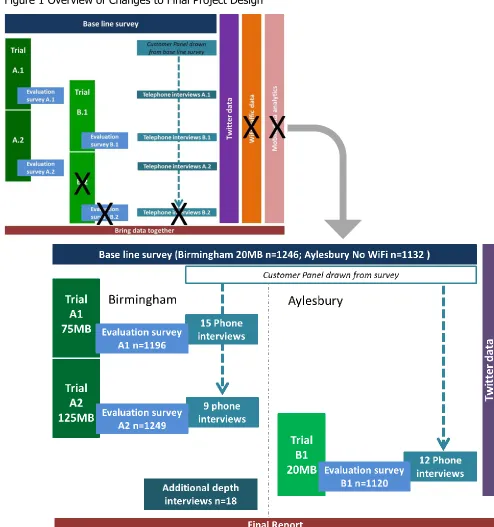
The research was designed to measure the impact of an increase in the amount of free WiFi data. Figure 1 provides an overview of the original plan, and revisions made during the course of the research.
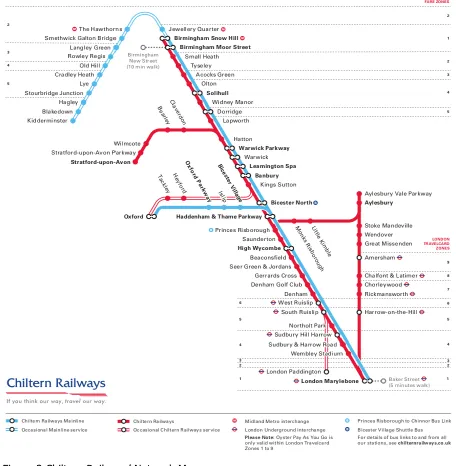
Chiltern Railways facilitated two 20 week free WiFi trials on the Birmingham to London route (e.g. A1 – 75 MB and A2 – 125 MB). The same strategy was planned for the Aylesbury-London route, but resulted in one 20 week trial of 20MB.
A stratified randomised survey of 1000 passengers on board trains before and at the end of each trial was proposed. Each survey had a different population of participants to measure change at a ‘population’ level rather than track the changes in individual behaviour. Surveys were conducted by Wavelength, and analysed by UWE. The Baseline survey was conducted on both train lines in July/August 2016.
(Birmingham, 20MB n=1246; Aylesbury, No WiFi n=1132.)
The Evaluation survey, with the same questions as the Baseline, was conducted in the last two weeks of the trial. (Total numbers Birmingham A1 n=1196 and A2 n=1249; Aylesbury B1 n=1120.)
A panel of survey participants who used the free WiFi took part in two short telephone interviews to probe experiences and track impacts at an individual level at the end of each trial (A1:15→A2:9; B1:12). Interviews conducted by Wavelength, analysed by UWE.
A discourse analysis of Twitter data over the trial periods to evaluate tweets about WiFi on the @ChilternRailways twitter feed. Data collected and analysed by UWE.
WiFi traffic data was to be provided by Icomera/WiFi Spark to confirm trends.
EE mobile data analytics was to provide estimated numbers of rail passengers on the Birmingham route, and numbers of people travelling between Birmingham and London by road, during the trial periods from mobile phone data.
Reasons for the changes to the original research plan are set out below.
Changes to the project design.
Only one trial of 20MB (B1) took place on the Aylesbury to London route due to supply costs.
An additional 18 qualitative interviews were conducted by UWE with passengers on the Birmingham to London route using re-allocated funds from B2 activities with additional financial support from Chiltern Railway. The intention was to gain further insights into passengers’ connectivity focusing on the relationship between mobile data (e.g. 4G) and free WiFi; journey flexibility and reasons for choosing to travel by rail.
11 Organisational changes for EE (BT take-over) removed the opportunity for the project team
to have access to EE’s data analytic resources. The project team explored other information sources such as manual and automatic [Infodev] onboard passenger counts, other mobile
[image:11.595.68.562.216.743.2]phone data sources (i.e. Transport Catapult) to validate passenger numbers but it was not available in the timescale of the project. This has affected Research Questions 3.3/3.4.
13
3
The Connected Customer
This section sets out the impact of the trials on levels of free WiFi, satisfaction with free WiFi, and WiFi as a reason for travelling by train. It also considers changes to mobile data use. Context to the trials is provided first.
Chiltern Railways’ passenger will have assumptions about the company’s
offer based on variable experiences of public WiFi. There has been a varied WiFi offer on trains in Britain across the network; some train operating companies (TOCs) charge for connection, other TOCs offer it for free. The amount of WiFi data provided per device also varies from route to route. Free WiFi is also delivered in a wide variety of other public spaces, including buses, cafés, meeting venues, hotels, and retail outlets. The YouGov research (2017) shows a poor perception of WiFi on trains in general.
Accessing the Internet through mobile data has improved since the inception of 4G in 2012. During the period of this research 4G network coverage and capacity has improved; including lineside delivery by EE on Chiltern Railways’ routes as part of providing WiFi on trains. There are remaining gaps, including some tunnels. Many of Chiltern Railways’ passengers should have experienced improvements.
More mobile operators are offering larger mobile data packages to their customers at cheaper rates, which will impact on the demand for free public WiFi.
Evidence shows that Smartphones have increased demand for connectivity on the move, but OFCOM argues these are more likely to connect to WiFi than mobile data. This is not necessarily the case on the train.
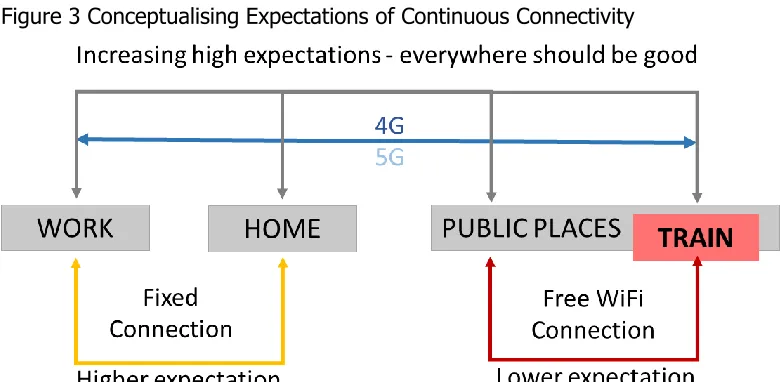
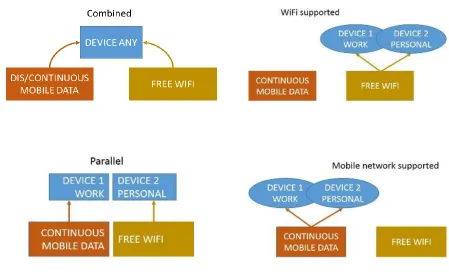
[image:13.595.72.462.565.756.2] Figure 3 conceptualises ‘continuous connectivity’ as an interplay between free WiFi networks, other networks (e.g. through fixed connections at work or home), and mobile networks.
14
3.1
Overview of Internet use
Over two thirds of all passengers on both the Birmingham and the Aylesbury services connected to the Internet in some way during their journeys, either through WiFi or mobile data. It demonstrates that a large proportion of passengers feel the need for being connected, and it can be assumed that they want to be continuously connected.
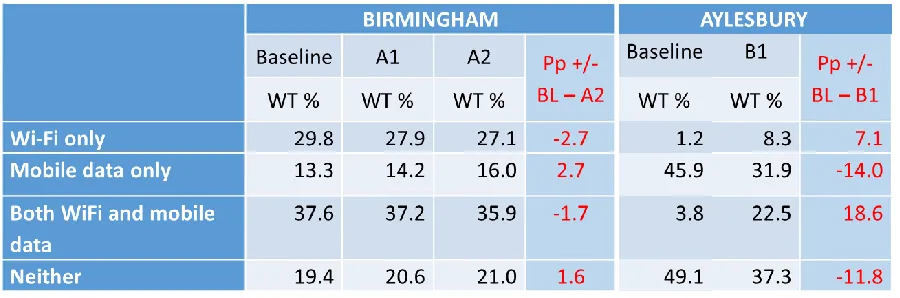
Table 1 presents survey data that shows in the final trials the highest proportion of passengers who had successfully connected to the Internet on the Birmingham route had used both WiFi and mobile data during their journey. On the Aylesbury route most people had used only mobile data, with the next highest proportion having used both.
Over a quarter of passengers connected to the Internet on the Birmingham route did
so only using the free WiFi, which is not an insignificant proportion even though the numbers have not increased. At the end of 20 weeks only a very small proportion of passengers on the Aylesbury route only connected to free WiFi, but in total more people are connected to the Internet at the end of the B1 trial.
Figure 4 uses this data and evidence from the interviews to visualise the interplay
between the free WiFi and mobile data in how people use both to support single and multiple devices. The discussion in the following section explains how the free WiFi is important part of providing continuous connectivity on the Birmingham route for long distant commuters and business travellers. On the Aylesbury route it is beginning to play a similar role.
[image:14.595.78.528.389.538.2] In Figure 4 passengers operate in four different ways: (i) using both free WiFi and mobile data by connecting a single device (usually a phone or tablet) to both for continuous connection (combined); (ii) free WiFi only (usually a laptop) (WiFi supported); (iii) mobile data only (usually a phone tethered to a laptop); (iv) uses free WiFi on one device (e.g. personal phone/tablet) and mobile data on other devices (e.g. work phone tethered to laptop) (parallel).
15
3.2
Use of free WiFi
The overall impact of free WiFi trials was greater on the Aylesbury route than the Birmingham route in terms of behaviour change. However, journey purpose had an important effect on the numbers using the free WiFi (and mobile data).
On the Birmingham route there was little recorded change in total levels of WiFi use across the two trials (A1- 75MB and A2 – 125MB), suggesting no effect of the increase in amount of free data on the number of people connecting to the free WiFi service.
This result could be seen as surprising, but Icomera use data suggest that passengers on average use around 40MB of data over 53 minutes (end of November 2016). Figure 5 shows from Icomera data a substantive decline in the number of users being “throttled” (i.e. exceed the data allowance) associated with the increase in data, with less than 10% of passengers not receiving enough data for their online activity at 125MB (Figure 5). The Icomera data suggest that passengers are adequately supplied with data.
[image:15.595.69.518.133.413.2]However, the interviews and survey data show that passengers largely are combining the free WiFi with mobile data, therefore these figures do not represent their total data needs. Explanations from qualitative interviews suggest larger data users and those requiring faster speeds are more reliant on mobile data networks for all or much of the time, with the free WiFi supplementing gaps in mobile network coverage.
16 On the Aylesbury route however, there was a substantial uptake of the new free
WiFi provision, with 34.2% using it in Trial B1, compared to the Baseline survey. This finding suggests that the provision of free WiFi only had an effect on use in the context of moving from “no provision” to “some provision”.
The survey results show that free WiFi is being used in the highest proportions by business travellers and commuters, at the time of the final trials.
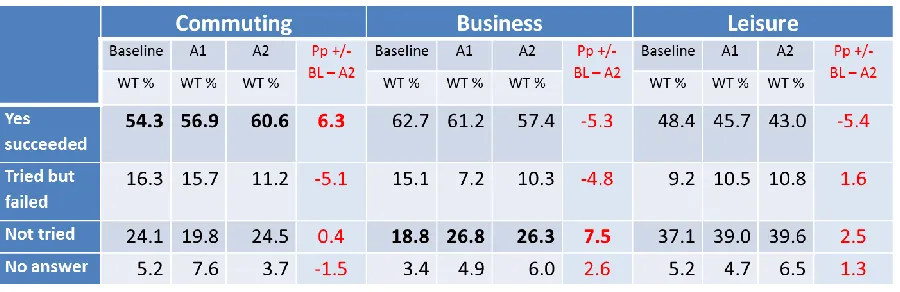
[image:16.595.81.366.132.314.2] On the Birmingham route the largest proportion of users on different journey types that had successfully connected to WiFi was amongst commuters (60.6%), followed closely by business travellers (57.4%). Table 2 demonstrates how the changes in the total numbers of people connecting to the WiFi hide the variations in specific groups over the trial. The figures for commuters suggest that regular travellers are more likely to use the free WiFi. More concerning is the rising numbers of business travellers who have not tried to connect, with the figures suggesting that after a failed attempt (or poor experience) they have simply not bothered to try again.
Figure 5 Throttled users Birmingham route (Icomera data)
[image:16.595.74.524.597.743.2]17 On the Aylesbury route, business travellers were most likely to have successfully
connected to the WiFi (40.4%), followed by commuters (36.2%). also. This demonstrates that WiFi is performing an important function for these groups of travellers. On both routes, free WiFi use was lower amongst leisure travellers (Birmingham route: 43.0% of leisure travellers, Aylesbury route: 29.3% of leisure travellers); however, it is important to not discount this group, as the data show that these passengers also derive benefit from an Internet connection for various purposes during their travel, and this group forms a large proportion of customers.
The device used to connect to the free WiFi differed substantially by route.
On the Birmingham route, the highest proportion of people were connecting using laptop computers (93.0%), with slightly smaller proportions using an iPad/tablet (85.7%), or a mobile phone/smartphone (72.1%). Use is high across all device categories on this route.
The mobile device most often used to connect to the free WiFi on the Aylesbury route was the mobile phone/smartphone (38.3% of travellers). Only small proportions on this route use laptop computers (2.4%) or iPads/tablets (1.1%) to connect to the free WiFi.
This difference is likely to be reflective of the different travelling environments on the two services. On the Birmingham route, the layout of the coaches is more conducive to laptop and tablet computer use, with tables additional space; on the Aylesbury route, there are only small tables at some seats, and more crowding in carriages, which means less space for travellers to unpack larger devices. Moreover, overall journey duration tends to be shorter on the Aylesbury route, which may make unpacking a laptop less worthwhile.
3.3
Experiences of WiFi
Beneficial role of WiFi
Arguably, free WiFi is a beneficial element of the service for a proportion of passengers. Overall Internet connectivity for both work and personal use is consistently rated as
“important” or “very important” by over 50% of passengers on both routes. (Section 4 illustrates the diversity of Internet based activities for work and personal benefit.) The number of people using the free WiFi suggests it plays an important role.
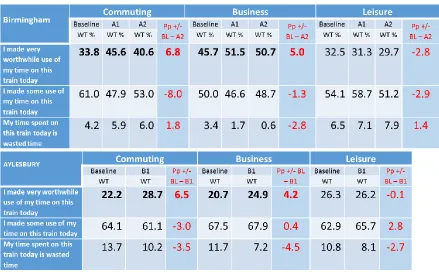
18 The introduction of free WiFi on the Aylesbury route is correlated with a modest
increase (6.5 percentage points) in the proportion of people reporting that they had made very worthwhile use of their time.
The similarities between the data for free WiFi and mobile data use suggest that free WiFi is not particularly favoured over mobile data, and that people value the Internet connection most, as opposed to the specific connection method. The interview data supports this assumption (see below).
Everyone interviewed in the study, whether travelling predominantly for business, commuting or leisure, had used the Chiltern WiFi to some degree, and most had used it for a range of purposes. Predictably, business travellers and commuters were much more likely to be using the free WiFi for work than were leisure travellers, although some people occasionally took the opportunity to work when travelling for leisure purposes, particularly if they were self-employed. The boundaries between ‘work time’ and ‘leisure time’ whilst on the train often blurred, particularly for those who were self-employed. The free WiFi was seen as an enabler, by interviewees, for all these types of activity,
but it was rare for someone to depend on it entirely, as nearly everyone was also accessing the Internet directly using 3G or 4G, mainly via their mobile phones.
Interviews demonstrated that most people interviewed mixed free WiFi with mobile data connections to maximise connectivity time, and most also engaged to some degree in non-Internet activities.
Many interviewees thought that the free WiFi improvements had not led them to change the way they used their time on the train, although some were now using the WiFi to do more of the same activities; for example, staying connected for longer, downloading (more) documents, or streaming video clips.
Satisfaction with WiFi
Satisfaction with the reliability of the Internet connection by free WiFi is different
on the two services, reflecting the different changes in provision in the two trial locations. On the Birmingham route, satisfaction with the reliability of the WiFi increased over the
trial period.
There was a 6.8 percentage point increase in passengers reporting themselves as satisfied in Trial A2 (up from 39.0% to 45.8%), whilst there has been a decrease of 7.3 percentage points
@chilternrailway the reliability and quality of
the WiFi greatly improved recently
(Twitter) “I am a wheelchair user so it is important for me to get the travel arrangements right. (.…) It helps me
stay on top of things and avoid problems and surprises and it means I
can stay in touch with whoever I am meeting if I can use WiFi calling when
19 in the proportion of passengers reporting themselves as unsatisfied (down from 37.7% to 30.4%).
On the Aylesbury route, satisfaction had increased at the end of the trial, but this is to be expected due to the very limited service provision in the Baseline. In total in Trial B1, 34.7% of passengers were satisfied overall with the free WiFi Internet connection, with 10.4% very satisfied.
Interviewees were generally satisfied with the Chiltern free WiFi provision.
Passengers on the Birmingham route who were interviewed after both the A1 and A2 trials expressed higher levels of satisfaction after the data allowance increased, and were using the WiFi more often and their mobile data less often than they had at A1. They remarked upon improvements between A1 and A2 that included increased speed of download, the larger free data allowance, and fewer breaks in connectivity.
In contrast, most of the passengers on the Birmingham route who were interviewed in-depth but only once (when 125MB had been in place for a longer period) generally had not noticed improvements to the free WiFi. One person had started travelling on the Chiltern mainline since the upgrade to 125MB. Having started at this higher ‘baseline’, he felt that the free WiFi had recently become worse rather than better.
Many of the Aylesbury to London travellers were more positive about the free WiFi provision, despite their quota being limited to 20MB, presumably because they were comparing it with no WiFi at all.
Overall the interviews demonstrate differing opinions, but suggest that customer expectations shift and become raised once a level of WiFi is provided. Reducing the level of free WiFi therefore could have a negative effect on customer satisfaction.
Negative experiences of the free WiFi can discourage passengers from using it.
A small number of interviewees across the full sample had not used the WiFi for some time because they had tried it once and found it lacking (so
may have been unaware of recent improvements). These were mainly business travellers who chose to connect with their mobile data (see below). This is a reminder of the importance of advertising service improvements effectively to customers.
Aside from those who had not tried to connect to the
WiFi for a year or so, most people thought that the WiFi provision already met their needs even though there was also a desire that connectivity be more consistent over the whole of each route. Consistency of connection was generally seen as more important than an increase in bandwidth or quota.
“I tear my hair out less! It is less frustrating. I am doing what I always did, but more successfully and with fewer headaches.” (Clive, commuter traveller, Birmingham)
“It is just about the consistency. I often don’t bother trying as I don’t
expect it to be all that good. Perhaps they should advertise that
20
Free WiFi is not an option for some business travellers. One problem which remained
for a small number of business travellers was the difficulty in accessing their employer’s Virtual Private Network (VPN) using the free WiFi, which was thought to be for security reasons. Therefore, their use was for personal activities on personal devices, rather than work. More evidence is needed to understand how widespread this issue is for people working on the train.
The analysis of the Twitter feed indicated a positive response to free WiFi, and a small reaction to announcements of data increases. However, this channel of communication is often use for expressing complaints and resolving difficulties with the connection through Twitter conversations with Chiltern Railways, WiFiSpark and Icomera. Tweets often position Chiltern Railways provision of free WiFi in relation to other service factors (see section 5) and in comparing other TOCs’ WiFi offers.
WiFi as a reason for using the train
Passengers were asked whether the free WiFi was a main reason for choosing to use the train (as well as travel time use - see section 4).
The large majority of people on both routes reported that it was not a main reason for choosing the train.
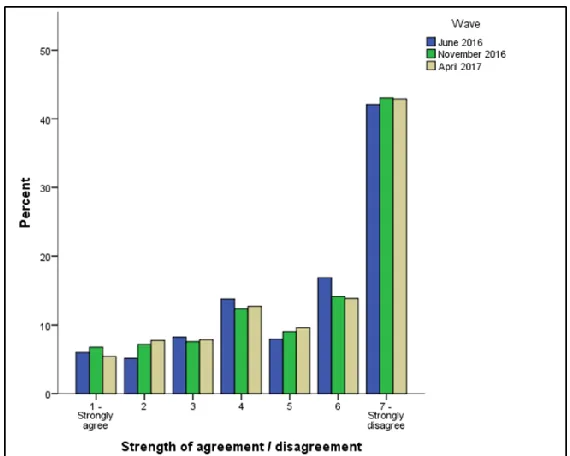
On the Birmingham route 20.9% of people agreed that free WiFi that a main reason for choosing the train to some degree. (See Figure 6.) It is also evident that providing free WiFi can contribute to a proportion of people choosing to travel on Chiltern Railways over an alternative TOC or other mode of transport on this route.
@chilternrailway trains to Birmingham Snow Hill are amazing. Commuting is
[image:20.595.241.526.541.769.2]bearable when there's plug sockets, comfy seats and free wifi (Twitter)
21 On the Aylesbury route, free WiFi affected far fewer people; only 7.5% agreed to any
degree that it was a main reason for choosing the mode. On this route, people may have little alternative to taking Chiltern Railways, and so free WiFi provision is likely to be a secondary benefit to passengers – albeit a welcome one.
A couple of interviewees in the depth interviews indicated that the free WiFi was a critical part of choosing to travel on Chiltern Railways’ Birmingham route over Virgin trains because of the opportunity to use their journey time productively, but this was also closely connected to the physical environment (e.g. table and power source) and convenience of a local station.
3.4
Experiences of Mobile Data
Use of mobile data
At the end of the trials the Birmingham and Aylesbury routes had very different patterns of mobile data use versus the free WiFi.
On the Birmingham route, 16.0% of passengers had used only mobile data on that journey, whilst the majority (35.9%) had used a combination of mobile data and WiFi. Nearly twice the number, 31.9%, only used mobile data on the Aylesbury service, with a smaller proportion (22.5%) using a combination.
The difference between routes is likely to reflect the duration of free WiFi availability. The behaviour change had occurred prior to the trials on the Birmingham route when the initial 20MB of free WiFi was provided, whereas the passengers on the Aylesbury route had free WiFi for the first time with trial B1. However, other factors might be important, such as mobile network coverage, and more emphasis on Smartphone use as an upshot of the train environment and shorter journeys.
The highest proportions of people by journey purpose using mobile data overall on both services are business travellers (Birmingham route: 52.7%, Aylesbury route: 55.8%) and commuters (Birmingham route: 47.7%, Aylesbury route: 52.2%), with slightly fewer leisure travellers connecting (Birmingham route: 43.0%, Aylesbury route: 40.4%).
Interviewees who only used mobile data believed it generally met their needs, and offered
faster speeds. Those with unlimited mobile data allowance are less likely to use the free WiFi, particularly where it does not support their specific needs, such as access to an employer network (VPN) with security restrictions. Few of those travelling for business or commuting felt constrained by the costs of their personal data or by personal data quotas.
Some of the interviewees who mainly used mobile data still valued the free WiFi in
22
Satisfaction with mobile data
Satisfaction with the reliability of the Internet connection by mobile data is relatively
similar on the two routes: there is a relatively even split of satisfaction between people that are more satisfied and less satisfied indicating some people are getting good mobile data service, whilst for others it is not meeting their needs.
The distribution may be affected by different mobile data network providers’ network capacity, coverage along the routes, and people’s personal devices, but these aspects were not possible to measure in the survey.
Interviewees thought that mobile coverage and connectivity on the two lines
was improving, although experiences could differ depending on the service provider being used. Some thought that the WiFi provided better connectivity, particularly in the rural areas, whilst others thought their mobile connection was better.
Mobile network coverage for phone calls
Section 4 demonstrates that many passengers make or take phone calls, or make or receive text messages. There were some insights from the research interviews about phone calls, but these views are not representative of all train passengers given the survey results. Phone calls are not the central remit for this research, but was an element of the work undertaken by SDG (2016) for the Department of Transport.
Few interviewees made or took phone calls during the journey. This was thought
to be partly because a lot of communication now happened via email and WhatsApp; partly because conversations tended to be interrupted through loss of signal; and partly because taking voice calls on the train was slightly disapproved of within this group - it disturbed other passengers and could raise confidentiality issues if work matters were being discussed within earshot of other passengers. The majority of those interviewed in depth thought being disconnected from the Internet led to a greater feeling of being out of touch than if they had no phone signal for voice calls and messages.
3.5
Implications for Free WiFi
In general, the results in this section demonstrate the value to passengers of having an Internet connection. Free WiFi is generally something that is seen as a positive element of service provision for passengers, but it is not clear that WiFi is particularly valuable in-and-of-itself, rather, it is the ability to be connected on-the-move which is important to passengers.
23 It can be assumed that dissatisfaction would quickly mount if a break in connectivity was
more than temporary. Dissatisfaction with the free WiFi ‘failure’ – either not available or problems with staying connected, is frequently tweeted; but often as a mechanism to seek a resolution from the WiFi provider.
Expectations about continuous connectivity are varied in how passengers feel they
should be provided for by the rail network. However, it is evident that expectations are closely connected to the fact that work and personal activities are predominantly reliant on Internet connections in a variety of ways, and passengers value continuous connectivity. The interviews suggested that as the free WiFi offer on trains improves, levels of
expectation also rise, leading to a sense of frustration or annoyance among passengers if it is absent, or not working as well expected. Passengers who expect continuous connectivity often organise their activities on the assumption that it will be there. When the system fails, then a good journey can deteriorate into a bad journey because the expectations have not been met. With free WiFi now being offered as standard in many public spaces, cafes etc., it may be turning into something which is taken for granted, and paradoxically, valued less. Its presence may barely be noticed, but its absence is keenly felt.
If mobile network coverage improves (capacity and speed) and mobile data is cheaper
24
4
Travel Time Use on the Train
How people use their time when travelling affects their perception of time value. Productive time can shift to wasted time if the Internet connection is lost or the train becomes crowded. Productive time may be related to paid work, but may include personal activities too, which make commuting longer distances more acceptable.
This section of the report summarises the main activities passengers undertake on Chiltern Railways, including those requiring an Internet connection. The interviews elucidate the reasons for undertaking specific activities and the experience of doing so, and this evidence sets the scene for the survey results which follow in 4.2.
4.1
Travel Time Expectations
Many of the interviewees on the Birmingham route described the time they spent on the train in a way which suggested it was a protected time, during which they could engage in a given activity, or simply think, without the distraction of other pressing demands. At the same time, Internet connectivity was valued as a core way of allowing travellers to both catch up and stay connected during their journeys.
Making travel time a productive time for work was regarded as essential by all the business travellers, and many of the commuters. It is a key attraction of rail travel among these groups. For many, the rail journey was considered part of the working day, during which they perceived their time as having a financial cost to themselves (if self-employed) or their employer; they therefore felt a degree of obligation to use this time productively. Such evidence contributes to shifting thinking around the economic values attributed to business travel time in the digital age.
‘Catching up’ was a phrase used frequently, in the context of work, socialising (via SMS, social media etc.) and relaxation. ‘Catching up’ included: work tasks (especially emails); personal business such as online shopping; friends via social media; or with oneself by ‘nodding off’.
Productive travel time could also be argued to reduce the likelihood of work eroding personal/family time for some people. This was expressed as ‘clearing the decks’ before getting home, which you cannot do if you are travelling on business by car.
However, some - particularly those travelling for leisure purposes - regarded their travel time as potentially boring; here, Internet-based activities were a means of helping them to pass the time, and free WiFi data provided greater opportunities to do this. It was also clear that being able to connect, and being available to others, was ‘part of life’ and goes beyond the needs of work.
“So I am either catching up with work or if I don’t need to do that and I can just have some time to myself I just use the time to
avoid work and read”.
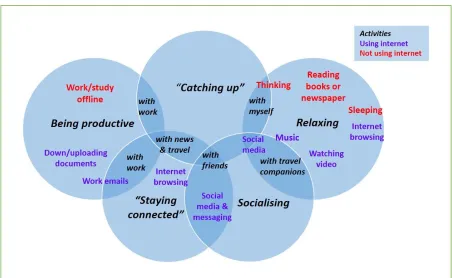
25 Figure 7 depicts some of the overlaps between these different conceptualisations of travel
[image:25.595.72.524.175.453.2]time, and identifies the most common types of activities engaged in by those interviewed.
Figure 7 Conceptualising Travel Time
4.2
Internet based activities
As the interviews show, connecting to the Internet supports work and personal activities, and while business travellers undertake work activity, so also do commuters. Likewise, both undertake personal activities, demonstrating there is a blurring of the work-leisure boundary on the move.
The survey results suggest that changing amounts of free WiFi has a negligible effect on activities, although the qualitative interviews indicate that people may spend longer on some of these activities with the increased data allowance. There are some differences between the two routes.
26 On the Aylesbury route, at the end of the B1 trial there had been a modest change in
levels of some Internet based activities, which correlated with changes in the provision of free WiFi. It suggests that going from a situation of no WiFi to some free WiFi could have had an effect on people’s journey activities, but there is a lot of variability in the results. The highest proportions of respondents reported Internet browsing, checking/sending emails (work or personal), instant messaging, and using social media.
For the Aylesbury route, change is noticeable for three key activities. There was a 9.2 percentage point increase in the proportions of passengers Internet browsing; social media activities also saw an increase, with 6.1 percentage points more passengers using instant messaging, and an increase of 5.3 percentage points in the proportion of passengers using social media. There was a 4.6 percentage point increase in people checking and sending work emails.
On both routes there was a modest increase across the study period in the proportions of business travellers uploading/downloading documents for work use during their journey, which supports comments made in the interviews. On the Birmingham this was a 4.5 percentage point increase from the Baseline to Trial A2, whilst on the Aylesbury route it was a 4.9 percentage point increase from the Baseline to Trial B1. This finding too supports evidence from the interviews and demonstrates the contribution of the free WiFi to facilitating work activities on the train.
Having something to do while travelling affects perception of time, and interviews confirm that most travellers want to use their time productively, even if that is for relaxation. The survey research found very small increases on both lines in passengers viewing their travel time as ‘very worthwhile’ at the end of trials A2 and B1.
On the Birmingham route, business passengers remain the group who are most likely to see their travel time use as ‘very worthwhile’. Less than 1% of business travellers on this route see their time as wasted time (see Table 3 below). Yet on the Aylesbury route it is the commuters who had a largest increase in their time being ‘very worthwhile’
27
The survey evidence does not demonstrate that free WiFi has had a direct impact
on changing these values, but with evidence from the qualitative interviews WiFi can be seen as an enabler for ‘continuous connectivity’, and may be improving the overall experience in conjunction with mobile data improvements (as discussed in section 3; see also Figure 7).
The interviews confirmed reading, writing and sending emails to be the most commonly mentioned uses of the Internet on the train; the ability to carry out work-related email tasks was considered especially important. They also confirmed that the ability to upload or download work-related documents was also valued, and this was one of the main improvements noticed when WiFi quotas increased.
[image:27.595.82.521.131.403.2] The interviews also showed the importance of time for personal activities across all travellers. Many people browsed the Internet whilst on the train, often for news and entertainment, and for personal business such as online shopping. Some used it to seek travel information updates to reduce uncertainly with regard to their journey. Many people were also using social media and Internet messaging, sometimes to stay in touch with friends or colleagues they were meeting at the end of the journey.
28
4.3
Non-Internet based activities
Non Internet based activities are not the focus of this report, but between 20-40% of passengers do not connect to the Internet while travelling across the two lines, and the Internet base activities may not be the sole activities. This evidence is useful more broadly to understand the range of activities passengers engage with while travelling. It also confirms that mobile connectivity is important for phone calls and text messages, although few of the interviewees made calls while travelling.
The most popular non-Internet based activities on both services were relatively similar across the trials. The data below are taken from Trial A2 and B1:
On the Birmingham route, the most commonly reported activities were: looking out of the window (52.3%), text messages/phone calls (personal) (43.3%), reading for leisure (36.9%), daydreaming/thinking (34.4%), and working/studying (34.2%).
On the Aylesbury route, the most commonly reported activities were: looking out of the window (57.1%), reading for leisure (43.1%), text messages/phone calls (personal) (40.5%), daydreaming/thinking (37.3%), and working/studying (26.0%).
One notable trend on both services is the reduction in the proportion of people reading for leisure across the study period. This mirrors a broader trend observed in the NRPS (Lyons et al., 2016).
The interviews indicated the importance of non-Internet activities. As a consequence of many activities being Internet-enabled, many expressed a sense that it would be frustrating or disruptive if they were unable to access the Internet at all, although they often had other activities at their disposal (shown in red in Figure 7), either as a back-up or as first preference. For example, some of the business travellers ensured that they had downloaded work materials on their laptops before starting their journeys, and some people downloaded films in advance.
Other common activities not requiring an Internet connection included: listening to downloaded music or radio podcasts; reading books or newspapers; chatting to other passengers; looking out of the window; or sleeping.
The interviews questioned the necessity of the Internet connection (free WiFi or mobile data.) Many said they would ‘survive’, or ‘it wouldn’t be the end of the world’ if they did not have an Internet connection, but generally wanted it.
4.4
Travel time as a Reason for Choosing Rail
The use of travel time arguably is a positive feature of rail travel, and a strong
29 On the Birmingham route approximately 30% of passengers across the three waves
agreed that travel time use was the main reason for choosing to use the train for that journey. The highest proportion was amongst business travellers (37.5%), compared to commuters (29.5%) and leisure travellers (21.6%).
On the Aylesbury route, time use was a less important factor in choosing to use the train. In both surveys (Baseline and B1), approximately 15-20% of passengers overall agreed that travel time use was the main reason for choosing to use the train for that journey. The interviews concluded that for these passengers rail was the most convenient
option, over the car, for direct routes into London. Being able to use travel time was part of that idea of convenience. One interviewee did indicate he would take the train to other more distant destinations specifically to work on the train. Others weighed up complex journeys, numbers of changes and travel time against the convenience of the car for other trips. The ability to work on the train is not always a strong enough factor to encourage modal shift.
4.5
Travel Time as an Rail Industry Opportunity
There appears to be an opportunity for the rail industry more generally, as well as Chiltern Railways, to capitalize on the potential of rail travel as a productive work space assisted with free WiFi, especially in attracting new passengers.
The in-depth interviews with business travellers also found that where people can work on the train, it does not always matter if the journey is slightly longer than a competitor’s route. For the most part, the dominant view was that greater benefits arose from an environment conducive to working rather than small reductions in journey time.
People travelling for business try and choose off-peak trains to maximise their
travel time use opportunities with a quieter train, as well as to reduce the cost of travelling.
Flexibility for commuters is dependent on the nature of the employment and the
culture of the work place. Those who have the flexibility to work at home are more likely to have the flexibility to travel at different times. While people work on the train, few commuters see this as official work time, but rather a supplementary time that enables some form of preparation or ‘catching up’ time.
30 times; and number of rail connections for a given journey. Travelling into London is a clear ‘winner’ for rail, because of the perceived disadvantages of using a car in London.
31
5
The Wider Travel Experience
Free WiFi use and travel time activities need to be considered in the context of the wider Chiltern Railways experience. Passengers are highly satisfied and this connects to a broader set of journey benefits, from the physical space to customer services. This section considers customer satisfaction scores from the survey and other qualitative evidence indicating that the physical environment needs to be right for productive time use.
5.1
Customer Satisfaction
In general, surveyed passengers were consistently very satisfied with the train service on both routes, with large majorities being either “satisfied” or “very satisfied”. On the Birmingham route, 70.2% of passengers reported themselves as being
satisfied overall with the service (i.e. scored 1, 2, or 3), with 29.6% reporting themselves as very satisfied.
On the Aylesbury route, 60.2% of passengers reported themselves as being satisfied with the service, with 29.2% reporting themselves as very satisfied.
There was some increase in satisfaction across the study period on both routes, with Birmingham seeing a rise of 2.7 percentage points from the Baseline to Trial A2, and Aylesbury seeing an increase of 7.3 percentage points to Trial B1.
Whilst an encouraging finding, consistently high satisfaction scores make it difficult to statistically attribute changes to free WiFi to general satisfaction, because many people are already highly satisfied overall, and so there is not much more that can be done to improve these scores, and little to differentiate between people in this regard. During the statistical analysis, regression modelling was undertaken to try and further
understand the relationship between WiFi provision and customer satisfaction, by exploring any statistically significant relationships between changes in passengers’ satisfaction and people’s use of the WiFi. This modelling challenge is discussed further in Appendix 5
5.2
Wider Experience Insights from Interviews
32 For users of the Aylesbury route, the availability of a seat was the main factor influencing
the overall journey experience and determining the way in which travel time was spent and different Internet-enabled devices used. Compared with the Birmingham route, the interviewees using the Aylesbury route were more likely to mention crowding and the possibility of having to stand. Some said they timed their journeys to avoid the busiest times, or to wait on the platform for a quieter train, in order to get a seat.
Despite making a valuable contribution to these uses of travel time, Internet connectivity was regarded as less important than many other features of the train environment. Principal among requirements were: the availability of a seat (without which a journey was unlikely to be either productive or relaxing); punctuality and reliability of the service; and reasonably-priced fares. Chiltern was seen as offering a high quality service in these respects, comparing very well with competitors. Those interviewees who also had the choice of travelling with Virgin between Birmingham and London tended to favour Chiltern for all of these reasons.
Crowding on trains could affect the journey experience and activities undertaken, even if an interviewee was seated. For example, busy trains were also noisy, which could make it difficult to concentrate or to relax. However, crowding did not appear to be frequent or problematic enough to have a significant impact on interviewees’ overall satisfaction with the Chiltern service.
33
6
Conclusions and Implications
This section summarises the main conclusions from the research, and considers the debate around ‘a post-WiFi age’. This section of the report also sets out the opportunities and challenge of this research project, research dissemination, future research ideas, and commercialisation. While this report has been compiled by the UWE team, Chiltern Railways’, Arriva, and AUKT are able to deliver organisational decision making informed by the research, within their franchises. Thus the commercialisation of the research is incumbent on these project partners, including BAS LLP. UWE will take a lead in wider dissemination for a global audience, which may in turn influence decision making in the UK and beyond.
6.1
Conclusions from the Research
Travel time is used productively for work and personal activities by many passengers
on Chiltern Railways, especially on the longer distance route between Birmingham and London. The Internet, including free WiFi facilitates increasing levels of digital communication, and the need to work online. A proportion of travellers choose Chiltern Railways because they can work and access the free WiFi.
Enabling travel time to be economically productive is critical to transport policy.
Free WiFi may not serve all business travellers’ needs, especially where there are data security issues, for example relating to work VPNs, or activities are very data hungry. However, the free WiFi may bridge the gap for some activities, or offer companion tools (e.g. personal phone) connection for other activities.
Social and leisure activities are also important to passengers and should not be
overlooked in their contribution to making longer commutes feasible and bearable. Travel time can be important time the individual has for his/her self, whether catching up on Facebook or watching a downloaded film. Likewise, it may improve the customer experience of commuter routes such as the Aylesbury route, where space is limited for working.
Free WiFi has added value in particular to commuters on the Birmingham route and
business travellers on the Aylesbury route. There is room to think creatively about how and why free WiFi might add more value to those travelling for leisure or on personal business (e.g. access to travel information), but it should be recognised that sometimes people want (and need) a break from the “digital world”, especially if they are travelling with significant others.
Free WiFi has two key roles. Firstly, it enables people, particularly with laptops, to
34
Journey satisfaction is statistically highly related to free WiFi as well as other service
benefits experienced on Chiltern Railways.
However, the large increase in the free WiFi data allowance has not encouraged more people to use it on the Birmingham route. This finding may be an outcome of improved 4G and larger mobile data allowances, which is discussed below. The smaller increase on the Aylesbury route has created change in behaviour. There is an obvious difference in going from zero to something, than going from something to a much larger offer. It is likely that some of those on the Birmingham route became put off by the earlier offer
having limited use for them, and by issues around registering and connecting which were evident in the Twitter feed. It is essential that Chiltern Railways with Icomera ensure the reliability of the free WiFi on each route, and that ways are sought to encourage more users to try the existing product.
Given the evidence in this report, the research team would recommend that free WiFi remain part of an overall service package, and that it is marketed well to customers. Its absence would be missed by existing customers, even if they use it to support their continuous connectivity when mobile data signals are dropped. It appears to be one factor which keeps people using Chiltern Railways, rather than its competitors between Birmingham and London.
Good free WiFi might ‘nudge’ people into choosing the train over the car for some
journeys, but this would need a careful segmented marketing approach from the rail operator (i.e. Chiltern Railways). Further quantitative evidence is needed to evaluate the impact of free WiFi on changing travel behaviour (e.g. increased frequency of using the train, and moving from road to rail).
The overriding perception that working on the train contributed to individual
(economic) productivity is a critical message for transport policy. From a marketing perspective there is ground to be gained from understanding that people often choose to travel on Chiltern Railways, even though the journey is longer, because time can be well spent in a conducive environment, and cost less than competitors.
A consistent free WiFi connection is more important to customers than speed or
amount of data, particularly in areas where 3G/4G signal is patchy. For example, there is not a huge demand for streaming video. The most important thing is to have a signal which does not keep ‘dropping out’. However, a faster download speed and increased data allowance could attract more users who currently see their mobile data as a preferred option, especially as apps on mobile devices are data hungry.
Journey flexibility needs further investigation. For commuters this idea links to the
35
6.2
Is Internet on the train entering a “post WiFi age”?
As the research has progressed, the findings have prompted the question of whether there is a movement into a post-WiFi age, and the relevance of this to the provision of free WiFi on train services in the future.
The evidence suggests that passengers largely do not particularly mind where their data comes from, so long as they have a good Internet connection. Many people now tether their smartphone to their laptop computer to connect as an Internet hotspot. This can provide faster data speeds and reliability, especially on busy trains. For some passengers this is essential for work due to their work network security.
Assuming that mobile data coverage will continue to improve, it might be that in the near future there is not a need to provide WiFi to passengers, as the significant majority will be satisfied with using their mobile data package. However, this can only improve if mobile network operators ensure that the rail network is sufficiently covered, which would require an investment commitment.
The rail industry needs to continue providing free WiFi to meet rising customer expectations and comply with government requirements. It is paradoxically therefore that WiFi is becoming less essential for growing numbers of passengers as mobile coverage and data speeds improve, and costs to the individual fall.
The task for the rail industry now might be to continue to offer a standard of free WiFi which meets the needs of those passengers who feel constrained by the cost of personal mobile data, and also fills a gaps where mobile coverage is still weak, in order to ensure continuous connectivity.
The implications of a post-WiFi age should be a political discussion that connects
36
6.3
Research Opportunities and Challenges
The research has produced a robust and detailed dataset (quantitative and qualitative) which complements and extends existing research on travel time use. It offers unique insights into rail passenger’s engagement with free WiFi and mobile data on the move, and is the first study of this type in the UK, if not internationally. Evidence from the research has the potential basis for world-leading academic publications (see section 6.4) and will inform future national and international research.
The collaboration has also enabled the UWE team to build on existing research knowledge in this field and apply it to a real world setting that has the potential for actual research impact. It has built researcher capacity and provided insights into rail operations.
Research projects often encounter challenges in the project process, thus the research team offer insights to be considered for future research collaborations:
External collaborations. The corporate changes at EE left an important gap in the
project evidence. It would not have been possible to gain the data analytics in advance as the data needed to follow the trials. However, this should have been considered a risk, and an alternative route to sourcing other data considered at the outset.
Qualitative recruitment. The qualitative research has provided useful insights into
traveller behaviour. Recruiting long distance commuter and business travellers proved more difficult than anticipated, with a high dropout rate. Research participants can be encouraged to participate with a small reward, and this may have been beneficial to encourage participation and reduce attrition. However, it is likely that busy people are less willing to give up personal time unless they have a vested interest in the topic and/or want to make a difference.
Ensuring all elements are costed. The project team did not include the cost of
advertising changes to the free WiFi, and there was limited advertising to passengers. Lack of knowledge of the free WiFi improvements may have reduced the impact, particularly with business and leisure travellers who are less frequent travellers and may not consider trying out the free WiFi.
Ensuring all research partners are signed up to the goals at the outset. In this
instance Chiltern Railway was unable to deliver different levels of WiFi provision to peak/off-peak services which was inferred in the proposed hypothesis as a way of changing demand. In this instance it was too commercially risky to test this idea, therefore an alternative way of measuring this concept should have been proposed in the plan.
Challenge of researching digital futures. A final point is to note that researching