The influence of city centre
environments on the affective walking
experience
Annapaola Bornioli
A thesis submitted in partial fulfilment of the requirements of the University of the West of England, Bristol for the degree of Doctor of Philosophy
Centre for Transport and Society
Faculty of Environment and Technology
University of the West of England, Bristol
Abstract
The current PhD thesis explores the influence of the built environment on the affective walking experience. In fact, while urbanisation trends are increasing, levels of walking in urban settings are decreasing, despite the important health, social, and environmental benefits of walking. However, while there is a rich body of research indicating that walking in natural spaces supports psychological wellbeing, there is a general lack of literature on the potential benefits of walking in urban settings specifically.
A novel theoretical framework is applied, combining two main disciplines: environmental psychology literature on environmental affect and restoration, and geographical literature on walking and mobilities. The following questions are addressed:
- In what ways can walking in urban environments support affect? What is the role of motor traffic and architectural styles on the affective walking experience? - What are enablers and barriers to a positive affective walking experience in
urban contexts other than presence of natural elements?
- To what extent does the affective walking experience influence walking intentions?
A mixed-methods strategy was adopted. First, an online experiment with residents of Bristol (UK) (n=384) compared affective outcomes of walking in five settings in Bristol city centre following a video-simulated walk. Second, a sub-sample of 14 participants was involved in photo and video-elicited interviews based on a real walk.
Quantitative results showed that simulated walks in pedestrianised areas without green elements were associated with affective benefits, as opposed to a commercial area with traffic. Building on these findings, the qualitative phase showed that motor traffic, poor aesthetics, and city busyness have a negative impact on affect. On the other hand, presence of nature and a connection with place supported affect. Specifically, it emerged that such connection is enabled by personal associations, historic elements, and sense of community.
Acknowledgements
I would like to give my sincerest thanks to my supervisors, Professor Graham Parkhurst and Dr Phil Morgan, for their time, advice, guidance, and dedication (and good humour!). They have been invaluable mentors on both academic and personal level in the ups and downs of this journey; I will be forever grateful for their guidance and training throughout the past three years.
I am also very grateful to my fellow PhD colleagues in DocSoc and Team 4Q57, with whom I have shared the experience - they have provided great academic and social support. I am also thankful to all members of the Centre for Transport and Society and UWE colleagues – Dr Deirdre Toher, Professor John Parkin, Miriam, Daniela, and Gill, to name a few – for their precious help and advice. I also wish to give sincere thanks to my viva examiners for their inspiring feedback and comments, which will be extremely useful in my future work.
I am particularly thankful to my wonderful family and friends for their support from multiple time zones. Especially thanks to my second family, Giulia, Laura, Giulia, Martina, and Roberta for their encouragement through laughs, cenette, and love.
Finally, I would like to thank the anonymous research participants for their time and kindness, as without whom this research would not have been possible.
Copyright
TABLE OF CONTENTS
Introduction ... 1
Context And Rationale ... 1
Theoretical Context ... 5
Research Design ... 8
Thesis Structure ... 10
Environmental Affect And Restoration During Walking ... 13
Introduction ... 13
Theoretical Perspectives On The Moderating Role Of Settings ... 14
Evidence Regarding Environmental Affect And SRT... 21
Personal Characteristics And Affective Experiences ... 38
Synthesis Of Knowledge Gaps ... 41
A Geographical Perspective On Walking, Place, And Affect ... 43
Introduction ... 43
The New Mobilities Paradigm And Affective Walking Experience ... 44
Walking And Engagement With Place ... 47
Affective Walking Experience And Walking Intentions ... 51
Chapter Summary And Detailed Research Questions ... 58
Methodology ... 62
Introduction ... 62
Research Strategy ... 62
Research Questions And Associated Methods ... 65
Phase 1: Experimental Design ... 66
Phase 2: Photo-Elicited Interviews ... 86
Chapter Summary ... 98
The Affective Potential Of Five Virtual Walks In City Centre Environments... 100
Introduction ... 100
Results ... 102
Discussion ... 121
Chapter Summary ... 127
Qualitative Insights On The Psychological Wellbeing Potential Of Walking In City Centre Environments ... 130
Introduction ... 130
Enablers Of The Positive Affective Walking Experience ... 148
Chapter Summary ... 172
The Influence Of The Affective Walking Experience On Walking Intentions ... 176
Introduction ... 176
Results ... 178
Discussion ... 183
Chapter Summary ... 199
Integrated Discussion And Conclusions ... 201
Introduction ... 201
Aims And Key Findings... 202
Theoretical And Methodological Contributions ... 215
Policy Implications ... 222
Final Reflections, Limitations, And Future Research Recommendations ... 229
Conclusions ... 243
References ... 245
Appendix 1: Other Methods Considered for Phase 1 ... 265
Appendix 2: List Of Companies Participating in Phase 1 (Online Survey) ... 267
Appendix 3: Online Experiment Information Sheet ... 268
Appendix 4: Copy Of Questionnaire ... 270
Appendix 5: Links to Experimental Videos ... 282
Appendix 6: Interview Schedule ... 283
Appendix 7: Interview Information Sheet ... 285
Appendix 8: Interview Consent Form ... 287
Appendix 9: Ethical Approval ... 288
Appendix 10: Kruskal Wallis Outputs ... 293
Appendix 11: SPSS Outputs ... 296
Appendix 12: Correlations... 308
LIST OF TABLES
Table 3-1: Research Questions ... 61
Table 5-1: Hypotheses and test types ... 101
Table 5-2: Pre-test affective states ... 103
Table 5-3: Pre-test differences in affective states ... 103
Table 5-4: Pre-test differences in socio-demographics ... 104
Table 5-5: Descriptive statistics for ∆stress, ∆hedtone, and ∆energy ... 104
Table 5-6: ANOVA of stress variations pre to post in each setting. ... 105
Table 5-7: ANOVA of hedtone variations pre to post in each setting... 107
Table 5-8: ANOVA of energy variations pre to post in each setting. ... 109
Table 5-9: Mean ratings for PRS score and Kaplan and Kaplan’s properties across the five setting conditions... 111
Table 5-10: Mean ratings (standard deviations) for attractiveness and interestingness across the five setting conditions ... 113
Table 5-11: Descriptive statistics for pre-test affective states, students and employees ... 114
Table 5-12: Differences in pre-test affective states, students and employees ... 114
Table 5-13: Students-employees socio-demographics differences ... 115
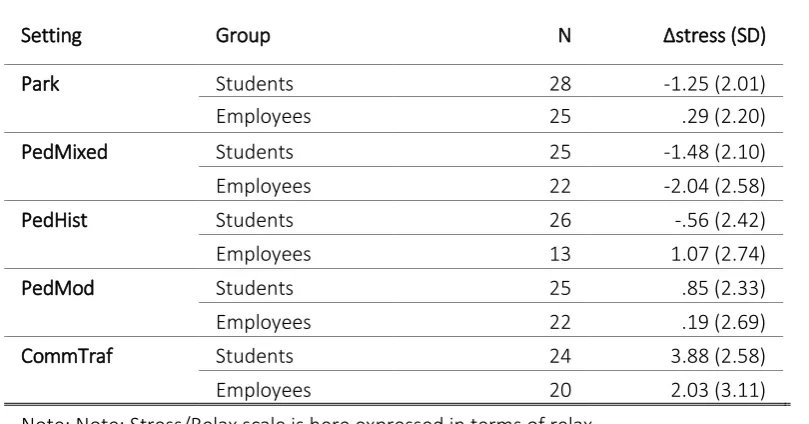
Table 5-14: Descriptive statistics for ∆stress in student and employee samples ... 116
Table 5-15: Descriptive statistics for ∆hedtone in student and employee samples... 118
Table 5-16: Students-employees differences among participants familiar with settings ... 121
Table 7-1: Walking Intentions (5-point scale) ... 178
Table 7-2: Model 1: Walking intentions ... 182
Table 7-3: Model 2: Walking intentions with affective experiences ... 183
LIST OF TEXT BOXES
Box 1.1: Initial research questions ... 8Box 2-1: Research Question 1 ... 42
Box 5-1: Chapter 5 Research Questions and Hypotheses ... 100
Box 6-1: Chapter 6 Research Questions ... 130
Box 6-2: Chapter 6 Research Questions and Hypotheses ... 130
Box 7-1: Chapter 7 Research Questions and Hypotheses ... 176
Box 8-1: Recommendations for urban design ... 226
LIST OF FIGURES
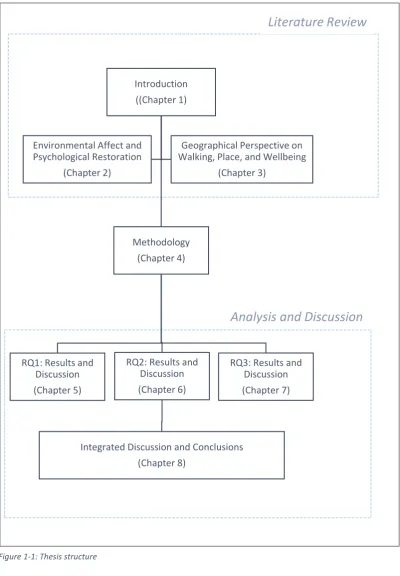
Figure 1-1: Thesis structure ... 12
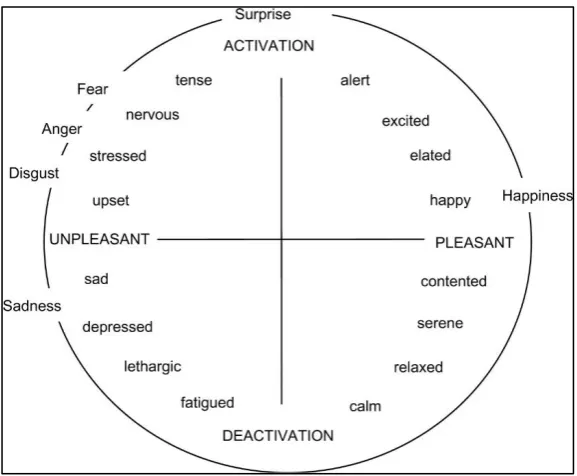
Figure 2-1: The Circumplex Model of Affect (Russell and Barrett, 1999). ... 15
Figure 3-1: Positioning the thesis ... 60
Figure 4-1: PedHist (Corn Street).. ... 76
Figure 4-2: PedMod (Millennium Promenade).. ... 77
Figure 4-3: PedMixed (College Green). ... 77
Figure 4-4: CommTraf (the Horsefair). ... 78
Figure 4-5: Park (Castle Park).. ... 78
Figure 4-6: Bristol city centre and setting locations, Used with permission of the copyright holder © OpenStreetMaps contributions ... 79
Figure 4-7: Interview sampling strategy ... 95
Figure 4-8: Research phases, RQs, and thesis chapters ... 99
Figure 5-1: ∆stress per setting.. ... 105
Figures 5-2 A to F: Mean Relaxation scores associated with pre and post-test phases, in each setting. ... 106
Figure 5-3: ∆hedtone per setting.. ... 107
Figures 5-4 A to F: Mean Hedtone scores associated with pre and post-test phases, in each setting. ... 108
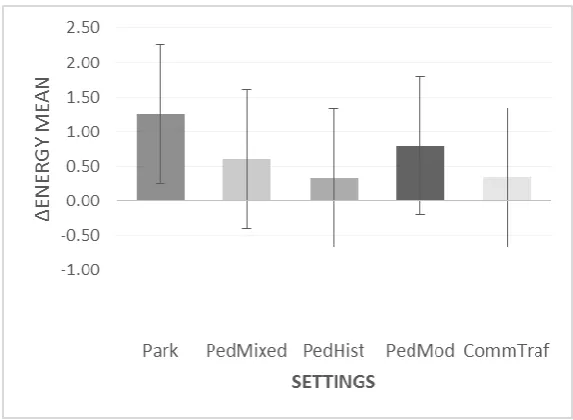
Figure 5-5: ∆energy per setting. ... 109
Figures 5-6 A to F: Mean Energy scores associated with pre and post-test phases, in each setting. ... 110
Figure 5-7: Perceived Restoration by setting and between-groups differences. ... 112
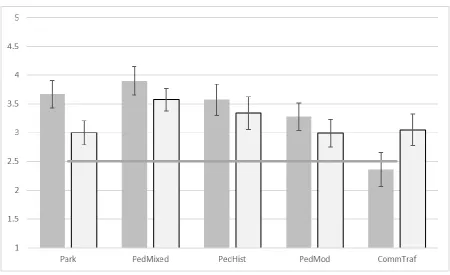
Figure 5-8: Attractiveness (dark grey) and Interestingness (light grey) mean scores per setting.. ... 113
Figures 5-9 A to C: Time x Group interactions in Stress among employees-students in three settings.. ... 118
Figure 5-10: ∆hedtone per setting, students vs employees.. ... 119
Figures 5-11 A to C: Time x Group interactions in Stress among employees-students in three settings.. ... 120
Figure 6-1: The affective walking experience in the urban context ... 132
Figure 6-2: Motor traffic represented by participants' photographs ... 135
Figure 6-3: Traffic light and the frustration of waiting at crossing points ... 138
Figure 6-4: Negotiating and thinking about crossing the road ... 139
Figure 6-6: Crowded pavements make walking frustrating ... 142
Figure 6-7: Construction works and related signs disturb the pedestrian ... 143
Figure 6-8: Multitude of signs represent increased cognitive load ... 144
Figure 6-9: A building that triggers negative feelings ... 146
Figure 6-10: Poor aesthetics and lack of care trigger negative emotions ... 146
Figure 6-11: Graffiti triggers a personal association ... 150
Figure 6-12: Physical places trigger excitement related to future events ... 150
Figure 6-13: A falafel shop that reminds participant of home ... 151
Figure 6-14: Becoming familiar with people and places forming part of the everyday commute ... 153
Figure 6-15: Historic elements are symbols of the identity of Bristol ... 156
Figure 6-16: An old building triggers imagination and curiosity ... 157
Figure 6-17: Cobbled floor improves safety perceptions ... 158
Figure 6-18: Participants' photographs representing interest in street art ... 161
Figure 6-19: The mix of old and new during the affective walking experience ... 162
Figure 6-20: Walking makes individuals discover "Nooks and crannies" ... 163
Figure 6-21: Humour around Bristol ... 164
Figure 6-22: A well-kept garden triggers sense of community ... 166
Figure 6-23: Spaces to socialise contribute to a positive affective walking experience ... 167
Figure 6-24: Presence of people improves safety perceptions in the Bearpit ... 168
Figure 6-25: The stillness and quietness of water ... 169
Figure 6-26: Noticing details of nature and the change of seasons ... 171
Figure 7-1: Walking intentions per setting. ... 179
Figure 7-2: Construction sites and scaffolding reduce walking space and deter waking ... 188
Figure 7-3: “Tower blocks” make some participants feel small and deter walking ... 189
Figure 7-4: Litter can make walking unpleasant and deter walking intentions ... 190
Figure 7-5: A quiet green space constrasts with a busy road ... 192
Figure 7-6: Green routes are preferred over roads with traffic... 192
Figure 7-7: Green areas are often quiet and more suited for walking ... 194
Figure 7-8: Historic areas encourage walking and support sense of safety ... 196
Figure 7-9: Some participants feel encouraged to walk in the centre during Christmas ... 197
Figure 8-1: Thesis findings... 203
LIST OF ACRONYMS
ANOVA Analysis of Variance
ART Attention Restoration Theory
CommTraf Commercial Road with Traffic condition (The Horsefair) – see Chapter 4
DfT Department for Transport
Park Inner urban park condition (Castle Park) – see Chapter 4
PedHist Pedestrianised Historic Environment condition (Corn Street) – see Chapter 4
PedMixed Pedestrianised Mixed green-historic Environment condition (Deanery Street in College Green) – see Chapter 4
PedMod Pedestrianised Modern Environment condition (Millennium Promenade) – see Chapter 4
PRS Perceived Restorativeness Scale
R2
Adj Adjusted R2
RIBA Royal Institute of British Architects
RQ Research Question
SPSS Statistical Package for the Social Science
SRT Stress Recovery Theory
TIB Theory of Interpersonal Behaviour
TFL Transport for London
UWIST MACL University of Wales Institute of Science and Technology Mood Adjective Check List
1
CHAPTER 1
I
NTRODUCTION
Context and Rationale
City environments and psychological wellbeing
The psychological wellbeing of individuals living in cities is nowadays one of the major public health challenges worldwide. Research has shown that compared to rural living, urban living is associated with increases in mood disorders (up to 39%) and anxiety disorders (up to 21%) (Peen et al., 2010). A 2017 review has confirmed that living in cities is associated with higher risk for some major mental illnesses (e.g., anxiety, psychotic, mood, or addictive disorders) (Gruebner et al., 2017). These data are even more relevant considering current and future trends of urban living. In fact, in 2011, 81.5 per cent of population of England and Wales within the UK lived in urban areas (ONS, 2013), and in 2015 72.4 percent of the European Union’s population lived in built-up areas (Eurostat, 2015). Furthermore, urbanisation trends are growing, with the UN estimating that more than half of the global population will be living in cities by 2060 (UN, 2014).
2
recommendations on how physical environments can support psychological wellbeing.
The field of environmental psychology advances that environments have the capacity to moderate our psychological wellbeing (e.g., Fleury-Bahi, Pol and Navarro, 2016; Gifford, 2007; Mehrabian and Russell, 1974). Building on this idea, a rich body of research from environmental psychology and health-related disciplines has explored the benefits of nature contact on psychological wellbeing. Nature exposure has been shown to have positive effects on affective states and cognition (e.g., Cox et al., 2017a; Cox et al., 2017b; White et al., 2017; McMahan and Estes, 2015; Thompson Coon et al., 2011; Bowler et al., 2010 – see Chapter 2 for extensive review). Hence, scholars largely agree on the notion that incorporating nature within cities is a successful strategy to improve urban dwellers’ psychological wellbeing. However, due to factors such as financial and/or practical constraints, incorporating nature elements in cities not always possible. In addition, recent research has attested that opportunities to visit natural areas are limited for most urban dwellers, with 75% of time spent in nature experienced by just a third of the British urban population (Cox et al., 2017a). Therefore, further strategies to improve the suitability of built environments to support psychological wellbeing are needed. The current PhD thesis focuses on one particular aspect of psychological wellbeing, which is the affective construct, and the next section introduces the concept.
Psychological wellbeing and affect
The term wellbeing refers to “optimal psychological functioning and experience” (Ryan and Deci, 2001, p. 142). Wellbeing refers not only to the absence of disease, but to a positive dimension of mental health (WHO, 2014; Ryan and Deci, 2001). In fact, according to Ryan and Deci (2001) since the 1960s there has been a policy focus towards prevention, rather than curing an illness.
3
philosophical tradition of hedonism, tends to equate wellbeing with hedonic pleasure and happiness (Ryan and Deci, 2001). The current research focuses on the hedonic view of wellbeing, and defines psychological wellbeing as the presence of positive affect and the absence of negative affect (Ekkekakis, 2013; Russell, 2003; Ekkekakis and Petruzzello, 2000; Russell, 1980). Affective state is defined as “a neurophysiological state that is consciously accessible as a simple, nonreflective feeling that is an integral blend of hedonic (pleasure–displeasure) and arousal (sleepy–activated) values” (Russell, 2003, p. 145), hence referring to feeling good or bad, energized or enervated. These states are at the heart of emotions, that are short and intense reactions to something (Russell, 2003) (for further discussion on this, see Chapter 2).
4
have recently called for a broader range of measures of wealth next to financial measures such as the GDP. For example, the UN have recently released the fifth edition of the World Happiness Report (Helliwell, Huang, and Wang, 2017), which proposes happiness as indicator to inform policy decisions.
Therefore, the current research examines immediate affective states and considers them as proxy of psychological wellbeing. The next section illustrates how walking, which is the policy focus of the current thesis, can entail affective benefits.
Walking
A further successful strategy to promote psychological wellbeing, other than designing health-supportive physical environments, is to encourage physical activity. The current research focuses on walking, an activity which entails social, environmental, economic, and health benefits (Gatrell, 2013; Robertson et al., 2012; Sinnett et al., 2011). In fact, despite the fact that it is a less vigorous form of exercise than most others (e.g., running), research indicates that walking has a positive impact on affective states. For example, it has been shown that walking can reduce stress (Roe and Aspinall 2011), increase energy (Ekkekakis et al. 2008), and elevate engagement levels (e.g., effortless attention triggered by aesthetics of the environment: Johansson et al. 2011). In 2012, a systematic review by Robertson et al. also showed that walking has a significant and large effect on the long-term symptoms of depression. According to scholars, the psychological wellbeing benefits of walking can be explained by several factors, including the physiological action of endorphins, increased social contacts, and psychological effects related to engaging with surroundings (Gatrell, 2013; Robertson et al, 2012). The current thesis focuses on the third aspect.
5
2003). Considering that walking is an inexpensive, relatively low-skilled mode of travelling that can be incorporated into daily routines, increasing walking levels is a priority for the urban sustainability agenda.
However, looking at the English context, people walk less compared to past decades. Levels of walking in England have dropped by 30% since 1995/97 (DfT, 2014a), and while walking is still the most popular mode for trips under one mile, less than 20% of trips between 1 and 5 miles involve walking (DfT, 2014a). In response to this, the DfT has set out a cycling and walking investment strategy that aims “to make cycling and walking the natural choices for shorter journeys, or as part of a longer journey” (DfT, 2017, p. 6). While the literature indicates that the affective walking experience varies depending on settings (e.g., Roe and Aspinall, 2011; van den Berg, Koole and van der Wulp, 2003), it is not clear whether the affective quality of walking also influences walking levels. This research also aimed to explore the association between the affective walking experience and walking intentions.
Therefore, given the context and rationale presented above, the current PhD research aims to explore how different characteristics of built environments can contribute to psychological wellbeing – in terms of affect – during walking. Specifically, the current research examined the effects of walking on affective variables in response to environmental exposure, and as a distinct phenomenon to the psychophysiological benefits of walking as physical exercise (see Chapter 4). In addition, another goal was to assess whether and how walking intentions are influenced by psychological wellbeing outcomes of walking. The central argument of the current thesis is that certain characteristics, such as motor traffic and architectural style, can influence the affective walking experience negatively and positively respectively, and also influence walking intentions (see Chapters 2 and 3).
Theoretical Context
6
can support psychological wellbeing during walking and eventually encourage walking. The two sets of theories are critically analysed in Chapters 2 and 3 respectively, but a brief introduction is presented immediately below to enable contextualisation of the thesis topic.
First, this research is informed by Russell’s (2003, 1988, 1980) theory of environmental affect and Ulrich’s (Ulrich et al., 1991; Ulrich, 1983) Stress Recovery Theory (SRT), both popular in the field of environmental psychology (for detailed discussion of these see Chapter 2). Both theories posit that environments elicit affective responses in individuals, and such responses subsequently influence behaviours. In particular, SRT has contributed to the emergence of restorativeness research, a field which focuses on the restorative properties of natural environments to support recovery from depleted affective states. The framework is complemented by Kaplan and Kaplan’s (1989) Attention Restoration Theory (ART), which looks at the capacity of natural settings to aid cognitive recovery.
The second framework is the mobilities paradigm within geography (Urry, 2007; Sheller and Urry, 2006), which explores meanings and experiences of different types of journeys, from global mobility to everyday trips (see Chapter 3). The field is relevant for two reasons. First, because it proposes a focus on the travel experience per se, and looks at practices, performances, use of travel time, and emotional experiences of travel – with the latter being especially relevant for the current research. Second, because it considers environments as places, rather than mere physical contexts. Hence it examines them as the result of the relationship between individuals, movements, and environments (Tuan, 1977; Relph, 1976). According to Relph, the ways individuals experience physical space define place (1976).
7
(Kaplan and Kaplan, 1989; Ulrich, 1983). Based on these ideas, the literature tends to assess the affective and restorative potential of settings – even though Russell’s theory of environmental affect argues that affective appraisals are influenced by previous experiences, thus allowing a degree of individuality in the way settings affect humans (Russell and Lanius, 1984).
On the other hand, the mobilities field assumes that multiple realities exist, and these are constructed by individuals. Hence, the goal of much research within this field is to explain individual experiences and processes. However, by focusing attention on “practices, performances, politics, and poetics of walking”, the field has tended to romanticise walking (Gatrell, 2013, p. 99). As a consequence, the wellbeing aspect of walking has largely been overlooked, as noted by Gatrell (2013), and opportunities for practical applicability seem to remain limited.
Therefore, the current PhD research aimed to bridge the gap between the two approaches. First, it aimed to offer to the field of affective and restorativeness research within environmental psychology a more constructivist approach that examines contextual and individual factors that might influence environmental affect and restoration. With this regard, some environmental psychologists have recently started to explore whether and how personal memories, attachments, and associations with environments contribute to restorative benefits (e.g., Ratcliffe and Korpela, 2016). Therefore, the current thesis proposes that the mobilities literature can offer a valuable contribution to the field of affective and restorative experiences, especially to this emerging body of literature.
8
environmental psychology and geography offers a more detailed insight on the ways environments impact wellbeing and affect during walking.
Research Design
Aims and objectives
The overarching aim of this research is to explore how city centre environments influence the affective walking experience. More specifically, this thesis addresses three aims. First, it aims to assess the affective and restorative potential of walking in several built settings (RQ1). In fact, while the effects of walking in natural environments, either rural or urban, have received extensive attention from scholars (e.g., Roe and Aspinall, 2011; van den Berg, Koole and van der Wulp, 2003), there is a substantial lack of literature on the affective and restorative benefits of walking in built settings, as already noted by some scholars (e.g., Fornara, 2011; Karmanov and Hamel, 2008). Second, the current thesis aims to explore the processes behind affective and restorative outcomes, thus exploring why some settings might offer affective benefits and identifying barriers and enablers of a positive affective walking experience (RQ2). Third, it aims to assess the association between affective walking experience and walking intentions (RQ3). The three initial research questions are outlined in Box 1.1 and these will be developed in more detail in Chapters 2 and 3.
Box 1.1: Initial research questions
RQ1: To what extent can different urban environments support positive
affective outcomes?
RQ2: What are the barriers and enablers of a positive affective walking
experience in city centre environments?
9
Overview of the methodology
This research adopted a critical realist approach that builds on the strengths of two disciplines (Robson, 2011), mobilities geography and environmental psychology (see Chapter 4), with a mixed methods strategy addressing the research questions. The methodology was driven by the research questions, in line with the critical realist approach. Such a methodological approach was suited to linking the two main disciplines that informed this research, whilst enabling the combination of different epistemological, theoretical, and methodological backgrounds.
10
Thesis Structure
This thesis is structured into 8 chapters, which are briefly outlined below (also see Figure 1.1). Chapters 2 and 3 illustrate the literature review that informed the current research. Chapter 2 presents theories on environmental affect and related empirical evidence. Russell’s theory of environmental affect and Ulrich’s Stress Recovery Theory are outlined. The chapter also reviews empirical evidence of the affective and restorative outcomes of walking in urban settings, thus partially addressing RQ1. Chapter 3 sets out the second theoretical pillar of this research, which is the mobilities paradigm within geography. This chapter critically analyses the contributions of the mobilities field to the current work: first, it illustrates the role of the affective aspects of walking; second, it reviews how engaging with place can have psychological wellbeing benefits. The chapter also illustrates how affective walking experiences might influence walking intentions. Following these points, the research questions are presented, setting the context for the discussion of the methodology in Chapter 4.
Chapter 4 sets out the research methodology and this is informed by the theoretical perspective and epistemological position of this research. Specifics of the methodological strategy are then presented. The research design and administration are then illustrated for Phase 1 and 2 of research, including the rationale, data collection strategy, recruitment procedures and analysis strategy related to each phase.
11
walking intentions within city centre environments?) with a mix of quantitative and qualitative research methods and analyses.
12
Introduction ((Chapter 1)
Methodology (Chapter 4)
RQ1: Results and Discussion (Chapter 5)
RQ3: Results and Discussion (Chapter 7) RQ2: Results and
Discussion (Chapter 6)
Integrated Discussion and Conclusions (Chapter 8)
Environmental Affect and Psychological Restoration
(Chapter 2)
Geographical Perspective on Walking, Place, and Wellbeing
(Chapter 3)
Literature Review
[image:22.595.123.524.87.664.2]Analysis and Discussion
13
CHAPTER 2
E
NVIRONMENTAL
A
FFECT AND
R
ESTORATION
D
URING
W
ALKING
1Introduction
This chapter outlines the first set of theoretical frameworks that informed the current thesis and related empirical evidence. Specifically, Russell’s (Russell, 2009, 2003, 1980; Russell and Barrett, 1999; Russell and Lanius, 1984; Russell and Pratt, 1980) Theory of Environmental Affect and Ulrich’s (Ulrich et al., 1991; Ulrich, 1984) Stress Recovery Theory (SRT). These are popular in the field of environmental psychology, which involves the study of interactions between individuals and their physical settings (Fleury-Bahi, Pol and Navarro, 2016; Gifford, 2007; Mehrabian and Russell, 1974). Russell and Ulrich claim that environments elicit affective responses in individuals, and such responses subsequently influence behaviours. While both theories examine environmental affect, SRT focuses on the properties of some environments – specifically natural – to support recovery from depleted affective states.
The chapter also reviews the evidence on the possible moderating role of different settings on environmental affect. Whilst there is a rich literature documenting the benefits of nature contact on affect during walking, the affective and restorative potential of walking in urban settings have not received much attention from scholars. However, as illustrated in the introduction of the current thesis (Chapter 1), assessing the possible benefits of walking in urban settings has the potential to reveal important policy implications. Hence, the current chapter aims to establish the basis
1 Part of this chapter is based on Bornioli, Parkhurst, and Morgan, 2018. With permission from authors,
14
for the rest of the thesis by outlining and critically discussing theories and evidence on affective and restorative experiences of urban settings.
The chapter is structured as follows. Section 2.2 illustrates Russell’s framework of environmental affect (2009; 2003; 1980) and Ulrich’s SRT (Ulrich et al., 1991; Ulrich, 1983). The limited evidence on the moderating role of different settings on affective states is reviewed in Section 2.3, with a particular focus on affect and restoration during walking. Building on such a review, Section 2.4 illustrates the factors that might contribute to environmental affect in urban settings. A critical synthesis is also presented at the end of the chapter (Section 2.5).
Theoretical Perspectives on the Moderating Role of Settings
Environmental affect
The first theoretical framework that informed the current PhD thesis is Russell’s theory of affect (Russell, 2009, 2003, 1980; Russell and Barrett, 1999; Russell and Lanius, 1984; Russell and Pratt, 1980). Russell proposed that the key to understanding people’s response to the physical environments is through affect, and that places are interpreted by individuals in terms of affect:
Objects, events, and places (real, imagined, remembered, or anticipated) enter consciousness affectively interpreted (Russell, 2003, p. 149).
According to Russell (1980), environmental affect is the influence of the physical environment on affective states. The way individuals perceive physical settings through affect influences subsequent reactions, activities, and behaviours. Specifically, affective responses elicit two general forms of behaviour: approach (desire to stay and explore) or avoidance (desire to leave) (Mehrabian and Russell, 1974). Positive affect elicits approach behaviours and negative affect triggers avoidance.
15
encountered stimuli” (Russell and Lanius, 1984, p. 121). Hence, affective appraisals are influenced by previous experiences. For instance, and according to Russell and Lanius (1984), individuals that migrate to cities from rural areas are likely to evaluate urban settings as noisier and more polluted than dwellers who have spent more time residing in cities (1984). In this sense, affective appraisals are considered relative and subjective, as they are influenced by previous experience, judgements, and previously encountered places (Russell and Lanius, 1984; Mehrabian and Russell, 1974).
[image:25.595.175.464.498.736.2]Russell (1980) proposed a circumplex model of affect as a theoretical context to underpin environmental affect (Figure 2.1). An environment is automatically perceived in terms of two dimensions: valence (degree of pleasantness) and arousal (degree of intensity). In Figure 2.1, positive affect lies on the right of the x-axis, and negative affect on the left; active affective states lie at the top of the y-axis, while inactive affective states lie at the bottom. These two dimensions (valence and arousal) characterise core affect at any point. Therefore, affective states such as 'happy', 'gloomy', 'stressed', 'relaxed', etc. are located at specific points in the two-dimensional space. For instance, ‘stress’ is a combination of activation and unpleasant. Therefore, affective states vary in intensity and pleasantness, but core affect is a flow that is always present.
16
Note. The inner circle shows core affective states. The outer circle shows prototypical emotional episodes. From “Core affect, prototypical emotional episodes, and other things called emotion: dissecting the elephant.” by J.A Russell and L.F. Barrett,1999, Journal of Personality and Social Psychology, 76(5), 805-819. Copyright 1999 by
American Psychological Association. No permission required for reprint.
The intensity of core affect also depends on external stimuli. Core affect can be unconscious and free-floating, or directed at something. When unconscious, it can still be very intense – such as in the case of feeling tense at the end of a stressful day – and is still related to events or elements. When it has a conscious object, it becomes an emotion – using Russell and Barrett’s terminology, a “prototypical emotional episode” (1999, p. 806).
Emotions are a subset of core affect, in the sense that they involve affect. While core affect is “the most elementary consciously accessible affective feeling” (Russell and Barrett, 1999, p. 805), emotional episodes are short and intense reactions to something (e.g., getting angry with someone, experiencing fear towards something). Examples of prototypical emotional episodes are fear, anger, disgust, awe, shame – represented in the outer circle in Figure 2.1 (Russell and Barrett, 1999). They last for a specific amount of time that lasts from “seconds to minutes” (Ekkekakis, 2013, p. 47). Emotions entail four components: 1) core affect, 2) a cognitive appraisal of the object, 3) physiological reactions – facial expressions, change of heart rate, etc., and 4) a behaviour related to the object (Russell, 2003).
A third affective construct that is used in the literature is mood (Ekkekakis, 2013). Mood refers to a long-term status that can last hours or days. The intensity is lower than that of an emotion but generally higher than that of core affect. Similarly to core affect, an object is not necessary to experience mood. Examples are euphoria, grumpiness, and clinical conditions such as depression are also considered to invoke mood states. Hence, while affect refers to the generic valence response, both mood and emotion point towards a cognitive appraisal process. Whereas mood describes a long-term status, emotion refers to a short-term, intense reaction resulting from a specific event.
17
scholars defining ‘stress’ as a mood state (e.g., Roe and Aspinall, 2011; Van den Berg, Koole and van der Wulp, 2003), even though within Russell’s framework stress is conceived as an affective state (Russell, 2003). The current thesis argues that the walking experience involves both core affect and emotions. Specifically, appraisals related to physical settings can be unconscious and mild, hence involving core affect, or intense and directed to specific objects, hence triggering emotions. By referring to the affective walking experience, the current PhD research aims to explore both its affective and emotional aspects (see also Chapter 4 for methodological issues related to measurement of core affect).
Russell and Lanius (1984) also distinguish between affective appraisals and affective/emotional experiences. Affective evaluations are defined as judgments “[…] about the ability of the place to alter emotional feelings” (1984, p. 119). For instance, individuals attribute affective qualities to a place when they state that 'a place is gloomy, arousing', etc. On the other hand, the affective and emotional experience is a “short-term state that is directly related to the environmental stimuli” that can be “either observed consciously (feeling aroused, pleasant in a specific environment) or unconsciously processed” (Schreuder et al., 2016, p. 3). Hence, while affective appraisals do not necessarily involve actual emotions, affective and emotional experiences refer to the actual emotional state of individuals (‘I feel aroused’) in a place.
18
he/she will be likely to base his/her appraisal on actual emotional reactions that took place in the past. On the other hand, affective appraisals can automatically increase levels of arousals, thus triggering an emotional episode (Schreuder et al., 2016). Importantly, authors have also attested that both affective appraisals and experiences produce behaviours (Damasio, 1994; Russell and Lanius, 1984; Mehrabian and Russell, 1974). Specifically, positive affective appraisals and experiences elicit approach behaviours, while negative appraisals and experiences elicit avoidance behaviours. The difference relies on the fact that an emotion is a more potent driver of decision making, hence it can trigger irrational behaviour, while an affective appraisal is likely to elicit rational behaviour (Schreuder et al., 2016). The current thesis focuses on affective experiences, rather than on appraisals, and methodological implications will be discussed in Chapter 4.
To sum up, this section has provided a discussion of Russell’s conceptualisation of environmental affect. This seems to offer an excellent conceptual and methodological framework to assess the influence of environments on individuals’ wellbeing and behaviours. However, the framework does not posit specific hypothesis on the types of environments, nor on specific characteristics, that might support affect. In contrast, Ulrich’s SRT is based on the assumption that natural environments, as opposed to built settings, support positive affect. SRT is illustrated in the next section.
Restoration Theories
The second framework of environmental affect that informed the current thesis is Ulrich’s Stress Recovery Theory (SRT), also referred to as theory of restorative environments (Ulrich et al., 1991; Ulrich, 1983). Ulrich defines restorative environments as those settings that contribute to stress recovery and increase positive affect. Therefore, and differently from Russell, Ulrich’s theory specifically considers the stress-relieving and affect-enhancing properties of environments, hence focusing on stressed individuals.
19
“independent of recognition”, and are based on “very little information” (1983, p. 89). According to Ulrich (1983), affect also guides behaviour: while an initial feeling of interest and pleasantness will produce a positive behaviour (approach or exploration), an initial negative feeling of fear or anxiety will produce avoidance or flight. Similarly to Russell (2003), Ulrich acknowledges that personal experiences, memories, and imagination can accompany cognitive evaluations of settings (1983) (e.g., see also Ratcliffe and Korpela, 2016; Ratcliffe, Gatersleben and Sowden, 2013). However, he tends to exclude that cultural factors have an influence (Ulrich et al., 1991).
While Russell does not appear to advance hypotheses on the type of setting that elicits positive affect, according to Ulrich, it is exposure to natural settings that promotes greater restoration than contacts with urban environments (Ulrich et al., 1991). This idea is based on the psycho-evolutionary hypothesis, which argues that individuals have an innate inclination towards natural environments due to the fact that humans evolved over a long period in natural environments (1991, p. 205). Ulrich claims that exposure to natural settings elicits positive affect and stress recovery specifically when individuals are experiencing stress or anxiety (1983). However, restoration includes not only stress recovery but also the recuperation from negative states, either under-stimulation or low arousal (Ulrich, 1983).
20
inclinations), and scope (the environment has sufficient content and structure that it can occupy the mind for an extended period). The perspective adopted by these theories (SRT and ART) is also supportive of the Biophilia hypothesis, which proposes that humans have an innate inclination towards nature (Kellert and Calabrese, 2015), and that exposure to natural environments is beneficial to wellbeing.
Table 2.1 summarises the characteristics and differences between Russell's model of environmental affect and Ulrich's SRT. As shown in Table 2.1, both models target affect; however, SRT focuses on stressed individuals and looks at the capacity of environments to contribute to recovery from depleted mental states. Both models conceive affect as pre-cognitive and as an approach-avoidance response and frame affect as innate. However, Russell’s framework allows a certain degree of subjectivity, also based on the idea of adaptation – i.e., that previous experience influences affective responses. Conversely, SRT excludes cultural influences, even though it recognises the secondary role of memories and personal associations. Finally, one of the most important differences is that while Russell does not advance hypothesis on the type of settings that can support affect, SRT posits that it is natural settings that can support affect.
Table 2.1: Summary of features of Circumplex Model of Affect and Stress Recovery Theory
Affective construct
Approach -avoidance
Cognition Influences
Adaptatio-nal Type of settings Circumplex Model of Affect (Russell)
Affect Yes
Pre-cognitive Based on survival instinct but subjective Yes (subjecti-ve) No specific hypothesi s Stress Recovery Theory (Ulrich) Affect in stressed indivi-duals
Yes
Pre-cognitive Innate; secondary role of memories and imaginatio n No (tends to be cross-cultural) Natural settings support stress recovery
21
with affective restoration (e.g., White et al., 2010; Fornara 2011), perceptions on restoration are likely to say something about the affective potential of settings. For this reason, the evidence on perceived restoration that is considered relevant to this thesis is also reviewed.
Evidence Regarding Environmental Affect and SRT
The 'urban versus built' dichotomy
As discussed above, Russell does not advance hypotheses on the specific characteristics of environments that can trigger positive affect. Despite the partial subjectivity of environmental affect, he argues that it is still possible to ascertain an average affective appraisal from a group of individuals relative to a particular environment (Russell, 1980). Differently from Russell’s circumplex model of affect, both ART and SRT argue that it is exposure to natural environments, as opposed to built environments, that can promote restoration (Ulrich et al., 1991).
22
environment, positively contribute to recovery of anger, fatigue, sadness, and energy. Third, similar conclusions have been reached by McMahan and Estes (2015), who conducted a meta-analysis on the effects of nature contact on affect. Results indicated that there is strong evidence on the benefits of exposure to natural environments on positive affect, with a smaller, yet consistent, association with decrease in negative affect relative to comparison conditions – built settings. However, despite these reviews indicating that walking in natural settings supports affect more than walking in built settings does, it becomes clear that these findings say little about the impacts of urban walking on affective variables.
23
entails negative effects on affective variables; arguably, the affective potential of urban settings might be positive, even though lower than the benefits of nature exposure. In fact, recent studies have attested that exposure to and activities in some urban settings can trigger affective and restorative benefits, thus confirming Kaplan and Kaplan’s idea that any setting can potentially support restoration from stress (Kaplan and Kaplan 1989). Among these, several studies have found for example, that visiting a shopping centre elicits perceived restoration (Rosenbaum, Otalora and Ramírez, 2016) and positive affect (Fornara, 2011). Also spending time in a café was judged as restorative (Staats et al., 2016). Finally, some scholars attested that visiting museums (Packer, 2013; Packer and Bond, 2010; Kaplan, Bardwell and Slakter, 1993), houses of worship (Herzog et al., 2010) and a monastery (Ouellette, Kaplan and Kaplan, 2005) can reduce stress and is perceived as restorative. These findings also echo previous research by Hartig et al. (1996) and Scopelliti and Giuliani (2004), which assessed participants’ descriptions of their everyday restorative experiences across the lifespan. In fact, these two studies attested that also built settings offer restorative experiences.
Nevertheless, little attention has been given to the study of the affective potential of walking in built settings. In fact, within the experimental studies reviewed, the affective walking experience in cities was examined exclusively as part of a comparison between walking in nature and in built settings, and no study to date seems to have compared affective benefits of walking in different urban settings. As Chapter 1 outlined, it is argued that examining environmental outcomes of walking in urban settings would have important policy implications, which are related to the psychological wellbeing of urban dwellers and to the decreasing levels of walking in cities. The next section aims to fill this gap by reviewing the limited evidence, based on experimental approaches, on the affective outcomes of walking in urban settings.
A review of the affective outcomes of walking in urban settings
24
1. Studies that evaluated the outcomes of walking on psychological wellbeing in at least one outdoor built setting.
2. Studies that included a quantitative measure of affect expressed with psychometric scales (physiological measures are not considered here). In particular, only those studies that included affect, mood and emotions scales were considered.
3. Studies examining leisure walking, hence excluding those analysing exercise, running, jogging etc.
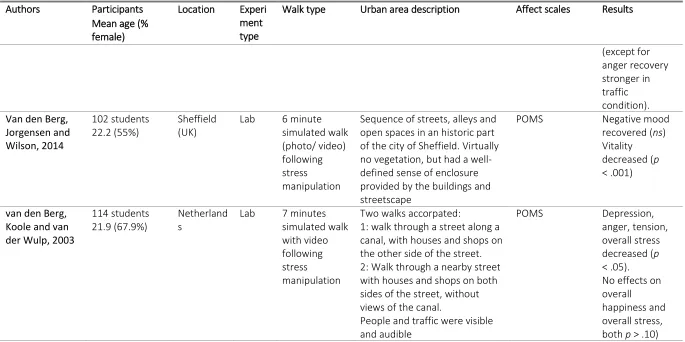
25 Table 2.2: Reviewed studies on affective outcomes of walking in urban settings
Authors Participants
Mean age (% female)
Location Experi
ment type
Walk type Urban area description Affect scales Results
Berman, Jonides and Kaplan, 2008 38 students 22.6 (61%) Ann Arbor, Michigan (USA)
Field 50-minute
individual walk following attention manipulation
Downtown area on traffic-heavy street. University and office buildings. Positive and Negative Affect Schedule (PANAS) No pre-post changes presented. Only between-setting comparisons presented.
Gidlow et al., 2016 38 adults 40.9 (35%) West Midlands (UK)
Field 30-min walk,
no stressor
Residential area with low motor traffic
Brunel Mood Scale (BRUMS, Profile of Mood Scale (POMS)
Mood improved
(p < .05).
Hartig and Staats, 2006 103 students 24 (52.4%) Stockholm (Sweden)
Lab 12 min
slideshow following a stressful lecture
Urban, densely built. Several streets: area of office buildings and hotels, outdoor market, another is a major thoroughfare. Relatively low levels of
pedestrians and traffic. Buildings are predominantly modern high-rise. Some plants and trees are visible.
Attitude toward walk;
Likelihood of restoration
City walk related to low likelihood of restoration in both fatigue and not fatigued conditions.
Hartig et al.,
1991 Study 2
102 college students Na (50%) Santa Ana, California (USA)
Field 40-minute
individual walk following stressor
Well-kept mixed residential-commercial area near the centre
26 Table 2.2: Reviewed studies on affective outcomes of walking in urban settings
Authors Participants
Mean age (% female)
Location Experi
ment type
Walk type Urban area description Affect scales Results
Overall
happiness scale
Hartig et al., 2003
112 students 20.8 (50%)
Orange (USA)
Field 50-min walk
following attention manipulation
Industrial, outskirt area ZIPERS Positive affect
decreased (p
<.05). anger and depression
increased (p
< .01) Johansson, Hartig and Staats, 2011 20 students 23 (50%)
Sweden Field 40-mins
individual
walk, no
stressor used
Commercial area with heavy traffic Exercise-induced Feeling Inventory (EFI) Tranquillity decreased
(p < .10)
Karmanov and Hamel, 2008 85 students 21.8 (63.5%) Amsterda m (The Netherland s)
Lab 10-minute
simulated walk with video, no stressor used
Modern development by Amsterdam docks – canal
POMS Improvement in
depression,
anger, tension (p
< .05) Kinnafick and Thøgersen-Ntoumani, 2014 Study 1 40 physically inactive students and staff 23.8 (80%) Northampt on (UK) Lab on tread mill with video
15 min walk with video on treadmill, no stressor used
Busy commercially dominant area with crossings
PANAS, Activation-Deactivation Adjective Check List (ADACL) Feeling Scale (FS) Positive affect increased
(p < .01)
Negative Affect increased
(p < .05)
tiredness decreased
27 Table 2.2: Reviewed studies on affective outcomes of walking in urban settings
Authors Participants
Mean age (% female)
Location Experi
ment type
Walk type Urban area description Affect scales Results
calmness decreased
(p < .01)
pleasure
improved (p
< .01) energy increased Kinnafick and Thøgersen-Ntoumani, 2014
Study 2a – walking condition 30 physically inactive students and staff 25.8 (60%) Northampt on (UK)
Field 15-min
individual walk, no stressor used
Busy commercially dominant area with crossings
PANAS ADACL FS
Positive affect
increased (ns),
negative affect decreased (ns), energy
increased (p
< .01) tiredness
decreased (p
< .01) pleasure
increased (p <.
01)
Roe and Aspinall, 2011 (Good mental health group)
24 adults with poor and good mental health 46 (64%)
Stirling (UK)
Field 1-hour group
walk, no stressor used
Stirling town centre with some greenery and some historic interest
UWIST MACL Hedonic tone,
stress improved
28 Table 2.2: Reviewed studies on affective outcomes of walking in urban settings
Authors Participants
Mean age (% female)
Location Experi
ment type
Walk type Urban area description Affect scales Results
Roe and Aspinall, 2011 (Poor mental health group)
46 adults with good mental health (64%)
Stirling (UK)
Field 1-hour group
walk, no stressor used
Stirling town centre with some greenery and some historic interest
UWIST MACL Non-significant
hedonic tone and stress improvement;
Tilley et al., 2017 8 older individuals NA (NA) Edinburgh (UK)
Lab 15 min video
of walk that participants took
previously, no stressor used
Urban busy road with narrow pavements, high buildings, shops, supermarket, and traffic
Visual analogue scale (VAS)
High excitement (direct
attention) – but in green was higher High engagement (arousal) but green was higher Low frustration (negative valence) but in green was lower
Tsunetsugu et al., 2007 12 university students 22 (0%) Nigata (Japan) Field walks, repeat ed Several 15-minute walks following stressor
Central area with traffic Stress–Refresh
feeling test
Decrease in feelings of
comfort (p < .05)
“Comfortable” feeling lowered
29 Table 2.2: Reviewed studies on affective outcomes of walking in urban settings
Authors Participants
Mean age (% female)
Location Experi
ment type
Walk type Urban area description Affect scales Results
Decrease in feeling refreshed
(p < .05)
Tyrväinen et al., 2014 77 employees healthy, non-smoking 47.6 (92%) Helsinki (Finland) Field walk 30 minutes group walk led by researcher following stress manipulation
City centre, with few urban trees. Passed shopping and traffic centre and back
Positive and Negative Affect Schedule (PANAS), Vitality Scale Positive affect, high energy level, full concentration and pleasurable engagement)
decreased (ns);
Negative affect, distress, nervousness, anger, guilt
decreased (ns)
Ulrich et al.,
1991
120 students NA (50%)
Texas (USA)
Lab 10-minute
video (no walk task) following stress
manipulation
Traffic condition: commercial street with heavy to light traffic. two way street;
Pedestrianised condition: outdoor shopping mall with varying levels of pedestrians
ZIPERS Fear, sadness,
30 Table 2.2: Reviewed studies on affective outcomes of walking in urban settings
Authors Participants
Mean age (% female)
Location Experi
ment type
Walk type Urban area description Affect scales Results
(except for anger recovery stronger in traffic condition).
Van den Berg, Jorgensen and Wilson, 2014 102 students 22.2 (55%) Sheffield (UK)
Lab 6 minute
simulated walk (photo/ video) following stress manipulation
Sequence of streets, alleys and open spaces in an historic part of the city of Sheffield. Virtually no vegetation, but had a well-defined sense of enclosure provided by the buildings and streetscape
POMS Negative mood
recovered (ns)
Vitality
decreased (p
< .001)
van den Berg, Koole and van der Wulp, 2003
114 students 21.9 (67.9%)
Netherland s
Lab 7 minutes
simulated walk with video following stress manipulation
Two walks accorpated:
1: walk through a street along a canal, with houses and shops on the other side of the street. 2: Walk through a nearby street with houses and shops on both sides of the street, without views of the canal.
People and traffic were visible and audible
POMS Depression,
anger, tension, overall stress
decreased (p
< .05). No effects on overall
happiness and overall stress,
31
2.3.2.1 Descriptive summary of studies included in review
Seventeen studies were identified. Eight studies involved laboratory experiments (Karmanov and Hamel, 2008; van den Berg, Koole and van der Wulp, 2003) and nine involved field experiments (e.g., Johansson, Hartig, and Staats, 2011; Hartig et al., 2003), thus highlighting a fairly balanced methodological choice.
Study populations were university students in 64% of cases – 11 out of 17 studies (e.g., Van den Berg, Jorgensen and Wilson, 2014; Johansson, Hartig, and Staats, 2011; Berman, Jonides and Kaplan, 2008; Hartig et al., 1991), non-student adults in five cases (e.g., Tyrväinen et al. 2014; Roe and Aspinall, 2011 – both samples), or a mix of the two sample types (Kinnafick and Thøgersen-Ntoumani, 2014 – study 1 and 2). Mean age was lower than 26-years in 14 cases, between 40 and 47 in three cases, and not reported in three studies; this finding highlights a disproportion which will be further discussed in Section 2.4.2. Gender of participants was fairly balanced, with a greater proportion of female participants in ten studies (e.g., Gidlow et al., 2016) (see Section 2.4.2 for extensive discussion).
Turning to setting characteristics, experimental urban settings were unattractive commercial or peripheral areas with motor traffic in 10 cases (e.g., Tilley et al, 2017; Tyrväinen et al., 2014; Kinnafick and Thøgersen-Ntoumani, 2014 - study 1 and 2; Johansson, Hartig, and Staats, 2011; Hartig et al., 2003; Ulrich et al., 1991;). In the remaining seven studies, settings were city centre or residential areas with reportedly low levels of traffic and some aesthetic quality (e.g., Van den Berg, Jorgensen and Wilson, 2014; Karmanov and Hamel, 2008; van den Berg, Koole and van der Wulp, 2003). Hence, it becomes clear that selected locations are mainly areas defined negatively in socio-cultural terms (see Section 2.3.2.2).
32
Turning to results, five studies found that walking in urban settings triggered positive affect (Gidlow et al., 2016; Kinnafick and Thøgersen-Ntoumani, 2014 - Study 2; Roe and Aspinall, 2011 – poor mental health group; Karmanov and Hamel 2008; Van den Berg, Koole and van der Wulp, 2003). Seven studies reached the opposite conclusion (Tilley et al., 2017; Van den Berg, Jorgensen and Wilson, 2014; Johansson, Hartig, and Staats, 2011; Tsunetsugu et al., 2007; Hartig and Staats, 2006; Hartig et al., 2003; Staats et al., 2003). Finally, four studies reported non-significant or mixed results (e.g., Kinnafick and Thøgersen-Ntoumani, 2014 - Study 1; Roe and Aspinall, 2011 – good mental health group). The remaining studies did not report significance levels of pre to post-test changes (e.g., Ulrich et al., 1991; Hartig et al., 1991), with some studies also not reporting descriptive statistics for pre to post-tests (Hartig et al., 1991; Berman, Jonides and Kaplan, 2008). This is possibly due to the fact that in most cases, the research aim was to compare affective recovery between green and built settings, rather than assessing the pre and post-test change in each setting, thus confirming the general lack of attention given to the affective potential of urban settings.
Among the studies detecting positive affective benefits of walking there are both laboratory and field experiments. In particular, it was concluded within two laboratory studies that walking in urban areas led to a significant recovery of affect. These included a simulated, short walk in a city centre which decreased levels of depression, anger, tension, and overall stress in a group of university students (van den Berg, Koole and van der Wulp, 2003) and a simulated walk along city docks that led to improvements in depression, anger, and tension in a group of university students (Karmanov and Hamel, 2008). Similarly, three field experiments detected a positive effect of walking on affective states. First, a city centre walk led to stress recovery and hedonic tone improvement in a group of adults with poor mental health (Roe and Aspinall, 2011). Second, a walk in a residential area with light motor traffic improved mood in a group of adults (Gidlow et al., 2016). Third, a walk in a busy area was related to energy and pleasure increase and decrease in tiredness in a group of physically inactive students and adults (Kinnafick and Thøgersen-Ntoumani, 2014, Study 2a).
33
were field experiments: first, a 50-minute walk in an industrial area decreased positive affect and increased anger and depression in a group of university students (Hartig et al., 2003). Second, tranquillity decreased in a group of university students after a walk in a commercial area with traffic (Johansson, Hartig, and Staats, 2011). Third, in Tsunetsugu and colleagues’ study (2007), participants reported a decrease in feelings of being comfortable and refreshed following several short walks in a traffic-congested area. Fourth, Tilley et al. (2017) found that a walk in an urban busy road was associated with high attentional fatigue, arousal, and frustration in a group of older individuals. Negative affective outcomes were also found within three laboratory experiments. First, a simulated walk in a city centre led to a decrease in vitality in a group of students (Van den Berg, Jorgensen and Wilson, 2014). Second, Hartig and Staats (2006) attested that two groups of fatigued students attributed low affective and restorative potential to two simulated walks in urban, commercial areas. Third, a simulated walk along a canal led to a decrease in vitality in a group of 102 university students (Van den Berg, Jorgensen and Wilson, 2014).
Therefore, it becomes evident that results are contrasting and interpretation is not straightforward. In addition, while the benefits of the field walks may be partially attributed to the physical activity involved, the benefits related to the simulated walks can be attributed solely to the environmental exposure (see Chapter 4 for methodological implications). The next section critically examines these results and discusses the implications for the current research.
2.3.2.2 Critical appraisal of studies within the review and implications for the current thesis
34
age range of 20–28.5 years identified by McMahan and Estes’ (2015) review. This aspect will be discussed in Section 2.4.2.
Second, the review highlighted a prevalence of studies performed in built settings defined negatively in socio-cultural terms, such as areas with heavy motor traffic or industrial areas. Importantly, one element that emerges is the role of setting qualities, with general attractiveness of settings appearing as crucial factor in the affective and restorative walking experience. In fact, the affective outcome was negative when walks took place in unattractive urban settings, including a Swedish commercial area with heavy traffic (Johansson, Hartig, and Staats, 2011), an industrial area in urban outskirts (Hartig et al. 2003), a traffic-congested area (Tsunetsugu et al., 2007), a busy commercial area with traffic (Kinnafick and Thøgersen-Ntoumani, 2014), and an urban busy road with shops and high buildings (Tilley et al., 2017). Conversely, walks in moderately attractive settings led to positive or uncertain results, and these included streets along a canal (Karmanov and Hamel, 2008; Van den Berg, Koole and van der Wulp, 2003), an attractive residential area with low motor traffic (Gidlow et al., 2016), and a town centre with some greenery and some historic interest (Roe and Aspinall, 2011). Therefore, the current research argues that by selecting unattractive urban places such as commercial and industrial areas, urban outskirts, or streets with heavy motor traffic, the potential for some urban environments also to offer restoration was downplayed. In fact, scholars have recently noted that a busy urban street is not representative of the restorative potential of urban settings (Staats et al., 2016). However, as previous research has pointed out, there is a substantial lack of literature assessing the impact of ‘attractive’ urban places on affective variables (Fornara, 2011; Hartig et al., 2003).
35
1-10 (Seresinhe et al. 2015). It was attested that living in scenic locations is related to better psychological wellbeing, independently of the type of location (either natural or urban) (Seresinhe et al. 2015); thus, urban ‘scenicness’ seems to support psychological wellbeing, despite the absence of nature.
However, the question of which specific elements related to the built environment can contribute to affect remains unanswered. The next section explores the potential factors related to built settings that might contribute to environmental affect.
What factors might contribute to positive affective outcomes in urban settings?
The review within Section 2.3.2 does not clarify which specific characteristics related to built environments are likely to influence affective responses. Importantly, it emerged that no previous study proposed a comparison of affective walking experiences in different urban settings, as only built versus nature settings comparisons were proposed. Arguably, this has limited the understanding of the affective and restorative potential of walking in urban settings. A further issue which has limited such investigation is that previous studies selected urban areas with a mix of elements (e.g., traffic and pedestrianised areas, different architectural styles, residential and leisure areas), rather than homogeneous areas. For instance, Hartig and Staats’ (2006) urban condition was constituted by streets with “different characters: one passes through an area of office buildings and hotels, another passes beside an outdoor market, another is a major thoroughfare [with] high pedestrian and/or vehicular traffic flow rates” (2006, p. 218). In this sense, it becomes challenging to determine which specific elements caused the positive or negative affective outcome.
This section builds on the review presented in Section 2.3.2 and proposes that two factors – motor traffic and architectural style – might contribute to positive affective experiences in urban settings.
2.3.3.1 Motor traffic
36
areas with medium to heavy traffic detected a negative affective outcome of walking (e.g., Johansson, Hartig, and Staats, 2011; Tsunetsugu et al., 2007; Hartig et al., 2003). According to scholars, traffic congestion is one of the most severe environmental stressors of contemporary urban life, thus often associated with negative affective outcomes (Van den Berg, Joye, and DeVries, 2013). Several observational studies attested the negative effect of traffic on affective variables in the long or medium-term. For instance, a recent study has assessed the role of motor traffic in perceived urban stress, and found that pedestrianised streets and areas with light motor traffic are negatively associated with stress levels (Knöll et al. 2017). Turning to the residential context, traffic exposure is related to increased depressive symptoms (Gee and Takeuchi, 2004) and less daytime relaxation (Öhrström et al. 2006). Several studies have also assessed the role of traffic on affective and restorative outcomes experimentally, thus looking at the immediate effects of motor traffic exposure on affect. However, these scholars have mainly focused their attention on one specific aspect of traffic, that is its sonic dimension. A 2015 study compared restorative effects of listening to birdsongs and