Data Access Project
Department of Social Services
i
This report has been prepared for the Australian Department of Social Services by Elizabeth Green and Felix Ritchie of Bristol Economic Analysis at the University of the West of England, Bristol. This report has benefited from discussions with various interested parties in the Australian
government and the research community, as well as respondents to an online survey; in particular we are grateful for the engagement of the Department itself for identifying a number of areas of confusion, ambiguity or factual error. All remaining errors and omissions are the responsibility of the authors.
The views expressed in this document are those of the authors and should not be taken to imply a policy position by the Department.
ii
Executive summary ... v
Definitions ... ix
Part I Project context ... 11
1. Context, aims and objectives for the Data Access Project... 11
1.1 Department of Social Services data access strategy ... 11
1.2 Objectives of the project ... 12
1.3 Structure of the report ... 12
2. Relevant considerations ... 13
2.1 Current facilities and solutions ... 13
2.1.1 Department of Social Services paths to access ... 13
2.1.2 Data access resources within or accessible to the Australian Government ... 14
2.2 User groups ... 16
2.3 Legal framework ... 17
2.3.1 Laws covering access... 17
2.3.2 Ethical approval ... 18
2.3.3 Organisations working in data privacy ... 18
2.4 Wider strategic framework ... 18
Part II International practice ... 20
3. Introduction ... 20
3.1 Sources of information ... 20
3.2 Structure ... 21
4. Components of a data access solution ... 22
4.1 The five safes... 22
4.2 Settings: options for access ... 22
4.2.1 Distributed data ... 23
4.2.2 Distributed analysis 1: online or remote tabulation ... 25
4.2.3 Distributed analysis 2: remote job servers ... 26
4.2.4 Distributed analysis 3: RDCs and Remote (virtual) RDCs ... 28
4.2.5 Analysis services ... 30
4.2.6 Synthetic data ... 30
4.2.7 Settings: summary... 31
4.3 Project approval ... 32
iii
4.3.2 Contract details ... 33
4.3.3 Institutional versus personal agreements... 34
4.3.4 Ethical approval, due diligence and the use of precedents ... 35
4.3.5 Composition and perception of ethical approval authorities ... 36
4.3.6 Identifying benefits ... 37
4.3.7 Need-to-know versus standard datasets ... 39
4.3.8 International access ... 39
4.3.9 Projects: summary ... 40
4.4 People ... 41
4.4.1 How trustworthy are users? ... 41
4.4.2 Can users develop and/or be trained?... 43
4.4.3 When researchers go bad ... 44
4.4.4 People: summary ... 44
4.5 Data management and input SDC ... 45
4.5.1 Confidentialisation and anonymity ... 45
4.5.2 Anonymisation as a residual ... 45
4.5.3 Spontaneous recognition ... 46
4.5.4 Digital object identifiers ... 46
4.5.5 Data: summary ... 47
4.6 Output SDC ... 47
4.6.1 The origins of modern OSDC ... 47
4.6.2 ‘Safe statistics’ ... 48
4.6.3 Principles- versus rules-based OSDC ... 48
4.6.4 Current practices ... 48
4.6.5 Outputs: summary ... 49
5. Managing institutional expectations ... 50
5.1 The role of defaults ... 50
5.2 Costs and charging ... 50
5.3 Stakeholder/customer relationships ... 52
5.3.1 Identifying stakeholders ... 52
5.3.2 Identifying benefit for the data owner ... 52
5.4 Public buy-in ... 53
5.5 The Nordic example ... 54
iv
6.1 The data access spectrum ... 55
6.2 Devising a strategic overview ... 55
Part III Mapping users and solutions ... 57
7. User descriptions ... 58
7.1 The ‘non-expert’ group ... 59
7.2 The ‘professional research’ group ... 60
7.3 The ‘other researchers’ ... 62
8. Mapping users to solutions ... 64
8.1 The ‘non-expert’ group ... 64
8.2 The ‘professional research’ group ... 64
8.3 The ‘other researchers’ ... 65
8.4 Summary: user-solution map ... 65
9. Overarching issues ... 67
9.1 Common operational issues ... 67
9.1.1 Mechanics of access and personal agreements ... 67
9.1.2 Ethical and operational approval ... 68
9.1.3 Institutional access agreements ... 69
9.1.4 Charging policy ... 69
9.1.5 Data and trusted user maps ... 70
9.1.6 Training programme ... 70
9.1.7 Demand identification ... 71
9.2 Attitudes... 71
9.3 Stakeholder management ... 72
9.4 Perceptions ... 72
Part IV Items for action and roadmap ... 74
10. Items for action ... 74
10.1 Virtual RDC ... 74
10.2 TableBuilder ... 76
10.3 Scientific Use Files ... 77
10.4 Public use files ... 79
10.5 Institutional components ... 80
11. Roadmap ... 82
v
Executive summary
This report reviews the context and options available to the Department of Social Service (DSS) in developing its data access strategy, and proposes future developments based upon international practice. The structure of the report is separated into 4 parts.
Part I: context for the study
Part I provides the context for the report, considering current practices, law and the wider strategic framework. It notes that DSS already has a number of data access mechanisms in place. In addition, there are a number of off-the-shelf solutions currently operating in Australia, which may be relevant to DSS. Three typical DSS user groups are identified and defined based on their statistical skills and understanding of DSS; ‘non-expert’ (general public, journalists, non-PhD students), ‘professional researchers’ (Australia-based academics and PhDs) and ‘other researchers’.
Part II: international experience
Considering first the operational perspective, the report uses the Five Safes structure to break down data access mechanisms into five separate components: the project purpose, the people, the settings, the level of detail in the data, and checks on any statistics produced. In respect of those elements:
Project purpose
Data should be made available for research purposes if the expected benefit to society outweighs the potential loss of privacy for the individual; however, it is not clear that the claimed benefits are effectively realised. There is widespread agreement that data should only be used for statistical research and must be sanctioned by an appropriate authority. The design of the approval process can make a substantial difference to the effectiveness of data access, particularly if precedents or classes of project are used. Data access
agreements should encompass physical, time, environmental and behavioural elements, instructing the user to best practice; they often include much more but it is not clear that this is justified or wise.
People
Traditionally users have been treated as customers of the service that the data owner delivers. More recent models have raised awareness of the importance of understanding the psychology of users and, if possible, building a ‘community of interest’ between data owners and users. This has been demonstrated, albeit in a small number of situations, to deliver improved security and greater usefulness as lower costs. It does require a greater
commitment to training both researchers and data owners, but this is increasingly seen as best practice.
Settings for data access solutions
vi
hold fully detailed data with minimal de-identification carried out. Remote tabulation is a well-established technology, but Australia is currently leading the field in new
developments. A number of organisations are now considering creating synthetic data for educational/training purposes.
Level of detail in the data
This is a very mature field where off-the-shelf tools and a vast academic literature means that data can be created to any level of ‘safety’ desired. However, some recent authors have argued that the applications of the conceptual models is seriously flawed, and have
demonstrated that a more evidential approach can generate both more secure and more user-friendly outcomes.
Checks on the output
In the last ten years a new field of ‘output statistical disclosure control’ (OSDC) has developed, specifically to ensure that the results of research use of sensitive data do not breach confidentiality. vRDCs are more likely to use ‘principles-based’ OSDC, but this does require a commitment to training researchers. Distributed data solutions still tend to rely on sending users a set of instructions with the dataset. However, some modern training tools are being developed.
The report also considers the wider institutional and ethical concepts. This has an important influence on the effectiveness of any operational solution, and it can lead to very different
outcomes. The report contrasts two approaches to data access planning: the ‘traditional’ model and the ‘EDRU’ model.
The traditional model is fundamentally defensive in nature; the focus is on the costs and risk to the data owner, and it assumes that the primary aim of any data access strategy is to prevent malicious misuse. This model therefore makes extensive use of worst-case scenarios and protection against hypothetical possibilities. The traditional model is default-closed; that is, it assumes that no access will be granted unless it can be proven to be safe.
The evidence-based, default-open, risk-managed, user-centred (EDRU) model reverses almost all of these precepts. It is evidence-based: hypothetical possibilities have little or no place in decision-making. It is default-open: data is assumed to be released, and the question for the data owner is how to manage confidentiality risks. It accepts that their data access choices are subjective and made in conditions of uncertainty, and that the relevant metric for costs and benefits is society, not the data owner; therefore, decision-making is a balance of subjective probabilities. Finally, it is user-centred, focusing on the usefulness of outputs rather than the risk to the data owner.
vii
This reports concludes that the EDRU ethos provides a more sustainable world-view and, on the limited evidence available, is more likely to provide a secure and useful data access solution; it also seems better suited to exploit the gains from increased data access by engaging with researchers more. The report acknowledges that this is very much a minority view, but a growing one which seems likely to become much more significant.
Part III: mapping users and solutions for DSS
Following the broad identification of user groups in Part I, and international understanding of good management of the user community in Part II, this section describes user groups in detail and the proposed data access solutions mapped to each user group:
Remote tabulation would serve the non-expert user group well; in the longer term, synthetic data may have value in educational contexts.
Expert researchers need access to micro level data; the full data with minimal
de-identification should be delivered through vRDCs, but Scientific Use Files (SUFs) with a lower level of detail in the data should also be part of DSS’ strategy.
For researchers working abroad or in private sector organisations, our recommendation is that the vRDC/SUF combination also suits this market.
Institutional factors can have a strong influence on the effectiveness of operational decisions, and this report covers them separately. The recommendations made are based on the EDRU ethos and so many of them are at the edge of current knowledge about how to manage data access effectively; some of them may be seen as very radical. However, based on the experience of the last ten years, we expect that this approach will become more important, not less, and we believe this is a rare opportunity for DSS to lead such developments.
Overarching issues which need to be addressed at the institutional level are:
Common operational issues: standardisation of both institutional and personal access agreements; classification of data types for mapping onto technical solutions; training institutional signatories about the data community and their role within it; developing training programs for researchers.
Attitudes: formal statement of intent for ‘default-open’ institutions, clarification of staff roles and duties within data accessibility, and a modern approach to risk management and the likelihood of human error.
Stakeholder management: developing a strong relationship with data providers and researchers to share findings, particularly in terms of developing whole-of-government solutions to data access in Australia.
Perceptions: early discussion with privacy campaigners and with users; the development of an advisory board with representatives from different institutions, the general public, journalists and privacy campaigners to discuss data sharing practice.
viii
Part IV Implementation
Part IV provides a roadmap for future development, based on the three user groups (plus
overarching issues), considered over the short, medium and long term. The timing is based on both the natural order of changes, and the feasibility of targets. The list of proposed actions is long, but the elements should be complementary. The programme is also ambitious in its scope, but we believe this is feasible and will provide DSS with a solid base for an enviably coherent long-term strategic direction.
The strategic roadmap provides short-term and long-term guidance on the following areas:
The creation of synthetic data files and associated metadata for Public Use Files
Development of TableBuilder for the dissemination of SUF and metadata
Simplifying the provision of SUFs and clarifying the access arrangements
Scoping a potential pilot for a virtual RDC for hosting detailed datasets with minimal de-identification and
ix
Definitions
Definitions used in this report are as follows (note, these may differ slightly from similar definitions given elsewhere):
Types of data
Microdata: individual unit records about a person or organisation, such as information collected from surveys or administrative data
Raw data: the source data collected by the Department
Identified data: data which includes information allowing the recipient to be directly known just from one or two fields in the data (such as name, or social security number)
De-identified data: data which includes sufficient detail to allow the data subject to be identified, but only with effort and with less certainty (for example, a combination of gender, age, type of employer, salary range and disability status)
Anonymous data: data which does not include sufficient detail to allow the data subject to be identified, under any reasonable conditions
Confidentialisation: the act of reducing the likelihood or harm of re-identification by reducing detail or perturbing the dataset
Confidential data: data which, for legal and/or ethical reasons, must not be made available to anyone who does not have appropriate authorisation
Sensitive data: data where release to an unauthorised person is likely to cause non-negligible harm or distress to the data subject; for the purposes of this report, we assume that all sensitive data is also confidential
Protected information: a specific term used in various ways in Australian legislation, that includes referring to information ‘about a person’ but not necessarily identifying a person; anonymous data can still be ‘protected information’ under Australian law
Disclosure and breaches
Unauthorised disclosure: the unauthorised release of information about an identified data subject
Statistical disclosure control (SDC): applying statistical measures to (a) determine if there is a substantive risk of unauthorised disclosure in a dataset or publication, and (b) make changes to the data or publication to reduce that risk
Input SDC: the application of SDC methods to raw data to reduce data risk before it is released to the users
Output SDC (OSDC): the application of SDC methods to potential publications after the analysis has been carried out, to guard against residual risk
Breach of confidentiality: the release of identified or de-identified data to an unauthorised system, environment or person; a breach of confidentiality may not mean a disclosure as it will depend on the circumstances
x
Forms of access:
Distributed data: sending microdata to users under licence, to analyse on their own machines
Distributed access: restricting the physical location of the data, but allowing users in others locations to carry out analysis and take retain statistical results (but not microdata)
Table server: a system which allows users to generate their own tables from the data flexibly, but without seeing the source data; a form of distributed access
Remote job server: a system allowing a range of complex analyses to be carried out, not just tabulations, without seeing the source data; a table server is a remote job server which has only one function
Remote access: a system which allows users to ‘see’ and manipulate the source data
Research data centre (RDC): a restricted access facility where users can manipulate the source data without restriction as if on their own computers; but the environment is made secure so that users cannot bring information into or take data out of the facility without approval, and additional services (such as internet access) are normally very restricted; typically provided by on-site access, where the facility is hosted on the organisation’s premises
Virtual RDC or Remote RDC (vRDC): an RDC where technology is used to provide equivalent security to a physical site and to separate the RDC from the actual location of the data, such as SURE
Public use file (PUF): data file without restrictions on use or onward access
Scientific use file (SUF): data file which retains some non-negligible confidentiality risk and so therefore has circulation restricted to authorised users for specific research purposes
11
Part I Project context
1.
Context, aims and objectives for the Data Access Project
1.1
Department of Social Services data access strategy
The Department of Social Services (DSS) “aspire[s] to be Australia’s pre-eminent social policy agency. [The Department’s] mission is to improve the lifetime wellbeing of people and families in Australia”1. One part of that mission is providing external users with access to statistics and raw data collected by DSS, so that third parties can potentially enhance DSS activities with their own research, and generally boost service provision from Federal, state and local council programs and non-government services.
The public benefits expected to arise from this project are:
greater ability of the general public to identify useful information specific to their circumstances, such as small area data
improved capability for professional researchers using detailed information to produce policy-relevant analyses
streamlining of DSS’ data access procedures, including integration with the wider Australian Government strategy
better understanding of user needs by DSS
methodological commentary and quality control arising from an expanded pool of expert users and
greater understanding and acceptance of data collection and use by DSS.
This strategy is consistent with Australian Government Public Data Policy (AGPDP)2 and associated report Public Sector Data Management (PSDM)3, which provide high-level guidance on how public sector data resources are to be managed for the benefit of the community. DSS is investigating how to best implement the AGPDP, particularlyin respect of access to confidential or sensitive microdata. Some practical elements of this investigation are already in place or are being piloted, by the
Department on its own and in collaboration with other agencies (such as the Multi-Agency Data Integration Project).
A key element of this strategy is developing a Trusted User Model to manage access to confidential data. This has proven difficult for governments in the past, not just in Australia but around the world. Solutions are typically over-cautious and fail to encourage users to engage positively with the service. The AGPDP and PSDMpropose a conceptual framework which challenges traditional perspectives on data access, and encourages data access to develop along ‘modern’ lines: the evidence-based, default-open, risk-managed, user-centred (EDRU) model which is increasingly seen as a more effective and cost-effective strategy for delivering data access. The Australian Bureau of
1
DSS website “About the Department”. https://www.dss.gov.au/about-the-department.
2
Australian Government (2015) Australian Government Public Data Policy. Office of the Prime Minister and Cabinet. https://www.dpmc.gov.au/sites/default/files/publications/aust_govt_public_data_policy_statement_1.pdf
3
12
Statistics has already redesigned its data access strategy along EDRU lines, and DSS has already made moves towards adopting a similar approach.
The Trusted User Model is being developed to provide a platform for providing access to relevant administrative data to “trusted” users. DSS is committed to developing a Trusted User Model in alignment with the AGPDP alongside coordinating similar activities across organisations; to help develop a sustainable system.
1.2
Objectives of the project
The Department has commissioned the University of the West of England to:
Review international good practice in data access
Consider how the needs of different user groups accessing DSS data might be met by alternative (technical and organisational) solutions; particular attention should be paid to institutional relationships
Identify where tools and practices already exist which DSS uses or may be able to exploit; and where gaps in policy or practice exist
Recommend a development path, focusing particularly on access to confidential microdata and the development of the Trusted User Model and
Advise the Department with practical proposals on how such a development path might be implemented, including timing and priorities.
While the focus is on meeting the needs of DSS and its data users, consideration should also be given to integration with other Australian initiatives, to identify potential areas for collaboration and avoid creating data solution silos in different Departments.
This report considers how to make best use of the microdata that DSS holds; that is, record level data. Access to this data allows users to make their own analyses of the data. At one end of the spectrum, effective use of the microdata this might be achieved by allowing journalists to create their own tabulations of the data, but without ever seeing the source data. At the other end, expert statistical analysts may have unrestricted access to identifiable microdata (subject to legislation such as the Privacy Act 1988 and security requirements imposed by DSS when receiving data), with only their publications being subject to confidentiality checks. Standard statistical analyses produced by DSS or bespoke statistical services provided by DSS are not considered in this report.
1.3
Structure of the report
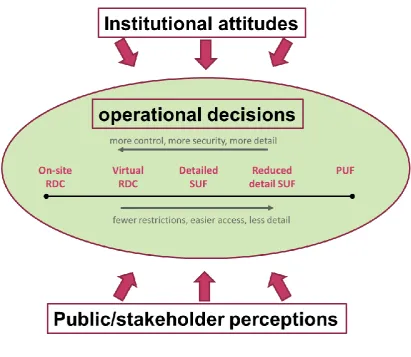
The remainder of Part I summarises the current position in respect of DSS’s interests and activities. Part II reviews international practice, both on operational issues and in terms of wider institutional issues. It then introduces the tripartite structure (operational issues, institutional matters, public relations) which will be used for the proposals and recommendations.
Part III reviews the specific combinations of options and draft provisional recommendations. It also considers the wider institutional context, and where DSS may need attitudinal statements.
13
2.
Relevant considerations
2.1
Current facilities and solutions
2.1.1
DSS paths to access
General access to data
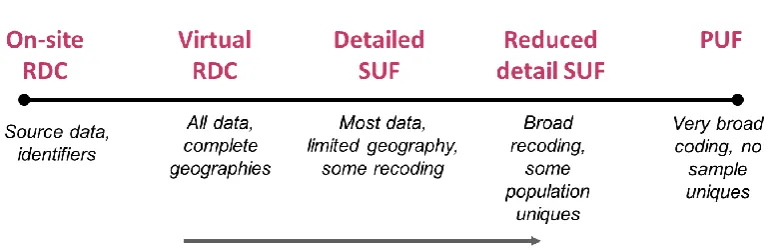
DSS data is provided widely to universities and other institutions on request subject to meeting legislative requirements under social security law, family assistance law etc. and the Privacy Act 1988. The information is typically provided after a Public Interest Certificate (PIC) or Protected Information Disclosure (PID) has been approved under the legislation which required the collection of the data for Government purposes. The data is supplied to the researcher with restrictions on what the researcher can do with it. We will refer to these datasets as Scientific Use Files (SUFs), to contrast them with Public Use Files (PUFs) which are unrestricted. DSS does not at present produce PUFs. A third type of data is a Secure Use File (SecUF), a detailed data file made available to
researchers remotely through facilities controlled by the data owner. Currently DSS does not produce SecUFs.
To the casual observer, DSS does not appear to make its data available for third-party analysis. There is no statement on the website about access to data, a general data strategy, or to indicate that data might be available.
National Centre for Longitudinal Data
An exception to the general invisibility of data is DSS longitudinal data resource. DSS created and maintains several longitudinal studies, the earliest from 2001 and the most recent from 2013. These are managed by DSS’ National Centre for Longitudinal Data (NCLD4). The microdata is distributed to researchers through a transparent and apparently long-established process, described in detail on DSS website.
The key features of this distributed data approach relevant to this project are:
Data are released as SUFs with two levels of confidentialisation: ‘General Release’ (lower risk) and ‘Unconfidentialised’ (higher risk).
Both datasets have to be kept on systems with defined security standards; the
Unconfidentialised datasets require additional electronic and physical locks; both are subject to DSS spot-checks with three hours’ notice.
Users can apply for an individual access agreement.
Alternatively, they can apply through their organisation’s licensing agreement with DSS (for some categories such as Honours students this is the only route).
When an organisation has an agreement with DSS, a data manager needs to be appointed at the organisation to take responsibility for the implementation of procedures.
Eligible users are Australian academics and students, research organisations, government users; all research must be for public benefit.
4
14
The same eligibility criteria apply to overseas researchers, but they are only able to access the lower risk General Release files, not the Unconfidentialised files.
The finest detail in the Unconfidentialised files is date of birth, which is very detailed by international standards.
There have been a small (single-digit) number of breaches of procedure from using these data since 2003; mistakes and poor handling practices are counted as breaches; it is possible that some of these might have led to breaches of confidentiality, but the impact of any breaches appears to have been contained.
Development projects
DSS is participating in two relevant development projects.
The Multi-Agency Data Integration Project (MADIP) is a collaboration between DSS, the Australian Taxation Office, the Department of Health, the Department of Human Services and the Australian Bureau of Statistics (ABS), with the latter leading the project. This project shares data between the agencies to allow personal and health data to be combined for policy analysis. The Trusted User Model being developed for that project has a significant potential overlap with this project; hence developments in MADIP will be important for recommendations on this project. However, ABS is already committed to the EDRU model of data access, and so differences across projects should be a matter of degree rather than principles.
DSS is developing its own Trusted User Model project. This project will provide research access to the income support dataset via a virtual Research Data Centre (vRDC), the Secure Unified Research Environment (SURE) of the Sax Institute. Proof of concept in terms of physical access to systems and agreement on approval of projects is underway, with user agreements based on personal contracts. The ambition is that the final Trusted User Model will reflect the EDRU model and, where possible, be compatible with developments across government. The findings of the Data Access Project will directly feed into the post-pilot implementation of the Trusted User Model project, and so this report will pay particular attention to the management of vRDCs.
2.1.2
Data access resources within or accessible to the Australian Government
At this stage, there are several data access systems in Australia which could either be exploited or used as precedents for DSS solutions.
Distributed data solutions are:
NCLD, already in operation at DSS for research access to DSS longitudinal studies
Confidentialised Unit Record Filesor CURFs, the ABS’ microdata files for distribution and
data.gov.au, the Australian Government website which facilitates the distribution of data. On-site solution is:
In-postings, used by the ABS to provide access to an on-site RDC (the Australian Data Lab or ADL) for government researchers.
15
TableBuilder, a tabulation tool designed by SpaceTime Research for the ABS, providing real-time statistical disclosure control before generating the tables; it has generated considerable interest amongst other statistical institutes
Secure Unified Research Environment (SURE), a vRDC run by the Sax Institute which appears to run along similar lines to the dominant model in the rest of the world
Virtual Microdata Laboratory, a remote access version of the Australian Data Lab under development and piloting by the ABS and
Remote Access Data Laboratory (RADL), a remote-job server for more detailed CURFs, run by the ABS.
16
2.2
User groups
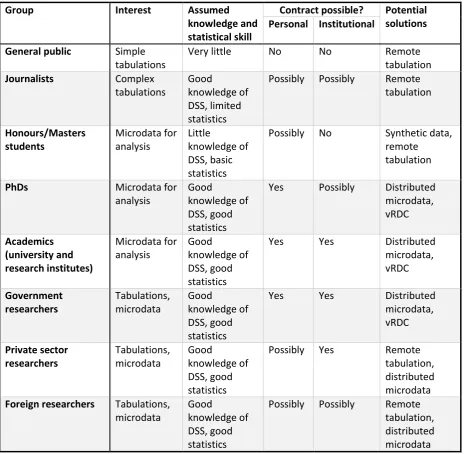
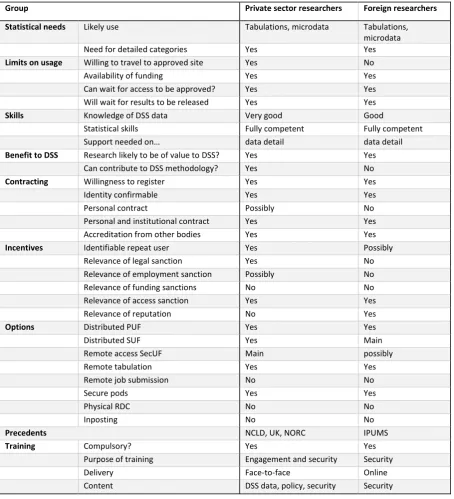
DSS has identified a number of user groups who need to be considered for this project. These are categorised in Table 1, along with provisional solutions to help in considering alternative solutions. ‘Knowledge’ is classified by whether users have a good understanding of DSS activities, and whether they have strong statistical skills. The possibility of contracting is based on the practicality,
[image:17.595.67.532.207.661.2]credibility, meaningfulness to the user, and difficulty of enforcement.
Table 1 Summary of DSS user groups
Group Interest Assumed
knowledge and statistical skill
Contract possible? Potential solutions Personal Institutional
General public Simple tabulations
Very little No No Remote
tabulation Journalists Complex
tabulations
Good
knowledge of DSS, limited statistics
Possibly Possibly Remote tabulation Honours/Masters students Microdata for analysis Little knowledge of DSS, basic statistics
Possibly No Synthetic data, remote
tabulation
PhDs Microdata for
analysis
Good
knowledge of DSS, good statistics
Yes Possibly Distributed microdata, vRDC Academics (university and research institutes) Microdata for analysis Good knowledge of DSS, good statistics
Yes Yes Distributed
microdata, vRDC Government researchers Tabulations, microdata Good knowledge of DSS, good statistics
Yes Yes Distributed
microdata, vRDC Private sector researchers Tabulations, microdata Good knowledge of DSS, good statistics
Possibly Yes Remote
tabulation, distributed microdata Foreign researchers Tabulations,
microdata
Good
knowledge of DSS, good statistics
17
2.3
Legal framework
2.3.1
Laws covering access
DSS data is covered by several laws and determinations reflecting the range of activities carried out by the department. This part discusses laws which discuss the governance of data collection. Although the premise of the laws are similar, there are differences within the acts. The laws which predominately affect data governance are briefly outlined and discussed below.
Social Security (Administration) Act 1999 (SS(A) Act)
This Act addresses ‘protected information’- information which is about a person but which does not necessarily identify a person; hence even anonymous microdata is still covered. The gateway for research access is provided in s202(2C), which allows research use by individuals in “matters of relevance to a Department”. S208(1)(a) offers an alternative approach as the Secretary of the Department may provide the information “…to such persons and for such purposes as the Secretary determines”, by providing a ‘Public Interest Certificate’. Moreover, the Secretary can develop guidelines to settle matters of access in both cases and classes of cases. S2081)(a) appears to be the clause under which research data access is given. However, the guidelines specified in relation to the access clause (defined in the Social Security (Public Interest Certificate Guidelines) (DSS)
Determination 2015) make clear that, for the Certificate to be granted, research still has to be relevant to the department.
The Act also allows DSS to have an institutional arrangement with another government department, where data is shared for the purposes of that department.
Note that, in case of breaches of confidentiality, the intention of the miscreant has to be taken into consideration (s204). On the other hand, asking for protected information to be provided unlawfully is an offence. In other words, the law appears to provide sensible protection against mistakes whilst explicitly criminalising the “can I borrow your data without authority” attitude. Both of these are useful messages to send to researchers.
A New Tax System (Family Assistance) (Administration) Act 1999
This provides research access to data under very similar wording (s167) to the SS(A) Act s207. Again, the Secretary is allowed to approve guidelines on access and classes of access. The Family Assistance (Public Interest Certificate Guidelines) Determination 2015 provides more detail on what will count as sufficiently important to be ‘in the public interest’.
This Act does not directly provide for research access to data (unlike s202(2C) of the above SS(A)Act), but it does have the same references to error, strict liability, and encouraging others to break the law.
Privacy Act 1988
18
2.3.2
Ethical approval
Ethical approval is not required by DSS where administrative data already exists or is part of routine data collecting related to an application for government support (e.g. when data is collected when someone applies for a pension). Ethical approval is however required when conducting a new survey or linking new data which obtains further data related to existing data.
2.3.3
Organisations working in data privacy
As well as legal constraints on data access, and ethical constraints raised by the Department, the success of data access initiatives may be affected by the support or opposition of organisations with an interest in data privacy.
On the anti-access front, one organisation is the Australian Privacy Foundation, who in the past has made some extreme statements about data access (for example over the ABS’ plans to retain name and addresses on the Census data)5.
On the more pro-access side, the Menzies Foundation has been commissioning work looking at public concerns and preferences over linking government and health data.6
Finally, the Office of the Australian Information Commissioner (OAIC) may be a powerful ally or a major limit on activities. The EDRU approach is likely to be welcomed by the OAIC because it tends to produce demonstrably more secure solutions at lower cost; this has been the experience in other countries.
In all of these cases the lesson from international experience is that early and meaningful
engagement with interested parties matters as much as compliance with legislative requirements.
2.4
Wider strategic framework
In terms of data access, it is important to build on previous developments. First, this enables one to learn from others. Second, and more importantly in government, following precedents enables difficult decisions to be taken more easily. For example, the fact that the PIC/PID requests and the NCLD appear to have been securely providing very detailed data for several years without
confidentiality problems suggests that (a) potential problems are manageable in practice, and (b) DSS has the experience manage risk effectively. A third reason for looking to other Departments is that several bodies are working through the same issues, all perhaps driven by the AGPDP. This provides a unique opportunity to consider whole-of-government approaches. While exactly the same solution may not suit all parties, there should be enough commonality to avoid re-inventing wheels, or building data sharing systems on principles or organisational attitudes that are
incompatible.
Therefore in section we consider systems in existence as well as potentially useful precedents.
5
‘ABS slammed for breach of trust over 'intrusive' 2016 Census data matching plan’. Financial Review (2016), 9th March
6
Menzies Foundation. (2013). Public Support of Data Linkage for Better Health.
19
Since the beginning of 2015, the ABS has developed strategic data management plans which bear substantial similarities to the needs of DSS. Traditionally the ABS was seen by statistical
organisations in other countries as one of the more conservative bodies, but the strategic decision to adopt the EDRU approach and use the Five Safes (see below) as an organising framework means that the ABS is currently, in our opinion, a world leader in modern approaches to data access. This makes the ABS approach a useful precedent for DSS’ data access strategy, as well as a potential partner in developing a whole-of-government approach. The change in perspective has not necessarily required wholesale changes in the specific solutions (for example, distributed data solutions are essentially unchanged), but has radically changed the decision-making process and the way different elements of the data access strategy knit together7.
In a process linked to the Policy Statement, the Australian Productivity Commission in undertaking an inquiry into the collection and dissemination of data, including research strategy, across all levels of government. Preliminary responses are due by the end of July 2016, after this project has
completed. Although the Productivity Commission (PC) primarily deals with data relating to
businesses rather than individuals, and so the stakeholder group is different, information on the PC’s perception of data access may usefully enable DSS to start building a wider coalition of knowledge. In November 2015 the Department of the Prime Minister and Cabinet, sponsors of the AGPDP, established a ‘Public Data Branch’ which ‘aims to maximise the economic, social and environmental benefits from the use of data whilst maintaining a strong focus on and commitment to privacy and security’8. At present this branch appears to be mainly concerned with making better use of open (unrestricted) data, but this branch also has an interest in cross-government developments and coordination of confidential data access.
Finally, in 2014 the National Health and Medical Research Council produced a set of ‘Principles’ of data access9. Although pre-dating the AGPDP, the broad ideas are very similar to the subsequent AGPDP, and have already been suggested as a possible model for adoption by other bodies10.
7
A similar process took place in the UK Office for National Statistics in 2011: a Data Access Policy was produced which changed systems very little in practice, but put all of ONS’ procedures into one conceptual framework and showed how this could be integrated with legal obligations to develop specific guidelines for future changes. See ONS (2011) Data Access Policy.
8
https://www.dpmc.gov.au/pmc/about-pmc/core-priorities/public-data-branch-within-dpmc
9
National Health and Medical Research Council (2014) Draft Principles for accessing publicly funded data
https://consultations.nhmrc.gov.au/files/consultations/drafts/draftprinciplesaccessingpubliclyfundeddata141209.pdf
10
The Wellcome Trust (2015)Enabling data linkage for better public health research.
20
Part II International practice
3.
Introduction
This part reviews international practice with the aim of identifying relevant precedents, experiences, and solutions for DSS.
Note that the aim is to ‘review’ rather than ‘identify best practice’. This is an evolving field, and while there is some agreement on current best practice, there is more agreement on what works and what doesn’t work in different environments. Hence, for example, Eurostat uses the phrase ‘Expert advice is that…’ rather than ‘Best practice is…’ This seems to us more helpful then trying to identify a gold standard, particularly when the preferred outcome is likely to be sensitive to the specific
environment.
3.1
Sources of information
Practice and theory in access to government data is dominated by National Statistical Institutes (NSIs) generating personal (non-health) and business data, such as the Office for National Statistics in the UK, the Census Bureau in the US, and the Australian Bureau of Statistics. Whilst other
government bodies also release data, NSIs are often influential in setting the standards under which government bodies release data. Almost all of the literature on statistical aspects of data access is targeted at and/or sponsored by NSIs; and development of data access solutions is mostly driven by NSIs. In some countries data archives or research institutes have played an important role in
improving access to data, but these work closely with NSIs when dealing with government data. NSIs also generally produce multiple types of data for analysis, and so may try to develop coherent data access strategies across a range of customer types. This is the relevant model for DSS to follow. Hence, although the discussion below does make use of examples from other government bodies, much of the discussion references NSIs.
Other than NSIs, most discussion about data access arises from epidemiology/public health.
Research in this field largely focuses on three topics: data linking; consent; and public perceptions of data use. The first two topics are not directly relevant; they were reviewed in the 2015 Public Health Research Data Forum report Enabling Data Linkage to Maximise the Value of Public Health Research Data11, and will not be covered here in detail. That report noted that public health was lagging significantly behind social sciences in practical matters; that is, most of the activity in public health is focused on ethical issues, and the practicalities of data access (alternative technical solutions, researcher management, stakeholder management, risk evaluation) do not, generally, reflect the advances made in access to personal and business data this century.
Public health is much more advanced then social science in the understanding of public perceptions of data access. Important studies have shown that public opinion is typically hostile by default to government data sharing but very amenable to persuasion; and the successful management of public opinion is, in some ways, more important than any technical solution for providing access.
11
21
In summary, the following review draws mainly on the experience and perspectives of NSIs who drive much of the work in this area, supported by examples from other government departments providing personal microdata, data archives and research institutes, and public health bodies. It should also be noted that the evidence base is sparse. Breaches of confidentiality amongst research users of government data are exceedingly rare; and almost every government release strategy has the same, defensive, conceptual framework. As a result, identifying cause and effect in public data protection is very difficult, and relies heavily on expert opinion.
Much of the recent thinking about effective data management has come from the vRDC world, where different data strategies have been tried; there are also a handful of examples from the world of distributed data. Evidence does not show that breaches of confidentiality have been prevented – this is almost impossible to show – but that the perceived likelihood of a breach has been reduced, while user value has not been reduced and costs have not increased. As a result, when the report comments ‘evidence shows…’ this is a shorthand for ‘what little empirical evidence there is, is supportive of…’
It is slightly easier to determine what is perceived to be ‘good practice’, and where there are differences between schools of thought. Note however that these perceptions are also largely unevidenced.
3.2
Structure
The second section in this part looks at the practical elements of data access solution, following the ‘Five Safes’ structure widely used for analysing data access solutions. This breaks down complex solutions into five independent but linked questions around the managerial and statistical
components, enabling one part of the data puzzle to be addressed at a time. These are covered in Section 4.
Such practical information needs to be put in the institutional context. One of the great changes in recent years has been the realisation that the effectiveness of any practical implementation is highly dependent upon the institutional attitudes that pervade the organisation: whether the perspective is default-open or default-closed, whether worst-case scenario planning should be used, what role do users play in the decision-making process, and so on.
Allied to this is the wider topic of managing public expectations; this may seem like an operational issues – and in many cases is so – but increasingly it is recognised that pro-active PR can bring significant benefits, and to be effectively pro-active requires an accommodating organisational stance.
Hence, Section 5 considers all of these overarching issues. It differs from the second section where there is broad agreement on what works. There is much less agreement on institutional
perspectives, largely because it has not been addressed, and so this section has less of an evidence base to work with.
22
4.
Components of a data access solution
4.1
The five safes
12The Five Safes is a framework for organising thinking about data access. The basic premise of the framework is that data access can be seen as a set of five ‘risk dimensions’: safe projects, safe people, safe data, safe settings, safe outputs. Each dimension provokes a question about access:
Safe projects Is this use of the data appropriate?
Safe people Can the researchers be trusted to use it in an appropriate manner? Safe data Is there a disclosure risk in the data itself?
Safe settings Does the access facility limit unauthorised use? Safe outputs Are the statistical results non-disclosive?
These dimensions embody a range of values: ‘safety’ is a measure, not a state. For example, ‘safe data’ is the dimension under which the safety of the data is being assessed; it does not mean that the data is non-disclosive. Nor does it necessarily specify how the dimensions should be calibrated. ‘Safe data’ could be classified using a statistical model of re-identification risk, or a much more subjective scale, from ‘very low’ to ‘very high’. The point is that the user has some idea of ‘more safe data’ and ‘less safe data’.
Any data access solution needs to consider all five dimensions (even if simply to note that a
particular dimension is not relevant), which is done in Part III of this report. However, each element can be reviewed independently for risk characteristics and evidence of appropriate practice; this is how we use the framework in this section, evaluating each of the individual elements.
4.2
Settings: options for access
There are four options for providing access to data:
1. Secure on-site research facilities (research data centres or RDCs) 2. Distributed data (licensing)
3. Distributed analysis, broken down into a. Remote tabulation
b. Remote job servers c. Remote or virtual RDCs d. Analysis services and 4. Synthetic data.
12
23
The first option relates to access which requires the user to be in the same physical place as the data, in a facility controlled by the data owner. As these are usually implemented nowadays by virtualised technology (and so the limitation to be in a physical research facility is the choice of the data owner) we will consider these to be a subset of option 3, distributed analysis.
4.2.1
Distributed data
Sending data to users has been the dominant solution in social science and epidemiology for providing access to research data for most of the last fifty years. As such, current good practice is well-established and uncontroversial:
Determine whether the data to be released is a ‘public use file’ (PUF) or ‘scientific use file’ (SUF); the former can be disseminated without significant disclosure risk, whereas the latter are assumed to retain some non-negligible risk and so have access limited to approved users
For SUFs, validate the identity of the user
For SUFs, require a commitment to a level of IT security where the data will be held and used
Distribute the data to the user (via a physical medium or download); for SUFs an acknowledgement of receipt should be required
For SUFs, the data may also be encrypted; if so, the encryption key should be sent by an alternative medium (such as SMS or email) once receipt is acknowledged and
For SUFs, provide advice on management of the data and the publication of outputs. However in practice, not all of these steps are followed. For example it is rare but not unheard of for both data and encryption keys to be sent by email to the same address. Thankfully incidence of this has become increasingly rare practice with no major data-holding organisations presently making this mistake.
The advantage of distributing the data is that the data owner can concentrate on a specific statistical problem (making the data safe enough for this user group) and not on the need to think about the research process. If a fixed set of data files are produced and made available to multiple users, then the cost of that production can be spread over many units; this is the case for PUFs and for some, but not all, SUFs.
The concern that arises from distributed data is the lack of control of the distributing organisations in respect of SUFs. These arise from concerns about storage, appropriate use, and unauthorised sharing. For example, users of data downloaded from the UK Data Service under the End User Licence (EUL) are merely required [edited T&Cs]13:
to use the data in accordance with the EUL and to notify the UK Data Service of any breach you are aware of [summary text, condition 1]
to give access to the data collections only to registered users with a registered use (who have accepted the terms and conditions, including any relevant further conditions) [condition 6]
13
24
to ensure that the means of access to the data (such as passwords) are kept secure and not disclosed to anyone else [condition 7]
Most distributed data providers have similar terms and conditions.
There seems to be very little evidence about how well such T&Cs are followed, but there is a general impression amongst data managers with experience of universities that:
academic researchers do mean stick to the purposes for which they applied for the data, but projects may ‘drift’ over time
there is a strong suspicion that academics do not delete the data after project completion, as ‘research’ is never complete
disclosure control of outputs is not applied effectively in academia and
academics are over-confident in their own abilities to manage data securely.
In contrast, government researchers appear to place their trust in government IT systems and seem more inclined to follow rules than academics. Finally, for both government and academic
researchers, mistakes are thought to be more common than taking deliberate actions to get round restrictions on use.
These perceptions apply to SUFs where acquiring them is relatively easy, for example by download after registration as a verified user. There is some support for the idea that, where the effort of acquiring the data is larger, adherence to the rules is likely to be higher as the researchers have a stronger incentive to protect their interests. One team of researchers argued that the slowness of the Eurostat application process provides protection against frivolous or casual access to SUFs14. In France prior to the introduction of SecUFs in 2011, researchers wishing to get access to business data SUFs were required to travel to Paris and make a formal presentation to an ethical committee. In the UK, Census microdata distributed to the universities of Southampton and Manchester required certification of IT systems and processes to government secure standards with impromptu inspections possible.
Unfortunately, these perceptions are based upon evidence that is ad hoc and anecdotal. We are not aware of any systematic attempt to quantify how well rules are followed for distributed data. For some secondary organisations hosting very sensitive data, or significant amounts of data for onward redistribution (such as the UK Data Archive), periodic inspections are feasible, but this is not
generally the case; for example, the UK Data Archive receives roughly 1,000 new registrations and 400 re-registrations for its services each month. Most evidence comes from informal visits or discussions with university IT colleagues, which is the source for the idea that mistakes are much more common than deliberate infractions. The general belief is that researchers try to do the right thing; but that they do not, in general, try very hard.
An important qualification is that almost no evidence, anecdotal or otherwise, has come to light which suggested deliberate attempts to re-identify research data. We explore the very small number of exceptions in the section on ‘Safe People’.
14
25
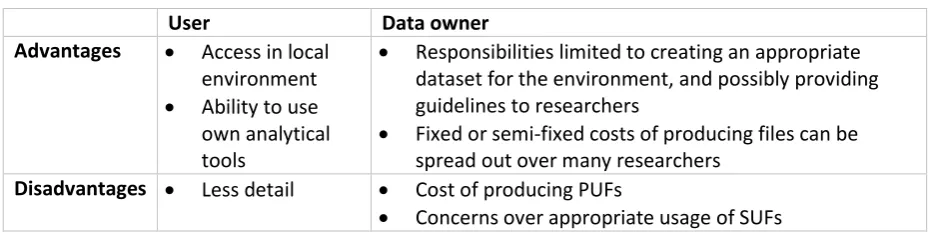
Table 2 Distributed data: summary of advantages and disadvantages
User Data owner
Advantages Access in local environment
Ability to use own analytical tools
Responsibilities limited to creating an appropriate dataset for the environment, and possibly providing guidelines to researchers
Fixed or semi-fixed costs of producing files can be spread out over many researchers
Disadvantages Less detail Cost of producing PUFs
Concerns over appropriate usage of SUFs
4.2.2
Distributed analysis 1: online or remote tabulation
Remote tabulation tools are designed to allow users to create their own tabulations of the data, rather than relying on the data owner’s choice of tables or bespoke tabulations. As well as data tables, homologous tools can produce geographical images or time series. What distinguishes these tools is that the output statistic is a simple linear value (sum, mean, index) broken down by
categories under the control of the user.
The value to the user of remote tabulation is twofold. First, it allows the user to have data presented in a useful form to his or her demands without needing to manipulate microdata. Second, it allows the data owner to present results from data which may be confidential and not suitable for release as microdata, but which nevertheless can produce secure tabulations.
There are many tools for displaying data using non-confidential data, but relatively few tools which can produce secure tabulations. Confidentiality is ensured in one of two basic ways; restricting the input or restricting the output.
To restrict the input, one option is to apply standard anonymisation techniques to the underlying microdata before analysis. This is the approach taken in the US Census Bureau’s Table Creator15, and appears to be the mechanism underlying the OECD’s online tabulation tool16. The assumption is that the data is near enough non-confidential. A slightly more flexible approach is to identify all
acceptable combinations of key variables (allowing for differencing between possible tables) and then only allow any analysis on the confidential data which uses an acceptable combination; this is partly the approach taken by the ABS’s CData system (now supplanted by TableBuilder).
Restricting output rather than input allows for more flexibility in table creation; the web tabulation tool at LISSY17 (see below) allows tabulations on the same restricted microdata access through its remote job service, and only redacts small cells. This does raise concerns about confidentiality breaches caused by differencing (different numbers of observations in tables with slightly different selection characteristics, allowing observations with distinguishing characteristics to be separated out). Standard rules-based output SDC (see below) cannot address this problem.
15
http://www.census.gov/cps/data/cpstablecreator.html
16
http://stats.oecd.org/.
17
26
The solution adopted by the ABS’ TableBuilder18 is to add a small amount of random noise to each table cell, so that the true value of the cell is uncertain (and the true difference between two cells is much more uncertain). To get round the objection of users that adding random noise makes results difficult to compare across tables, TableBuilder permanently attaches the noise to the cell using the combination of key variables to index the data. Thus the same table requested twice, or the same cell appearing in different tables, should appear the same. Whilst these concepts are not new, at present TableBuilder appears to be an outlier in implementing them in a production environment (rather than as an academic exercise)19.
Table 3 Remote tabulation: summary of advantages and disadvantages
User Data owner
Advantages Easy to manipulate data and get tables, maps, graphs etc. quickly
User friendly interfaces
Large number of off-the-shelf tools
Fixed cost of producing base dataset spread out over many researchers Disadvantages Limited to univariate statistics on
complex categories
Ongoing cost of the system
Need to create base dataset and apply some form of SDC
4.2.3
Distributed analysis 2: remote job servers
Remote job servers are a generalisation of remote tabulation tools to allow a range of statistical analysis to be carried out on a confidential dataset. Users submit code to the server (nowadays mostly through a web interface, but in some cases still through email), which runs the code on the data and generates results. These results may then be checked by someone to make sure there is no residual disclosure risk; if the outputs are acceptable, they are returned to the user. The RADL system developed by the ABS and adapted for New Zealand is an example.
The best example of a successful remote job server is the LISSY system supporting analysis of the Luxembourg Income Study (LIS)20. This has been providing a remote job interface for over a decade, and claims to have serviced over 50,000 job requests; recently a web tabulation tool was added to interrogate the same data.
In theory, the advantage to both parties is that the user can carry out unrestricted analysis without ever seeing the microdata, therefore meeting the goals of both sides. In practice this is not the case:
Users do in practice need to see the microdata (for example, when creating new variables); hence the ABS RADL allowed users to display a small number of records for checking purposes, but this meant the goal of not letting users see the microdata was not achieved.
Users need to see the results of analysis which might be confidential (for example to study outliers); again, if these are not blocked then microdata are visible to researchers.
18
http://www.abs.gov.au/websitedbs/censushome.nsf/home/tablebuilder
19
TableBuilder is currently being evaluated by Statistics Sweden as a potential service; see Andersson K., Jansson I., and Kraft K. (2015) Protection of frequency tables – current work at Statistics Sweden in UNECE/Eurostat Worksession on Statistical Data Confidentiality 2015, Helsinki
http://www1.unece.org/stat/platform/download/attachments/109248612/Session%202%20-%206%20-%20Sweden%20%28Jansson%29.pdf?version=1&modificationDate=1440606581076&api=v2
20
27
Developing and testing code is difficult (for example, when Stata fails it just gives an error code and does not return the line on which the code failed); hence researchers are restricted in their activity in practice, even if not in theory.
If code takes a long time to run, researchers may want to store intermediate versions of the dataset (particularly during development where mistakes are most likely to be made); this may not be possible.
The code-input system needs to be relatively tolerant of coding faults, and researchers need to be instructed on how to use reference the input data.
There is also an unresolved theoretical debate over whether code and outputs should be checked for inappropriate content and, if so, whether this should be ‘default-allowed’ or ‘default-blocked’. In the former, codes and outputs are allowed unless there is a reason to block them; this is likely to miss many cases of code or outputs which should not have been allowed. In contrast, the default-blocked position (only pre-defined commands and outputs are allowed) is likely to severely restrict user flexibility.
Finally, as noted below in the ‘People’ section, the remote job model relies upon researchers being trustworthy. In Australia this is particular problems, as two breaches of the RADL have made this contention hard to sustain21. In the worst case, a team of researchers systematically misused the facility over a period of time to download data to their own machines. Part of this has been
attributed to a breakdown in the relationship between the user community and the data owner, and two opposing lessons could be taken away from this. The first is that the environment needs to strengthened to prevent misuse; the opposite view is that the restrictions imposed by the environment created the behaviour they were supposed to deter.
For these reasons, remote job servers have largely dropped out of the frame for analysis; they satisfy neither user not data owner. The development path of Australia (and New Zealand) has not had a wider impact (although Statistics Canada has acquired and is adapting the ABS’ DataAnalyzer). The US Census Bureau and German NSI DeStatis have supported concept systems, but remote job servers have mostly been pushed out of the frame by virtual RDCs.
In this light it is worth considering why LISSY stands out as a counter-example. The consensus is that LISSY is successful because:
The data is relatively simple, well understood, and does not change dramatically; this helps with the development of documentation too.
There is a large and well-established user community.
The system takes a light-touch approach to user and confidentiality management (and yet still has an excellent record on maintaining security).
Finally, the LIS began providing remote access to analysis via email long before remote job or remote RDCs became available. It therefore had a large reservoir of goodwill when it developed its remote job solution, which has become ‘the way’ to access the LIS. This goodwill seems to have been difficult to replicate in other systems.
21
28
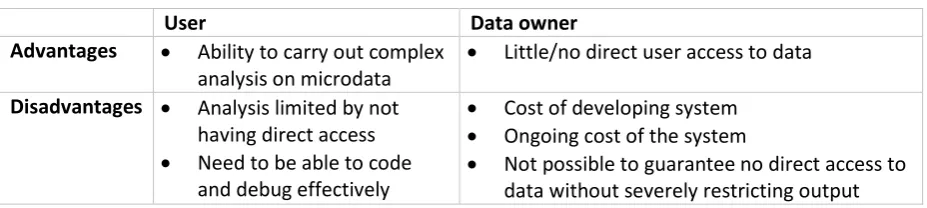
Table 4 Remote job server: summary of advantages and disadvantages
User Data owner
Advantages Ability to carry out complex analysis on microdata
Little/no direct user access to data Disadvantages Analysis limited by not
having direct access
Need to be able to code and debug effectively
Cost of developing system
Ongoing cost of the system
Not possible to guarantee no direct access to data without severely restricting output
4.2.4
Distributed analysis 3: RDCs and Remote (virtual) RDCs
Prior to remote access technologies, researchers were required to visit ‘Research Data Centres’, RDCs: sites located in the data owners’ offices (or controlled and monitored by them). In return for physical travel and isolation in a secure environment, researchers were given access to the most detailed microdata. Many statistical organisations set up such facilities; in some places (such as Canada) the academics took the initiative and secured funding to set up the secure facilities. In the US and Canada, geographical constraints were limited by having duplicate facilities set up in multiple locations under the direct supervision of Census Bureau or Statistics Canada staff.
In 2002 the Danish NSI set up the first virtual RDC (vRDC), offering the same facilities as an on-site system but accessible from the desktop of researchers across Denmark. This was quickly taken up across much of Europe with the UK, the Netherlands, and Sweden being early adopters, followed by Italy, Finland, Slovenia, NORC (US), and Mexico in the third wave. Most European NSIs, as well as the US, Canada, Mexico, South Africa and Japan, now have or are planning some form of vRDC system. Some countries have more: in Germany both DeStatis and the Employment Department research unit (IAB) run vRDCs, as did the Bank of Italy and IStat, the Italian NSI. In the UK vRDCs are run by ONS, the UK Data Archive, the Tax Department and a network of four universities; the latter are exploring doubling up for both social science and epidemiological research.
Almost all facilities use Citrix ‘thin client’ software (or the Microsoft clone, Terminal Services); the US Census Bureau uses Unix to achieve the same end. Most European government-run vRDCs cite the Danish/Dutch system as the mode for their technology. However, NORC is more often cited as the technical model for systems set up by academics.
The ‘virtual’ in vRDC relates to the way it can be used, not the way it is used. The Census Bureau and UK tax department only allow access from restricted sites; vRDC technology simplifies management but does not necessarily change the user experience. The ONS vRDC, the ‘Virtual Microdata
Laboratory’ (VML) allows access to users across the UK government network but not beyond. The UK non-ONS facilities allow access across the university network, as does the Danish system. The Dutch and French systems are unrestricted, although eligibility requirements for international access, for example, are stringent.
Despite this, there are various common features22 :
22
29
Most have institutional as well as personal agreements, and both parties are liable in the event of a breach.
Some RDCs make the same data available to all, whilst others restrict detail based upon organisation and user, separating the users into ‘classes’ based on the organisation they work for.
Most allow the most detailed data to be available to researchers (such as postcode); some even allow direct but uninformative identifiers, such as tax reference numbers.
Almost all provide training on security awareness, mostly through face to face or online courses rather than passive use of documents.
Almost all provide training on output checking and output SDC.
The growth of vRDCs has led to several changes in perspective. First, the level of control has allowed the detail of data to be increased. Second, the efficiency gains from principles-based output SDC (see below) have encouraged training which emphasise engagement. Third, engagement is also
encouraged because of the high cost of having untrustworthy users in the vRDC. Fourth, more control has increased confidence in allowing non-typical users (for example, private sector
organisations) to get access to data. Finally, the unrestricted nature of the research carried out in a vRDC has led to the new field of output-based SDC targeted specifically at research.
Two recent innovations have raised new possibilities for accessing secure data through vRDCs. The French research organisation Reseau Quetelet developed ‘secure thin clients’ to provide access to their vRDC. These patent-pending boxes were designed specifically so that they could be plugged in anywhere that was connected to the internet, and they would provide a secure end-to-end connection, using both password and biometric markers to authenticate. They have enabled France to become the leading provider of international access to a vRDC, and have also been adopted for the Eurostat “Decentralised and Remote Access to Confidential Data in the ESS project” (DARA), replacing the original plan to build a dedicated secure network23.
Secure Pod is a complete module, roughly six square metres, which is also designed to provide a secure facility for access to a vRDC24. Users enter the pod using a biometric key only at an approved time; only one user can be in the module at a time. The module contains a screen, keyboard, mouse and secure link, but nothing else, and is monitored by a remote camera connected the vRDC team. It was envisaged as the sort of thing that could be installed in a university library where access from a researcher’s desktop was not feasible or not appropriate for extra-risky data. At present these have not been widely adopted, partly because the underlying ethos of the module is that ‘the researcher can’t be trusted’; this is in direct conflict with the EDRU ethos adopted by the Administrative Data Research Network team behind the pods. Nevertheless, they remain an interesting option where exceptionally secure remote solutions might be needed.
23
http://ec.europa.eu/eurostat/cros/system/files/final_report_ESSnet_DARA_20140321_publishable.pdf_en
24
Dibben C.(2015) Micro, remote, safe settings (safePODS) – extending a safe setting network across a country in UNECE/Eurostat Worksession on Statistical Data Confidentiality 2015, Helsinki
30
Table 5 vRDCs: summary of advantages and disadvantages
User Data owner
Advantages Full access to data Very high level of control and monitoring possible
Disadvantages Location may not be convenient
Some researchers resent restrictions on uploading and downloading
Cost of developing system
Ongoing cost of the system
4.2.5