Knowledge Distribution and the Effect of Design Tools
on the Design Process
Mina Tahsiri, Jonathan Hale and Chantelle Niblock University of Nottingham,U.K.
This paper compares the cognitive performance of architecture students when designing tasks using one of the three design tools: pencil and paper, software Sketch Up and Rhinoceros 3D. It questions if a design tool can affect when knowledge is generated and used in the duration of design ac-tivity. This is explored through a protocol ‘think aloud’ study for which a new coding scheme was developed. The methodology is grounded on the theory of Distributed Cognition and Zhang and Norman’s (1994) method of ‘representational analysis’, based on which, knowledge is either ‘inter-nal’ in that it is actively memorized by the designer or is ‘exter‘inter-nal’ in that it is implicitly made available via a stimuli like a design tool. Using an Analysis of Variance (ANOVA) test, for the five participants of this study, external knowledge generated significantly earlier on within the process when using Sketch Up compared to the other two tools.
Introduction
2
knowledge being one of them, to control the operations and implement re-quired changes. As is explained by Edmonds (5), a knowledge-based crea-tive system makes use of knowledge to further revise and refine
knowledge. These accounts suggest that knowledge is not only a structural component of the system, but a product of the processes and also an opera-tional tool. Therefore how knowledge is created, particularly in the earlier stages of a design process, can be said to influence the designer’s evalua-tion on the fitness of their ideas as they unfold (4, 6, 7). Arguably it will also have semantic implications, as it will both affect the issues the design-er attends to and the depth and gendesign-erality of their application (1, 8).
The initial stages of a design process are important in cohesively fram-ing the task as it enables deliberation over a wider breadth of issues before committing to the details (9). To ensure this good practice, it is common in design schools to encourage students to spend a good chunk of their time in framing the problem as best as they can, early on in the process. It has been reported that students that succeed in this section are more creative in their productions (1). This approach reinforces a notion that the earlier
knowledge is exerted, the more impact it will have on the structure of the task space.
Respectively this paper questions whether a design tool can control the design process by affecting how knowledge is distributed throughout the duration of the design process. It questions where along the process, the mean distribution of knowledge falls if a designer was to conduct a task us-ing one design tool compared to another. It then examines design behav-iour under the influence of the design tool that enabled the earlier average occurrence of knowledge.
Given the importance of the topic for design education, five final year architecture students from the University of Nottingham were chosen to participate in a ‘think aloud’ protocol design experiment. The experiment required each student to conduct three similarly structured tasks, each time with one of the design tools assigned to that task. These design tools were pencil and paper, software SketchUp and Rhinoceros 3D.
Design tools, knowledge and Distribute Cognition
3
theory of Distributed Cognition, which defines cognition as a phenomenon extending the boundaries of the skull and the mind, into the environment. Based on this theory, cognition is distributed across people, artefacts and time involved in the execution of a task (12). The manifestation of cogni-tion into the world is therefore a refleccogni-tion of an aggregating contribucogni-tion of all its components and not just processes in the ‘mind’.
Notably, the accumulated knowledge which the mind holds, is argued by environmental psychologists to be informed by the experience of perfor-mances in the real world. Noe (13) asserts that our knowledge, is not only determined by what is done but also our know-how for doing something. This denotes that in thinking, we incorporate both perception of the past and future into the instantaneous present. To explain how future actions can inform present knowledge, Grafton et al’s (14) study is relevant. Their study showed that just the naming of the ‘use’ of a tool has motor valence and effects cognitive processes. Dartnall’s (15) philosophical account also helps understand this further. He states that the world sometimes leaks into the mind, in the sense that we can deploy our sensory abilities offline. Therefore designers can structure their task space and predict their course of action by their knowledge of the tool. In this regard Jonson’s (16) study demonstrated how the structure in which digitally native designers attend to design differs from its traditional alternative. He reports that these de-signers use verbalization rather than freehand sketching as a conceptual tool in the early stages of their process.
On the other hand it could also be claimed that the knowledge a design-er brings to the process holds a preconception of a manndesign-er of pdesign-erformance. Arguably for most designers this would be the knowledge accumulated through conducting design tasks via freehand sketching, particularly since it is the method employed by many design schools in the early years of ed-ucating students. In this regard, an alternative explanation could be provid-ed for studies such as that conductprovid-ed by Bilda et al(17) where they com-pared the performance of designers when freehand sketching and when blindfolded (using imagery) and concluded that the actual physical activity of drawing made no significant difference in the overall outcome of the process. Similarity in the designers’ cognitive performances could in fact be due to deploying their knowledge of freehand sketching both times re-gardless of using imagery or an actual pencil to design.
4
Methodology
In acquiring insight into designer’s knowledge, it is common in design studies to rely on the designer’s verbalization which is the basis of the pro-tocol study methodology. In this methodology, verbal utterances and de-sign actions of structured tasks are segmented and coded based on a coding scheme. The coding scheme provides an ontological perspective of the de-sign process and therefore allows for a specific analysis of cognitive activi-ty (18, 19). The ‘think aloud’ method was chosen over retrospective ver-balization to obtain a direct correspondence between thought content (knowledge) and immediate actions.
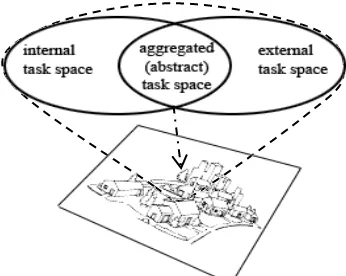
Presuming that design can be seen as a distributed cognitive activity, the structure of the tasks for this study had to be designed in a way that ena-bles the knowledge provided (through verbalization) to be further catego-rized into its ‘internal’ and ‘external’ components. The internal compo-nents are retrieved from internal memory (the mind), in other words what is memorized and the external components from external memory (the de-sign environment), for example through drawing with the dede-sign tool. The
knowledge the designer manifests through verbalization and/or drawings are an aggregated and abstract representation of processes within both of these task spaces. Figure 1 provides an illustrated diagram of this concept.
[image:4.595.209.382.419.557.2]5
ods, either focused on internal structure, or when taking external structure into account, failed to separate them from internal structure. Therefore they insist on the importance of “decomposing the representation of a task into its internal and external components so that the different functions of internal and external representations can be identified”(20:89).
Respectively studies conducted thus far on the effect of design tools on the design process suggest that the overall quality of the design process, in terms of idea productivity and frequency of attending to design issues is not significantly affected by the design tool used (17, 21). Therefore it is suggested that should a design tool affect cognition it will be more on low-er level activity such as plow-erception or physical activity rathlow-er than concep-tion(22). However it may be that we are facing a similar issue as that iden-tified by Zhang and Norman (20) regarding analysis methods used in cognitive science studies. Similarly it can be argued that in the context of a design experiment, when a designer conducts similar tasks with different design tools, they compensate for the micro internal and external changes in a way that the overall aggregated structure is not significantly affected.
Alternatively Zhang and Norman (20) propose a method called ‘repre-sentational analysis’. In their account, a task comprises of a series of rules and the structure of the task space represents the relationships between these rules. In the process of solving a problem, the problem solver thus applies these rules to progress towards the solution. To enable use of their method, they structure the tasks of their study so that some of the require-ments require active attention and memorization, which they label as “in-ternal rules”. These rules are explicitly made available by the conditions of the task. On the other hand some of the requirements are arranged to be implicitly made available by the internal rules or conditions of the task and therefore do not require to be memorized. This category is labelled as the “external rules”. In this research a similar approach is employed, based on which a three phase design task and a coding scheme is proposed. The de-sign processes will then be compared and analyzed at the level of the ag-gregated, internal and external task spaces.
Hypothesis
6
effect on the overall cognitive activity measures (17, 21). On the other hand the expectancy is to find differences at the level of internal and exter-nal task spaces. In particular, the research is interested with differences in the mean knowledge distribution in the external task space, where
knowledge exclusive to the situation of that particular task is generated and put to use.
The design experiments
Each participant was required to conduct three tasks, each with its own assigned design tool. To ensure that performances in each task were com-parable to one another, the three tasks all had the same structure but repre-sented in different contexts. This means that the requirements in the briefs were the same, but displayed differently so that the designer is under the impression that they are designing a totally different task each time. There was a two week break in between the time each task was taken to ensure that the information learnt in one task does not affect the next. Also, to compensate for the possible affect that the order in which tasks are taken in can have on the results, the order each participant executed the tasks was randomized.
It has been reported that designers’ individual approach and their exper-tise affects the process (23). What is suggested here is that each designer would read and interpret the requirements of the task differently. This calls for a mechanism through which an understanding of the mental model the designer creates from the briefing information is obtained and later used as a reference to analyse the distribution of knowledge in the duration of ac-tual design activity. Therefore each task was comprised of the following three phases:
1- Briefing phase: Participants were asked to watch a short three minutes video clip which display a walk through in the 3D model of the site and explained the brief to them. They were asked to listen and watch carefully. They were then given one minute to recite as much of the infor-mation that they had managed to memorize or pick up from the contextual information.
other-7
wise it is forgotten (24).The participants were also asked to talk about which information is important to them and why. This enabled an under-standing of their rationale in interpreting and analysing, which would make judging the process easier. This phase lasted about five minutes.
Together these two phase enable the participant to construct a mental model which withholds the primary knowledge they will take onto to the design phase.
3-Design phase: In this phase, all the documents except for the plan were taken away from the participants. They were given 40 minutes to de-velop a concept only using the tool provided and on the 3D model of the site pre constructed for them. They were specifically asked to plan their time so no process lasts any less than 30 minutes to ensure fairness of comparison. The removal of the written brief and other documents allows the information that is inputted into the process to be controlled.
The tasks
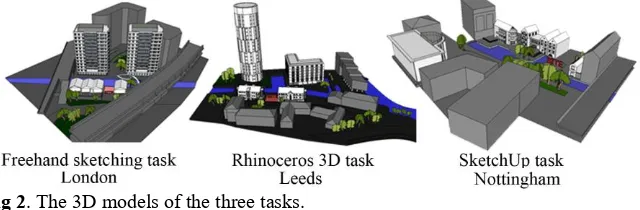
The tasks asked for a small cultural center on a square shaped site in close proximity to a river and boxed in by east and west neighbors. The freehand sketching process was located in London and asked for the design of an exhibition hall. The Sketch Up process was located in Nottingham and asked for a performing arts center. The Rhinoceros 3D task was locat-ed in Lelocat-eds and requirlocat-ed the design of a public atrium and reading hall. Figure 2 illustrates the 3D models of each site.
All tasks were located on sites in the UK, where the participants had more cultural familiarity with. This had proved to be an important factor in a similar pilot study conducted previously, where the task was set in Vi-etnam and the participants struggled because of the lack of precedent knowledge.
The tasks were designed based on design issues the researchers had known students at the University of Nottingham to have had practice in. Therefore all tasks were centered on incorporating maximum diffused day-light. Each task required one main central space which would cover the
[image:7.595.139.459.457.562.2]8
tire ground floor of the site and had to be the most public place of the building. Other complementary smaller spaces that were more private were also needed. A few of these spaces did not need any natural daylighting, such as film and documentary show room for the Rhinoceros 3D task for example. All tasks had the same height restriction. Therefore participants were encouraged to locate the required functions in a creative way that al-lows each space to receive its required light while maintaining a meaning-ful narrative in how the building denotes its overall function.
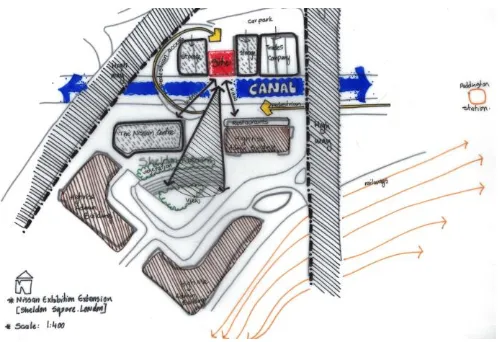
Figure 3 presents an example of the site plans given to the participants. Notably to ensure that the information that can affect external knowledge is similar across the tasks, participants were provided with plans that had been stripped down to some essential information, presented in the same way. This was also the case for the 3D models of the sites. All the architec-tural elements in the site such as windows had the same details across the tasks.
Participant recruiting
A call for participants was sent to final year students in the Diploma Ar-chitecture Programme at the University of Nottingham with experience in using the three tools and confidence in developing a concept in those me-diums. Out of the volunteers, the suitability of candidates was conferred with two lecturers who knew each student’s design skill level. All the stu-dents had undergone their undergraduate degree at Nottingham and so came from the same education background. The shortlisted candidates were then invited to an introductory workshop on how to ‘think aloud’,
[image:8.595.174.423.341.512.2]9
they were given short five minute tasks to accomplish using the software Rhinoceros 3D to practice thinking aloud.
Why the three tools: Pencil on Paper, Sketch Up and Rhinoceros 3D
In this study, the researchers chose to compare designing with pencil on paper, Sketch Up and Rhinoceros 3D. The latter two are 3D modelling software, which architecture students at the University of Nottingham of-ten use to assist them in developing initial design concepts as an alterna-tive to freehand sketching. These three tools were mainly chosen because of their fundamental differences in how they allow lines and shapes to be manipulated. The speculation is that each method of manipulation will conjure a different mind-set and potential for intervention and this will be the base cause of difference in the distribution of knowledge across the cognitive system.
For example when a designer freehand sketches on paper they inscribe lines into the material surface of the paper. That line is a true, scaled repre-sentation of the object it intends to be and its properties remain constant. If they choose to omit the line and rub it out, somehow the indentation will leave its trace behind. With another tool such as Sketch Up, lines are more like narrow sticky tapes. They can be picked up and moved around and if one line is drawn over the other on the same plane, it will dissect the first line into pieces; basically it will stick to it. A continuum of lines leading to a closed shape on one plane will always lead to the appearance of an opaque surface, suddenly making that shape more apparent than any other drawing in the medium. In Rhinoceros 3D however, lines are more like rubber band, they have topological properties and can be stretched, pulled and freely manipulated.
Analysis
The coding scheme
10
Table 1 A knowledge based, process oriented coding scheme
Category Name Description
Analysis Primary Internal Rule (IRpx)
Rules created directly from reading the de-sign brief for the first time, without any drawing taken out
Generated Internal Rule (IRgx)
Rules created as a result of evaluation
Modified Internal Rule (IRmx)
Rules from the previous design instances modified as a result of evaluation Primary Expected
External Rule (ERpx)
Implicit Rules in the design brief, driven from the primary internal rules. (rules oth-er than the intoth-ernal rules which justify the designers proceeding actions)
Generated Ex-pected External Rule (ERgx)
Implicit Rules created as a result of eval-uation
Modified Expected External Rule (ERmx)
Implicit rules from the previous design in-stance modified as a result of evaluation
Synthesis Applied Structural External Rule (ERsx)
Drawing ac-tions leaving a mark on the representational medium as rules
ERs1-closed lines
ERs2-Open ended lines
ERs3-Appearing lines
ERs4-continuous closed
lines
ERs5-continuous open
ended lines
Potential Structural External Rule
Drawing action or bodily actions (eye movement/hand movement) not leaving a mark or actions executed mentally Evaluation Transformed Image
evaluation (ERs’1)
When no new rule is added to the task space but an action is executed. These are evaluation actions occurring [immediately] after an element has been depicted and do not involve the drawing of lines.
Primary Image evaluation (ERs’2)
When no new rule is added to the task space but a drawing action is executed on the current configuration (design) and usu-ally happens concurrently with the act of drawing an element.
Task Space evalua-tion (ERs’3)
11
Coyne et al (4) discuss that a design system consists of five sets of com-ponents: “Designs”, “Vocabulary of Elements”, “Knowledge”, “Interpreta-tions” and “Contextual Information”. A synthesis of these components can generate new knowledge. Newly generated knowledge needs to be evaluat-ed for its fit in the design. As a result this may induce structural changes in the relationship of other components, which therefore encourages an anal-ysis of the overall structure. In this light Coyne et al (4) indicate that the design system’s potential for creativity can be strongly connected to mo-ments of induction of knowledge.
Respectively, in this scheme, the role of the synthesizer is relegated to the design tool in use, in that the tool enables knowledge to be expressed through the tool’s specific vocabulary of elements and via the designers’
drawing actions. “Evaluation” processes can also be executed through the medium of the tool. An example of which can be rotating a design artefact while thinking. Both “Synthesis” and “Evaluation” actions of such can be regarded as external in that they are readily available and do not require memorization and also structural as they contribute to the generation and modification of knowledge.
The “Synthesis” actions are also further divided based on drawing ac-tions. The intention was to base the division on a language common to drawing regardless of the design tool used. Therefore the most primitive token by which all design action can be describes was chosen: lines (25, 26) The different line type categories in this scheme denote an understand-ing of the degree of certainty the designer displays while dounderstand-ing that act. For example when a designer is certain about an idea, this is almost always illustrated by a crisp line with two definite end points.
The subdivision of the “Evaluation” actions is temporal. It reflects the scale of evaluation by revealing whether that action occurred concurrently to a drawing action or after. It is also notable that some “Synthesis” ac-tions, namely those conducted in the mind are not codable using this scheme, as analysis must be based on what is observable and represented through verbalization or actual physical activity.
Method of analysis
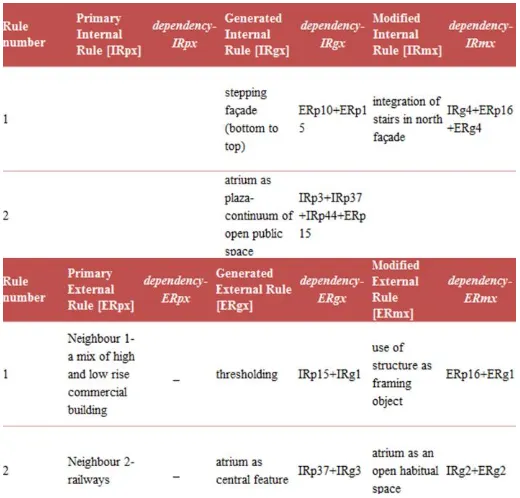
For every recorded process a code reference list based on the first two phases of the experiment was made. A partial example of the code refer-ence list for one participant can be seen in Figure 4. This is then used by the coders to interpret which segments embrace which rules. Table 2 shows two coded segments with the code reference list from Figure 4, where the coding of rules IRg2 and ERg2 can be seen in action. Where ever
12
[image:12.595.174.434.176.425.2]In segments where there is more than one rule used they are placed in the order they occur from left to right separated by the > sign.
Table 2 An example of two coded segments
Verbal utterance Rul e co d e (i n te rn a l) Rul e co d e (e x te rn a l) Rul e co d e (str u ctu ra l ex te rn a l) S eg m en t d ista n ce fr o m sta rt o f p ro ce ss
or maybe or maybe it could become a multi-functional space. [moves cursor to explain]
_ Erg1 ERs’3 18
And erm, then I need to create this vertical link between the atrium and library, and er,[moves cursor as if drawing, zooming in and out] let me just, because it’s all square and erm, and we have this solid wall, I will place them,[goes to plan view port and moves cursor to explain] the stairs in the, sort of middle, but not exactly central but the, in the middle of this solid wall. Just see what hap-pens, it’s just kind of idea of, I guess right now.
IRg2 >IR p34
ERp6>
ERg2
ERs’3>
ERs’3
19
[image:12.595.133.468.484.682.2]13
For the comparison of knowledge distribution, the variable was the number of segments each rule is distanced from the beginning of the de-sign stage. The means and standard deviations of the distributions for each participant’s tasks were calculated regardless of the rule type, for all three task spaces: internal, external and the aggregated. However since segments were not of equal time length across participants, the data necessary for analysis (the mean and standard deviations) was re-expressed in terms of the percentage of time passed when they occurred in their process. The aim was to underpin possible significant difference in the mean knowledge dis-tribution based on the design tool used. Therefore a one-way ANOVA (Analysis of Variance) test using IBM SPSS 21 was utilized here.
To not violate the assumptions of the ANOVA test, gaining assurance of the normality of the data was required. The Shapiro-Wilk test was used for this purpose. Also the homogeneity of variance of the means had to be checked for which Levene’s test(27) was used. Where the ANOVA indi-cates a significant difference at a level of α=0.05, this was followed up by a pairwise comparison applied through the LSD (Least Significant Differ-ence) post-hoc test to determine where within the data the difference lies.
Analysis was conducted at these levels: aggregated task space, Internal task space, External task space and External task space (new rules only)
It is also notable that due to a small study group (15 experiments) the in-tention was not to generalize findings from this study. The ANOVA was utilized only to show that a difference in the means of distribution, is a dif-ference that is considerable and worth further investigation.
[image:13.595.156.435.545.668.2]Results
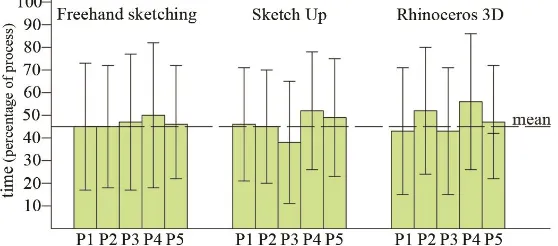
Figure 5 displays the mean knowledge distribution of the 15 processes at the level of the aggregated task space, where the error bars represent the standard deviation.
14
On average, in all processes regardless of the tool used or the partici-pants’ individual approaches, the mean knowledge distribution occurs just under half way within the process, at 45%. Each process on average also held a standard deviation of 28%. This fairly wide clustering of knowledge
around the mean indicates that participants are cognitively active out the process. A closer look at the distributions showed that all through-out the process, the participants managed to generate new knowledge.
Therefore it was not just the case that the creation of new knowledge were dedicated to a specific interval within the process. This alternation between reuse and generation of knowledge would thereby suggest that an executed action through the use of the design tool has a contributing role.
Based on the Shapiro-Wilk test, processes conducted with each tool rep-resent a normal population (null hypothesis rejected since p value> α=0.05
for each tool. The p values are; freehand sketching:0.71, SketchUp:0.80, Rhinoceros 3D:0.37). The 15 processes also indicate a homogenous popu-lation using Levene’s test (null hypothesis rejected with a p value of 0.34). Having passed these two tests, the ANOVA can be applied.
Studying Figure 5, the effect of the participants’ individual differences is also more apparent in tasks executed using the 3D modelling software, whereas in the freehand sketching process their performance in terms of
knowledge distribution is very similar. However the ANOVA shows the differences at this level of analysis, to be insignificance (null hypothesis accepted with a p value of 0.75). Therefore the tool has no significant ef-fect on the overall (aggregated) cognitive process.
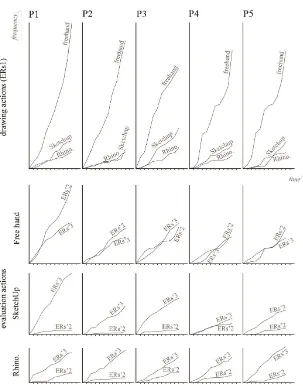
However it was still of interest to this study to understand why the par-ticipants’ performance in freehand sketching were more similar and con-sistent compared to the other two. Therefore, three categories of their de-sign actions were further observed; ERs1-the drawing of closed lines,
which displays certainty in the participants’ decision making; ERs’2-
eval-uation concurrent to a drawing action, which displays constant considera-tion of small scale spatial relaconsidera-tion; ERs’3-evalaution of the overall task
space, which represents consideration of fitness of ideas with the require-ments and large scale spatial relation. Figure 6, shows that all participants, were noticeably evaluating their concurrent actions more in the free hand sketching process. They were also excessively engaged with drawing ac-tions using this tool. In the case of the 3D modelling tools, there is propor-tionally more evaluation of the task space compared to the amount of lines drawn.
15
small scale options by excessive drawing (rapidly re-drawing over an al-ready depicted shape) without simultaneously being concerned about the effects of the actions on the overall configuration. However using the other tools, constant concern about the overall configuration (which is encour-aged through the possibility of zooming in and out for example), means that each drawn line plays more of an importance within the overall picture of the design. Therefore the participant only commits to drawing that line when assurance of its necessity is reached. In this sense, as each drawing action using these tools would bear more semantic value, it can also dra-matically change the structure of the design process compared to when
[image:15.595.146.449.143.529.2]16
freehand sketching. As a result more divergence between participants us-ing the 3D modellus-ing software can be expected.
The first part of the study shows that regardless of differences in ac-tions, participants had regulated their processes so that the overall mean
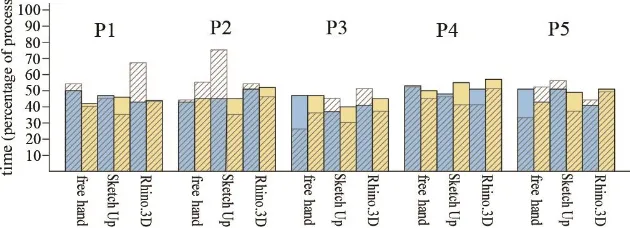
knowledge distributions were not affected. The second part of the study re-quires looking at whether the effect of these differences can be picked up when analysing distributions within internal and external task spaces. Fig-ure 7 illustrates the findings. When comparing the mean knowledge distri-bution of all rules in the internal and external task spaces the ANOVA in-dicated no significance difference (internal task space-p value: 0.39, external task space-p value: 0.37) However when we conducted a filtered analysis on the moments new rules were introduced, the differences be-tween the mean knowledge distribution across the two task spaces for each process were more dramatic (the hatched areas in Figure 7).
In analysing the differences in the distribution of new rules across the task spaces, there was a case of violation of normality for the mean
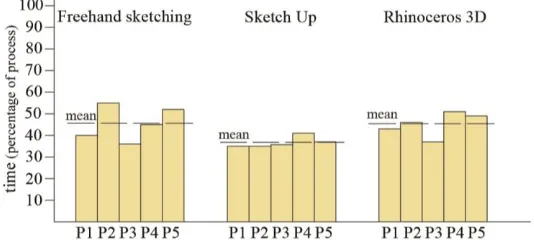
knowledge distribution of new internal rules, so we further looked to test the ANOVA for differences in the mean knowledge distribution of new ex-ternal rules only. Here, it was shown that there is a significant difference (p value: 0.04). The LSD post-hoc test, showed this difference to lie within the mean knowledge distribution when comparing freehand sketching to Sketch Up, and Rhinoceros 3D to Sketch Up but not in between Rhinocer-os 3D and freehand sketching, which is reflected in Figure 8.
This would imply that in design, the elements external to the task such as the design tool and the environment it creates for design do affect the process. For these participants, the fact that Sketch Up significantly entices external knowledge generation (which was discussed to be dependent on
[image:16.595.143.458.334.448.2]17
the tool in the case of this study) early on in the process, together with the semantics that as described drawing actions bear, means that this tool has had more of an impact of the structuring of the process and how ideas are defined.
Discussion
Based on the results, the question of interest for further discussion is on how design behaviour using Sketch Up in the earlier stages of the process differs from that conducted using the other two tools. Achieving a neat de-sign- that is one where drawings do not lead to frustrating issues, such as surfaces not forming in the same plane or objects becoming integrated into other objects unintentionally- using Sketch Up requires attention and plan-ning. Using this tool- more than the other tools- the designer is encouraged to break down the process based on the affordance of the workspace, be-cause the cost of errors can be quite high. Errors impose hindrance in the creative process and the sequential flow of ideas (28). Retrieving from a mistake in free hand sketching requires less effort and time and therefore an inappropriate decision would not affect the process as much as it would using Sketch Up.
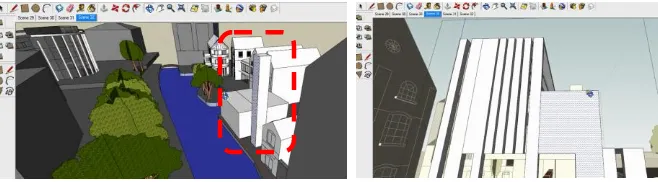
Therefore as observed in this study, to ensure sound decisions, the par-ticipants relied heavily on contextual information made available to them when using Sketch Up. Objects were often created as visual references to help the participant not diverge from the domain which they believed will yield in their desired design concept. An example of this can be seen in participant Jon’s process in figure 9.
What is postulated in this paper is that how the visual information at each moment is framed also affects the process. In Sketch Up the designer works on one 3D canvas, constantly exposed to all information. In free-hand sketching, only so much can be depicted in each perspective drawing
[image:17.595.160.427.207.327.2]18
or on one canvas. Therefore the designer can assess and read the infor-mation more effectively because the load has been broken down. Some times it is easier to solve superficial and present issues first before attend-ing to more complex issues. Workattend-ing on one canvas, holds the designer back from focusing on delving into the deeper issues as there are many trivial issues that can be attended to. There is a tendency in designers to shift between frames or to minimize the frame so that it can help them fo-cus on a small cluster of information at each given time. In this respect Rhinoceros 3D’s provision of four view ports is more effective than Sketch Up. Figure 9 shows instances when Jon has zoomed in to exclude contex-tual information in Sketch Up so as to focus on a specific issue.
In the case of this study, interestingly new knowledge distribution for both free hand sketching and Rhinoceros 3D process was the same. How-ever as discussed, these tools provide different workspaces and encourage different methods of manipulation. This suggests that different methods of manipulation can be isomorphs of one another, meaning that we do not necessarily require the assistance of intuitive or physically tangible tools such as pen and pencil to aid creative thinking. Therefore it can be con-cluded that tools have a cognitive role in the design process which goes beyond the physical nature of the tool. The change they apply is in the breaking down of the process and affordance for effectively handling in-formation.
Conclusion
This paper looked at how design processes can be affected by the tools used to execute them. The study was limited to a small sample size. There-fore, the findings are not considered to be truly representative of what hap-pens in design processes. However, it did manage to show the necessity of decomposing cognitive activity into its internal and external components for an effective study of differences in processes under the influence of varying external conditions.
[image:18.595.136.465.137.228.2]19
A new coding scheme was also introduced based on the theory of Dis-tributed Cognition that can be used in protocol design studies, where the role of tools is incorporated into the structure of the scheme. The scheme assisted in categorizing the knowledge used in the process as a series of rules. Studying the distribution of knowledge (rules), the results suggested there to be no significant difference between the tools when processes are compared at level of the aggregated task space. Research in this field, is currently focused on analysis at this level. However a significant differ-ence was in how the tools had affected the introduction of new knowledge
within the external task space.
The main argument here was that the reason for such outcomes, sur-passes differences in the physicality of the tools. The tools afford different controlling qualities in the decision making structure and incorporation of information available to the designer, which affects creativity by determin-ing when and how new knowledge is introduced to the process. Acknowl-edging this conclusion, we can investigate how different methods of ma-nipulation can result in isomorphs for a creative cognitive system.
References
1. Dorst K, Cross N (2001) Creativity in the design process: Co-evolution of problem-solution. Design Studies 22(5):425–437
2. Maher ML, Poon J (1995) Co-evolution of the fitness function and design solution for design exploration.in Evolutionary Computation, 1995 IEEE Conference on 1:240
3. Gero JS, Fujii H (2000) A computational framework for concept formation for a situated design agent. Knowledge-Based Systems 13(6):361–368 4. Coyne RD, Rosenman MA, Radford AD, et al. (1987) Innovation and
crea-tivity in knowledge based CAD. Expert Systems in Computer Aided Design 435–465
5. Edmonds EA (1993) Knowledge-based systems for creativity. Modelling Creativity & Knowledge-based Creative Design 259–271
6. Coyne RD, Gero JS (1986) Semantics and the organization of knowledge in design. Design Computing 1(1):68–89
7. Goel V, Pirolli P (1992) The structure of design problem spaces. Cognitive Science 16(3):395–429
8. Suwa M, Gero JS, Purcell T (1998) Macroscopic analysis of design pro-cesses based on a scheme for coding designer's cognitive actions. Design Studies 19(4):455-483
20
10. Baber C, Parekh M, Cengiz TG (2014) Tool use as distributed cognition: how tools help, hinder and define manual skills. Frontiers in psychology 5:1–14
11. Clark A, Chalmers D (1998) The extended mind. Analysis 58(1):7–19 12. Hollan J, Hutchins E, Kirsh D (2000) Distributed Cognition: Toward a New
Foundation for Human-computer Interaction Research. ACM Transactions on Computer.-Human Interaction (TOCHI) 7(2):174–196
13. Noe A (2006)Action in perception. The MIT Press, Cambridge: Mass. 14. Grafton ST, Fadiga L, Arbib MA, et al. (1997) Premotor cortex activation
during observation and naming of familiar tools. Neuroimage 6(4):231–236 15. Dartnall T (2005) Does the world leak into the mind? Active
external-ism,"Internalism" and epistemology. Cognitive Science 29(1):135–143 16. Jonson B (2005) Design ideation: the conceptual sketch in the digital age.
Design Studies 26(6):613–624
17. Bilda Z, Gero JS, Purcell T (2006) To sketch or not to sketch? That is the question. Design Studies 27(5):587–613
18. Dickson J, Mclennan J, Omodei MM (2000) Effects of concurrent verbali-zation on a time-critical, dynamic decision making task. The Journal of General Psychology 127(2):217–228
19. Ericsson KA, Simon HA (1993) Protocol analysis verbal reports as data. The MIT Press, Cambridge: Mass.
20. Zhang J, Norman DA (1994) Representations in distributed cognitive tasks. Cognitive Science 18(1):87–122
21. Yu R, Gero JS, Gu N (2013) Impact of using rule algorithms on designers' behavior in a parametric design environment: Preliminary results from a pi-lot study. Global Design and Local Materialization 13–22
22. Tang HH, Gero JS (2001) Roles of knowledge while designing and their implications for CAAD. in Proceedings of CAADRIA 1:81-89
23. Eisentraut R (1999) Styles of problem solving and their influence on the de-sign process. Dede-sign Studies 20(5):431–437
24. Gazzaniga M, Ivry RB, Mangun GR (2014) Cognitive neuroscience: The biology of the mind. W. W. Norton & Company Ltd, New York
25. Arnheim R (1977) The Dynamics of Architectural Form: Based on the 1975 Mary Duke Biddle Lectures at the Cooper Union. University of California Press, London
26. Mitchell WJ (1990) The logic of architecture: Design, computation and cognition. The MIT Press, Cambridge: Mass.
27. Spiegel MR, Stephens LJ (2008) Schaum’s outline of statistics. 4th ed. McGraw-Hill