BUILDING INFORMATION MODELLING (BIM) CAPABILITY AND DELIVERY SUCCESS ON CONSTRUCTION PROJECTS
ABDUL-MAJEED MAHAMADU1*; LAMINE MAHDJOUBI1; COLIN BOOTH1; PATRICK MANU1; AND EMMANUEL
MANU2
1Centre for Architecture and Built Environment Research, Department of Architecture and the Built
Environment, Faculty of Environment and Technology, University of The West of England, Bristol, BS16
7NQ, UK. *Corresponding Author Email: [email protected]
2school of Architecture Design and the Built Environment, Nottingham Trent University, Nottingham, NG1
4FQ, UK
Construction Innovation:
Information, Process, Management Journal
Purpose: Despite emerging research on Building Information Modelling (BIM) capability assessment, there is a general dearth of knowledge about the links between often pre-emptive
capability measurement attributes and actual delivery success. More so, current studies have
not considered success from the wider construction supply chain (CSC) perspective. So far,
the perceived importance of capability metrics is not based on post-project evaluations of their
contribution to BIM delivery success. This research identifies 28 relevant BIM capability
attributes used for qualifying CSC organisations for projects, as well as investigates their
relative importance and influence on some key aspects of BIM delivery success.
Design/methodology/approach: Based on heretofore validated set of BIM capability attributes from semi-structured interviews and a Delphi study, a survey of CSC firms on
BIM-enabled projects was used to model the influence of BIM capability attributes on BIM delivery
success. Multiple regression modelling was performed to ascertain the nature of the
relationship between BIM capability attributes and key aspects of BIM delivery success as
identified from the literature.
Findings: BIM staff experience and the suitability of proposed methodology prior to project commencement were identified as the most influential on BIM delivery quality, as well as
delivery within schedule and on budget. Conversely, the administrative and strategic level
capacities were found as the most influential in leveraging collaboration, coordination or
Originality/value: This study provides a step change in prioritizing BIM capability criteria based on evidence of their contribution to delivery success in key performance areas rather than their
perceived importance as capability metrics as widely practiced.
Introduction
Building Information Modelling (BIM) has become a pre-requisite on many construction projects and is
expected to eliminate information flow inefficiencies through virtual collaborative technologies (Arayici et
al., 2012). The Construction Supply Chain (CSC) is expected to evolve in terms of their capacity and
competencies in BIM-based processes and technology use in order to succeed in the delivery of projects.
Despite the emergence of several frameworks for measuring BIM capability, it remains unclear which
capability attributes are most relevant and responsible for successful delivery of BIM (Succar et al., 2012).
In this study ‘capability attribute’ is used to describe criteria that denote the maturity and capacity to
deliver BIM tasks competently and successfully. The assessment of BIM capability has often been
pre-emptive with a general lack of empirical justification for selection of relevant capability criteria or attributes
(Kam et al., 2013b; 2014; Smits et al., 2016). However, given an increase in the number of projects using
BIM over the past decade (BIS 2013a; NBS, 2016), there is sufficient basis for examining the influence
of the most widely used BIM capability measurement attributes on successful delivery of BIM.
Furthermore, the success criteria examined must include important CSC performance resulting from BIM
use on construction projects. This will enable the identification of potential differences and peculiarities
across different CSC organisational and project profiles. In summary several different criteria have been
promoted for use in evidencing the ability to deliver BIM in existing studies. None of these studies have,
however, specifically looked at the influence of the proposed criteria on actual BIM delivery success of
projects in order to aid more informed prioritisation of capability attributes during assessments.
To address the identified gaps, the most critical capability attributes being used to assess the BIM
capability of firms were identified and prioritised. The prioritisation was based on the attributes’ perceived
contribution to the successful delivery of BIM with specific focus on supply chain success through BIM
as well as BIM delivery quality, within schedule and cost. The assessment is based on the impact of
these attributes on specific BIM delivery success areas identified from the literature and relating
specifically to the CSC context of BIM use.In the following sections, a review of literature relating to BIM
capability and delivery success is first presented. The research methodology applied in the study is then
outlined. Subsequent to this, the research findings, their discussion and concluding remarks are
presented.
BIM Capability and BIM Delivery Success
According to Holt (1998) and Doloi (2009), the main premise on which an organisation should be selected
for projects must be their likelihood to succeed or meet the project objectives. Thus, any efforts towards
assessing BIM capability of a CSC organisation (for project pre-qualification or selection) must be
premised on an understanding of the actual influence of the capability attributes measured on the
likelihood of success (Mahamadu et al., 2017). Project success is generally described as attainment or
of BIM maturity in project performance generally (Smits et al., 2016), there remain no studies specifically
looking at BIM delivery success, especially in the CSC context. Emerging standards, frameworks and
tools provide a basis for identifying appropriate BIM capability or qualification criteria for selecting CSC
organisations on BIM-enabled projects (Succar, 2009; van Berlo et al., 2012; NIBS, 2012; CIC, 2013a;
Kam et al., 2013a,b; Succar et al., 2013; Du et al., 2014; Giel and Issa, 2014; Azzouz and Hill, 2017).
However, none of these initiatives provide relevant details about the influence of the BIM utilisation
capacity measures on delivery success.
Capability Criteria and Success
Doloi (2009) used multiple regression analysis to investigate the impact of 43 contractor capability criteria
on project success. From the findings, technical expertise, past success, time in business, work methods
and working capital emerged as the most influential on contractor’s delivery success on a project. Arslan
et al. (2008) proposed that capability criteria must be categorised based on their contribution to the
attainment of quality, cost and time. Al-Zahrani and Emsley (2013) studied the impact of construction
qualification related attributes on the success of completed projects. Based on logistic regression
analysis, adequacy of labour (β = 1.284) emerged as most influential on delivery on schedule and on budget, while size of past project completed (β = 0.893) was most influential on delivery of quality on
projects. Understandably, most construction pre-qualification and selection studies predate the recent
mandates for BIM use in many countries, thus, criteria considered in such studies do not include BIM
capability or BIM delivery success, more so, not in the CSC context (Mahamadu et al., 2017). Recently,
Smits et al. (2016) surveyed organisations in the Netherlands to identify the influence of BIM maturity
elements on project performance. The maturity elements investigated in this study were strategy, BIM
uses, process, information, infrastructure and personnel. Except for strategic level maturity attributes,
which marginally predicted time, cost and quality performance of projects, this study found no statistically
significant associations between BIM maturity and project success (time and cost). The findings were
also inconclusive about the effect of BIM maturity on delivery of project quality. As a result, Smits et al.
(2016) cautioned against over optimism in the expectations that BIM will improve project performance
and success overall. Abdirad (2017) also reviewed existing approaches, metrics, and criteria used for
assessing BIM implementation and revealed the lack of studies examining the role of BIM maturity in the
attainment of delivery success. Mom et al. (2014) and Tsai et al. (2014) identified the following critical
success factors of BIM implementation including organisational strategy; leadership; readiness;
capabilities and resources; BIM application; BIM tools; BIM Business model; and BIM processes. These
studies did not however distinguish between success factors and maturity elements. More recently,
Antwi-Afari et al. (2018) performed a longitudinal review of BIM success factors and revealed the need
investigated related to project success and strategic implementation measures of success rather than
success in the delivery of BIM itself or the CSC context of BIM use.
Success Factors in BIM Delivery
A review of BIM benefits and performance assessment literature provides useful pointers to some of the
most important indicators of success in the BIM and CSC context. Several studies highlight the
applicability of the traditional view of success to BIM delivery. For instance, Mom et al. (2011)
acknowledged the importance of quality, time and cost in the delivery of BIM value. Smits et al. (2016)
relied on the iron triangle metrics (quality, cost and time) to assess the impact of maturity elements on
project success. According to Atkins (1995) and Salmeron (2010), the traditional view of project success
(quality, time, and cost) is a valid measure of the success of information systems. More specifically, the
success of information systems in construction projects should be based on data accuracy, timeliness,
control and auditability (Atkins, 1995). Saleh and Alshawi (2005), similarly, relied on timeliness of
implementation and cost as a measure of success in the implementation of information systems in the
construction industry. Du et al. (2014) developed a framework for benchmarking BIM modelling
performance with emphasis on quality, time and cost efficiency related metrics for the BIM modelling
process. According to Al-Zahrani and Emsley (2013), the iron triangle remains the most universally
applicable success indicator in most construction project scenarios. Consequently, studies examining
the successful delivery of information systems (Atkins, 1995) and BIM more specifically (Du et al., 2014;
Abdirad, 2017) in construction have adopted the ‘iron triangle’ for definition of success. As outlined in
Table 1, key dimensions of success were adopted relative to the ‘iron triangle’ based on a review of BIM
studies.
In addition to the iron triangle view of success, the other important dimensions reviewed were
performance issues related to the integration of project supply chain through BIM. To identify these
dimensions of BIM delivery success, the role of the construction supply chain was examined revealing
four important dimensions: creating a focus on the CSC rather than a single organisation; creating an
effective interface between SCM principles and the construction site; transferring activities from
construction sites to the CSC; and focussing on the integrated management of the CSC (Khalfan et al.,
2015). Vrijhoef (2011) and Papadonikolaki et al. (2015a) highlight the importance of collaboration,
integration and coordination to CSC success as well as the role of BIM in achieving these performance
objectives. The benefits of the pervasive nature of BIM include transparency and communication, which
further enhance collaboration in CSC (Papadonikolaki et al. 2015a). From a review of policy documents
(BIS, 2011; 2013a,b) and other literature (Pryke, 2009; Lönngren et al., 2010; Vrijhoef, 2011), three
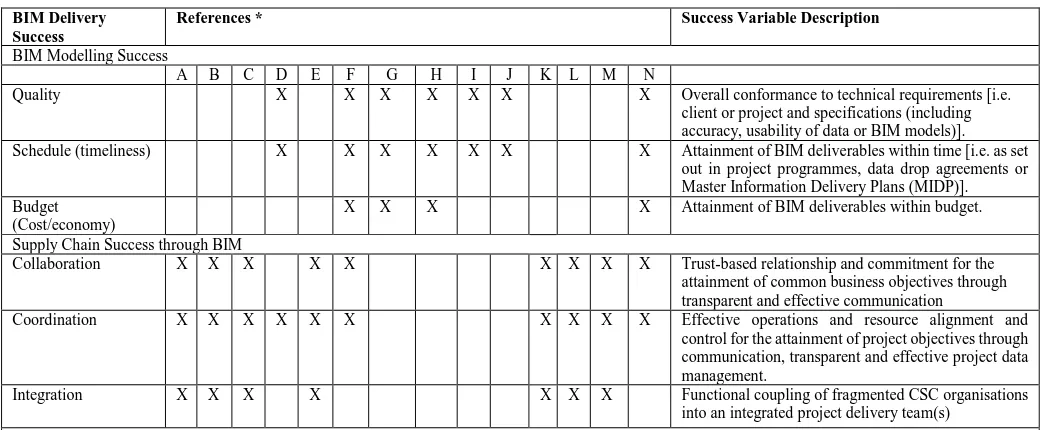
Collaboration: The CSC often consists of a temporary setup for one-off projects resulting in instability
and fragmentation (Dainty et al., 2001). The levels of fragmentation can be reduced through open and
honest communication that is facilitated by integrated BIM project environments (Vrijhoef, 2011).
Coordination: CSC is functionally characterised by fragmentation that prevents effective convergence of
materials, goods and services on site efficiently (Manu, 2014). Thus, cross functional coordination is vital
to achieving this with BIM-based communications regarded as central to enhanced operational planning
through visualisation and virtual prototyping (Vrijhoef, 2011).
Integration: The CSC is also characterised by structural fragmentation. BIM, however, enables
technologically seamless organisational structures (Papadonikolaki et al., 2015 a,b). Thus, BIM-based
centralised communication enables the disparate organisations to work better as a single unit (Vrijhoef,
2011). Based on the review of literature, the success indicators adopted for this study are summarised
in Table 1.
Table 1.
BIM Capability Criteria Used in Existing Assessment Tools and Frameworks
Succar et al.’s (2012) BIM competency framework provides a generic description of BIM capability
attributes namely technology, process and policy. Technology attributes represent organisational
attributes related to physical artefacts while process category represents resources, activities, workflows,
products, services, leadership and management related attributes often used to evidence BIM utilisation
capacity (Succar, 2010). Policy attributes refer to contracts, benchmarks and guidance for BIM
implementation within organisational units (Succar et al., 2012). Dib et al. (2012) categorised capability
attributes as follows: planning and management of process and technology; team structure; hardware;
process definition; and information management abilities. The Pennsylvania State University BIM guide
(CIC, 2013a), on the other hand, relies on the following distinctive areas of BIM capability: strategy; BIM
uses; process; information; infrastructure and personnel. Different criteria have been promoted for use
in evidencing the ability to deliver BIM. None of these studies have, however, specifically looked at the
influence of the proposed criteria on actual BIM delivery success on projects in order to aid more informed
prioritisation of capability attributes during assessments. Overall, these studies have focused more on
the aspects of BIM that give an indication of the extent of BIM maturity achieved by an organisation, but
do not provide empirical basis for BIM delivery success on projects. BIM delivery success on projects
might arguably require more than just achieving a state of maturity based on technology, processes and
policy as from the CSC perspective, these have to be mobilised together to achieve the collaboration,
integration and coordination requirements which are perhaps more predictive of BIM delivery success
on projects especially with regards to CSC objectives. Thus, this study aims to bridge this gap through
Research Methodology
Based on a pragmatic philosophical position, the influence of 28 previously validated BIM capability
criteria (Mahamadu et al., 2017) on selected BIM delivery success indicators, was modelled based on a
survey of BIM enabled projects (n = 64). The 28 BIM capability criteria were validated through interviews
with BIM experts (n = 8) and a two-round Delphi study (n = 25 [round 1] and n = 30 [round 2]) of
experienced BIM practitioners in Phase 1 of the study which has been reported in Mahamadu et al.
(2017) as presented in Table2.
Phase 1 (Interviewees and Delphi Study)
Semi-structured interviews were conducted with BIM experts to explore relevant BIM capabilities given
the relative novelty of BIM capability as a subject. This was to solicit their expert opinion about BIM
capability attributes that are currently being used in practice to consolidate the list of attributes identified
from literature. Phenomenological principles were relied on to satisfy the requirements of the qualitative
parts of the study. This is as a result of the need to investigate construction experts’ personal perspectives
on BIM capability criteria based on their experience of working on construction projects. Similar methods
have been applied in the exploratory phase of mixed method research (Manu, 2012). Furthermore,
according Adriaanse (2007) and Navendren et al., (2014) digital technology research in construction
requires such initial qualitative explorations due to its novelty to provide sufficient context for further
investigations. Interviewees comprised of BIM managers, digital engineers, commercial managers and
quantity surveyors with extensive industry and BIM experience. All interviewees had management roles
in the BIM implementation of major construction projects and organisations. Interviews were transcribed
verbatim for analysis. The interviews, which lasted up to 40 minutes on average, represented the
exploratory phase of the mixed method research strategy adopted. Interviews were terminated after the
eighth interview as a result of saturationas suggested byGuest et al. (2006).
After the identification of BIM capability attributes, a Delphi survey was then used to establish the most
relevant. The Delphi technique was first developed by Dalkey and Helmer (1963) as a method for
achieving convergence of opinion among groups of experts. Delphi has gained popularity within
construction management studies recently and is regarded as a strong approach for the determination
of capability or competence criteria (Hallowell and Gambatese, 2010). Delphi has been adopted for
contractor selection criteria (Hatush and Skitmore, 1997), as well as BIM competence criteria
prioritisation for owner organisations (Giel and Issa, 2014). The Delphi survey of 30 construction
practitioners resulted in 25 valid final Delphi round responses. This phase was used to validate the list of
capability attributes generated from the interviews and literature as well as reduce it to a concise number
consisting of only the most critical attributes being used within industry for evidencing BIM capability of
Phase 2 (Survey)
A survey was then used to solicit senior project participant’s independent evaluation of the BIM delivery
performance of a CSC firm on a project, as well as evaluate the extent of their BIM capability and its
influence on the success indicators investigated (Table 1). According to Yin (2003) surveys are
appropriate for the exploration of relationships between personal or perception-based variables on
samples wider than those covered by qualitative strategies. A survey research strategy was therefore
adopted to enable investigation of research propositions from the earlier phases among a wider group
of respondents (i.e. projects). Surveys are the most associated strategy with the conduct of quantitative
research including several BIM studies as well as evaluation of the influence of capability on delivery
success (Kam et al., 2014; Smits et al., 2016). The survey consisted of practitioners on BIM enabled
projects (n = 64) and was thus used to establish the influence of the 28 critical BIM capability criteria on
various aspects of BIM delivery success in the CSC context. The survey was used to solicit senior project
participant’s independent evaluation of the BIM delivery performance of a CSC firm on a project, as well
as evaluate the extent of their BIM capability and its influence on the success indicators investigated
(Table 1).
Data Analysis
Phase 1 (Interviews and Delphi Study)
Thematic analysis was deemed appropriate contextualisation of capability attributes proposed from
the interviews and literature (see Thomas and Harden, 2008; Navendren et al., 2014). Thematic
analysis allows systematic data structuring to adduce patterns relevant to the phenomenon being
investigated (Creswell, 2007). Based on the coded responses, interviewee’s opinions on BIM
capability attributes were further categorised into distinctive but related concepts, leading to the
development of a three-tier hierarchy of BIM capability attributes presented in Table 2.
The Delphi study was used as a validation of interviews and to develop a more parsimonious list of
capability attributes. Critical attributes were determined through statistical determination of
consensus with the aid of the interrater agreement (rwg). Based on the analysis of the rwg values and
mean ratings, all criteria that recorded acceptable (rwg ≥ 0.750), as well as a mean scores equivalent or above ‘agree’ were retained. This was based on the five-point rating scale used in the Delphi
survey (1 = Strongly Disagree, 2= Disagree, 3 = Neither Agree or Disagree, 4 = Agree, 5 = Strongly
Agree). From the principles of mathematical approximation, BIM qualification criteria with mean
values ≥3.5 were accepted as critical provided there was consensus among participants (i.e. rwg ≥
0.750). Delphi studies involve iterative rounds of data collection which is terminated when there is
coefficient (rho) was adopted to assess stability between Delphi rounds considering the ordinal
nature of the data gathered from the questionnaires (Field, 2013). The correlations tests between
Delphi rounds resulted in statistically significant correlations hence no significant shift in participant
opinion thus leading to reliance on data from round two of the process.
Phase 2 (Survey)
Both descriptive and multivariate analysis were employed to explore the data. Descriptive statistics
are often used to uncover the patterns, distribution and simple deviations within sample data
(Denscombe, 2010). Measures of central tendency (means) were used to identify response points
on the questionnaire scales (Denscombe, 2010). Standard Deviation (SD) was used to assess the
measure of spread within data. Multivariate statistical modelling techniques were then used to model
the relationship between the BIM capability attributes and key BIM delivery success indicators in the
CSC context. This was achieved through Multiple Linear Regression (MLR) analysis of survey data.
This process involved the construction of an index of BIM capability attributes and success variables.
Thus, an index of the eleven main BIM capability attributes (consisting constituent 28 capability
attributes) were modelled as independent variables on success indicators representing the
dependent variables. Two dimensions of success indicators were drawn from the literature (Table
1). The first dimension was ‘BIM modelling success’ representing the traditional iron triangle view of
success. This dimension of success consisted of criteria measuring the quality of BIM, delivery of
BIM on schedule (time) and delivery of BIM within budget (cost). The second dimension was ‘CSC
success through BIM’ representing the attainment of strategic CSC/SCM objectives through the
application of BIM namely collaboration, coordination and integration. This study relied on modelling
several observational measures and latent variables from a survey thus making MLR and Structural
Equation Modelling (SEM) the most suitable analysis techniques (Field, 2013; Hair et al., 2010). The
choice of MRL over SEM was due to a couple of reasons. SEM is more suitable where there is very
complex relationships between variables, however the relationships examined in this study were less
complex thus making MLR adequate (Anvuur, 2008). Furthermore, SEM is recommended to
overcomes problems associated with MLR analysis where there is prevalence of issues such as
multicollinearity and spurious suppression (Field, 2013; Hair et al., 2010). None of these were,
however, observed from preliminary analysis of data to determine non-violation of primary
assumptions of MLR. The key assumptions that had to be met for effective application of MLR were:
linearity of the relationship between outcome and predictor variables; constant variance of the error
terms; independence of the error terms: normality of the error term distribution. All these were met
after examination of residuals from the MLR and test of normality of variables used. Another key
factor which made SEM undesirable was the fact that SEM requires often large cases of data for
modelling technique for the dataset in this study. The choice of MLR is also consistent with the
principle that simple and minimally sufficient statistical analysis are most appropriate to avoid over
interpretation (Best and Smith, 2005).
Pearson’s correlation coefficient (r) was also used to establish linear relationships between variables
in order to check intra-variable relationships as a pre-cursor to the MLR analysis (Field, 2013). A
parametric test (r) was chosen given variables studied were composite variables from the
construction of an index of variables thus assumed normal distribution and making parametric test
suitable. Based on classical MLR modelling, the relationship between the predicted outcomes Yp
and predictor variables (X1, X2, Xk-1, Xk) were assessed. The MLR was used for the development of
predictive models for BIM delivery success through BIM capability attributes (as the predictor
variables). The stepwise method in MLR was adopted in this study to support development of
optimum regression models containing only the most relevant predictors after iterative rounds of
analysis (Brace et al., 2003).
The Capability Criteria Adopted in Survey: Table 2 presents a summary of the 28 critical BIM
capability attributes adopted from literature and interviews and subsequently validated by the Delphi
survey (Mahamadu et al., 2017). These BIM capability attributes are most suitable for the study of
influencers of success given they incorporate all attributes relied on in BIM project pre-qualification and
selection, thereby providing a wide range of criteria as well as opportunities for understanding relative
importance of criteria relative to selecting firms most likely to succeed prior to project commencement.
Table 2.
Recruitment and Sampling
As cited by Denscombe (2010), decisions on selecting research participants can be as precise when
based on familiarity and good judgment. Preliminary enquiries about major BIM-enabled projects was
performed through internet searches, published case studies and industry event discussions. Interview
and Delphi experts were subsequently recruited with the total number of subjects commensurate with
past qualitative studies (n=8) and Delphi studies (n=25/30) in BIM literature (Navendren et al., 2014; Giel
and Issa, 2014). Similar methods were used to identify expert and experienced BIM professional
respondents working on BIM projects who were targeted through for random distribution of surveys both
online and in paper versions. In order to determine a suitable sample size, the Creative Research
Systems (2003) formula was applied leading to a recommended sample size of 480. This led to the
posting of the online version of surveys to identifiable internet groups with construction professionals and
in institutions that use BIM. This included LinkedIn, google and yahoo groups restricted to various BIM
and construction professionals. The LinkedIn professional group pages contacted included ‘BIM4SME’, ‘RICS’, ‘CIOB’, ‘ICE’ ‘BIM Experts’, and ‘BIM Architects’, among others. These groups have
to individuals in the generated contact list from the internet searches and solicitation of contacts from
BIM events. The survey resulted in 13.3% (n = 64) response rate, which is acceptable based on a review
of similar construction management studies (Ankrah, 2007).
Results
The survey was used to ascertain the perceived influence of the 28 critical BIM capability attributes (Table
2) on the six dimensions of success reviewed (Table 1). The majority of survey respondents were BIM
Managers or Technicians (31.4%), with a substantial proportion possessing between 11-15 years of
industry experience (46.7%) or 4-6 years of BIM or other virtual digital construction technologies
experience (35.9%). In relation to academic qualifications, 42.2% of respondents were holders of a
Bachelor’s degree as their highest qualification with a good number of post-graduate degree holders
(Masters - 29.7% and Doctorate - 7.8%) This is indicative of a substantially experienced and
knowledgeable group of respondents.
In relation to the background of projects assessed, 19.3% were large scale with estimated project values
above £50 million. Though the majority of projects (80.7%), were less than £50 million in value, more
than half were above £25 million. Most of the projects surveyed reported middle tier CSC involvement
in their BIM implementation or strategy, though a much less proportion (1.6%) reported lower tier CSC
involvement in BIM processes. The projects assessed in the survey were mostly building projects
(90.3%) as summarised in Table 3.
Table 3.
Modelling the Impact of BIM Capability Attributes on Delivery Success
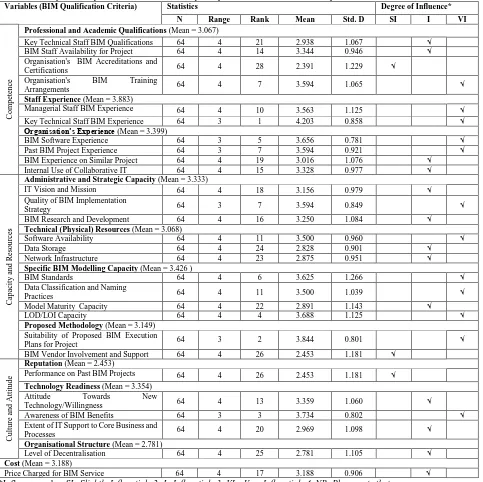
Staff Experience (Mean = 3.883) emerged as the most important attribute, with a positive influence on
overall BIM delivery success. The other important influencing attributes were Specific BIM Modelling
Capacity (Mean = 3.426), Organisation’s Experience (Mean = 3.399) and Technology Readiness (Mean
= 3.354). The constituent attributes regarded as most highly influential on BIM delivery success were:
Technical Staff BIM Experience, Suitability of Proposed BIM Execution Plans for Project (BEPs),
Awareness of BIM Benefits, Organisation's BIM Training Arrangements, Managerial Staff BIM
Experience, Key BIM Software Experience and Past BIM Project Experience. The rest were Quality of
BIM Implementation Strategy, Software Availability, BIM Standards, Data Classification and Naming
Practices and LOD/LOI (level of detail / information) Capacity. The remaining attributes had arithmetic
means between 1.5 and 2.5 representing ‘Slightly Influential’ on the scales. These were BIM Vendor
Involvement and Support and Reputation (in relation to performance on past BIM projects) of CSC
attributes assessed reported as not influential on BIM delivery success on projects. This is summarised
in Table 4.
Table 4.
From the analysis the area within which assessed firms performed best overall, was the delivery of
BIM within budget (Mean = 4.656). This was followed by the delivery quality of BIM (Mean = 4.297),
delivery within schedule (Mean = 4.094) and then use of BIM to achieve collaboration (Mean = 3.922)
within the project CSC. Respondents were of the opinion that coordination (Mean = 3.469) and the
integration (Mean = 3.313) were not attained to similar extents as the other success factors. While
the high standard deviations (SD = 0.946 - 1.123) could be indicative of high level of variability in the
performance assessment, Cronbach's Alpha (0.810) was indicative of highly reliable scales for
assessing success. The results are summarised in Table 5.
Table 5.
Association between BIM Capability Attributes and BIM Delivery Success Indicators
Based on Pearson’s correlation coefficients (r), all capability attributes were found to have a positive
association with BIM delivery success overall. Professional and Academic Qualifications recorded
the most significant level of association (r = 0.520; p < 0.01, n = 64) with BIM modelling success
while Cost recorded the least (r = 0.283; p < 0.05, n = 64). Most of the BIM capability attributes were
found to influence the delivery of quality in comparison with the rest of the success indicators. Cost
charged for BIM services was the only attribute that did not record association with quality delivery
of BIM (r = 0.144; p > 0.05, n = 64). The capability criteria with the most significant association with
quality was Staff Experience (r = 0.602; p < 0.01, n = 64).
A total of five capability attributes were found to have a significant degree of associations with the
delivery of BIM on schedule with Proposed Methodology (r = 0.475; p < 0.01, n = 64) recording the
highest degree of association. Furthermore, seven of the capability attributes recorded significant
degrees of associations with the delivery of BIM within budget. Administrative and Strategic Capacity
recorded the highest level of association (r = 0.482; p < 0.01, n = 64) followed by Staff Experience
(r = 0.404; p < 0.01, n = 64). In relation to the delivery of CSC success through BIM, only four of the
capability attributes recorded statistically significant levels of associations with Administrative and
Strategic Capacity emerging with the highest degree of association (r = 0.507; p < 0.01, n = 64).
Administrative and Strategic Capacity emerged with significant correlations across all three areas of
CSC success through BIM (r = 0.374; p < 0.01, n = 64). Coordination through BIM had a weak but
statistically significant correlation coefficient (r = 0.377; p < 0.01, n = 64) while integration through
Modelling the Impact of Capability Attributes on BIM Delivery Success
Two MLR models were developed to ascertain influence of capability attributes on the two
dimensions of delivery success (BIM modelling success and CSC success through BIM). With
regards BIM modelling success, the outcome variable consisted of respondents’ assessment of CSC
performance in relation to BIM modelling quality, BIM delivery on schedule, as well as BIM delivery
within budget on a current or recently completed project. The multiple regression modelling resulted
in a statistically significant regression equation (F [2, 61] = 18.629; p < 0.05) with an R2 of 0.379.
The adjusted R2 of 0.359, denotes 35.9% of the variation in the BIM modelling success due to
predictor variables. Based on the findings BIM modelling success can thus be predicted from
Equation 1.
Equation 1: Regression Equation for Predicting BIM Modelling Success
BIM MODELLING SUCCESS = 0.857 + 0 .483 (Staff Experience) + 0.447 (Proposed Methodology)
From this regression equation, BIM delivery success on a project increases per 0.483 unit
increments in level of Staff Experience and 0.447 unit increments in the level of suitability in relation
to BIM Proposals submitted by firms prior to commencement of projects. Both Staff Experience (p <
0.05, n = 62) and Proposed Methodology (p < 0.05, n = 62) were significant predictors of overall BIM
modelling success as summarised in Table 6 and Figure 1. Table 6.
Figure 1
The Durbin-Watson test recorded value of 1.383 indicative of no independence of the error term.
The variance inflation factor (VIF) were within acceptable range (1.179 for Staff Experience and
1.179 for Proposed Methodology) (Hair et al., 2010). Further residual analysis revealed no violations
of MLR assumptions.
With regards to CSC success through BIM, the outcome variable consisted of ratings of performance
outcomes in relation to collaboration, coordination and integration of the CSC through BIM on the
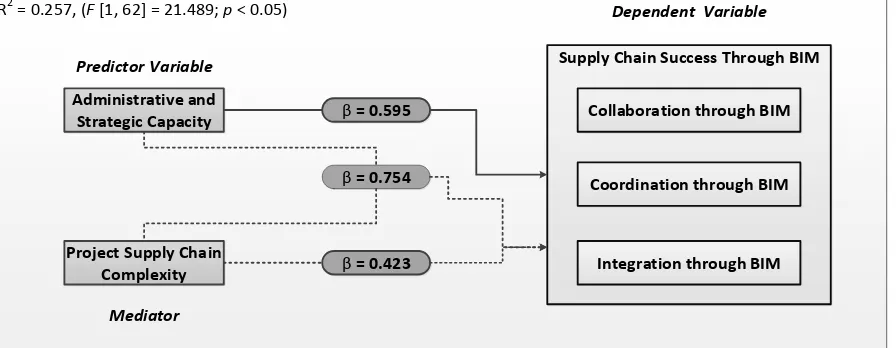
projects assessed. The MLR exercise resulted in a significant regression equation (F [1, 62] =
21.489; p < 0.05), with an R2 of 0.257. Adjusted R2 was 0.245 implying that the predictors in the
regression model accounted for 24.5% of the variation in CSC success through BIM. From the
Equation 2: Regression Equation for Predicting CSC Success through BIM
OVERALL SUPPLY CHAIN SUCCESS THROUGH BIM = 1.483 + 0.595 (Administrative and
Strategic Capacity)
From this analysis, administrative and strategy related capacities are the most significant predictors
of performance related to collaboration, coordination and integration of the CSC through BIM. Table 7 and Figure 2 is a summary of the key parameters of the regression model for predicting CSC success through BIM.
Table 7.
Figure 2.
The Durbin-Watson test for MLR model for CSC success through BIM was 2.059, indicating that the
residuals errors were not correlated unduly. This is indicative of no evidence of first-order
autocorrelation. The VIF of the significant predictors was 1, thus, within acceptable range (Hair et
al., 2010). This is indicative of highly satisfactory results in relation to the violation of collinearity
assumptions. Further residual analysis revealed no violation of the principle MLR assumptions.
Mediating and Moderating Effect of Project and Organisational Characteristics
Mediation in a regression model refers to the elucidation of the mechanisms that underlies an
observed relationship between independent and dependent variables (Kenny, 1986; Hayes, 2009).
Mediator variables, thus, clarifies the nature of the relationship between the predictors and outcome
variables (Kenny, 1986). This is often done through the investigation of the influence of mediating
variables in the regression modelling (Hayes, 2009). In this study, mediation analysis was
undertaken to identify whether or not project complexity mediated the influence of capability
attributes on delivery success. If significant changes occur in the model parameters, this is indicative
of a mediating role of the additional variables (project complexity characteristics). The three principal
dimensions of complexity measured were project size, BIM complexity and supply chain complexity.
Project size was based on the value of the projects surveyed and categorised within the following
ranges: < £25 million; £26-50 million; £51-75 million; £76-100 million; and > £100 million. BIM
complexity accounted for BIM Task responsibility of the CSC organisation, project BIM model
complexity (including BIM maturity level) and product or facility complexity (in terms of design).
Supply chain complexity included the level of CSC’s involvement in the BIM process and the extent
of the use of BIM across the CSC of the project. MLR was re-run with the inclusion of mediator
variables revealing only marginal decrease in the adjusted R2 from 0.245 to 0.229 with evidence of
additional significant predictor, Project Supply Chain Complexity (β = 0.423; p < 0.05, n = 62) for
remained a strong predictor despite an overall drop in the variance accounted for in the entire
regression model. No project characteristic was found to influence attainment of BIM modelling
success.
Moderation in regression is used to describe the relationship between two variables when they are
dependent on a third variable called the moderator (Kenny, 1986). The relationships between the
predictors in the regression models for BIM modelling success and CSC success through BIM was
tested through a moderation analysis with the aid of PROCESS software for SPSS (Hayes, 2016).
Using a path analysis framework, the PROCESS tool provides a moderation analysis through an
estimation of the coefficients of a regression model (Hayes, 2016). None of the project and
organisational characteristics were found to have a moderating effect (p > 0.05).
Validity and Reliability of Analysis
The R2 values (25.7% and 35.9%) recorded in the regression models were highly acceptable from a
review of the R2 values of other construction management studies, employing similar methods (4.0%
- 26.0%) (Omoregie, 2006; Ankrah, 2007). According to Harris (1985) reliance on the ratio of number
of predictor variables (‘p’) to observations (‘N’) is most appropriate method for establishing sample
size adequacy in regression modelling. From a review of empirical studies, Howell (1997) suggests
that ‘N’ is adequate when it exceeds ‘p’ by between 40 and 50. Following Harris (1985) and Howells
(1997), the ratio of observations to predictors in this study satisfies the requirements for conduct of
regression analysis. Furthermore, Cronbach's Alpha values (0.810 - 0.93) were indicative of highly
reliable scales (Field, 2013) for both success and BIM capability variables, respectively.
Discussion of Findings
A review of the relationship between the significant predictors of BIM modelling success and
constituent success indicators revealed that Staff Experience has a higher degree of association
with BIM modelling quality and delivery within budget, while suitability of Proposed Methodology is
more associated with BIM delivery within schedule. With regards to CSC success through BIM,
Administrative and Strategic Capacity emerged as the only capability attribute with a meaningful
contribution albeit dependent on the level of CSC complexity (i.e. large, multi-layered CSC
characterised by substantial lower tier BIM involvement or use). The results suggests that BIM is
likely to influence collaboration, integration and coordination on projects with more complex supply
chains. Administrative and Strategic Capacity was also found to influence the attainment of
According to Du et al. (2014), the key performance expectations of BIM include, information quality,
as well as timely and cost effective delivery. This includes the accuracy of data in models and
generally, the extent to which modelling conforms to requirements. From the findings, individual skills
at developing BIM models as well as appropriate execution planning, are found to constitute the
most critical capability attributes that influenced successful delivery of BIM.
In circumstances where the traditional view of success (quality, schedule and budget) is a concern,
individual competencies should be the most important consideration. According to Succar et al.
(2013), such individual BIM skills should be both procedural and applied or conceptual knowledge.
While there are multiple areas of performance, Succar et al. (2013) have not advocated the specific
areas within which experience is most likely to influence success. This study, however, reveals that
individual experience influences tangible performance expectations of BIM, specifically, in relation
to the quality of modelling, delivery within budget and on schedule. Smits et al. (2016), on the other
hand, found strategic capability as the most influential on project cost, time and quality performance.
This contrast may, however, be explained by the fact that Smits et al. (2016) investigated the
influence of BIM maturity on project level success factors rather than the success in the delivery of
BIM itself on the project.
While planning has always been recommended for the attainment of project objectives, no empirical
studies have explicitly investigated the impact of BIM execution plans on successful delivery on
projects. However, the ability to develop an effective plan or method in response to a project brief or
need is identified as key to BIM modelling success, more specifically delivery within schedule.
Standards documents such as the CIC protocol (CIC, 2013b) and PAS1192:2 (2013) have promoted
the concept of BIM Execution Plans (BEP). Other studies have highlighted the importance of BEP to
project success (Al-Ahbabi and Alshawi, 2015). However, no study has sought to establish the
relationship between proposed methodology (project specific BEPs) and delivery success in practice
especially through an empirical assessment. From the findings suitable Proposed Methodology (e.g.
a BEP) is mostly associated with delivery within schedule. This study aligns with a wider view within
construction that effective planning and allocation of CSC resources affect timely deliveries of BIM
output (Murphy, 2014). The delivery of quality BIM models within budget is mostly associated with
higher levels of staff experience. This also aligns with the views that construction organisations are
able to conform to requirements better, when workforce possess adequate levels of procedural skill
and knowledge (Arditi and Gunaydin, 1999). The finding further supports the notion that years of
repetitive usage of BIM or related technologies aid individuals to develop core or domain
competencies that assure value. This value is mostly evident in the quality of the deliverables and
and proposed methodology have featured among the most important predictors of success in
construction studies in general (Doloi, 2009).
Administrative and Strategic Capacity emerged as the single most important influencer of CSC
success through BIM. This variable provides evidence of effective vision, planning, development and
management of resources in BIM implementation within an organisation. While other studies have
highlighted strategic factors as important to BIM capability overall (Murphy, 2014; Giel and Issa,
2015), this study indicates, it primarily influences the attainment of collaboration, coordination and
integration in the CSC context. The attainment of CSC success through BIM was, however, mediated
by the level of complexity of the project CSC. Consequently, more complex supply chains present
more opportunities for achieving collaboration, coordination and integration through strategic
implementation of BIM (Vrijhoef, 2011; Manu, 2014; Papadonikolaki et al., 2015a).
According to Giel and Issa (2014), strategic capacity refers to factors that impact on an organisation’s
ability to plan and develop courses of action for BIM execution. Administrative capacity also refers
to how organisations manage resources to meet desired goals associated with their internal BIM
execution strategies (Giel and Issa, 2015). Similarly, the following factors constituted administrative
and strategic capacity: IT Vision and Mission, Quality of BIM Implementation Strategy and BIM
Research and Development. It is still not clear the extent to which the construction industry is
leveraging BIM to achieve CSC objectives, however, this study highlights the importance of strategy
and administrative issues on attaining these objectives. The findings suggest that strategic objectives
of the CSC must be incorporated in the long-term planning activities as well as allocation of resources
in BIM implementation in order to attain success. According to Papadonikolaki et al. (2015a), CSC
BIM performance is underpinned by strategy that is normally linked to effective long-term and
commercially driven factors. Thus, while there are operational benefits of BIM use, its success in the
CSC is largely dependent on the overarching strategy, as well as management of BIM
implementation resources. Consonant with these assertions, Manu (2014) recommended the
incorporation of BIM capability criteria in performance management of the CSC. According to Manu
(2014), this improves the strategic management of the CSC, which currently focusses mostly on
factors such as health and safety performance, financial health and programme compliance.
Evidence of BIM research and development (R&D) within an organisation is a likely indicator of ability
to leverage BIM for the attainment of CSC objectives (Succar, 2010). The findings, therefore, support
a notion that the success of BIM application for CSC operations is not dependent on procedural,
process, or technology related capacity but rather management and strategy level factors. Thus, it
can be inferred that BIM enhances strategic functions of the supply chain much more than
operational areas which arguably is still at the infancy of BIM application (Papadonikolaki et al.
maturity influences project level performance rather than the performance in the attainment of BIM
deliverables themselves.
Respondents recounted that the attainment of CSC success through BIM was generally not as high
as the levels of BIM modelling success (quality, schedule and budget). This confirms existing
evidence that CSC and CSC management objectives are not solely met by the use of technologies
like BIM but also other commercial and structural imperatives (Cerovsek, 2011; Antwi-Afaria et al.,
2018).
Conclusions
The findings provide empirical evidence on the need for the prioritisation of BIM capability attributes
based on their relative influence on desirable success indicators. Thus, the prioritisation of criteria
during capability assessments must be based on their relative contribution to all relevant areas of
success in order to provide a holistic view. Prioritisation of criteria in existing frameworks are,
however, based only on the relative importance of such criteria as capability metrics rather than their
relative contribution to various areas of success as investigated in this study. Furthermore, capability
or maturity only denotes the basic abilities to perform BIM-related tasks efficiently, rather than the
actual attainment of the objectives expected from BIM deployment.
This study has provided insights about the influence of key capability attributes on other BIM
deployment objectives such as: the quality of BIM; delivery of BIM on schedule, delivery of BIM within
budget; collaboration, coordination and the integration of CSC through BIM. While some studies
have sought to explore influence of BIM maturity elements on project success in general no studies
have investigated influence of CSC BIM capability on the successful delivery of BIM itself. This is,
however, a more meaningful measurement given overall project success is presumably influenced
by many other factors.
Study Implications for Practice
The main implications of the research findings for practice are two-fold: development of BIM
capability and maturity; and development of procurement policies. These are elaborated as follows.
BIM Capability and Maturity Development
The BIM capability attributes and their priority rankings would enable organisations to
self-examine their internal capacity and maturity for the purposes of performance management
and improvement. This would aid the identification of areas of strength, weaknesses and
overall. Furthermore, these organisations can identify BIM implementation areas that require
prioritisation such that there is efficient allocation of investment in BIM capacity building. On
this note, this research has demonstrated the need for prioritising administrative and strategic
capacity for supply chain BIM use success and on the other hand, staff experience and
project execution planning (i.e. methodology) for more efficient BIM delivery performance.
Procurement Policy Development
Despite Government mandate for adoption of BIM, particularly, in UK and more recently
across Europe, Asia and the Middle East, there remains no policy directives regarding
capacity building. The research findings, however, have implications for BIM implementation
on projects particularly in relation to procurement. Clients, main contractors and principal
suppliers can prioritise selection criteria such that they are consistent with the research
findings. This is important given relevant documentations for procurement such as British
Standards Institution (2013) PAS 91:2013 and the Pennsylvania State Planning Guide (CICa,
2013), which do not prescribe selection criteria priority weightings for selection of
organisations on BIM projects.
From the findings the key determinants of success from supply chain integration perspective
has been established to be Strategic and Administrative BIM process maturity. This
distinction is critical to current efforts for the adoption of integrated procurement methods
such as Integrated Project Delivery (IPD) (Porwal and Hewage, 2013) which promises to
integrate supply chains more effectively through BIM.
This study provides an empirically supported justification for propositions about the role of BIM
capability in BIM delivery success as espoused within literature. It further shows the multidimensional
nature of this relationship, which hitherto has been viewed as a unilateral and technologically
deterministic concept. It brings into focus the need for prioritising BIM capability criteria based on
their contribution to delivery success. The findings debunk the hard technology centric nature of BIM
capability discourse. Criteria relied on for assessing BIM capability in most existing frameworks are
often hard technology centric. Thus, most capability frameworks align with a hard technological
deterministic view of BIM, where the technology artefacts and resources are primary determinants
of BIM capability and delivery success. While this study acknowledges the importance of
technological capacities, such as hardware and software, it places more emphasis on the role of
specific information process maturity and collective knowledge, skills and attitudes within a CSC
Limitations and Implications for Future Research
Future studies could adopt more longitudinal approaches to explore the evolution of BIM maturity
and how that influences delivery success over longer periods as opposed to the cross-sectional
focus of this study. A review of the survey respondent’s backgrounds revealed many of the CSC
organisations assessed were design consultants, as well as main and sub-contractor organisations
with high-level design responsibility and between middle to the top tier of the CSC. This is largely
due to reported lack of usage of BIM by lower tier CSC organisations that often have less design
responsibility and digital technology expertise. Future studies could, however, focus on the lower
tiers of the CSC especially when BIM adoption increases in this segment of the market. Lastly, some
key BIM delivery success factors have been examined, albeit in a supply chain and project model
delivery perspective. Future studies could consider other dimensions of success especially at project
level with consideration of other non-BIM capability indicators.
References
Abdirad, H. (2017), “Metric-based BIM Implementation Assessment: A Review of Research and
Practice”, Architectural Engineering and Design Management, Vol. 13 No.1, pp. 52-78.
Adriaanse A (2007), “The use of interorganisational ICT in construction projects: a critical perspective”.PhD thesis, University of Twente, The Netherlands.
Al Ahbabi, M. and Alshawi, M. (2015), “BIM for Client Organisations: A Continuous Improvement Approach”, Construction Innovation, Vol.15 No. 4, pp. 402-408.
Al-Zahrani, J.I. and Emsley, M.W. (2013), “The Impact of Contractors’ Attributes on Construction
Project Success: A Post Construction Evaluation”, International Journal of Project Management, Vol.
31 No. 2, pp.313-322.
Ankrah, N.A. (2007), “An Investigation into the Impact of Culture on Construction Project
Performance”. PhD Thesis, School of Engineering and the Built Environment, University of
Wolverhampton. UK.
Antwi-Afaria, M.F., Lib, F., Pärnc, E.A., and Edwards, D.J (2018), “Critical success factors for implementing building information modelling (BIM): A longitudinal review”. Automation in
Construction. Vol. 91, pp. 100-110.
Anvuur, A.M. (2008), “Cooperation in Construction Projects: Concept, Antecedents and Strategies”.
Arayici, Y., Coates, P., Koskela, L., Kagioglou, M., Usher, C. and O'Reilly, K. (2011), “Technology Adoption in the BIM Implementation for Lean Architectural Practice”, Automation in Construction
Vol.20 No. 2, pp. 89-195.
Arditi, D. and Gunaydin, H. (1999), “Perceptions of Process Quality in Building Projects”, Journal of
Management in Engineering, Vol. 15 No. 2 pp.43-53.
Arslan, G., Kivrak, S., Birgonul, M.T. and Dikmen, I. (2008), “Improving Sub-Contractor Selection Process in Construction Projects: Web-Based Sub-Contractor Evaluation System (WEBSES)”,
Automation in Construction, Vol. 17 No. 4, pp.480-488.
Atkin, B. (1995), “Information Management of Construction Projects”, In Brandon, P.; Betts, M., (Eds)
Integrated Construction Information. London: E and FN Spon, pp. 291-315.
Azzouz, A. and Hill, P. (2017), “Hunting for perfection: How Arup measures BIM maturity on projects worldwide”. Construction Research and Innovation, Vol. 8 No.2, pp. 49-54.
Best, R. and Smith, N. (2005), “Statistics and the peer review process in construction research”. In:
Sidwell, A.C. (Ed.), The Queensland University of Technology Research Week International
Conference, 4-8 July, Brisbane, Australia. pp.1027-1033.
BIS (2011), “Government Construction Strategy”, London, UK: Department of Business and
Innovation.
BIS (2013a), “Industrial Strategy: Government and Industry in Partnership: Construction 2025”.
Report number: URN BIS/13/955. London, UK: Department for Business, Innovation and Skills.
BIS (2013b), “Supply Chain Analysis into the Construction Industry: A Report for the Construction
Industrial Strategy”. Report number: BIS Research Paper No. 145.London, UK: Department for
Business, Innovation and Skills.
Bliese, P.D. (2000), “Within Group Agreement, Non-Independence and Reliability”, In; Klein, K.J.
and Kozlowski, S.W.J. (Eds.) Multilevel Theory, Research, and Methods in Organizations:
Foundations, Extensions, and New Directions. San Francisco: Jossey-Bass.
Brace, N., Kemp, R. and Snelgar, R. (2003), “SPSS for Psychologists. A Guide to Data Analysis
Using SPSS for Windows”. Palgrave Macmillan.
Cerovsek, T. (2011), “A Review and Outlook for a ‘Building Information Model’ (BIM): A
multi-Standpoint Framework for Technological Development”, Advance Engineering Informatics Vol. 25
CIC (2013a), “BIM Planning Guide for Facility Owners: Computer Integrated Construction (CIC)”,
Pennsylvania: Pennsylvania State University, USA.
CIC (2013b), “Building Information Model (BIM) Protocol. Standard Protocol for Use in Projects Using Building Information Models”, Construction Industry Council. London, UK.
Creative Research Systems (2003), “The Survey System”. Available from:
http://www.surveysystem.com/index.htm [Accessed 12 January 2015].
Creswell, J.W. (2003), “Research Design: Qualitative, Quantitative, and Mixed Method Approaches”.
2nd ed. California: Sage.
Creswell, J.W. (2007), “Qualitative Inquiry and Research Design: Choosing Among Five Approaches”. Thousand Oaks: Sage.
Dainty, A.R.J., Briscoe, G.H. and Millett, S.J. (2001) “New Perspectives on Construction Supply
Chain Integration”. Supply Chain Management: An International Journal, Vol. 4, pp. 163-173. Dalkey, N. and Helmer, O. (1963), “An Experimental Application of the Delphi Method to the Use of Experts”, Management Science, Vol. 9 No. 3 pp. 458-467.
Denscombe, M. (2010), “The Good Research Guide for Small Scale Social Research Projects”. 4th
ed. London: Open University Press.
Dib, H., Chen, Y. and Cox, R.F (2012), “A Framework for Measuring Building Information Modeling Maturity Based on Perception of Practitioners and Academics outside the USA”. Proceedings 29th
International Conference CIB W78 2012. Beirut, Lebanon, 17-19 October. CIB.
Doloi, H. (2009), “Analysis of Pre‐Qualification Criteria in Contractor Selection and Their Impacts on Project Success”, Construction Management and Economics, Vol. 27 No.12, pp.1245-1263.
Du, J., Liu, R. and Issa, R. (2014), “BIM Cloud Score: Benchmarking BIM Performance”, Journal of
Construction Engineering and Management, Vol.140 No. 11.
Field, A. (2013), “Discovering Statistics Using SPSS”, 4th ed. London: Sage Publications Ltd.
Giel, B. and Issa, R. (2014), “Framework for Evaluating the BIM Competencies of Building Owners”,
Computers in Civil and Building Engineering, pp. 552-559.
Giel, B. and Issa, R. (2015), “Framework for Evaluating the BIM Competencies of Facility Owners.
Guest, G., Arwen, B. and Laura, J. (2006). “How Many Interviews are Enough? An experiment with data saturation and variability”, Field Methods, Vol.18 No. 1, pp. 59-82.
Hair, J.F., Black, W.C., Babin, B.J., Anderson, R.E. and Tatham, R.L. (2010), “Multivariate Data
Analysis with Readings”, 7th ed. New Jersey: Prentice Hall.
Harris, R.J. (1985), “A Primer of Multivariate Statistics”, 2nd ed. New York: Academic Press.
Hallowell, M. and Gambatese, J. (2010), “Qualitative Research: Application of the Delphi Method to CEM Research”. Journal of Construction Engineering and Management, Vol.136, No.1, pp.99-107.
Hatush, Z. and Skitmore, M. (1997), “Evaluating Contractor Prequalification Data: Selection Criteria and Project Success Factors”, Construction Management and Economics, Vol.15, pp.129–147.
Hayes, A.F. (2009), “Beyond Baron and Kenny: Statistical Mediation Analysis in the New Millennium”
Communication Monographs, Vol. 76 pp.408-420.
Hayes, A.F. (2016), “My Macros and Code for SPSS and SAS”. [Cited 3 January 2016]. Available
from: http://www.processmacro.org/index.html
Holt, G.D., Olomolaiye, P.O. and Harris, F.C. (1994), “Evaluating Prequalification Criteria in
Contractor Selection”, Building and Environment, Vol. 29 No. 4, pp.437-448.
Howell, D. C. (1997), “Statistical Methods for Psychology” 4th ed. Belmont, CA: Wadsworth.
Kam, C., Rinella, T., Mak, D. and Oldfield, J. (2012), “BIMSCORE: GPS for BIM Navigation: From aspirations to quantitative measures of success”. Practical BIM 2012: Management, Implementation
Coordination and Evaluation, Los Angeles, CA, USA.
Kam, C.; Rinella, T.; Oldfield, J. (2013a), “Using Objectified Measures to Realize the Promise of
BIM”, Journal of National Institute of Building Science (JNIBS), Vol.1 No.1, pp.14-18.
Kam, C., Senaratna, D., McKinney, B., Xiao, Y. and Song, M. (2014), “The VDC Scorecard:
Formulation and Validation. Stanford University: Center for Integrated Facility Engineering (CIFE)”,
CIFE Working Paper WP135.
Kam, C., Senaratna, D., Xiao, Y., McKinney, B. (2013b), “The VDC Scorecard: Evaluation of AEC Projects and Industry Trends”. Stanford University: Center for Integrated Facility Engineering (CIFE).
Keavney, M., Mitchell, C. and Munn, D. (2013), “An examination of the potential of building
information modelling to increase the efficiency of Irish contractors on design and build projects”,
Proceedings International Virtual Conference, 25-29 March 2013, University of Zilina, Slovakia.
Kenny, D.A. (1986), “The Moderator-Mediator Variable Distinction in Social Psychological Research: Conceptual, Strategic, and Statistical Considerations”, Journal of Personality and Social Psychology,
Vol. 51, pp.1173-1182.
Khalfan, M., Khan, H. and Maqsood, T. (2015), “Building Information Model and Supply Chain
Integration: A Review”, Journal of Economics Business and Management, Vol. 3 No. 9, pp.912-916.
Lonngren, H.M., Rosenkranz, C. and Kolbe, H. (2010), “Aggregated Construction Supply Chains: Success Factors In Implementation of Strategic Partnerships”, Supply Chain Management An
International Journal, Vol.15 No. 5 pp. 404 - 411.
Mahamadu, A-M., Mahdjoubi, L. and Booth, C. (2017), “Critical BIM Qualification Criteria for
Construction Pre-Qualification and Selection”, Architectural Engineering and Design Management.
DOI: 10.1080/17452007.2017.1296812.
Manu, P. A. (2012), “An Investigation into the Accident Causal influence of Construction Project Features”. PhD Thesis, School of Technology, University of Wolverhampton. UK.
Manu, E. (2014), “Supply Chain Management Practices in Construction and Inter-organizational
Trust Dynamics”, PhD Thesis, School of Technology, University of Wolverhampton. UK.
Mom, M., Tsai, M. and Hsieh, S. (2011), “On Decision Making and Technology-Implementing Factors for BIM Adoption”. In: Bargstaedt, H.J. and Ailland, K. Proceedings of the 11th International
Conference on Construction Applications of Virtual Reality, Weimar: Bauhaus-Universität Weimar
3-4, November, Weimar: Bauhaus-Universität Weimar, pp. 217–229.
Mom, M., Tsai, M. and Hsieh, S. (2014), “Developing Critical Success Factors for the Assessment of BIM Technology Adoption: Part II. Analysis and Results”. Journal of the Chinese Institute of
Engineering, Vol. 37 No. 7, pp.859-868.
Murphy, M.E. (2014), “Implementing Innovation: A Stakeholder Competency-based Approach for
BIM”, Construction Innovation. Vol.14 No. 4, pp. 433-452.
Aboagye-Nimo, E. (Eds) Proceedings the 30th Annual Association of Researchers in Construction
Management (ARCOM) Conference, Portsmouth, UK, pp.733-742.
NBS (2016), “National BIM Report 2016”, National Building Specification, London, UK.
NIBS (2012), “National Building Information Modeling Standard - Version 2.0-Chapter 5.2 Minimum
BIM”. National Institute of Building.
Omoregie, A. (2006), “Blueprints for Infrastructure and Service Delivery in Sub-Saharan Africa”. PhD
Thesis, The Leicester School of Architecture, De Montfort University, Leicester. UK
Porwal, A. and Hewage, K.N. (2013), “Building Information Modeling (BIM) partnering framework for public construction projects”. Automation in Construction, Vol. 31 (2013), pp. 204–214.
Papadonikolaki, E., Vrijhoef, R. and Wamelink, H. (2016), “The Interdependences of BIM and Supply Chain Partnering: Empirical Explorations”. Architectural. Engineering and Design Management,
Vol.12 No.6 pp.476-494.
Papadonikolaki, E., Vrijhoef, R. and Wamelink, H. (2015a), “BIM Adoption in Integrated Supply
Chains: A multiple case study”, In: Raidén, A.B. and Aboagye-Nimo, E. (Eds), Proceedings of the
31st Annual Association of Researchers in Construction Management (ARCOM) Conference, 7-9
September 2015, Lincoln, UK, pp. 631-640.
Papadonikolaki, E., Vrijhoef, R. and Wamelink, H. (2015b), “Supply Chain Integration with BIM: a
Graph-Based Model”. Structural Survey, Vol.33 No. 3 pp.257-277.
PAS 91:2013 (2013), “Construction Prequalification Questionnaires”, UK: British Standards
Institution (BSI).
PAS1192:2 (2013), “Specification for Information Management for the Capital Delivery Phase of
Construction Projects using Building Information Modelling”. Report number: Part 2.UK: British
Standards Institution (BSI).
Porwal, A. and Hewage, K.N (2013), “Building Information Modeling (BIM) partnering framework for public construction projects”. Automation in Construction, Vol. 31, pp.204–214.
Pryke, S. (2009), “Construction Supply Chain Management”. 1st ed. Chichester: Blackwell
Publishing.