Placing Poverty in Context: A Case Study
Deepak Gopinath1and Murali Nair2
1
University of Dundee, Dundee, Scotland 2
University of Southern California, Los Angeles, CA
The “poverty-in-context” approach to understanding poverty is shaped by the needs and priorities of a particular context, and it can be used as the basis for identifying pro-poor projects in local strategies such as City Development Plans. A key argument for the introduction of the City Development Plans initiative (2007–2012) in India was to move away from national conceptions of and responses to poverty and to instead focus on engaging with local understandings of poverty. Through a case study of the City Development Plan initiative in Trivandrum, the capital city of the Kerala state in southern India, we argue that an understanding of poverty at the local level did not accommodate contextual needs and priorities; consequently, we develop a poverty-in-context approach based on semi-structured qualitative interviews with various stakeholders in the case study area. The article concludes by suggesting how in the future a poverty-in-context approach might be used to shape pro-poor policy in general and preparation of City Development Plans in particular. KEY WORDS: poverty-in-context, local self-help, pro-poor policy, India, Kerala, City Development Plans, Jawaharlal Nehru National Urban Renewal Mission
Introduction
One of the central aims of the Jawaharlal Nehru National Urban Renewal Mission (JNNURM) initiative introduced by India’s central government for the period 2007–2012 was to improve the lives of the urban poor. Such a focus over a six-year period was seen as necessary because although Indian cities account for around 55 percent of the country’s gross domestic product (GDP), over a quarter of this urban population struggles to obtain minimum nutritional levels for sustenance and lives in substandard housing, resulting in what Tipple and Speak (2009, p. 1) refer to as the “rapid urbanization of poverty.”
This article examines one of the key purposes of the JNNURM-financed City Development Plan (CDP), “the integrated development of slums through projects for providing shelter, basic services, and other related civic amenities to the urban poor” (Government of India, 2005, p. 6). It explores how the CDP initiative might offer the possibility of developing an understanding of poverty that is shaped by the needs and priorities of its context. A key argument for the introduction of the
135
CDP was to move away from national conceptions of and responses to poverty and to instead focus on engaging with local understandings of poverty. This seemed to suggest parallels with a “poverty-in-context” approach, where an understanding of poverty is shaped by the needs and priorities of a particular context and could be used as the basis for identifying pro-poor projects in local strategies such as CDPs.
However, following reports on the use of ambiguous stakeholder involve-ment to identify pro-poor projects in CDPs in the state of Kerala, there were concerns about whether a poverty-in-context approach was ever adopted or even clearly understood. For instance, the JNNURM initiative sets out guidelines that require local authorities to carry out stakeholder participation before projects are identified in the CDP. A few studies have been carried out in the state of Kerala in southern India (where fieldwork for this research was carried out) to under-stand how stakeholder participation has been carried out prior to identification of projects. For instance, research conducted by the Administrative Staff College of India (2008) in the city of Cochin in the Kerala state reveals the following:
The CDP (City Development Plan), as per Guidelines of JNNURM, should be formulated through a consultative process involving the key stakeholders and members of civil society.…[The] process of formulating the CDP (Cochin) presented is very succinct and too general and there was no description of how CDP was prepared.… [T]he CDP also states that recently “several meetings with experts and stakeholders were held to finalize the City Development Plan formulation” It is not clear as to how recently the consultations were held and with whom.…[F]rom the description it appears that there were no consultations. (p. 4)
Methodology
Drawing on the gaps identified in the literature and current approaches to pro-poor policy in India, the primary research question is presented.
How might a locally informed, place-based understanding of poverty be developed to complement the preparation of City Development Plans in India?
The nature of the research question requires (i) that descriptions of poverty be understood from the ground up, as the literature has offered a limited understand-ing, and (ii) that the range of factors shaping an understanding of poverty be revealed. The purpose of such “how” and “why” research questions in this study is not merely to present descriptions but also to seek explanations of why things have happened in a particular way. In answering “how” and “why” questions, Yin (2008) discusses the use of different strategies, including case study and historical examination. However, since this research is focused on investigating “contempo-rary events,” a historical examination as an isolated strategy is not particularly helpful. It is in this regard that the case study approach becomes a useful strategy in answering our research question, particularly because (i) contemporary events can be investigated by both carrying out in-depth interviews with actors involved in the phenomenon as well as by collecting secondary information, (ii) such a strategy acknowledges a lack of control of the different factors shaping the phenomenon being studied, and (iii) there are possibilities within the case study strategy to include techniques used by a historian, such as the use of secondary documents to provide insight into the sociopolitical characteristics of the context.
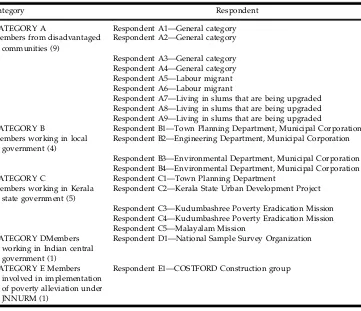
In response, the preparation of CDPs in the city of Trivandrum in the Kerala state was taken up as the case study. Both primary and secondary data were collected in Kerala in 2011.1Primary data collection involved carrying out in-depth, semi-structured, qualitative interviews with 11 representatives with knowledge and/or experience of formulating and/or implementing the JNNURM scheme in Trivandrum, and with nine representatives who were beneficiaries of the JNNURM scheme in the study area (see Table 1). Semi-structured interviewing was adopted in this research as it “has some degree of predetermined order but still ensures flexibility in the way issues are addressed by the informant” (Dunn, 2000, p. 52).
Drawing on work by Ritchie, Spencer, and O’Connor (2003), a two-state analytical approach will be employed where (i) we identify themes and indices to develop apoverty-in-context framework and (ii) we identify criteria for well-being from the interviews and draw on them to develop apathways to well-being matrix at the neighborhood level.
Literature Review
Contemporary Approaches to Poverty Alleviation
is living in poverty when he or she lacks the means for self-sustenance; in modern times, this translates into the deprivation of an income-generating activity. More recently, other attributes of deprivation that reinforce a person’s identity as “poor” have been drawn into development discourse: education, health, and human and civil rights (Hulme & Shepherd, 2003). In this regard, poverty could be viewed as a trap that those born into cannot escape. The neoliberal approach views poverty as a temporary state afflicting individuals that will disappear when they make informed choices in a free market society, such as focusing on an income-generating activity (Dini & Lippit, 2009). Many have questioned this model of “individual, economic self-determination,” and whether it enables individuals to escape the poverty trap (Bowles, Durlauf, & Hoff, 2006).
[image:4.504.77.438.78.389.2]However, in offering an explanation for the origins and persistence of poverty, there seems to be a lack of consensus. On one hand, it is argued that poverty has always existed as a local issue only to emerge as a global issue around the 1500s as a result of globalization (Beaudoin, 2007). It is also argued that the transition of society from a feudal to a capitalist mode of production has resulted in poverty. In this regard, a distinction is made between inequality and poverty, where the former exists in both forms of societies, but the latter is prevalent only in a capitalist society (Novak, 1988).
Table 1. Semi-Structured Interviews With the Following Were Carried Out in June–July 2011
Category Respondent
CATEGORY A Respondent A1—General category
Members from disadvantaged communities (9)
Respondent A2—General category
Respondent A3—General category Respondent A4—General category Respondent A5—Labour migrant Respondent A6—Labour migrant
Respondent A7—Living in slums that are being upgraded Respondent A8—Living in slums that are being upgraded Respondent A9—Living in slums that are being upgraded
CATEGORY B Respondent B1—Town Planning Department, Municipal Corporation
Members working in local government (4)
Respondent B2—Engineering Department, Municipal Corporation
Respondent B3—Environmental Department, Municipal Corporation Respondent B4—Environmental Department, Municipal Corporation
CATEGORY C Respondent C1—Town Planning Department
Members working in Kerala state government (5)
Respondent C2—Kerala State Urban Development Project
Respondent C3—Kudumbashree Poverty Eradication Mission Respondent C4—Kudumbashree Poverty Eradication Mission Respondent C5—Malayalam Mission
CATEGORY DMembers working in Indian central government (1)
Respondent D1—National Sample Survey Organization
CATEGORY E Members involved in implementation of poverty alleviation under JNNURM (1)
Amidst competing arguments on the origins of poverty, however, conceptions of poverty have been broadly and consistently premised on the ideas of subsistence, basic needs, and relative deprivation of individuals and groups. Mostly based on the work of nutritionists, poverty defined by subsistence was seen as affecting those families whose incomes were not “sufficient enough to obtain the minimum necessities for the maintenance of merely physical efficiency” (Rowntree, 1901, p. 86; Townsend, 1993). For instance, the needs of the poor were measured in terms of quantities of food, such as bread, bread flour, or the cash equivalent. In essence, this approach advocated that individuals and families ought to be supported with the minimum income or quantity of food that would maintain physical efficiency. The basic needs approach, conceived as an “enlargement of the subsistence concept” (Townsend, 1993, p. 32), argued that individuals and families should be supported with not only minimum amounts of food or equivalent cash, but also other requirements for private and family consumption, such as shelter, clothing, and certain minimum essential services provided by and for the community, such as safe drinking water, sanitation, public transport, and health (International Labour Office, 1976; Townsend, 1993). In the United Kingdom, the Poverty and Social Exclusion Survey of Britain measured poverty using three different indicators: lacking socially perceived necessities, being subjectively poor, and having a relatively low income (Bradshaw & Finch, 2003). However, the notion of poverty as lacking subsistence and/or basic needs has, over time, been influenced by the concept of relative deprivation, where poverty is considered to vary across different contexts and where particular material and social deprivations need to be observed, described, and measured (Townsend, 1993).
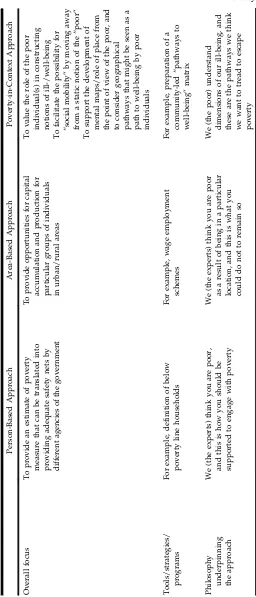
These debates on defining and measuring poverty have considerably shaped policy interventions, particularly in the Indian context, which we argue can be grouped under a person-based (or family-based) or area-based (or geographically based) approach.
Person-Based Approach to Poverty
A household is poor if the sum total of income earning assets which it commands, including land, capital and labour cannot provide an income above the poverty line.… [I]nadequate ownership of income earning assets is not however the whole story. The poorest households also suffer from a problem of “lack of access” which compounds problems arising from insufficient ownership of physical and human assets. (Ahluwalia, 1990, p. 2).
recom-mendations of the Tendulkar Committee (2010) is Rs.446.68 (£6 or $9 approx.) in rural areas and Rs.578.80 (£7.70 or $11.5 approx.) in urban areas in 2004–2005. In Kerala, the equivalent figures are Rs.537.31 (£7.1 or $10.7 approx.) and Rs.584.70 (£7.8 or $11.7), respectively (Planning Commission, 2011). Persons whose monthly expenditure falls below the above-mentioned figures are considered poor. This estimate is based on a sample survey of consumer expenditure carried out by the National Sample Survey Organisation every five years. The Ministry of Rural Development, on the other hand, carries out a census of all rural households in the country; the first census was carried out in 1992, followed by one in 1997 and another in 2002. Those identified as poor are referred to as “BPL” (below poverty line) households, and they would benefit from a range of schemes funded by this ministry, such as the Indira Awaz Yojna (Rural Housing Scheme).
State and local governments and other central government departments can use these measures of poverty provided by the Planning Commission and the Ministry of Rural Development. For instance, the Public Distribution System, a system whereby essential commodities are supplied to the public at subsidized prices, is jointly managed by central and state governments, where the former, through the Food Corporation of India, has the responsibility for the procure-ment, storage, and allocation of food grains to state governments, and the latter is responsible for the identification of families below the poverty line.
Area-Based Approach to Poverty
More recently for urban areas, the JNNURM was introduced in 2005 with an estimated budget of rupees 100,000 crore2 during a period of seven years, with the central government committed to contribute3 rupees 66,000 crore (Government of India, 2012). The JNNURM funding aims to improve infrastructure provisions in cities and to provide better services for the urban poor. An agency of state government coordinates and monitors the implementation of JNNURM projects funded across different cities in that state. Some officials from this agency also work in local governments to provide technical support in identifying and implementing the JNNURM projects. The JNNURM consists of two components—the Urban Infrastruc-ture Program and Basic Services for the Urban Poor. The Basic Services for the Urban Poor component of the JNNURM scheme is 80 percent centrally funded, 10 percent by the state government, and the remaining 10 percent by the local government.
Developing a “Poverty-in-Context” Approach
In the previous section, we looked at two broad approaches to conceptualiz-ing/engaging with poverty in India. Each of these can make significant contributions to understanding poverty. For instance, a person-based approach provides an estimate of poverty measure that can be translated into providing adequate safety nets for vulnerable individuals by different agencies of the government. The use of “below poverty line” households is an example, where the government basically says, “we think you are poor; this is why and this is what you should be entitled to.” On the other hand, an area-based approach sets out a framework to provide opportunities for capital accumulation/production for particular groups, depending on whether they are in urban or rural areas. Wage employment schemes are based on such an approach, where the govern-ment argues that “we think you are poor, and based on where you live, this is how we could support you so that you do not remain poor.”
Each of these approaches presupposes that units of conceptualization are similar across the country; that is, a below poverty line household in one part of India is similar to others in a different part of the country, or that particular area-based approaches for urban areas have the same framework for implementation as in other urban areas. But we argue that although each of these approaches makes significant contributions to understanding and engaging with poverty, neither seems to consider the role of context in how poverty might be conceptualized. In other words, it is our contention that one below poverty line household is potentially different from another, and that area-based approaches in one location would be shaped by factors that are not necessarily the same in another. Thus, there emerges a need to set out a framework, or what we refer to as a “poverty-in-context” approach, that has the potential to capture character-istics of vulnerable people living in different areas.
a need to acknowledge the existence of deep differences (Watson, 2003) in how “empowerment, oppression, and exclusion” (Fincher & Jacobs, 1998) are shaped by differences in priorities and contingent circumstances of an individual group (e.g., ethnicity, gender, class, race). In contrast, experts who tend to generalize the contextual dimension of poverty shape existing approaches to poverty in India; that is, individuals of certain characteristics in one area are assumed to experience/understand poverty with those with similar characteristics in another area. In the next section, the case study is introduced. The CDP initiative is briefly discussed, and the possibility for adopting a poverty-in-context approach within its preparation is explored.
Case Study
One of the key features of the central government–led initiative JNNURM is to empower local authorities to “tackle local problems effectively” through the preparation of a CDP. The aim of a CDP is “to identify and plan the future economic growth of the city and to reduce urban poverty” (Trivandrum Municipal Corporation, 2006, p. ii). A Detailed Project Report is also prepared that identifies a range of projects (e.g., slum redevelopment) to realize the aims of the CDP. In addition to preparing a CDP and an accompanying Detailed Project Report, local authorities also use the JNNURM funding for the following: (i) training and capacity building and community participation, and (ii) grants for project implementation.
The Indian central government identified a range of cities across the country and set them the task of preparing CDPs, placing them under three categories: (i) Category A, cities with a population over 10 million (seven cities were identified within this category); (ii) Category B, cities with a population over one million (28 cities were identified within this category); and (iii) Category C, cities with a population less than one million (28 cities were identified within this category). The case study this article investigates is a Category C city, Trivandrum (with a population of 835,228 as per Census 2011 and an area of 141.74 km2), one of the local authorities that is in receipt of JNNURM funding. Trivandrum is the capital of Kerala, one of the southern states in India. Also, as per guidelines of the JNNURM initiative, central government funding accounts for 80 percent of the total costs, and the Trivandrum Municipal Corporation (local authority) and Kerala state government (regional authority) contribute 10 percent each.
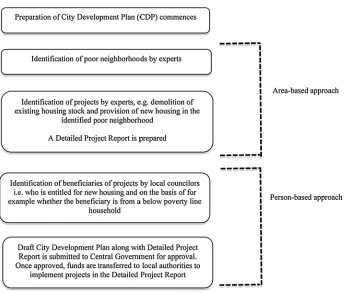
Phase 1, experts identify a range of projects. A Detailed Project Report is then compiled that lists projects in various neighborhoods in Trivandrum city. In Phase 3, a list of beneficiaries in identified neighborhoods is drawn up based on criteria such as living below poverty line and is authorized by local councilors. In the final phase, the local authority submits the CDP along with the Detailed Project Report and list of beneficiaries to the central government for securing funding for projects. Once approved, implementation of projects commences in selected neighborhoods.
It appears that currently only area-based and person-based approaches are used. These may not effectively capture needs and priorities in poor neighbor-hoods in Trivandrum city. Williams, Thampi, Narayana, Nandigama, and Bhattacharaya (2011) point out that contemporary conceptualization of poverty in Kerala does not reflect context-based priorities but rather is derived from national frameworks. This then raises questions of what the components of a place-based understanding of poverty might be. It is in this regard that we argue that the CDPs (see Figure 1) as part of the JNNURM initiative adopt a poverty-in-context approach. The preparation of a community-led project-identification process through a pathways to well-being matrix or poverty mapping can be made part of the preparation of CDPs. We particularly focus on the development of a poverty-in-context framework and pathways to well-being matrix. These draw on an approach that records the perceptions of poverty from the point of view of the poor (Moore et al., 1998). But one should avoid the pitfalls of reductionism, for instance, in saying that this is how the poor in a particular area view themselves and/or understand poverty. In addition, it is important to see how and whether the poor see poverty as an expression embedded across geographies, and that an escape from the poverty cycle has as much to do with income/material well-being as it does with physical translocation from existing sites of deprivation to improved living environments.
This is where the preparation of CDPs has an important role in translating the conceptions of well-being of disadvantaged communities into “aspirational spaces.” Reproduction of inequality occurs at particular sites, and there emerges a question of whether the concept of a poverty-focused CDP has the potential to address this. Therefore, it becomes necessary to understand key themes and indices that would define a poverty-in-context approach and how such an approach can be applied to the preparation of a CDP. The following section outlines the methodological approach.
Poverty-in-Context Framework
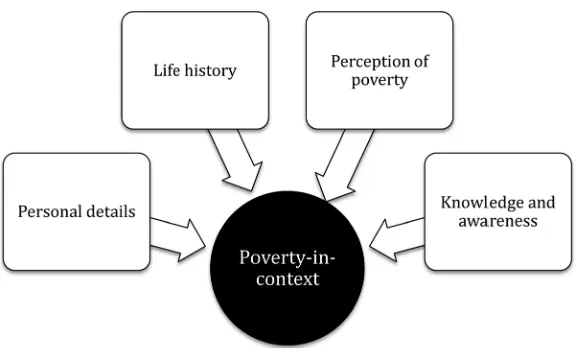
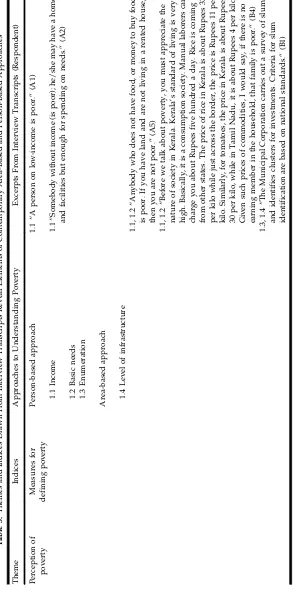
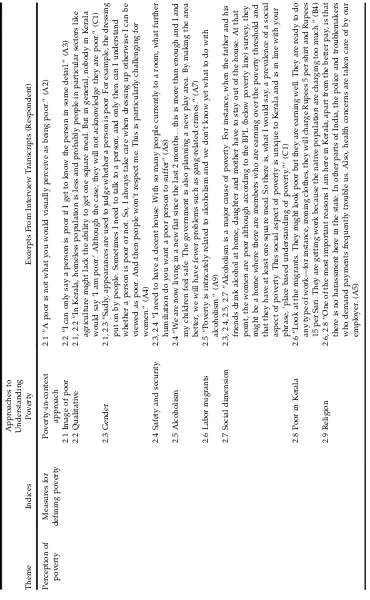
With regard to perceptions of poverty, an identification of themes and indices within themes was carried out from interview transcripts. The following illustration shows key themes of a context approach. The poverty-in-context approach can be seen as grounded in four interrelated themes (see Figure 2): (i) personal details; (ii) life history and circumstances; (iii) perception of poverty; (iv) knowledge, awareness, and support. The first two themes build on the person-based approach to poverty discussed earlier in this article. However, the themes from the interviews have a distinct focus in that they place emphasis on characterizing the individual in context rather than decontextualizing the individual (which typical person-based approaches do). Similarly, the last two themes derive from an area-based approach to poverty that was set out previously in the article. Again, the emphasis is different and is on the relationship between individuals in particular places and not merely a categoriza-tion of areas such as urban and rural that assumes individuals in such areas have similar characteristics. Indices within these four core themes are further elaborated:
[image:11.504.80.424.64.357.2]1. Personal Details (1.1 Demographic/partnership status, 1.2 Details of accommo-dation, 1.3 Economic activity, 1.4 Health, 1.5 Other)
2. Life History and Circumstances (2.1 Experiences of effects of poverty in childhood, 2.2 Ethnic, religious, caste, gender and migrant identity and poverty, 2.3 Presence of effective relationships (family, networks, friends), 2.4 Coping strategies, 2.5 Others)
3. Perception of Poverty (3.1 Key measures for defining poverty, 3.2 Comparing one’s life with others, 3.3 Charting out pathways to well-being, 3.4 Other issues)
4. Knowledge, Awareness, and Support (4.1 Knowledge of poverty alleviation programmes, 4.2 Awareness of the role and responsibilities of various levels of govt., 4.3 Support from NGOs and the private sector, 4.4 Gatekeepers and access to benefits from poverty policies, 4.5 Political nature of BPL (Below Poverty Line) card)
[image:12.504.111.399.66.240.2]Since in this article we focus on demonstrating how an in-context approach that reflects local needs and priorities might be used to conceptualize poverty, responses within the theme “perception of poverty” are used to illustrate two interesting findings. First, that person-based and area-based approaches are still used in talking about poverty (see Table 3), for instance, in how income (person-based) or level of infrastructure provision (area-(person-based) is considered an important indicator of well-being. Equally, the second finding points to a conceptualization of poverty shaped by the particular context (see Table 4). Such a conceptualiza-tion was underpinned by a range of elements, such as associating poverty with labor migrants. Thus, it can be said that the poverty-in-context framework provides a basis for understanding the various themes and indices with which poverty is conceptualized in a particular context. Using such themes and indices that reflect contextual realities along with person-based and area-based approaches will provide a richer understanding of poverty.
Pathways to Well-Being Matrix
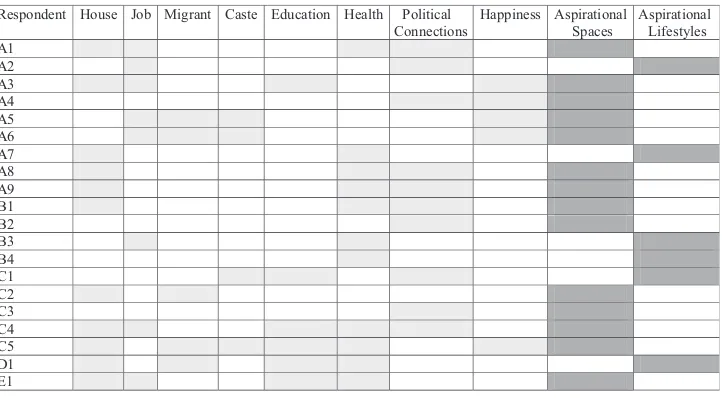
However, a description of poverty in a particular context using themes and indices is only one part of the framework. The second part is to explore what can be done about poverty and how to translate this richer understanding into a tool that could be used in community forums. Key criteria for well-being are first drawn up from the transcripts from the point of view of each of the respondents. These are then mapped onto a matrix that not only captures the different criteria but also indicates pathways to well-being, that is, in how the poor think their intended state of well-being might be achieved.
The illustration in Table 5 suggests two broad pathways: (i) aspirational spaces and (ii) aspirational lifestyles. In the former, an intended state of well-being is only seen as possible if a physical relocation takes place or, in other words, if spatial mobility occurs. In the latter, socioeconomic mobility is seen as the key determinant for achieving an intended state of mobility. Each of these preferences has important consequences for the nature of projects identified in particular neighborhoods. For instance, those preferring an “aspirational path-way” might be looking for projects that would help them move into another part of the city. For others, remaining in the same location might be important.
Discussion
[image:18.504.77.438.455.654.2]The preparation of CDPs was rolled out as an ambitious project by the Government of India (as part of the JNNURM initiative) to improve the quality of urban infrastructure and to provide due safety nets for the urban poor struggling with employment opportunities and inadequate housing and services. One of the
Table 5. Development of a Pathways to Well-Being Matrix: Aspirational Spaces, Aspirational Lifestyles
Political Health
Education Caste
Migrant Job House Respondent
Connections
Happiness Aspirational Spaces
Aspirational Lifestyles A1
A2 A3
A4
A5 A6 A7
A8 A9 B1
B2
B3
B4
C1
C2
C3
tasks was to improve urban areas by allowing local authorities to engage with poverty in context. With regard to this task, local authorities, with support from their respective state governments, would identify projects for which funding would be sought from the central government under the CDP/JNNURM scheme.
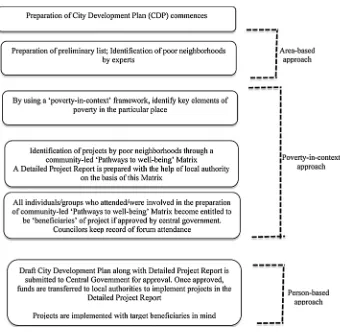
An area of general concern was how these urban projects would be identified. In particular, it was not clear how poverty was understood or situated in relation to the needs and priorities of the local area. In response, we engaged with various stakeholders in the case study area to develop a poverty-in-context approach. The resulting poverty-in-context framework produced (i) a rich, descriptive understand-ing of poverty through a range of themes and indices and (ii) a pathways to well-being matrix that sets out the basis for translating ideas into action. Thus, the question of how best to use these findings in the preparation of future CDPs in Trivandrum (or other cities across India) emerges. We propose a revised approach to the preparation of CDPs (Figure 3). There would be a range of phases, where the first phase would be underpinned by an area-based approach, the next two by a poverty-in-context approach, and the last by a person-based approach.
Following the preparation of CDPs, experts identify poor neighborhoods in Phase 1 (this is an area of future inquiry, where one can consider how a poverty-in-context approach might be used in this phase as well). In Phase 2, key themes and indices underpinning a poverty-in-context approach are first identified based on the methodology presented in this article. Following this, a pathways to well-being matrix is developed for the particular poor neighborhood. Experts now identify projects based on this matrix and prepare Detailed Project Reports. In the next phase, a list of beneficiaries is drawn in these neighborhoods by virtue of attendance/participation in community forums and is ratified by local councilors. In the final phase, following approval by the central government of the CDP and the Detailed Project Reports, projects are implemented in select neighborhoods.
Conclusion
This article contributed to an understanding of how a poverty-in-context approach might be used as a basis for identifying pro-poor projects while preparing CDPs. In particular, the findings in this article shed new light by arguing that a poverty-in-context approach can be effectively developed by drawing on two elements: (i) a poverty-in-context framework that appreciates unique characteristics of poverty in a place beyond the conventional area-based and person-based approaches and (ii) a pathways to well-being matrix that links the understanding of poverty developed using the poverty-in-context framework with aspirations for well-being of poor populations.
important to understand the poor’s view on poverty, such as how and whether the poor see poverty as an expression embedded across geographies, and to understand that an escape from the poverty cycle has to do with income/material well-being and the physical translocation from existing sites of deprivation to improved living environments. The former can be addressed through a range of interventions, including employment generation schemes or housing up-grada-tion projects; however, the latter is more challenging, as the intervenup-grada-tions need to engage with the reproduction of inequality that occurs at particular sites within human settlements. This is where the preparation of CDPs, required as part of the JNNURM scheme, has a potentially important role in translating the conceptions of well-being of disadvantaged communities into actual spaces where the aspirations of the poor can be realized.
[image:20.504.86.427.65.401.2]However, further work needs to be done. For instance, what might be the best way to bring together pathways to well-being matrices prepared in different neighborhoods? Who might be responsible for integrating these elements? Furthermore, is integration possible, or even desirable? Having said that, the
poverty-in-context approach this article developed is no doubt an important starting point and clearly throws light on an alternative to existing person-based and area-based approaches to poverty alleviation in the Indian context.
Acknowledgment
The authors are grateful to the British Academy for funding this research through the Small Grant Research scheme (ref: SG101753). We are also indebted to the helpful comments provided by the two anonymous referees.
Notes
1. Data collection was carried out as part of British Academy–funded project Ref. SG10153, titled “The possibility of local communities shaping an understanding of poverty? Experiences from the Jawaharlal Nehru Urban Renewal Mission for improving the lives of urban poor in India” in May– July 2011.
2. One crore Rupees¼100 lakh rupees¼10,000,000 rupees¼£133,333.33¼$200,000 (assuming an exchange rate of 1£¼rupees 75¼$1.50).
3. 66,000 crore rupees ¼66,000£133,333.33¼£8,799 million¼£8.8 billion (over a seven-year period). So, an annual estimate of central government contribution¼£8.8/7¼£1.2 billion¼$1.8 billion. 4. This includes professionals from the engineering, architecture, town planning, and environment
departments in the local authority; officials from both municipal and state administration; and other experts from relevant state and central government departments.
References
Administrative Staff College. (2008). City development plan—Kochi: Appraisal report. Retrieved from http://jnnurm.nic.in/wp-content/uploads/2010/12/KOCHI_AR1.pdf.
Ahluwalia, M. S. (1990). “Policies for poverty alleviation.”Asian Development Review: Studies of Asian and Pacific Economic Issues, 8(1), 1–15.
Beaudoin, S. M. (2007).Poverty in world history. London: Routledge.
Bhagvati, J. (1988). “Poverty and public policy.”World Development, 16(5), 539–555.
Bowles, S., S. N. Durlauf, & K. R. Hoff. (2006).Poverty traps. New York: Russell Sage Foundation. Bradshaw, J., & N. Finch. (2003). “Overlaps in dimensions of poverty.”Journal of Social Policy, 32,
513–525.
Dini, A., & V. Lippit. (2009, August). Poverty, from orthodox to heterodox approaches: A methodological comparison survey(Working Paper). Riverside: University of California.
Dunn, K. (2000). “Interviewing.” In I. Hay (Ed.), Qualitative research methods in human geography. Victoria: Oxford University Press.
Fincher, R., & J. Jacobs. (Eds.). (1998).Cities of difference. New York: Guilford Press.
Government of India. (2005).Jawaharlal Nehru National Urban Renewal Mission—An overview. Retrieved from http://jnnurm.nic.in/wp-content/uploads/2011/01/PMSpeechOverviewE.pdf.
Government of India. (2012). Compendium of projects under JNNURM, July 2012, Volume 1. Retrieved from http://jnnurm.nic.in/wp-content/uploads/2012/11/Compendium-Projects-amp-Reforms-JnNURM-MoUD-July-12-Vol-01Part-01.pdf.
Himmelfarb, G. (1984).The idea of poverty: England in the early industrial age. London: Faber and Faber. Hulme, D., & A. Shepherd. (2003). “Conceptualizing chronic poverty.”World Development, 31, 403–
International Labour Office. (1976).Employment growth and basic needs: A one-world problem, report of the director-general of the International Labour Office. Geneva: International Labor Office.
Moore, M., M. Choudhary, & N. Singh. (1998). How can we know what they want? Understanding local perceptions of poverty and ill-being in Asia (IDS Working Paper 80). Sussex: Institute for Development Studies.
Novak, T. (1988).Poverty and the state. Milton Keynes, UK: Open University Press.
Planning Commission. (2001).Poverty alleviation. Retrieved from http://planningcommission.gov.in/ plans/annualplan/ap2021pdf/ap2021ch4-2.pdf.
Planning Commission. (2011).Press notes on poverty estimates, 27 January 2011. Retrieved from http:// planningcommission.nic.in/reports/genrep/Press_pov_27Jan11.pdf.
Ritchie, J., L. Spencer, & W. O’Connor. (2003). “Carrying out qualitative analysis.” In J. Ritchie & J. J. Lewis (Eds.),Qualitative research practice: A guide for social science students and researchers. London: Sage.
Rowntree, B. S. (1901).Poverty: A study of town life. London: Macmillan.
Tipple, G., & S. Speak. (2009). The hidden millions: Homelessness in developing countries. London: Routledge.
Townsend, P. (1993).The international analysis of poverty. London: Harvester Wheatsheaf.
Trivandrum Municipal Corporation. (2006). City development plan—Trivandrum. Report submitted to Ministry of Urban Development and Ministry of Employment and Poverty Alleviation, Government of India. Trivandrum: Trivandrum Municipal Corporation and Local Self Govern-ment DepartGovern-ment. GovernGovern-ment of Kerala.
Watson, V. (2003). “Conflicting rationalities: Implications for planning theory and ethics.” Planning Theory and Practice, 4, 395–407.
Williams, G., B. V. Thampi, D. Narayana, S. Nandigama, & D. Bhattacharaya. (2011).State strategies for defining and alleviating poverty in Kerala, India. Sheffield International Development Network (SIDNET) Policy/Research Briefing no.4. Sheffield, UK: University of Sheffield.