5-Chloro-2-methoxyanilinium nitrate
Hanene Hemissi, Sonia Abid* and Mohamed Rzaigui
Laboratoire de Chimie des Mate´riaux, Faculte´ des Sciences de Bizerte, 7021 Zarzouna Bizerte, Tunisia
Correspondence e-mail: [email protected]
Received 16 February 2008; accepted 1 April 2008
Key indicators: single-crystal X-ray study;T= 293 K; mean(C–C) = 0.003 A˚; Rfactor = 0.042;wRfactor = 0.109; data-to-parameter ratio = 16.5.
The title salt, C7H9ClNO +
NO3
, exhibits extensive hydrogen bonding between the ammonium functional group and the nitrate anion. A two-dimensional network of bifurcated N— H O hydrogen bonds generates corrugated layers in thebc plane. The organic molecules are stacked in a parallel orientation as a result of–interactions, with an inter-ring distance of 3.837 A˚ .
Related literature
For related literature, see: Abid et al. (2007); Aloui et al. (2002); Desiraju & Steiner (1999); Hemissi et al. (2005); Jayaraman et al.(2002); Ouslati & Ben Nasr (2006); Steiner (2002); Kefiet al.(2007).
Experimental
Crystal data
C7H9ClNO+NO3
Mr= 220.61
Monoclinic,P21=c a= 10.681 (2) A˚
b= 9.474 (3) A˚
c= 9.802 (3) A˚
= 102.38 (3)
V= 968.8 (5) A˚3 Z= 4
MoKradiation
= 0.39 mm1
T= 293 (2) K 0.20.180.16 mm
Data collection
Enraf–Nonius TurboCAD-4 diffractometer
Absorption correction: none 4244 measured reflections 2125 independent reflections
1409 reflections withI> 2(I)
Rint= 0.029
2 standard reflections frequency: 120 min intensity decay: 5%
Refinement
R[F2> 2(F2)] = 0.041
wR(F2) = 0.109 S= 1.02 2125 reflections
129 parameters
H-atom parameters constrained max= 0.18 e A˚
3
min=0.42 e A˚
[image:1.610.313.564.173.256.2]3
Table 1
Hydrogen-bond geometry (A˚ ,).
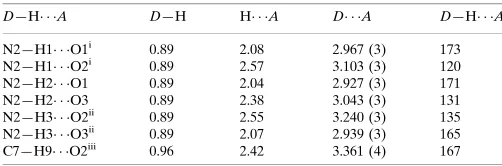
D—H A D—H H A D A D—H A
N2—H1 O1i
0.89 2.08 2.967 (3) 173 N2—H1 O2i
0.89 2.57 3.103 (3) 120 N2—H2 O1 0.89 2.04 2.927 (3) 171 N2—H2 O3 0.89 2.38 3.043 (3) 131 N2—H3 O2ii
0.89 2.55 3.240 (3) 135 N2—H3 O3ii
0.89 2.07 2.939 (3) 165 C7—H9 O2iii
0.96 2.42 3.361 (4) 167
Symmetry codes: (i)x;yþ1 2;zþ
1
2; (ii)xþ2;yþ 1 2;zþ
3
2; (iii)x;yþ1;z. Data collection: CAD-4 EXPRESS (Enraf–Nonius, 1994); cell refinement:CAD-4 EXPRESS; data reduction:XCAD4(Harms & Wocadlo, 1995); program(s) used to solve structure: SHELXS97 (Sheldrick, 2008); program(s) used to refine structure:SHELXL97 (Sheldrick, 2008); molecular graphics: ORTEP-3 for Windows (Farrugia, 1997),DIAMOND(Brandenburg, 1998); software used to prepare material for publication:WinGX(Farrugia, 1999).
Supplementary data and figures for this paper are available from the IUCr electronic archives (Reference: FJ2102).
References
Abid, S., Hemissi, H. & Rzaigui, M. (2007).Acta Cryst.E63, o3117. Aloui, Z., Abid, S. & Rzaigui, M. (2002).Mater. Res. Bull.37, 697–703. Brandenburg, K. (1998).DIAMOND. University of Bonn, Germany. Desiraju, G. R. & Steiner, T. (1999).The Weak Hydrogen Bond. Oxford
University Press.
Enraf–Nonius (1994).CAD-4 EXPRESSSoftware. Enraf–Nonius, Delft, The Netherlands.
Farrugia, L. J. (1997).J. Appl. Cryst.30, 565. Farrugia, L. J. (1999).J. Appl. Cryst.32, 837–838.
Harms, K. & Wocadlo, S. (1995).XCAD4. University of Marburg, Germany. Hemissi, H., Abid, S. & Rzaigui, M. (2005).Anal. Sci.21, 137–138. Jayaraman, K., Choudhury, A. & Rao, C. N. R. (2002).Solid State Sci.4, 413–
422.
Kefi, R., Abid, S., Ben Nasr, C. & Rzaigui, M. (2007).Mater. Res. Bull.42, 404– 412.
Ouslati, A. & Ben Nasr, C. (2006).Anal. Sci.22, 1–2. Sheldrick, G. M. (2008).Acta Cryst.A64, 112–122. Steiner, T. (2002).Angew. Chem. Int. Ed.41, 48–76.
Structure Reports Online
supporting information
Acta Cryst. (2008). E64, o801 [doi:10.1107/S1600536808008805]
5-Chloro-2-methoxyanilinium nitrate
Hanene Hemissi, Sonia Abid and Mohamed Rzaigui
S1. Comment
Hydrogen bonding is of intense interest because of their widespread occurrence in biological systems. So, it is very
helpful to search simple molecules allowing to understanding the configuration and the function of some complex
macromolecules.The hybrid compounds are rich in H-bonds and they could be used to this effect because of their
potential importance in constructing sophisticated assemblies from discrete ionic or molecular building blocks due to its
strength and directionality (Steiner. et al. 2002, Jayaraman, et al. 2002). In this work, the combination of
2-methoxy-5-chloroaniline and nitric acid has been chosen to elaborate the special hydrogen-bond pattern. The asymmetric unit of
crystal structure, depicted in ORTEP drawing (Fig. 1), correspond to the formula unit C6H9ClNO+.NO3-. The main feature
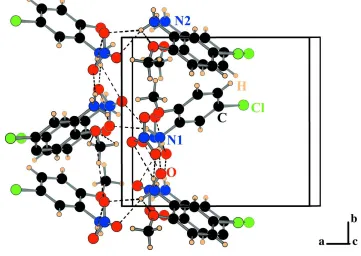
of this atomic arrangement is the existence of thick inorganic corrugated layers spreading around bc plane (Fig. 2). Inside
layer, each NO3- anion is linked to three organic groups through bifurcated N–H···O H-bonding. The N···O and H···O
bond lengths are in the ranges of 2.927 (3)–3.240 (3) Å and 2.04–2.57 Å, respectively. The organic species interact also
with a weak C–H···O hydrogen bond with H···O separation of 2.42 Å. These interactions are weaker than those observed
otherwise (Ouslati et al. 2006, Kefi et al. 2007). The orientation of molecules in this framework is governed by a nearly
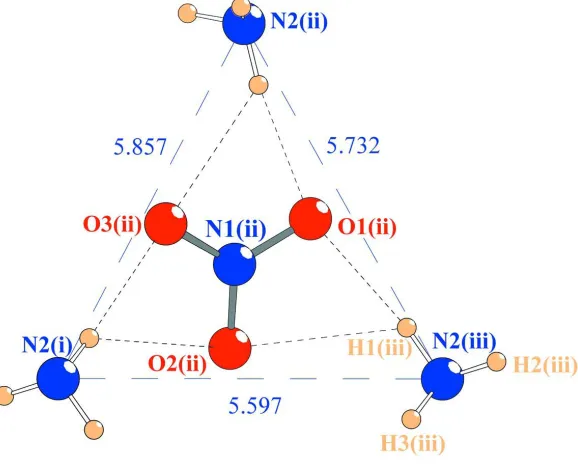
regular triangular arrangement of 2-methoxy-5-chlorophenylammonium groups [N···N distances between nitrogen
ammonium atoms are in the range of 5.597 and 5.857 Å, N···N···N angles range from 57.75 to 62.25°] (Fig. 3). As well as
electrostatic and van der Waals forces and hydrogen bonds, aromatic π-π stacking interactions participate to define the
crystal packing. Indeed, in the atomic arrangement of the title compound, the phenyl ring of the organic molecules are
stacked in the parallel orientation with inter-planar separation of 3.837 Å indicating there are π–π stacking interactions
(Desiraju & Steiner, 1999). The –Cl, –NH3 and –OCH3 substituents form, respectively, different torsion angles with the
benzene ring: Cl—C5—C6—C1 ((t1) = 178.71°), N2—C1—C2—C3 ((t2) = -179.74°) and C7—O4—C2—C3 ((t3) =
12.43°). (t1) and (t2) angle values show that the chloro and amino substituents are nearly coplanar with the aryl ring. The
torsion angle (t3) value indicates that the methoxy group lies out the plane of the benzene ring. This conformation
resembles that observed in other compounds (Abid et al. 2007, Aloui et al. 2002, Hemissi et al. 2005).
S2. Experimental
An ethanolic 2-methoxy-5-chloroaniline solution (5 mmol, in 5 ml) was added to an aqueous HNO3 solution (0.5 M). The
obtained solution is evaporated during several days in ambient condition until the formation of single crystals of the title
compound.
S3. Refinement
All H atoms were positioned geometrically and treated as riding on their parent atoms, [N–H = 0.89, C–H =0.96 Å (CH3 )
Figure 1
ORTEP-3 (Farrugia,(1999)) view of the title compound, with the atom numbering scheme. Displacement ellipsoids for
non-H atoms are drawn at the 30% probability level, and H-atoms are shown as spheres with an arbitary radius.
Figure 2
[image:3.610.124.485.359.615.2]Figure 3
Nitrate anion environment in the title compound. [Symmetry operators: (i) x, y, z; (ii) -x, y + 1/2, -z + 1/2; (iii) -x, -y, -z].
5-Chloro-2-methoxyanilinium nitrate
Crystal data
C7H9ClNO+·NO3− Mr = 220.61 Monoclinic, P21/c
Hall symbol: -P 2ybc
a = 10.681 (2) Å
b = 9.474 (3) Å
c = 9.802 (3) Å
β = 102.38 (3)°
V = 968.8 (5) Å3 Z = 4
F(000) = 456
Dx = 1.513 Mg m−3
Mo Kα radiation, λ = 0.71073 Å Cell parameters from 25 reflections
θ = 9.1–10.8°
µ = 0.39 mm−1 T = 293 K Prism, black
0.2 × 0.18 × 0.16 mm
Data collection
Enraf–Nonius TurboCAD4 diffractometer
Radiation source: Enraf–Nonius FR590 Graphite monochromator
non–profiled ω scans 4244 measured reflections 2125 independent reflections 1409 reflections with I > 2σ(I)
Rint = 0.029
θmax = 27.0°, θmin = 2.9°
h = −13→13
k = −12→0
l = −12→12
2 standard reflections every 120 min intensity decay: 5%
Refinement
Refinement on F2
Least-squares matrix: full
R[F2 > 2σ(F2)] = 0.041 wR(F2) = 0.109 S = 1.02
2125 reflections 129 parameters 0 restraints
map
Hydrogen site location: inferred from neighbouring sites
H-atom parameters constrained
where P = (Fo2 + 2Fc2)/3
(Δ/σ)max < 0.001
Δρmax = 0.18 e Å−3
Δρmin = −0.42 e Å−3
Special details
Geometry. All e.s.d.'s (except the e.s.d. in the dihedral angle between two l.s. planes) are estimated using the full
covariance matrix. The cell e.s.d.'s are taken into account individually in the estimation of e.s.d.'s in distances, angles and torsion angles; correlations between e.s.d.'s in cell parameters are only used when they are defined by crystal symmetry. An approximate (isotropic) treatment of cell e.s.d.'s is used for estimating e.s.d.'s involving l.s. planes.
Refinement. Refinement of F2 against ALL reflections. The weighted R-factor wR and goodness of fit S are based on F2,
conventional R-factors R are based on F, with F set to zero for negative F2. The threshold expression of F2 > σ(F2) is used
only for calculating R-factors(gt) etc. and is not relevant to the choice of reflections for refinement. R-factors based on F2
are statistically about twice as large as those based on F, and R- factors based on ALL data will be even larger.
Fractional atomic coordinates and isotropic or equivalent isotropic displacement parameters (Å2)
x y z Uiso*/Ueq
Cl 0.39657 (5) 0.59783 (8) 0.79445 (7) 0.0703 (2)
N2 0.83926 (16) 0.40697 (19) 0.75239 (18) 0.0478 (4)
H2 0.8415 0.3375 0.6918 0.072*
H1 0.8331 0.3705 0.8344 0.072*
H3 0.9107 0.4579 0.7630 0.072*
O4 0.83237 (15) 0.55493 (16) 0.52279 (16) 0.0568 (4)
C1 0.72828 (18) 0.4973 (2) 0.6998 (2) 0.0387 (4)
C2 0.72905 (19) 0.5751 (2) 0.5790 (2) 0.0425 (5)
C3 0.6254 (2) 0.6618 (2) 0.5276 (2) 0.0530 (6)
H4 0.6241 0.7158 0.4481 0.064*
C4 0.5237 (2) 0.6682 (2) 0.5941 (2) 0.0532 (5)
H5 0.4537 0.7256 0.5585 0.064*
C5 0.52562 (19) 0.5906 (2) 0.7117 (2) 0.0465 (5)
C6 0.62876 (18) 0.5041 (2) 0.7675 (2) 0.0425 (5)
H6 0.6303 0.4523 0.8484 0.051*
C7 0.8528 (3) 0.6480 (3) 0.4147 (3) 0.0714 (7)
H7 0.7883 0.6316 0.3316 0.107*
H8 0.9360 0.6309 0.3957 0.107*
H9 0.8477 0.7441 0.4443 0.107*
O1 0.82176 (15) 0.19146 (16) 0.53507 (16) 0.0556 (4)
N1 0.88696 (17) 0.09358 (19) 0.60238 (19) 0.0484 (4)
O2 0.8812 (2) −0.02617 (18) 0.5536 (2) 0.0835 (6)
O3 0.95687 (16) 0.12025 (18) 0.71720 (17) 0.0648 (5)
Atomic displacement parameters (Å2)
U11 U22 U33 U12 U13 U23
C2 0.0474 (11) 0.0390 (10) 0.0426 (11) −0.0011 (9) 0.0133 (9) −0.0051 (9) C3 0.0641 (14) 0.0486 (13) 0.0465 (12) 0.0072 (11) 0.0123 (10) 0.0052 (10) C4 0.0518 (12) 0.0508 (13) 0.0539 (13) 0.0117 (10) 0.0043 (10) −0.0034 (11) C5 0.0389 (10) 0.0487 (12) 0.0525 (12) −0.0016 (9) 0.0112 (9) −0.0156 (10) C6 0.0465 (11) 0.0410 (11) 0.0411 (11) −0.0061 (9) 0.0122 (9) −0.0044 (9) C7 0.0947 (19) 0.0575 (15) 0.0752 (17) −0.0137 (14) 0.0481 (15) −0.0009 (13) O1 0.0598 (9) 0.0502 (9) 0.0562 (9) 0.0115 (8) 0.0108 (7) 0.0016 (7) N1 0.0526 (10) 0.0451 (10) 0.0522 (11) −0.0002 (9) 0.0215 (9) −0.0025 (9) O2 0.1170 (16) 0.0446 (10) 0.0859 (13) 0.0093 (10) 0.0152 (12) −0.0144 (10) O3 0.0709 (11) 0.0675 (11) 0.0518 (10) 0.0030 (8) 0.0038 (8) −0.0049 (8)
Geometric parameters (Å, º)
Cl—C5 1.744 (2) C3—H4 0.9300
N2—C1 1.463 (2) C4—C5 1.364 (3)
N2—H2 0.8900 C4—H5 0.9300
N2—H1 0.8900 C5—C6 1.388 (3)
N2—H3 0.8900 C6—H6 0.9300
O4—C2 1.349 (2) C7—H7 0.9600
O4—C7 1.431 (3) C7—H8 0.9600
C1—C6 1.370 (3) C7—H9 0.9600
C1—C2 1.397 (3) O1—N1 1.258 (2)
C2—C3 1.383 (3) N1—O2 1.228 (2)
C3—C4 1.383 (3) N1—O3 1.236 (2)
C1—N2—H2 109.5 C5—C4—H5 119.9
C1—N2—H1 109.5 C3—C4—H5 119.9
H2—N2—H1 109.5 C4—C5—C6 121.21 (19)
C1—N2—H3 109.5 C4—C5—Cl 120.13 (17)
H2—N2—H3 109.5 C6—C5—Cl 118.66 (17)
H1—N2—H3 109.5 C1—C6—C5 118.04 (19)
C2—O4—C7 118.86 (18) C1—C6—H6 121.0
C6—C1—C2 122.12 (18) C5—C6—H6 121.0
C6—C1—N2 120.77 (18) O4—C7—H7 109.5
C2—C1—N2 117.11 (17) O4—C7—H8 109.5
O4—C2—C3 126.62 (19) H7—C7—H8 109.5
O4—C2—C1 115.18 (18) O4—C7—H9 109.5
C3—C2—C1 118.19 (19) H7—C7—H9 109.5
C4—C3—C2 120.2 (2) H8—C7—H9 109.5
C4—C3—H4 119.9 O2—N1—O3 120.9 (2)
C2—C3—H4 119.9 O2—N1—O1 120.0 (2)
C5—C4—C3 120.3 (2) O3—N1—O1 119.02 (18)
C7—O4—C2—C3 12.4 (3) C2—C3—C4—C5 0.8 (3)
C7—O4—C2—C1 −168.9 (2) C3—C4—C5—C6 0.1 (3)
C6—C1—C2—O4 −178.65 (18) C3—C4—C5—Cl −179.46 (17)
N2—C1—C2—O4 1.4 (3) C2—C1—C6—C5 0.7 (3)
O4—C2—C3—C4 177.7 (2) Cl—C5—C6—C1 178.71 (15)
C1—C2—C3—C4 −1.0 (3)
Hydrogen-bond geometry (Å, º)
D—H···A D—H H···A D···A D—H···A
N2—H1···O1i 0.89 2.08 2.967 (3) 173
N2—H1···O2i 0.89 2.57 3.103 (3) 120
N2—H2···O1 0.89 2.04 2.927 (3) 171
N2—H2···O3 0.89 2.38 3.043 (3) 131
N2—H3···O2ii 0.89 2.55 3.240 (3) 135
N2—H3···O3ii 0.89 2.07 2.939 (3) 165
C7—H9···O2iii 0.96 2.42 3.361 (4) 167