Multicultural Project Teams and
Their Management.
Les équipes multiculturelles de
projet et leur gestion.
Dorota Magdalena DUDA and Guru Prakash PRABHAKAR
Bristol Business School, University of the West of England (United Kingdom)
Abstract
Organisations are becoming more and more diverse due to the increasing globalisation of business operations. Multicultural project teams can potentially assist in better decision making and bring in greater creativity and innovation. Additionally, the possibility for an organisation to learn through multinational project teams is perceived as the main attributor of the more international viewpoint. However, multiple cultural backgrounds of project team members can also create conflicts, communication breakdowns and increase stress levels. It is therefore necessary to fully appreciate multicultural project teams, together with their advantages and drawbacks and understand their management. This paper explores the literature available on managing multicultural project teams. Three main challenges facing multicultural project teams are presented: cultural diversity, communication and trust. Furthermore, managerial approaches to deal with those challenges are discussed. Four leadership styles are found and investigated for leading such teams, namely: Ethnocentrism, Synergy, Polycentrism and Switch Leadership. Lastly, methodological limitations are pointed out and further research directions are suggested.
Keywords :
Project; culture; leadership; teams.
Corresponding authors: Guru Prakash Prabhakar, Coldharbour Lane, Bristol. BS16 1QY. United Simon, H.A. (1991)Rationality in Political Behaviour, Carnegie Mellon University.
New York: The Free Press.
Tarkowsky, Z-M. (1958) Symposium: problems in decision taking. Operational Research Quarterly.9(2), 121-123.
Wathne, K. H., & Heide J. B. (2000) Opportunism in Inter firm Relationships: Forms, Outcomes and Solutions. Journal of Marketing. 64(4), 36-51.
Willamson, O. E. (1975) Markets and Hierarchies: Analysis and Antitrust implications. New York: the Free Press.
Willamson, O. E. (1985) The Economic Institutions of Capitalism. New York: The Free Press.
Introduction
The overwhelming constant globalisation of today’s business operations has directed firms’ management to an increased concentration on the successful relations and collaboration of employees from various cultural backgrounds in multi-cultural project teams (Davison, 1994). Makilouko (2004) distinguishes three types of multicultural project teams. The first one is a project team consisting of members with different national cultures, but working together in the same country. The second type is a project team in which the members are partly or completely dispersed but meet in face-to-face interactions. The last type is a project team, in which members communicate only via electronic channels and encounter no face-to-face interaction. These are known as ‘virtual project teams’ (Jarvenpaa & Leidner, 1999). As described by Adler (2002), a multinational project team is made up of people coming from a minimum of three different national cultures. Govindarajan and Gupta (2001) introduce the name of a ‘cross-border team’ and characterise it as a ‘team of individuals of different nationalities, working in different cultures, businesses and functions, who come together to coordinate some aspects of the multinational operation on a global basis’. Hofstede (1983) gives one definition of national culture as a part of ‘collective mental programming’ that we share with other members of our country and that differs from people from another country. Stewart (1972) adds that different cultures are characterised by a set of values, opinions, ideologies and norms. These values that vary from one another can influence variables such as the approach towards organisational operations, motivational methods, approaches to leadership (Erez, 1994; Erez & Earley, 1987; Hui, 1990) and most importantly, can greatly affect the project team’s unity. The majority of the research that is available on interactions between different cultures shows that they are, as such, likely to be complex (Elron, 1997). An extensive research into organisational psychology shows that multicultural project teams can be more innovative, creative and therefore more efficient (Jackson, May & Whitney, 1995; Maznevski & Di Stefano, 2000). The benefits of culturally diverse teams lie in their vast mixture of different points of view, skills, values and talents (Maznevski, 1994; McLeod, Lobel & Alisa, 1996). The great advantages of multicultural project teams become even more evident when compared to homogenous teams, which have the tendency towards a single perspective on the world and similar type of behaviour. Most importantly, the members of homogenous project teams speak the same language and words and expressions have the same meaning to them. This is where the disadvantages of multicultural project teams begin to become apparent. Language barriers can make the communication between members problematic. Team members who only know the basics of the language of the dominant party always find it challenging to understand the common expressions and idiomatic terms (Miller, Fields, Kumar & Ortiz, 2000). Further problems include negative effects on team unity due to cultural differences, high degree of stress and uncertainty and numerous conflicts (Adler 2002). Taking into consideration all the advantages and disadvantages, multicultural project teams
Résumé
Les organisations sont de plus en plus diversifiées en raison de la mondialisation croissante des activités commerciales. Les équipes multiculturelles de projet peu-vent potentiellement contribuer à une meilleure prise de décision et apporter plus de créativité et une plus grande innovation. De plus, la possibilité pour une or-ganisation d'apprendre au travers des équipes multinationales de projet est perçue comme le principal apport permettant d’adopter un point de vue plus in-ternational. Cependant, les multiples origines culturelles des membres de l'équipe peuvent également créer des conflits, des ruptures de communication et accroître le stress. Il est donc nécessaire d’apprécier pleinement les équipes de projet mul-ticulturelles, avec leurs avantages et leurs inconvénients et de comprendre leur gestion. Ce document explore la littérature disponible sur la gestion des équipes projet multiculturelles. Les trois principaux défis auxquels ces équipes sont con-frontées sont: la diversité culturelle, la communication et la confiance. Les ap-proches de gestion pour faire face à ces défis sont également examinées. Quatre styles de leadership sont trouvés au travers d’une enquête menée près de telles équipes, à savoir: l'ethnocentrisme, la synergie, le polycentrisme et le Switch leadership. Enfin, les limitations méthodologiques sont exposées et l'orientation de recherches supplémentaires sont proposées.
Mots-clés:
The purpose of this paper is to improve the understanding of issues concerning multicultural project teams and examine what has so far been known about managing such teams. The paper is divided into three sections. The first part carefully explores the most influential literature on the challenges facing multicultural project teams and presents the main findings. In this section the challenges of cultural diversity, communication and trust are investigated. The second section focuses on different leadership styles and approaches that are proposed by academics, which could be adopted when managing multicultural project teams. This section examines in greater depth four types of leadership: Ethnocentric, Synergy, Polycentric (Makilouko, 2004) and Switch Leadership (Prabhakar, 2005). Finally, the third part will analyse and discuss the limitations of the present findings and propose further research directions into the management of multicultural project teams.
1
Challenges facing the Management of
Multicultural Project Teams
Brett, Behfar & Kern (2006) research shows that one of the major challenges facing project managers of multicultural teams is the problem with direct vs. indirect communication. Matveev & Nelson (2004) look at how the communication competence challenges the performance of multicultural project teams. Hofstede (1983) further adds that the main issue concerning the management of multinational project teams is that the parties involved in the project come from different organisations and therefore share different organisational cultures. In such a setting, the manager is unable to change the ‘mental programming’ of all the team members. Hofstede further argues that project managers are challenged by the understanding and appreciation of cultural sensitivity. Matveev and Milter (2004) explain that challenges faced by multicultural teams lie in the diverse cultural backgrounds of their team members. Jarvenpaa & Leidner (1996) discuss the challenge of trust and whether it is possible to build and maintain trust in multicultural project teams due to their temporary nature and geographical dispersion.
1.1 Cultural Diversity
Many researchers argue that management practices find their roots in national cultures and that the exploration of one universal successful way to manage multicultural project teams is pointless (Hofstede, 1980; Trompenaars, 1997).
Individuals coming from a particular cultural background have the tendency to communicate certain points of view (Alfreder & Smith, 1982) with regards to cooperation, conflict resolution, hierarchy and authority and communication styles (d’Iribarne, Henry, Segal, Chevrier & Globokar, 1998; Triandis, 1994).
Research on cross-cultural issues concerning multicultural project teams reveals that national culture justifies between 25% and 50 % of differences in opinions (Gannon, 1994). It is arguable whether the wide variety of different points of view is a positive or negative feature of multicultural project teams. The empirical researches are varied and no clear conclusion has been reached (Raghuram & Garud, 1996). Some experts support multicultural project teams and their diversity and state that many different worldviews can augment the variety of different solutions that members of such teams can produce when coping with difficult problems. As a result, multicultural project teams are probably more resourceful when it comes to solving problems than homogenous project teams (Watson, Kumar & Michaelsen, 1993). Then again, diversity has been proved to increase ambiguity, difficulties and misunderstanding in project team processes which can possibly damage the effectiveness of the project team’s outputs. Ultimately, no real connection can be found between cultural diversity and the success of a project but relative and transitional variables should be examined to justify these dissimilar findings (Chevrier, 2003). Some scholars are of the opinion that certain variables such as the proportional representation of different cultural groups can allow the project team and the project manager to take the full advantage of cultural diversity (Cox, 1993).
requires simply not taking any notice of cultural distinctions, with project managers often ignoring them and considering not talking about them as acceptable. ‘Trial and error processes coupled with personal relationships’ means that project managers encourage team members to get to know each other well in order to set up working procedures more easily. Regular communication between project team members enables the establishment of acceptable behaviours through the trial-and-error process. Lastly, ‘setting up transnational cultures’ is the turning to professional or corporate cultures to manage multicultural project teams, due to the inability to draw upon native cultures.
1.2 Communication
The growing dependence on multicultural teams in today’s workplace necessitates for the development of the understanding of communication methods essential to maintain high performance multicultural project teams (Wheelan, Buzalo & Tsumura, 1998). Matveev and Nelson (2004) confirmed that little has been written on cross cultural communication competence and consequently conducted a research on the subject of cross cultural communication and its effects on multicultural project team performance and on the influence of national culture on cross cultural communication competence. Matveev and Nelson (2004) also critique the literature on multicultural communication on the basis that it provides untried designs (Cox, Lobel, & McLeod, 1991; Kirchmeyer and Cohen, 1992), which are simulated and have not much practical relevance. On the contrary, the study presented by them is based on real circumstances with real managers working in multinational project teams. They analyse American and Russian managers’ opinions on their personal behaviour in cross cultural settings and their findings show that national culture has a considerable impact on establishing whether communication is seen as competent. Their research also reveals that multicultural project teams’ performance is a subject to how effectively the team members cooperate together and whether they can build up a synergy in their working relationships. An effective communication within the project team can assist in conquering the number of challenges that multicultural project teams often face.
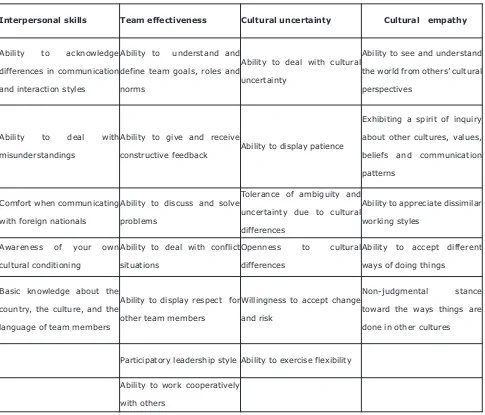
[image:4.1247.682.1167.134.549.2]With the increasing diversity of employees, managers must be able to develop and maintain effective cross cultural communication with the aim of realizing high team performance. The research introduces factors that can help in achieving this. Figure 1 presents the scope of Cross Cultural Communication Competence (Matveev & Nelson, 2004, p. 257).
Figure 1
The cross cultural communication competence model
Source: Matveev & Nelson (2004)
Brett et al. (2006) introduce the ‘direct versus indirect communication’ challenge faced by multinational project teams. The paper compares the manners of communication of Western and non-Western cultures. Their findings show that Americans are direct and open when it comes to expressing their messages which are on the surface, with listeners finding it easy to interpret. On the contrary, other cultures, such as Japanese or Korean, search for meanings hidden in the way that messages are presented. Furthermore, their research indicates that communication can cause damage to effective team work by limiting information flow and creating conflicts (Brett, et al. 2006).
Interpersonal skills Team effectiveness Cultural uncertainty Cultural empathy
Ability to acknowledge
differences in communication
and interaction styles
Ability to understand and
define team goals, roles and
norms
Ability to deal with cultural
uncertainty
Ability to see and understand
the world from others’ cultural
perspectives
Ability to deal with
misunderstandings
Ability to give and receive
constructive feedback Ability to display patience
Exhibiting a spirit of inquiry
about other cultures, values,
beliefs and communication
patterns
Comfort when communicating
with foreign nationals
Ability to discuss and solve
problems
Tolerance of ambiguity and
uncertainty due to cultural
differences
Ability to appreciate dissimilar
working styles
Awareness of your own
cultural conditioning
Ability to deal with conflict
situations
Openness to cultural
differences
Ability to accept different
ways of doing things
Basic knowledge about the
country, the culture, and the
language of team members
Ability to display respect for
other team members
Willingness to accept change
and risk
Non-judgmental stance
toward the ways things are
done in other cultures
Participatory leadership style Ability to exercise flexibility
Ability to work cooperatively
1.3 Trust
The members of multicultural project teams are often geographically distributed, especially in the case of virtual project teams. Jarvenpaa & Leidner (1999) describe a global virtual project team as a ‘temporary, culturally diverse, geographically dispersed, electronically communicating work group’. They argue that trust is more difficult to develop in such teams in comparison with teams whose members are involved in frequent face-to-face interactions. In their paper they attempt to establish whether trust can actually exist within global virtual project teams. As defined by Cummings and Bromiley (1996), a team member trusts the other members when he or she thinks that the group:
(a) makes a good-faith effort to behave in accordance with any commitments both explicit and implicit,
(b) is honest in whatever negotiations preceded such commitments, and
(c) does not take excessive advantage of another even when the opportunity is available’. Numerous aspects, namely common social norms, recurring communication between project team members and similar experiences have been proposed to ease the development of trust among project team members (Bradach & Eccles 1988; Lewis & Weigert 1985; Mayer, Davies & Schoorman, 1995). In addition, face-to-face interactions are regarded as necessary for developing trust or restoring broken trust (Nohria & Eccles 1992; O’Hara-Devereaux & Johansen, 1994).
In his milestone study, Hofstede (1980) classifies culture using four dimensions which structure organisations and societies. These dimensions comprise of power distance, uncertainty avoidance; individualism vs. collectivism and masculinity vs. femininity. He interviewed and questioned 16000 employees coming from 40 different countries and his findings have been extremely dominant in later literature on culture and management (e.g., Erez & Earley, 1993; Kedia & Bhagat, 1988; Shore & Venkatachalam, 1995). The most influential dimension proposed by Hofstede (1980), which affects trust within the multicultural project team, is individualism vs. collectivism. Team members with an individualistic cultural background tend to focus more on their individual needs, values and objectives, rather than those of the project team as a whole. On the contrary, collectivist nationals share the needs, values and objectives with the other members of the project team. His research also implies that individualistic nationals are not majorly affected by team membership, find it easy to join and leave the team and tend to be involved in open and direct communication, in comparison to individuals with a collectivist national background (Hall, 1976; Hofstede, 1980, 1991). Additionally, trusting behaviour (Pearce, 1974) reflected in the responsiveness to unclear messages, occurs more amongst individualistic cultures
in comparison with collectivist ones (Gudykunst, Matsumoto, Ting-Toomey, Nishida, Linda, & Heyman, 1996). Jarvenpaa & Leidner (1999) put forward an assumption that project team members coming from individualistic cultures are more willing to trust others.
2
Leadership Styles for Multicultural Project
Teams
the leader is to recognise the differences in working styles and combine them so that the team as a whole is unconscious of them being an issue. This leadership style is believed to be the next stage from the previous leadership approach, synergy. It is also considered as the most efficient way of achieving project goals.
2.4 Switch Leadership
Prabhakar (2005) investigates various project leadership styles and tries to connect those approaches to the success of a project regardless of business type, funds, culture or geographic dispersion. In his research, he attempts to tackle issues such as the types of leadership which produce high project performance and the motion of switching between different leadership styles and its effect on the success of the project. The research was based on 153 projects across 28 countries. The study corresponded to multicultural and multidisciplinary settings.
Prabhakar defines switch leadership as the skill of changing leadership styles from one to another in order to increase project performance. The author proves that by the project manager switching his or her leadership style from autocratic and task oriented to more consultative and people centred, projects achieve higher performance levels. However, leaders prefer to adopt autocratic leadership style. Furthermore, there appears to be a link between Transformational Leadership and the success of the project, where the leader is a constructive and encouraging member of the project team and respectful towards individuals. Transformational leaders develop relationships with the project team members by the use of interactive contacts and creating cultural connection to achieve set goals. As summarised by Prabhakar (2005): “Good leaders do inspire confidence in themselves, but a truly great leader inspires confidence within the people they lead to exceed their normal performance level”.
3
Discussion and further research directions
Regarding culture’s role in project management process, limited literature is available (Kruglianskas & Thamhain, 2000) in comparison to studies carried out on culture in management. Yet, the former represents an important issue to the managers of engineering projects (Kern, 2002). The lack of in depth knowledge on how cultural aspects affect behaviour raises many issues such as the relevance
2.1 Ethnocentrism
Ethnocentric leaders showed ‘cultural blindness’ (Makilouko, 2004) and the ten-dency to look at the project teams from the perspective of Finnish culture. They also demonstrated high task orientation. This particular leadership approach fo-cuses on official negotiations amongst the project team members, which often has negative effects on the team’s integration. Consequently, this means that, in the research, Finnish team members worked together and the other culture formed another team. In this situation, Finnish leaders perceived the other team as sub-standard and their own as the superior performer. However, there were cases where Finnish leaders would approve team members from other cultures as long as they exhibited some Finnish behaviour. While executing ethnocentric leader-ship style, managers mostly do not see themselves as leaders and are purely task oriented.
2.2 Synergy Leadership
The second type of leadership distinguished by Makilouko (2004) is the synergy leadership which features ‘cultural synergy’. Cultural is illustrated in the effort of building individual connections with project team members. Synergy leaders exhibit cultural awareness and are willing to appreciate team members’ culturally driven behaviours. The multicultural project team under synergy leadership is subject to casual and open interactions. Additionally, managers see themselves as leaders and do not display the characteristics of cultural blindness and ethnocentrism. They appreciate that, by building relationships, they can cooperate with culturally diverse project team members and therefore benefit from their competences.
2.3 Polycentrism
Conclusion
This paper provides an insight into the management of multicultural project teams by looking at the challenges that those teams are often faced with. Cultural diversity, communication and building trust appear to be main obstacles affecting the performance of multicultural project team. With regards to diversity, it is proven to have both positive and negative effects on project team performance. It can provide the project team with a variety of different perspectives when it comes to problem solving. It can also fuel conflicts and communication breakdowns as well as lead to mistrust. This paper proposes three managerial practices for coping with cultural diversity in multicultural project teams which are used by project managers. In many cases project managers do not take cultural differences into consideration and treat not dealing with them as acceptable. Others attempt to build personal relationships with culturally diverse project team members by introducing regular communication and setting up acceptable behavioural patterns through trial-and-error processes. Lastly, project managers refer to professional or corporate cultures in situations when they are unable to draw upon national cultures.
Regarding communication within diverse project teams, it is proven that effective communicative behaviour is necessary for achieving high team performance. In this paper, a perspective on cross cultural communication is introduced and presented in The Cross Cultural Communication Competence Model.
When looking at the issue of trust within multicultural project teams, it becomes apparent that it is more easily developed in teams which encounter frequent face-to-face interactions as opposed to virtual project teams which communicate via electronic channels. Yet, a geographically distributed team can be perceived as an advantage as it can speed up project processes by deriving benefits from the time zone differences. It has also been proven that individuals from certain cultures find it easier to trust team members.
With regards to multicultural project team leadership, this paper looks at four approaches: Ethnocentrism, Synergy, Polycentrism and Switch Leadership. The latter one proves to be very successful as it enables the manager to be flexible in his or her leadership approach, adapting to different situations and therefore achieving higher project team performance.
Many companies nowadays are using multinational project teams through joint ventures, global project development teams, etc. The firms should therefore be aware of the ways of remodelling and improving multicultural project team management (Snow, Snell, Davison, & Hambrick, 1996). If the project managers are to realise the possible benefits from culturally diverse project teams, all team members must be taught how to fully appreciate the cultural differences and be of culture to project management; culture affecting project performance and
outcomes; how the understanding of the cultural influences benefits the project manager etc. (Shore & Cross, 2005). In addition, not much research has been conducted on managing multicultural project teams in the light of their temporality. With regards to managing multicultural project teams, the research has to move away from purely concentrating on cultural diversity studies. There of culture to project management; culture affecting project performance and outcomes; how the understanding of the cultural influences benefits the project manager etc. (Shore & Cross, 2005). In addition, not much research has been conducted on managing multicultural project teams in the light of their temporality. With regards to managing multicultural project teams, the research has to move away from purely concentrating on cultural diversity studies. There is a need for more comprehensive and more in depth explanation of multicultural project team processes. The increasing value that multicultural project teams can bring to an organisation produces the necessity as well as the opening for an extensive stream of research to be able to produce more comprehensive theoretical and practical knowledge of multicultural project teams. At the organisational level, more in depth studies are required regarding the influence of multicultural project teams on the performance of the entire organisation not just a single project (Hambrick, Davison, Snell, & Snow, 1998)
This literature review also found that, although Hofstede’s research on cultural dimensions have often been criticised in later literature (Erez & Earley, 1993), his findings still appear in numerous studies as the basis for distinguishing major cultural differences amongst project team members. Regarding the leadership styles of multicultural project teams, the literature is very limited and, if found, it appears to be partial and incomplete. Several writers attempted to put forward different ideas about leading multicultural project teams, but not many explored them in any great depth.
Cleland, I.C. (1995) Leadership and project management body of knowledge.
International Journal of Project Management, 13, 83-88.
Cox, T. H. (1993) Cultural diversity in organizations: Theory, research and practice. San Francisco: Berrett-Koehler.
Cox, T.H., Lobel, S.A. & McLeod, P.L. (1991) Effects of Ethnic Group Cultural Differences on Cooperative versus Competitive Behaviour on a Group Task.
Academy of Management Journal, 34, 827–47.
Cummings, L.L. & Bromiley, P. (1996) The organisational trust inventory (OTI): Development and validations. In R.M. Kramer & T.R. Tyler (Eds.), Trust in Organisations: Frontiers of Theory and Research: 302-330. Thousand Oaks, CA: Sage.
d’Iribarne, Ph., Henry, A., Segal, J. P., Chevrier, S. & Globokar, T. (1998) Cultures et mondialisation. Paris: Seuil.
Davison, S.C. (1994) Creating a High Performance International Team. Journal of Management Development, 13, 81-90.
Elron, E. (1997) Top management teams within multinational corporations: Effects of cultural heterogeneity. The Leadership Quarterly, 8: 393-412.
Ely, R.J. & Thomas, D.A., (2001) Cultural diversity at work: The effects of diversity perspectives on work group processes and outcomes. Administrative Science Quarterly 46, 229–273.
Erez, M. (1994) Toward a model of cross-cultural industrial and organizational psychology. In M.D. Dunnette & L. M. Hough (Eds.), Handbook of industrial and organisational psychology: 569-607. Palo Alto, CA: Consulting Psychologists Press.
Erez. M. & Earley. P. C. (1987) Comparative analysis of goal-setting strategies across cultures. Journal of Applied Psychology, 72, 658-665.
Erez. M. & Earley. P. C. (1993) Culture, self-identity and work. New York: Oxford University Press.
Eriksson, M., Lillieskold J., Jonsson, N., & Novosel, D. (2002) How to manage complex, multinational R&D projects successfully. Engineering Management Journal, 14, 53–61.
Gannon, M. J. (1994) Understanding global cultures: Metaphorical journeys through 17 countries. Thousand Oaks, CA: Sage.
Govindarajan, V. & Gupta, A.K. (2001) The Quest for Global Dominance. CA: Jossey-Bass.
able to communicate in an effective manner while overcoming cultural barriers. Hofstede (1983) tries to link his cultural dimensions with project management and suggests that the main factor contributing to the success of a multicultural project team is cultural sensitivity and the consciousness of the cultural disparities through the understanding of the differences in the ‘mental programming’ that are present within the multicultural project team. However, there is a need for more research regarding the management of multicultural project teams. This paper explores what so far has been acknowledged and recognised as the management of multicultural project teams and to some extent proves that culture is relevant to project management and can affect project performance.
References
Adler, N. J. (1986) International dimensions of organizational behaviour.Boston: Kent Publishing Company.
Adler, N.J. (2002) International dimension of organisational behaviour. 4th Ed., Cincinatti: South Western.
Alderfer, C. P. (1987) An intergroup perspective on group dynamics. In J. Lorsch (Ed.), Handbook of organizational behaviour: 190–219. Englewood Cliffs, NJ: Prentice Hall.
Alderfer, C.P. & Smith, K.K., (1982) Studying intergroup relations embedded in organizations. Administrative Science Quarterly, 27, 35–65.
Bartlett ,C.A. & Ghoshal, S. (1989) Managing across borders: the transnational solution. Boston, MA: Harvard Business School Press.
Bjorkman, I. & Schaap, A. (1994) Outsiders in the middle kingdom: expatriate managers in Chinese-Western joint ventures. European Management Journal, 12, 147–153.
Bloom, H., Calori, R. & de Woot, P. (1994) Euro management: a new style for the global market. London: Kogan Page.
Bradach, J.L. & Eccles, R.G. (1988) Markets versus hierarchies: From ideal types to plural form. Annual Review of Sociology, 15, 97-118.
Brett, J., Behfar, K.& Kern, M.C. (2006) Managing Multicultural Teams. Harvard Business Review, 84, 84-91.
Chevrier, S. (2003) Cross-cultural management in multinational project groups.
Kruglianskas I. & Thamhain, H.J. (2000) Managing technology-based projects in multinational environments. IEEE Transactions on Engineering Management, 47, 55–64.
Lewis, J.D. & Weigert, A. (1985) Trust as a Social Reality. Social Forces, 63, 967-985.
Makilouko, M. (2004) Coping with multicultural projects: the leadership styles of Finnish project managers. International Journal of Project Management, 22, 387– 396.
Matveev, A. V. & Nelson, P.E. (2004) Cross Cultural Communication Competence and Multicultural Team Performance: Perceptions of American and Russian Managers. International Journal of Cross Cultural Management, 42, 253–270. Matveev, A.V. & Milter, R. G. (2004) The value of intercultural competence for performance of multicultural teams. Team Performance Management, 10, 104-111.
Mayer, R.C., Davies, J. H. & Schoorman, F.D. (1995) An integrative model of organisation trust. Academy of Management Review, 20, 709-734.
Mays, N. & Pope, C. (1995) Qualitative Research: Rigour and qualitative research.
British Medical Journal, 311, 109-112.
Maznevski, M.L. (1994) Understanding our Differences: Performance in Decision making Groups with Diverse Members. Human Relations, 47, 531–52.
Maznevski, M.L. & Distefano, J.J. (2000) Global leaders are team players: Developing global leaders through membership on global teams. Human Resource Management, 39, 195-208.
McLeod, L., Lobel, P. & Alisa, S. (1992) The effects of ethnic diversity on idea generation in small groups. Academy of Management Proceedings, 1992, 227-231.
Miller, D. M., Fields, R., Kumar, A. & Ortiz, R. (2000) Leadership and Organizational Vision In Managing a Multiethnic and Multicultural Project Team.
Journal of Management in Engineering, 16, 18-22.
Nancarrow, C. & Brace, I. (2000) Saying the “Right Thing”: Coping with Social Desirability Bias in Marketing Research. Bristol Business School Teaching and Research Review, 3, 168–179.
Nohria, N. & Eccles, R.G. (1992) Face-to-face: Making network organisations work. In N. Nohria & R. G. Eccles (Eds.), Network and Organisations: 288-308. Boston , MA: Harvard Business School Press.
Gudykunst, W.B., Ting-Toomey, S., Nishida, T., Linda, K.S. & Heyman, S. (1996) The influence of cultural individualism-collectivism, self construals, and individual values on communication styles across cultures. Human Communication Research, 22, 510-543.
Hall, E. T. (1976) Beyond Culture. Garden City, NJ: Anchor Books/Doubleday. Hambrick, D.C., Davison, S.C., Snell, S.A. & Snow, C.C. (1998) When Groups Consist of Multiple Nationalities: Towards a New Understanding of the Implications. Organisation Studies, 19, 181-205.
Hofstede, G. (1980) Culture’s consequences: International differences in work-related values. Beverly Hills, CA: Sage.
Hofstede, G. (1983) Cultural dimensions for project management. International
Journal of Project Management, 1, 41-48.
Hofstede, G. (1991) Cultures and Organisations: Software of the Mind. London, UK: McGraw-Hill.
House, R. J., Hanges, P. J., Javidan, M., Dorfman, P.W. & Gupta, V. (2004) Culture, Leadership, and Organizations: The GLOBE Study of 62 Societies.Thousand Oaks, CA: Sage.
Hui. C. H. (1990) Work attitudes, leadership styles, and managerial behaviours in different cultures. In R. W. Brislin (Ed.), Applied cross-cultural psychology.
Newbury Park, CA: Sage.
Iles, P. & Hayers, P.K. (1997) Managing diversity in transnational project teams: A tentative model and case study. Journal of Managerial Psychology, 12, 95-117. Jackson, S.E., May, K.E. & Whitney, K. (1995) Understanding the Dynamics of Diversity in Decision-making Teams. In R.A. Guzzo & E. Salas (Eds.), Team Effectiveness and Decision Making in Organizations: 7–61. San Francisco: Jossey-Bass.
Jarvenpaa, S. L. & Leidner, D.E. (1999) Communication and Trust in Global Virtual Teams. Organisation Science, 10, 791-815.
Kedia, B.L. & Bhagat, R.S. (1988) Cultural constraints on transfer of technology across nations: Implications for research in international and comparative management. Academy of Management Review, 13, 559-571.
Kern, DJ. (2002) Content and trends in engineering management literature.
Engineering Management Journal, 14, 43–48.
Vingt ans de réformes sanitaires
en France à l'occasion de
l'échéance de la prospective
«Santé 2010 ».
Twenty years of sanitary reforms
in France on the occasion of the
term of the prospective "Health
2010".
Michel CUCCHI
Université de Caen Basse-Normandie (France)
Centre d’Etudes et de Recherches sur les Risques et les Vulnérabilités
Résumé
Dans les suites de la loi n°91-748 du 31 juillet 1991, qui instaurait une démarche prospective dans l’organisation des soins, un groupe d’experts a été mis en place au sein du Commissariat Général au Plan pour proposer une vision prospective du système de santé à l’horizon 2010. Le modèle reposait sur « une solidarité nationale renforcée […] faisant une place accrue à des mécanismes locaux et diversifiés de régulation ». La clé de voûte du rapport « Santé 2010 » rédigé par ce groupe était la proposition d’un niveau régional d’organisation et de gestion concrétisé par la création d’une « Agence régionale des services de santé », qui devait entraîner une réorganisation plus large du système de santé. Àl’approche de l’échéance de 2010, cette contribution fait un point, à l’aune de ce rapport, sur les réussites et les échecs de ces vingt dernières années de réformes sanitaires, sur ce qui demeure des ambitions initiales, sur les orientations inabouties et sur leurs perspectives.
Mots-clés :
Prospective, réforme, santé, agence. O’Hara-Devereaux, M., & Johansen, R. (1994) Global Work: Bridging Distance,
Culture, and Time. San Francisco, CA: Jossey Bass.
Pearce, W. B. (1974) Trust in interpersonal communication. Speech Monographs,
41, 236-244.
Prabhakar, G. P. (2005) Switch leadership in projects: An empirical study reflecting the importance of transformational leadership on project success across twenty-eight nations. Project Management Journal, 36, 53-60.
Raghuram, S. & Garud, R. (1996) The vicious and virtuous facets of workforce diversity. In M. Ruderman, M. Hughes-James, & S. Jackson (Eds.) Selected research on work team diversity. American Psychological Association and Center for Creative Leadership. 155–178.
Shore, B. & Venkatachalam, A.R. (1995) The role of culture in systems analysis and design. Journal of Global Information Management, 3, 5-14.
Shore, B. & Cross, B. J. (2005) Exploring the role of national culture in the management of large-scale international science projects. International Journal of Project Management, 23, 55-64.
Slevin, D.P. & Pinto, J.K. (1991) Project leadership: understanding and consciously choosing your style. Project Management Journal, 22, 29–47.
Snow, C. C., Snell, S.A., Davison, S.C. & Hambrick, D.C. (1996) Use transnational teams to globalise your company. Organisational Dynamics, 24, 50-67.
Stewart, E. C. (1972) American cultural patterns: A cross cultural perspective.
Yarmouth, Maine: Intercultural Press Inc.
Triandis, H. C. (1994) Cross-cultural industrial and organizational psychology. In H. C. Triandis, M. D. Dunnette, & L. Hough (Eds.) Handbook of industrial and organizational psychology: 103–172. Palo Alto, CA: Consulting Psychologists Press.
Trompenaars, F. (1997) Riding the waves of culture. London: Nicholas Brealey. Watson, W.E., Kumar, K. & Michaelsen, L.K. (1993) Cultural diversity’s impact on interaction process and performance: Comparing homogeneous and diverse task groups. Academy of Management Journal 36: 590–602.
Wheelan, S.A., Buzalo, G. & Tsumura, E. (1998). Development Assessment Tools for Cross-cultural Research. Small Group Research, 29, 359–70.