S T U D Y P R O T O C O L
Open Access
Multidimensional individualised Physical
ACTivity (Mi-PACT)
–
a technology-enabled
intervention to promote physical activity in
primary care: study protocol for a
randomised controlled trial
Oliver J. Peacock
1, Max J. Western
1, Alan M. Batterham
2, Afroditi Stathi
1, Martyn Standage
1, Alan Tapp
3,
Paul Bennett
1and Dylan Thompson
1*Abstract
Background:Low physical activity is a major public health problem. New cost-effective approaches that stimulate meaningful long-term changes in physical activity are required, especially within primary care settings. It is becoming clear that there are various dimensions to physical activity with independent health benefits. Advances in technology mean that it is now possible to generate multidimensional physical activity ‘profiles’ that provide a more complete representation of physical activity and offer a variety of options that can be tailored to the individual. Mi-PACT is a randomised controlled trial designed to examine whether personalised multidimensional physical activity feedback and self-monitoring alongside trainer-supportive sessions increases physical activity and improves health outcomes in at-risk men and women.
Methods/Design:We aim to recruit 216 patients from within primary care aged 40 to 70 years and at medium or high risk of cardiovascular disease and/or type II diabetes mellitus. Adopting an unequal allocation ratio (intervention: control) of 2:1, participants will be randomised to one of two groups, usual care or the intervention. The control group will receive usual care from their general practitioner (GP) and standardised messages about physical activity for health. The intervention group will receive physical activity monitors and access to a web-based platform for a 3-month period to enable self-monitoring and the provision of personalised feedback regarding the multidimensional nature of physical activity. In addition, this technology-enabled feedback will be discussed with participants on 5 occasions during supportive one-to-one coaching sessions across the 3-month intervention. The primary outcome measure is physical activity, which will be directly assessed using activity monitors for a 7-day period at baseline, post intervention and at 12 months. Secondary measures (at these time-points) include weight loss, fat mass, and markers of metabolic control, motivation and well-being.
Discussion:Results from this study will provide insight into the effects of integrated physical activity profiling and self-monitoring combined with in-person support on physical activity and health outcomes in patients at risk of future chronic disease.
Trial registration:ISRCTN18008011 Trial registration date: 31 July 2013
Keywords:Physical activity, Sedentary behaviour, Technology, Feedback, Self-monitoring, Behaviour change, Primary care, Health promotion
* Correspondence:[email protected]
1Department for Health, University of Bath, Bath BA2 7AY, UK
Full list of author information is available at the end of the article
Background
Physical inactivity has substantial effects on global health and an increase in activity at the population level would have considerable impact on the future burden of chronic disease [1]. In the United Kingdom, the Department of Health recently began a national programme (NHS Health Check) that aims to reduce chronic disease by identifying adults who are at increased risk and offering them perso-nalised advice and support to lower their risk [2]. Physical activity has the potential to increase the success of such initiatives, but existing interventions in primary care have met with limited success and typically small improve-ments are not maintained [3]. New cost-effective ap-proaches that stimulate meaningful long-term changes in physical activity are required and this is especially import-ant in those identified as at risk of cardiovascular disease and type II diabetes mellitus.
To date, physical activity has typically been captured and recommended in unidimensional terms (e.g. 150 mi-nutes of moderate intensity physical activity per week) [4]. Physical activity is a much more heterogeneous behaviour than this approach implies, with various dimensions known to have clear biological and health benefits [5]. In-deed, past work shows that it is quite possible for an indi-vidual to score highly in one dimension of physical activity but low in another, while only very few people score con-sistently across all physical activity metrics [6]. This obser-vation is a problem because people who focus on a single physical activity descriptor may form incomplete or in-accurate conclusions about the appropriateness of their behaviour. For example, many forms of structured phys-ical activity have only a modest impact on overall energy expenditure [7]. Weight loss is critical to some health out-comes, or an outcome in itself, and it will be important for individuals aiming to lose weight (or prevent weight regain after substantial loss) to understand which aspects of physical activity have the largest thermogenic effect. In this specific scenario, a multidimensional approach will help people incorporate novel activity within the context of their existing behaviour such that the net effect on total energy expenditure is maximised [7, 8]. Clearly, a multidi-mensional profile will provide greater insight, awareness, and deeper understanding than the reliance on more uni-dimensional feedback; enabling people to take greater re-sponsibility for managing their physical activity.
In addition to providing a more accurate reflection of physical activity, the diverse options associated with a multidimensional physical activity profile create an ex-ploitable social marketing opportunity. The marketing of structured and informational feedback and the provision of personally relevant and attainable physical activity op-tions is potentially a key step in supporting an individ-ual’s satisfaction of autonomy and competence [9, 10]. When people experience a sense of self-endorsed and
choicefully enacted behaviour this tends to improve the quality of their motivation and sustain engagement in physical activity [9, 10]. Indeed, the provision of more comprehensive and revealing feedback on behaviour should also raise awareness and support the formation of implementation intentions (i.e. where, when and how to act); increasing goal attainment and habit formation [11].
New technologies, which include wearable devices and web-based applications, enable self-monitoring of phys-ical activity and create opportunities for the provision of personalised feedback regarding the multidimensional nature of physical activity [5]. This type of individually tailored feedback tends to be more effective than generic messages about physical activity [12, 13]. Moreover, feedback and self-monitoring in combination with spe-cific goal setting are acknowledged as key constituents of successful behavioural interventions [14–16]. In order to exploit the opportunities for physical activity monitor-ing and multidimensional physical activity profilmonitor-ing, we developed a website-based application for linking phys-ical activity data with informational feedback; creating an interface for self-monitoring, specific planning and trainer interaction, that collectively forms the basis for the present trial. This was informed by prior work, in which we generated visualisations for the presentation of integrated physical activity profiles and demonstrated that patients at medium or high risk of chronic disease found this feedback to be informative, understandable and motivating [17]. In addition, while patients reported feeling confident in using technology and feedback for self-monitoring physical activity, it was identified that supplementary in-person guidance may further support behaviour change.
The Multidimensional individualised Physical ACTivity (Mi-PACT) study is a randomised controlled trial with the following objectives: (1) to examine whether personalised multidimensional physical activity feedback and self-monitoring using a web-based platform alongside in-person advice supports an increase in physical activity in men and women at risk of future chronic disease; and (2) to examine whether this change is sufficient to generate meaningful weight loss and/or improved metabolic con-trol and reduced risk.
Methods Trial design
approved by the National Health Service (NHS) South West 3 Research Ethics Committee with an allocated reference number: 13/SW/0179. The pro-ject was subsequently registered as a current con-trolled trial (ISRCTN18008011).
Participants/eligibility
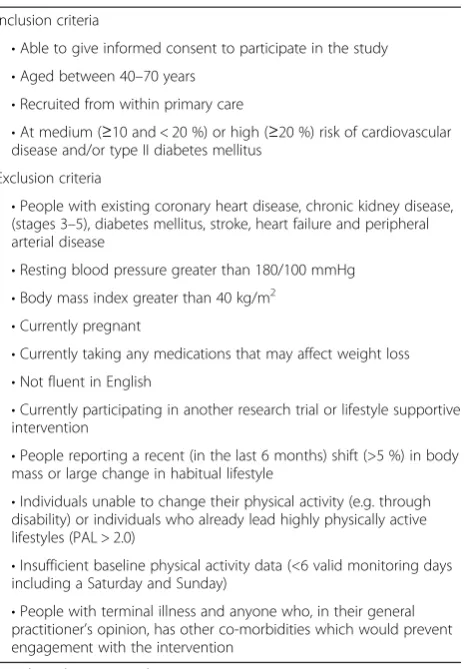
We will recruit men and women treated in primary care aged 40–70 years at medium (≥10 and < 20 %) or high (≥20 %) risk of cardiovascular disease and/or type II dia-betes mellitus. Risk will be calculated from clinical data using well-established prediction algorithms for estimating a person’s 10-year risk of developing cardiovascular disease (QRISK®2) [19] and diabetes mellitus (QDiabetes®) [20] available at QResearch® [21]. As our focus is on prevention, people with existing coronary heart disease, chronic kidney disease (stages 3–5), diabetes mellitus, stroke, heart failure and peripheral arterial disease (as they will be managed via
existing care pathways) will be excluded. The Physical Ac-tivity Level (PAL) is a standard objective method of ex-pressing total daily energy expenditure in multiples of resting metabolic rate. Individuals will be excluded with an average daily PAL > 2.0, which has been categorised in a re-port of a joint FAO/WHO/UNU expert consultation as representing a highly active lifestyle [22]. In addition, indi-viduals will be excluded for whom sufficient baseline phys-ical activity data is not available. To be eligible, individuals will need at least 6 valid monitoring days (including both a Saturday and Sunday) [23]. A valid day will require at least 80 % of data for a given 24-hour period. See Table 1 for a complete list of eligibility criteria.
Study procedures Recruitment
[image:3.595.58.539.89.466.2]practices with variety in terms of socioeconomic status ac-cording to National General Practice Profiles and the Eng-lish Indices of Deprivation [24, 25]. We will recruit potentially eligible participants via two routes. Firstly, indi-viduals in medium or high-risk groups (based on existing risk-score information in patient notes) will be identified by searching practice databases. Secondly, because not all people will have risk information in their records, individ-uals at potentially increased risk will be identified (people with a body mass index (BMI) > 30 kg/m2in combination with a total cholesterol level between 5.5 and 7.5 mmol/L and/or blood pressure > 140/90 mmHg). This is consistent with Health Check criteria, and clinical data from baseline assessments will be used to verify that individuals are in medium or high-risk groups, using QRISK®2 and QDia-betes® algorithms [19, 20]. Potentially eligible participants will then be approached by a letter from their general practitioner (GP). The recruitment letter will emphasise that participation is entirely voluntary and that individuals will be free to withdraw at any time without any impact on their health care provision. A study information sheet and sample consent form will be included with the letter so that patients have time to consider their participation. The invitation letter will include a free post reply slip for
the patient to return to the research team indicating whether or not they wish to learn more about the study. Individuals who return positive replies will then be con-tacted by the research team. Those not wishing to partici-pate will not be contacted again.
Participant screening and baseline assessment
A research nurse will first conduct a telephone screen to re-confirm eligibility. In addition, information regarding marital status, ethnicity, smoking status, profession and education will be recorded. All potentially eligible partic-ipants interested in taking part will be invited to attend a 60-minute baseline assessment clinic following an overnight fast. At baseline clinics, the research nurse will further explain the nature of the study and answer any questions. Individuals who agree to participate following the briefing will be provided with an informed consent form, indicating their full understanding of the study and their protected rights for confidentiality and with-drawal from the study without giving a reason. For those providing written informed consent, concomitant medi-cations and relevant clinical history will be recorded and a questionnaire pack will be issued for completion within clinic. Thereafter, the nurse or researcher will measure each individual’s blood pressure, weight, height, waist circumference and take a blood sample. During the clinic, individuals will receive an activity monitor with oral and written instruction for use and will be pro-vided with a freepost envelope for returning monitors to the research team. For those participants who choose to opt-in, a visit to the University of Bath will be arranged for the assessment of body composition via dual energy X-ray absorptiometry. Blood results will be shared with each patient’s GP. Patients with a fasting blood glucose of > 7.0 mmol/l at this stage will be excluded from fur-ther participation as this will likely initiate furfur-ther test-ing by the GP and is indicative of probable diabetes mellitus. People successfully completing activity moni-toring who are not highly physically active and are in medium-risk or high-risk groups (confirmed via recalcu-lated risk scores using baseline measurements and the results of blood tests) will be eligible for randomisation.
Randomisation/allocation
[image:4.595.59.293.97.432.2]Eligible people will be randomised to one of two groups. We opt for an unequal allocation ratio (intervention: control) of 2:1, primarily to increase our experience with and amount of information on the new intervention [26] (the small loss of precision with unequal allocation only increases the totalNrequired by 20). Participants will be allocated remotely by the trial statistician by concealed minimisation [27], providing balance across the trial arms for sex (male/female), age group (40–59 and 60–70 years), general practice, risk (medium/high) and PAL < 1.75 or≥ Table 1Inclusion and exclusion criteria for Mi-PACT
Inclusion criteria
•Able to give informed consent to participate in the study
•Aged between 40–70 years
•Recruited from within primary care
•At medium (≥10 and < 20 %) or high (≥20 %) risk of cardiovascular disease and/or type II diabetes mellitus
Exclusion criteria
•People with existing coronary heart disease, chronic kidney disease, (stages 3–5), diabetes mellitus, stroke, heart failure and peripheral arterial disease
•Resting blood pressure greater than 180/100 mmHg
•Body mass index greater than 40 kg/m2
•Currently pregnant
•Currently taking any medications that may affect weight loss
•Not fluent in English
•Currently participating in another research trial or lifestyle supportive intervention
•People reporting a recent (in the last 6 months) shift (>5 %) in body mass or large change in habitual lifestyle
•Individuals unable to change their physical activity (e.g. through disability) or individuals who already lead highly physically active lifestyles (PAL > 2.0)
•Insufficient baseline physical activity data (<6 valid monitoring days including a Saturday and Sunday)
•People with terminal illness and anyone who, in their general practitioner’s opinion, has other co-morbidities which would prevent engagement with the intervention
1.75. Although individual patients are the unit of random-isation, we believe that the threat of contamination within a practice is largely theoretical, especially given that the intervention is personalised.
Follow-up assessment
Follow-up data collection will take place post-intervention at 3 and 12 months and will include the same measure-ments completed during baseline assessment. Participants who opt-in for the assessment of their body composition at baseline will be offered repeat dual-energy X-ray ab-sorptiometry scans at follow-up clinics. Participants will receive a £50 voucher for completing all assessments.
Usual care (control)
Participants allocated to the control group will receive usual care by their GP. Any care that they receive in rela-tion to supporting changes in weight or physical activity will be documented through self-report and examination of practice records at assessment clinics. Hence, the trial will assess effectiveness over-and-above existing ‘usual care’ alternatives. In order to standardise exposure to healthcare professionals and content, this group will attend a 20-minute meeting with a lifestyle coach at their GP practice following their baseline assessment (i.e. week 0). At this session, participants will receive standardised infor-mation (including printed materials and links to Internet-based resources) regarding cardiovascular disease and type II diabetes mellitus, the potential benefits of physical activ-ity on reducing ‘risk’, current physical activity guidelines and ideas about getting more physically active. Standar-dised information and messages will be consistent with other print and Internet-based resources available in 2014 (for example, Department of Health: Change4Life [28], NHS Choices: Live Well [29]) and include reference to local opportunities where applicable.
Intervention: overview
Mi-PACT is a complex intervention or‘treatment package’ involving multiple components [30]. The intervention con-tent and iterative web-based platform was developed by the project team and drew heavily on our formative re-search involving the generation of novel integrated phys-ical activity profiles [4, 6]. The content was further informed by our prior qualitative research with healthcare professionals and patients at risk of future chronic disease (reflecting the intended user group) in the development and evaluation of innovative ways of presenting per-sonalised multidimensional physical activity feedback that is informative, understandable and motivating [17]. The intervention is described in accordance with TIDieR (Template for Intervention Description and Replication) guidance relevant to protocols of trials [31].
Intervention: overarching theoretical framework
Social marketing represents an attractively designed
‘customer proposition’ that has been developed and communicated using marketing principles to align with the self-interests of participants and in exchange for be-haviour which benefits them and society as a whole [32]. This is where a multidimensional physical activity profile creates a clear social marketing opportunity. In-deed, the marketing of structured and informational feed-back coupled with a menu of achievable physical activity options may facilitate greater empowerment (or autono-mous engagement) via support of an individual’s satisfac-tion of autonomy and competence [9]. When people experience autonomy and competence in their treatment, they experience greater volitional engagement and are more likely to persist in desirable health behaviours [9, 10]. In promoting the formation of new habits, imple-mentation intentions are specific plans regarding where, when, and how to act, and have been found to increase goal attainment [11] and predict participation in physical activity [33]. A multidimensional profile that supports the forma-tion of implementaforma-tion intenforma-tions as feedback is more re-vealing and plans may be considered within the context of an individual’s existing behaviour. Indeed, the combination of implementation intentions and autonomous behaviour has been shown to result in greater goal achievement [34] and represent theoretical constructs that are inherent within the marketing of integrated physical activity profiles.
Intervention: physical activity profiling and the Mi-PACT platform
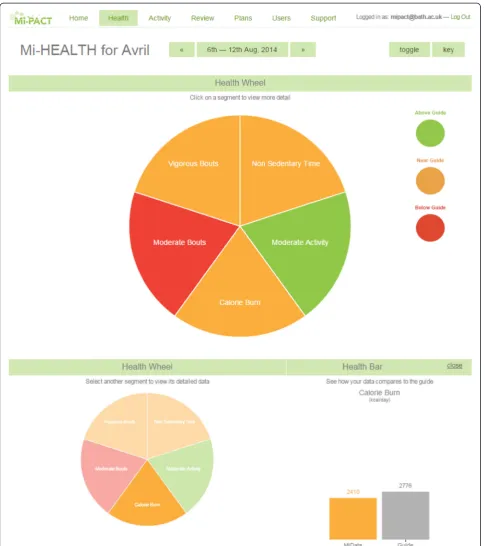
The Mi-PACT technology consists of a Bodymedia Core physical activity monitor (BodyMedia, Inc., Pittsburgh, PA, USA) and a web-based application or‘platform’ devel-oped in collaboration with Ki Health Innovation Ltd. (Surrey, UK) Information graphics used for the presenta-tion of data within the web-based platform were initially developed alongside graphic designers (Information is Beautiful, IIB Studio, London, UK). Draft designs were subsequently refined by the research team based upon the findings of in-depth qualitative interviews in patient groups and healthcare professionals [17]. Overall, patients preferred simple messages rather than more complex or abstract visualisations [17]. However, as there is unlikely to be a definitive design solution to meet the needs of everyone, and to provide some choice, the Mi-PACT plat-form includes alternative graphical plat-formats for displaying the same data.
relative to guidelines; allowing an expression of magni-tude for each dimension. Each participant’s profile captures 5 different dimensions of their behaviour: (1) overall energy expenditure, (2) time engaged in moderate-to-vigorous physical activity accumulated on a minute-by-minute basis,
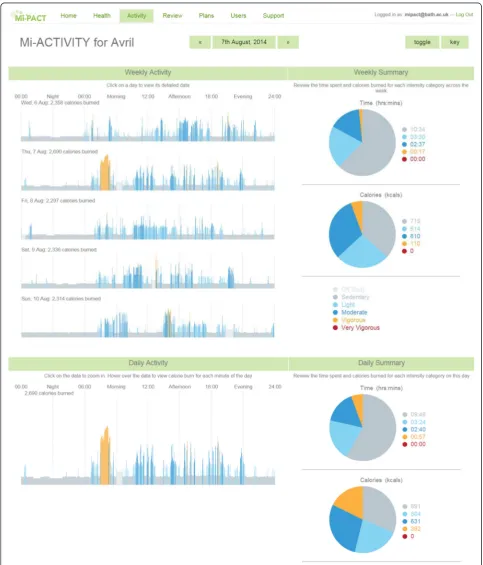
[image:6.595.57.543.87.634.2]The platform also includes visualisations for depicting time spent and energy expended within different inten-sity thresholds determined using metabolic equivalents
(METs). These data are presented as minute-by-minute 24-hour line graphs (using a ‘heat’ colour palette) and are summarised into daily and weekly totals (Fig. 3). In
[image:7.595.56.540.141.707.2]order to convert energy expenditure to METs, age-specific equations are used to estimate Basal Energy Ex-penditure [35]. Activities with a MET value below 1.8 are considered as sedentary behaviour when using this specific monitoring technology [23, 36]. MET values greater or equal to 1.8 and less than 3 are considered to reflect light activity, while moderate and vigorous activ-ities are calculated from MET values greater or equal to 3 and less than 6, and greater or equal to 6 [37]. Re-cently, evidence has emerged that short bouts of high-intensity exercise has profound metabolic and health benefits, e.g. short bouts of exercise at approximately 80–90 % maximal oxygen uptake [38]. In the absence of an accepted definition of such activity in free-living con-ditions, we define physical activity greater or equal to 10.2 METs as‘highly vigorous’[6]; equivalent to approxi-mately 85 % maximal oxygen uptake in an average per-son [39].
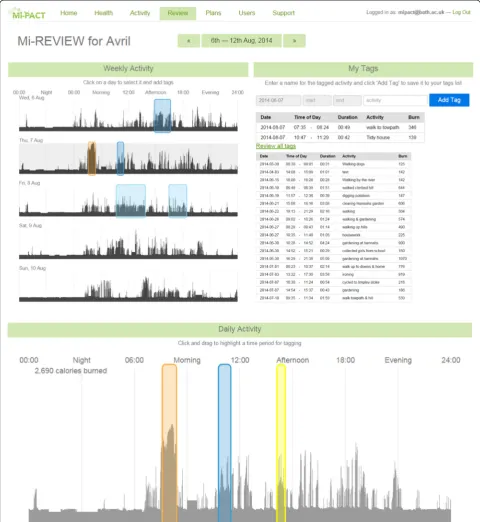
In addition to providing feedback in the form of inte-grated physical activity profiles for‘Health’and as‘Activity’ within different intensity thresholds, there are reviewing and planning components to the platform. The ‘Review’ section displays personalised minute-by-minute data (as a greyscale silhouette to emphasise activity patterning) that enables the individual to highlight, annotate or ‘tag’ and store information regarding discrete activities and behav-iours as part of the self-monitoring process (Fig. 4). This
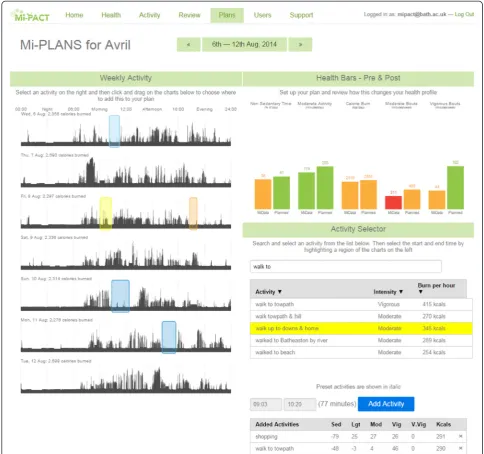
‘tagged’information is then available as part of an individ-ual’s historical data and viewable/editable on subsequent access of the platform. The ‘Plans’section displays daily physical activity visualisations for the week and presents this information relative to the individual’s integrated phys-ical activity profile (Fig. 5). In line with an implementation intention approach, there is an opportunity for the gener-ation of specific plans regarding where, when and how to act. Indeed, the participant can explore the effects of ex-changing sedentary behaviour for more positive behaviours (selecting from their personal ‘tags’or from a database of activities) to realise the impact of any such substitution [8] on a change in their physical activity profile.
Intervention: Multidimensional individualised Physical ACTivity (Mi-PACT)
In the Mi-PACT group, feedback in the form of persona-lised physical activity profiles will be marketed, explained and discussed with participants in supportive one-to-one coaching sessions using the web-based platform. Partici-pants will attend their GP practice for 5 consultations with a lifestyle coach: at baseline, and after approxi-mately 2, 4, 8 and 12 weeks. Each participant will have access to activity monitors and the web-based platform for the duration of the 3-month intervention. Training materials for lifestyle coaches as well as hand-outs pro-vided to study participants are available on request [40].
In the first session, participants will initially receive the same standardised messages as in the control group. The primary aim of this session is to explain the multidimen-sional nature of physical activity, to provide an understand-ing of which personalised behaviours have contributed to each dimension and to explain the options and choices that are available. A further objective is to familiarise the participant to activity self-monitoring and using the web-based platform. For this purpose, each participant will be given a Mi-PACT platform user manual and quick-start guide along with an activity monitor and Universal Serial Bus (USB) cable (for docking to their computer). Partici-pants will have access to a personalised website account (protected by a log-in and password) and accompanying software for uploading their physical activity data. Prior to their next session, participants will be encouraged to ex-periment and engage in new and enjoyable activities (i.e.
‘trying different things’) while self-monitoring and explor-ing the functionality of the platform.
Subsequent sessions will be approximately 20–30 mi-nutes in duration. Prior to meetings, coaches will be en-couraged to log-in to the platform and review participants’ profiles as a preparatory exercise to help inform session delivery. Once it is established that the participant is confi-dently self-monitoring and reviewing their data, the aim of the second session is to revisit the participants’ physical activity profile and to discuss aspects of their physical ac-tivity behaviour that they would consider changing. Here, there will be a particular emphasis on identifying oppor-tunities for achievable but sufficiently meaningful modifi-cation and specific goal setting regarding what, where and how to act. Participants who have low activity in every di-mension have the most‘choice’and will be guided through a menu of physical activity options. Participants who score well in one or more dimensions will be supported in add-ing to their existadd-ing behaviour knowadd-ing that what they are doing is recognised. In terms of the tone of advice pro-vided, coaches will attempt to use neutral language and encourage choice (e.g. using terms such as ‘you may choose to’or‘how would you’rather than‘you should’or
‘you must’) and show empathy (e.g. ‘I appreciate why you might find this difficult’). These vocalisations will be pro-vided in a structured manner such that goals, strategies, and implementation intentions are clear, realistic, and well-defined [10].
what has been achieved and to develop a future action plan towards long-term change.
Participants will be urged to make the most of the web-based platform by wearing their physical activity monitor as much as possible (day and night) and to regularly upload their data and review their informational feedback over the
[image:9.595.57.538.90.613.2]individual’s profile will be made available to them as a colour print-out where applicable. Participants with limited or no access to the platform outside of sessions will be pro-vided with a diary for recording what aspects of their phys-ical activity they have consciously changed between sessions (i.e. for self-monitoring purposes).
Training of the lifestyle coaches: intervention and control We will recruit 4–6 intervention providers from the local community (including healthcare providers and other ap-propriate settings) with experience and qualifications as physical activity or lifestyle advisors. Intervention providers
[image:10.595.55.540.89.543.2]the integrated physical activity profile for setting specific goals and forming implementation intentions, and (iv) provision of information in an autonomy-supportive man-ner (facilitating the participant’s satisfaction of autonomy and competence inherent within multidimensional profil-ing). All coaches will be given a written manual to support delivery of the intervention and will have the opportunity to practice and receive feedback on delivery style and con-tent. The manual includes reference to general information on facilitating behaviour change adapted from the Depart-ment for Health NHS Health Trainer Handbook [41]. Whilst sessions are not specifically founded on Self-Determination Theory, they are designed to be delivered in an autonomy-supportive style. Other materials to fur-ther support delivery of and document the intervention will be produced as required.
Measurements
The primary outcome measure is physical activity, which will be directly assessed using physical activity monitors (see Physical Activity Assessment) for a 7-day period at all assessment points. We will use the underlying raw data for minute-by-minute physical activity energy ex-penditure to extract multiple physical activity character-istics and determine the change in a given (multiple) dimension(s) of physical activity behaviour. Specifically, this includes: overall energy expenditure (expressed as PAL); time engaged in moderate-to-vigorous physical ac-tivity accumulated on a minute-by-minute basis and in bouts of at least 10 minutes; time engaged in vigorous intensity activity accumulated in bouts of at least 10 mi-nutes; and, non-sedentary time. To explore if the change in physical activity is meaningful, we will include sec-ondary measures of weight, height, waist circumference, fat mass, lipids (total cholesterol, high-density lipoprotein and low-density lipoprotein cholesterol, and triglycerides), glucose control (insulin and glucose) and C-reactive pro-tein. In addition, processes of change (e.g. need satisfaction and markers of internalisation), habit strength, motivation (autonomous and controlled), and indices of well-being, health status and quality of life will all be assessed. To-gether with physical activity data, these measures will allow us to examine whether changes in specific dimen-sions of physical activity are more or less important for specific outcomes (e.g. PAL, time > 3 METs). Based on previous research, small groups of 12–20 people in each physical activity category would be sufficient to determine whether a change in a particular aspect of physical activity was important for these secondary outcomes [42].
Anthropometry, blood pressure and body composition Participants will be requested to remove any footwear and to wear only light clothing for anthropometric mea-surements. Body mass will be measured on a calibrated
electronic or balance scale to the nearest 0.1 kg, where participants will be asked to stand in the centre of the platform with their weight evenly distributed on both feet. Height will be measured using a stadiometer to the nearest 0.1 cm. Participants will be requested to hang their arms freely with their heels, gluteal area and shoul-ders in contact with the stadiometer and with their head in the Frankfort plane (orbitale and tragion are horizon-tally aligned). The participant inspires for measurement, and the recorder brings down the headboard to com-press the hair. From these collective measurements, BMI will be determined (kg.m−2). To assess waist circumfer-ence, participants will be asked to remove or lift their top to allow access to the measurement site. Otherwise, the measurement will be taken over the thinnest layer of clothing. With the participant standing with their feet together and weight evenly distributed, waist circumfer-ence will be assessed by positioning an anthropometric tape midway between the uppermost border of the iliac crest and the lower border of the costal margin, with the tape placed around the abdomen at the level of the mid-way point. Following a deep inhalation and a gentle ex-piration, the measurement is taken at the end of the expiration, with the tape snug but not compressing the skin. Three consecutive measurements will be made to the nearest 0.1 mm. Blood pressure will be assessed using a stethoscope or automated monitor after at least a 5-minute period of seated rest. With the arm sup-ported at the level of the heart the measurement will be taken from the brachial artery on three consecutive oc-casions (with the lower of the last two measurements being recorded).
Dual energy X-ray absorptiometry
status between individuals and because body water affects lean mass estimates [44]. In addition, participants will only wear light clothing for the analysis. Fat mass index (FMI) will be calculated using the equation:
FMI ¼ total fat mass kgð Þ=height2 m2
with participants classified according to FMI reference ranges for obesity classification [45].
Blood sampling and analysis
Fasting blood tests will take place at the GP practice be-tween 08:00 and 11:00. Participants who are not fasted on arrival will complete the venepuncture on another occasion. Blood samples will be drawn by the research or practice nurse from an antecubital vein and dispensed into vacutai-ner collection tubes (Becton Dickinson, Oxford, UK) con-taining the anticoagulants ethylenediaminetetraacetic acid or fluoride oxalate for plasma samples, and serum-separator tubes for serum samples. Blood samples will be marked with a project identifier code and participant study number before being sent to the Royal United Hospital Bath NHS Trust Clinical Pathology Laboratory. Samples will be centrifuged at ambient temperature within 6 hours of collection (3120 g for 10 minutes). Samples will be sepa-rated and analysed within 24 hours (except for insulin which was frozen at −20 °C and analysed at a later date). Serum triglycerides, total and high-density lipoprotein chol-esterol, plasma glucose, and C-reactive protein will be de-termined using a Cobas 8000 (Roche Diagnostics Limited, Burgess Hill, UK). Low-density lipoprotein cholesterol will be calculated using the Friedewald equation [46]. Insulin analyses will be undertaken on a Roche E170 analyser (Roche Diagnostics, Mannheim, Germany). The assay em-ploys a direct electro-chemiluminescence immunoassay uti-lising a mouse monoclonal antibody labelled with ruthenium and a second mouse monoclonal antibody coupled to paramagnetic particles.
Questionnaire and qualitative measurements
The Psychological Need Satisfaction in Exercise Scale will be used to measure perceived competence, relatedness and autonomy [47] while motivational regulations for exercise will be assessed using the BREQ-2 [48]. Leisure-time phys-ical activity habit will be measured using a four-item auto-maticity subscale of the Self-Report Habit Index [49], vitality using the Subjective Vitality Scale [50] and compe-tence using the Perceived Compecompe-tence Scale [51]. In addition, subscales from the Intrinsic Motivation Inventory [52, 53] will be adapted to specifically measure the dimen-sions of exercise-related interest/enjoyment, effort/import-ance and pressure/tension. Health status and quality of life will be assessed using the SF-36 Health Survey Question-naire [54] and the EQ-5D 3 L [55]. In addition, the
Department of Health’s Life-Stage Segmentation Toolkit [56] will be used to segment participants factoring in attitu-dinal and psychographic data (a person’s overall approach to life, including personality traits, values and beliefs) and
within the context of their social and material
circumstances.
We will conduct focus groups at the end of the trial with 20–30 participants from a subset of the intervention arm to explore their experiences from participating in the trial and to seek detailed feedback for the suitability and acceptability of the intervention components. These focus groups will specifically focus on the importance of the physical activity profiles, the usefulness of the meetings, the barriers and fa-cilitators of change, the dimensions of physical activity that participants modified and any other lifestyle behaviours in-fluenced by participation in the trial. We will employ pur-poseful sampling procedures to capture diverse experiences of responders and non-responders across different physical activity dimensions.
Physical activity assessment
Physical activity energy expenditure will be estimated using a Bodymedia Core monitor (BodyMedia Inc., Pittsburgh, PA, USA). This is a wireless multisensor device worn over the triceps muscle that integrates accelerometry and heat-related measurements (heat flux, galvanic skin response, skin temperature and near body ambient temperature), and sex, age, height and body mass to estimate energy expend-iture using proprietary algorithms (SenseWear® Pro 8.0, al-gorithm v5.2, BodyMedia Inc., Pittsburgh, PA, USA). The monitor has rechargeable batteries and can be used to col-lect and store data for 2 weeks–with data sampled at 1-minute intervals. Previous research has shown the Bodyme-dia SenseWear® (BodyMeBodyme-dia Inc., Pittsburgh, PA, USA) de-vice accurately measures energy expenditure relative to criterion measures [57–59] and has been increasingly used to quantify sedentary time, physical activity and energy ex-penditure in experimental trials [60, 61]. Participants will be required to wear the monitor for at least 6 days (includ-ing a Saturday and Sunday) to be included in the analysis [23], and will be instructed to only remove the device for showering and water-based activities. A valid day requires at least 80 % data for a given 24-hour period. As described previously, minutes spent in the distinct intensity thresh-olds based on metabolic equivalent cut points and multidi-mensional health target attainment will be calculated [6]. Data gaps will be assigned estimated basal energy expend-iture [35].
Sham activity monitoring
deliberately avoided telling people that their physical activ-ity is being observed (e.g. [7]) but, inevitably, this is not an option in the present study because the intervention group will become necessarily more aware of their physical ac-tivity and could potentially change their behaviour dur-ing specific outcome assessment periods (e.g. for social desirability). One approach to overcome this threat and to avoid any short-term changes in behaviour associ-ated with physical activity outcome assessment is to ex-tend the perceived assessment window. In order to achieve this, we will employ the use of a sham physical activity monitor worn on the wrist in the 1-month prior to follow-up measurements (in both groups). In most cases we will employ a genuine sham (i.e. an empty shell) but at least 5 % of sham monitors will be real working units (MotionWatch 8, Cambridge Neurotech-nology Ltd., Cambridge, UK). The motion watch can record and store data for up to 120 days with a 1-minute sampling frequency. Participants will be told that some devices will be recording and others may not.
Trial fidelity
We will include a range of the strategies outlined by the National Institute of Health Behaviour Change Consortium to maximize and monitor trial fidelity across the established five domains of Study Design, Training, Delivery, Receipt, and Enactment [62]. First, we will implement standardised training of intervention providers (see Training of the life-style coaches: intervention and control) and will train more coaches than needed to protect against dropout. Trial fidel-ity will be monitored by: selective recording of consultation meetings; fidelity checklists (administered at the end of each session); and, provision of formative feedback to health trainers. Engagement of participants with the on-line platform will be assessed quantitatively by the number of occasions that participants logged in to the website. In addition, adherence to coaching sessions will be assessed by coach records of the number and format of support ses-sions delivered.
Concomitant medication and usual care
All changes in medications or new diagnoses during the course of the study will be recorded by the research nurse either in-clinic or following examination of pa-tient records at baseline, 3 and 12 months. All relevant over-the-counter or prescription medication, the generic name of each medication, dose, frequency and history will be recorded. In addition, the research nurse will document any care participants receive in relation to supporting changes in weight or physical activity throughout the study.
Statistics
Number of participants
Although an exploratory trial, it is prudent and instruct-ive to conduct a formal sample size estimation. For this purpose, our specific outcome is mean physical activity energy expenditure (expressed as PAL). In middle-aged men [4], the standard deviation for PAL was 0.18 (we have no reason to suspect a substantially different vari-ability in women). Our targeted effect size is a difference between intervention and control arms in the 12-month change in PAL from baseline to follow-up of 0.07. Based on our previous data [4], an increase in PAL of that magnitude would result in an increase of 10 % in the proportion meeting the minimum physical activity rec-ommendation of a PAL of 1.6 [63], which we define as the smallest worthwhile effect [64]. With 2P= 0.05, 90 % power, and an assumed correlation between baseline and follow-up values ofr= 0.7, the required sample size with an Analysis of Covariance model [65] is 108 in the inter-vention and 54 in the control. Allowing for 25 % loss to follow-up (attrition) results in a final target sample size of 144 in the intervention group and 72 controls. The assumed correlation between baseline and follow-up (the 12-month reliability) is a conservative estimate, as we are aware of no long-term reliability data using the best objective measures. Note that we are not, a priori, attaching primacy to PAL and we will examine multiple physical activity dimensions. PAL permits a robust sam-ple size estimate and is clearly important.
Data analysis
to which intervention effects are mediated by changes in physical activity dimensions. Qualitative data will be analysed using thematic analysis based on constant comparison methods [72]. Techniques to enhance de-pendability and trustworthiness will include the develop-ment of a detailed coding scheme and coding checking protocol, cross-tabulation, negative case analysis and re-spondent validation (both in situ and by inviting feedback summaries of analysed data) [73].
Discussion
It is important that physical activity fulfils its potential in making an effective contribution towards the success of public health initiatives. This paper describes the protocol for the Mi-PACT randomised controlled trial which aims to modulate physical activity, generate meaningful weight loss and improve metabolic health in patients at risk of cardiovascular disease and diabetes mellitus recruited from primary care. It is increasingly apparent that there are a variety of dimensions to phys-ical activity that are independently important and we need to harness this information to avoid public confu-sion and disappointment regarding efforts to change physical activity behaviour. In particular, the marketing of informational feedback and set of physical activity op-tions is potentially a key step in supporting increased en-gagement and sustained lifestyle modifications.
With technological innovation, the capture and provision of multidimensional physical activity ‘profiles’ is increas-ingly accurate, precise and scalable. In the present trial, we will examine whether multidimensional physical activity feedback from wearable physical activity monitors and self-monitoring using an online platform can be successfully in-corporated into existing healthcare provision; and whether this leads to a meaningful change in physical activity in pa-tients at risk of chronic disease. We envisage direct poten-tial application within the context of public health initiatives (e.g. NHS Health Check). In addition, multidi-mensional physical activity profiling could become an ad-junct to other public health strategies in primary practice (e.g. weight loss or cardiac rehabilitation).
Trial status
Enrolment into the study started on 13 May 2014. Re-cruitment is expected to be completed by 1 June 2015 and follow-up assessment in a further 12 months.
Abbreviations
BMI:body mass index; CONSORT: Consolidated Standards of Reporting Trials; FMI: fat mass index; GP: general practitioner; ISRCTN: International Standard Randomised Controlled Number; MET: metabolic equivalent; Mi-PACT: Multidimensional individualised Physical ACTivity; NHS: National Health Service; PAL: Physical Activity Level; TIDieR: Template for Intervention Description and Replication; USB: Universal Serial Bus.
Competing interests
The authors declare that they have no competing interests.
Authors’contributions
OP: conception and design, data collection and analysis and manuscript writing. MW: design, data collection and analysis. AB: conception and design, data analysis and critical revision. AS: design, analysis and critical revision. MS: design and critical revision. AT: design and critical revision. PB: design, data collection and critical revision. DT: conception and design, data analysis and critical revision. All authors read and approved the final manuscript.
Acknowledgments
Funding for the work described was provided in part by the National Prevention Research Initiative (MR/J00040X/1). Funding partners are: Alzheimer’s Research Trust, Alzheimer’s Society, Biotechnology and Biological Sciences Research Council, British Heart Foundation; Cancer Research UK; Chief Scientist Office, Scottish Government Health Directorate; Department of Health; Diabetes UK; Economic and Social Research Council; Health and Social Care Research and Development Division of the Public Health Agency; Medical Research Council; The Stroke Association; Wellcome Trust; Welsh Assembly Government and World Cancer Research Fund.
We would like to thank Elizabeth Budd (Research Nurse, Department for Health, University of Bath) for her assistance with development of research procedures, GP practice setup and co-ordination.
Author details
1Department for Health, University of Bath, Bath BA2 7AY, UK.2Health and
Social Care Institute, Teesside University, Middlesbrough, UK.3Bristol Business School, University of the West of England, Bristol, UK.
Received: 17 April 2015 Accepted: 29 July 2015
References
1. Lee IM, Shiroma EJ, Lobelo F, Puska P, Blair SN, Katzmarzyk PT, et al. Effect of physical inactivity on major non-communicable diseases worldwide: an analysis of burden of disease and life expectancy. Lancet. 2012;380(9838):219–29. 2. Department of Health. Putting prevention first - vascular checks: risk assessment
and management. London: Department of Health Publications; 2009. 3. Orrow G, Kinmonth AL, Sanderson S, Sutton S. Effectiveness of physical
activity promotion based in primary care: systematic review and meta-analysis of randomised controlled trials. Br Med J. 2012;344:17. 4. Thompson D, Batterham AM, Markovitch D, Dixon NC, Lund AJS, Walhin J-P.
Confusion and conflict in assessing the physical activity status of middle-aged. PLoS One. 2009;4(2), e4337.
5. Thompson D, Peacock O, Western M, Batterham AM. Multidimensional physical activity: an opportunity, not a problem. Exerc Sport Sci Rev. 2015;43(2):67–74.
6. Thompson D, Batterham AM. Towards integrated physical activity profiling. PLoS One. 2013;8(2):9.
7. Turner JE, Markovitch D, Betts JA, Thompson D. Nonprescribed physical activity energy expenditure is maintained with structured exercise and implicates a compensatory increase in energy intake. Am J Clin Nutr. 2010;92(5):1009–16.
8. Thompson D, Peacock OJ, Betts JA. Substitution and compensation erode the energy deficit from exercise interventions. Med Sci Sports Exerc. 2014;46(2):423.
9. Ryan RM, Patrick H, Deci EL, Williams GC. Facilitating health behaviour change and its maintenance: interventions based on self-determination theory. Health Psychol Rev. 2008;10(1):2–5.
10. Standage M, Ryan RM. Self-determination theory and exercise motivation: facilitating self-regulatory processes to support and maintain health and well-being. In: Roberts GC, Treasure DC, editors. Advances in motivation in sport and exercise. Champaign, IL: Human Kinetics; 2012. p. 233–70. 11. Verplanken B. Beyond frequency: habit as mental construct. Br J Soc Psychol.
2006;45:639–56.
13. Lustria MLA, Noar SM, Cortese J, Van Stee SK, Glueckauf RL, Lee J. A meta-analysis of web-delivered tailored health behavior change interventions. J Health Commun. 2013;18(9):1039–69.
14. Michie S, Abraham C, Whittington C, McAteer J, Gupta S. Effective techniques in healthy eating and physical activity interventions: A meta-regression. Health Psychol. 2009;28(6):690–701.
15. Greaves CJ, Sheppard KE, Abraham C, Hardeman W, Roden M, Evans PH, et al. Systematic review of reviews of intervention components associated with increased effectiveness in dietary and physical activity interventions. BMC Public Health. 2011;11:119.
16. Conn VS, Hafdahl AR, Mehr DR. Interventions to increase physical activity among healthy adults: meta-analysis of outcomes. Am J Public Health. 2011;101(4):751–8.
17. Western M, Peacock O, Stathi A, Thompson D. The understanding and interpretation of innovative technology-enabled multidimensional physical activity feedback in patients at risk of chronic disease. PLoS One. In Press. 18. Schulz KF, Altman DG, Moher D, Grp C. CONSORT 2010 Statement: updated
guidelines for reporting parallel group randomised trials. Trials. 2010;11:8. 19. Hippisley-Cox J, Coupland C, Vinogradova Y, Robson J, Minhas R, Sheikh A,
et al. Predicting cardiovascular risk in England and Wales: prospective derivation and validation of QRISK2. Br Med J. 2008;336(7659):1475. 20. Hippisley-Cox J, Coupland C, Robson J, Sheikh A, Brindle P. Predicting risk of
type 2 diabetes in England and Wales: prospective derivation and validation of QDScore. Br Med J. 2009;338:15.
21. QResearch. 2014. http://www.qresearch.org/SitePages/Home.aspx. 22. FAO/WHO/UNU. Energy and protein requirements–Report of a joint expert
consultation. Geneva: World Health Organisation; 1985.
23. Scheers T, Philippaerts R, Lefevre J. Variability in physical activity patterns as measured by the SenseWear Armband: how many days are needed? Eur J Appl Physiol. 2012;112(5):1653–62.
24. Public Health England. National General Practice Profiles. 2010. http:// fingertips.phe.org.uk/profile/general-practice/data. Accessed 6 January 2014. 25. Department for communities and local government. English indices of
deprivation. 2010. http://www.gov.uk/government/publications/english-indices-of-deprivation-2010. Accessed 6 January 2014.
26. Dumville JC, Hahn S, Miles JNV, Torgerson DJ. The use of unequal randomisation ratios in clinical trials: a review. Contemp Clin Trials. 2006;27(1):1–12.
27. Treasure T, MacRae KD. Minimisation: the platinum standard for trials? Randomisation doesn't guarantee similarity of groups; minimisation does. Br Med J. 1998;317(7155):362–3.
28. Department of Health. Change4Life: Move more. 2011. http://www.nhs.uk/ Change4Life. Accessed 6 Jan 2014.
29. Department of Health. NHS Choices: Live Well. 2011. http://www.nhs.uk/ livewell. Accessed 6 Jan 2014.
30. Craig P, Dieppe P, Macintyre S, Michie S, Nazareth I, Petticrew M. Developing and evaluating complex interventions: the new Medical Research Council guidance. Br Med J. 2008;337(7676):5.
31. Hoffmann TC, Glasziou PP, Boutron I, Milne R, Perera R, Moher D, et al. Better reporting of interventions: template for intervention description and replication (TIDieR) checklist and guide. BMJ. 2014;348:g1687.
32. Kotler P, Lee NR. Social marketing influencing behaviours for good. 3rd ed. Thousand Oaks, CA: Sage Publications; 2008.
33. Ziegelmann JP, Luszczynska A, Lippke S, Schwarzer R. Are goal intentions or implementation intentions better predictors of health behavior? A longitudinal study in orthopedic rehabilitation. Rehabil Psychol. 2007;52(1):97–102. 34. Koestner R, Horberg EJ, Gaudreau P, Powers T, Di Dio P, Bryan C, et al.
Bolstering implementation plans for the long haul: the benefits of simultaneously boosting self-concordance or self-efficacy. Pers Soc Psychol Bull. 2006;32(11):1547–58.
35. Schofield WN. Predicting basal metabolic rate, new standards and review of previous work. Hum Nutr Clin Nutr. 1985;39 Suppl 1:5–41.
36. Swinnen TW, Scheers T, Lefevre J, Dankaerts W, Westhovens R, de Vlam K. Physical activity assessment in patients with axial spondyloarthritis compared to healthy controls: a technology-based approach. PLoS One. 2014;9(2):9. 37. Haskell WL, Lee IM, Pate RR, Powell KE, Blair SN, Franklin BA, et al. Physical
activity and public health: updated recommendation for adults from the American College of Sports Medicine and the American Heart Association. Med Sci Sports Exerc. 2007;39(8):1423–34.
38. Hood MS, Little JP, Tarnopolsky MA, Myslik F, Gibala MJ. Low-volume interval training improves muscle oxidative capacity in sedentary adults. Med Sci Sports Exerc. 2011;43(10):1849–56.
39. Pollock ML, Gaesser GA, Butcher JD, Despres JP, Dishman RK, Franklin BA, et al. The recommended quantity and quality of exercise for developing and maintaining cardiorespiratory and muscular fitness, and flexibility in healthy adults. Med Sci Sports Exerc 30. 2014; 975–991 Accessed 29 July 2015. 40. MiPACT Trial Materials. 2015. http://dx.doi.org/10.15125/BATH-00081. 41. Michie S, Rumsey N, Fussell A, Department of Health Publications (Best
Practice Guidance: Gateway Ref 9721) Hardeman W, Johnston M, Newman S et al. Improving health: changing behaviour. NHS health trainer handbook. 2008. 42. Dixon NC, Hurst TL, Talbot DCS, Tyrrell RM, Thompson D. Active
middle-aged men have lower fasting inflammatory markers but the postprandial inflammatory response is minimal and unaffected by physical activity status. J Appl Physiol. 2009;107(1):63–8.
43. Paradisi G, Smith L, Burtner C, Leaming R, Garvey WT, Hook G, et al. Dual energy X-ray absorptiometry assessment of fat mass distribution and its association with the insulin resistance syndrome. Diabetes Care. 1999;22(8):1310–7.
44. Lohman TG, Harris M, Teixeira PJ, Weiss L. Assessing body composition and changes in body composition - Another look at dual-energy X-ray absorptiometry. In: Yasumura S, Wang J, Pierson RN, editors. In vivo body composition studies. Annals of the New York Academy of Sciences. New York: New York Acad Sciences; 2000. p. 45–54.
45. Kelly TL, Wilson KE, Heymsfield SB. Dual Energy X-Ray Absorptiometry body composition reference values from NHANES. PLoS One. 2009;4(9):8. 46. Friedewa W, Fredrick D, Levy R. Estimation of concentration of low-density
lipoprotein cholesterol in plasma, without use of preparative ultracentrifuge. Clin Chem. 1972;18(6):499.
47. Wilson PM, Rogers WT, Rodgers WM, Wild TC. The psychological need satisfaction in exercise scale. J Sport Exerc Psychol. 2006;28(3):231–51. 48. Markland D, Tobin V. A modification to the behavioural regulation in exercise questionnaire to include an assessment of amotivation. J Sport Exerc Psychol. 2004;26(2):191–6.
49. Verplanken B, Orbell S. Reflections on past behavior: a self-report index of habit strength. J Appl Soc Psychol. 2003;33(6):1313–30.
50. Ryan RM, Frederick C. On energy, personality, and health: subjective vitality as a dynamic reflection of well-being. J Pers. 1997;65(3):529–65.
51. Williams GC, Freedman ZR, Deci EL. Supporting autonomy to motivate patients with diabetes for glucose control. Diabetes Care. 1998;21(10):1644–51. 52. McAuley E, Wraith S, Duncan TE. Self-efficacy, perceptions of success, and
intrinsic motivation for exercise. J Appl Soc Psychol. 1991;21(2):139–55. 53. Ryan RM. Control and information in the intrapersonal sphere - an extension
of cognitive evaluation theory. J Pers Soc Psychol. 1982;43(3):450–61. 54. Brazier JE, Harper R, Jones NMB, Ocathain A, Thomas KJ, Usherwood T, et al.
Validating the SF-36 health survey questionnaire - new outcome measure for primary care. Br Med J. 1992;305(6846):160–4.
55. The EuroQol Group (1990). EuroQol-a new facility for the measurement of health-related quality of life. Health Policy 16(3): 199-208.
56. National Social Marketing Centre. Procurement Guide for Social Marketing Services. Department of Health Publications (Best Practice Guidance: Gateway Ref 11724).
57. Johannsen DL, Calabro MA, Stewart J, Franke W, Rood JC, Welk GJ. Accuracy of armband monitors for measuring daily energy expenditure in healthy adults. Med Sci Sports Exerc. 2010;42(11):2134–40.
58. Mackey DC, Manini TM, Schoeller DA, Koster A, Glynn NW, Goodpaster BH, et al. Validation of an armband to measure daily energy expenditure in older adults. J Gerontol Ser A Biol Sci Med Sci. 2011;66(10):1108–13.
59. Lee JM, Kim Y, Welk GJ. Validity of consumer-based physical activity monitors. Med Sci Sports Exerc. 2014;46(9):1840–8.
60. Bond DS, Thomas JG, Raynor HA, Moon J, Sieling J, Trautvetter J, et al. B-MOBILE - A smartphone-based intervention to reduce sedentary time in overweight/ obese individuals: a within-subjects experimental trial. PLoS One. 2014;9(6):8. 61. Barry VW, McClain AC, Shuger S, Sui X, Hardin JW, Hand GA, et al. Using a
technology-based intervention to promote weight loss in sedentary overweight or obese adults: a randomized controlled trial study design. Diabetes Metab Syndr Obes. 2011;4:67–77.
62. Bellg AJ, Borrelli B, Resnick B, Hecht J, Minicucci DS, Ory M, et al. Enhancing treatment fidelity in health behavior change studies: best practices and recommendations from the NIH behavior change consortium. Health Psychol. 2004;23(5):443–51.
64. Hopkins WG, Marshall SW, Batterham AM, Hanin J. Progressive statistics for studies in sports medicine and exercise science. Med Sci Sports Exerc. 2009;41(1):3–12.
65. Frison L, Pocock SJ. Repeated measures in clinical trials - analysis using mean summary statistics and its implications for design. Stat Med. 1992;11(13):1685–704.
66. Laird N. Further comparative analyses of pretest-posttest research designs. Am Stat. 1983;37(4):329–30.
67. Scott NW, McPherson GC, Ramsay CR, Campbell MK. The method of minimization for allocation to clinical trials: a review. Control Clin Trials. 2002;23(6):662–74.
68. Atkinson G, Batterham AM. True and false inter-individual differences in the physiological response to an intervention. Exp Physiol. 2015: [In Press]. 69. Shakespeare TP, Gebski VJ, Veness MJ, Simes J. Improving interpretation of
clinical studies by use of confidence levels, clinical significance curves, and risk-benefit contours. Lancet. 2001;357(9265):1349–53.
70. Batterham AM, Hopkins WG. Making meaningful inferences about magnitudes. Int J Sport Physiol Perform. 2006;1(1):50–7.
71. Pocock SJ. Clinical trials with multiple outcomes: a statistical perspective on their design, analysis, and interpretation. Control Clin Trials. 1997;18(6):530–45. 72. Miles M, Huberman M. Qualitative data analysis: a sourcebook of new methods.
2nd ed. Newbury Park, CA: Sage; 1994.
73. Morse JM, Barrett M, Mayan M, Olson K, Spiers J. Verification strategies for establishing reliability and validity in qualitative research. Int J Qual Methods. 2002;1(2):13–22.
Submit your next manuscript to BioMed Central and take full advantage of:
• Convenient online submission
• Thorough peer review
• No space constraints or color figure charges
• Immediate publication on acceptance
• Inclusion in PubMed, CAS, Scopus and Google Scholar
• Research which is freely available for redistribution