RESEARCH ARTICLE
Species-specific differences in the fine structure of learning walk
elements in
Cataglyphis
ants
Pauline N. Fleischmann1,*, Robin Grob1, Rüdiger Wehner2and Wolfgang Rössler1
ABSTRACT
Cataglyphisdesert ants are famous navigators. Like all central place foragers, they are confronted with the challenge to return home, i.e. relocate an inconspicuous nest entrance in the ground, after their extensive foraging trips. When leaving the underground nest for the first time, desert ants perform a striking behavior, so-called learning walks that are well structured. However, it is still unclear how the ants initially acquire the information needed for sky- and landmark-based navigation, in particular how they calibrate their compass system at the beginning of their foraging careers. Using high-speed video analyses, we show that differentCataglyphisspecies include different types of characteristic turns in their learning walks. Pirouettes are full or partial rotations (tight turns about the vertical body axis) during which the ants frequently stop and gaze back in the direction of the nest entrance during the longest stopping phases. In contrast, voltes are small walked circles without directed stopping phases. Interestingly, onlyCataglyphisant species living in a cluttered, and therefore visually rich, environment (i.e.C. nodaandC. aenescensin southern Greece) perform both voltes and pirouettes. They look back to the nest entrance during pirouettes, most probably to take snapshots of the surroundings. In contrast, C. fortis inhabiting featureless saltpans in Tunisia perform only voltes and do not stop during these turns to gaze back at the nest–even if a set of artificial landmarks surrounds the nest entrance.
KEY WORDS: Celestial compass, Central place forager, Panorama snapshot, Spatial orientation, Visual landmark, Vector navigation
INTRODUCTION
Hymenopteran central place foragers–such as bees, wasps and ants
–perform so-called learning flights or walks whenever they have to
memorize the landmark panorama surrounding a particular place, e.g. the location of their nest. Since the first descriptions over a century ago (Peckham and Peckham, 1898; Wagner, 1907), learning flights have been investigated in great detail in wasps (Tinbergen, 1932; Zeil, 1993a,b; Zeil et al., 1996), honeybees (Becker, 1958; Capaldi and Dyer, 1999; Lehrer, 1991, 1993; Opfinger, 1931; Vollbehr, 1975) and bumblebees (Collett et al., 2013; Hempel de Ibarra et al., 2009; Philippides et al., 2013; Robert et al., 2017) using increasingly sophisticated techniques like harmonic radar (Capaldi et al., 2000; Degen et al., 2015, 2016; Osborne et al., 2013) or high-speed cameras (Riabinina et al., 2014;
Stürzl et al., 2016). Much less is known about learning walks of ants (Fleischmann et al., 2016; Jayatilaka, 2014; Müller and Wehner, 2010; Muser et al., 2005; Nicholson et al., 1999; Stieb et al., 2012;
Wehner et al., 2004). However, these few studies document that–
like flying insects–some ant species exhibit a striking behavioral
sequence at the beginning of their foraging life. Desert ants in particular, which are well known for their navigational performance (Ronacher, 2008; Wehner, 2008; Wehner and Rössler, 2013; Wehner et al., 1996), use a considerable amount (up to 3 days; Fleischmann et al., 2016; Stieb et al., 2012) of their short lives (often less than a week; Schmid-Hempel and Schmid-Hempel, 1984)
outside the nest to perform learning walks. Cataglyphis ants are
thermophilic scavengers searching for dead arthropods during their
extensive foraging excursions.Cataglyphis fortisinhabiting North
African chotts and sebkhas cover the largest distances compared with other desert ant species (Wehner, 1983, 1987a). Their paths can be longer than 1 km and their maximal foraging distances more
than 300 m from the nest (Buehlmann et al., 2014). Cataglyphis
noda, native to Greece, search for food closer to the nest, but still
cover large distances (Wehner et al., 1983), as do Cataglyphis
bicolor[Wehner, 1987a; note that in that publication (and others:
Harkness, 1977; Wehner et al., 1983),C. noda belonging to the
bicolor species group, i.e. to the same phylogenetical group as
C. bicolor, is namedC. bicolor]. Before the successful completion
of these extensive foraging trips,Cataglyphisants perform learning
walks characterized by several typical features: naive ants (called
‘novices’below) move slowly around the nest entrance and explore
all directions around it in subsequent learning walks (Fleischmann et al., 2016; Wehner et al., 2004). These ants include repeated body turns in their small excursions and they do not bring back any food items (Fleischmann et al., 2016; Stieb et al., 2012; Wehner et al., 2004). However, in novices, the characteristics of the learning walks, including circular movements as well as saccadic rotations with distinct stopping phases, have not yet been analyzed in detail. Only a few studies have recorded these striking elements during learning walks in different desert ant species and report on their
rotational motifs (C. fortis: Stieb et al., 2012;Melophorus bagoti:
Wystrach et al., 2014; Myrmecia croslandi: Jayatilaka, 2014).
Namibian desert ants,Ocymyrmex robustior, perform‘re-learning
walks’when presented with a new landmark situation around the
nest (Müller and Wehner, 2010). These walks contain marked pirouettes with well-defined nest-fixating stopping phases.
Here, we used high-speed video recordings to reveal temporal and spatial characteristics of the learning walk of novices in different
Cataglyphis species inhabiting different types of environments (cluttered and open). Our analyses show that the ant species performed different types of turn. Only ants inhabiting a cluttered
environment (namely C. noda and Cataglyphis aenescens)
performed both voltes (small walked circles) and pirouettes (tight rotations about the vertical body axis). They paused during the latter to gaze in the nest direction. In contrast, ants inhabiting a featureless
Received 13 February 2017; Accepted 19 April 2017
1Behavioral Physiology and Sociobiology (Zoology II), Biozentrum, University of Würzburg, Am Hubland, Würzburg 97074, Germany.2Brain Research Institute, University of Zürich, Winterthurerstrasse 190, Zürich CH-8057, Switzerland. *Author for correspondence ( [email protected])
P.N.F., 0000-0002-5051-884X
Journal
of
Experimental
habitat (C. fortis) only performed voltes and did not gaze back to the nest entrance even if artificial landmarks offered a prominent panorama.
MATERIALS AND METHODS Test animals and study sites
To compare learning walks of different Cataglyphis species
inhabiting different environments, we performed experiments in
Tunisia and Greece. The experiments withC. noda (Brullé 1832)
were performed in July and August 2015 in the Schinias National
Park near Marathon, Greece (38°08′N, 24°02′E). We used two nests
located on different clearings in the surrounding pine forest. The trees around the clearings offer prominent skylines with natural landmarks (Fig. 1A). In addition, during July 2016, we recorded learning walks
of a smaller species,C. aenescens(Nylander 1849), inhabiting the
same clearings asC. noda. The experiments withC. fortis(Forel
1902) were carried out in June and July 2014 at a saltpan near Menzel
Chaker, Tunisia (34°57′N, 10°24′E). The saltpan offers an almost
landmark-free habitat. We used two different colonies for the video recordings, both situated towards the middle of the saltpan where almost no natural landmarks occurred (Fig. 1B).
Data acquisition: video recordings
All foragers were marked with the same color (Motip Lackstift Acryl, Motip Dupli GmbH, Haßmersheim, Germany) over a period
of 3–4 days before video recordings started. We considered
unmarked ants appearing on subsequent experimental days at the nest entrance as novices and recorded their learning walks for
2–3 days. As these novices are easily disturbed and disappear
immediately into the nest (Wehner et al., 2004), we usually did not mark them. Therefore, we usually could not decide whether a learning walk was the first or a subsequent one. However, as the walks were only included in the data if the ants stayed within the recording area, and the ants move further away with more experience (Fleischmann et al., 2016), these walks were most
probably early learning walks. In one colony ofC. noda, we marked
some of the naive ants with an individual color code in order to record subsequent learning walks of individual ants. The experimental setup consisted of cameras mounted on one or two tripods (Manfrotto 190, Lino Manfrotto+co. Spa, Cassola, Italy) placed north of the nest entrance. A Full HD video camera (HDC-SD300, Panasonic Corp., Osaka, Japan) recorded the nest entrance and its surroundings (i.e. an area of about 100 cm×60 cm) at
25 frames s−1 and minimal zoom throughout the entire day. We
used these videos to trace the learning walks in the case of one
individually marked ant (see Fig. 2D–F), because its paths left the
high-speed recording area. The high-speed camera (Lumix DMC-FZ200, Panasonic Corp.) recorded a smaller area (about
25 cm×43 cm) at 100 frames s−1 temporal and 1080×720 pixel
spatial resolution. The observer sitting 5 m east of the nest watched the ants through binoculars (Condor 10×50 1821050, Bresser GmbH, Rhede, Germany), and started and stopped the high-speed recordings via a remote control (Wireless Remote Release DCCS System Base, HAMA GmbH & Co KG, Monheim, Germany) whenever learning walks occurred.
In Tunisia, we performed three experiments with C. fortis: no
artificial landmarks, one artificial landmark or three artificial landmarks were placed near the nest entrance. In the first case, the ants did not have any additional landmarks (Fig. 1B). In the second case, one black cylinder (height: 33 cm, diameter: 20 cm) was positioned 0.4 m north of the nest entrance (vertical angular size: 48 deg, horizontal angular size: 28 deg; Fig. 1C). In the third case, three black cylinders (height: 38 cm, diameter: 22 cm) were placed 2 m from the nest at 0 deg (north), 120 deg (southeast) and 240 deg (southwest) (for each cylinder: vertical angular size: 11 deg, horizontal angular size: 6 deg; Fig. 1D).
Data analysis
We cut the videos to the length of one learning walk or one turn and converted them into image sequences using QuickTime Player Pro 7.7.5 (Apple Inc., Cupertino, CA, USA). Both learning walks and individual turns were easily identifiable and were extracted by eye. A learning walk was defined as an explorative trip, i.e. no digging or foraging, of an unmarked ant from exiting the nest entrance until its return into the nest. A turn was defined as a circular movement during which an ant changed its gaze direction until eventually re-establishing its previous walking direction. We analyzed the image sequence frame by frame with the Matlab (MathWorks, Inc., Natick, MA, USA) application Digilite (Jan Hemmi and Robert Parker, The
Australian National University). We tracked the ant’s position by
marking the mandibles as well as the thorax. Furthermore, the position of the nest and the north direction were marked. We used
these four types of coordinates to determine the ant’s position and
its viewing direction relative to the nest (the nest direction was defined as 180 deg). We defined a stopping phase as a period of at least 100 ms during which the ant did not move forward and gazed in one direction. Of course, the duration of 100 ms is an arbitrary
criterion. However, as O. robustiorants pause for about 150 ms
(Müller and Wehner, 2010), and bothCataglyphisandOcymyrmex
desert ants are very fast (Wehner and Wehner, 2011), we are confident that we captured the vast majority of relevant stopping
A
B
C
D
[image:2.612.53.296.394.636.2]30° 60°
Fig. 1. Panoramic (360 deg) pictures of the different experimental setups. (A) In the pine forest in Greece, the trees and bushes offer a natural and prominent skyline. (B) In contrast, the saltpan in Tunisia lacks prominent natural landmarks. (C) One or (D) three black cylinders were offered as artificial landmarks close the nest entrance for the setup shown in B. The camera tripod stood north of the nest entrance in all setups. The experimenter sitting 5 m east of the nest watched the ants through binoculars to start high-speed recordings when naive ants performed learning walks at the nest entrance. The white lines indicate 30° and 60° latitudes above the horizon; the zenith is in the middle of
the circles. The panoramic pictures in A and C are also shown in Movie 1.
Journal
of
Experimental
0 10 20 30 40 50 60A
North 5 cm
Duration (s)
0 1 2 B
Duration (s)
5 cm North
C
D E F
5 cm North 5 cm North 5 cm North
10
0
G H I
10
10 20
0
0 5 cm North 5 cm North 5 cm North
Duration (s) Duration (s) Duration (s)
[image:3.612.119.496.51.544.2]5 cm North
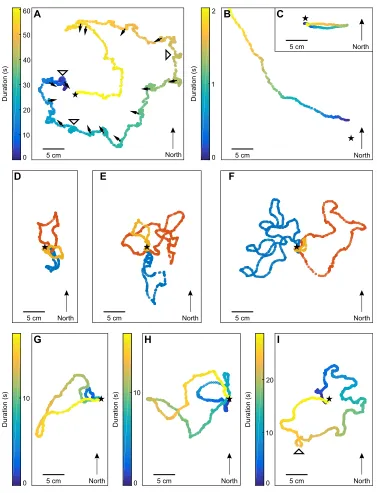
Fig. 2. Characteristics of learning walks inCataglyphis.(A–C) Three paths walked by ants (C. noda) leaving the nest for different purposes recorded at 100 frames s−1. (A) Typical learning walk circling around the nest entrance (black star), including several pirouettes, during which the ant looks back to the nest entrance (black arrows), and voltes, without stopping phases (white arrowheads). (B) An experienced forager leaves the nest in a straight line without any turns. (C) Typical path of a digger ant leaving the nest in a straight line, followed by a 180 deg turn and run back to the nest after depositing soil. Time is color coded in all traces. Note that the learning walk in A takes about 1 min, whereas the path of the forager in B and the digger in C disappears after 2 s outside the recording area or into the nest, respectively. (D–F) Successive learning walks of an individual ant (C. noda) during 1 day (18 July 2015) recorded at 25 frames s−1. This individually marked ant was seen only once outside the nest in the morning before the recordings started. (D) The first three walks happened in short sequence at 11:05:05, 11:05:33 and 11:07:02 h local time. The durations were 14 s (yellow), 16 s (red) and 10 s (blue). After these explorative trips, the ant re-appeared outside the nest entrance at 11:07:21 h local time, became lost and searched for several minutes (4 min 55 s) to find its way back to the nest (not shown). (E) This ant immediately continued to perform learning walks at 11:12:26 h local time (7 s, yellow). The subsequent two learning walks were performed in short sequence, at 11:43:25 h (24 s, red) and 11:43:58 h (12 s, blue), respectively. (F) Three further learning walks directly followed the ones shown in E. The first of these three started at 11:45:06 h and was aborted (2 s, yellow) because the ant was frightened and returned to the nest immediately. The next learning walk occurred directly afterwards at 11:45:21 s (14 s, red). The last learning walk of this ant was recorded at 12:17:32 s (19 s, blue). During subsequent learning walks, the ant explored different sectors around the nest entrance. (G–I) Examples of three ants (C. fortis) performing a learning walk with no, one or three artificial landmarks recorded at 100 frames s−1. (G) Without artificial landmarks. (H) One black cylinder, 0.4 m north of the nest entrance. (I) Three artificial landmarks positioned symmetrically at a 2 m distance around the nest entrance. Time is color coded in all traces. Note that the durations of learning walks depicted were slightly different (color bars). However, the learning walk durations of ants in different experimental groups were not significantly different between species and experimental setups (Fig. 3). A complete learning walk ofC. nodarecorded from the top as well as from the side is shown in Movie 1.
Journal
of
Experimental
phases with this criterion. It is also noteworthy that the duration of the
stopping phases inOcymyrmexis temperature dependent (Müller and
Wehner, 2010). However, the ground temperatures in Tunisia and
Greece were similar [Tunisia: 41.7±9.3°C, 36.5–45.8°C; Greece:
47.2±21.6°C, 38.8–60.4°C; median±interquartile range (IQR:
Q1–Q3), ranging from 31.3 to 51.4°C in Tunisia and from 26.6 to
66.3°C in Greece]. Concerning the gaze direction, we tolerated a deviation of 10 deg during a stopping phase. Multiple analyses of the same sequence showed that the accuracy for determining gaze direction is within this 10 deg limit. Based on these data, we also calculated the angular velocities of the turns.
Statistics
Because our data were not normally distributed, we report medians± IQR, calculated by subtracting the lower quartile (Q1) from the upper quartile (Q3). We compared the duration of learning walks and the number of turns per learning walk of our experimental
groups using the Kruskal–Wallis test. The significance level was
α=0.05. If necessary, i.e. if there was a significant difference
indicated by the Kruskal–Wallis test, we performed post hoc
pairwise comparisons with the Mann–Whitney U-test with
Bonferroni correction. The significance level was α=0.05 (i.e.
α=0.0084 with Bonferroni correction, because we compared
the four experimental groups: ‘C. fortis with no artificial
landmark’,‘C. fortiswith one artificial landmark’,‘C. fortiswith
three artificial landmarks’and‘C. noda’pairwise with each other,
resulting in six performed tests). We compared the number of stopping phases and the angular velocity of different types of turn
pairwise within species using the Mann–WhitneyU-test (α=0.05).
All these statistical tests were performed with Matlab R2014b (MathWorks, Inc.). To analyze gaze direction, we used the Rayleigh test to test for uniformity, i.e. whether the data were randomly distributed over the 360 deg. If the data were significantly directed
(α=0.05), we calculated the 95% confidence interval and checked
whether the expected value, i.e. the direction of the nest (180 deg) was between the limits. All circular statistics were performed with Oriana (version 4.02, Kovach Computing Services, Pentraeth, UK).
RESULTS
Cataglyphisants perform characteristic learning walks Cataglyphisdesert ants leave their nest for quite different reasons. When observing the happenings at the nest entrances of three
Cataglyphisspecies (C. noda,C. fortisandC. aenescens) in two completely different environments (Fig. 1), three main reasons were identifiable, i.e. performing learning walks, digging/waste disposal
and foraging (Fig. 2A–C). All these outdoor behaviors were clearly
distinguishable. In this study, the focus was on the learning walks performed by the ants before starting their foraging careers (Fig. 2A). However, ants also left the nest to carry out nest-related tasks like waste disposal or digging behavior (Fig. 2C; see Harkness, 1977; Stieb et al., 2012), and of course to search for food (Fig. 2B). In addition, some ants carried out single nest mates or stood next to the nest entrance and guarded it from time to time as has been described in detail elsewhere (Harkness, 1977). Indoor workers that deposited soil or waste outside the nest moved very fast. They ran in a straight line outside the nest, dropped their item a
few centimeters away [9.9±3.7 cm, 8.5–12.2 cm, median±IQR
(Q1–Q3) dropping distance from the nest entrance,n=20], turned
around by 180 deg immediately and ran back into the nest (Fig. 2C). Foragers also left the nest quickly and in a straight line. In contrast to diggers and learners, foragers moved far away from the nest entrance and left the recording area rapidly (Fig. 2B). Conversely, novices
performed their learning walks at the beginning of their foraging career in close vicinity to the nest entrance, and therefore they remained inside our selected recording area, enabling us to analyze entire learning walks using high-speed video recordings. These
explorative trips were very short [C. noda n=25: 10.4±9.3 s, 6.8–
16.1 s; C. fortis without artificial landmarks n=12: 12.0±5.4 s,
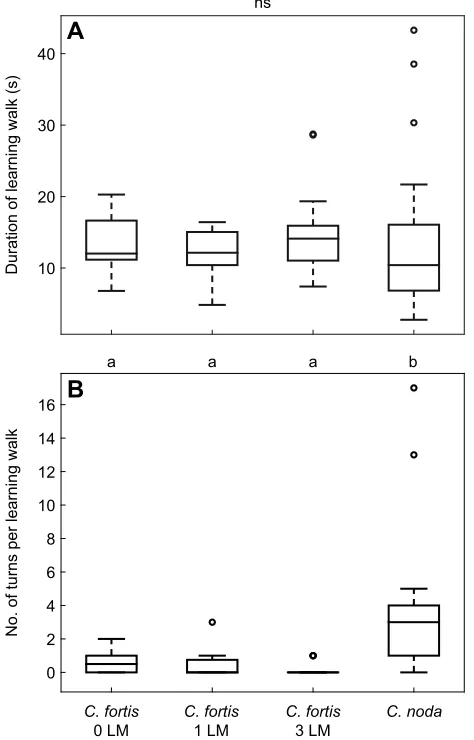
11.2–16.6 s, median±IQR (Q1–Q3); Fig. 3A, Kruskal–Wallis test:
duration of learning walksχ2
3=3.98,n=66,P=0.27]. No significant
differences between the durations of the learning walks of the different species or setups were apparent (Fig. 3A). We marked
some individualC. nodaants with a unique color code at their first
appearance so that we could record subsequent learning walks of the
same ants (Fig. 2D–F). Typically,C. nodamoved further away from
the nest entrance with increasing experience until they eventually
Duration of learning walk (s) 10 20 30 40
No. of turns per learning walk
0 2 4 6 8 10 12 14 16
C. fortis
0 LM
C. fortis
1 LM
C. fortis
3 LM
C. noda
a a a b
A
B
[image:4.612.321.558.238.608.2]ns
Fig. 3. Comparison of early learning walks performed by two different
Cataglyphisspecies and under different conditions.The central mark of each boxplot represents the median, the edges of the boxes are the 25th and 75th percentiles, and the whiskers extend to the most extreme data points (excluding outliers). Outliers are plotted individually as open circles. Different letters indicate significant differences between the groups when compared pairwise (Mann–WhitneyU-test with Bonferroni correction, i.e.α=0.0084). (A) The durations of early learning walks performed within our recording areas were not significantly different between the experimental conditions (C. fortis
with no, one or three artificial landmarks) or between the two species. (B) The number of turns per learning walk was significantly different between species. However, there was no significant difference between the three experimental
setups ofC. fortis.
Journal
of
Experimental
became foragers. The most obvious characteristic of C. noda
learning walks were the frequent turns, during which the ants usually looked back to the nest. The ants performed up to 17 turns per learning walk in our recording area. The average number of turns
was 3±3 [1–4, median±IQR (Q1–Q3), n=25; Fig. 3B]. In
comparison to the GreekC. nodaants living in a pine forest, the
TunisianC. fortisants inhabiting a saltpan performed fewer turns
during their learning walks [0.5±1, 0–1, median±IQR (Q1–Q3),
n=12; Fig. 3B; Kruskal–Wallis test: number of turns per walk
x2
3=30.75,n=66,P<0.05, andpost hocpairwise comparison with
Mann–WhitneyU-test with Bonferroni correction:C. nodaversus
C. fortis without an artificial landmark (LM) z=3.41, nCn=25,
nCf0LM=12,P<0.0084;C. nodaversusC. fortiswith one artificial
landmarkz=4.03,nCn=25,nCf1LM=15,P<0.0084;C. nodaversusC.
Gaze direction [°]
0 90 180 270
A
B
C
D
E
F
1
1 2
3 4 5 6
7
1
2 3
Gaze direction (deg)
Duration (s) 1
1 2
1 0
90 180 270 0 90 180 270
1
1
2 3
4 5
6 7
1
2 3 Nest
direction
Nest direction
[image:5.612.93.522.52.540.2]Nest direction
Fig. 4. Different types of turns.(A–C) The position of the mandibles and thorax was tracked to monitor the different types of turns. The dots show the position of the mandibles (gray) and the thorax (black) recorded every 10 ms (as illustrated in C). The walking and turning directions are indicated by white arrows. Black arrows point towards the nest. (A) A volte was defined as a walked circle. The tracks of the mandibles and thorax follow the same path. In contrast, (B) full or (C) partial pirouettes were defined as turns about the ant’s own axis. The tracks of the mandibles circle around the position of the thorax. Stopping phases (>100 ms) are indicated by yellow and orange arrows (see D–F), and are numbered consecutively. (D–F) Gaze directions of the ants during these three turns with regard to the nest (180 deg) is plotted over time. A stopping phase is defined as an interval of at least 100 ms during which the ant does not move forward and does not change its gaze direction for more than 10 deg. The stopping phases of the turns are highlighted in yellow, and the longest stopping phase per turn is in orange. (D) The volte has only one stopping phase (100 ms), which is not directed towards the nest. (E) The full pirouette includes seven stopping phases of which no. 5 is the longest (180 ms). Stopping phase no. 6 (132 ms) is directed towards the nest. (F) The partial pirouette has three stopping phases of which the longest (no. 3, 185 ms) is directed towards the nest. In general, pirouettes include more stopping phases than voltes (Fig. 5). The underlying data are shown in Movie 1.
Journal
of
Experimental
fortiswith three artificial landmarks z=4.27,nCn=25,nCf3LM=14,
P<0.0084].
An artificial panorama in an otherwise featureless environment does not alter the learning walks inC. fortis
To check whetherC. fortisdid not perform frequent turns because
of the absence of visual landmarks, we manipulated its natural habitat with two different settings of artificial landmarks. In one experiment, we installed a black cylinder 0.4 m north of the nest entrance (Fig. 1C; Movie 1); in another, three cylinders were placed at 2 m distance around the nest entrance (Fig. 1D). However, there was not any noticeable difference between the learning walks of
C. fortisunder the different conditions (Fig. 2G–I). The duration of
the learning walks remained the same (Kruskal–Wallis test: duration
of learning walksx2
3=3.98,n=66,P=0.27; Fig. 3A), and the number
of turns per learning walk ofC. fortisdid not increase [one artificial
landmark: 0±0.75, 0–0.75, median±IQR (Q1–Q3), n=15; three
artificial landmarks: 0±0, 0–0, median±IQR (Q1–Q3), n=14;
Fig. 3B]. There was no significant difference between the number
of turns per walk in the three conditions under whichC. fortisants
performed their learning walks (Fig. 3B; Kruskal–Wallis test:
number of turns per walkx2
3=30.75,n=66,P<0.05, andpost hoc
pairwise comparison with Mann–WhitneyU-test with Bonferroni
correction:C. fortiswithout an artificial landmark versusC. fortis
with one artificial landmark z=1.09, nCf0LM=12, nCf1LM=15,
P=0.28; C. fortiswithout an artificial landmark versus C. fortis
with three artificial landmarks z=1.55, nCf0LM=12, nCf3LM=14,
P=0.13;C. fortiswith one artificial landmark versusC. fortiswith
three artificial landmarksz=0.38,nCf1LM=15,nCf3LM=14,P=0.71).
As stated above,C. nodamade significantly more turns per learning
walk thanC. fortiseven when artificial landmarks were available for
the latter species (Fig. 3B).
Cataglyphisants perform different types of turns with distinct features
Beside the difference in the number of turns per learning walk
between C. fortis and C. noda, our high-speed recordings also
revealed striking qualitative differences of turns across and within
species.Cataglyphis fortisandC. nodaincluded different types of
turns in their learning walks (Fig. 4). Cataglyphis fortis ants
performed only one type of turn during their learning walks: small walked circles, we termed voltes. During this type of turn, the ants moved forward on a circumference. Voltes were only rarely interrupted by stopping phases longer than 100 ms. The median
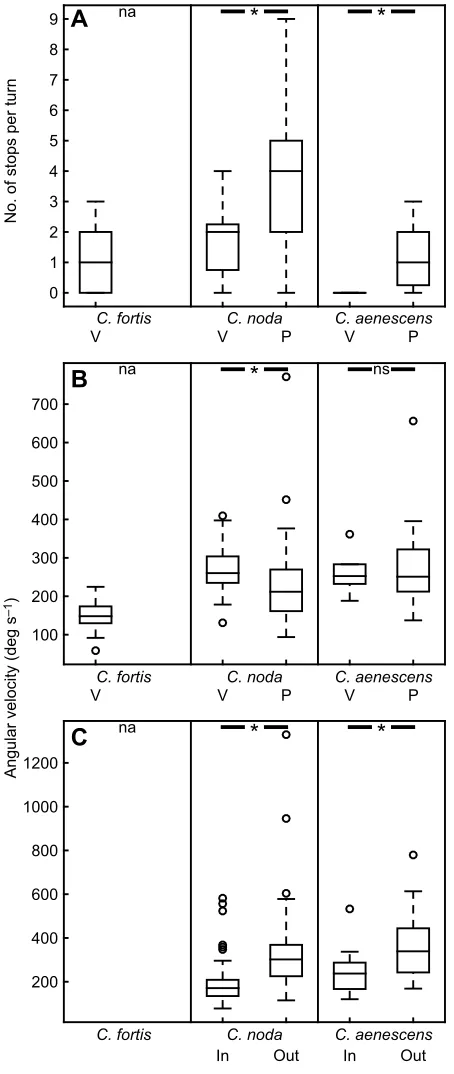
number of stopping phases per volte of C. fortis was 1±2 [0–2,
median±IQR (Q1–Q3), n=20; Fig. 5A]. Cataglyphis noda also
performed this type of turn (Fig. 4A,D; Movie 1). During these
voltes,C. nodastopped 2±1.5 times [0.75–2.25, median±IQR (Q1–
Q3),n=17; Fig. 5A, Mann–WhitneyU-test:C. nodavoltes versus
pirouettesz=−3.99,nCnV=17,nCnP=85,P<0.05]. However,C. noda
much more frequently performed another, more saccadic, type of turn we termed pirouettes (as in Müller and Wehner, 2010). Over
80% ofC. nodaturns were pirouettes (85 out of 102 analyzed turns
were pirouettes and only 17 were voltes). In contrast to a volte, a pirouette does not include any forward motion. Instead, to perform a
C
na*
*
In Out In Out
200 400 600 800 1000 1200
No. of stops per turn
0 1 2 3 4 5 6 7 8
9
*
*
C. fortis C. noda C. aenescens
C. fortis C. noda
P C. aenescens
C. fortis C. noda C. aenescens
V V V P
na
A
B
Angular velocity (deg s
–1
)
*
na ns
100 200 300 400 500 600 700
P
[image:6.612.63.290.57.594.2]V V V P
Fig. 5. Interspecies comparison of the different types of turn.The central mark of each boxplot represents the median, the edges of the boxes are the 25th and 75th percentiles, and the whiskers extend to the most extreme data points (excluding outliers). Outliers are plotted individually as open circles. Data were compared pairwise within each species using the Mann–Whitney
U-test when applicable.Cataglyphis fortisdid not perform any pirouettes; therefore, no statistical comparison was possible (na, not applicable). Asterisks indicate significant differences (P<0.05), groups labeled‘ns’are not significantly different. (A) Number of stopping phases per turn. Pirouettes (P) of
C. nodaandC. aenescensinclude more stopping phases than do voltes (V). (B) Angular velocity during turns. The angular velocity ofC. nodavoltes was significantly higher than that of pirouettes, but there was no significant difference forC. aenescens. However, it is noteworthy that the angular velocities were quite different depending on the turning direction relative to the nest, i.e. whether the ant turned to the nest (turning-in) or back to continue the learning walk (turning-out). This becomes especially clear when examining the fine structure of the partial pirouettes performed by the GreekCataglyphisants. (C) Angular velocity of in- and out-turns of the partial pirouettes. Both species performing partial pirouettes, i.e.C. nodaandC. aenescens, turn in with less speed than they turn out, as does the Namibian desert antO. robustior(Müller and Wehner, 2010).
Journal
of
Experimental
pirouette, an ant stops walking and turns on its vertical axis without any translation (Fig. 4B,C; Movie 1). To re-establish its former walking direction, an ant has to turn back either continuing or reversing its direction of rotation. Therefore, pirouettes may be full 360 deg turns or partial turns (Fig. 4E,F; Movie 1). Usually, the ants took the shorter way back to re-establish their initial angular position
–only in 12 partial pirouettes did ants cover an angle larger than
180 deg when turning back (n=74). Furthermore, the angular
velocities of the back-turns were usually higher than those of the in-turns (Fig. 5C). Pirouettes were frequently interrupted by stopping phases defined as phases of at least 100 ms during which the ants did not move forward and gazed in one direction (±10 deg to compensate
for tracking inaccuracies).Cataglyphis nodapirouettes included 4±3
[2–5, median±IQR (Q1–Q3),n=85] stopping phases, significantly
more than their voltes (Fig. 5A). In addition,C. nodapirouettes had a
lower angular velocity than their voltes (Fig. 5B, Mann–Whitney
U-test:C. nodavoltes versus pirouettesz=2.84,nCnV=17,nCnP=85,
P<0.05). Interestingly, a smallerCataglyphisspecies (C. aenescens)
inhabiting the same clearings asC. nodain the Greek pine forest also
performed both types of turns. Similar toC. noda, pirouettes inC.
aenescens contained more stopping phases than voltes (Fig. 5A,
Mann–Whitney U-test: C. aenescens voltes versus pirouettes z=
−2.50,nCaV=5,nCaP=15,P<0.05); however, there was no significant
difference in their angular velocity (Fig. 5B, z=0.00, nCaV=5,
nCaP=15,P=1). In both C. nodaand C. aenescens, the turning-in
movements of the partial pirouettes were slower than the turning-out
movement (Fig. 5C, Mann–Whitney U-test: C. noda turning-in
versus turning-outz=−6.79,nCni=74,nCno=74,P<0.05;C. aenescens
turning-in versus turning-outz=−2.04,nCai=14,nCao=14,P<0.05).
OnlyCataglyphisspecies inhabiting cluttered environments perform pirouettes during which they turn back to the nest entrance
The striking feature of the saccadic pirouettes is that the ants turn back and look towards the nest entrance. As has been described for
other desert ants (seeC. bicolor: Wehner et al., 2004;O. robustior:
Müller and Wehner, 2010),C. nodaants turned back to the nest
(defined as the direction 180 deg), faced the nest entrance (which was invisible to them) and paused for a few hundred milliseconds
[longest stopping phase per turn: 162±68 ms, 134–202 ms, median±
IQR (Q1–Q3); minimum by definition 100 ms, maximum 469 ms,
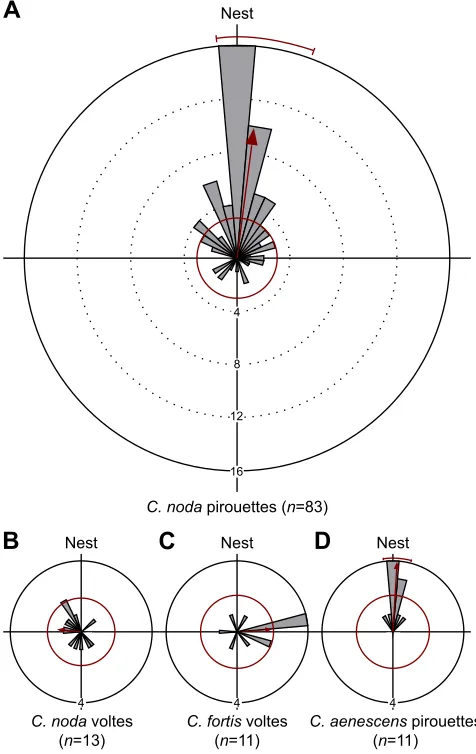
n=83]. However,C. nodaants only paused and fixated the position
of the nest entrance during one type of turn, i.e. during pirouettes
(Rayleigh test: z=30.48,n=83, P<0.05; 187.5 deg, mean vector,
174.7–200.2 deg, 95% confidence interval; Fig. 6A). In contrast, the
gaze direction of C. noda ants during the voltes was randomly
distributed (Rayleigh test: z=1.29,n=13, P=0.28; Fig. 6B). The
same was true forC. fortisants–they also did not fixate the nest
direction during voltes (Rayleigh test: z=2.46, n=11, P=0.08;
Fig. 6C).In contrast to C. noda, C. fortis never performed any
pirouettes during which they stopped to look back to the nest
entrance (Fig. 5).Cataglyphis aenescensants inhabiting the same
clearings in the Greek pine forest as C. noda also performed
pirouettes and looked back to the nest entrance during the longest
stopping phases (Rayleigh test:z=10.17,n=11,P<0.05; 183.5 deg,
mean vector, 172.5–194.4 deg, 95% confidence interval; Fig. 6D).
DISCUSSION
Conspicuous turns have been observed in several desert ant species (C. fortis: Fleischmann et al., 2016; Stieb et al., 2012;C. bicolor:
Wehner et al., 2004; C. aenescens: Petrov, 1993; Cataglyphis
bombycina: Wehner, 1994; Wehner and Wehner, 1990;M. bagoti:
Wystrach et al., 2014; O. robustior: Müller and Wehner, 2010).
However, these turns have never been directly compared with each
other. In this study, we showed that bothC. nodaandC. aenescens
inhabiting a pine forest in Greece (Fig. 1A) performed voltes as well as pirouettes during their learning walks. These different types of
turns can be easily distinguished qualitatively – the former is a
walked circle whereas the latter consists of a full or partial rotation about the body axis. However, there were also quantitative
differences – the number of stops per turn was higher in
pirouettes than in voltes in both species. Most importantly, C.
Nest Nest
B
NestC
D
A
Nest4 4 4
16 12 8 4
C. noda pirouettes (n=83)
C. fortis voltes (n=11)
C. noda voltes (n=13)
C. aenescens pirouettes (n=11)
Fig. 6. Viewing directions during the longest stopping phases.Data are shown in gray and the corresponding statistics are shown in red. The width of the circular histogram bins was 10 deg. The red circle indicates Rayleigh’s critical valueα=0.05. The red arrow indicates ther-vector pointing in the mean direction. If the red arrow exceeds the red circle, the data are directed and not randomly distributed. In that case, the 95% confidence interval is also shown (red circular line). If the expected direction (nest) lies between the confidence interval limits, we assume that the ants look back at the nest entrance. (A)Cataglyphis nodamean gaze direction during the longest stopping phases of their pirouettes was not significantly different from the nest direction. (B) In contrast,C. nodavolte gaze was non-directional. (C) The same was true for the gaze direction ofC. fortisduring the longest stopping phases of their voltes– there was no preferred viewing direction towards the nest. (D)Cataglyphis aenescensants inhabit the same clearings asC. nodaants, and also looked back to the nest entrance during the longest stopping phases of their pirouettes. In these diagrams, only the turns that had at least one stopping phase (>100 ms) were included–all turns without stopping phases were disregarded here (see Fig. 5).
Journal
of
Experimental
[image:7.612.317.555.60.437.2]nodaas well asC. aenescensonly stopped to gaze back at the nest entrance during the pirouettes. Furthermore, in partial pirouettes, the turning-in rotations were slower than the turning-out rotations as is
the case inO. robustior(Müller and Wehner, 2010). In contrast,C.
fortisinhabiting a featureless saltpan in Tunisia (Fig. 1B) did not perform any pirouettes and did not look back at the nest. We manipulated the natural panorama around the nest entrance using artificial landmarks (Fig. 1C,D). However, even this enrichment of the visual environment did not induce the performance of pirouettes inC. fortiswith pauses directed to the nest entrance, even though experiments showed that the ants learn these landmarks reliably during their learning walks (Fleischmann et al., 2016). It is noteworthy, however, that the artificial landmarks did not enrich the
visual panorama comparable to the natural environment ofC. noda
(Fig. 1A versus B). Therefore, one might speculate that the panorama was not visually enhanced enough to induce the performance of pirouettes. We think this is unlikely, because other desert ants that live in cluttered but less structured
environments than the pine forest of the GreekCataglyphis ants
in this study also perform turns and look back to the nest entrance repeatedly during their learning walks (Müller and Wehner, 2010;
Wehner et al., 2004). Why is it thatC. fortisdoes not invest any time
in stopping and looking back at the nest entrance? As its natural habitat usually does not offer a prominent panorama and all directions look alike, it may not be worth making distinct snapshots of the panorama, as has been suggested for the Namibian desert ant
O. robustior(Graham et al., 2010). These ants only stop once or twice during their back turns (Müller and Wehner, 2010). This suggests a possible correlation between the richness of the visual scene in the natural environment and the number of stopping phases during the frequent turns of the desert ants performing learning
walks [i.e. C. fortis: no landmarks (saltpans and chotts) –
exclusively voltes without stopping phases, O. robustior: few
landmarks (a skyline of distant dunes and acacia trees)–only
nest-centered stopping phases during pirouettes; Müller and Wehner,
2010;C. nodaandC. aenescens(forest): many landmarks, i.e. a lot
of visual information available –two types of turns with several
stopping phases during pirouettes]. Further analyses should investigate whether fixation directions are associated with
panorama features. Wood ants (Formica rufa), for example, look
back to fixate a landmark when becoming familiar with a new feeder (Nicholson et al., 1999). Therefore, it is possible that desert ants might fixate prominent landmarks during the other stopping phases. However, systematic fixations of specific landmarks could not be observed by qualitative judgments, whereas the look back to the nest
entrance behavior was as obvious in the GreekCataglyphisspecies
as in the NamibianO. robustior.
Besides the question of the purpose of the other stopping phases during the pirouettes, there are two other pressing questions: (1) what enables the ants to look back precisely towards the nest
entrance?; and (2) why doCataglyphisdesert ants perform different
types of turns? Concerning the first question, it has been proposed that the main navigational tool, i.e. path integration, offers the reference system needed to precisely gaze at the nest (Graham et al., 2010; Müller and Wehner, 2010). Further experiments need to be conducted to verify that path integration enables the Greek
Cataglyphisants in their landmark-rich habitat to turn back to the nest, as opposed to another mechanism, such as landmark guidance. Concerning the second question, it may be that there are anatomical reasons for performing different types of turn (Wehner, 1994). However, the behavioral trait to perform pirouettes is independent from morphological traits enabling different desert ant species to
raise their gasters to improve their mobility (McMeeking et al., 2012). This indicates that the habitat, rather than anatomical constraints or phylogenetic relationships, exerts a selection pressure on the performance of the different types of turns.
Therefore, the second question has to be reformulated: what
might be the function of the voltes performed exclusively (C. fortis)
or in addition to other turns (C. noda,C. aenescens)? As mentioned
above, the main navigational toolkit of Cataglyphis is path
integration (Ronacher, 2008; Wehner, 2008). To determine the direction of their home vectors, the ants mainly rely on celestial cues, especially the polarization pattern and the azimuthal position of the sun (Wehner and Müller, 2006). In principle, compass information can be deduced from the polarization pattern by either a sequential or an instantaneous method (Wehner and Labhart, 2006). Voltes could provide the rotatory component necessary for the sequential method (Wehner, 1987b, 1994). Moreover, voltes may be used by desert ants to learn the configuration of landmarks close to the nest entrance even though they do not include stopping phases
like pirouettes. Regardless, C. fortis ants learn the artificial
landmarks surrounding the nest entrance even though they do not perform any pirouettes or other turns with distinct stopping phases
(Fleischmann et al., 2016). It is not known how ants – or other
animal species–store snapshots or other visual information in their
brains. However, it was shown that short-term light exposure at the
beginning of the ants’foraging careers has long-term effects on the
synaptic architecture in visual subregions of the mushroom bodies, high order sensory integration and learning and memory centers (Stieb et al., 2010, 2012). Similarly, microglomerular synapses in the lateral complex, the last synaptic relay station in the neural pathway of the sky compass are influenced by light particularly in the UV region of the spectrum during first exposure (Schmitt et al., 2016). We hypothesize that visual information gained by different types of turns during learning walks may represent crucial elements triggering neuroplastic calibrations in visual pathways.
Interestingly, circular movements and rotatory motifs are important not only in the learning walks of desert ants but also in the orientation behavior of other arthropods. Learning flights of flying hymenoptera include repeated arcs, loops and turn-backs (honeybees: Becker, 1958; Capaldi and Dyer, 1999; Capaldi et al., 2000; Degen et al., 2015, 2016; Lehrer, 1991, 1993; Opfinger, 1931; Vollbehr, 1975; wasps: Peckham and Peckham, 1898; Stürzl et al., 2016; Tinbergen, 1932; Zeil, 1993a,b; Zeil et al., 1996; bumblebees: Collett et al., 2013; Hempel de Ibarra et al., 2009; Philippides et al., 2013; Riabinina et al., 2014; Robert et al., 2017; Wagner, 1907). Dung beetles perform rotations about their vertical axis before rolling a ball away from the dung pile (Baird et al., 2012), during which they take a snapshot of the celestial scenery (el Jundi et al., 2016). Desert spiders also perform learning walk-like behavior: they leave their burrows in sinusoidal paths when departing to unfamiliar terrains (Nørgaard et al., 2012).
In conclusion, different types of turns performed by desert ants (and other arthropods) during learning walks (or flights) are likely to serve different functions. Pirouettes during which the desert ants look back to the nest entrance are only performed by ants inhabiting cluttered
environments (C. nodaandC. aenescens). The stopping phases during
pirouettes are most suited to taking snapshots (Graham et al., 2010; Müller and Wehner, 2010), suggesting that the ants take snapshots of the distant panorama around the nest entrance. Additionally, all
Cataglyphisspecies investigated so far performed voltes, which may provide the rotational movement needed to successfully calibrate the celestial cues as compass tools or serve other navigational purposes
like memorizing the configuration of nearby landmarks.
Journal
of
Experimental
Acknowledgements
We thank the Tunisian and the Greek governments for the permits to conduct our experiments in these two wonderful home countries ofCataglyphis. We especially want to thank the management board of the Schinias National Park for permission to perform our research in the Schinias National Park in Marathon. Furthermore, we are deeply grateful for the indispensable support on site by Maria Trivourea and Olga Papigioti. We also want to thank Christos Georgiadis for introducing us to the Greek
Cataglyphisants and for his help with administrative issues. In addition, Christos
made contact with two students from the University of Athens, Thanos Tsiatouras and Tom Zisis, who kindly enriched our field team in 2016 and helped to record the learning walks ofC. aenescens. We also want to thank all members of the field teams of 2014, 2015 and 2016, without whom the experiments could not have been performed in this way. We thank Bernhard Ronacher, who supported our research excursions with his expertise concerningCataglyphisfieldwork and by lending us his VW bus, Jochen Zeil for help with data analysis and the introduction to the Digilite application, for many discussions during the project and for his remarks concerning the manuscript, and Martin Strube-Bloss for helping to solve Matlab problems. We thank two anonymous reviewers for their very helpful comments.
Competing interests
The authors declare no competing or financial interests.
Author contributions
Conceptualization: P.N.F., R.G., R.W., W.R.; Methodology: P.N.F., R.G., R.W., W.R.; Software: P.N.F., R.G.; Validation: P.N.F., R.G.; Formal analysis: P.N.F., R.G.; Investigation: P.N.F., R.G.; Resources: W.R.; Data curation: P.N.F., R.G.; Writing -original draft: P.N.F.; Writing - review & editing: P.N.F., R.W., W.R.; Visualization: P.N.F.; Supervision: P.N.F., R.W., W.R.; Project administration: P.N.F., R.W., W.R.; Funding acquisition: R.W., W.R.
Funding
This study was supported by the Deutsche Forschungsgemeinschaft (DFG), Collaborative Research Center SFB1047‘Insect Timing’[Project B6 to W.R. and R.W.].
Supplementary information
Supplementary information available online at
http://jeb.biologists.org/lookup/doi/10.1242/jeb.158147.supplemental
References
Baird, E., Byrne, M. J., Smolka, J., Warrant, E. J. and Dacke, M.(2012). The dung beetle dance: an orientation behaviour?PLoS ONE7, e30211.
Becker, L.(1958). Untersuchungen über das Heimfindevermögen der Bienen.
Z. vergl. Physiol.41, 1-25.
Buehlmann, C., Graham, P., Hansson, B. S. and Knaden, M.(2014). Desert ants locate food by combining high sensitivity to food odors with extensive crosswind runs.Curr. Biol.24, 960-964.
Capaldi, E. A. and Dyer, F. C.(1999). The role of orientation flights on homing performance in honeybees.J. Exp. Biol.202, 1655-1666.
Capaldi, E. A., Smith, A. D., Osborne, J. L., Fahrbach, S. E., Farris, S. M., Reynolds, D. R., Edwards, A. S., Martin, A., Robinson, G. E., Poppy, G. M. et al.(2000). Ontogeny of orientation flight in the honeybee revealed by harmonic radar.Nature403, 537-540.
Collett, T. S., de Ibarra, N. H., Riabinina, O. Philippides, A.(2013). Coordinating compass-based and nest-based flight directions during bumblebee learning and return flights.J. Exp. Biol.216, 1105-1113.
Degen, J., Kirbach, A., Reiter, L., Lehmann, K., Norton, P., Storms, M., Koblofsky, M., Winter, S., Georgieva, P. B., Nguyen, H. et al.(2015). Exploratory behaviour of honeybees during orientation flights.Anim. Behav.102, 45-57.
Degen, J., Kirbach, A., Reiter, L., Lehmann, K., Norton, P., Storms, M., Koblofsky, M., Winter, S., Georgieva, P. B., Nguyen, H. et al.(2016). Honeybees learn landscape features during exploratory orientation flights.Curr. Biol.26, 2800-2804.
el Jundi, B., Foster, J. J., Khaldy, L., Byrne, M. J., Dacke, M. and Baird, E.(2016). A snapshot-based mechanism for celestial orientation.Curr. Biol.26, 1456-1462.
Fleischmann, P. N., Christian, M., Müller, V. L., Rössler, W. and Wehner, R.
(2016). Ontogeny of learning walks and the acquisition of landmark information in desert ants,Cataglyphis fortis.J. Exp. Biol.219, 3137-3145.
Graham, P., Philippides, A. and Baddeley, B.(2010). Animal cognition: multi-modal interactions in ant learning.Curr. Biol.20, R639-R640.
Harkness, R. D.(1977). The carrying of ants (Cataglyphis bicolorFab.) by others of the same nest.J. Zool. Proc. Zool. Soc. London183, 419-430.
Hemple de Ibarra, N. H., Philippides, A., Riabinina, O. and Collett, T. S.(2009). Preferred viewing directions of bumblebees (Bombus terrestrisL.) when learning and approaching their nest site.J. Exp. Biol.212, 3193-3204.
Jayatilaka, P.(2014). Individual foraging careers of the Jack Jumper ant,Myrmecia
croslandi.PhD thesis, The Australian National University.
Lehrer, M. (1991). Bees which turn back and look. Naturwissenschaften 78, 274-276.
Lehrer, M.(1993). Why do bees turn back and look?J. Comp. Physiol. A172, 549-563.
McMeeking, R. M., Arzt, E. and Wehner, R.(2012).Cataglyphisdesert ants improve their mobility by raising the gaster.J. Theor. Biol.297, 17-25.
Müller, M. and Wehner, R.(2010). Path integration provides a scaffold for landmark learning in desert ants.Curr. Biol.20, 1368-1371.
Muser, B., Sommer, S., Wolf, H. and Wehner, R.(2005). Foraging ecology of the thermophilic Australian desert ant, Melophorus bagoti. Aust. J. Zool. 53, 301-311.
Nicholson, D., Judd, S. P. D., Cartwright, B. A. and Collett, T. S.(1999). Learning walks and landmark guidance in wood ants (Formica rufa).J. Exp. Biol.202, 1831-1838.
Nørgaard, T., Gagnon, Y. L. and Warrant, E. J.(2012). Nocturnal homing: learning walks in a wandering spider?PLoS ONE7, e49263.
Opfinger, E.(1931). Über die Orientierung der Biene an der Futterquelle.Z. Vgl.
Physiol.15, 431-487.
Osborne, J. L., Smith, A., Clark, S. J., Reynolds, D. R., Barron, M. C., Lim, K. S. and Reynolds, A. M.(2013). The ontogeny of bumblebee flight trajectories: from naïve explorers to experienced foragers.PLoS ONE8, e78681.
Peckham, G. W. and Peckham, E. G.(1898).On the Instincts and Habits of the Solitary Wasps. Geological and Natural History Survey Bulletin, no. 2, pp. 1-245. Madison, WI. http://dx.doi.org/10.5962/bhl.title.26182
Petrov, I. Z. (1993). Some remarks on the foraging strategy in Cataglyphis
aenescensNyl. (Hymenoptera, Formicidae).Tiscia (Szeged)27, 23-28.
Philippides, A., de Ibarra, N. H., Riabinina, O. and Collett, T. S. (2013). Bumblebee calligraphy: The design and control of flight motifs in the learning and return flights ofBombus terrestris.J. Exp. Biol.216, 1093-1104.
Riabinina, O., de Ibarra, N. H., Philippides, A. and Collett, T. S.(2014). Head movements and the optic flow generated during the learning flights of bumblebees.J. Exp. Biol.217, 2633-2642.
Robert, T., Frasnelli, E., Collett, T. S. and de Ibarra, N. H. (2017). Male bumblebees perform learning flights on leaving a flower but not when leaving their nest.J. Exp. Biol.220, 930-937.
Ronacher, B.(2008). Path integration as the basic navigation mechanism of the desert ant, Cataglyphis fortis (Forel, 1902) (Hymenoptera: Formicidae).
Myrmecological News11, 55-62.
Schmid-Hempel, P. and Schmid-Hempel, R.(1984). Life duration and turnover of foragers in the antCataglyphis bicolor(Hymenoptera, Formicidae).Insectes Soc.
31, 345-360.
Schmitt, F., Stieb, S. M., Wehner, R. and Rössler, W.(2016). Experience-related reorganization of giant synapses in the lateral complex: Potential role in plasticity of the sky-compass pathway in the desert antCataglyphis fortis.Dev. Neurobiol.
76, 390-404.
Stieb, S. M., Muenz, T. S., Wehner, R. and Rössler, W.(2010). Visual experience and age affect synaptic organization in the mushroom bodies of the desert ant
Cataglyphis fortis.Dev. Neurobiol.70, 408-423.
Stieb, S. M., Hellwig, A., Wehner, R. and Rössler, W.(2012). Visual experience affects both behavioral and neuronal aspects in the individual life history of the desert antCataglyphis fortis.Dev. Neurobiol.72, 729-742.
Stürzl, W., Zeil, J., Boeddeker, N. and Hemmi, J. M.(2016). How wasps acquire and use views for homing.Curr. Biol.26, 1-13.
Tinbergen, N.(1932). Über die Orientierung des Bienenwolfes.Z. Vergl. Physiol.
16, 305-334.
Vollbehr, J. (1975). Zur Orientierung junger Honigbienen bei ihrem 1. Orientierungsflug.Zool. Jb. Physiol.79, 33-69.
Wagner, W.(1907).Psycho-biologische Untersuchungen an Hummeln. Stuttgart: E. Schweizerbartsche Verlagsbuchhandlung.
Wehner, R.(1983). Taxonomie, Funktionsmorphologie und Zoogeographie der saharischen Wüstenameise Cataglyphis fortis (Forel 1902) stat. nov.
Senckenbergiana biol.64, 89-132.
Wehner, R. (1987a). Spatial organization of foraging behavior in individually searching desert ants,Cataglyphis (Sahara desert) andOcymyrmex(Namib desert). InFrom Individual to Collective Behavior in Social Insects(ed. J. M. Pasteels and J.-L. Deneubourg), pp. 15-42. Basel, Bostom: Birkhäuser Verlag.
Wehner, R.(1987b).“Matched filters”- neural models of the external world.J. Comp.
Physiol. A161, 511-531.
Wehner, R. (1994). The polarization-vision project: Championing organismic biology. InNeural Basis of Behavioural Adaptations(ed. K. Schildberger and N. Elsner), pp. 103-143. Stuttgart, Jena, New York: Gustav Fischer Verlag.
Wehner, R.(2008). The desert ant’s navigational toolkit: Procedural rather than positional knowledge.J. Inst. Navig.55, 101-114.
Wehner, R. and Labhart, T.(2006). Polarisation vision. InInvertebrate Vision(ed. E. J. Warrant and D. E. Nilson), pp. 291-347. Cambridge: Cambridge University Press.
Wehner, R. and Müller, M.(2006). The significance of direct sunlight and polarized skylight in the ant’s celestial system of navigation.Proc. Natl. Acad. Sci. USA103,
12575-12579.
Journal
of
Experimental
Wehner, R. and Rössler, W. (2013). Bounded plasticity in the desert ant’s navigational tool kit. InInvertebrate Learning and Memory(ed. R. Menzel and P. R. Benjamin), pp. 514-529. New York: Academic Press.
Wehner, R. and Wehner, S.(1990). Insect navigation: use of maps or Ariadne’s thread?Ethol. Ecol. Evol.2, 27-48.
Wehner, R. and Wehner, S.(2011). Parallel evolution of thermophilia: daily and seasonal foraging patterns of heat-adapted desert ants: Cataglyphis and
Ocymyrmexspecies.Physiol. Entomol.36, 271-281.
Wehner, R., Harkness, R. D. and Schmid-Hempel, P.(1983).Foraging Strategies in Individually Searching Ants Cataglyphis bicolor (Hymenoptera: Formicida). Stuttgart, New York: Gustav Fischer Verlag.
Wehner, R., Michel, B. and Antonsen, P. (1996). Visual navigation in insects: coupling of egocentric and geocentric information.J. Exp. Biol.199, 129-140.
Wehner, R., Meier, C. and Zollikofer, C.(2004). The ontogeny of foraging behaviour in desert ants,Cataglyphis bicolor.Ecol. Entomol.29, 240-250.
Wystrach, A., Philippides, A., Aurejac, A., Cheng, K. and Graham, P.(2014). Visual scanning behaviours and their role in the navigation of the Australian desert ant Melophorus bagoti.J. Comp. Physiol. A Neuroethol. Sensory, Neural, Behav.
Physiol.200, 615-626.
Zeil, J. (1993a). Orientation flights of solitary wasps (Cerceris; Sphecidae; Hymenoptera) I.Description of flight.J. Comp. Physiol. A172, 189-205.
Zeil, J. (1993b). Orientation flights of solitary wasps (Cerceris; Sphecidae; Hymenoptera) II. Similarities between orientation and return flights and the use of motion parallax.J. Comp. Physiol. A172, 207-222.
Zeil, J., Kelber, A. and Voss, R.(1996). Structure and function of learning flights in bees and wasps.J. Exp. Biol.199, 245-252.
Journal
of
Experimental