RESEARCH ARTICLE
Archerfish fast-start decisions can take an additional variable into
account
Caroline P. Reinel and Stefan Schuster*
ABSTRACT
The analysis of saccadic decision-making tasks with two or four alternatives has shown what appears to be a general hallmark of decision-making: adding more alternatives decreases speed and accuracy. In their everyday lives, however, animals often select among many more than two options and under heavy constraints on speed and accuracy. Here we analyse a rapid decision made by hunting archerfish. As in the classical saccadic tasks, the fish must first estimate sensory information: based on an estimate of horizontal speed, azimuthal direction and initial height of falling prey, the fish must quickly select a suitable fast-start to arrive at the right place at the right time. Our results suggest that the fast-start decisions of archerfish are surprisingly robust with respect to adding a further decision-relevant variable. We show that the fish can appropriately account for vertical speed as an independent further variable–but the need to do so does not affect speed or accuracy of the decisions. Our findings suggest novel ways by which rapid and yet complex decisions could be balanced against increasing complexity.
KEY WORDS: Decision-making, Speed–accuracy trade-off, Multidimensional decisions, Saccadic decisions, Urgency, Integrator model
INTRODUCTION
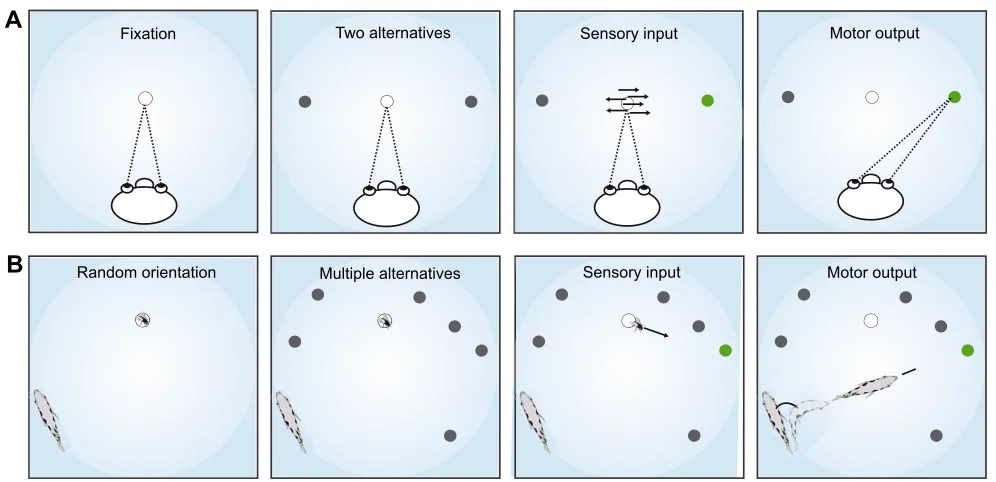
In our everyday lives we permanently make decisions of varying complexity and under changing constraints. Decisions typically link a perceptual estimate of what happens in the world with an appropriate action (e.g. Shadlen and Kiani, 2013; Murakami et al., 2014). How accurate and how quickly this match can be made depends on how many sensory input constellations and motor output alternatives need to be considered. Everyday experience suggests that accurate decisions take more time if more variables need to be taken into account. If we have to decide within a set interval of time, then increasing the number of alternatives lowers accuracy. These expectations have been confirmed in a simple but well-controlled perceptual task that by now has become the classical model of decision-making: the saccadic decisions made by appropriately trained monkeys (e.g. Palmer et al., 2005; Shadlen and Kiani, 2013; Kiani et al., 2014; de Lafuente et al., 2015). In these forced-choice tasks (Fig. 1A), a monkey first must take sensory information into account to decide which of two possible constellations applies. A screen shows moving dots; a fraction of these moves to the left, the other fraction to the right (indicated with
arrows). The perceptual system must decide whether the sensory evidence sampled supports the alternative‘movement to the left’or the other one‘movement to the right’. After having estimated which of the two constellations occurs, the monkey makes a saccade of fixed size (because the monkey’s initial orientation and gaze are fixed) either towards a fixed spot at the right or at the left. Evidently these decisions capture a very small fraction of the perceptual abilities of monkeys and have no evident ethological background from which clear constraints could be deduced about how fast or how accurate the monkey has to be. Nevertheless, the task captures an important aspect of decision-making: increasing the number of possible sensory constellations from two to four increased response time (latency) of the decisions and/or decreased accuracy in picking the appropriate end point of the saccade (Churchland et al., 2008). Furthermore, deciding faster comes at the price of a decrease in accuracy (e.g. Palmer et al., 2005; Hanks et al., 2014). This important finding is particularly remarkable, given that the monkeys used in the experiments certainly have extended experience–before and after the experimental session–with making saccades of all sizes and to all target points in their normal lives. Yet, the experimental design allows researchers to clearly and unequivocally dissect the effect of increased decisional complexity on the quality of the decisions, by first offering a restricted decision and then adding slightly more of the degrees of freedom a monkey naturally has.
Although the findings of saccadic decision-making capture what we feel is the essence of decision-making, the only scientific way of actually showing this is by leaving the safe harbour of two-alternative saccadic decision-making and studying other decisions that differ in certain aspects, such as ecological constraints on speed and accuracy, the number of alternatives involved or the brain circuitry used. The decision we study here is taken from the natural hunting behaviour of archerfish (Dill, 1977; Schuster, 2007) but allows tight experimental control in the laboratory (Schlegel and Schuster, 2008). As in the saccadic decisions, the archerfish decisions comprise, first, a perceptual decision: based on a very brief sampling of an initial motion cue, the fish needs to decide which alternative sensory constellation is supported by the sampled data. However, in contrast to the classical monkey task, the number of potential alternatives is far larger, while at the same time the time interval allowed for sampling sensory evidence is extremely short. Depending on which constellation appears best supported by the available sensory data, the fish then selects a rapid response (motor output) that leads it optimally to a particular spot and in a particular time (Fig. 1B). In this so-called‘predictive start’, archerfish match two components of their fast-starts to the sensory data at hand: the angle of turn and the take-off speed (Reinel and Schuster, 2014). Which of the many possible target points the fish has chosen can be inferred from an analysis of the speed and the orientation of the fish right at the end of its fast-start. In contrast to the saccadic decisions, the motor output of the fish is not fixed by the sensory data alone but
Received 23 December 2015; Accepted 29 June 2016
Department of Animal Physiology, University of Bayreuth, Bayreuth 95440, Germany.
*Author for correspondence ([email protected])
S.S., 0000-0003-0470-9802
Journal
of
Experimental
must be gauged with the fish’s position and orientation as well as with other aspects of the situation (Schuster, 2012).
To better appreciate the context of this peculiar decision, it is important to know that the archerfish’s predictive start appears to be an essential addition to the archerfish’s hunting technique, needed to secure downed prey in the presence of many competitors, such as other surface-feeding fish (Rischawy et al., 2015). As soon as the shot of an archerfish dislodges aerial prey from its substrate, the fish can select a so-called C-start (Wöhl and Schuster, 2007) that appropriately turns the fish to the later landing point of prey (Rossel et al., 2002; Schuster, 2012) and optimally sets its take-off speed (Wöhl and Schuster, 2006; Reinel and Schuster, 2014). This allows the fish to be at the point of catch just when the prey arrives. The perceptual decision (i.e. what are the prey’s initial motion parameters) is demanding as it must be based on a very brief sampling interval (40 ms appear to be sufficient; Schlegel and Schuster, 2008). Moreover, accuracy and latency of the decision are independent of whether initial motion always starts from the same location or from different ones. It does not even matter whether motion starts from the spot the fish is fixating or from a displaced location (Schlegel and Schuster, 2008). A remarkable property of the archerfish’s fast-start decisions is that the assembly of initial motion values can be varied randomly from trial to trial and yet the fish can select the appropriateC-start manoeuvre (Schuster, 2012). Finally, several aspects show that the mapping between perception and action is not trivial: for instance, it does appropriately take the fish’s initial orientation and position into account. Moreover, when confronted with a situation in which two prey objects fall simultaneously in opposing directions – but otherwise have identical movement parameters – then the fish do not choose at random but tend to base their decision on that object whose later
landing point will be closer to the fish’s starting position (Schlegel and Schuster, 2008).
All previous studies on the archerfish’s fast-start decisions have employed setups in which the initial speed of prey was exclusively horizontal. Although these studies varied height, azimuthal direction and horizontal speed from trial to trial, they did not explore how the quality of the decisions would be affected by the need to take an additional variable into account: an initial (vertical) upward component of speed. If prey, hit by the shot of an archerfish, pick up vertical speed, this will prolong time of flight and lead to a more distant landing point. Outside the laboratory, archerfish shots do indeed transfer vertical speed onto prey and it is reasonable to assume that the fish must have ways to account for it. In principle, they might manage with much simpler strategies than feeding vertical speed into the decision. Here we show that the fast-start decisions can account for vertical speed as an additional independent variable. Unlike the monkey’s saccadic decisions, accuracy and latency of the archerfish fast-start decisions are unaffected by the need of acquiring and feeding additional information into the decisions.
MATERIALS AND METHODS Animal care
All experiments were performed on a group of 10 archerfish [three Toxotes jaculatrix (Pallas 1767) and seven Toxotes chatareus (Hamilton 1822)]. Body size of fish, measured between the tip of the mouth to the caudal peduncle, ranged from 6 to 12 cm. Fish were kept in a tank of 1.2×0.5×0.5 m (length×depth×height) filled with 210 litres of brackish water (conductivity 3.5–3.7 mS cm−1; temperature 28°C). A 12 h:12 h light:dark regime was kept and all experiments began no earlier than 4 h after light onset. Stationary
Motor output
A
Random orientation Multiple alternatives
B
Fixation Two alternatives Sensory input
[image:2.612.58.556.55.296.2]Sensory input Motor output
Fig. 1. Archerfish multidimensional decision-making.Mechanisms of decision-making are typically studied in trained forced-choice tasks with two alternatives. (A) The most prominent paradigm for studying perceptual decisions. An observer is trained to fixate a point on a screen and then to make a saccade towards one of two fixed points (grey). Which point needs to be chosen is based on a perceptual decision between two options: either predominant
motion is towards the left or towards the right. (B) The archerfish fast-start decisions. The fish initially are oriented at random with respect to the onset of falling
motion of prey.A prioria large number of prey landing points are possible (a few of them are shown in grey). Which one of them is going to be the target point
(illustrated in green) can only be decided by a perceptual decision in which the fish decides, based on a brief sampling of sensory input, which value of initial speed, direction and height applies in the given scene. Based on this it then activates a fast-start (motor output) that rotates it right towards the appropriate later point of catch (while prey has just started to fall) and gets it going with the speed needed to arrive simultaneously with its prey. The combination of initial motion parameters as well as position and orientation of the responding fish change randomly from trial to trial.
Journal
of
Experimental
prey items were dead flies (Calliphora, killed by freezing, fresh mass∼57 mg, size∼1.1±0.5 cm, mean±s.d.). Because all 10 group members shot at prey and responded with predictive starts, their responses were pooled.
Experimental setup and testing procedure
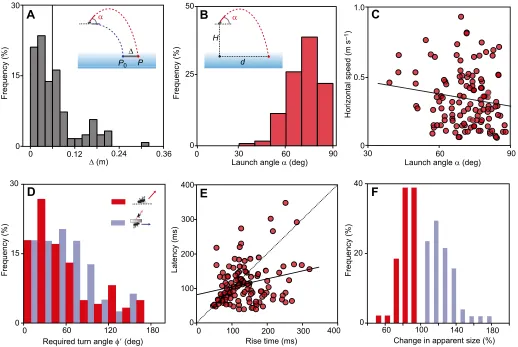
Previous studies used ‘horizontal only’ conditions (Fig. 2A, trajectory shown in blue) in which initial vertical motion was blocked by sticking prey onto the bottom side of a rigid disk (Rossel et al., 2002; Wöhl and Schuster, 2006; Schlegel and Schuster, 2008; Krupczynski and Schuster, 2013). To explore if and how well the predictive starts would also take initial vertical speed into account, prey were placed on top of two parallel, thin, transparent nylon threads such that a shot could lift the fly up. Initial prey height was 40 cm above the water surface. Fish fired from various horizontal positions (with horizontal distances between 0.01 and 0.31 m) below prey so that the launch angles of prey varied between trials (as required). Most importantly, the fish responded to the full range of
variation in the angle of launch (Fig. 2B). The horizontal distance of the shooter from the prey was not different in the‘horizontal only’ and ‘vertical added’ trials (Mann–Whitney: P>0.61, data not shown).
Our aim was to explore the effect of adding vertical speed in two phases: one that was preceded by extensive experience with initial vertical motion and one that was preceded by a long phase with complete absence of vertical motion. We therefore proceeded in five stages. (1) During an extended pre-phase (intended to be a‘training phase’) with at least 1000 trials, the fish experienced mixtures of vertical and horizontal motion. (2) Subsequently, we recorded responses to prey items with‘vertical added’initial motion in a total of 870 trials performed during 22 experimental days. (3) Afterwards, the fish faced a period of 18 days with 1060 trials in which movement was exclusively horizontal. (4) Subsequent to this experience, we analysed the performance under‘horizontal only’ conditions for 10 days and a total of 600 trials. (5) Finally, we switched immediately back to the first task (‘vertical added’)
Required turn angle φ⬘ (deg)
Frequency (%)
0 15 30
0 60 120 180
D
Launch angle α (deg)
Horizontal speed (m s
–1
)
30 60 90
0 0.5 1.0
B
C
40
20
0
100 140
60 180
Change in apparent size (%)
Frequency (%)
F
A
0 0.12 0.24 0.36 0
15 30
Frequency (%)
Δ (m)
Δ P P0 α
Launch angle α (deg)
Frequency (%)
0 25 50
30 60 90
0
H
d
α
400
300
200
100
0
Latency (ms)
0 100 200 300 400 Rise time (ms)
E
[image:3.612.48.566.271.618.2]X X
Fig. 2. Prerequisites for introducing vertical speed as an independent variable in archerfish fast-start decision-making.Depending on launch angleα
(inset), prey travels from its initial height to a landing pointPthat is offset byΔfrom pointP0expected in the absence of vertical speed. Experimental design
requires (i) large and varyingΔ, (ii) independence of horizontal speed andα, and (iii) large differences in the turn angles required (φ′) in different trials. (A) Average
displacementΔ(solid line) was large enough (6.42±0.54 cm, mean±s.e.m.) so that the error in ignoring vertical speed would be observable. (B) Actual distribution
of launch angleα.H, starting height;d, flight distance. (C) Launch angleαvaried independent of initial horizontal speed (linear regression:r2=0.02,F=2.698,
P=0.102,n=123). (D) Taking vertical speed into account would have required largely different turn anglesφ′in then=123 (‘vertical added’) andn=79 (‘horizontal
only’) trials. Distributions were not significantly different (Brown–Forsythe:P=0.766). (E) Fish did not match latency to rise time. The correlation (solid line) is weak
but significant (linear regression:r2=0.06,F=7.391,P=0.008); however, the slope is significantly (two-samplet-test:P=0.0001) different from the expected unity
slope (dotted line). (F) Relative changes in apparent prey size during the interval preceding the fast-start could provide the cue to infer vertical speed and to
discriminate the‘vertical added’(apparent size decreases) from the‘horizontal only’conditions (apparent size increases). Analysis based onn=49 (‘vertical
added’) and 51 (‘horizontal only’) recordings in which apparent size of the fly could most reliably be obtained. Note that all data are from trials in which the fish had
actually responded.
Journal
of
Experimental
without allowing a period in which the fish could slowly adjust to the regular occurrence of vertical speed. This last phase took 15 days and yielded a total of 900 trials. By following this procedure we hoped to see any indications for experience-dependent long-term adjustments in the performance. However, the results of the first phase (with preceding experience of vertical movement) and the last phase (with preceding experience of absence of vertical movement) did not differ in any of the parameters we analysed, so we pooled data sampled in the two phases.
Recording
We used a digital high-speed video system recording at 500 frames s−1 (HotShot 1280M, NAC Image Technology, Simi Valley, CA, USA; lens Sigma 20 mm/1.8 EX DG). The camera was mounted 1.2 m above the water surface and viewed the scene at a right angle (visible area of the tank: 1.0×0.5 m) with the starting point of prey in the centre of the image. We used additional light from a halogen lamp (500 W) placed below the tank to optimize contrast and to provide homogeneous brightness (290 cd m−2), as described previously (e.g. Schlegel and Schuster, 2008).
Data analysis
All recordings were analysed using ImageJ 1.42 (developed at the National Institutes of Health, Bethesda, MD, USA). Timing, distances, velocities and angles were analysed using custom-written software. To be informative for the questions of this study, the recordings selected for analysis had to fulfil a set of criteria that has been described and applied previously (Rossel et al., 2002; Wöhl and Schuster, 2006, 2007; Schlegel and Schuster, 2008; Krupczynski and Schuster, 2013): (1) we only analysed the first responding fish to ensure that theC-start had been initiated solely on the basis of prey motion; (2) the fish had to take off before the prey touched the water surface–so that the response was driven only by visual input; (3) the fish’s path to the future point of catch had to be free from any obstacles– such as other group members; (4) the C-starts had to turn the fish by at least 10 deg so that latency as well as accuracy of the turn could be determined unequivocally; and (5) all trials were excluded in which dislodged prey (i) simply fell vertically downwards or (ii) had been hit by more than one shot.
Prey motion
We analysed the following aspects of prey motion. Time of flight was taken as the number of frames between the one in which prey had first changed its initial position – clearly observable by
displacement and/or change in apparent size–and the one in which it had first touched the water surface (or the mouth of a fish), with the latter frame included in the count. The relative changes in apparent prey size were inferred from the apparent changes in size of the falling fly on the recorded frames. Changes are reported in the interval between motion onset of the prey and onset of the fish’s
C-start. Flight distance was the horizontal distance between the prey’s starting point ( projected vertically on the water surface) and its impact point. Based on time of flightT, flight distance d and starting heightH, we calculated the angle of launchα=arctan [(gT2/2−H)/d] (Fig. 2B), whereg(=9.81 m s−2) is the gravitational acceleration. The fly’s initial horizontal velocityvhorwas derived from the distance covered between the first frame in which displacement occurred and 10 subsequent frames (i.e. the first 10×2 ms=20 ms of free falling). Based on starting height, direction and horizontal velocity, we calculated an (‘virtual’) impact pointP0 at which the fly would land if there was no initial vertical motion and if motion followed simple ballistics with no air friction. To check the accuracy of our estimates ofP0, we ran the same procedures in the trials in which there was indeed only horizontal initial motion. In these cases, actual and calculated‘virtual’impact point should be equal. And indeed, our checks proved clearly that measured‘real’ flight distance and the calculated‘virtual’flight distance (estimated on the basis of the initial values of motion) did not differ (‘real’ 0.21±0.01 m, ‘virtual’ 0.21±0.01 m, mean±s.e.m., based on the samen=79 responses; Mann–Whitney:P=0.91).
Archerfish response
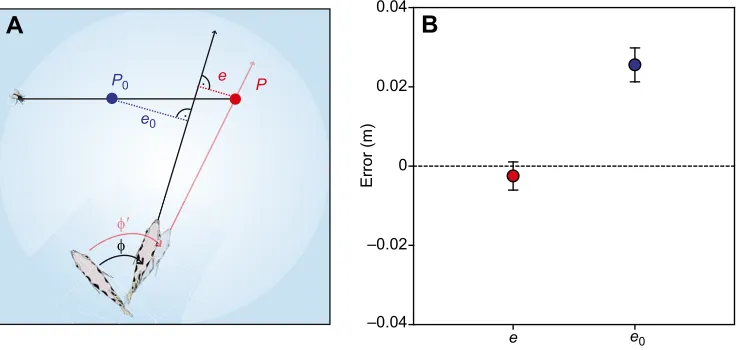
The following aspects of the archerfish’s response were analysed. Latency was determined from the first frame with prey displacement (or change in apparent size) and the one in which the fish first changed its position (including this frame into the count). Next we investigated turn angle by measuring the angle between the fish’s orientation before and after its C-shaped turn as described previously (Reinel and Schuster, 2014).Of great interest was the fish’s aim at the end of theC-start. To quantify its accuracy, we calculated errors e and e0 (Fig. 3A) by extending the fish’s orientation immediately at the end of stage 2 of itsC-start in a line and taking the minimum deviation of either the true later landing pointPor the‘virtual’landing pointP0(if vertical speed was absent or ignored) from that line. Following the earlier conventions (e.g. Rossel et al., 2002; Reinel and Schuster, 2014), a negative sign is assigned to the error if the line drawn through the fish and the path of the fly intersect at a point closer to the origin than the impact point.
e0
.
.
φ
φφ φ⬘
P0 e P
A
e e0
Error (m)
B
–0.04 –0.02 0 0.02
0.04 Fig. 3. Archerfish account for vertical
speed.(A) Scheme of errors in C-start
turn angleφmade either to the real impact
pointP(errore) or to pointP0obtained in
the same situation when vertical speed is ignored (errore0). For errore,φ′illustrates
the required turn angle (φ′not also shown
for error e0). Note thatewould be zero if
φ=φ′. Errors were defined as negative
when the prolonged paths of fish and prey intersected between the start (fly symbol) and impact point. Otherwise, errors were defined as positive. (B) Means±s.e.m. of
errorseande0show that the responses
minimizedeand note0. Note that errorse0
are systematically shifted towards positive values, just as expected for responses
directed at the actual impact pointP.
Journal
of
Experimental
[image:4.612.49.426.563.738.2]If the point of intersection is beyond the impact point, the error was taken as positive. Hence, in the example shown in Fig. 3A, errore would be negative and errore0positive.
To determine the archerfish’s take-off speed, we measured changes in the position of the fish’s snout within six subsequent intervals (each 10 ms) immediately at the end of itsC-start. We first confirmed–for the present dataset–that initial take-off speed was constant (Reinel and Schuster, 2014) for at least 60 ms, for both the ‘horizontal only’ and ‘vertical added’ conditions [Friedman repeated-measures ANOVA: P>0.61; testing speed changes between two consecutive intervals: one-sample t-test or one-sample signed rank test: P>0.25, based on n=79 (‘horizontal only’) and n=123 (‘vertical added’) starts, data not shown]. For further examinations we used the average speed of all six intervals (e.g. in Fig. 5). Additionally, we probed for changes in the kinematics of the response by measuring the duration of the two phases of the C-start: stage 1 (onset until maximal bend; e.g. Krupczynski and Schuster, 2013) and stage 2 (maximal bend until completely straightened). Furthermore, we measured the maximal bending angleθachieved at the end of stage 1 (Wöhl and Schuster, 2007).
Statistical analysis
All tests were run using SigmaPlot (version 12.5, Systat Software 2011) and performed two-tailed with an alpha level ofP=0.05. We used Shapiro–Wilk tests to examine whether data were normally distributed. We then ran the following procedures for parametric data: Levene’s tests to check for equal variance, one-samplet-tests to test whether distributions had zero means, two-samplet-tests to compare two independent samples or one-way ANOVA to compare three or more independent samples. Otherwise, we used paired t-tests or one-way repeated measures ANOVA for paired data sets. Non-parametric data were tested as follows: rank-based Brown– Forsythe tests were used to check equal variances, distributions
around zero means were verified with one-sample signed rank tests, and comparisons of two or more samples were run with either Mann–Whitney tests (U-test) or Kruskal–Wallis tests (H-test). Paired data sets were checked running Wilcoxon signed rank tests (two data sets) or Friedman repeated-measures ANOVA on ranks (three or more data sets). Correlations were checked with Pearson correlations ( parametric data) or Spearman rank correlations (non-parametric data). Two-samplet-tests were used to check differences in slopes and intercepts of the resulting regression lines. Finally, multivariate linear models were employed to find out which independent variable (e.g.‘virtual’speed) best predicts a dependent variable (e.g. take-off speed). Circular–circular correlations as described by Batschelet (1981) were utilized to analyse the correlation between two circular variables, e.g. azimuthal direction and angle of launch. To compare the quality of two correlation coefficients, we used Fisherz-transformations.
RESULTS
Introducing vertical speed as an additional independent variable of archerfish fast-start decision-making
In analogy to increasing the complexity in the monkey’s experimental task, we attempted to also challenge our archerfish with yet another increase in the complexity of their experimental task. Our aim was to require the fish to take an additional vertical speed component of prey motion into account. This is easily done technically; however, it requires much work to show that vertical speed is actually included in the start decisions and whether it is included as an additional independent variable.A prioriit is not clear whether the fish take this variable into account in its full range and in all possible combinations with the other three parameters (height, azimuthal direction and horizontal speed) that need to be known to determine the optimalC-start pattern. We therefore first explored whether the potential effect of added vertical speed would be detectable. Next, we needed to support the notion that the fish
‘Vertical added’
‘Horizontal only’
X
–0.2 –0.1 0 0.1 0.2 Error e (m)
0 15 30
Frequency (%)
0 100
50 150 200
Actual turn angle
φ
(deg)
0 50 100 150 200 Required turn angle φ⬘ (deg) 0
100
50 150 200
Actual turn angle
φ
(deg)
0 50 100 150 200 Required turn angle φ⬘ (deg)
0 15 30
Frequency (%)
Error e (m)
–0.2 –0.1 0 0.1 0.2
A
B
[image:5.612.47.426.56.346.2]C
D
Fig. 4. Accuracy of turning is not affected by accounting for vertical speed as an additional variable.
(A) Distribution of erroreand plot of actual
versus required turn angle (B) in the
‘vertical added’trials (n=123). (C,D) Same
analysis under‘horizontal only’conditions
(n=79). In A and C, errors had zero means
and distributions were not significantly different (one-sample signed rank test:
P>0.101; Mann–Whitney:P=0.587;
Brown–Forsythe: P=0.276). Moreover,
regressions between required and actual turn angle were highly significant [linear
regressions:r2=0.96 (B) andr2=0.95 (D),
F>1443.98,P<0.001] and equal
(B,D: Fisherz-transformation:P=0.279).
Journal
of
Experimental
accounted for an added variable. This requires evidence not only that the fish respond within a broad range of vertical speed levels but also that doing so requires very differentC-starts, e.g. different turn angles. Without evidence that the fish can handle the full range of both input and output constellations, the fish could‘simply’add a few extra rules to their decision–rules that hold in a few selected constellations in which the fish‘chooses’to respond. Moreover, it also needs to be shown that the fish respond to constellations in which the added vertical speed is truly independent of the other variables of initial prey movement. If not, the fish may respond only to constellations in which, for instance, vertical speed can be inferred from horizontal speed. Finally, the list of tedious but necessary pre-analyses also must include a check of whether the fish could be reducing the complexity of the problem in other ways. We hope to justify with these remarks why a long list of checks follows next (Fig. 2).
First, we estimated in our dataset ofn=123 responses–with added vertical motion–which corrections the fish would have to make. Would they ignore vertical speed? If so, then theirC-starts would turn to‘fictive’landing pointsP0that are closer to the prey’s initial position than the real impact points P. Fig. 2A shows the actual distribution of the distance betweenPandP0in our dataset. Based on this distribution and on the expected errors in aim, an analysis of the average aim could in principle resolve whether the fish aim atPorP0 (as will be justified later). Next, we checked whether added vertical speed did vary from one response to the next and whether it was independent of the other initial variables of prey motion. As an example of this analysis, Fig. 2B shows the distribution of the angle of launch and Fig. 2C illustrates the lack of any significant correlation between the angle of launch and initial horizontal speed of prey (linear regression:r2=0.02,F=2.698,P=0.102,n=123). The angle of launch was also not correlated to other variables, for instance, to the required turn angle (circular–circular correlation: r2=0.00,n=123, data not shown). The fish responded over a broad range of vertical speed levels ranging from 1.79 to 4.62 m s−1. Levels of vertical and horizontal speed were not correlated (linear
regression: r2=0.03, F=3.92, P=0.050, n=123, data not shown). Hence, the fish responded to constellations in which vertical speed was independent of horizontal speed. Furthermore, the angle of launch varied without any correlation to the corresponding horizontal (azimuthal) direction (circular–circular correlation: r2=0.02,n=123, data not shown). In addition, the fish also had not simplified their decisions by reducing their output range (Fig. 2D) but responded over the full range of required turn angles in both the ‘horizontal only’ and ‘vertical added’ conditions (no difference among distributions, Brown–Forsythe:P=0.766).
Still, the fish could employ the following trick: upon detecting any initial vertical movement they could postpone their responses and wait until the prey reaches peak height. At this point the situation would be equivalent to one in which only initial horizontal speed needs to be taken into account. However, most responses occurred before prey had even reached peak height [difference in latency and rise time (the time between prey motion onset and reaching peak height) Mann–Whitney: P<0.001] and latency did not vary such as to match rise time (difference in slopes of actual correlation versus correlation expected if latency matches rise time: two-samplet-test,P=0.0001; Fig. 2E).
Finally, Fig. 2F concludes the preliminaries by reporting a potential cue that the fish might be using to discriminate a situation with added vertical motion from one without. The apparent changes in prey size that occurred between motion onset and start of the fish’s response did not overlap in the two situations and the initial ‘shrinking’during the‘vertical added’trials is evident. This does not show that the fish actually use changes in image size to infer vertical speed, but changes in image size could be a potential cue.
Archerfish take vertical speed into account
To test whether the fish actually take vertical speed into account as an independent variable, we analysed how the fish were aligned immediately at the end of theirC-starts, when prey were still falling. For each given alignment (aim) of the fish we quantified two types of error: the erroremade with respect to the true later point of impact
0 1 2 3
0 1 2 3
T
a
ke-of
f speed (m s
–1
)
‘Virtual’ speed (m s–1)
D
0 1 2 3
B
T
a
ke-of
f speed (m s
–1
)
‘Horizontal only’
X
0 15 30 45
A
Frequency (%)
–1.5 –1.0 –0.5 0 0.5 1.0 0
15 30 45
C
Frequency (%)
Take-off speed–‘virtual’ speed (m s–1)
[image:6.612.48.435.56.327.2]‘Vertical added’
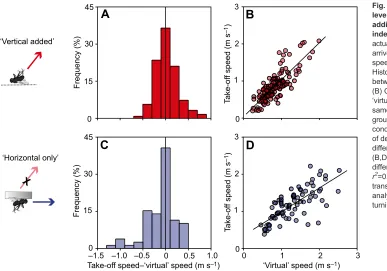
Fig. 5. Accuracy of setting the appropriate level of take-off speed is not affected by adding vertical speed as a further independent variable.(A) Difference of actual take-off speed and speed required to arrive simultaneously with prey (‘virtual’
speed) with vertical motion added (n=123).
Histogram shows distribution of deviations
between take-off speed and‘virtual’speed.
(B) Correlation between take-off speed and
‘virtual’speed. (C,D) For comparison, the
same analysis of take-off speed in the same
group of fish but under‘horizontal only’
conditions (inset) (n=79). (A,C) Distributions
of deviations were not significantly
different (Brown–Forsythe:P=0.346).
(B,D) Correlations were not significantly
different [linear regressions:r2=0.67 (B) and
r2=0.75 (D),F>100.905,P<0.001; Fisher-z
-transformation:P=0.227]. Same C-starts as
analysed in Fig. 4 for quantifying accuracy of turning.
Journal
of
Experimental
(P), and the errore0made with respect to the point (P0) that the fish would choose if they ignored vertical speed (Fig. 3A). Note thatP0 is a virtual point, the fictive point at which prey would land if the vertical speed component was missing. Controls (described in Materials and methods) showed clearly that our way of measuring horizontal speed was accurate enough to inferP0. This allowed us to define an errore0made relative to pointP0. Please also note that our definition of the errors allows responses made from different initial orientations and distances to be compared. If the fish were able to take vertical speed into account, errorevalues should scatter around zero mean, whereas error e0 values should be shifted towards positive values. Conversely, if added vertical speed was ignored, thene0should scatter around zero mean andeshould be negative. Additionally, the error that the fish minimize should be independent of any of the input variables, i.e. the variables that define the motion of the falling prey. The results are clear: values of errore–but not errore0–were symmetrically distributed around zero mean (errore:
−0.003±0.004 m, mean±s.e.m., one-sample signed rank test: P=0.157; Fig. 3B). Error e0 was significantly shifted towards positive values (0.03±0.004 m, mean±s.e.m., one-sample t-test: P<0.001). Furthermore, errors e and e0 also were significantly different (Mann–Whitney:P<0.001). The fish thus minimized error eand note0. Moreover, errorein aiming was unrelated to horizontal and vertical speed as well as to azimuthal direction (linear regressions:r2<0.126,F<2.641,P>0.107). Finally, errorevalues were also not correlated with the motor output variables, i.e. actual (and required) turn angle and level of take-off speed (linear regressions: r2<0.019, F<2.337, P>0.129). The analysis thus produces two results. First, the fish had appropriately taken vertical speed into account, allowing them to target the real later landing pointP. Second, the error in choosing an aim at pointPwas appropriate for any situation and did not correlate with any of the input variables that determine pointP.
No effect of the added variable on turning accuracy
How did accounting for added vertical speed affect the across-trial scatter in inferring the pointPto which the starts need to be aimed? To clarify this, we compared the distributions of error e in the ‘vertical added’responses (Fig. 4A) and in the‘horizontal only’ responses (Fig. 4C). The prediction–based on the clear findings in the saccadic decisions – would be that the ‘vertical added’ distribution should be broader. The larger input complexity should cause the fish to be less accurate in pinpointing the exact location of point P. This would increase the rate of erroneous choices of an incorrect target point. However, errors and their distributions showed no detectable differences when obtained under ‘horizontal only’or‘vertical added’conditions (Mann–Whitney: P=0.59; Brown–Forsythe:P=0.276;n=79‘horizontal only’,n=123 ‘vertical added’). This surprising finding could not be attributed to the confounding effects distance had on our way of assigning the errors. In fact, average distance between responding fish and the later landing point was not different in the two conditions (Mann– Whitney:P=0.094; data not shown). A detailed analysis of the turns that were required and actually made (Fig. 4B,D) showed that the range of turns did not differ between‘horizontal only’and‘vertical added’ trials (Mann–Whitney: P>0.53, n=79 ‘horizontal only’, n=123 ‘vertical added’). Furthermore, required and actual turn angles were tightly correlated and the quality of the correlation did also not differ between‘horizontal only’and‘vertical added’trials (Fisherz-transformation:P=0.279; Fig. 4B,D).
In these analyses (Figs 3, 4), the two experimental phases in which we probed the performance under the ‘vertical added’
condition (see Materials and methods) could be pooled. The first phase (withn=53 responses sampled) was preceded by extensive experience with added vertical motion. In contrast, the second phase (withn=70 responses sampled) was preceded by a long phase in which no vertical motion had occurred. The values of error eof responses sampled in the two phases were not different (Mann– Whitney: P=0.473). Moreover, neither required nor actual turn angles differed between the two phases (Mann–Whitney:P>0.126) and the distances of responding fish and impact point also were equal (Mann–Whitney:P=0.069). In fact, performance in the two phases differed in none of the characteristics we had examined. This suggests at least that the fish did not need to have extended experience with vertical movement to account so well for it.
The speed adjustment of theC-start also takes the new variable into account
The archerfish predictive start involves not only turning but also straightening from theC-bend in such a way that the fish attains an appropriate level of take-off speed, fit for the distance from the later impact point and appropriate for the time that remains until impact (Wöhl and Schuster, 2006; Reinel and Schuster, 2014). Is this component also adjusted to vertical speed? Adding vertical speed increases the time of flight, which also significantly affects the remaining time archerfish have to reach the impact point (Mann– Whitney:P<0.001). Independent of adding vertical speed or not, fish respond from any position at the (limited) surface area of their experimental tank. Hence, median distances between the responding fish and the impact point are equal (Mann–Whitney: P=0.094). Take-off speed (attained at the end of theC-start) was best predicted by the combination of (i) pre-C-start distance to the real impact pointPand (ii) the actual remaining pre-C-start time (i.e. the actual time of flight minus latency) (multivariate linear model: r2=0.72,F=74.34,P<0.001), as seen in earlier studies in the absence of vertical speed (Krupczynski and Schuster, 2013; Reinel and Schuster, 2014). Other models, in particular ones in which the fish would not account for vertical speed in estimating time of flight and/ or distance, were worse in predicting take-off speed (Fig. S1).
Taking vertical speed into account as an additional variable also did not affect the accuracy with which the fish set their take-off speed. This is seen from considering the deviations between actual take-off speed and predicted‘virtual’speed (i.e. the speed required to arrive in time). As shown in Fig. 5A,C, the scatter in the deviations was not statistically different in the ‘horizontal only’ (n=79) and‘vertical added’conditions (n=123; Brown–Forsythe: P=0.346). Furthermore, also the correlation coefficients (‘virtual’ versus actual take-off speed) did not significantly differ between ‘horizontal only’and‘vertical added’conditions (linear regressions: r2>0.67,F>100.905, P<0.001; Fisher z-transformation:P=0.160; Fig. 5B,D).
We also checked whether the small but economical (Wöhl and Schuster, 2006) delay at which archerfish sometimes arrive after their prey was different between‘vertical added’and ‘horizontal only’trials. No significant difference in the delay could be detected (‘vertical added’: mean±s.e.m.: 23.2±2.9 ms, n=23; ‘horizontal only’: 35.7±7.3 ms, n=26; Mann–Whitney: P=0.696; data not shown). In both conditions, no event occurred in which the fish arrived too early and overshot the future landing point.
Higher average latency andC-start duration in the trials with added vertical speed
The accuracy at which the predictive starts were aimed at the appropriate later impact point (Fig. 4) and were launched with an
Journal
of
Experimental
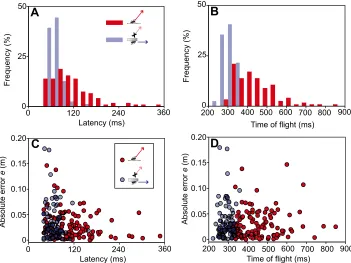
appropriate take-off speed (Fig. 5) was not affected by taking vertical speed appropriately into account. However, median latency was strikingly larger in the trials with vertical speed (Mann– Whitney:P<0.001; Fig. 6A). So, was accuracy maintained at the cost of increased latency? A number of analyses made us doubt this simple explanation. First, the minimum latencies do not seem to be affected (Fig. 6A) but the shapes of the distributions differ (Brown– Forsythe:P<0.001): in the‘horizontal only’condition, the latency distribution was more focused, whereas under the‘vertical added’ condition it became much broader. In addition, skewness decreased from 1.73 to 1.50 and kurtosis decreased from 6.29 to 3.13 in the ‘vertical added’condition (n=123) compared with the‘horizontal only’ condition (n=79). Note that time of flight also differed significantly (Mann–Whitney: P<0.001; Fig. 6B) and the distribution was much broader and shifted towards larger values in the ‘vertical added’ condition (Brown–Forsythe: P<0.001). Skewness and kurtosis increased with added vertical speed (skewness from 0.0135 to 1.204, kurtosis from−0.810 to 1.812). Second, we were unable to see the expected (e.g. Dambacher and Hübner, 2015; Hanks et al., 2014) tight correlation between latency and accuracy of turning [linear regressions:‘vertical added’(red): r2=0.06, F=7.14, P=0.009, n=123; ‘horizontal only’ (blue): r2=0.01,F=1.14, P=0.289, n=79; Fig. 6C]. Third, accuracy did not improve when an increase in the time of flight would allow for longer response times [linear regressions: ‘vertical added’ (red): r2=0.01, F=0.915, P=0.341; ‘horizontal only’ (blue): r2=0.00, F=0.22, P=0.643, based on the same responses as previously; Fig. 6D]. Finally, slopes (two-samplet-test:P>0.591), intercepts (two-sample t-test: P>0.994) and correlation coefficients (Fisher z-transformation: P>0.417) did not differ between the ‘vertical added’and the‘horizontal only’conditions (Fig. 6C,D).
In addition to latency, the duration of one of the two stages (Wöhl and Schuster, 2007) of theC-start also increased. Adding vertical speed did not affect the duration of the initial bending phase of the C-starts (‘stage 1’; Mann–Whitney:P=0.131; Fig. 7A,C). This is probably because the range of turns the fish are required to make
under both conditions is similar (Mann–Whitney: P=0.527) and because the bending obtained in stage 1 correlated well with these required turn angles (linear regressions: r2>0.82, F>442.532, P<0.001; insets in Fig. 7A,C). However, adding vertical speed increased stage 2 durations (Mann–Whitney:P<0.001; Fig. 7B,D) and decreased average take-off speed (Mann–Whitney:P<0.001; insets in Fig. 7B,D).
Latency increased to optimize take-off but not to account for increased task complexity
Taken together, these findings raise doubt that latency increased to maintain accuracy. We therefore ran a direct series of experiments in which we selectively varied the time of flight without changing the complexity of the task. To do this, we simply changed the initial starting height of prey but blocked vertical speed (Fig. 8, Table 1). Remarkably, doing so also caused latency to increase (with increasing time of flight; Fig. 8A) while leaving accuracy constant (linear regression: r2=0.08, F=0.925, P=0.357; Fig. 8B; linear regression:r2=0.01,F=0.060,P=0.812; Fig. 8C). The way median latency increased with increasing median time of flight (sigmoidal fit:r2=0.80,χ2/d.f.=52.99; Fig. 8A) appears to be independent of whether time of flight increased because of larger initial height (Fig. 8A, blue circles) or because of added vertical initial speed (Fig. 8A, red circles). This suggests that it was simply the increase in time of flight but not the increase in task complexity that caused the increased latency in the‘vertical added’trials.
DISCUSSION
The enormous success of the simple and well-controlled two-alternative saccadic decisions approach has led to a key finding that appears to be a universal element in decision-making (e.g. Shadlen and Kiani, 2013): decisions take longer if more options need to be taken into account. Because of the success of the approach and its ability to capture what are thought to be a priori universal characteristics of decision-making, the need to actually show universality by examining other tasks has come out of focus.
Time of flight (ms)
Frequency (%)
200 300 400 500 600 700 800 900 50
25
0
B
0 0.05 0.10 0.15 0.20
Absolute error
e
(m)
200 300 400 500 600 700 800 900 Time of flight (ms)
D
0 120 240 360 0
0.05 0.10 0.15 0.20
Absolute error
e
(m)
Latency (ms)
C
Frequency (%)
0 25 50
A
0 120 240 360 Latency (ms)
[image:8.612.50.401.473.736.2]x x
Fig. 6. Analysis of the effect of added vertical motion on response latency and urgency.(A) Distribution of latency was
significantly broadened (Mann–Whitney:
P<0.001; Brown–Forsythe:P<0.001) when
vertical speed was added (red), but minimum latency (40 ms) was not affected. (B) Time of
flight increased significantly (Mann–Whitney:
P<0.001) with vertical speed added,
decreasing the urgency of the fish to arrive simultaneously with the prey. Distributions
were significantly different (Brown–Forsythe:
P<0.001). (C,D) The relationship between
accuracy of turning (aim; quantified as
magnitude of errore) and either response
latency (C) or time of flight (D) in the
‘horizontal only’(blue) and‘vertical added’
(red) trials. Linear regressions: (C)r2=0.06,
F=7.14,P=0.009 (‘vertical added’);r2=0.01, F=1.14,P=0.289 (‘horizontal only’); (D)r2=0.00,F=0.22,P=0.643 (‘horizontal only’);r2=0.01,F=0.92,P=0.341 (‘vertical
added’). Slopes, intercepts and correlation
coefficients did not differ between‘horizontal
only’and‘vertical added’conditions in C or D
(see Results). Same C-starts as analysed in previous figures.
Journal
of
Experimental
However, universality cannot simply be defined, but requires science to actually study other decisions. Here we suggest that looking beyond forced-choice decisions is rewarding. By studying the predictive start decisions that archerfish must make to secure their prey against many competitors (Rischawy et al., 2015), we challenge the view that the principle‘more complexity means less accuracy and/or more decisional time’ applies universally. The decisions are not easily ‘defined away’ as being not proper decisions and – as we argue below–they are neither trivial nor based on as yet unknown trivial feats. We argue that our findings could be stimulating to reconsider the universality of a framework
that so successfully accounts for the saccadic decisions, i.e. the so-called integrator (or accumulator) models. In these, a separate integrator, one for every perceptual option (i.e.‘movement is to the left side’or‘to the right’; Fig. 1A), accumulates sensory evidence in favour of the option. This framework has been very successfully applied to saccadic decisions and predicts many other aspects such as (1) the relationship between speed (response time) and accuracy in the decisions, (2) how accuracy would be affected by making the task more difficult and (3) the distribution of response timing (e.g. Churchland et al., 2008; Kiani et al., 2014; Murakami et al., 2014).
0 25 50
Frequency (%)
Max. bending θ (deg)
T
u
rn angle
φ
⬘
(deg)
0 180
0 180
A
0 15
0 2.5
Take-off speed (m s–1) 0
25
Frequency (%)
B
15
0 60 120 180 240 300 360 Duration stage 2 (ms)
0 30
0 2.5
Take-off speed (m s–1) 0
25
Frequency (%)
D
x
Duration stage 1 (ms)
0 30 60 90
0 25 50
Frequency (%)
C
Max. bending θ (deg)
0 180
T
u
rn angle
φ
⬘
(deg)
[image:9.612.47.412.56.328.2]0 180
Fig. 7. The straightening but not the bending phase of theC-start is adjusted to account for longer time of flight.
(A,C) Median durations of the bending phase (stage 1) were not significantly different
(Mann–Whitney:P=0.131) in‘vertical added’
(A) and‘horizontal only’(C) trials. Maximal
bendingθis highly correlated with the
required turn angleφ′(insets in A and C: linear
regressions:r2>0.82,F>442.53,P<0.001) regardless of whether vertical speed was
added (Fisherz-transformation:P=0.105).
(B,D) However, stage 2 duration was
significantly longer (Mann–Whitney:P<0.001)
and take-off speed lower [Mann–Whitney:
P<0.001, see insets in B (‘vertical added’) and D (‘horizontal only’)] with added vertical speed (B). Same responses as analysed in preceding figures.
120
80
60 100
200 400 600
Time of flight (ms)
Latency (ms)
A
‘Vertical added’
‘Horizontal only’
x
0.06
0.04
0.02
60 90 120 Latency (ms)
B
Absolute error
e
(m)
200 400 600 Time of flight (ms) 0.06
0.04
0.02
Absolute error
e
(m)
C
Fig. 8. Evidence suggesting that latency was increased to optimize take-off at longer time of flight of prey.(A) To increase time of flight without adding a
vertical component of speed, we analysed decisions made under‘horizontal only’conditions (blue circles) but when prey fell from different initial height levels
(range 35–75 cm; see Table 1). We took the median time of flight for each height and plotted corresponding (median) latency against it. Latency increased
significantly with time of flight (sigmoidal fit:r2=0.80,χ2/d.f.=52.99). Latencies obtained with vertical speed added (red circles) appear to follow the same
relationship, suggesting that latency was due to larger time of flight and not increased complexity of the decision. (B) Accuracy of turning (aim; measured as the
absolute value of errore) is independent of response time (latency) (linear regression:r2=0.08,F=0.925,P=0.357), i.e. we find no speed–accuracy trade-off. Fast
responses do not lead to decreased accuracy and high accuracy does not involve long response times. (C) Moreover, accuracy of turning is also not related to the
corresponding time of flight (linear regression:r2=0.01,F=0.060,P=0.812).
Journal
of
Experimental
[image:9.612.116.499.476.654.2]The degree of buffering in the archerfish’s multidimensional decisions
Although these predictions are convincingly met in the saccadic decisions (Fig. 1A), they seem not to hold for the archerfish’s fast-start decisions in which the fish also has to make perceptual decisions, based only on a quick view the fish must first reliably estimate initial direction, speed and height of falling prey. Furthermore, the mapping to a motor response appears to be more challenging than in the saccades because a responding fish must also take its own orientation and position into account to select the appropriate turn and take-off speed to arrive at the right spot at the right time. In addition, the decision is known to include further aspects. For instance, the decision can handle two conflicting sets of sensory data (Schlegel and Schuster, 2008; Schuster, 2012). It is therefore surprising that the archerfish’s decisions appear buffered against substantial increases in the number of input constellations that need to be taken into account. The motor choice that the fish makes after its perceptual decision comprises two aspects, and the accuracy of both stays constant regardless whether the additional variable had been taken into account: the fish equally well adjusted theirC-start to provide the appropriate turn angle (to rotate the fish towards the point where its prey will later land) as well as take-off speed (to arrive simultaneously with prey and not overshooting the landing point).
Surprisingly, keeping accuracy constant despite an increase in the number of alternatives does not seem to increase response time (latency). We conclude this from two findings: first, minimum latency was the same in the‘horizontal only’and‘vertical added’conditions; and second, the broader distribution and larger median latency in the ‘vertical added’ condition could be explained as resulting from a reduction in urgency rather than an increase in complexity of the decisions. This follows from experiments in which the effects on latency found in the ‘vertical added’ condition could simply be mimicked by varying the initial height of prey in the absence of any vertical initial motion. Increases in the time of flight also appear to explain the increased duration specifically of the second (straightening; stage 2) phase of the C-start that is thought to determine linear speed (Wöhl and Schuster, 2007; Reinel and Schuster, 2014). With the prey further into their flight when vertical speed is added, the fish need to take off at lower speed. Suppose the time of flight would be so long that a fish starting at the lowest possible speed would still overshoot the later impact point (which would ruin its chances of making the catch). The only way out would be to postpone the start. In this sense, the fish might perhaps be co-adjusting
response latency (‘viewing time’) and the remaining (‘action’) time to carry out the actual manoeuver in similar ways as described for human reaching movements (Battaglia and Schrater, 2007; Faisal and Wolpert, 2009). At any rate, the increase in latency and in aspects of response timing is related to increases in‘time of flight’but not to the increased complexity of the‘vertical added’condition.
It is important to note that the clear and robust effects of an increase in the number of alternatives that have been discovered in the saccadic decisions of monkeys (Churchland et al., 2008) clearly cannot be explained by the monkey never having had any experience with any other than the experimentally tested movement directions. Certainly the monkeys used in the experiments also had seen many more motion patterns and made appropriate saccades to much more complex stimuli in their lives outside the experimental sessions. Yet, adding two more options to the trials strongly affected accuracy and/ or latency of the saccadic decisions. Thus, a potential familiarity of our fish with vertical movement and an absence of a similar familiarity in the monkeys clearly cannot account for the very different performance of the two types of decision.
Is vertical speed truly represented as an additional independent variable?
The vast discrepancy between how increasing task complexity affects the saccadic decision-making and the archerfish’s predictive start makes it important to examine a hypothesis that might arise because the retinal mapping is so much more unclear in our study–with large variations in orientation and distance of the responding fish–than in the well-controlled saccadic decisions in which, for example, the distances between observer and targets are kept constant. The hypothesis is that the fish could have decided without actually treating vertical speedvvertas a truly independent variable. Suppose the retinal image and/or its analysis by retinal circuitry only allowed access to a confounded speedv′that actually mixesvhorandvvertaccording to some functionv′(vhor,vvert). Adding vertical speed would then lead to a changed ‘confounded’ speed, and the question at hand now is whether this could account for our pattern of results. The idea can actually be carried through quantitatively, producing the mapping of v′(vhor,vvert) that would be consistent with our findings, i.e.:
v0¼vhor=pffiffiffiffiffiffiffiffiffi2gH vvertþ
ffiffiffiffiffiffiffiffiffiffiffiffiffiffiffiffiffiffiffiffiffiffi
v2
vertþ2gH
q
; ð1Þ
[image:10.612.45.565.68.232.2]where H is target height and g=9.81 m s−2 (gravitational acceleration). If driving their predictive start for exclusively
Table 1. Median latency and error in aim (accuracy of turning) when time of flight was changed by changing initial height of prey
Initial height (condition) Time of flight (ms) Latency (ms) Absolute errore(m) n
Dislodged by archerfish
35 cm (horizontal only) 264 64 0.05 100
40 cm (horizontal only) 288 64 0.04 79
40 cm (vertical added) 426 106 0.03 123
55 cm (horizontal only) 332 68 0.05 155
65 cm (horizontal only) 378 82 0.05 55
65 cm (horizontal only) 362 86 0.04 60
65 cm (vertical added) 498 102 0.04 71
75 cm (horizontal only) 416 91 0.05 26
Dislodged by experimenter
35 cm (horizontal only) 294 72 0.04 179
45 cm (horizontal only) 326 70 0.03 261
55 cm (horizontal only) 364 70 0.05 265
55 cm (horizontal only) 365 70 0.04 286
65 cm (horizontal only) 408 82 0.05 245
Journal
of
Experimental
ballistically falling prey (i.e. in absence of air friction) was the only task for which archerfish needed the perception of three-dimensional speed, such mapping (if it could be realized) would, in principle, work and–by its very nature–account for our data. However, archerfish perceive three-dimensional speed in other contexts as well, and for this the confounded representationv′would not work. For instance, archerfish can learn to aim shots at moving targets, depending on both their vertical and horizontal speed (Schuster et al., 2006). They even learn something about this task by watching other fish learn the task, so that they quickly can engage moving targets without having to practice themselves (Schuster et al., 2006). A different ‘confounded speed’, i.e. v″, would be needed for these tasks. This removes simple optics as a way to create a functionv′. In fact, with more tasks, different functionsv′,v″,v‴, …would be needed and it becomes increasingly simpler to realize such functions by brain circuits fed with estimates ofvhorandvvert.
Evidence for fast perceptual decisions in monkeys and rodents
The low speed of the monkey’s saccadic decisions could lead to the misleading view that perceptual decisions might generally be much slower than the ones we describe in archerfish. However, both olfactory and visual decisions in monkeys and rodents can also occur very rapidly. The archerfish’s 40 ms decision (Schlegel and Schuster, 2008) appears to be paralleled by findings that monkeys can make accurate perceptual decisions in less than 30 ms, although the apparent overall response time was around 200 ms (Carpenter, 1981; Stanford et al., 2010). A further interesting finding, obtained in rodents, is that allowing more time than 200 to 300 ms no longer helped to increase decisional accuracy (Uchida et al., 2006), suggesting again that decisions can be much faster than found in the saccadic tasks. More recently, findings in more urgent decision-making of mammals raise the possibility that not only can decisions be made much faster but that they also can efficiently handle added complexity and limitations in response time (Reddi and Carpenter, 2000; Reddi et al., 2003; Salinas et al., 2014). It could thus be that the discrepancy of our findings with regard to the predictions of classical decision-making are less attributable to differences between fish and mammals but simply reflect differences in the general design of the decision-making systems that are recruited for rapid decisions. It would thus be interesting to see whether the rapid perceptual decisions of mammals are equally buffered against substantial increases in the number of perceptual options.
Can integrator models account for multidimensional decision-making?
To develop our understanding of decision-making beyond simple two-alternative decisions it would be important to see whether integrator models could be extended to the archerfish’s multidimensional decision-making. With the enormous number of perceptual input and motor output states, a large number of integrators (on the order of 1000) would seem to be needed. So far there seem to be only a few studies in which integrator models had been extended to account for more than two integrators (e.g. three alternatives: Niwa and Ditterich, 2008; four alternatives: Churchland et al., 2008). Recent findings might prove valuable in working out such extensions by re-interpreting the perhaps too naive classical view of an integrator. They suggest that the integrators could be realized by averaging units that individually respond much faster and in an all-or-none fashion (Latimer et al., 2015).
Conclusions
Our case of a multi-alternative decision in the context of an animal’s natural hunting behaviour shows that even complex decisions can be surprisingly immune against a substantial further increase in the number of alternatives. The challenge is now whether our findings can be explained within the framework of evidence accumulation or whether new concepts are needed to move the field towards eventually accounting for the multidimensional decisions of the real world.
Acknowledgements
We thank Thomas Schlegel, Claudia Donnerhack and Wolfram Schulze for help and discussions, and our reviewers for their many helpful and stimulating questions and comments.
Competing interests
The authors declare no competing or financial interests.
Author contributions
C.P.R. and S.S. conceived the project, C.P.R. performed the experiments, and C.P.R. and S.S. analysed the data and wrote the paper.
Funding
Funding came from the Deutsche Forschungsgemeinschaft (Schu1470/8).
Supplementary information
Supplementary information available online at
http://jeb.biologists.org/lookup/doi/10.1242/jeb.136812.supplemental
References
Batschelet, E.(1981).Circular Statistics in Biology. London: Academic Press.
Battaglia, P. W. and Schrater, P. R.(2007). Humans trade off viewing time and
movement duration to improve visuomotor accuracy in a fast reaching task.
J. Neurosci.27, 6984-6994.
Carpenter, R. H. S. (1981). Oculomotor procrastination. In Eye Movements:
Cognition and Visual Perception(ed. D. F. Fisher, R. A. Monty and J. W. Senders),
pp. 237-246. Hillsdale, NJ: Lawrence Erlbaum.
Churchland, A. K., Kiani, R. and Shadlen, M. N.(2008). Decision-making with
multiple alternatives.Nat. Neurosci.11, 693-702.
Dambacher, M. and Hübner, R. (2015). Time pressure affects the
efficiency of perceptual processing in decisions under conflict. Psychol. Res.79, 83-94.
de Lafuente, V., Jazayeri, M. and Shadlen, M. N.(2015). Representation of
accumulating evidence for a decision in two parietal areas.J. Neurosci.35, 4306-4318.
Dill, L. M.(1977). Refraction and the spitting behavior of the archerfish (Toxotes
chatareus).Behav. Ecol. Sociobiol.2, 169-184.
Faisal, A. A. and Wolpert, D. M.(2009). Near optimal combination of sensory and
motor uncertainty in time during a naturalistic perception-action task.
J. Neurophysiol.101, 1901-1912.
Hanks, T., Kiani, R. and Shadlen, M. N.(2014). A neural mechanism of
speed-accuracy tradeoff in macaque area LIP.Elife3, e02260.
Kiani, R., Corthell, L. and Shadlen, M. N.(2014). Choice certainty is informed by
both evidence and decision time.Neuron84, 1329-1342.
Krupczynski, P. and Schuster, S.(2013). Precision of archerfish C-starts is fully
temperature compensated.J. Exp. Biol.216, 3450-3460.
Latimer, K. W., Yates, J. L., Meister, M. L. R., Huk, A. C. and Pillow, J. W.(2015).
Single-trial spike trains in parietal cortex reveal discrete steps during decision-making.Science349, 184-187.
Murakami, M., Vicente, M. I., Costa, G. M. and Mainen, Z. F.(2014). Neural
antecedents of self-initiated actions in secondary motor cortex.Nat. Neurosci.17, e1574-e1582.
Niwa, M. and Ditterich, J.(2008). Perceptual decisions between multiple directions
of visual motion.J. Neurosci.28, 4435-4445.
Palmer, J., Huk, A. C. and Shadlen, M. N.(2005). The effect of stimulus strength on
the speed and accuracy of a perceptual decision.J. Vision5, 376-404.
Reddi, B. A. J. and Carpenter, R. H. S.(2000). The influence of urgency on
decision time.Nat. Neurosci.8, 827-830.
Reddi, B. A. J., Asrress, K. N. and Carpenter, R. H. S.(2003). Accuracy,
information and response time in a saccadic decision task.J. Neurophysiol.90, 3538-3546.
Reinel, C. and Schuster, S.(2014). Pre-start timing information is used to set final
linear speed in a C-start manoeuvre.J. Exp. Biol.217, 2866-2875.
Journal
of
Experimental
Rischawy, I., Blum, M. and Schuster, S.(2015). Competition drives sophisticated hunting skills of the archerfish in the wild.Curr. Biol.25, R595-R597.
Rossel, S., Corlija, J. and Schuster, S.(2002). Predicting three-dimensional target
motion: how archer fish determine where to catch their dislodged prey.J. Exp. Biol.
205, 3321-3326.
Salinas, E., Scerra, V. E., Hauser, C. K., Costello, M. G. and Stanford, T. R.
(2014). Decoupling speed and accuracy in an urgent decision-making task reveals multiple contributions to their trade-off.Front. Neurosci.8, 85.
Schlegel, T. and Schuster, S.(2008). Small circuits for large tasks: high-speed
decision-making in archerfish.Science319, 104-106.
Schuster, S.(2007). Archerfish.Curr. Biol.17, R494-R495.
Schuster, S.(2012). Fast-starts in hunting fish: decision-making in small networks
of identified neurons.Curr. Opin. Neurobiol.22, 279-284.
Schuster, S., Wöhl, S., Griebsch, M. and Klostermeier, I.(2006). Animal cognition:
how archer fish learn to down rapidly moving targets.Curr. Biol.16, 378-383.
Shadlen, M. N. and Kiani, R.(2013). Decision making as a window on cognition.
Neuron80, 791-806.
Stanford, T. R., Shankar, S., Massoglia, D. P., Costello, M. G. and Salinas, E.
(2010). Perceptual decision making in less than 30 milliseconds.Nat. Neurosci.
13, 379-385.
Uchida, N., Kepecs, A. and Mainen, Z. F.(2006). Seeing at a glance, smelling in a
whiff: rapid forms of perceptual decision making.Nat. Rev. Neurosci.7, 485-491.
Wöhl, S. and Schuster, S.(2006). Hunting archer fish match their take-off speed to
distance from the future point of catch.J. Exp. Biol.209, 141-151.
Wöhl, S. and Schuster, S.(2007). The predictive start of hunting archer fish: a
flexible and precise motor pattern performed with the kinematics of an escape C-start.J. Exp. Biol.210, 311-324.
Journal
of
Experimental