Original Article
Association of ATP-binding cassette transporter A1
gene polymorphisms with plasma lipid variability
and coronary heart disease risk
Yuping Lu1, Yawen Liu1, Yong Li1, Huiping Zhang2, Mingxi Yu1, Joseph Sam Kanu1, Yichun Qiao1, Yuan Tang1, Qing Zhen1, Yi Cheng3
1Department of Epidemiology and Biostatistics, School of Public Health, Jilin University, Changchun 130021,
China; 2Department of Psychiatry, Yale University School of Medicine, VA Medical Center/116A2, 950 Campbell
Avenue, West Haven, CT 06516, USA; 3The Cardiovascular Center, The First Hospital of Jilin University, Changchun
130021, China
Received August 7, 2015; Accepted September 21, 2015; Epub October 1, 2015; Published October 15, 2015
Abstract: Objective: Our study aimed to investigate the association of ABCA1 polymorphisms with plasma lipid variability and CHD risk in the Chinese Han population. Methods: 754 CHD patients and 760 controls were in-cluded in this case-control study. Three SNPs (rs363717, rs4149339, and rs4149338) in ABCA1 3’UTR and one nonsynonymous SNP (rs2230808) in ABCA1 exon 35 were selected and genotyped. The analysis of genetic data was performed using the SNPstats program and the SPSS17.0 software. Results: Significant associations were ob -served between SNP rs363717 and CHD risk under different genetic models before or after Bonferroni corrections (codominant model: OR = 0.70, P = 0.003 for AG vs. AA; dominant model: OR = 0.71, P = 0.003 for GG + AG vs. AA). The nonsynonymous SNP rs2230808 was associated with higher total cholesterol levels (P = 0.047). The GCC haplotype (consisting of alleles of SNPs rs363717, rs4149339, and rs4149338) was associated with a decreased risk of CHD (OR = 0.8, P = 0.027). Three ABCA1 SNPsinteracted with high triglyceride levelsto increase CHD risk (P values of interactions were 0.010 for rs363717, 0.010 for rs4149339, and 0.020 for rs4149338, respectively). Conclusions: Our results suggest that ABCA1 polymorphisms influence plasma lipid variability and CHD risk. ABCA1
polymorphisms could also modify the effects of plasma lipids on CHD risk.
Keywords: ATP-binding cassette transporter A1 gene, single nucleotide polymorphism, coronary heart disease, plasma lipids
Introduction
Coronary heart disease (CHD) is a leading cause of mortality and disability, and accounts for approximately 30% of all deaths worldwide [1, 2]. Epidemiological studies have shown that
CHD is a multifactorial disease influenced by
genetic variants, environmental factors, and alterations of plasma lipid levels as well as their interactions with each other [3, 4]. Coronary atherosclerosis, which is caused by the accu-mulation of cholesterol in arterial wall macro-phages and the dysregulation of lipid metabo-lism, is generally considered to be the patho-logical foundation of CHD [5].
Adenosine triphosphate (ATP)-binding cassette transporter A1 (ABCA1) is a member of the superfamily of ATP-binding cassette
transport-ers. It is highly expressed in a wide range of tis-sues such as liver, intestines, lung, leukocytes, and macrophages [6, 7]. ABCA1 hydrolyzes ATP, and the released energy is used to transport various molecules across cellular membranes [8]. ABCA1 has a major impact on lipid metabo-lism and atherosclerosis, and plays a critical role in the development of CHD [6, 9-11]. ABCA1 participates in the initial step of reverse
choles-terol transportation by regulating the efflux of
cholesterol and phospholipids from peripheral cells to lipid-poor apolipoprotein acceptors [12,
13]. In addition, it influences the initiation of
high-density lipoprotein (HDL) particle forma-tion in the liver and the intestine [14].
been identified in ABCA1 [15-17]. Mutations in
ABCA1 cause Tangier disease and familial HDL
deficiency, which are characterized by reduced
plasma HDL-C levels and increased susceptibil-ity to CHD due to the impairment of cholesterol clearance from vascular endothelial cells back to the liver [15, 17-20]. Genetic association studies have demonstrated that common poly-morphisms in the coding and untranslated regions (UTRs) of ABCA1 were associated with CHD susceptibility, and the results suggest a relationship between ABCA1 polymorphisms and plasma lipid levels [6, 9, 11, 17, 21-24]. Previous studies have investigated the associa-tion of ABCA1 polymorphisms with plasma lipid levels and CHD risk, but the published results are inconsistent in different ethnic populations. Furthermore, the interaction of genetic varia-tion and plasma lipids on the risk of CHD has not been thoroughly explored. This study aimed to investigate whether four ABCA1 SNPs (three in the 3’UTR and one in the coding region) are associated with the risk of CHD and the vari-ability in lipid levels, and evaluate the interac-tion of these SNPs and plasma lipids on the risk of CHD in the Chinese Han population.
major coronary arteries) according to the crite-ria of the World Health Organization. Control subjects were free of CHD by clinical evaluation
and electrocardiographic profiling. None of the
control subjects had a history of diabetes and hypertension. Both patients and control sub-jects were unrelated Chinese Hans from Nor- theast China.
The protocol of this study was approved by the Ethics Committee of Jilin University School of Public Health, and complied with the Helsinki declaration of ethical principles for medical research involving human subjects. Informed consents were obtained from all participants of the study.
Epidemiological survey and biochemical ex-amination
[image:2.612.91.392.86.204.2]Demographic information and clinical charac-teristics were collected with standardized ques-tionnaire. Fasting blood samples were obtain- ed from all participants. Plasma lipid concen-trations were measured by the MODULE P800 automated biochemistry analyzer (ROCHE, USA). Plasma lipids examined in both case and control subjects included triglycerides (TG), Table 1. Baseline characteristics of CHD patients and control subjects
CHD patients (n = 754) Controls (n = 760) P*
Age (years) 63.12 ± 8.05 63.10 ± 8.37 0.960
Sex (M/F) 404/350 378/382 0.140
Smoking, n (%) 378 (50.1) 88 (11.6) <0.001
Alcohol drinking, n (%) 107 (14.2) 55 (7.2) <0.001
TG (mmol/L) 1.73 ± 1.12 1.25 ± 0.66 <0.001
TC (mmol/L) 4.35 ± 1.06 4.11 ± 0.80 <0.001
LDL-C (mmol/L) 2.78 ± 0.89 2.62 ± 0.71 <0.001
HDL-C (mmol/L) 1.15 ± 0.33 1.31 ± 0.25 <0.001
*Analyzed by Student’s t test for continuous variables and by Pearson’s Chi-square test
for categorical variables.
Table 2. Information on ABCA1 SNPs
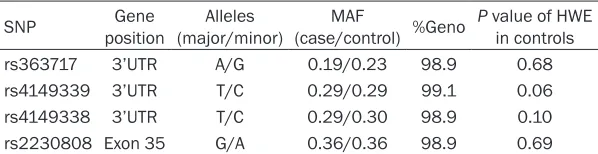
SNP positionGene (major/minor)Alleles (case/control) %GenoMAF P value of HWE in controls
rs363717 3’UTR A/G 0.19/0.23 98.9 0.68
rs4149339 3’UTR T/C 0.29/0.29 99.1 0.06
rs4149338 3’UTR T/C 0.29/0.30 98.9 0.10
rs2230808 Exon 35 G/A 0.36/0.36 98.9 0.69
%Geno, the percentage of non-missing genotypes for each marker; UTR, untranslated region; MAF, minor allele frequency; HWE, Hardy-Weinberg equilibrium.
Materials and methods
Study subjects
1,514 participants, includ-ing 754 CHD patients and 760 control subjects, were enrolled in this case-con-trol study. Patients with CHD were recruited from the PetroChina Jilin Gen- eral Hospital and the First Bethune Hospital of Jilin University in Changchun, Jilin Province, China. Age and sex matched controls were randomly recruited from the Health Examin- ation Center of these two hospitals at the same time. CHD was diagnosed by two or more experien- ced cardiologists and
[image:2.612.91.390.263.340.2]total cholesterol (TC), low-density lipoprotein cholesterol (LDL-C), and high-density lipopro-tein cholesterol (HDL-C).
DNA extraction
The peripheral blood of each participant was collected in non-anticoagulant plexiglass tubes and stored at -20°C until DNA extraction. Genomic DNA was extracted using a blood DNA extraction kit (ClotBlood DNA kit, Cwbio, Beijing, China) according to the manufacturer’s instruc-tions. DNA samples were checked for purity and concentration by ultraviolet spectropho-tometer (Beckman, USA) with ultraviolet read-ings at 260 nm and 280 nm, respectively.
[image:3.612.89.392.102.482.2]Continuous variables were expressed as mean ± standard deviation (SD), and categorical vari-ables were presented as absolute and percent-age. Student’s t test was applied for compari-son of the mean of continuous variables be- tween cases and controls. The distribution of categorical variables between cases and con-trols were compared by the Chi-square (c2) test. Hardy-Weinberg equilibrium (HWE) test [26] and genotype distributions of SNPs were also performed by Chi-square test. Analysis of cova-riance (ANCOVA) was used to assessing the effect of different genotypes on plasma lipid levels. Unconditional logistic regression analy-sis was used to evaluate the association be- Table 3. Lipid profiles in control subjects carrying different ABCA1
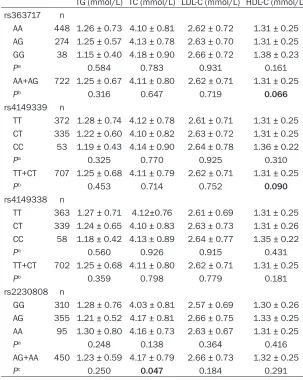
geno-types or alleles
TG (mmol/L) TC (mmol/L) LDL-C (mmol/L) HDL-C (mmol/L) rs363717 n
AA 448 1.26 ± 0.73 4.10 ± 0.81 2.62 ± 0.72 1.31 ± 0.25 AG 274 1.25 ± 0.57 4.13 ± 0.78 2.63 ± 0.70 1.31 ± 0.25 GG 38 1.15 ± 0.40 4.18 ± 0.90 2.66 ± 0.72 1.38 ± 0.23
Pa 0.584 0.783 0.931 0.161
AA+AG 722 1.25 ± 0.67 4.11 ± 0.80 2.62 ± 0.71 1.31 ± 0.25
Pb 0.316 0.647 0.719 0.066
rs4149339 n
TT 372 1.28 ± 0.74 4.12 ± 0.78 2.61 ± 0.71 1.31 ± 0.25 CT 335 1.22 ± 0.60 4.10 ± 0.82 2.63 ± 0.72 1.31 ± 0.25 CC 53 1.19 ± 0.43 4.14 ± 0.90 2.64 ± 0.78 1.36 ± 0.22
Pa 0.325 0.770 0.925 0.310
TT+CT 707 1.25 ± 0.68 4.11 ± 0.79 2.62 ± 0.71 1.31 ± 0.25
Pb 0.453 0.714 0.752 0.090
rs4149338 n
TT 363 1.27 ± 0.71 4.12±0.76 2.61 ± 0.69 1.31 ± 0.25 CT 339 1.24 ± 0.65 4.10 ± 0.83 2.63 ± 0.73 1.31 ± 0.26 CC 58 1.18 ± 0.42 4.13 ± 0.89 2.64 ± 0.77 1.35 ± 0.22
Pa 0.560 0.926 0.915 0.431
TT+CT 702 1.25 ± 0.68 4.11 ± 0.80 2.62 ± 0.71 1.31 ± 0.25
Pb 0.359 0.798 0.779 0.181
rs2230808 n
GG 310 1.28 ± 0.76 4.03 ± 0.81 2.57 ± 0.69 1.30 ± 0.26 AG 355 1.21 ± 0.52 4.17 ± 0.81 2.66 ± 0.75 1.33 ± 0.25 AA 95 1.30 ± 0.80 4.16 ± 0.73 2.63 ± 0.67 1.31 ± 0.25
Pa 0.248 0.138 0.364 0.416
AG+AA 450 1.23 ± 0.59 4.17 ± 0.79 2.66 ± 0.73 1.32 ± 0.25
Pc 0.250 0.047 0.184 0.291
Pa, comparisons among all genotypes; Pb, minor allele homozygote serves as the
refer-ence; Pc, major allele homozygote serves as the reference; P values were calculated with
ANCOVA adjusted for age, sex, smoking, and alcohol drinking; Bold P values are statisti-cally significant.
SNP genotyping
Four SNPs in ABCA1
were selected using the HapMap website and the Haploview 4.2 software (Daly Lab. at the Bro- ad Institute, USA). SNPs rs363717, rs4149339, and rs4149338 reside in the 3’UTR of ABCA1, and the nonsynonymous SNP rs2230808 (or Arg- 1587Lys) resides in exon 35 of ABCA1. The minor allele frequency (MAF) of these four SNPs was greater than 5%. SNP genotypes were deter-mined by Matrix-Assis- ted Laser Desorption/ Ionization Time of Flight Mass Spectrometry (MA- LDI-TOF-MS) of the Ma- ssARRAY system (Sequ- enom, San, Diego, CA, USA) [25]. Polymerase chain reactions (PCRs) were performed in 384-well plate format using a MassARRAY Nanodis- penser (Sequenom). PCR primers were designed using the Assay Design 3.1 software (Seque- nom Inc., San Diego, CA, USA).
tween ABCA1 polymorphisms and CHD risk. The Akaike information criterion (AIC) was used to determine the best genetic model for each SNP. Bonferroni correction was applied for mul-tiple testing to reduce Type I error in associa-tion analyses. LD blocks were constructed by the Haploview software for evaluating the asso-ciation between different haplotypes and CHD risk [27]. Interactive effects of ABCA1 polymor-phisms and plasma lipid levels on the risk of CHD were also estimated by unconditional logistic regression analysis. Statistical analy-ses were performed using the SPSS17.0 soft-ware and the SNPStats program [28]. A P-value (two-sided test) less than 0.05 was considered
statistically significant.
Results
Characteristics of study subjects and ABCA1 SNPs
The demographic and clinical data and plasma lipid levels of 1514 participants enrolled in this study are presented in Table 1. There were no
significant differences in age and sex between
CHD patients and control subjects (P > 0.05). Patients with CHD had higher levels of TG, TC, and LDL-C, but lower levels of HDL-C than con-trols. There were more smokers and drinkers in CHD patients than in control subjects.
Table 2 presents gene position, major and minor alleles, MAF, genotyping rates, and HWE test results of four ABCA1 SNPs. The genotype distributions of all SNPs did not deviate from HWE in control subjects (P > 0.05).
Associations between ABCA1 polymorphisms and plasma lipid levels
Plasma lipid changes in carriers of different genotypes or alleles are shown in Table 3. Nonsynonymous SNP rs2230808 was found to be associated with TC levels. Individuals who were carriers of the A allele of SNP rs2230808 had a higher TC level than noncarriers. Re- garding the effect of SNPs rs363717 and rs4149339 on HDL-C levels, there was a
bor-derline significant trend in the difference of
HDL-C levels between carriers and noncarriers of the major allele of these two SNPs (P = 0.066 for rs363717, P = 0.090 for rs4149339).
Associations between ABCA1 polymorphisms and CHD risk
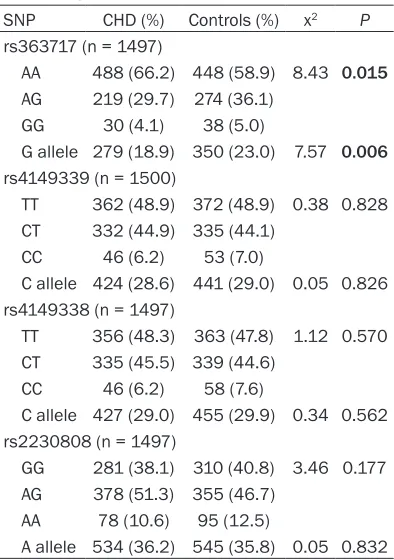
The genotype distribution and allelic frequency of each SNP between CHD patients and con- trol subjects are shown in Table 4. For SNP
rs363717, a significant difference in
genoty-pe distributions was observed between CHD patients and control subjects (x2 = 8.43, P = 0.015). And the frequency of the G allele in CHD patients was lower than in controls. Genotype distributions and allelic frequencies of three other ABCA1SNPs were not significantly differ -ent between CHD pati-ents and control subjects (P > 0.05).
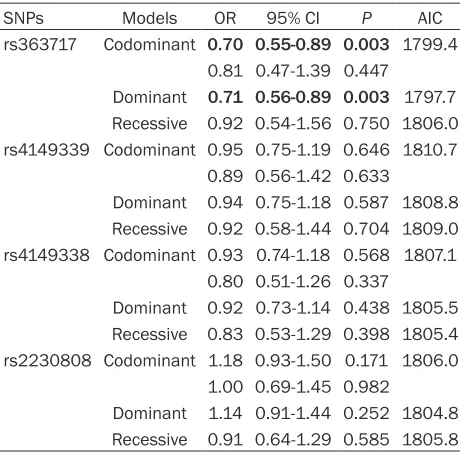
As shown in Table 5, SNP rs363717 was found to have a protective effect on CHD risk. Under the codominant and dominant models of
inheri-tance, carriers of the G allele had a significantly
decreased risk of CHD as compared to those with the wild-type genotype AA (OR = 0.70, 95% CI 0.55-0.89, P = 0.003 for AG, OR = 0.71, 95% CI 0.56-0.89, P = 0.003 for AG + GG). The above P values remained significant after Bon-ferroni corrections. There was no significant
[image:4.612.91.288.94.374.2]association between three other ABCA1 SNPs and CHD risk under the three genetic models. Table 4. Genotype distribution and allele
frequency of four ABCA1 SNPs
SNP CHD (%) Controls (%) x2 P
rs363717 (n = 1497)
AA 488 (66.2) 448 (58.9) 8.43 0.015 AG 219 (29.7) 274 (36.1)
GG 30 (4.1) 38 (5.0)
G allele 279 (18.9) 350 (23.0) 7.57 0.006 rs4149339 (n = 1500)
TT 362 (48.9) 372 (48.9) 0.38 0.828 CT 332 (44.9) 335 (44.1)
CC 46 (6.2) 53 (7.0)
C allele 424 (28.6) 441 (29.0) 0.05 0.826 rs4149338 (n = 1497)
TT 356 (48.3) 363 (47.8) 1.12 0.570 CT 335 (45.5) 339 (44.6)
CC 46 (6.2) 58 (7.6)
C allele 427 (29.0) 455 (29.9) 0.34 0.562 rs2230808 (n = 1497)
GG 281 (38.1) 310 (40.8) 3.46 0.177 AG 378 (51.3) 355 (46.7)
AA 78 (10.6) 95 (12.5)
A allele 534 (36.2) 545 (35.8) 0.05 0.832 Data were analyzed by Pearson’s Chi-square test. Bold P
Linkage disequilibrium (LD) and haplotype analysis
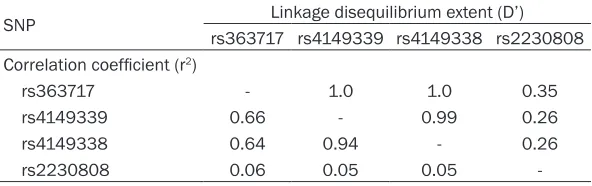
Pairwise LD extent (D’) and correlation coeffi -cient (r2) among the four ABCA1 SNPs are pre-sented in Table 6.
Haplotype analysis results are summarized in Table 7. Only one LD block was constructed by the Gabriel algorithm [29]. It was comprised of three SNPs (rs363717, rs4149339, and
rs4149338). The GCC haplotype was signifi -cantly more frequent in control subjects than in CHD patients, thus potentially playing a protec-tive role in CHD (OR = 0.80, 95% CI 0.65-0.97,
P = 0.027). Compared to the ATT haplotype, the
ACC haplotype was associated with a signifi -cantly increased risk of CHD (OR = 1.59, 95% CI 1.15-2.20, P = 0.005).
Interactions of ABCA1 polymorphisms and plasma lipids on CHD risk
Significant interactions were observed between
TG levels and three ABCA1 SNPs (P = 0.010 for
function of ABCA1 [9]. The three 3’ UTR SNPs may affect mRNA stability or interact with
microRNAs [30], and ultimately influence the
expression of ABCA1.
We found that the nonsynonymous SNP rs2230808 was associated with plasma TC lev-els but not with the risk of CHD. The frequency of the G allele was 63.8% in CHD patients and 64.2% in control subjects. Similarly, the fre-quency was 68% in the normal Greek popula-tion [6]. Previous studies have investigated the effect of ABCA1 SNP rs2230808 on plasma
lipids and CHD risk, but their findings are incon -sistent. Kolovou et al. [6] found that ABCA1
SNP rs2230808 was associated with plasma lipid levels, and subjects with heterozygous genotype GA had higher TC levels compared to those with the GG genotype. Clee et al. [31] reported that ABCA1 SNP rs2230808 was not
a modifiable risk factor for CHD. The study by
Tregouet et al. [9] showed that this SNP was not associated with CHD risk. In accordance with
[image:5.612.91.321.95.322.2]the above findings, we also did not find a signifi -cant association of SNP rs2230808 and CHD Table 5. Analysis of the association of four ABCA1
SNPs with CHD risk
SNPs Models OR 95% CI P AIC
rs363717 Codominant 0.70 0.55-0.89 0.003 1799.4 0.81 0.47-1.39 0.447
Dominant 0.71 0.56-0.89 0.003 1797.7 Recessive 0.92 0.54-1.56 0.750 1806.0 rs4149339 Codominant 0.95 0.75-1.19 0.646 1810.7
0.89 0.56-1.42 0.633
Dominant 0.94 0.75-1.18 0.587 1808.8 Recessive 0.92 0.58-1.44 0.704 1809.0 rs4149338 Codominant 0.93 0.74-1.18 0.568 1807.1
0.80 0.51-1.26 0.337
Dominant 0.92 0.73-1.14 0.438 1805.5 Recessive 0.83 0.53-1.29 0.398 1805.4 rs2230808 Codominant 1.18 0.93-1.50 0.171 1806.0
1.00 0.69-1.45 0.982
Dominant 1.14 0.91-1.44 0.252 1804.8 Recessive 0.91 0.64-1.29 0.585 1805.8 Data were analyzed by unconditional logistic regression analyses adjusted for age, sex, smoking, and alcohol drinking; OR, odds ratio; CI, confidence interval; AIC, Akaike information criterion; Codominant model, homozygote for the major allele serves as the reference; Dominant model (minor allele homozygote + heterozy-gote vs. major allele homozygote); Recessive model (minor allele homozygote vs. major allele homozygote + heterozygote); Bold values are statistically significant.
rs363717, P = 0.010 for rs4149339, P = 0.020 for rs4149338). The odds ratios for subjects with different genotypes and TG levels are shown in Table 8. Subjects with wild-type homozygotes of each
polymor-phism and TG < 1.70 mmol/L were defined
as the reference group. For each of the three ABCA1 SNPs, the OR to develop CHD was largest among subjects who were homozygous for the major allele and had a plasma TG level between 1.70 mmol/L and 2.26 mmol/L (OR = 15.1 for rs363717; OR = 17.7 for rs4149339; and OR = 17.6 for rs4149338). In subjects with TG < 1.70 mmol/L, the ORs to develop CHD were sim-ilar in those subjects homozygous for the major allele and carriers of the minor allele (1.00 vs. 0.80 for rs363717; 1.00 vs. 1.00 for rs4149339; and 1.00 vs. 1.00 for
rs4149338). There were no significant
in-teractions between the four polymorph- isms and other plasma lipids on the risk of CHD (data not shown).
Discussion
risk. Nevertheless, we found that individuals
who were carriers of the A allele had a signifi -cantly higher level of TC than noncarriers of the A allele. On the contrary, a prospective study showed that SNP rs2230808 predicted an increased risk of CHD in the Danish population,
and this SNP remained to be a significant factor
for the prediction of CHD after adjustment for age, smoking, hypertension, and diabetes [21]. It is likely that the effects of ABCA1 variation on
CHD risk may be modified by ethnic background
or environmental factors [17, 32].
We found a significant association of ABCA1
3’UTR SNPs via both single SNP and haplotype analyses. Regarding the three 3’UTR SNPs in
ABCA1, there is limited information on the effect of these SNPs on CHD risk and plasma lipid levels. In our study, two SNPs (rs363717 and rs4149339) were shown to be associated with plasma levels of HDL-C, with the major allele being associated with decreased HDL-C levels. Both single-locus and haplotype effects on the risk of CHD were observed in our study. By single-locus analysis, only SNP rs363717 was associated with CHD risk, with the G allele being associated with a decreased risk of CHD. It is believed that low levels of plasma HDL-C were major risk factors for CHD [9, 10, 21, 33, 34]. Therefore, the association between SNP rs363717 and CHD risk could account for its association with HDL-C. Haplotype analysis has the ability to provide extra power in association studies of complex diseases such as CHD, and it can reduce the numbers of statistical tests when evaluating the interaction between gene variants [9, 10]. In the present study, the GCC haplotype generated from the three 3’UTR SNPs (rs363717, rs4149339, and rs4149338) was overrepresented in controls and was asso-ciated with a decreased risk of CHD, while the ACC haplotype was overrepresented in cases and thus associated with an increased risk of
between genetic variation and environmental factor play a critical role in the development of multifactorial diseases [33, 35]. If the interac-tions exist, the effects of environmental factors
on the risk of these diseases will be modified by genotypes. CHD is influenced by multiple fac -tors and their interactions, and the causes are not fully understood [1, 3, 4, 36]. Conventional risk factors such as altered lipid levels, smok-ing, hypertension, and diabetes may only ex- plain about two-thirds of the presence of CHD [1]. Genetic factors and gene-environment in- teractions are also essential in the etiology of CHD [1, 17]. The metabolism of plasma lipids is complex. In general, high TG levels often accompany low HDL-C levels [1, 31, 37]. Several remnant particles in TG-rich lipoprotein metab-olism are essential for the formation of HDL-C. Cholesteryl ester in HDL-C is mainly transferred to VLDL particles, which increase TG levels but lower HDL-C levels in the blood. The above two processes are often modulated by ABCA1 poly-morphisms, resulting in increased TG and VLDL levels, and reduced formation of HDL-C [1, 33, 38]. Therefore, we supposed that the effect of
high TG levels on CHD risk could be modified by
ABCA1 polymorphisms. These ABCA1 SNPs may serve as markers to identify those with a high risk for CHD in subjects with high TG lev-els. In subjects with borderline high TG levels, TG levels should be controlled by mediations if they are homozygous for the major allele of these three ABCA1 SNPs.
Our study has several limitations, and thus the
findings from the present study should be inter -preted with caution. Because of ethnic differ-ences, we cannot necessarily generalize our results to other populations with different races and ethnicities. Further studies with a large cohort and in other ethnic populations are
[image:6.612.91.387.98.191.2]needed to confirm the role of ABCA1 polymor-phism in plasma lipid variability and CHD risk. Table 6. Pairwise linkage disequilibrium extent (D’) and correlation
coefficient (r2) among four ABCA1 SNPs
SNP Linkage disequilibrium extent (D’)
rs363717 rs4149339 rs4149338 rs2230808 Correlation coefficient (r2)
rs363717 - 1.0 1.0 0.35
rs4149339 0.66 - 0.99 0.26
rs4149338 0.64 0.94 - 0.26
rs2230808 0.06 0.05 0.05
-CHD. Our study suggest that ABCA1 3’UTR SNP rs363717 and 3’UTR haplo-types may be critical con-tributors to CHD risk, and
this finding needs to be vali -dated in further genetic association studies with a larger sample.
In addition, our study cannot rule out the poten-tial role of other untested SNPs within ABCA1 in affecting plasma lipid variability and CHD risk. In conclusion, our study demonstrated that
ABCA1 polymorphisms influences plasma lipid
levels and CHD risk in a Chinese Han popula-tion. The three 3’UTR SNPs in ABCA1 interact-ed with high triglyceride levels to affect the risk of CHD, and they could serve as markers to identify high risk patients for CHD in subjects with high triglyceride levels.
Acknowledgements
This research was supported by the National Natural Science Foundation of China (No. 30870952), the Science and Technology Department of Jilin Province (No. 20080735), the Health Department of Jilin Province (No. 2001R009), the Bethune B Project of Jilin University (No. 2013102009), and the Inter- national Cooperation of Science and Technology Department of Jilin Province (No. 20140413- 016GH).
Disclosure of conflict of interest
None.
Address correspondence to: Dr. Yi Cheng, The Cardiovascular Center, The First Hospital of Jilin University, 71 Xinmin Street, Changchun 130021, China. Tel: 86-431-88782104; Fax: 86-431-856- 19187; E-mail: [email protected]
References
[1] Abd El-Aziz TA, Mohamed RH and Hagrass HA. Increased risk of premature coronary artery disease in Egyptians with ABCA1 (R219K), CETP (TaqIB), and LCAT (4886C/T) genes poly-morphism. J Clin Lipidol 2014; 8: 381-389. [2] Finegold JA, Asaria P and Francis DP. Mortality
from ischaemic heart disease by country, re-gion, and age: statistics from World Health Organisation and United Nations. Int J Cardiol 2013; 168: 934-945.
[3] Chow CK, Jolly S, Rao-Melacini P, Fox KA, Anand SS and Yusuf S. Association of diet, ex-ercise, and smoking modification with risk of early cardiovascular events after acute coro-nary syndromes. Circulation 2010; 121: 750-758.
[4] Li Y, Tang K, Zhou K, Wei Z, Zeng Z, He L and Wan C. Quantitative assessment of the effect of ABCA1 R219K polymorphism on the risk of coronary heart disease. Mol Biol Rep 2012; 39: 1809-1813.
[image:7.612.91.524.84.165.2][5] Libby P and Theroux P. Pathophysiology of cor-onary artery disease. Circulation 2005; 111: 3481-3488.
Table 7. Association of ABCA1 haplotypes and CHD risk
Haplotypes Frequencies OR (95% CI) P
rs363717 rs4149339 rs4149338 Total CHD Controls
1 A T T 0.703 0.711 0.695 1.00
-2 G C C 0.210 0.189 0.230 0.80 (0.65-0.97) 0.02
3 A C C 0.076 0.098 0.054 1.59 (1.15-2.20) 0.005
rare - - - 0.011 0.002 0.021 0.11 (0.03-0.38) <0.001
The analysis was adjusted by age, sex, smoking, and drinking; Bold P values were statistically significant; The reference group was the most common haplotype (ATT); Rare haplotypes: haplotypes with frequencies below 0.01.
Table 8. Odds ratios (ORs) for CHD in subjects with different genotypes and plasma TG levels Lipid levelsa
(mmol/L)
rs363717 rs4149339 rs4149338
AA AG/GG TT CT/CC TT CT/CC
TG<1.70 1.0b 0.8 (0.6-1.0) 1.0b 1.0 (0.8-1.3) 1.0b 1.0 (0.8-1.3)
1.70≤TG<2.26 15.1 (7.1-32.1) 2.6 (1.3-5.1) 17.7 (7.4-42.2) 4.2 (2.3-7.8) 17.6 (7.4-42.1) 4.2 (2.3-7.8) TG≥2.26 5.1 (2.9-8.9) 5.1 (2.5-10.1) 4.9 (2.7-9.0) 6.5 (3.5-12.2) 5.2 (2.8-9.6) 6.1 (3.3-11.2)
P* 0.01 0.01 0.02
aLipid levels were divided into three groups: low (TG<1.70), borderline high (1.70≤TG<2.26), and high (TG≥2.26); bThis group
serves as the reference group; *P, Interaction between three polymorphisms and plasma TG levels; Odds ratios, 95% CI, and
[image:7.612.89.522.224.303.2][6] Kolovou V, Kolovou G, Marvaki A, Karakosta A, Vasilopoulos G, Kalogiani A, Degiannis D, Marvaki C and Demopoulos CA. ATP-binding cassette transporter A1 gene polymorphisms and serum lipid levels in young Greek nurses. Lipids Health Dis 2011; 10: 56.
[7] Kolovou V, Marvaki A, Karakosta A, Vasilopoulos G, Kalogiani A, Mavrogeni S, Degiannis D, Marvaki C and Kolovou G. Association of gen-der, ABCA1 gene polymorphisms and lipid pro-file in Greek young nurses. Lipids Health Dis 2012; 11: 62.
[8] Dean M, Hamon Y and Chimini G. The human ATP-binding cassette (ABC) transporter super-family. J Lipid Res 2001; 42: 1007-1017. [9] Tregouet DA, Ricard S, Nicaud V, Arnould I,
Soubigou S, Rosier M, Duverger N, Poirier O, Mace S, Kee F, Morrison C, Denefle P, Tiret L, Evans A, Deleuze JF and Cambien F. In-depth haplotype analysis of ABCA1 gene polymor-phisms in relation to plasma ApoA1 levels and myocardial infarction. Arterioscler Thromb Vasc Biol 2004; 24: 775-781.
[10] Pasdar A, Yadegarfar G, Cumming A, Whalley L, St Clair D and MacLeod MJ. The effect of ABCA1 gene polymorphisms on ischaemic stroke risk and relationship with lipid profile. BMC Med Genet 2007; 8: 30.
[11] Coban N, Onat A, Komurcu Bayrak E, Gulec C, Can G and Erginel Unaltuna N. Gender specific association of ABCA1 gene R219K variant in coronary disease risk through interactions with serum triglyceride elevation in Turkish adults. Anadolu Kardiyol Derg 2014; 14: 18-25. [12] Oram JF. HDL apolipoproteins and ABCA1:
partners in the removal of excess cellular cho-lesterol. Arterioscler Thromb Vasc Biol 2003; 23: 720-727.
[13] von Eckardstein A, Nofer JR and Assmann G. High density lipoproteins and arteriosclerosis. Role of cholesterol efflux and reverse choles -terol transport. Arterioscler Thromb Vasc Biol 2001; 21: 13-27.
[14] Lee JY and Parks JS. ATP-binding cassette transporter AI and its role in HDL formation. Curr Opin Lipidol 2005; 16: 19-25.
[15] Singaraja RR, Brunham LR, Visscher H, Kastelein JJ and Hayden MR. Efflux and athero -sclerosis: the clinical and biochemical impact of variations in the ABCA1 gene. Arterioscler Thromb Vasc Biol 2003; 23: 1322-1332. [16] Brunham LR, Singaraja RR and Hayden MR.
Variations on a gene: rare and common vari-ants in ABCA1 and their impact on HDL choles-terol levels and atherosclerosis. Annu Rev Nutr 2006; 26: 105-129.
[17] Jensen MK, Pai JK, Mukamal KJ, Overvad K and Rimm EB. Common genetic variation in the ATP-binding cassette transporter A1,
plas-ma lipids, and risk of coronary heart disease. Atherosclerosis 2007; 195: e172-180. [18] Rust S, Rosier M, Funke H, Real J, Amoura Z,
Piette JC, Deleuze JF, Brewer HB, Duverger N, Denefle P and Assmann G. Tangier disease is caused by mutations in the gene encoding ATP-binding cassette transporter 1. Nat Genet 1999; 22: 352-355.
[19] Marcil M, Brooks-Wilson A, Clee SM, Roomp K, Zhang LH, Yu L, Collins JA, van Dam M, Molhuizen HO, Loubster O, Ouellette BF, Sensen CW, Fichter K, Mott S, Denis M, Boucher B, Pimstone S, Genest J Jr, Kastelein JJ and Hayden MR. Mutations in the ABC1 gene in familial HDL deficiency with defective cholesterol efflux. Lancet 1999; 354: 1341-1346.
[20] Cenarro A, Artieda M, Castillo S, Mozas P, Reyes G, Tejedor D, Alonso R, Mata P, Pocovi M and Civeira F. A common variant in the ABCA1 gene is associated with a lower risk for prema-ture coronary heart disease in familial hyper-cholesterolaemia. J Med Genet 2003; 40: 163-168.
[21] Frikke-Schmidt R, Nordestgaard BG, Jensen GB, Steffensen R and Tybjaerg-Hansen A. Genetic variation in ABCA1 predicts ischemic heart disease in the general population. Arterioscler Thromb Vasc Biol 2008; 28: 180-186.
[22] Liu N, Hou M, Ren W, Cao J, Wu H and Zhou W. The R219K Polymorphism on ATP-Binding Cassette Transporter A1 Gene is Associated with Coronary Heart Disease Risk in Asia Population: Evidence from a Meta-Analysis. Cell Biochem Biophys 2015; 71: 49-55. [23] Fan SL, Li X, Chen SJ and Qi GX. ABCA1
rs4149313 polymorphism and susceptibility to coronary heart disease: A meta-analysis. Ann Hum Genet 2014; 78: 264-276.
[24] Junyent M, Tucker KL, Smith CE, Lane JM, Mattei J, Lai CQ, Parnell LD and Ordovas JM. The effects of ABCG5/G8 polymorphisms on HDL-cholesterol concentrations depend on ABCA1 genetic variants in the Boston Puerto Rican Health Study. Nutr Metab Cardiovasc Dis 2010; 20: 558-566.
[25] Buetow KH, Edmonson M, MacDonald R, Clifford R, Yip P, Kelley J, Little DP, Strausberg R, Koester H, Cantor CR and Braun A. High-throughput development and characterization of a genomewide collection of gene-based sin-gle nucleotide polymorphism markers by chip-based matrix-assisted laser desorption/ioniza-tion time-of-flight mass spectrometry. Proc Natl Acad Sci U S A 2001; 98: 581-584.
[27] Barrett JC, Fry B, Maller J and Daly MJ. Haploview: analysis and visualization of LD and haplotype maps. Bioinformatics 2005; 21: 263-265.
[28] Sole X, Guino E, Valls J, Iniesta R and Moreno V. SNPStats: a web tool for the analysis of as-sociation studies. Bioinformatics 2006; 22: 1928-1929.
[29] Gabriel SB, Schaffner SF, Nguyen H, Moore JM, Roy J, Blumenstiel B, Higgins J, DeFelice M, Lochner A, Faggart M, Liu-Cordero SN, Rotimi C, Adeyemo A, Cooper R, Ward R, Lander ES, Daly MJ and Altshuler D. The structure of hap-lotype blocks in the human genome. Science 2002; 296: 2225-2229.
[30] Mattei J, Parnell LD, Lai CQ, Garcia-Bailo B, Adiconis X, Shen J, Arnett D, Demissie S, Tucker KL and Ordovas JM. Disparities in allele frequencies and population differentiation for 101 disease-associated single nucleotide poly-morphisms between Puerto Ricans and non-Hispanic whites. BMC Genet 2009; 10: 45. [31] Clee SM, Zwinderman AH, Engert JC, Zwarts
KY, Molhuizen HO, Roomp K, Jukema JW, van Wijland M, van Dam M, Hudson TJ, Brooks-Wilson A, Genest J Jr, Kastelein JJ and Hayden MR. Common genetic variation in ABCA1 is as-sociated with altered lipoprotein levels and a modified risk for coronary artery disease. Circulation 2001; 103: 1198-1205.
[32] Kyriakou T, Hodgkinson C, Pontefract DE, Iyengar S, Howell WM, Wong YK, Eriksson P and Ye S. Genotypic effect of the -565C>T poly-morphism in the ABCA1 gene promoter on ABCA1 expression and severity of atheroscle-rosis. Arterioscler Thromb Vasc Biol 2005; 25: 418-423.
[33] Tsai CT, Hwang JJ, Chiang FT, Tseng CD, Lin JL, Tseng YZ and Lai LP. ATP-binding cassette transporter A1 gene I823M polymorphism af-fects plasma high-density lipoprotein choles-terol level and modifies the effect of low high-density lipoprotein cholesterol on the risk of coronary artery disease. Cardiology 2007; 107: 321-328.
[34] Slatter TL, Jones GT, Williams MJ, van Rij AM and McCormick SP. Novel rare mutations and promoter haplotypes in ABCA1 contribute to low-HDL-C levels. Clin Genet 2008; 73: 179-184.
[35] Hines LM, Stampfer MJ, Ma J, Gaziano JM, Ridker PM, Hankinson SE, Sacks F, Rimm EB and Hunter DJ. Genetic variation in alcohol de-hydrogenase and the beneficial effect of mod -erate alcohol consumption on myocardial in-farction. N Engl J Med 2001; 344: 549-555. [36] Wijeysundera HC, Machado M, Farahati F,
Wang X, Witteman W, van der Velde G, Tu JV, Lee DS, Goodman SG, Petrella R, O’Flaherty M, Krahn M and Capewell S. Association of tem-poral trends in risk factors and treatment up-take with coronary heart disease mortality, 1994-2005. JAMA 2010; 303: 1841-1847. [37] Frikke-Schmidt R, Nordestgaard BG, Jensen
GB and Tybjaerg-Hansen A. Genetic variation in ABC transporter A1 contributes to HDL cho-lesterol in the general population. J Clin Invest 2004; 114: 1343-1353.