Original Article
KIR2DL4 expression rather than its single nucleotide
polymorphisms correlates with pre-eclampsia
Dandan Wang, Yuan Tian, Yanhui Zhao, Lianlian Liu, Xianying Liu, Fuju Wu
Department of Obstetrics and Gynecology, The Second Hospital of Jilin University, Changchun 130041, China
Received September 25, 2015; Accepted October 27, 2015; Epub November 1, 2015; Published November 15, 2015
Abstract: Objective: To evaluate the single nucleotide polymorphisms and expression of KIR2DL4 (killer cell immu-noglobulin-like receptors) gene in pre-eclampsia patients. Methods: KIR2DL4 gene polymorphisms were detected in 100 patients with pre-eclampsia and 100 healthy pregnant women, respectively, by using PCR-SS. Then, the expression of KIR2DL4 was measured in 5 cases of placentas tissues with pre-eclampsia and normal pregnancies by using qRT-PCR. Results: Compared with healthy controls, 16 loci of single nucleotide polymorphisms (SNP) were identified in pre-eclampsia patients, including 7 new polymorphisms loci. But, no significant difference was found in genotype distributions and allele frequencies in pre-eclampsia and controls (P>0.05). However, qRT-PCR results showed that KIR2DL4 mRNA in placenta tissues with pre-eclampsia was significantly lower than those with normal pregnancy, and the difference was statistically significant. Conclusion: Decreased level of KIR2DL4 rather than its SNP is correlated with the susceptibility of pre-eclampsia.
Keywords: KIR2DL4, single nucleotide polymorphisms, pre-eclampsia, susceptibility
Introduction
Pre-eclampsia (PE) is a severe immune-related disorder, which is characterized by the de novo onset of hypertension and proteinuria [1, 2]. It is reported that the incidence of pre-eclampsia ranges from 5% to 10% in the world [3, 4]. Also, this condition is the main cause of perinatal mortality and morbidity [5, 6]. However, the pathogenesis of PE remains unclear.
KIR2DL4 is a member of killer cell immunoglob-ulin-like receptors (KIR) family, which is charac-terized by both inhibitory and activating KIR [7]. KIR2DL4 can serve as a cell surface receptor in peripheral blood NK cells as well as uterine and decidual NK cells [8-10]. Recently, KIR2DL4 polymorphism was found in the Australian pop-ulation [11] and correlated with risk for PE in multigravid pregnancies [12]. Here, we detect-ed KIR2DL4 gene polymorphisms in 100 patients with pre-eclampsia and 100 healthy pregnant women from China. Moreover, the expression of KIR2DL4 was measured in 5 cases of placentas tissues with pre-eclampsia and normal pregnancies.
Materials and methods
Patients
A total of 100 preeclamptic and 100 healthy pregnant Chinese women between November 2012 and December 2013 were enrolled in this study. All women were from the Second Hos- pital of Jilin University, Changchun, China. Preeclamptic women were aged for 24-34 years and had 30-40 weeks’ pregnant. Healthy preg-nant woman were aged for 24-34 years and had 30-40 weeks’ pregnant. The sample collec-tion, selection criteria for cases and controls, as well as DNA isolation procedures have been described previously. All patients agreed with the informed consent and permitted to use samples for research. This study was approved by Ethics Committee of the Second Hospital of Jilin University, Changchun, China.
Genomic DNA extraction and genotyping
Genomic DNA was isolated from peripheral
-Table 1. The SNP loci of KIR2DL4 gene
SNP number region location nucleotide P value
1 intron1 242 C>G 0.6152
2 (rs604076) intron1 261 A>C 0.5698
3 intron2 375 G>A 0.7241
4 (rs2295803) intron2 502 C>T 0.6594
5 (rs598452) intron2 551 T>C 0.9646
6 (rs618835) extron3 1264 A>G 0.3494
7 Intron3 1541 C>T 0.9345
8 (rs2075769) extron5 2380 C>T 0.0270
9 (rs1051454) extron5 2397 A>G 0.9135
10 (rs1051456) extron5 2610 C>G 0.4419
11 (rs35837163) intron5 5141 T>G 0.6675
12 intron5 5180 00>AA 0.4066
13 (rs687423) intron5 5220 A>G 0.7320
14 intron6 9417 C>T 0.1246
15 intron6 9509 T>C 0.0046
16 extron7 9578 C>T 0.1246
17 (rs604076) intron8 10184/5 CT>AG 0.7893
18 (rs1051457) extron9 10399 G>A 0.7322
ples was mixed with
Boiled RNase A, Pro-teinase K and TBM
Solution at 55°C for 10 min. The supernatant was collected and trans-ferred to GenClean Co-
lumn. Then, DNA fluid
was obtained by centrif-ugation by using wash solution and Elution
Buffer. DNA concentra -tion was measured and stored at -20°C until analysis. Then, PCR-SSP was performed by fo- llowing the
manufactur-er’s instructions. Briefly, each 50 μl PCR reaction mixture contained 5 μl LA PCR Buffer, 4 μl
MgCl2, 10 μl
deoxy-nucleotide triphosphate
(dNTP), 8 μl pairs of for -ward and reverse prim-ers (Table 1), 5 μl Templete, 1 μl LA Taq DNA Polymerase, 1 μl
dimethylsulfoxide (DM-
SO) and 16 μl ddH2O. Polymerase chain reac-tion condireac-tions were as follows: a 5-minute initial denaturation at 94°C, followed by 5 cycles of 94°C for 30 seconds, 61°C for 45 se- conds, 68°C for 6 min-utes, and ending with a
final extension step at
68°C for 10 minutes. A
total of 3 μl PCR product was mixed with 1 μl Loading Buffer and ana -lyzed by electrophoresis through a 0.8% agarose gel for 1 hour. In order to detect the SNP in intron and exon of KIR2DL4, we performed DNA se- quencing analysis in exon 2, 3, 5, 6, 7, 8 and 9 by designing the
ampli-fication sequences of
[image:2.629.101.406.92.344.2]KIR2DL4 gene (Table 2).
Table 2. Distribution of alleles and genotypes in KIR2DL4 polymor-phisms loci
Location Alleles Frequency value GenotypeP Frequency valueP
PE Control PE Control
242 C 0.458 0.49 0.744 C/C 0.25 0.257 0.905
G 0.542 0.51 C/G 0.417 0.457
G/G 0.333 0.286 261 A 0.81 0.79 0.772 A/A 0.649 0.611 0.945
C 0.19 0.21 A/C 0.324 0.361
C/C 0.027 0.028 375 G 0.959 0.944 0.671 G/G 0.919 0.889 0.663
A 0.041 0.056 G/A 0.081 0.111
A/A 0.000 0.000 502 C 0.923 0.932 0.824 C/C 0.846 0.865 0.817
T 0.077 0.068 C/T 0.154 0.135
T/T 0.000 0.000 551 T 0.397 0.375 0.778 T/T 0.154 0.139 0.960
C 0.603 0.625 T/C 0.487 0.472
C/C 0.359 0.389 1264 A 0.675 0.671 0.963 A/A 0.475 0.486 0.957
G 0.325 0.329 A/G 0.4 0.371
G/G 0.125 0.143
1541 C 1 0.987 0.303 C/C 1 0.974 0.302
T 0 0.013 C/T 0 0.026
T/T 0 0
2397 A 0.539 0.566 0.744 A/A 0.289 0.316 0.946
G 0.461 0.434 A/G 0.5 0.5
[image:2.629.98.417.397.724.2]2610 C 0.461 0.434 0.744 C/C 0.237 0.158 0.587
G 0.539 0.566 C/G 0.447 0.553
G/G 0.316 0.289 5141 T 0.5 0.441 0.506 T/T 0.267 0.176 0.684
G 0.5 0.559 T/G 0.467 0.529
G/G 0.267 0.294 5180* OO 0.516 0.426 0.306 OO/OO 0.258 0.147 0.511
AA 0.484 0.574 OO/AA 0.516 0.559 AA/AA 0.226 0.294 5220 A 0.962 0.947 0.673 A/A 0.923 0.895 0.665
G 0.038 0.053 A/G 0.077 0.105
G/G 0 0
9417 C 0.763 0.851 0.164 C/C 0.65 0.757 0.474
T 0.238 0.149 C/T 0.225 0.189
T/T 0.125 0.054 9578 C 0.763 0.851 0.164 C/C 0.65 0.757 0.474
T 0.238 0.149 C/T 0.225 0.189
T/T 0.125 0.054 10184/5 CT 0.775 0.855 0.198 CT/CT 0.650 0.737 0.391
GA 0.225 0.145 CT/GA 0.250 0.237 GA/GA 0.100 0.026 10399 G 0.500 0.419 0.316 G/G 0.231 0.189 0.510
A 0.500 0.581 G/A 0.538 0.459
A/A 0.231 0.351
into cDNA by using Re- verse Transcription Sys- tem (TAKARA, Japanese). The PCR analysis of TRAP1 gene expression was performed by using
the SYBR Green RT-PCR
Kit (TAKARA, Japanese). The primer sequences of KIR2DL4 were (F) 5’ CTTCCCTTCTTTCTCCTT- CATCG 3’ and (R): 5’-CA- CATCAAACATGGACGGT- TT-3’. GAPDH was used as internal control and its primer sequences of were (F) 5’-AGGTC- GGTGTGAACGGATTTG-3’ and (R) 5’-TGTAGACCAT- GTAGTTGAGGTCA-3’. All
primers were purified
[image:3.629.97.396.51.607.2]and synthesized by the Huada Company (HuaDa, Shenzhen, China). Real-time PCR cycle condi-tions were one cycles of 95°C for 30 s, followed
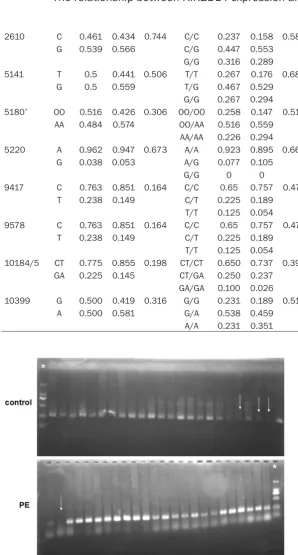
Figure 1. Electrophoretogram of polymerase chain reaction for KIR2DL4. *: molecular weight marker, white arrow: negative for KIR2DL4.
Quantitative reverse transcription PCR (qRT-PCR)
Total RNA was abstracted from 5 cases of pla-centas tissues with pre-eclampsia and 5 cases of normal pregnancies tissues by Trizol reagent
by 40 cycles of 95°C for 5 s and 60°C for 34 s.
Statistical analyses
Statistical analyses were performed using SPSS 17.0 (SPSS. Inc., Chicago, IL, USA). The Hardye Weinberg equilib-rium of KIR2DL4 gene allele frequencies was tested. The chi-square test was used to compare allele and genotype frequencies between pre-eclamptic and healthy con-trols. The difference of KIR2DL4 mRNA level in pre-eclamptic patients and heal- thy controls was assessed by independent samples t
test. Statistical significance
was set at P<0.05.
Results
The SNP of KIR2DL4 was systematically
KIR2DL4 gene, and all other samples from both controls and patient groups were positive (Figure 1). However, the difference between
controls and patient groups was not significant
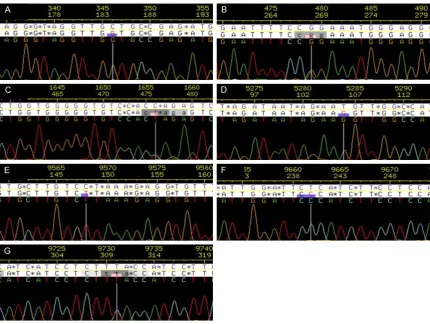
(P>0.05). DNA sequencing analysis showed that there were 18 SNP loci in the exon-intron junction of KIR2DL4 gene in preeclamptic patients and healthy controls, including 13 con-versions and 4 transversion and 1 insertion mutation (Table 1). Meanwhile, there were 7 novel SNP loci that had not been previously
described in NCBI’s dbSNP (Figure 2). In 18 SNPs loci, six (four non-synonymous substitu-tions and two synonymous substitusubstitu-tions) were located in coding regions and the others were located in the exon-intron junction. These SNP loci except 2380 and 9509 were accorded with Hardye Weinberg equilibrium (P>0.05).
Then, we analyzed the distribution of alleles and genotype in the 16 polymorphic loci of
KIR2DL4 gene (excluding 2380 and 9509) in the preeclampsia and normal pregnancy group. As shown in Table 2, no significant difference
was found in alleles and genotype distribution between the two groups (P>0.05).
In addition, to evaluate whether KIR2DL4 expression is correlated with pre-elampsia tox-emia, we detected the KIR2DL4 level in 5 cases of placentas tissues from preeclamptic patients and healthy controls by qRT-PCR. The quality of
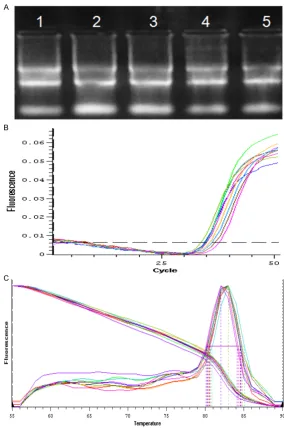
RNA and the specificity of primer sequence were confirmed to be reliable (Figure 3). Then, we found that KIR2DL4 level in preeclamptic
patients was significantly decreased compared
with healthy controls (P<0.05, Figure 4).
Discussion
[image:4.629.99.530.77.401.2]to soluble mediators, and are prevalent in uterine leukocyte population during the early stages of pregnancy, which play key roles in uterine tis-sue remodeling [13]. During the stages of successful preg-nancy, NK cells located in
uterine secrete inflammatory
and angiogenic factors to pro-mote the growth, differentia-tion, and migration of tropho-blast cells and the remodel-ing of spiral artery [13]. Recent studies suggest that KIR2DL4 may play a role in this process.
KIR2DL4 is a member of killer cell immunoglobulin-like
receptors (KIRs) family. Based
on the number of extracellu-lar domains, the length of cytoplasmic tail and the sequence similarity, KIR
pro-teins are classified into
[image:5.629.98.383.80.512.2]in-hibitory and activating KIR [14]. However, KIR2DL4 has distinct expression, cellular localization, structure and function among KIR mem-bers. Studies have indicated that the KIR2DL4 is expressed by all NK cells and some T cells at the transcriptional level, while its surface expres-sion is variable [15, 16]. Compare with other KIRs, KIR2DL4 has a D1 and D2 domain structure, and com-prises multiple exons. Fur- thermore, it is unique that KIR2DL4 only possesses a single immune tyrosine-based inhibitory motif (ITIM) and an arginine residue in the transmembrane region. Fun- ctionally, KIR2DL4 can regu-late the cytokine secretion and cytotoxicity. In addition, KIR2DL4 is characterized by its high degree of conserva-tion and low polymorphism Figure 3. The quality of RNA and the specificity of primer sequence were
evaluated. A. Electrophoretogram of RNA between PE patients (lane 1-3) and healthy controls (lane 4-5). B. Amplification Plot of KIR2DL4 gene. C. Solubil-ity curve of KIR2DL4 gene.
[image:5.629.98.384.587.693.2]among the highly variable KIR family members [13].
Several studies have reported that KIR2DL4 is
a specific receptor for HLA-G [16, 17]. HLA-G, a
non-classical MHC class I molecule, is expressed only by fetal-derived trophoblast cells in pregnant women and can create a bar-rier to prevent the fetus from maternal NK cell attack [10]. The reduced levels of HLA-G in pregnant women have been reported to be associated with pre-eclampsia and recurrent spontaneous abortion [18-20]. Thus, it seems to imply that the interaction of KIR2DL4 with HLA-G may play an important role in the main-tenance of pregnancy. Nonetheless, Nowak et al. reported that a Polish woman who is lacking KIR2DL4 gene had a normal pregnancy and delivered a child [21]. Moreover, the relation-ship between KIR2DL4 and pre-eclampsia is rare to report. Witt et al. reported that alleles of
the KIR2DL4 were significantly related to
pre-eclampsia in the Australian population [11]. While Tan et al. reported that the possible gene-gene interaction of KIR2DL4 with HLA-G*0106 is correlated with the risk of PE in Malaysia population [12].
In present study, we detected the SNP of KIR2DL4 gene in preeclamptic patients and healthy controls from China. The results revealed that 97% cases of healthy controls and 99% cases of preeclamptic patients were positive for KIR2DL4 gene, indicating that KIR2DL4 gene may be important for both healthy population and preeclamptic patients. In addition, the results demonstrated that there were 18 SNP loci in the exon-intron junction of KIR2DL4 gene, including 13 conversions and 4 transversion and 1 insertion mutation. Meanwhile, there were 7 novel SNP loci that
have not been previously described in NCBI’s
dbSNP. These SNP loci except 2380 and 9509 were accorded with Hardye Weinberg
equilibri-um. However, no significant difference was
recorded in alleles and genotype distribution between preeclamptic patients and healthy controls. These data were consistent with the studies reported by Witt [11] and Tan [12],
indi-cating that KIR2DL4 SNP was not significantly
correlated with the susceptibility of pre-eclamp-sia. In addition, Zhu et al. reported that Chinese Han population has distinct allele frequencies of KIR2DL4 in comparison to some other popu-lations [22]. Then, to further evaluate whether
KIR2DL4 expression is correlated with pre-elampsia toxemia, we detected the KIR2DL4 mRNA level in preeclamptic patients and healthy controls by qRT-PCR. The results revealed that KIR2DL4 mRNA level in
pre-eclamptic patients was significantly decreased
compared with healthy controls, suggesting that KIR2DL4 expression was associated with pre-eclampsia. It is well known that HLA-G is the ligand of KIR2DL4 and associated with pre-eclampsia [19, 20]. Thus, we considered that the decrease of KIR2DL4 in preeclamptic patients might be connected with the reduced level of HLA-G. Of course, further investigation is needed.
In conclusion, this study demonstrates that the SNP loci of KIR2DL4 gene is found in pre-eclamptic patients. While the SNP of KIR2DL4
gene is not significantly correlated with the sus -ceptibility of pre-eclampsia. However, the decreased level of KIR2DL4 may be connected with the occurrence of pre-eclampsia.
Acknowledgements
This study was supported by grants from the Jilin Provincial Science & Technology De- partment, Jilin Province, China, 20130206- 057SF.
Disclosure of conflict of interest
None.
Address correspondence to: Dr. Fuju Wu, De- partment of Obstetrics and Gynecology, The Se- cond Hospital of Jilin University, 218 Ziqiang Street, Nanguan District, Changchun 130041, China. Tel: 88796162; Fax: +86-431-88796162; E-mail: [email protected]
References
[1] Aquino LO, Leite HV, Cabral AC, Brandão AH. Doppler flowmetry of ophthalmic arteries for prediction of pre-eclampsia. Rev Assoc Med Bras 2014; 60: 538-541.
[2] Hu W, Wang H, Huang H. Analysis of gene ex-pression and preliminary study of methylation about 11beta-HSD2 gene in placentas of Chinese pre-eclampsia patients of Han ethnic-ity. J Obstet Gynaecol Res 2015; 41: 343-349. [3] Olatunji RB, Adekanmi AJ, Obajimi MO, Roberts
[4] Ge J, Wang J, Zhang F, Diao B, Song ZF, Shan LL, Wang W, Cao HJ, Li XQ. Correlation between MTHFR gene methylation and pre-eclampsia, and its clinical significance. Genet Mol Res 2015; 14: 8021-8028.
[5] Bergink V, Laursen TM, Johannsen BM, Kushner SA, Meltzer-Brody S, Munk-Olsen T. Pre-eclampsia and first-onset postpartum psy-chiatric episodes: a Danish population-based cohort study. Psychol Med 2015; 45: 3481-3489.
[6] Cormick G, Zhang NN, Andrade SP, Quiroga MJ, Di Marco I, Porta A, Althabe F, Belizán JM. Gaps between calcium recommendations to prevent pre-eclampsia and current intakes in one hos-pital in Argentina. BMC Res Notes 2014; 7: 920.
[7] Rajagopalan S, Long EO. KIR2DL4 (CD158d): an activation receptor for HLA-G. Front Immunol 2012; 3: 258.
[8] Goodridge JP, Lathbury LJ, John E, Charles AK, Christiansen FT, Witt CS. The genotype of the NK receptor, KIR2DL4, influences IFNgamma secretion by decidual natural killer cells. Mol Hum Reprod 2009; 15: 489-497.
[9] Hromadnikova I, Pirkova P, Sedlackova L. Influence of in vitro IL-2 or IL-15 alone or in combination with Hsp-70-derived 14-mer pep-tide (TKD) on the expression of NK cell activa-tory and inhibiactiva-tory receptors. Mediators Inflamm 2013; 2013: 405295.
[10] Yan WH, Lin A, Chen BG, Zhou MY, Dai MZ, Chen XJ, Gan LH, Zhu M, Shi WW, Li BL. Possible roles of KIR2DL4 expression on uNK cells in human pregnancy. Am J Reprod Immunol 2007; 57: 233-242.
[11] Witt CS, Whiteway JM, Warren HS, Barden A, Rogers M, Martin A, Beilin L, Christiansen FT. Alleles of the KIR2DL4 receptor and their lack of association with pre-eclampsia. Eur J Immunol 2002; 32: 18-29.
[12] Tan CY, Chong YS, Loganath A, Chan YH, Ravichandran J, Lee CG, Chong SS. Possible gene-gene interaction of KIR2DL4 with its cog-nate ligand HLA-G in modulating risk for pre-eclampsia. Reprod Sci 2009; 16: 1135-1143. [13] Vacca P, Moretta L, Moretta A, Mingari MC.
Origin, phenotype and function of human natu-ral killer cells in pregnancy. Trends Immunol 2011; 32: 517-523.
[14] Schellekens J, Tilanus MG, Rozemuller EH. The elucidation of KIR2DL4 gene polymorphism. Mol Immunol 2008; 45: 1900-1906.
[15] Rajagopalan S, Long EO. KIR2DL4 (CD158d): An activation receptor for HLA-G. Front Immunol 2012; 3: 258.
[16] Li G, Weyand CM, Goronzy JJ. Epigenetic mech-anisms of age-dependent KIR2DL4 expression in T cells. J Leukoc Biol 2008; 84: 824-834. [17] Gómez-Lozano N, Trompeter HI, de Pablo R,
Estefanía E, Uhrberg M, Vilches C. Epigenetic silencing of potentially functional KIR2DL5 al-leles: Implications for the acquisition of KIR repertoires by NK cells. Eur J Immunol 2007; 37: 1954-1965.
[18] Gómez-Lozano N, de Pablo R, Puente S, Vilches C. Recognition of HLA-G by the NK cell receptor KIR2DL4 is not essential for human reproduction. Eur J Immunol 2003; 33: 639-644.
[19] LeMaoult J, Zafaranloo K, Le Danff C, Carosella ED. HLA-G up-regulates ILT2, ILT3, ILT4, and KIR2DL4 in antigen presenting cells, NK cells, and T cells. FASEB J 2005; 19: 662-664. [20] Rizzo R, Vercammen M, van de Velde H, Horn
PA, Rebmann V. The importance of HLA-G ex-pression in embryos, trophoblast cells, and embryonic stem cells. Cell Mol Life Sci 2011; 68: 341-352.
[21] Yie SM, Li LH, Li YM, Librach C. HLA-G protein concentrations in maternal serum and placen-ta tissue are decreased in preeclampsia. Fertil Steril 2004; 83:30-36.
[22] Steinborn A, Varkonyi T, Scharf A, Bahlmann F, Klee A, Sohn C. Early detection of decreased soluble HLA-G levels in the maternal circula-tion predicts the occurrence of preeclampsia and intrauterine growth retardation during fur-ther course of pregnancy. Am J Reprod Immunol 2007; 57: 277-286.
[23] Nowak I, Majorczyk E, Płoski R, Senitzer D, Sun JY, Kuśnierczyk P. Lack of KIR2DL4 gene in a fertile Caucasian woman. Tissue Antigens 2011; 78: 115-119.