Original Article
Liquid-based cytology in the fine needle aspiration of
parathyroid lesions: a comparison study with the
conventional smear, ThinPrep, and SurePath
Gyeong Sin Park1, Sung Hak Lee1, So Lyung Jung2, Chan Kwon Jung1
1Department of Hospital Pathology, College of Medicine, The Catholic University of Korea, Seoul, Korea; 2Department of Radiology, College of Medicine, The Catholic University of Korea, Seoul, Korea
Received August 24, 2015; Accepted September 25, 2015; Epub October 1, 2015; Published October 15, 2015
Abstract: Liquid-based cytology (LBC) has been progressively used for evaluating fine needle aspiration (FNA) speci
-mens. However, limited studies have examined LBC in FNA of parathyroid lesions. We retrospectively reviewed 24 FNA specimens of parathyroid lesions, including 6 specimens prepared by conventional smear, 12 specimens
prepared using ThinPrep method, and 6 specimens prepared using SurePath method. The 18 LBC specimens were also used for cell block preparation and immunostaining for parathyroid hormone (PTH). LBC specimens more fre-quently showed variable cellularity; microfollicular structure; bubbly or vacuolated cytoplasm; and small, round cells with distinct borders compared to specimens prepared by conventional smear. ThinPrep specimens showed a clean background and fewer isolated cells and naked nuclei compared to specimens prepared using the other methods. SurePath specimens showed many white blood cells in the background and more scattered single cells and naked nuclei compared to ThinPrep specimens. Specimens prepared using the 3 methods often showed colloid-like
mate-rial but did not contain dense globular colloidal structures. White blood cells in the background of LBC specimens
serve as useful indicators for estimating cell size. The nuclear size of parathyroid cells was similar to or smaller
than that of inflammatory cells in the background. Cell block sections showed definite histological features of the
parathyroid tissue and strong positive immunostaining for PTH. Awareness of these cytologic features of parathyroid
FNA specimens prepared using ThinPrep and SurePath methods may help in preventing misdiagnosis. Cell block preparation and PTH immunostaining should be performed for the definitive diagnosis of parathyroid lesions.
Keywords: Fine needle aspiration, cytology, ThinPrep, SurePath, parathyroid
Introduction
The number and location of the parathyroid glands can vary [1]. More than 4 parathyroid glands are present in approximately 25% of the normal population, and locations of the inferior glands are more variable than those of the superior glands [1, 2]. Fine needle aspiration (FNA) of parathyroid lesions can produce diag-nostically challenging specimens, especially for patients without any clinical evidence of hyper-parathyroidism. Therefore, analysis of FNA specimens of parathyroid nodules located with-in the thyroid gland often results with-in their miswith-in- misin-terpretation as thyroid nodules. Identification of the ectopic locations of the parathyroid glands and awareness of the cytomorphologic features of parathyroid FNA specimens are important to avoid misdiagnosis in such cases.
are often cellular and their cytomorphologic features are similar to those of thyroid lesions [3, 4]. FNA specimens of parathyroid lesions showing hypercellularity and microfollicular structures are often misinterpreted as follicular neoplasm of the thyroid gland [5]. Although some studies have investigated the diagnosis of parathyroid lesions by performing FNA [3, 6, 7], their diagnosis by using FNA specimens is still challenging [7-9].
Liquid-based cytology of parathyroid lesions
ventional smear [11-16]. However, little is known about the cytologic features and utility of LBC preparations for evaluating parathyroid lesions.
This study aimed to establish the cytomorpho-logic features of parathyroid FNA specimens prepared using ThinPrep and SurePath meth-ods and to determine the preoperative diagnos-tic role of LBC for evaluating parathyroid lesions.
Materials and methods
We retrospectively reviewed 24 specimens of patients with parathyroid lesions who under-went FNA at the Catholic University of Korea,
staining of cell block sections (n = 18) for para-thyroid hormone (PTH). Final diagnoses of the lesions were parathyroid hyperplasia (n = 17), parathyroid adenoma (n = 5), and parathyroid carcinoma (n = 2).
Results
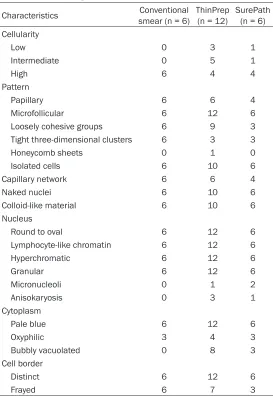
Table 1 summarizes the cytologic features of parathyroid FNA specimens prepared by con-ventional smear and LBC.
Conventional smear
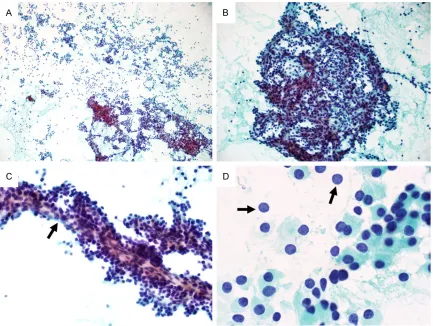
All FNA smears were highly cellular and showed variable architecture, including papillary, micro-follicular, loosely cohesive, or tight three-dimen-Table 1. Cytomorphologic features of parathyroid fine needle
aspiration specimens prepared by conventional smear and liquid-based cytology
Characteristics smear (n = 6)Conventional ThinPrep (n = 12) SurePath (n = 6) Cellularity
Low 0 3 1
Intermediate 0 5 1
High 6 4 4
Pattern
Papillary 6 6 4
Microfollicular 6 12 6
Loosely cohesive groups 6 9 3
Tight three-dimensional clusters 6 3 3
Honeycomb sheets 0 1 0
Isolated cells 6 10 6
Capillary network 6 6 4
Naked nuclei 6 10 6
Colloid-like material 6 10 6
Nucleus
Round to oval 6 12 6
Lymphocyte-like chromatin 6 12 6
Hyperchromatic 6 12 6
Granular 6 12 6
Micronucleoli 0 1 2
Anisokaryosis 0 3 1
Cytoplasm
Pale blue 6 12 6
Oxyphilic 3 4 3
Bubbly vacuolated 0 8 3
Cell border
Distinct 6 12 6
Frayed 6 7 3
Seoul St. Mary’s Hospital be- tween January 2009 and De- cember 2014. All FNA proce-dures were performed by radiolo-gists by using 23-gauge needles under real-time ultrasound guid-ance. Of the 24 FNA specimens, 6 were directly smeared on slides and were immediately fixed using 95% ethanol, 12 were prepared using the ThinPrep method (Hologic Inc, Marl- borough, MA), and 6 were pre-pared using the SurePath meth-od (BD Diagnostics, Franklin Lakes, NJ). The 18 specimens prepared using LBC (ThinPrep and SurePath methods) were also used for preparing cell blocks. All FNA specimens were stained with Papanicolaou stain, and the cell blocks were stain- ed with hematoxylin-eosin. Spe- cimens prepared by conventional smear and LBC were indepen-dently reviewed by 2 endocrine pathologists (SHL and CKJ), and all the cytomorphologic fea-tures of these specimens were recorded. Discrepancy in the observations of the 2 reviewers was resolved based on con- sensus.
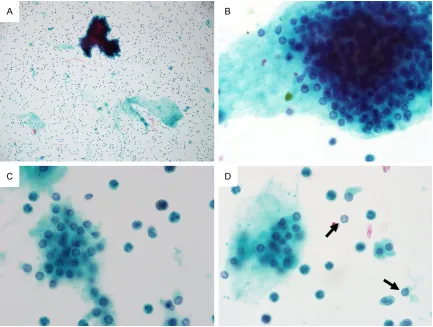
[image:2.612.91.364.106.503.2]sional clusters (Figure 1A and 1B). Numerous isolated cells were scattered throughout the background, and naked nuclei were frequently observed. Capillary networks were frequently observed (Figure 1C) while colloid-like material was occasionally observed in all the smears. The nuclei were round to oval, hyperchromatic, and granular, and the cytoplasm was pale blue or oxyphilic. Cell borders were often frayed (Figure 1D).
ThinPrep LBC
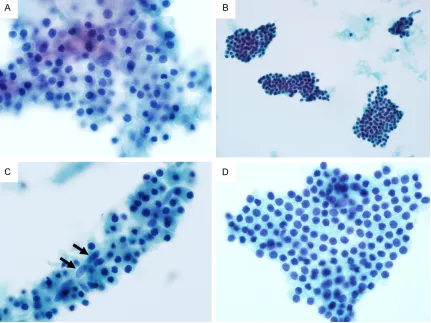
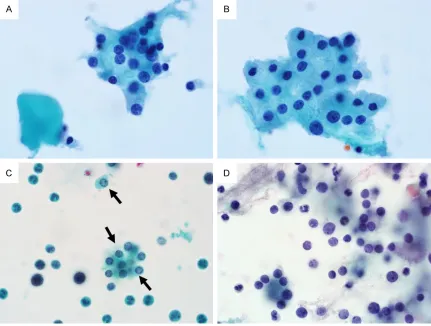
Specimens prepared using ThinPrep LBC showed variable degree of cellularity. The spec-imens predominantly showed a microfollicular architectural pattern; however, other patterns were also observed (Figure 2). Monolayered, honeycomb-shaped sheets were observed in 1 ThinPrep specimen. Naked nuclei were
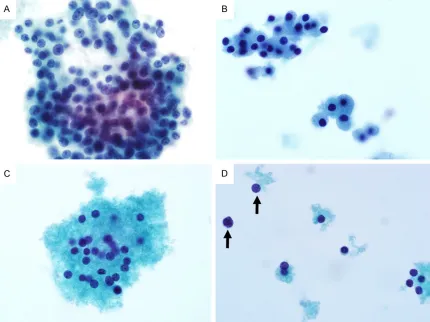
occa-sionally observed (Figure 3), while colloid-like material and capillary networks were variably observed (Figure 4). Nuclear features of these specimens were similar to those observed in specimens prepared by conventional smear. However, the size of the nuclei was smaller and cell borders were better preserved in ThinPrep specimens than in specimens prepared by con-ventional smear (Figure 2). Further, bubbly or vacuolated cytoplasm was more frequently observed and mild anisokaryosis was occa-sionally observed in ThinPrep specimens (Figure 3).
SurePath LBC
[image:3.612.91.524.70.396.2]Cytomorphologic features of parathyroid cells in specimens prepared using SurePath LBC were not largely different from those of parathy-roid cells in specimens prepared using ThinPrep Figure 1. Conventional smears of parathyroid fine needle aspiration specimens. A. The smear is highly cellular and
shows dispersed single, small uniform cells; microfollicular clusters; and loosely cohesive tissue fragments (× 100). B. A cluster of cells showing prominent capillary vasculature (× 200). C. Papillary architecture consisting of small,
Liquid-based cytology of parathyroid lesions
LBC. However, SurePath specimens showed thicker three-dimensional clusters, more iso-lated single cells, and more white blood cells in the background than ThinPrep specimens (Figure 5).
Cell blocks
All LBC specimens (n = 18) could be used for preparing cell blocks. Use of cell blocks allowed easy identification of whether cells were of parathyroid or thyroid origin, irrespective of the cell number (Figure 6). All the cell blocks, including those with less number of cells, yield-ed positive results for the immunostaining of PTH (Figure 6).
Discussion
Previous studies have indicated that differenti-ation between parathyroid and thyroid follicular
lesions by using FNA specimens is difficult [7, 17-19]. Nevertheless, the cytologic features favoring parathyroid lesion over thyroid follicu-lar lesion are smaller cells having pale scant cytoplasm, round to oval nuclei with stippled nuclear chromatin (so-called salt-and-pepper appearance), prominent vascular network with attached epithelial cells, and the frequent occurrence of single cells and naked nuclei [7]. Cytologic features of parathyroid FNA speci-mens that lead to their misdiagnosis as thyroid follicular lesions include high cellularity, follicu-lar formation, papilfollicu-lary structure, and presence of colloid-like material [3, 7, 8, 18, 19]. However, these features have been primarily studied using specimens prepared by conventional smear. To our knowledge, only one study has characterized the cytomorphologic features of parathyroid lesions by using ThinPrep speci-Figure 2. Architectural patterns of parathyroid fine needle aspiration specimens prepared using ThinPrep. A. Loosely cohesive clusters of cells with small, uniform, and round nuclei and well-defined borders (× 1000). B. Tissue frag -ments showing microfollicular pattern with crowding and overlapping of uniform, small nuclei (× 400). C. Papillary structure consisting of uniform, small cells clinging to the capillary vasculature and endothelial cells (arrows; ×
1000). D. A monolayer of parathyroid cells with well-defined borders and centrally located uniform, small nuclei in
[image:4.612.92.523.74.397.2]mens. However, characterization of the
[image:5.612.92.522.73.395.2]cyto-morphologic features of parathyroid lesions by using SurePath specimens has not been report-ed to date [20]. Figure 3. Cytologic features of parathyroid fine needle aspiration specimens prepared using ThinPrep. A. A
three-dimensional cluster of parathyroid cells with a microfollicular arrangement. Nuclei showing mild anisokaryosis, granular chromatin, and small nucleoli (× 1000). B. Loose two-dimensional clusters of oxyphilic cells consisting of
uniform, round cells with vacuolated cytoplasm and well-define borders. Nuclei are centrally or eccentrically located
(× 1000). C. A cluster of parathyroid cells with frayed borders. Their cytoplasmic borders are indistinct (× 1000). D. The cytoplasm is fragile, and naked nuclei (arrows) are observed (× 1000).
[image:5.612.92.523.489.651.2]Liquid-based cytology of parathyroid lesions
In our study, the common features of parathy-roid lesions observed in the FNA specimens prepare using the 3 methods were microfollicu-lar structure; small, round-to-oval nuclei with lymphocyte-like chromatin; and naked nuclei in the background. These results were consistent with those of previous studies [18-20]. However, comparison of specimens prepared using each method showed that cellularity was lower in specimens prepared using ThinPrep than in those prepared using the other methods. Specimens prepared using ThinPrep showed a clean background and fewer isolated parathy-roid cells and naked nuclei than those prepared using the other methods. SurePath specimens showed many white blood cells in the back-ground; therefore, it was difficult to differenti-ate isoldifferenti-ated parathyroid cells and naked nuclei from background white blood cells in these specimens. Specimens prepared using both
[image:6.612.90.523.71.398.2]ground can serve as an indicator for estimating cell size (Figure 7C). The nuclear size of para-thyroid cells is similar to or smaller than that of inflammatory cells in the background while the nuclear size of follicular cells is larger than that of inflammatory cells in the background (Figure 7C and 7D).
Parathyroid FNA specimens often show a papil-lary architecture, with a fibrovascular core. However, parathyroid lesions can be easily dis-tinguished from papillary thyroid carcinoma based on the absence of the typical nuclear features of papillary thyroid carcinoma [3, 21]. Immunocytochemical staining of PTH or PTH chemical assay of parathyroid FNA rinse is use-ful for the definitive diagnosis of parathyroid lesions [3-5]. In the present study, all FNA spec-imens were suitable for preparing cell blocks after LBC. Positive immunocytochemical
stain-ing of PTH in cell block sections confirmed the parathyroid origin of cells.
No difference was observed in cytologic fea-tures of parathyroid hyperplasia, parathyroid adenoma, and parathyroid carcinoma between conventional smear and LBC specimens in our study, which was consistent with results of pre-vious studies [7, 19, 20].
[image:7.612.92.525.71.398.2]Liquid-based cytology of parathyroid lesions
preparation and PTH immunostaining of FNA specimens is highly effective for the differential diagnosis of parathyroid lesions.
Acknowledgements
This research was supported by the Basic Science Research Program through the National Research Foundation of Korea (NRF) funded by the Ministry of Science, ICT and Future Planning (2013R1A2A2A01068570).
Disclosure of conflict of interest
None.
Address correspondence to: Dr. Chan Kwon Jung, Department of Hospital Pathology, College of
Medicine, The Catholic University of Korea, 222
Banpodaero, Seocho-gu, Seoul 06591, Korea. Tel:
+82-2-2258-1622; Fax: +82-2-2258-1627; E-mail:
References
[1] LiVolsi VA and Hamilton R. Intraoperative as-sessment of parathyroid gland pathology. A common view from the surgeon and the pa-thologist. Am J Clin Pathol 1994; 102: 365-373.
[2] Wang C. The anatomic basis of parathyroid sur -gery. Ann Surg 1976; 183: 271-275.
[3] Absher KJ, Truong LD, Khurana KK and Ramzy I. Parathyroid cytology: avoiding diagnostic pit-falls. Head Neck 2002; 24: 157-164.
[4] Giorgadze T, Stratton B, Baloch ZW and Livolsi
[image:8.612.91.522.73.399.2]VA. Oncocytic parathyroid adenoma: problem in cytological diagnosis. Diagn Cytopathol 2004; 31: 276-280.
[5] Owens CL, Rekhtman N, Sokoll L and Ali SZ.
Parathyroid hormone assay in fine-needle aspi -rate is useful in differentiating inadvertently sampled parathyroid tissue from thyroid le-sions. Diagn Cytopathol 2008; 36: 227-231. [6] Paker I, Yilmazer D, Yandakci K, Arikok AT and
Alper M. Intrathyroidal oncocytic parathyroid
adenoma: a diagnostic pitfall on fine-needle
aspiration. Diagn Cytopathol 2010; 38: 833-836.
[7] Dimashkieh H and Krishnamurthy S.
Ultrasound guided fine needle aspiration biop -sy of parathyroid gland and lesions. Cytojournal 2006; 3: 6.
[8] Tseng FY, Hsiao YL and Chang TC. Ultrasound-guided fine needle aspiration cytology of para -thyroid lesions. A review of 72 cases. Acta Cytol 2002; 46: 1029-1036.
[9] Lieu D. Cytopathologist-performed
ultrasound-guided fine-needle aspiration of parathyroid
lesions. Diagn Cytopathol 2010; 38: 327-332. [10] Rossi ED, Morassi F, Santeusanio G, Zannoni
GF and Fadda G. Thyroid fine needle aspiration
cytology processed by ThinPrep: an additional slide decreased the number of inadequate re-sults. Cytopathology 2010; 21: 97-102. [11] Hayama FH, Motta AC, Silva Ade P and Migliari
DA. Liquid-based preparations versus conven-tional cytology: specimen adequacy and diag-nostic agreement in oral lesions. Med Oral Patol Oral Cir Bucal 2005; 10: 115-122. [12] de Luna R, Eloubeidi MA, Sheffield MV, Eltoum
I, Jhala N, Jhala D, Chen VK and Chhieng DC. Comparison of ThinPrep and conventional
preparations in pancreatic fine-needle aspira -tion biopsy. Diagn Cytopathol 2004; 30: 71-76. [13] Dey P, Luthra UK, George J, Zuhairy F, George
SS and Haji BI. Comparison of ThinPrep and
conventional preparations on fine needle aspi -ration cytology material. Acta Cytol 2000; 44: 46-50.
[14] Jung CK, Lee A, Jung ES, Choi YJ, Jung SL and Lee KY. Split sample comparison of a liquid-based method and conventional smears in
thy-roid fine needle aspiration. Acta Cytol 2008;
52: 313-319.
[15] Chang H, Lee E, Lee H, Choi J, Kim A and Kim BH. Comparison of diagnostic values of thyroid aspiration samples using liquid-based prepa-ration and conventional smear: one-year expe-rience in a single institution. APMIS 2013; 121: 139-145.
[16] Lee SH, Jung CK, Bae JS, Jung SL, Choi YJ and Kang CS. Liquid-based cytology improves pre-operative diagnostic accuracy of the tall cell variant of papillary thyroid carcinoma. Diagn Cytopathol 2014; 42: 11-17.
[17] Tseleni-Balafouta S, Gakiopoulou H, Kavantzas N, Agrogiannis G, Givalos N and Patsouris E. Parathyroid proliferations: a source of
diagnos-tic pitfalls in FNA of thyroid. Cancer 2007; 111:
130-136.
[18] Agarwal AM, Bentz JS, Hungerford R and
Abraham D. Parathyroid fine-needle aspiration
cytology in the evaluation of parathyroid
ade-noma: cytologic findings from 53 patients.
Diagn Cytopathol 2009; 37: 407-410.
[19] Heo I, Park S, Jung CW, Koh JS, Lee SS, Seol H, Choi HS and Cho SY. Fine needle aspiration cy -tology of parathyroid lesions. Korean J Pathol 2013; 47: 466-471.
[20] Odronic SI, Reynolds JP and Chute DJ. Cytologic
features of parathyroid fine-needle aspiration
on ThinPrep preparations. Cancer Cytopathol 2014; 122: 678-684.
[21] Abati A, Skarulis MC, Shawker T and Solomon
D. Ultrasound-guided fine-needle aspiration of