RESEARCH ARTICLE
Slime moulds use heuristics based on within-patch experience
to decide when to leave
Tanya Latty1,* and Madeleine Beekman2
ABSTRACT
Animals foraging in patchy, non-renewing or slowly renewing environments must make decisions about how long to remain within a patch. Organisms can use heuristics (‘rules of thumb’) based on available information to decide when to leave the patch. Here, we investigated proximate patch-departure heuristics in two species of giant, brainless amoeba: the slime moulds Didymium bahienseand Physarum polycephalum. We explicitly tested the importance of information obtained through experience by eliminating chemosensory cues of patch quality. In P. polycephalum, patch departure was influenced by the consumption of high, and to a much lesser extent low, quality food items such that engulfing a food item increased patch-residency time. Physarum polycephalum also tended to forage for longer in darkened,‘safe’patches. InD. bahiense, engulfment of any food item increased patch residency irrespective of that food item’s quality. Exposure to light had no effect on the patch-residency time of D. bahiense. Given that these organisms lack a brain, our results illustrate how the use of simple heuristics can give the impression that individuals make sophisticated foraging decisions.
KEY WORDS: Decision making, Foraging, Protist, Rules of thumb, Sampling, Unicellular
INTRODUCTION
Animals foraging in patchy environments are faced with complex decisions about how to search for food, where to forage and how long to remain within patches of varying quality. The Marginal Value Theorem (MVT) predicts that the optimal strategy for foragers is to depart patches when the instantaneous rate of return in the patch falls to the average rate of return that can be achieved in all the other patches within the environment (Charnoc, 1976). However, the MVT does not provide a mechanistic ( proximate) strategy in the absence of complete information about the global foraging environment. Even if global information was available, the cognitive load required to process this information is probably beyond the capacity of most, if not all, organisms. Therefore, to make accurate, yet computationally efficient decisions, organisms may employ simple behavioural rules, known as‘rules of thumb’or heuristics. Heuristics allow foragers to use selected information from the environment to make decisions that, while not optimal, are often‘good enough’(Hutchinson and Gigerenzer, 2005). Foragers might, for example, leave a patch after consuming a fixed number of
food items (Gibb, 1962), after a fixed length of time (Krebs, 1973), or after a certain period of time has elapsed without food encounters (Krebs et al., 1974). Heuristics have the benefit of being computationally efficient, yet often result in near-optimal solutions (Hutchinson and Gigerenzer, 2005).
Perhaps the most well-studied patch-leaving heuristic was proposed by Waage (1979) based on the patch-leaving decisions made by female parasitoid wasps. Waage (1979) proposed that parasitoids use each sequential host encounter as a piece of information to update their expectation about patch quality. According to this model, females enter a patch with a baseline probability of remaining in the patch. Each encounter with a suitable host either increases or decreases the parasitoid’s probability of leaving the patch. If each encounter with a host increases patch-residency time, then the parasitoid is said to be using an ‘incremental’ departure mechanism. Conversely, if host encounters decrease the tendency to remain in the patch, the parasitoid is said to be using a ‘decremental’ or ‘count down’ departure mechanism (Driessen and Bernstein, 1999). In addition to encounters with food, other factors such as the presence of competitors or predators could theoretically influence patch departure by altering the baseline leaving probability. For example, individuals foraging in a dangerous environment might increase their baseline departure probability, thus leaving the patch sooner.
To date, studies of patch-leaving heuristics have focused exclusively on neurologically sophisticated organisms; after all, even the tiniest parasitoid wasps have brains containing hundreds (and more usually tens of thousands) of neurons (Polilov, 2012). Yet, many of earth’s taxa, including large and ecologically significant groups such as bacteria, plants and fungi, lack brains. Here, we asked two main questions: (1) are brainless organisms capable of using information obtained while foraging to inform their patch-leaving decisions?; and (2) if so, which heuristics do they use? We addressed these questions using two species of slime moulds:Physarum polycephalumSchwein andDidymium bahienseGottsb. Slime moulds are large, unicellular organisms that forage as a mass of flowing pseudopods, engulfing and digesting suitable food items as they move through their environment. Previous work on slime mould foraging behaviour found that P. polycephalumis capable of altering its search strategy according to food quality (Latty and Beekman, 2009), balancing a trade-off between risk and food quality (Latty and Beekman, 2010), solving shortest path problems (Nakagaki et al., 2000, 2004; Tero et al., 2010; Reid and Beekman, 2013), and balancing its uptake of several macronutrients (Dussutour et al., 2010). Didymium bahiense and P. polycephalumwere selected as study species because they were easy to obtain and were both amenable to culture in the laboratory.
We investigated patch-leaving heuristics in slime moulds in experimental arenas (Fig. 1). The arena contained artificial food patches consisting of nine individual food items of either high (6% oat) or low (1% oat) food concentration. As we were interested in determining whether slime moulds could integrate information obtained during sampling, it was important that we prevent Received 10 November 2014; Accepted 11 February 2015
1
Department of Plant and Food Science, Faculty of Agriculture and the Environment, University of Sydney, Sydney, NSW 2015, Australia.2Behaviour and Genetics of Social Insects Lab, Centre for Mathematical Biology, School of Biological Sciences A12, University of Sydney, Sydney, NSW 2006, Australia. *Author for correspondence ([email protected])
The
Journal
of
Experimental
chemosensory cues from diffusing through the agar and providing slime moulds with global information about patch quality. We therefore placed each food item on top of a small disc made from impermeable plastic. We created patches of different quality by adjusting the number of high quality food discs available. We used four levels of patch quality with patches containing 3, 4, 5 or 6 high concentration (6% oatmeal) food items per patch. The remaining food discs were of low concentration (1% oatmeal) foods. In addition to investigating the effect of patch quality, we were also interested in whether slime moulds used information about risk. We used light as an abiotic danger because exposure to light causes nuclear degeneration (Devi et al., 1968) and reduces growth rate (Latty and Beekman, 2010). Arenas were randomly assigned to either a‘safe’or a ‘dangerous’ treatment environment, resulting in a total of eight treatments (four levels of patch quality, two levels of danger).
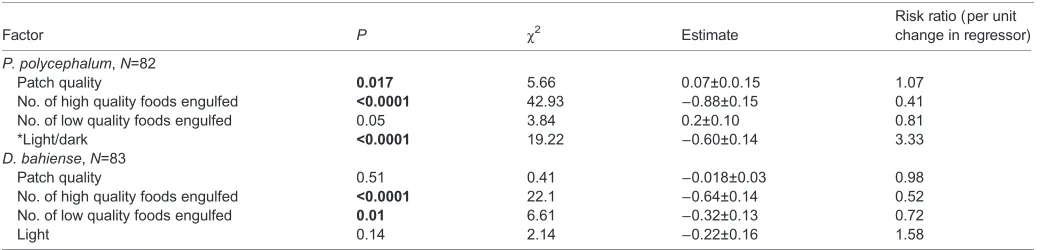
We analysed our data using Cox proportional hazards models. Proportional hazard models consist of a hazard function that, in our analysis, describes the probability per unit time that a plasmodium will leave the patch (given that it is still on it), and a risk ratio that describes how the tendency to leave a patch is influenced by each explanatory variable. Risk ratios greater than 1 indicate an increase
in the probability of leaving the patch while risk ratios less than 1 indicate that the factor decreases the probability of leaving the patch.
RESULTS
Physarum polycephalum
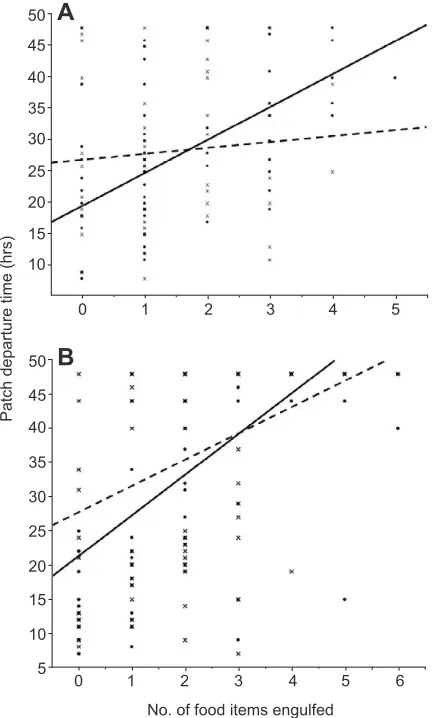
Each encounter with a high concentration food disc increased the probability that P. polycephalum amoebae remained in the patch (Table 1, Fig. 2A). The number of low quality food items engulfed had a marginally significant effect on patch-departure time, such that each engulfment tended to increase the length of time plasmodia remained in the patch (Table 1, Fig. 2A). Patch quality had a significant influence on patch-departure time, but the risk ratio was very close to 1, suggesting a relatively small increase in the risk of leaving (Table 1). Physarum polycephalumplasmodia stayed in darkened patches longer than they did in illuminated patches (Table 1).
A small proportion (9%) ofP. polycephalumplasmodia fragmented into multiple amoebae; fragmentation was not influenced by patch illumination (chi-square test: χ2=1.35, P=0.24, N=117) or patch
quality (logistic regression:χ2=0.5,P=0.24,N=117).
Didymium bahiense
Each engulfment of a food item increased the length of time D. bahiense spent in the patch, irrespective of the food item’s quality (Table 1, Fig. 2B). Neither illumination nor overall patch quality influenced patch-departure time (Table 1).
Overall, 19% of D. bahiense plasmodia fragmented, and the tendency to fragment was significantly higher in the illuminated environments (chi-square;χ2=18.0,P<0.0001,N=93). In the dark,
only 5% of plasmodia fragmented, compared with 40.5% in the illuminated patch. Patch quality did not have a significant influence on fragmentation (logistic regression:χ2=1.04,P=0.30,N=94).
DISCUSSION
Our study aimed to answer two main questions: are brainless organisms capable of using information obtained while foraging to inform their patch-leaving decisions and, if so, which heuristics do they use? We found evidence that both D. bahiense and P. polycephalum used information about patch quality obtained during sampling. As plasmodia were prevented from accessing chemosensory information about global patch quality, our study demonstrates that slime moulds can adapt their patch-leaving behaviour using information on patch quality obtained by sampling individual discrete food items.
5 mm
* *
[image:2.612.77.266.53.240.2]* *
Fig. 1. Experimental arenas.The dark circles represent food discs, which could be of either high (6%) or low (1%) oatmeal concentration. The asterisks show each of the four possible‘start’locations. Start locations were selected randomly.
Table 1. Factors influencing patch-residency time
Factor P χ2 Estimate
Risk ratio (per unit change in regressor)
P. polycephalum,N=82
Patch quality 0.017 5.66 0.07±0.0.15 1.07
No. of high quality foods engulfed <0.0001 42.93 −0.88±0.15 0.41 No. of low quality foods engulfed 0.05 3.84 0.2±0.10 0.81
*Light/dark <0.0001 19.22 −0.60±0.14 3.33
D. bahiense,N=83
Patch quality 0.51 0.41 −0.018±0.03 0.98
No. of high quality foods engulfed <0.0001 22.1 −0.64±0.14 0.52 No. of low quality foods engulfed 0.01 6.61 −0.32±0.13 0.72
Light 0.14 2.14 −0.22±0.16 1.58
The table summarises the results of a Cox proportional hazards model forPhysarum polycephalumandDidymium bahiense.Risk ratios describe how much a risk factor changes the probability of leaving the patch. Risk ratios greater than 1 indicate an increase in the probability of leaving the patch. Risk ratios less than 1 indicate that the factor decreases the probability of leaving the patch. SignificantP-values are highlighted in bold.
*The value presented shows the risk ratio relative to the‘illuminated’condition, so that values above 1 indicate that plasmodia were more likely to leave the patch if it was illuminated. ForP. polycephalum, the risk of leaving an illuminated patch is 3.33 times greater than the risk of leaving a darkened patch.
The
Journal
of
Experimental
[image:2.612.47.569.565.690.2]Our results are consistent with the use of an incremental patch-departure rule in bothP. polycephalumandD. bahiense.In addition to being extensively reported in parasitoid wasps, incremental and decremental patch-departure heuristics have also been observed in bumble bees (Lefebvre et al., 2007; Biernaskie et al., 2009) and humans (Hutchinson et al., 2008; Wilke et al., 2009; Louâpre et al., 2010). It has even been suggested that humans use incremental departure rules when solving word problems (Wilke et al., 2009). The use of an apparent departure heuristic in slime moulds suggests that patch-departure heuristics can be implemented by organisms with limited information-processing capabilities. Heuristics may therefore underlie many departure decisions irrespective of the organism’s precise information-processing abilities.
Our experiment does not allow us to rule out the possibility that the slime moulds based their decision on‘time since last food capture’, rather than on the strict incremental departure rule. Using simulated data, Hutchinson and colleagues (Hutchinson et al., 2008) showed that the behaviour generated by animals using incremental heuristics is indistinguishable from that of an animal using a heuristic based on time since last food capture when results are analysed using the standard Cox regression model. The two distinct rules can be distinguished from one another if both‘time since last food capture’and‘number of captures’are included in the Cox regression model. Unfortunately, determining time since last food capture in a slime mould is logistically
difficult because of the organism’s amoeboid morphology. Time since last food capture ideally encapsulates information about how long an organism has gone without feeding. However, slime moulds remain in contact with multiple food items whilst simultaneously searching the environment, thus making it difficult to measure the time since last food capture in any meaningful way. Thus, we are unable to distinguish whether the slime mould is truly using an incremental rule, or whether it is using a rule based on the time since its last food capture. In either case, the strength of our result is in the finding that the slime moulds are using information about encounters with food items to modify their patch-residence behaviour.
How do encounters with food items modify patch-residency time, given that slime moulds lack a nervous system? In parasitoid wasps, patch-departure mechanisms are driven by changes in locomotory behaviour. Contact with food-associated cues increases turning rates and decreases walking speed (Gardner and Van Lenteren, 1986; Wajnberg, 2006). A similar mechanism is probably at play in slime moulds. Previous work onP. polycephalumfound that slime moulds which fed on high concentration foods tended to engage in area-restricted search, characterised by slower movements, higher fractal dimension (more‘intense’search) and a more localised search pattern (Latty and Beekman, 2009). Each engulfment of a high quality food item would therefore lead to an increase in patch-residency time, as we have observed here inP. polycephalum. Also consistent with our results, a study on the search strategy ofD. bahiensefailed to find any effect of food concentration on the amount of area-restricted search the plasmodia engaged in after consuming a food item (Yip et al., 2014). The same study found thatD. bahiensewas only sensitive to the presence or absence of food such that when food was present, plasmodia engaged in area-restricted search irrespective of the food’s concentration. Such behaviour would explain our finding that the consumption of both high and low concentration food items increased patch-residency time in D. bahiense. One of the benefits of incremental and decremental patch-departure heuristics may be their easy implementation through simple changes in locomotory behaviour, and the fact that they do not necessarily require the use of more intensive cognitive abilities such as memory or learning. We suggest that future studies might look for evidence of incremental or decremental patch-departure heuristics in other non-neuronal organisms such as plants, fungi and bacteria.
Analytical models predict that the optimal patch-departure heuristic depends crucially on the distribution of prey and on variance in patch quality (Iwasa et al., 1981). Although little is known about the foraging ecology of natural populations ofD. bahienseand P. polycephalum, most slime moulds are bacterial and fungal predators (Stephenson et al., 1994), and it has been suggested that P. polycephalumis a mushroom specialist (Martin and Alexopoulos, 1969). Although it is plausible that these resources occur in aggregated patches (for example, bacterial colonies), the variance in quality within these food patches is unknown. Indirect evidence that slime moulds forage on aggregated resources comes from experimental microlandscape studies on P. polycephalum, which found that plasmodia gain more weight when foraging in patches in which within-patch variation in food quality is high (Latty and Beekman, 2009). We tentatively suggest that the incremental patch-departure heuristic used byD. bahienseandP. polycephalumallows them to forage efficiently on spatially aggregated resources.
[image:3.612.64.280.58.417.2]Our two species of slime mould appear to use different patch-departure heuristics. InP. polycephalum, each engulfment of a high concentration food item led to a 2.45 times decrease in the probability that the slime mould would leave the patch (calculated by taking the reciprocal of the risk ratio, see Table 1). In contrast, Fig. 2. The effect of engulfing high and low quality food items on the time
it took for plasmodia to leave patches.(A)Physarum polycephalum.
(B)Didymium bahiense.Solid lines, high quality food items; dashed lines, low quality food items.
The
Journal
of
Experimental
each engulfed low quality item had only a marginally significant effect on patch-departure time (see Fig. 2 and Table 1).Physarum polycephalum therefore appears to distinguish between high and low concentration items when making patch-leaving decisions, such that high quality food items have a stronger effect than low quality food items, although both are included in the decision heuristic. In D. bahiense, engulfing a food item decreased the probability that a plasmodium would leave the patch irrespective of the food’s concentration (Fig. 2B). Our pilot experiments showed that D. bahiensecan readily distinguish between a 1% and a 6% food disc, and that they have a strong preference for the 6% food disc; thus, our results cannot be explained by an inability to tell the two kinds of food disc apart. Taken together, our results show that slime moulds are capable of using patch-departure heuristics that use information obtained during sampling, but that the details of these heuristics are species dependent.
Physarum polycephalum and D. bahiensealso differed in their response to light exposure. Physarum polycephalum adjusts its foraging strategy when exposed to light, whileD. bahienseseems indifferent to light exposure. The negative effects of light exposure on P. polycephalum are well described (Devi et al., 1968; Dove and Rusch, 1980) and it is generally assumed that light exposure will have a negative effect on all slime mould species. However, there are no specific data on the effect of light exposure forD. bahiense. Thus, it is possible thatD. bahiensedid not alter its foraging behaviour when illuminated because it is less susceptible to the negative effects of light exposure than isP. polycephalum. However, light exposure increased the probability thatD. bahiensewould fragment into multiple pieces, each of which continued foraging independently. Fragmentation can result from irradiation by high levels of UVA (Kakiuchi et al., 2001) or exposure to low temperatures (Kakiuchi and Ueda, 1999), presumably indicating that fragmentation is a response to stressful conditions. Thus, it appears that light exposure impacts behaviour in slime moulds differently:P. polycephalumreacts by altering its foraging behaviour, whileD. bahienseresponds by fragmenting.
Our work builds on the growing body of evidence suggesting that slime moulds are capable of making complex decisions that integrate information from a variety of sources (Latty and Beekman, 2009, 2010, 2011a,b; Dussutour et al., 2010; Reid et al., 2012, 2013). Here, we show that, despite being little more than giant amoebae, slime moulds use departure heuristics similar to those used by many animals, including humans. This is remarkable given that the mechanism of decision making in slime moulds must be substantially different from the neuron-based decision-making systems of animals. Our results therefore suggest that a brain is not a prerequisite for many forms of decision making.
MATERIALS AND METHODS Collection and culture
Physarum polycephalumcultures were obtained from Southern Biological Supplies (Nunawading, Australia). Cultures were maintained on media composed of oat flakes (Coles brand, Australia) mixed with 1% water agar and poured into 30×30 cm rectangular plastic tubs. We sub-cultured plasmodia onto fresh media every 3 days. Cultures were maintained in the dark at 23°C. Didymium bahiensecultures were obtained from leaf litter using the‘moist chamber’extraction technique (Martin and Alexopoulos, 1969). Briefly, leaf litter (sticks, leaves, twigs) collected from around the University of Sydney (NSW, Australia) was placed in plastic Petri dishes (140 mm diameter) lined with filter paper. We filled each dish with distilled water and allowed it to soak for 24 h. We then drained each dish of excess water and left them under standard culture conditions (23°C in the dark) for 3 weeks. We visually examined each dish for plasmodia on a daily basis; if plasmodia were detected, we placed oat flakes in the anticipated path of growth. Once the slime mould
covered the oat flake, we removed the flake (with the slime mould) and transferred it onto a smaller Petri plate (90 mm diameter, 1.5% agar) for ongoing culture on agar. We sprinkled powdered oats on the culture every 3 days. Although several slime mould species were eventually isolated using this method, we chose to focus onD. bahiense, because it yielded vigorous, rapidly growing plasmodia that readily consumed oatmeal food discs.
Experimental techniques
We made food items by mixing different amounts of finely ground oats with 1% water agar. High concentration food items contained 6% oatmeal, while low concentration food items contained 1% oatmeal. Previous work on P. polycephalumshowed that the slime mould prefers higher concentration food discs over lower concentration food discs (Latty and Beekman, 2010, 2011a). As no such data existed forD. bahiense, we ran a pilot trial in which small plasmodia were offered a binary choice between 1% oatmeal food discs and 6% oatmeal food discs. Out of the 20 plasmodia, 20 (100%) had selected the 6% food disc by engulfing it within 24 h. We were therefore confident thatD. bahiensecould distinguish between 1% and 6% food discs. Foraging arenas for the present study consisted of 30 mm diameter Petri dishes filled with 1% agar. Each Petri dish contained one food patch consisting of nine food items arranged in a 3×3 grid (Fig. 1). Food items were placed 5 mm apart. We were specifically interested in the role of information obtained through experience, as opposed to global information obtained through a combination of sampling and chemosensory cues. Because we did not want the slime moulds to have access to chemosensory information before contacting and sampling food items, we used a syringe to place a droplet of molten agar–oatmeal mixture (the food item) on top of a 1 mm diameter plastic circle, taking care to ensure that none of the food mixture was in direct contact with the agar. The impermeable plastic prevented chemosensory cues from diffusing into the agar. We used a random number generator (Random NumGenerator version 2.0 for iPhone, Bice applications) to determine which of the nine plastic circles would contain high quality foods and which would contain low quality foods.
Experiments were conducted at 24°C. The experimental setup was identical for the two species of slime mould. We assigned 15D. bahienseand 15P. polycephalumplasmodia to each treatment group. During the experiment, 36 D. bahiensereplicates were excluded because of failure of the cameras (20) or contamination by fungi (17). Similarly, 38P. polycephalumreplicates were excluded because of camera failure (25) and fungal contamination (13).
We started the experiment by cutting plasmodial fragments from the extending front of an actively growing plasmodia using a standardised 2 mm diameter punch. Because plasmodia are multinucleate, severed fragments become fully functioning individuals within minutes of separation from the main cell (Kobayashi et al., 2006). We randomly placed fragments in food patches in one of four possible‘start’locations (Fig. 1). We took pictures every hour using a Canon digital SLR E0X camera equipped with an intervalometer. Each picture contained a ruler for scale. Pictures were examined using the imaging software‘ImageJ’(NIH).
As slime moulds are amoeboid, they can search beyond the patch while still remaining in contact with items in the patch. This ability to be in multiple places at once makes it difficult to quantify patch-departure time. In most of our experiments, slime moulds searched around the Petri dish whilst remaining attached via a tubule to at least one food item within the patch. In our experiments, plasmodia were considered to have left the patch when a pseudopod had extended at least 2 cm away from the closest food item into the surrounding agar matrix. We chose this definition because our previous experiments suggested that long directional movements indicate that a slime mould has begun to explore the environment for new food items (rather than exploiting current food items) (Latty and Beekman, 2009). Thus, the extension of a pseudopod more than 2 cm from the patch indicated that the slime mould had commenced exploration and was no longer committed solely to exploitation of resources within its current patch. We analysed picture sequences for each plasmodium to determine patch-residency time, and the number of high and low quality food items that were engulfed prior to departure.
During experiments, we noticed that plasmodia occasionally broke into fragments; each fragment would then continue to forage independently. In these cases, we continued to track the largest fragment.
The
Journal
of
Experimental
Statistical analysis
We tested the hypothesis that slime mould amoebae use information about patch quality obtained through sequential sampling, combined with an assessment of patch dangerousness, to inform their patch-leaving decisions. We used a Cox proportional hazards model (also known as survival analysis) to investigate patch-leaving heuristics in our two species of slime mould. A thorough description of the application of Cox proportional hazards models to patch-leaving decisions can be found in Wajnberg (2006). Briefly, the Cox proportional hazards model is a flexible statistical tool that can be used to test the effect of explanatory variables on the baseline patch-leaving tendency of an organism (Wajnberg, 2006). It has been used to identify patch-leaving rules in a variety of animals (for example, Driessen and Bernstein, 1999; Wajnberg et al., 2000, 2003; Boivin et al., 2004; Wajnberg, 2006; Lefebvre et al., 2007; Louâpre et al., 2011). Proportional hazard models yield a hazard function that describes the probability per unit time that a plasmodium will leave the patch (given that it is still on it), and a risk ratio that describes how the tendency to leave a patch is changed by each explanatory variable. In our experiments, explanatory variables with risk ratios less than 1 indicate that the variable causes a decreased tendency to leave a patch, whilst ratios greater than 1 indicate that the variable increases the tendency to leave a patch. For example, if‘light’has a risk ratio of 3, then individuals in the light have 3 times the risk of leaving the patch than individuals in the dark. We included the number of high quality food items engulfed, the number of low quality food items engulfed, patch quality and patch riskiness (light/dark) as explanatory variables in our model.
All analyses were conducted using JMP 9 (SAS).
Acknowledgements
We thank student volunteers Helen Le, Andrew Dang, Sara Perry and Samantha Zaitar for helping to construct experimental microlandscapes. James Makinson and Michael Holmes also helped with data extraction.
Competing interests
The authors declare no competing or financial interests.
Author contributions
T.L. conceived, designed and executed the experiments. T.L. and M.B. were both involved in interpreting the findings and drafting/revising the manuscript.
Funding
We would like to thank the Australian Research Council (DP110102998 to T.L. and DP0878924 and FT120100120 to M.B.), the Natural Sciences and Engineering Research Council of Canada (T.L.) and the Branco Weiss Society in Science Fellowship (T.L.) for financial support.
References
Biernaskie, J., Walker, S. and Gegear, R.(2009). Bumblebees learn to forage like Bayesians.Am. Nat.174, 413-423.
Boivin, G., Fauvergue, X. and Wajnberg, E.(2004). Optimal patch residence time in egg parasitoids: innate versus learned estimate of patch quality.Oecologia138, 640-647.
Charnoc, E. L.(1976). Optimal foraging, the marginal value theorem.Theor. Popul. Biol.9, 129-136.
Devi, V. R., Guttes, E. and Guttes, S.(1968). Effects of ultraviolet light on mitosis in
Physarum polycephalum.Exp. Cell Res.50, 589-598.
Dove, W. F. and Rusch, H. P.(1980).Growth and Differentiation in Physarum polycephalum. Princeton: Princeton University Press.
Driessen, G. and Bernstein, C.(1999). Patch departure mechanisms and optimal host exploitation in an insect parasitoid.J. Anim. Ecol.68, 445-459.
Dussutour, A., Latty, T. and Beekman, M. and Simpson, S. J.(2010). Amoeboid organism solves complex nutritional challenges.Proc. Natl. Acad. Sci. USA107, 4607-4611.
Gardner, S. M. and Van Lenteren, J.(1986). Characterisation of the arrestment responses ofTrichogramma evanescens.Oecologia68, 265-270.
Gibb, J. A.(1962). L. Tinbergen’s hypothesis of the role of specific search images.
Ibis104, 106-111.
Hutchinson, J. M. C. and Gigerenzer, G.(2005). Simple heuristics and rules of thumb: Where psychologists and behavioural biologists might meet. Behav. Process.69, 97-124.
Hutchinson, J. M. C., Wilke, A. and Todd, P. M.(2008). Patch leaving in humans: can a generalist adapt its rules to dispersal of items across patches?Anim. Behav.
75, 1331-1349.
Iwasa, Y., Higashi, M. and Yamamura, N.(1981). Prey distribution as a factor determining the choice of optimal foraging strategy.Am. Nat.117, 710-723. Kakiuchi, Y. and Ueda, T.(1999). Fragmentation of the plasmodium into equally
sized pieces by low temperatures in the true slime moldPhysarum polycephalum: a new morphogenesis.Protoplasma206, 131-136.
Kakiuchi, Y., Takahashi, T., Murakami, A. and Ueda, T.(2001). Light irradiation induces fragmentation of the plasmodium, a novel photomorphogenesis in the true slime mold physarum polycephalum: action spectra and evidence for involvement of the phytochrome A.Photochem. Photobiol.73, 324-329. Kobayashi, R., Tero, A. and Nakagaki, T.(2006). Mathematical model for rhythmic
protoplasmic movement in the true slime mold.J. Math. Biol.53, 273-286. Krebs, J. R.(1973). Behavioral aspects of predation.Perspect. Ethol.1, 73-111. Krebs, J. R., Ryan, J. C. and Charnov, E. L.(1974). Hunting by expectation or optimal
foraging? A study of patch use by chickadees.Anim. Behav.22, 953-964, IN3. Latty, T. and Beekman, M.(2009). Food quality affects search strategy in the
acellular slime mould,Physarum polycephalum.Behav. Ecol.20, 1160-1167. Latty, T. and Beekman, M.(2010). Food quality and the risk of light exposure affect
patch-choice decisions in the slime moldPhysarum polycephalum.Ecology91, 22-27.
Latty, T. and Beekman, M.(2011a). Irrational decision-making in an amoeboid organism: transitivity and context-dependent preferences.Proc. R. Soc. B Biol. Sci.278, 307–312.
Latty, T. and Beekman, M.(2011b). Speed-accuracy trade-offs during foraging decisions in the acellular slime mouldPhysarum polycephalum.Proc. R. Soc. B Biol. Sci.278, 539–545.
Lefebvre, D., Pierre, J., Outreman, Y. and Pierre, J.-S.(2007). Patch departure rules in bumblebees: evidence of a decremental motivational mechanism.Behav. Ecol. Sociobiol.61, 1707-1715.
Louâpre, P., van Alphen, J. J. M. and Pierre, J.-S.(2010). Humans and insects decide in similar ways.PLoS ONE5, e14251.
Louâpre, P., van Baaren, J., Pierre, J. S. and van Alphen, J. J. M.(2011). Information gleaned and former patch quality determine foraging behavior of parasitic wasps.Behav. Ecol.22, 1064-1069.
Martin, G. W. and Alexopoulos, C.(1969).The Myxomycetes. Iowa: University of Iowa. Nakagaki, T., Yamada, H. and Tóth, Á.(2000). Maze-solving by an amoeboid
organism.Nature407, 470.
Nakagaki, T., Kobayashi, R., Nishiura, Y. and Ueda, T.(2004). Obtaining multiple separate food sources: behavioural intelligence in thePhysarumplasmodium.
Proc. R. Soc. B Biol. Sci.271, 2305-2310.
Polilov, A. A.(2012). The smallest insects evolve anucleate neurons.Arthropod. Struct. Dev.41, 29-34.
Reid, C. R. and Beekman, M.(2013). Solving the Towers of Hanoi–how an amoeboid organism efficiently constructs transport networks.J. Exp. Biol.216, 1546-1551. Reid, C. R., Latty, T., Dussutour, A. and Beekman, M.(2012). Slime mold uses an
externalized spatial“memory”to navigate in complex environments.Proc. Natl. Acad. Sci. USA109, 17490-17494.
Reid, C. R., Beekman, M., Latty, T. and Dussutour, A.(2013). Amoeboid organism uses extracellular secretions to make smart foraging decisions.Behav. Ecol.24, 812-818.
Stephenson, S. L., Stempen, H. and Hall, I.(1994).Myxomycetes: A Handbook of Slime Molds. Portland, Oregon: Timber press.
Tero, A., Takagi, S., Saigusa, T., Ito, K., Bebber, D. P., Fricker, M. D., Yumiki, K., Kobayashi, R. and Nakagaki, T.(2010). Rules for biologically inspired adaptive network design.Science327, 439-442.
Waage, J. K.(1979). Foraging for patchily-distributed hosts by the parasitoid,
Nemeritis canescens.J. Animal Ecol.48, 353-371.
Wajnberg, É.(2006). Time allocation strategies in insect parasitoids: from ultimate predictions to proximate behavioral mechanisms.Behav. Ecol. Sociobiol.60, 589-611.
Wajnberg, E., Fauvergue, X. and Pons, O.(2000). Patch leaving decision rules and the Marginal Value Theorem: an experimental analysis and a simulation model.Behav. Ecol.11, 577-586.
Wajnberg, E., Gonsard, P.-A., Tabone, E., Curty, C., Lezcano, N. and Colazza, S. (2003). A comparative analysis of patch-leaving decision rules in a parasitoid family.J. Anim. Ecol.72, 618-626.
Wilke, A., Hutchinson, J. M. C., Todd, P. M. and Czienskowski, U.(2009). Fishing for the right words: decision rules for human foraging behavior in internal search tasks.Cogn. Sci.33, 497-529.
Yip, V., Beekman, M. and Latty, T.(2014). Foraging strategies of the acellular slime mouldsDidymium iridisandDidymium bahiense.Fungal Ecol.11, 29-36.