http://www.scirp.org/journal/ce ISSN Online: 2151-4771
ISSN Print: 2151-4755
DOI: 10.4236/ce.2019.102029 Feb. 21, 2019 407 Creative Education
Exploring Creativity in Medical Students:
Themes and Media in a Compulsory
Humanities Student Selected Component
James A. O’Hare, Diane O’Doherty
*, Sarah Hyde, Deirdre McGrath
Graduate Entry Medical School, University of Limerick, Limerick, Ireland
Abstract
Background: Humanities/arts modules are employed in medical education programmes with the aim of promoting reflection and creativity. The aim of this study was to examine media and themes chosen by students in a novel, compulsory, humanities Student Selected Component (SSC) with the aim of better understanding what influences students’ project choice at this point in their training. Methods: We studied 430 SSC projects (weighting equivalent to 2.5 ECTS credits) undertaken by students who had completed the first two years of a 4 year graduate entry medical degree program. Students’ work was qualitatively analysed, focusing on a number of themes and subthemes. Stu-dents have the option of a critique or producing an original work. Results: 99% of students produced original works (of which 85% were visual media, 10% written, 5% performing arts) while 1% were critiques. Descriptive analysis of the reflections identified six overarching themes as to why stu-dents chose particular projects: Biological (25.6%), Mental Health (11.9%),
Life of the Student (14.4%), Life of the Doctor (15.8%), the Patient Expe-rience/Perspective (12.6%) and Culture and Society (19.8%). There was a sig-nificant association between gender and choice of theme (p < 0.001) with fe-male students more likely to choose the Patient Experience/Perspective and
Culture and Society as a basis for their project than male students. Conclu-sion: The study demonstrates that students chose creative expression over critiques in self-selected media and themes related to medicine when moti-vated by a compulsory credited module. Gender rather than educational background influences themes chosen.
Keywords
Graduate Entry Medical Students, Humanities, Student Selected Component, Creativity, Art, Mental Health, Reflection, Patient Experience, Professionalism How to cite this paper: O’Hare, J. A.,
O’Doherty, D., Hyde, S., & McGrath, D. (2019). Exploring Creativity in Medical Students: Themes and Media in a Compul-sory Humanities Student Selected Compo-nent. Creative Education, 10, 407-422. https://doi.org/10.4236/ce.2019.102029
Received: November 21, 2018 Accepted: February 18, 2019 Published: February 21, 2019
Copyright © 2019 by author(s) and Scientific Research Publishing Inc. This work is licensed under the Creative Commons Attribution International License (CC BY 4.0).
DOI: 10.4236/ce.2019.102029 408 Creative Education
1. Background
Humanities is the study of what it is to be human, beyond what science alone can provide and encourages exploring a deeper understanding of how medicine operates in society (Fins, Pohls, & Doukas, 2013) through the disciplines of phi-losophy (including ethics), anthropology, sociology, psychology, history, and the arts. The Medical (Health) Humanities explore and critique ideas in health and illness (Bleakley, 2015; Cole, Carlin, & Carson, 2015; Macnaughton, 2000).
The Humanities’ role in medical education is to broaden reflection on its goals, values and priorities. It is also hoped it has a utilitarian value, refining thought, attitudes and behaviors that improve professional sensitivity, and em-pathy (Macnaughton, 2000) and with uncertainty (Ofri, 2013). There is also an additional potential agenda. Depression and “burn out” are unusually prevalent in medical students world-wide resulting in loss of empathy, motivation and meaning (Rotenstein et al., 2016). However, recent evidence from US students related exposure to or participation in the arts with less “burn out”, higher levels of empathy, wisdom and tolerance of ambiguity (Mangione et al., 2018). This raises the question whether engagements in the arts (in conjunction with other interventions) might help buffer aspects of “burn out” by giving students pro-tected time for creative sanctuary and reflection (Mangione et al., 2018). The in-tegration of humanities and arts is now a priority of the American National Academies of Science Engineering and Medicine (Skorton & Bear, 2018).
Student Selected Components (SSC), formerly known as Student Selected Modules (SSMs) (Riley, 2009), are a pedagogical medium facilitating students to concentrate on an area of interest in the curriculum (Riley & Murphy, 2013). A wide range of taught modules have been reported including philosophy (Macnaughton, 2000), history of medicine (Arnott, 2002), visual arts (Bardes, Gillers, & Herman, 2001), theatre (Shapiro & Hunt, 2003), cinema and television (Glasser, 2001), li-terature (Kuper, 2006; Downie et al., 1997) and poetry (Shapiro, 2009) amongst others (Lazarus & Rosslyn, 2003; Biley & Champney-Smith, 2002; Kirklin et al., 2000). An alternative approach is to engage students in a self-selected creative project related to medicine in a branch of the arts or discipline of the humanities where students choose the theme and media themselves (Shapiro et al., 2016; Thompson, Lamont-Robinson, & Younie, 2010). The value of this approach is to stimulate curiosity which is related to reflection and mindfulness (Dyche &
Eps-tein, 2011) providing an opportunity to ask questions rather than regurgitate
answers.
estab-DOI: 10.4236/ce.2019.102029 409 Creative Education lished views and practice. A self-directed humanities/arts SSC provides students the opportunity to explore these domains and be creative. How might medical students respond when faced with the challenge of thinking creatively to com-municate issues of special interest to them in their emerging identity as a doctor? (Kumagai, 2012; de la Croix et al., 2011; Jackson, 2005).
Objectives
The aim of the study was to document and analyze media and themes in a com-pulsory Humanities/Arts SSC in a graduate entry medical student cohort.
2. Methods
2.1. Programme Background
The University of Limerick Graduate Entry Medical School (ULGEMS) delivers a 4-year postgraduate MB, BCh. medical degree. Students must have a 2.1 hon-ors degree or higher and have passed the Graduate Australian Medical School Admission Test (GAMSAT) or Medical College Admission Test (MCAT) for North American candidates. The first 2 academic years provide early patient contact and problem-based learning (PBL).
2.2. Description of Novel Student Selected Component (SSC)
At the start of Year 3, all students are required to undertake a compulsory Stu-dent Selected Component (SSC) in the Humanities as part of an assessed module with 2.5 credits European Credit Transfer and Accumulation System (ECTS) al-located to this module. By this time students will have encountered a wide range of biological, social, psychological and ethical issues in medicine. The aim of the SSC module is to provide students time to investigate and reflect on an aspect of their profession, be creative and resourceful, and manage a self-directed project. Students are expected to utilize their powers of observation, investigation and synthesis and to engage their aesthetic senses during the course of the module. As previously outlined, creativity and innovation amongst medical students has been little explored (Green et al., 2016; Thompson, Lamont-Robinson, & You-nie, 2010) therefore this warrants further investigation.reflec-DOI: 10.4236/ce.2019.102029 410 Creative Education tions and works are photographed and archived.
2.3. Data Collection and Analysis
All works and reflections available for 3 consecutive academic year third year cohorts of graduate medical students from 2014-2017 were reviewed. A descrip-tive analysis of each work and reflection was undertaken by two authors. Two authors analysed the themes independently. Each individual theme (and one secondary theme if thought present) was recorded on an Excel spreadsheet with comments both manually and using NVivo. Authors reviewed themes again be-fore collectively reaching a consensus on a single dominant theme for each SSC. The themes were then discussed in an author group and themes subsequently refined into 6 major themes. From the reflections it was possible to identify whether the theme was based on personal experience. The evaluators were una-ware of the student background demographics or marks awarded for the work. The study was approved by the Education and Health Science Faculty Ethics Committee (2017_01_05_EHS) and written student consent obtained for public exhibition of the works. Data was analysed using SPSS 24, with descriptive anal-ysis completed on all data. Chi-square tests for associations were also done to highlight any associations between categorical items. It is intended that the ref-lective essays will undergo qualitative analysis as part of a future study.
3. Results
3.1. Students
Over the 3 years all 460 enrolled students completed the Humanities SSC and submitted a work and reflection. 430 works and reflections were available to the investigators. The mean student age was age was 27 s.d. (3.128) years, 57% were female, 43% male. 286 students (66.5%) had a Science, Technology Engineering or Mathematics (STEM) primary degree (honors 2.1 or higher), 69 (16%) a non-STEM degree and 75 (17.4%) had an allied medical professional degree. 66% of students (n = 284) came from within the EU and 146 students (34%) ori-ginated outside the EU, mainly North America. Of the 430 SSCs 4 chose a criti-que while 426 (99%) choose an original work.
3.2. Media
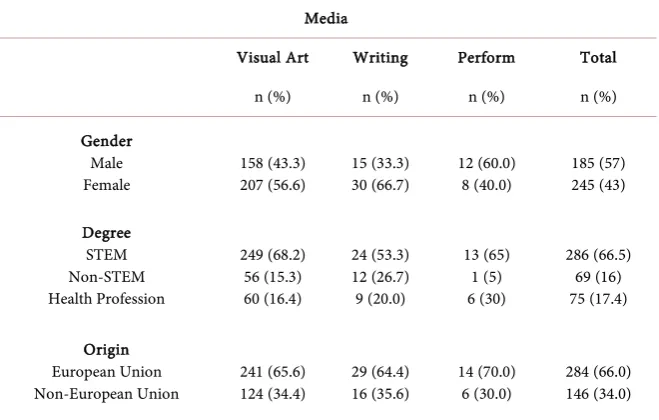
Table 1 summarizes media chosen. 365 (84.9%) of SSCs were visual, 45 (10.5%) written and 20 (4.7%) were performance works.
DOI: 10.4236/ce.2019.102029 411 Creative Education Table 1. Distribution of Media: Visual, Writing and Performance art (perform) in rela-tion to: gender, degree (primary), STEM: Science, Technology, Engineering or Mathe-matics, Non-STEM primary degrees not STEM and not health professional. Health Pro-fession: nursing or allied health profession. Origin refers to the geographical origin. % re-fers to within each category. Chi square analysis did not demonstrate statistically signifi-cant associations.
Media
Visual Art Writing Perform Total
n (%) n (%) n (%) n (%)
Gender Male
Female 158 (43.3) 207 (56.6) 15 (33.3) 30 (66.7) 12 (60.0) 8 (40.0) 185 (57) 245 (43)
Degree STEM Non-STEM Health Profession
249 (68.2) 56 (15.3) 60 (16.4)
24 (53.3) 12 (26.7) 9 (20.0)
13 (65) 1 (5) 6 (30)
286 (66.5) 69 (16) 75 (17.4)
Origin European Union
Non-European Union 241 (65.6) 124 (34.4) 29 (64.4) 16 (35.6) 14 (70.0) 6 (30.0) 284 (66.0) 146 (34.0)
3.3. Themes
The major themes of the works are documented in Table 2 and their relation-ships to background characteristics.
Six major themes were identified: The Biological (the body, disease and its management, aging and death), Mental Health (illness, wellbeing and addictions),
Life of the Student (identity formation, problem-based learning, skills/attitude ac-quisition, professionalism, stress, work-life balance, sacrifice), Life of the Doctor
included cognitive, ethical, and emotional issues, specialization, collaboration, work life balance and burn-out. Culture and Society included education, culture, public health, history of medicine, attitudes affecting health, economics, political and religious issues, women’s health, advocacy for change health inequalities, and commodification of health. The Patient Experience/Perspective included attitudes towards patients, empathy, communication, objectification, patient’s narratives, children’s experience and student’s own experiences of illness.
3.3.1. Gender
Table 2 shows there is a gender difference in themes chosen with female stu-dents choosing the Patient Experience/Perspective and Culture and Society more frequently and males tending to choose the theme of Life of the Doctor more frequently (p < 0.001). Table 3 shows cross tabulation of themes and media, which did not have significant associations.
3.3.2. Personal Experience
DOI: 10.4236/ce.2019.102029 412 Creative Education
Table 2. Student Selected Component (SSC) Themes chosen by medical student by
gender (%). Chi square analyses (on categorical variables) indicated that female student chose Medicine and Society and the Patient Experience more frequently (p < 0.001) while males chose Life of the Doctor** more frequently (p < 0.002).
Theme Female n (%) n (%) Male Total (total) n (%)
Biological 57 (51.3) 53 (48.6) 110 (25.6) Mental Health 27 (52.9) 24 (47.1) 51 (11.9) Life of the Student* 36 (58.1) 26 (41.9) 62 (14.4) Life of the Doctor** 26 (38.2) 42 (61.8) 68 (15.8) Culture and Society* 56 (65.9) 29 (34.1) 85 (19.8) The Patient Experience/Perspective* 43 (79.6) 11 (20.4) 54 (12.6)
Table 3. Themes and media chosen. There were no statistically significant associations.
Theme Visual Arts n (%) Writing n (%) Perform n (%)
Biological 94 (25.8) 11 (24.4) 5 (25.0) Mental Health 43 (11.8) 5 (11.1) 3 (15.0) Life of the Student 52 (14.2) 6 (13.3) 4 (20.0) Life of the Doctor 60 (16.4) 5 (11.1) 3 (15.0) Culture and Society 74 (20.3) 9 (20.0) 2 (10.0) The Patient Experience/Perspective 42 (11.5) 3 (20.0) 54 (12.6) Total 365 (84.9) 45 (10.5) 20 (4.7)
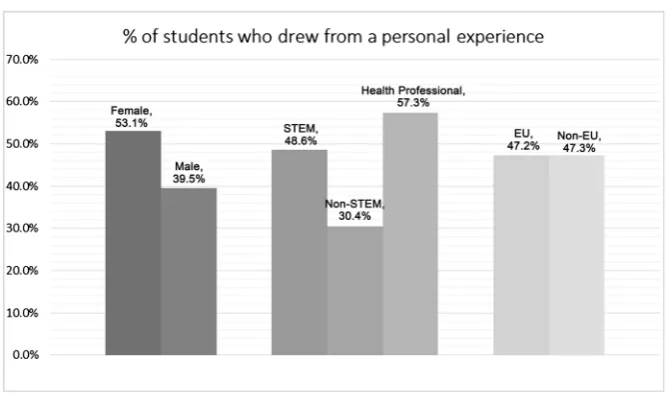
work was based on personal experience (Table 3). Students with a health profes-sional background were most likely to draw from a personal experience in choosing a topic for their SSC (57.3%), non-STEM 30.4% (p < 0.005). Overall 47.2% reported basing the SSC on personal experience, with female students doing so more frequently (53%) compared to males (39.5%, p <0.005). Female students and students with a previous allied medical professional degree were significantly more likely to base their theme on personal experience (Figure 1).
4. Discussion
[image:6.595.208.539.288.425.2]DOI: 10.4236/ce.2019.102029 413 Creative Education Figure 1. Proportion of students basing their SSC on personal experience. STEM: Science, Technology, Engineering, Mathematics, Allied Health Professionals degree (Health Prof.). And origin EU = European Union, Non-EU = Non-European Union. Significant difference at p < 0.001.
4.1. Creativity
There is no consensus on the definition of creativity or how to measure it, a simple definition from the Oxford Dictionary (2018) describes it as the use of imagination or original ideas; inventiveness. However, there is much debate on the elements of creativity and uncertainty on how best to measure it (Kaufman & Steinberg, 2010). There are few studies of “objective” measures of creativity in doctors and medical students. In a recent study of medical graduates, a com-monly employed questionnaire measuring creativity suggested a link to the per-sonality traits of Openness to Experience, but an inverse correlation to conscien-tiousness (Patterson & Zibarras, 2017). The majority of our students came from a STEM primary degree background which traditionally places limited emphasis on creativity or reflection. The importance of creativity in medical education has been acknowledged (Baruch, 2017; Bandaranayake, 2013) but underexplored in medical students (Green et al., 2016) while its importance is obvious especially when it comes to innovation in medicine (Darzi, 2009). The integration of the Humanities and Arts into STEM university degrees is now being strongly advo-cated by the American Academy of Science, Engineering and Medicine (Skorton & Bear, 2018; Lachman, 2018; Ness, 2011). The engagement and quality of the work from many students surprised with some dedicating special afford.
DOI: 10.4236/ce.2019.102029 414 Creative Education 2016), while its importance is obvious especially when it comes to innovation (Darzi, 2009). At the University of Bristol, medical students also chose a wide range of media and may have chosen creative works as a respite from the “fact” and memory-based dominance of the curriculum (Thompson, Lamont-Robinson, & Younie, 2010). The preference for an original work may be driven by emo-tions and ideas that could only be expressed through original work as has been highlighted in students who write poetry (Shapiro, 2009). The majority of hu-manities modules employ traditional taught programmes without taking into account student preferences. In our study, students undertook the risks in em-barking on a creative work (especially those with limited or no prior skill), rather than the “safer” approach of submitting a critique of a “given” work. It has been suggested that assignments that challenge students to solve problems for which they may not have a background, training and knowledge may be one way of encouraging creativity (Bandaranayake, 2013).
4.2. Media
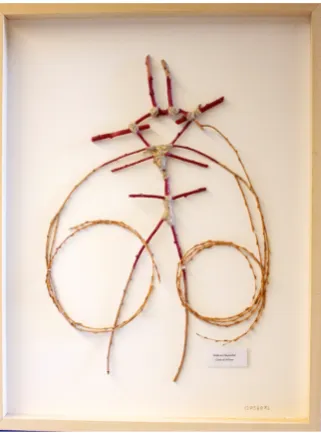
[image:8.595.293.454.442.659.2]There was a wide range of visual media approaches. Somewhat surprisingly, 85% of students presented a visual project with only choosing 10% writing and 5% performing arts. This differs from a U.S. study where 78% were written and a minority was visual arts (Shapiro et al., 2016). In our School, students used a wide range of natural materials such as wood (Circle of Willis fashioned from the flexible branches’ of the Willow tree, see Figure 2), metal (a copper cistern forged into a heart), paper and origami, e.g. one consisting of 1000 miniature elements representing dermal histology.
Figure 2. SSC Theme: Biological, Willow tree branches, tape and oil paint on board. Title:
DOI: 10.4236/ce.2019.102029 415 Creative Education Soft media from wool to crochet were also creatively employed usually for re-presentations of organs. Conventional painting and drawing were also employed (Figure 3 and Figure 4).
[image:9.595.208.539.251.412.2]Traditional mixed media selected included papier maché, wire, and soft mate-rials. Digital methods included audio, video, and 3D printing. Many students learned novel techniques such as silkscreen painting to specialized photography to convey their ideas. These often involved trial and error and repeated cycles of experimentation (and failure). Many students reported unexpected insight and engagement with the SSC and initial skepticism was replaced with satisfaction as reported in other arts based SSCs (de la Croix et al., 2011). We would have expected a higher proportion of projects to be written with the options of fiction,
Figure 3. SSC Theme: Mental Health painting (oil on canvas detail). Title: Extreme Measures Series, on the history of physical therapies in psychiatry illustrating electro-convulsive therapy on the left and pre-frontal leucotomy with trans-orbital approach on the right.
[image:9.595.213.537.477.682.2]DOI: 10.4236/ce.2019.102029 416 Creative Education poetry, or essays as has been the trend in other studies (Shapiro et al., 2016). This might be because students were required to provide written reflections, which may have been sufficient to fulfill the students’ need to explain their ideas in writing. The small numbers in performance media such as dance, musical composition and theatre (original compositions were required) may have re-flected an absence of sufficient skill to provide a work that would guarantee a pass mark or a merit. There were no statistically significant relationship between media and themes but this could be because of smaller numbers in non-visual media. We can also speculate that students may have believed the greatest chance of obtaining higher grades in visual works.
4.3. Themes
Biological themes (26%) were the most commonly chosen. The majority of stu-dents had a STEM primary degree but the majority of STEM stustu-dents (74.5%) chose a non-biological theme. Biological themes included envisioning anatomy, physiology, histology, the brain, diseases, aging and death in imaginative and novel ways beyond the textbook and the functionally representative. STEM stu-dents (11.2%) were as likely as non-STEM stustu-dents (10.1%) to choose the Pa-tient Experience/Perspective (Figure 4) but not unsurprisingly students with an allied health professional degree (20%) chose this theme significantly more fre-quently. These findings suggest STEM students in medical school are willing to explore areas outside the familiar, which was a pedagogical objective of the SSC.
There are few studies with thematic analysis in medical student art works. Shapiro (2009) examined 576 student poems identifying the following themes: the anatomy experience; becoming a doctor; becoming a patient; doctor patient relationships; language and culture, death and dying; society and medicine life and love (Shapiro, 2009). These themes were quite similar to those expressed by our students though most of our students conveyed the themes through visual media. Themes in a humanities SSM in a Californian pediatric clerkship demon-strated that students focused most frequently on the patient experience (Shapiro et al., 2016). Cox et al. (2016) analysed themes in art works from a wide group of health professionals, mainly medical students, who voluntarily submitted works to a conference (subject content is not documented). Interestingly, there is some overlap in their qualitative thematic analysis with those of this current study e.g. enhancing learning, balancing work and life, surviving medical school, self-care, patient experience, advocating change in medicine and society and escaping constraints. Cox et al. (2016) also emphasized the powerful positive effects of art making on the group however the participants were self-selected and from a wider professional body (i.e. not just medical students/professionals).
DOI: 10.4236/ce.2019.102029 417 Creative Education Some works were inspired by experiences of afflicted relatives of students baring witness to personal anguish. Life of the Student themes also contained mental health issues focusing on personal stress, anxiety and depression associated with work intensity, sacrifice, burnout, mental health, social media addiction, assess-ment, work life balance, and the experience of PBL. This focus on mental health and addiction possibly reflects the relatively high prevalence of mental health difficulties in medical students compared to that of the general population (Rotenstein et al., 2016). Ensuring a work-life balance was a common theme and which has become a major issue for doctors (Rich et al., 2016). Many of our stu-dents SSCs explored the issue in supporting mental health in Life of the Student. A recent systematic review supports the evidence base for the beneficial effects of creative arts-based interventions in stress management (Martin et al., 2018) and is one of the additional missions of our SSC.
In our study male students tended to choose the theme Life of the Doctor for their humanities projects more frequently than female students. Students por-trayed issues of professionalism, inter-professional working, life of the surgeon, the cognitive process in everyday practice and dilemmas relating to ethics and emigra-tion. Some focused on negative sentiments including “burn out”, distressed work life balance, medical and future employment. There are few recent studies on medical students’ perceptions of the Life of the Doctor (Draper & Louw, 2007). This focus on Life of the Doctor may reflect the experience of observing their pro-fession at close range that our students acquire through longitudinal early patient contact in the first two years of their medical degree programme.
Female students more frequently chose the theme of the Patient Experience.
This included experiences such as fear, loneliness, objectification bewilderment, dependency and other forms of distress. This finding could be related to the fact that female medical students score higher than male students in measurements of empathy (Quince et al., 2016; Berg et al., 2015; Hojat et al., 2002). Empathy in the context of medicine has been defined as a cognitive attribute requiring un-derstanding experiences, concerns and perspective of others with a capacity to communicate this and an intention to help (Berg et al., 2015). In this study nei-ther primary degree nor origin predicted an association with choosing the theme of the Patient Experience.Culture and Society was also more frequently chosen by female students and included priorities in societal needs, education, public health, women’s health, the influence of law, religion and culture on health, health inequalities, commodification and health care access, advocacy, home-lessness, HIV and other stigmatization. The focus on this theme may reflect the movement towards social responsibility and accountability that is becoming an emerging goal of medical education today (Reeve et al., 2017). Interestingly background degree and origin was not statistically associated with this theme. Whilst authors may speculate that differences in identity (ethnic diversity, so-cio-economic background for example) may result in differences in themes, these were not analysed in this study.
DOI: 10.4236/ce.2019.102029 418 Creative Education for female students possible due to better insight in to the value and validity of ex-perience in reflection. This could also reflect a more maturely formed medical pro-fessional identity. Furthermore Personal Experience was more likely to influence themes in students with an allied medical professional degree suggesting perhaps more awareness of the validity of their life experience in choosing a theme.
This SSC was compulsory. Macnaughton (2000) describes her experience with various humanities courses in medical education and emphasised that voluntary participation attracts the “converted”, but a compulsory course risks breeding resentment and apathy which may be the case depending on the stage of the cur-riculum. We believe that summative assessment in this SSC incentivised many students to achieve higher standards than would be achieved than in a non-assessed SSC (Wormald et al., 2009).
4.4. Limitations
One possible limitation is that students’ choice of project was influenced by works presented by students from earlier years. There may also have been un-identified external factors influencing themes chosen e.g. belief that certain ideas were “safer” or more likely to score highly however marks for previous. Howev-er, SSC projects are not published so there is no objective evidence available to students, other than hearsay from other students, to support this belief.
This study was also confined to graduate entry medical students in a single in-stitution and one might therefore argue that the findings are not generalizable. However, the purpose of the study was to describe a novel SSC (that might ulti-mately be used in other medical education curricula) and to explore the factors that might influence students’ project choice. The authors therefore believe that this paper offers a very helpful foundation to future research in this area despite this limitation. Future work would include a deeper narrative analysis of student reflections and an exploration as to how students use art as a way of interpreting and understanding themselves, each other and the world. A randomized-control control with those who completed a SSC and those who did not to examine how this might increase medical students’ creativity would also prove useful. As the SSC in our School was compulsory, authors were unable to adopt this metho-dology on this occasion.
5. Conclusion
curricu-DOI: 10.4236/ce.2019.102029 419 Creative Education lum. Female students chose themes more often related to the patient experience and medicine and society with male students tending to opt for the life of the doctor as their preferred theme. We are uncertain of the short or long-term val-ue of such a SSC or its relationship to other aspects of academic performance but believe assessment may have positively influenced engagement in the Humani-ties and Arts but these issues deserve further investigation. It is anticipated that future work will focus on a deeper narrative analysis of students’ accompanying reflections to investigate in detail individual meaning of these students’ works and the relationship of aptitude of the SSC to general scholastic aptitude in medical school.
Acknowledgements
Authors would like to thank Professor Ailish Hannigan at the Graduate Entry Med-ical School, University of Limerick, in reviewing and advising on statistMed-ical data.
Conflicts of Interest
The authors report no conflict of interest. The authors alone are responsible for the content and writing of the article.
Ethics Approval
The study was approved by the Education and Health Science Faculty Ethics Committee (2017_01_05_EHS) and written student consent obtained for public exhibition of the works.
Availability of Data and Materials
The datasets used and/or analysed during the current study are available from the corresponding author on reasonable request.
Funding
There was no funding source for this work.
Biographical Notes
• James A O’Hare MD, FRCPI, FRCPI is module lead in Professional
Compe-tencies year 3 and 4, Adjunct Associate Professor of Medicine at Graduate Entry Medical School, University of Limerick and Consultant Physician.
• Diane O Doherty is a research assistant based in the Graduate Entry Medical
School at the University of Limerick.
• Sarah Hyde MB, BCh, BAO, MRCPI, MICGP, M.Ed. is Lecturer in Medical
Education at the Graduate Entry Medical School, University of Limerick and General Practitioner.
• Deirdre McGrath, MB, BCH, BAO, MD, MMED, FRCP, FRCI, is Professor &
DOI: 10.4236/ce.2019.102029 420 Creative Education
References
Arnott, R. (2002). The University of Birmingham Medical School and the History of Medicine. Medical Humanities, 28, 33-34. https://doi.org/10.1136/mh.28.1.33
Bandaranayake, R. C. (2013). Study Skills. In K. Walsh (Ed.), Oxford Textbook of Medical Education. Oxford: Oxford University Press.
https://doi.org/10.1093/med/9780199652679.003.0021
Bardes, C., Gillers, D., & Herman, A. (2001). Learning to Look: Developing Clinical Ob-servational Skills at an Art Museum. Medical Education, 35, 1157-1161.
https://doi.org/10.1046/j.1365-2923.2001.01088.x
Baruch, J. M. (2017). Doctors as Makers. Academic Medicine, 92, 40-44.
https://doi.org/10.1097/ACM.0000000000001312
Berg, K., Blatt, B., Lopreiato, J., Jung, J., Schaeffer, A., Heil, D., Owens, T., Carter-Nolan, P., Berg, D., Veloski, J. et al. (2015). Standardized Patient Assessment of Medical Stu-dent Empathy: Ethnicity and Gender Effects in a Multi-Institutional Study. Academic Medicine, 90, 105-111. https://doi.org/10.1097/ACM.0000000000000529
Biley, F. C., & Champney-Smith, J. (2002). “Attempting to Say Something without Saying It...”: Writing Haiku in Health Care Education. Medical Humanities, 29, 39-42.
https://doi.org/10.1136/mh.29.1.39
Bleakley, A. (2015). Medical Humanities and Medical Education: How the Medical Hu-manities Can Shape Better Doctors. New York: Routledge.
https://doi.org/10.4324/9781315771724
Cole, T. R., Carlin, N. S., & Carson, R. A. (2015). Medical Humanities. Cambridge: Cam-bridge University Press.
Cox, S. M., Brett-Maclean, P., & Courneya, C. A. (2016). “My Turbinado Sugar”: Art-Making, Well-Being and Professional Identity in Medical Education. Arts & Health, 8, 65-81.
https://doi.org/10.1080/17533015.2015.1037318
Darzi, A. (2009). Why Innovation Matters. BMJ, 339, b2970.
https://doi.org/10.1136/bmj.b2970
de la Croix, A., Rose, C., Wildig, E., & Willson, S. (2011). Arts-Based Learning Arts-Based Learning in Medical Education: The Students’ Perspective. Medical Education, 45,
1090-1100. https://doi.org/10.1111/j.1365-2923.2011.04060.x
Downie, R. S., Hendry, R. A., Macnaughton, R. J., & Smith, B. H. (1997). Humanizing Medicine: A Special Study Module. Medical Education, 31, 276-280.
https://doi.org/10.1111/j.1365-2923.1997.tb02925.x
Draper, C., & Louw, G. (2007). What Is Medicine and What Is a Doctor ? Medical Stu-dents’ Perceptions and Expectations of Their Academic and Professional Career. Med-ical Teacher, 29, e100-e107. https://doi.org/10.1080/01421590701481359
Dyche, L., & Epstein, R. M. (2011). Curiosity and Medical Education. Medical Education, 45, 663-638. https://doi.org/10.1111/j.1365-2923.2011.03944.x
Fins, J. J., Pohl, B., & Doukas, D. J. (2013). In Praise of the Humanities in Academic Medicine Values, Metrics, and Ethics in Uncertain Times. Cambridge Quarterly of Healthcare Ethics, 22, 355-364. https://doi.org/10.1017/S0963180113000200
Glasser, B. (2001). From Kafka to Casualty: Doctors and Medicine in Popular Culture and the Arts—A Special Studies Module. Medical Humanities, 27, 99-101.
https://doi.org/10.1136/mh.27.2.99
DOI: 10.4236/ce.2019.102029 421 Creative Education Journal of Medical Humanities, 37, 475-483.
https://doi.org/10.1007/s10912-016-9397-1
Hojat, M., Gonnell, J. S., Mangione, S., Nasca, T. J., Veloski, J. J., Erdman, J. B., Callahan, C. A., & Magee, M. (2002). Empathy in Medical Students as Related to Academic Per-formance, Clinical Competence and Gender. Medical Education, 36, 522-527.
https://doi.org/10.1046/j.1365-2923.2002.01234.x
Jackson, N. (2005). Creativity in Medicine and Medical Education.
http://www.creativeacademic.uk/uploads/1/3/5/4/13542890/creativity_in_medicine.pdf
Kaufman, J. C., & Sternberg, R. J. (2010). The Cambridge Handbook of Creativity. Cam-bridge: Cambridge University Press. https://doi.org/10.1017/CBO9780511763205
Kirklin, D., Meakin, R., Singh, S., & Lloyd, M. (2000). Living with and Dying from Can-cer: A Humanities Special Study Module. Medical Humanities, 26, 51-54.
https://doi.org/10.1136/mh.26.1.51
Kumagai, A. K. (2012). Perspective: Acts of Interpretation. A Philosophical Approach to Using Creative Arts in Medical Education. Academic Medicine, 87, 1138-1144.
https://doi.org/10.1097/ACM.0b013e31825d0fd7
Kuper, A. (2006). Literature and Medicine: A Problem of Assessment Background. Aca-demic Medicine, 81, S128-S137. https://doi.org/10.1097/00001888-200610001-00032
Lachman, R. (2018). STEAM Not STEM: Why Scientists Need Arts Training. The Con-versation.
https://theconversation.com/steam-not-stem-why-scientists-need-arts-training-89788
Lazarus, P. A., & Rosslyn, F. M. (2003). The Arts in Medicine: Setting up and Evaluating a New Special Study Module at Leicester Warwick Medical School. Medical Education, 37, 553-559. https://doi.org/10.1046/j.1365-2923.2003.01537.x
Macnaughton, J. (2000). The Humanities in Medical Education: Context, Outcomes and Structures. Medical Humanities, 26, 23-30. https://doi.org/10.1136/mh.26.1.23
Mangione, S., Chakraborti, C., Staltari, G., Harrison, R., Tunkel, A. R., Liou, K. T., Cer-ceo, E., Voeller, M., Bedwell, W. L., Fletcher, K., & Kahn, M. J. (2018). Medical Stu-dents’ Exposure to the Humanities Correlates with Positive Personal Qualities and Re-duced Burnout: A Multi-Institutional US Survey. Journal of General Internal Medicine, 33, 628-634. https://doi.org/10.1007/s11606-017-4275-8
Martin, L., Oepen, R., Bauer, K., Nottensteiner, A., Mergheim, K., Gruber, H., & Koch, S. C. (2018). Creative Arts Interventions for Stress Management and Prevention—A Sys-tematic Review. Behavioral Sciences, 8, 28. https://doi.org/10.3390/bs8020028
Ness, R. B. (2011). Commentary: Teaching Creativity and Innovative Thinking in Medi-cine and the Health Sciences. Academic Medicine, 86, 1201-1203.
https://doi.org/10.1097/ACM.0b013e31822bbb9f
Ofri, D. (2013). Medical Humanities: The Rx for Uncertainty. Academic Medicine, 92,
165-1658.
Oxford Dictionary (2018). Definition of Creativity in English.
https://en.oxforddictionaries.com/definition/creativity
Patterson, F., & Zibarras, L. D. (2017). Selecting for Creativity and Innovation Potential: Implications for Practice in Healthcare Education. Advances in Health Sciences Educa-tion, 22, 417-428. https://doi.org/10.1007/s10459-016-9731-4
DOI: 10.4236/ce.2019.102029 422 Creative Education https://doi.org/10.1186/s12909-016-0603-7
Reeve, C., Woolley, T., Ross, S. J., Mohammadi, L., Halili, S. B., Cristobal, F., Siega-Sur, J. L., & Neusy, A. J. (2017). The Impact of Socially-Accountable Health Professional Education: A Systematic Review of the Literature. Medical Teacher, 39, 67-73.
https://doi.org/10.1080/0142159X.2016.1231914
Rich, A., Viney, R., Needleman, S., Griffin, A., & Woolf, K. (2016). “You Can’t Be a Per-son and a Doctor”: The Work-Life Balance of Doctors in Training—A Qualitative Study. BMJ Open, 6, e013897.
Riley, S. C. (2009). Student Selected Components (SSCs): AMEE Guide No 46. Medical Teacher, 31, 885-894. https://doi.org/10.3109/01421590903261096
Riley, S. C., & Murphy, M. J. (2013). Student Choice in the Undergraduate Curriculum: Student-Selected Components. In K. Walsh (Ed.), Oxford Textbook of Medical Educa-tion. Oxford: Oxford University Press.
Root-Bernstein, R., & Root-Bernstein, M. (2013). The Art and Craft of Science. Educa-tional Leadership, 5, 16-21.
Rotenstein, L. S., Ramos, M. A., Torre, M., Segal, J. B., Peluso, M. J., Guille, C., Sen, S., & Mata, D. A. (2016). Prevalence of Depression, Depressive Symptoms, and Suicidal Ide-ation among Medical Students: A Systematic Review and Meta-Analysis. JAMA, 316,
2214-2236. https://doi.org/10.1001/jama.2016.17324
Shapiro, J. (2009). The Inner World of Medical Students. Oxford: CRC Press.
Shapiro, J., & Hunt, H. (2003). All the World’s a Stage: The Use of Theatrical Perfor-mance in Medical Education. Medical Education, 37, 922-927.
https://doi.org/10.1046/j.1365-2923.2003.01634.x
Shapiro, J., Ortiz, D., Ree, Y.Y., & Sarwar, M. (2016). Medical Students’ Creative Projects on a Third Year Pediatrics Clerkship: A Qualitative Analysis of Patient-Centeredness and Emotional Connection. BMC Medical Education, 16, 93.
https://doi.org/10.1186/s12909-016-0614-4
Skorton, D., & Bear, A. (2018). The Integration of the Humanities and Arts with Sciences, Engineering, and Medicine in Higher Education: Branches from the Same Tree. Washington DC: The National Academies Press.
Thompson, T., Lamont-Robinson, C., & Younie, L. (2010). “Compulsory Creativity”: Ra-tionales, Recipes, and Results in the Placement of Mandatory Creative Endeavour in a Medical Undergraduate Curriculum. Medical Education Online, 15, Article No. 5934.
https://doi.org/10.3402/meo.v15i0.5394
Wormald, B. W., Schoeman, S., Somasunderam, A., & Penn, M. (2009). Assessment Drives Learning: An Unavoidable Truth? Anatomical Sciences Education, 2, 199-204.