doi:10.4236/jemaa.2011.39056 Published Online September 2011 (http://www.SciRP.org/journal/jemaa)
Thin Film Characterization Using Rotating
Polarizer Analyzer Ellipsometer with a Speed
Ratio 1:3
Sofyan A. Taya*, Taher M. El-Agez, Anas A. Alkanoo
Physics Department, Islamic University of Gaza, Gaza, Palestine. Email: *[email protected]
Received June 26th, 2011; revised July 27th, 2011; accepted August 10th, 2011.
ABSTRACT
In a recent previous work, we proposed a rotating polarizer-analyzer ellipsometer (RPAE) in which the two elements are rotating synchronously in the same direction with a speed ratio 1:3. We applied this technique to bulk samples. In this work, we present theoretically the characterization of 100 nm SiO2 thin film using this spectroscopic RPAE. We assume a structure consisting of air (ambient)/SiO2 (thin film)/c-Si (substrate). The ellipsometric parameters ψ and Δ are calcu-lated when a clean signal is received by the detector and when a hypothetical noise is imposed on this signal. The film thickness and the optical constants of the film are calculated for the noisy signal in the spectrum range 200 - 800 nm. The results are compared with the proposed thickness and with the accepted values for SiO2 optical constants.
Keywords: Ellipsometry, Rotating Polarizer-Analyzer Ellipsometer, Thin Film Characterization, Optical Constants, C-Si, Sio2
1. Introduction
Due to the unique optical and electric features of thin film structures, they have been widely studied in various appli-cations such as sensors and optical waveguides. However, imperfections such as small crackers, isolated islands, and layer roughness are inevitable in practical fabrication process of thin films [1]. These imperfections are in the nano-scale level. Thus, characterization of thin film with high spatial resolution becomes essential to ensure the performance of designed thin film devices. Among the different characterization methods, optical characterization techniques are preferred due to their non-destructiveness. Two commonly used optical methods are surface plasmon resonance methods [2], and ellipsometry methods [3-6]. Spectroscopic ellipsometry is nowadays a standard optical technique for studying the optical properties of materials and for thin films characterization.
An ellipsometric measurement allows one to quantify the phase difference between Ep and Es, Δ, and the ratio
of their amplitudes given by tanψ. For a reflecting sur-face, the forms of Δ and ψ are
p s
and tan p
s
r r
, (1)
where pand sare the phase changes for the p and s components of light and rp and rs are the complex Fresnel
reflection coefficients for the p and s components which may be written as
e e
p
s i
p p
i s s
r r
. (2)
requires particular techniques and the calibration of such system is also time consuming [13].
In 1987, a RPAE was proposed and constructed [11]. In the design, the polarizer and the analyzer rotate with a speed ratio 1:2. The final light intensity then contains three cosine terms from which ψ and Δ are calculated. In this design, the errors arising from the phase shift and dc background are eliminated.
An improved RPAE was proposed [12,13] with the speed ratio still being 1:2 but with the incident angle be-ing fully variable. Moreover, a fixed polarizer was placed in the optical path to eliminate the source polarization effect. The final light intensity thus contains four ac components. The optical constants and the ellipsometric parameters were obtained by calculating any one of the two sets of ac signals.
In 2010, El-Agez et al. proposed a RPAE in which the polarizer and the analyzer are rotating synchronously in opposite directions at the same speed [14]. The light in-tensity involves four components, one dc and three co-sine terms, with frequencies of ω, 2ω, and 3ω.
A RPAE in which the two elements rotate in the same direction with the same angular speed was also proposed and applied to bulk c-Si and Au samples [15]. The results of bulk samples have shown high accuracy. In a recent
theoretical work [16], a RPAE in which the polarizer and the analyzer are rotating synchronously in the same di-rection at a speed ratio 1:3 is proposed. The light inten-sity received by the detector contains six components, one dc and five ac, with frequencies of 2ω, 4ω, 6ω, 8ω, and 10ω, respectively. The ellipsometric parameters ψ
and Δ were calculated using any of six different sets of the Fourier coefficients. The results from the simulated spectra of the complex refractive index of c-Si, ZnSe, and GaP were presented.
In this work, we examine theoretically the noise effect on the characterization of 100 nm SiO2 thin film using the RPAE described in [16]. The structure under consid-eration consists of a thin SiO2 film sandwiched between air and silicon substrate. The optical parameters and the thickness of the film are calculated from the ellipsome- tric parameters and compared to accepted values. In or-der to simulate reality we consior-der a hypothetical noise is imposed on the clean signal. This noise causes a percent error on the calculated values. The percent error is also presented.
2. Theory
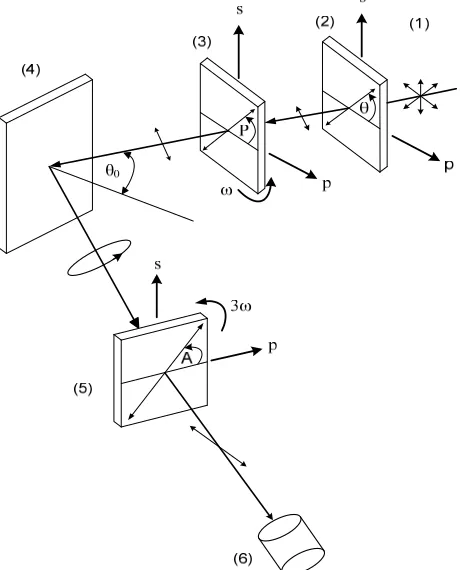
[image:2.595.199.434.396.681.2]The basic setup of the proposed ellipsometer is shown
Figure 1. It consists of the following elements: 1) light
source; 2) fixed linear polarizer; 3) linear polarizer rotat-ing at ω; 4) an isotropic specimen; 5) linear analyzer ro-tating at 3ω; and 6) a photodetector. Here we as- sume that the azimuth angles of the rotating polarizer and the rotating analyzer are given by P = ωt + τ and A = 3ωt + δ, respectively, where τ and δ are the azimuth an-gles of the rotating polarizer and the rotating analyzer at t = 0, respectively. A well-collimated beam of monochro-matic unpolarized light successively emerges through the fixed polarizer, the rotating polarizer, then is reflected from the sample, and finally is collected by the detector through the projection of the analyzer as shown in Fig-ure 1.
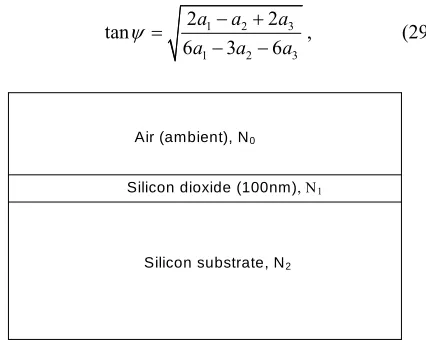
[image:3.595.89.541.327.733.2]The sample under consideration consists of a thin SiO2 film of thickness d = 100 nm and refractive index N1 sandwiched between an ambient (air) of refractive index N0 and a c-Si substrate of refractive index N2 as shown in
Figure 2. For the proposed configuration, the Fresnel reflection coefficients of the system is given by [3]
01 12
01 12
exp( 2 ) 1 exp( 2 )
j j
j
j j
r r i
r
r r i
, (3)
where
j stands for s in s-polarization and for p in p-polarization,
0 0 1 1
01
0 0 1 1
cos( ) cos( ) cos( ) cos( )
s N N r N N
(4)
1 1 2 2
12
1 1 2 2
cos( ) cos( ) cos( ) cos( )
s N N r N N
, (5)
1 0 0 1
01
1 0 0 1
cos( ) cos( ) cos( ) cos( )
p N N r N N
, (6)
2 1 1 2
12
2 1 1 2
cos( ) cos( ) cos( ) cos( )
p N N r N N
(7)
1 1
2πd N cos( )
(8) and θ1 and θ2 are the refraction angles in the film and the substrate, respectively.
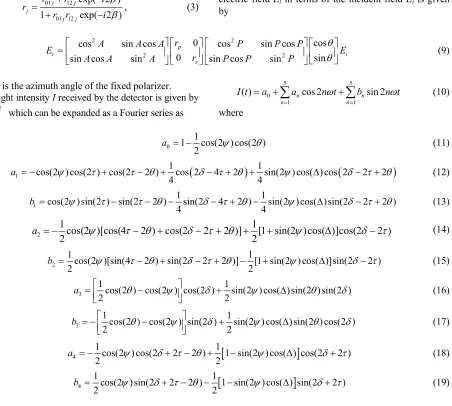
Employing Jones-matrix formalism, the transmitted electric field Et in terms of the incident field Ei is given
by
2 2
2 2
0 cos
cos sin cos cos sin cos
0 sin
sin cos sin sin cos sin
p
t i
s r
A A A P P P
E E
r
A A A P P P
(9)
where θ is the azimuth angle of the fixed polarizer. The light intensity I received by the detector is given by
2
t
I E which can be expanded as a Fourier series as
5 5
0
1 1
( ) ncos 2 nsin 2
n n
I t a a n t b n t
(10)where
0
1
1 cos(2 ) cos(2 ) 2
a (11)
1
1 1
cos(2 ) cos(2 ) cos(2 2 ) cos 2 4 2 sin(2 ) cos( ) cos 2 2 2
4 4
a
(12)1
1 1
cos(2 )sin(2 ) sin(2 2 ) sin(2 4 2 ) sin(2 ) cos( )sin(2 2 2 )
4 4
b (13)
) 2 2 cos( )] cos( ) 2 sin( 1 [ 2 1 )] 2 2 2 cos( ) 2 4 )[cos( 2 cos( 2 1
2
a (14)
2
1 1
cos(2 )[sin(4 2 ) sin(2 2 2 )] [1 sin(2 ) cos( )]sin(2 2 )
2 2
b (15)
3
1cos(2 ) cos(2 ) cos(2 ) 1sin(2 ) cos( )sin(2 )sin(2 )
2 2
a
(16)
3
1cos(2 ) cos(2 ) sin(2 ) 1sin(2 ) cos( )sin(2 ) cos(2 )
2 2
b
(17)
4
1cos(2 ) cos(2 2 2 ) 1 1 sin(2 ) cos( ) cos(2 2 )
2 2
a (18)
4
1cos(2 )sin(2 2 2 ) 1 1 sin(2 ) cos( ) sin(2 2 )
2 2
5
1 1
cos(2 4 2 ) sin(2 ) cos( ) cos(2 2 2 )
4 4
a (20)
5
1sin(2 4 2 ) 1sin(2 ) cos( )sin(2 2 2
4 4
b )
Assuming that the azimuth angles θ, τ, and δ are equal zero, Equation (10) reduces to
(21)
to
5
0 1
( ) ncos 2
n
I t a a n t
, (22)where the coefficients an are given by
2 2
0 3
2 1
p s
a , (23)
2 2
1
1 1
9 scos, (24)
8 p s 4 p
a
2 2
2
1 1
3
4 p s 2 p s
a cos, (25)
2 23 1
3
4 p s
a , (26)
2 4
1 1
cos
2 p 2 p s
a , (27) and
2 2
5
1 1
cos
8 p s 4 p s
a . (28) The ellipsometric parameters ψ and Δ c
mined using any set containing three coef cl
an be deter-ficients. Ex-uding the dc coefficient (a0), six different sets may be obtained. These sets are (a1, a2, a3), (a1, a2, a4), (a1, a2, a5), (a2, a3, a4), (a2, a3, a5), and (a3, a4, a5). Any of these sets can be used to calculate ψ and Δ. It was shown that in Ref. [16] that the first two sets correspond to the minimum error compared to other sets. The parameters ψ
and Δ in terms of the first set are given by
1 2 3
1 2 3
2 2
tan
6 3 6
a a a
a a a
, (29)
Silicon substrate, N2
Silicon dioxide (100nm), N1
Air (ambient), N0
2 3
1 2 3 1 2 3
2 3( )
cos
(2 2 )(2 2 )
a a
a a a a a a
(30)
3. Numerical Calculations
The Fresnel complex reflection coefficients rp and rs for
p and s light components are calculated according to Equation (3) based on the published values for the re-fractive indices of c-Si and SiO2 [17]. In our calculations, we assume that the incidence angle θ0 = 70˚ and the azi-muth angles θ, τ, and δ are set to zero. Simulated light signals are generated based on Equation (9) without con-sidering imperfections and misaligned optical com
0 5
(29) and (30) are used to calculate the ellipsometric pa-rameters ψ and Δ in the spectrum range 200
-We will restrict our calculations to the first set since it onds to the minimum . These values of the po-nents. Fourier transform of the generated signal was taken to extract the coefficients a through a. Equations
800 nm.
along with the second set corresp percent error among all sets [16]
ellipsometric parameters correspond to the clean signal without considering any noise.
The ultimate accuracy and detection limit of an ellip-someter is determined by the inevitable presence of un-desired noise which causes random fluctuations in the recorded signal. This noise may originates from a variety of sources such as thermal fluctuations in the light source, mechanical vibrations, pickup of stray AC light, and the self generated noise in detectors and electronics. Such noise is reduced by signal averaging, and can be meas-ured by performing multiple identical runs and by calcu-lating the mean and the standard deviation.
In order to simulate real signals, noise was generated using MathCAD code and was superimposed on the clean signal according to the following equation
( ) 2
noise
I rnd c c I
max (rnd(e) e / 2) 0.0001I
where MathCAD’s rnd(c) function produces random noise in the range from 0 to c and rnd(e) function pro-duces random noise in the range from 0 to e. In our simulation, we consider c = e = 1. The first term repre-sents the random noise recorded by the detector due to thermal fluctuations of the light source after passing through the system, the second corresponds to Johnson noise and shot noise encountered in the detector and readout electronics, and the third term repres
(31)
[image:4.595.70.283.524.694.2]ents the dc
0 60 120 180 240 300 360 -0.6
-0.4 -0.2 0.0 0.2 0.4 0.6
N
o
is
e x 10
[image:5.595.309.534.86.258.2]Polarizer angle (deg)
Figure 3. The noise superimposed on the clean signal. -3 (vo
lt)
offset due to long time drifts. Figure 3 shows the noise superimposed on the clean signal.
This noise is added to the pure signal. Fourier trans-form of the noisy signal is taken to extract the new coef-ficients a0 through a5 in the presence of the noise. Equa-tions (18) and (19) are used again to calculate the ellip-sometric parameters ψ and Δ for the noisy signal in the same spectrum range. Figures 4 and 5 show the calcu-lated ellipsometric parameters ψ and Δ, respectively, for the clean and noisy signals in the spectrum range 200 - 800 nm.
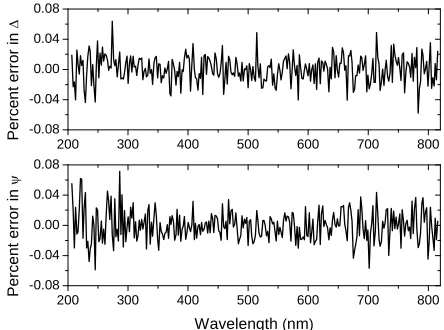
The percent error in the calculated values of ψ and Δ is shown in Figure 6. These fluctuations shown in the
fig-ure a
e es
are due to the noise imposed on the clean signal ntioned before. It is worth to mention that these valu
s m
of ψ and Δ were calculated using the coefficients a1, a2, and a3 without depending on the dc offset of the signal for the clean and the noisy signals. If the dc term is con-sidered in the calculations, the percent error in ψ and Δ
would be much higher [14-16]. This ellipsometer in which the polarizer and the analyzer rotate in the same direction with a speed ratio 1:3 has the advantage that the results do not depend entirely on this term.
The fundamental ellipsometric equation is convention-ally written as
tan( )e
s
r
, (32)
Substituting for rp and rs from Equation (3), we obtain p
r i
01 12 01 12
01 12 01 12
tan( )e
exp( 2 ) 1 exp( 2 )
1 exp( 2 ) exp( 2 )
p p s s
p p s s
i
r r i r r i
r r i r r i
(33)
This equation can be simplified [18] to give a quad-ratic equation as
40
200 300 400 500 600 700 800 8
16 24 32
240 260 37.6
38.0 38.4
clean signal with noise
(deg)
sometric parameter ψ as a function of the wavelength from 200 to 800 nm.
[image:5.595.65.281.87.251.2]Wavelength (nm)
Figure 4. The ellip
200 300 400 500 600 700 800 60
80 100 120 140 160
780 800 820 153.2
153.6 154.0
clean signal with noise
(d
eg)
Wavelength (nm)
Figure 5. The ellipsometric parameter Δ as a function of the wavelength from 200 to 800 nm.
200 300 400 500 600 700 800 -0.08
-0.04 0.00 0.04 0.08
Per
c
e
n
t er
ro
r
in
200 300 400 500 600 700 800 -0.08
-0.04 0.00 0.04 0.08
Wavelength (nm)
Pe
rc
e
n
t er
ro
r in
igure 6. Percent error in ψ and Δ as a function of the wavelength. This error arises from the noise imposed on the signal.
[image:5.595.311.535.302.472.2] [image:5.595.311.533.516.681.2]2 0
A B C (34) where
01p 01s
12p12sA r r r r (35)
01p01s 12p 12s 12s 12
B r r r r r r p, (36)
01s 01p
Cr r , (37) and
exp( 2 )i
(38) The solutions of Equation (34) have the conventional form
2 4
exp( 2 )
2
B B AC
i
A
. (39)
The thickness of the SiO2 film, d, in terms of 1
,N
and θ1 is
1 1
ln( ) 4π cos( )
i d
N
. (40)
In the considered spectrum range, Si this case the extinction coefficient is zero,
O2 is lossless. In i.e. k0. Thus will be real and hence exp( 2 j) is pure complex. Therefore,
ln 0. (41) Finally, the solution is to find
m
the value of N1 that akes
2 4
ln ln 0
2
B B AC
A
. (42)
A computer program was generated using MathCAD 20
dex o ple. Figure 7 shows the results obtained for the refractive index of SiO2 thi
sometric parameters ψ and Δ of
function of the wavelength in the range 200 - 800 nm. Th
t erro
fi function of th
ure 8. This error arises from the noise imposed on the clean si
tween ±1.5% which is accepted ra
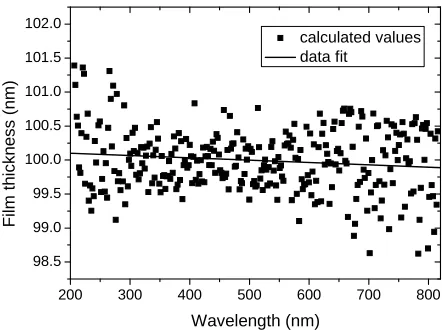
sti ated values of the film index into Equation (40). The results obtained for the thickness are plotted in Fig-ure 9 as a function of the wavelength. Th
in the film thickness as a function of the wavelength is sh
00 to solve Equaton (42) and to find the refractive in-f the sam
n film using the ellip-the noisy signal as a
e figure also shows a comparison between accepted and calculated values of the film index. The percen r
in the lm refractive index as a e
wave-length is shown in Fig
gnal. The error ranges be-nge.
The film thickness can be calculated by sub tuting the calcul
e percent error
own in Figure 10. This error arises from the noise im-posed on the clean signal. The error ranges between ±1.5% which is accepted range.
It is worth to mention that the noise used all through t
1.56 1.58 1.60 1.62 1.64
200 300 400 500 600 700 800 900 1.52
1.54
Fil
m
r
e
frac
tive
ind
ex
[image:6.595.307.534.87.253.2]Wavelength (nm)
Figure 7. Refractive index of the film versus the wavelength. Line: published values; Points: calculated values with the noise.
200 300 400 500 600 700 800 -2.0
-1.5 -1.0 -0.5 0.0 0.5 1.0 1.5
P
erce
n
t
error in
n
[image:6.595.58.288.87.207.2]Wavelength (nm)
Figure 8. Percent error in the film refractive index as a function of the wavelength.
200 300 400 500 600 700 800 98.5
99.0 99.5 100.0 100.5 101.0 101.5 102.0
calculated values data fit
F
ilm t
h
ick
n
e
ss
(n
m)
Wavelength (nm)
[image:6.595.310.535.315.484.2] [image:6.595.311.532.528.693.2]200 300 400 500 600 700 800 -1.5
-1.0 -0.5 0.0 0.5 1.0 1.5 2.0
P
e
rce
n
t
error in film thick
n
e
s
s
Wavelength (nm)
200 300 400 500 600 700 800 900 -0.10
-0.05 0.00 0.05 0.10
200 300 400 500 600 700 800 900 -0.10
-0.05 0.00 0.05 0.10
Percent error
in
in
Percent error
[image:7.595.310.529.87.248.2]Wavelength (nm)
Figure 11. Percent error in ψ and Δ as a function of the wavelength in the case of a noise with SNR equal to 1050.
Thus, it is important for the verification process to have some quantities for determination of the accuracy of the simulated data as a result of misalignment of the fixed polarizer, rotating polarizer, and rotating analyzer.
he parameters to be checked are the ellipsometric p
Based on Equations (11)-(21), the percent error in ψ, Δ, n,
[image:7.595.63.280.87.248.2]les equal to zero. As can be seen fr
Figure 10. Percent error in the film thickness as a function
presented in Figure 3. The signal to noise ratio (SNR) was calculated as the ratio of the signal mean to the standard deviation of the noise [19] and found to be 2260. In order verify that the percent error is still small enough for other kinds of im-posed noises, we impose a higher signal of SNR equal to 1050. Figure 11 shows the percent error in the calculated values of ψ and Δ for the new noise. As seen from the fig-ure the error is still in the same order of that of Figure 6.
Some sources of systematic errors are due to the azi-muthal misalignment of optical elements with respect to the plane of incidence, sample mispositioning, beam de-viation, and collimation errors. Wavelength and angle of incidence errors, also, contribute to systematic errors.
and calibration of the system and by
of the wavelength.
he above calculations is the same as
T
a-rameters ψ and Δ as well as the index of refraction n and the film thickness d.
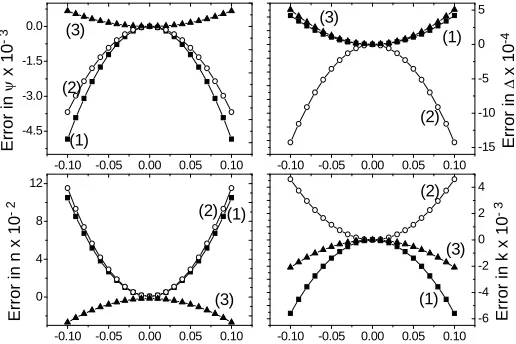
and d is calculated due to the offset in the azimuths θ, τ, and δ. Figure 12 shows the percent error committed on ψ,
Δ, n, and d as a function of the errors of the fixed polar-izer azimuth angle θ, the rotating polarizer azimuth angle
τ, and the rotating analyzer azimuth angle δ successively varied from –0.1˚ to 0.1˚ in steps of 0.01˚ while keeping the two other variab
Thus, it is necessary to invoke such error analysis in o calculations. These errors can be significantly reduced by
areful alignment
ur
om the figure, the impact of these errors on ψ, Δ, n, and d is not significant for small misalignment. The figure also reveals that the error due to misalignment of the
-15 -10 -5 0 5
c
choosing high quality optical components.
-6 -4 -2 0 2 4 -0.10 -0.05 0.00 0.05 0.
-4.5 -3.0 -1.5 0.0
10
(3)
(2)
E
rror in
x 1
0
- 3
(1)
-0.10 -0.05 0.00 0.05 0.10
(3)
(2) (1)
Erro
r in
x 10
-4
-0.10 -0.05 0.00 0.05 0.10 0
4 8 12
(3)
Erro
r in
n x 1
-0.10 -0.05 0.00 0.05 0.10
(2) (1)
0
- 2
(3) (2)
(1)
Erro
r in
k
x 1
0
- 3
Figure 12. Percent error in ψ, Δ, n, and d, for SiO2 film at λ = 632.8 nm and θ0 = 70˚, as a function of the error in (1) θ; (2) τ;
[image:7.595.169.427.517.689.2]tions, Vol. 8, No. 3, 1973, pp. 222-225.
doi:10.1016/0030-4018(73)90132-6 azimuth angle δ has almost the lowest impact on the four
parameters under consideration.
4. Conclusions
We have presented theoretically the characterization of 100 nm SiO2 thin film using RPAE in which the polar-izer and the analyzer rotate synchronously in the same direction with a speed ratio 1:3. The film thickness and the optical constants of the film are calculated for the noisy signal in the spectrum range 200 - 800 nm. As can be seen from the results, the proposed RPAE is very ac-curate and the percent error in the calculated optical pa-rameters and thickness of the film is in the accepted range. The results also show that the small misalignment of the optical elements of the structure doesn't have a
B. P. Ng and Y. C. Soh, ipsometry for Thin Film
Characteriza-press, Vol. 18, No. 4, 2010, pp.
3298-[8] D. E. Aspnes, “High Precision Scanning Ellipsometer,”
Applied Optics, Vol. 4, No. 1, 1975, pp. 220-228. [9] A.R. Zaghloul and R.M. Azzam, “Single-Element
Rotat-ing Polarizer Ellipsometer: PSI Meter,” Surface Science, Vol. 96, No. 1-3, 1980, pp. 168-173.
doi:10.1016/0039-6028(80)90301-5
[10] L. Vina, C. Umbatch, M. Cardona and L. Vodopyanov, “Ellipsometric Studies of Electric Interband Transitions in CdxHg1–xTe,” Physical Review B, Vol. 29, No. 12, 1984,
pp. 6752-6760. doi:10.1103/PhysRevB.29.6752
[11] L. Y. Chen and D. W. Lynch, “Scanning Ellipsometer by Rotating Polarizer and Analyzer,” Applied Optics, Vo. 26, No. 24, 1987, pp. 5221-5228.
[12] L. Y. Chen, X. W. Feng, Y. u, H. Z. Ma and Y. H. Qian,
1-2, 1993,
X. W. Feng, Y. Su, H. Z. Ma and Y. H. Qian,
significant impact on the film parameters.
REFERENCES
[1] Z. Liu, Y. Zhang, S. W. Kok,“Near-Field Ell tion,” Optics Ex
3310. doi:10.1364/OE.18.003298
[2] D. Roy, “Optical Characterization of Multi-layer Thin Films Using the Surface Plasmon Resonance Method: A Six Phase Model Based on the Kretschmann Formalism,”
Optics Communications, Vol. 200, No. 1-6, 2001, pp. 119-130.
[3] R. M. Azzam and N. M. Bashara, “Ellipsometry and Po-larized Light,” North-Holland, Amsterdam, 1977. [4] G. H. Tompkins, “Handbook of Ellipsometry,”William
Andrew, Heidelberg, 2005. doi:10.1007/3-540-27488-X
[5] B. Sun, Y. Chen, P. Zhou, C. H. Xu, Y. F. Kong, Y. X. Zheng and L. Y. Chen, “Ellipsometric Study of the Opti-cal Properties of Silicon-Based Si:SiO2 Composite Thin
Films under Different Annealing Temperatures,” The
rean Physical 5, 2006, pp.
2184-psometry,” Optics Society, Vol. 49, No. 9
2187.
[6] T. W. Oates, L. Ryves and M. M. Bilek, “Dielectric Func-tions of a Growing Silver Film Determined Using Dy-namic in Situ Spectroscopic Elli
press, Vol. 16, No. 4, 2008, pp. 2302-2314.
doi:10.1364/OE.16.002302
[7] D. E. Aspnes, “Fourier Transform Detection System for Rotating Analyzer Ellipsometers,” Optics
S
“Improved Rotating Analyzer-Polarizer of Scanning El-lipsometer,” Thin Solid Films, Vol. 234, No.
pp. 385-389. [13] L. Y. Chen,
“Design of a Scanning Ellipsometer by Synchronous Ro-tation of the Polarizer and Analyzer,” Applied Optics, Vol. 33, No. 7, 1994, pp. 1299-1305.
doi:10.1364/AO.33.001299
[14] T. M. El-Agez, A. A. El Tayyan and S. A. Taya, “Rotat-ing Polarizer-Analyzer Scann“Rotat-ing Ellipsometer,” Thin Solid Films, Vol. 518, No. 19, 2010, pp. 5610-5614.
doi:10.1016/j.tsf.2010.04.067
[15] T. M. El-Agez and S. A. Taya, “A Fourier Ellipsometer
6829. by Rotating Polarizer and Analyzer at a Speed Ratio 1:1,”
Journal of Sensors, Vol. 2010, 2010, Article ID: 70
doi:10.1155/2010/706829
[16] T. M. El-Agez, S. A. Taya and A. A. El Tayayn, “A Novel Scanning Ellipsometer by Rot
Analyzer at a Speed Ratio 1:3,” International Journal of ating Polarizer and Optomechatronics, Vol. 5, No. 1, 2011, pp. 51-67.
doi:10.1080/15599612.2011.559685
[17] E. D. Palik, “Handbook of Optical Constants of Solids,” Academic Press, San Diego, 1985.
[18] S. Samuel, “Ellipsometric Analyses for an Absorbing Substrate with or without an Intermediate Surface Layer,”
Surface Science, Vol. 56, 1976, pp. 97-108.
doi:10.1016/0039-6028(76)90437-4