COMPARISON OF COMPOSITION AND MICROSTRUCTURE TESTING OF ALUMINIUM
ZINC AND ALUMINIUM COPPER ALLOY USING CASTING PROCESS
*Ankur Gill and Dhiraj Parkash Dhiman
Department of Mechanical Engineering, Swami Vivekanand Institute of Engineering and Technology,
ARTICLE INFO ABSTRACT
Casting is a Process by which alloy Composition can be easily made. Due to daily Advancement in technology the material advancement to improve certain mechanical properties have to make new kinds of alloys. The various processes of Casting Aluminium Alloys
the basic structure consists of cored dendrites of aluminum solid solution, with a variety of constituents at the grain boundaries or inter
continuous network of eutectics.
with the other soluble and insoluble constituents dispersed within it. The coarse aluminium copper alloy was produced by sand mould casting method. Chemical Composition testing is also carrie by using chemical
Copyright © 2017, Ankur Gill and Dhiraj Parkash Dhiman permits unrestricted use, distribution, and reproduction
INTRODUCTION
Casting is a manufacturing process by which a liquid material is usually poured into a mold, which contains a hollow cavity of the desired shape, and then allowed to solidify. The solidified part is also known as a casting, which is ejected or broken out of the mold to complete the process. Casting materials are usually metals or various cold setting
that cure after mixing two or more components together; examples are epoxy, concrete, plaster and clay
often used for making complex shapes that would be otherwise difficult or uneconomical to make by other methods.
Aluminium casting techniques
Aluminium casting processes are classified as Ingot casting or Mould casting. During the first process, primary or secondary aluminium is cast into rolling ingot (slab), extrusion ingot (billet) and wire bar ingot which are subsequently transformed in semi- and finished products. The second process is used in the foundries for producing cast products. This is the oldest and simplest (in theory but not in practice) means of manufacturing shaped components. This section describes exclusively Mould casting which can be divided into two main groups:
*Corresponding author: Ankur Gill,
Department of Mechanical Engineering, Swami Vivekanand Institute of Engineering and Technology, Chandigarh, India.
ISSN: 0975-833X
Vol.
Article History:
Received 09th September, 2017
Received in revised form 27th October, 2017
Accepted 15th November, 2017
Published online 27th December, 2017
Citation: Ankur Gill and Dhiraj Parkash Dhiman
alloy using casting process”, International Journal of Current Research
Key words:
Casting, Aluminum Alloy, Chemical Composition Testing, Micro Hardness Testing.
RESEARCH ARTICLE
COMPARISON OF COMPOSITION AND MICROSTRUCTURE TESTING OF ALUMINIUM
ALUMINIUM COPPER ALLOY USING CASTING PROCESS
*Ankur Gill and Dhiraj Parkash Dhiman
Department of Mechanical Engineering, Swami Vivekanand Institute of Engineering and Technology,
Chandigarh, India
ABSTRACT
Casting is a Process by which alloy Composition can be easily made. Due to daily Advancement in technology the material advancement to improve certain mechanical properties have to make new kinds of alloys. The various processes of Casting Aluminium Alloys
the basic structure consists of cored dendrites of aluminum solid solution, with a variety of constituents at the grain boundaries or inter-dendritic spaces, forming a brittle, more or less continuous network of eutectics. Wrought products consist of a matrix of aluminum solid solution with the other soluble and insoluble constituents dispersed within it. The coarse aluminium copper alloy was produced by sand mould casting method. Chemical Composition testing is also carrie by using chemical Testing method.
Ankur Gill and Dhiraj Parkash Dhiman. This is an open access article distributed under the Creative in any medium, provided the original work is properly cited.
process by which a liquid material , which contains a hollow cavity of the desired shape, and then allowed to solidify. The art is also known as a casting, which is ejected or broken out of the mold to complete the process. Casting cold setting materials after mixing two or more components together; clay. Casting is most often used for making complex shapes that would be otherwise difficult or uneconomical to make by other methods.
Aluminium casting processes are classified as Ingot casting or Mould casting. During the first process, primary or secondary aluminium is cast into rolling ingot (slab), extrusion ingot (billet) and wire bar ingot which are subsequently transformed The second process is used in the foundries for producing cast products. This is the oldest and simplest (in theory but not in practice) means of manufacturing shaped components. This section describes ich can be divided into two main
Department of Mechanical Engineering, Swami Vivekanand Institute of
Sand casting
Die casting
Other techniques such as "lost
processes are also used but their economical importance is considerably lower than both listed techniques.
Sand Casting
In sand casting, re-usable, permanent patterns are used to make the sand moulds. The preparation and the bondin
mould are the critical step and very often are the rate controlling step of this process. Two main routes are used for bonding the sand moulds:
The "green sand" consists of mixtures of sand, clay and moisture.
The "dry sand" consists of san cured thermally or chemically.
The sand cores used for forming the inside shape of hollow parts of the casting are made using dry sand components.
This versatile technique is generally used for high production. An example of half sand mould is given in Figure 1. Normally, such moulds are filled by pouring the melted metal in the filling system. Mould designing is a particularly complex art and is based on the same principle as gravity die
International Journal of Current Research
Vol. 9, Issue, 12, pp.62366-62370, December, 2017
Ankur Gill and Dhiraj Parkash Dhiman, 2017. “Comparison of composition and microstructure testing of aluminium zinc & aluminium copper
Journal of Current Research, 9, (12), 62366-62370.
Available online at http://www.journalcra.com
z
COMPARISON OF COMPOSITION AND MICROSTRUCTURE TESTING OF ALUMINIUM
ALUMINIUM COPPER ALLOY USING CASTING PROCESS
Department of Mechanical Engineering, Swami Vivekanand Institute of Engineering and Technology,
Casting is a Process by which alloy Composition can be easily made. Due to daily Advancement in technology the material advancement to improve certain mechanical properties have to make new kinds of alloys. The various processes of Casting Aluminium Alloys were studied. In the cast alloys the basic structure consists of cored dendrites of aluminum solid solution, with a variety of dendritic spaces, forming a brittle, more or less Wrought products consist of a matrix of aluminum solid solution with the other soluble and insoluble constituents dispersed within it. The coarse aluminium copper alloy was produced by sand mould casting method. Chemical Composition testing is also carried out
Creative Commons Attribution License, which
Other techniques such as "lost foam" or "wax pattern" processes are also used but their economical importance is considerably lower than both listed techniques.
usable, permanent patterns are used to make the sand moulds. The preparation and the bonding of this sand mould are the critical step and very often are the rate-controlling step of this process. Two main routes are used for
The "green sand" consists of mixtures of sand, clay and
The "dry sand" consists of sand and synthetic binders cured thermally or chemically.
The sand cores used for forming the inside shape of hollow parts of the casting are made using dry sand components.
This versatile technique is generally used for high-volume of half sand mould is given in Figure Normally, such moulds are filled by pouring the melted metal in the filling system. Mould designing is a particularly complex art and is based on the same principle as gravity die
INTERNATIONAL JOURNAL OF CURRENT RESEARCH
casting illustrated in Figure 4. In the "low pressure" sand casting technique, the melted metal is forced to enter the mould by low pressure difference. This more complicated process allows the production of cast products with thinner wall thickness.
Figure 1. Half mould with cores and an example of a cast air intake for a turbocharger
Die Casting
In this technique, the mould is generally not destroyed at each cast but is permanent, being made of a metal such as cast iron or steel. There are a number of die casting processes, as summarised in Figure 2. High pressure die casting is the most widely used, representing about 50% of all light alloy casting production. Low pressure die casting currently accounts for about 20% of production and its use is increasing. Gravity die casting accounts for the rest, with the exception of a small but growing contribution from the recently introduced vacuum die casting and squeeze casting process.
Gravity Casting
A schematic view in Figure shows the main parts constituting a classical mould for gravity die casting. Cores (inner parts of the mould) are generally made of bonded sand.
Figure 2. Main parts constituting a classical mould for gravity die casting
Schematic view of the components of a casting mould (gravity die casting).
Gravity die casting is suitable for mass production and for fully mechanized casting.
High Pressure Die Casting
[image:2.595.308.546.156.325.2]In this process, the liquid metal is injected at high speed and high pressure into a metal mould. A schematic view of high pressure die casting is given in Figure.
Figure 3. Schematic view of a high pressure die casting machine
This equipment consists of two vertical platens on which bolsters are located which hold the die halves. One platen is fixed and the other can move so that the die can be opened and closed. A measured amount of metal is poured into the shot sleeve and then introduced into the mould cavity using a hydraulically-driven piston. Once the metal has solidified, the die is opened and the casting removed. In this process, special precautions must be taken to avoid too many gas inclusions which cause blistering during subsequent heat-treatment or welding of the casting product. Both the machine and its dies are very expensive, and for this reason pressure die casting is economical only for high-volume production.
Low Pressure Die Casting
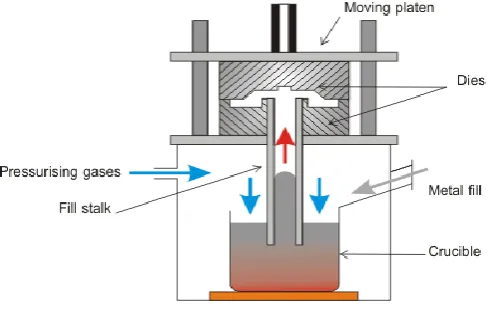
As schematized in Figure the die is filled from a pressurised crucible below, and pressures of up to 0.7 bar are usual. Low-pressure die casting is especially suited to the production of components that are symmetric about an axis of rotation. Light automotive wheels are normally manufactured by this technique.
[image:2.595.37.286.565.739.2] [image:2.595.312.557.609.765.2]Vacuum Die Casting
The principle is the same as low-pressure die casting. The pressure inside the die is decreased by a vacuum pump and the difference of pressure forces the liquid metal to enter the die. This transfer is less turbulent than by other casting techniques so that gas inclusions can be very limited. As a consequence, this new technique is specially aimed to components which can subsequently be heat-treated.
Squeeze Casting or Squeeze Forming
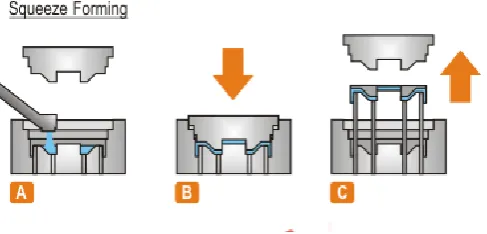
[image:3.595.42.286.295.412.2]As shown in Figure, liquid metal is introduced into an open die, just as in a closed die forging process. The dies are then closed. During the final stages of closure, the liquid is displaced into the further parts of the die. No great fluidity requirements are demanded of the liquid, since the displacements are small. Thus forging alloys, which generally have poor fluidities which normally precludes the casting route, can be cast by this process.
Figure 5. The squeeze casting principle
This technique is especially suited for making fibre-reinforced castings from fibre cake preform. Squeeze casting forces liquid aluminium to infiltrate the preform. In comparison with
non-reinforced aluminium alloy, aluminium alloy matrix
composites manufactured by this technique can double the fatigue strength at 300°C. Hence, such reinforcements are commonly used at the edges of the piston head of a diesel engine where solicitations are particularly high.
Literature review
The effect of casting temperature on the properties of squeeze cast aluminium and zinc alloys was invented by Yang. Gravity casting and squeeze casting were carried out on an aluminium alloy with 13.5% silicon and a zinc alloy with 4.6% aluminium with different temperatures, 660, 690 and 720°C for the former and 440, 460 and 480°C for the latter. A top-loading crucible furnace was used to melt the alloys. The die-preheat temperatures used were 200–220°C for the aluminium alloy and 150–165°C for the zinc alloy. A K-type thermocouples with digital indicator were used to measure the die surface temperature and the molten metal temperature; while a 25 t hydraulic press with a die-set containing a steel mould was used to perform the squeeze casting with a pressure of 62 MPa. Tensile, impact and density tests were carried out on the specimens. It was found that casting temperature had an effect on the mechanical properties of both gravity cast and squeeze cast aluminium and zinc alloys. The best temperatures to gravity cast the aluminium alloy and the zinc alloy was 720 and 460°C, respectively. For the squeeze casting of the aluminium alloy, the best temperature to use was either 690 or 660°C; the
former would give a better property at the top of the casting while the latter, at the bottom of the casting. However, for the squeeze casting of the zinc alloy, the best temperature was again 460°C (Savaşkan and Hekimoglu, 2004). Effect of copper content on the mechanical and sliding wear properties of monotectoid-based zinc-aluminium-copper alloys was carried out by Temel Savaşkan et al. One binary zinc-aluminium monotectoid and five ternary zinc- zinc-aluminium-copper alloys were produced by permanent mould casting. Their wear properties were examined using a block-on-ring test machine. Hardness, tensile strength and percentage elongation of the alloys were also determined and microhardness of aluminium-rich α phase was measured. It was observed that the hardness of the alloys increased continuously with increasing copper content up to 5%. Their tensile strength also increased with increasing copper content up to 2%, but above this level the strength decreased as the copper content increased further. Microhardness of the aluminium-rich α phase was also affected by the copper content in a manner similar to that of the tensile strength. It was found that the wear loss of the alloys decreased with increasing copper content and reached a minimum at 2% Cu for a sliding distance of 700 km. However, the coefficient of friction and temperature due to frictional heating were found to be generally less for the copper containing alloys than the one without the element. The effect of copper on the wear behaviour of the alloys was explained in terms of their
microstructure, hardness, tensile strength, percentage
elongation and microhardness of the α phase (Mondal et al., 2005).
Effect of zinc concentration and experimental parameters on high stress abrasive wear behavior of Al–Zn alloys a factorial design approach was developed by Mondal D.P. et al. High stress abrasive wear behaviour of Al–Zn alloys containing high zinc concentration at varying applied load and abrasive size has been studied through two-level full factorial design approach. The upper level of zinc concentration, applied load and abrasive size is selected as 70 wt%, 7 N and 180 μm, respectively. The lower level of zinc concentration, applied load and abrasive size is taken as 30 wt%, 1 N and 60 μm, respectively. The linear regression equation, for the wear rate (Wr) as a function of these parameters (applied load, abrasive size and Zn-concentration) and their interaction, has beendeveloped as:
Wr=17.34+1.81C+12.23L+3.27A+1.27CL+3.36LA+1.68CA+ 1.14CLA
where C, L and A are coded values of Zn-concentration, applied load and abrasive size, respectively, and the multiplication factor for the wear rate and the coefficients is 10−11 m3/m. The positive value of the coefficients associated with coded values of various parameters and their interactions in the above equation suggests that abrasive wear rate increases with zinc concentration, abrasive size and applied load. The validity of the developed equation has been checked with experimental values at randomly selected experimental parameters within the selected experimental domain. The results have been explained with selected worn surfaces and debris analysis.
strengthening zinc-aluminium foundry alloys. The composites are processed by squeeze casting, using performs of alumina, carbon, stainless steel or low carbon steel fibers. A drastic improvement of the creep strength is achieved with the use of alumina or steel fibers. However, an acceptable level of fracture toughness is maintained only in the composites reinforced with steel fibers. This property results from the low interface adhesion which allows bridging of the crack by the fibers. Low carbon steel fibers do not exhibit more interface reaction than stainless steel fibers. It is concluded that low carbon steel fibers provide a better compromise when taking into account the creep strength, the fracture toughness and the cost of the composite.
RESULTS AND CONCLUSION
Composition testing
Composition testing of aluminium alloy was performed by the following methods on the specimens of the work piece and following element composition was found.
1. Combustion Method
2. Gravmetric Method
3. Volumetric Method
Combustion Method: Combustion analysis is a method used in both organic chemistry and analytical chemistry to determine the elemental composition (more precisely empirical formula) of a pure organic compound by combusting the sample under conditions where the resulting combustion products can be quantitatively analyzed. Once the number of moles of each combustion product has been determined the empirical formula or a partial empirical formula of the ori compound can be calculated.
S.No. Elements Analyzed
Specimen I(Al-Cu) Specimen II (Al-Zn) Result obtained Result obtained 1. Silicon (Si) % 7.00 9.00 2. Magnesium (Mg) % Traces Traces 3. Copper (Cu) % 11.25 2.25 4. Nickel (Ni) % Traces Traces 5. Ferrous (Fe) % 0.82 1.10 6. Manganese (Mn)% 0.09 0.07 7. Chromium (Cr) % Traces Traces 8. Zinc (Zn) % 1.20 2.20 9. Stannous (Sn)% Traces Traces 10. Titanium (Ti)% Traces Traces
Figure:-Chemical Composition of Al-Cu & Al
Gravmetric Method: Gravimetric analysis describes a set of methods used in analytical chemistry for the quantitative determination of an analyte (the ion being analyzed) based on its mass. The principle behind this type of analysis is that once an ion's mass has been determined as a unique compound, that known measurement can then be used to determine the same analyte's mass in a mixture, as long as the relative quantities of the other constituents are known.
Types of Gravimetric Methods: The four examples in the previous section illustrate different ways in which the measurement of mass may serve as an analytical signal. When the signal is the mass of a precipitate, we call the method precipitation gravimetric. The indirect determination
3– by precipitating Hg2Cl2 is an example, as is the direct
aluminium foundry alloys. The composites are processed by squeeze casting, using performs of alumina, carbon, stainless steel or low carbon steel fibers. A drastic of the creep strength is achieved with the use of alumina or steel fibers. However, an acceptable level of fracture toughness is maintained only in the composites reinforced with steel fibers. This property results from the low lows bridging of the crack by the fibers. Low carbon steel fibers do not exhibit more interface reaction than stainless steel fibers. It is concluded that low carbon steel fibers provide a better compromise when taking fracture toughness and the
Composition testing of aluminium alloy was performed by the following methods on the specimens of the work piece and
Combustion analysis is a method used in both organic chemistry and analytical chemistry to determine the elemental composition (more precisely empirical mpound by combusting the sample under conditions where the resulting combustion products can be quantitatively analyzed. Once the number of moles of each combustion product has been determined the empirical formula or a partial empirical formula of the original
Technique Followed
By Combustion Method By Gravmetric Method By Gravmetric Method By Volumetric Method By Volumetric Method By Gravmetric Method By Gravmetric Method By Volumetric Method By Volumetric Method
Cu & Al-Zn Alloys
Gravimetric analysis describes a set of methods used in analytical chemistry for the quantitative determination of an analyte (the ion being analyzed) based on its mass. The principle behind this type of analysis is that once ass has been determined as a unique compound, that known measurement can then be used to determine the same analyte's mass in a mixture, as long as the relative quantities of
The four examples in the previous section illustrate different ways in which the measurement of mass may serve as an analytical signal. When the signal is the mass of a precipitate, we call the method precipitation gravimetric. The indirect determination of PO3 is an example, as is the direct
determination of Cl– by precipitating AgCl. In electro gravimetric, we deposit the analyte as a solid film an electrode in an electrochemical cell. The deposition as PbO
anode is one example of electro gravimetric. The reduction of Cu2+ to Cu at a Pt cathode is another example of electro
gravimetric. When we use thermal or chemical energy to remove a volatile species, we call the method volatilization gravimetric. In determining the
example, we use thermal energy to vaporize the water in the sample. To determine the amount of carbon in an organic compound, we use the chemical energy of combustion to convert it to CO2. Finally, in particulate gravimetric
determine the analyte by separating it from the sample’s matrix using a filtration or an extraction. The determination of total suspended solids is one example of particulate gravimetric.
Volumetric Method: Volumetric analysis, any method of quantitative chemical analysis in which the amount of a substance is determined by measuring the volume that it occupies or, in broader usage, the volume of a second substance that combines with the first in known proportions, more correctly called titrimetric analy
Microstructure Testing
Cast structure of the specimen consists of network of silicon in eutectic form. Globular and coarse silicon not observed because the percentage of silicon is less than 12%. Silicon particles are uniformly distributed throughout
Porosity presence is found in both macro and Presence of gases were also detected during the testing.
According to the microstructure testing following observations are made:
Cast Structure consist of network of Silicon in Eutectic form.
Globular & coarse silicon not observed
Silicon particle are uniformly distribution throughout the sample
Macro & micro porosity present
Gas present.
Figure 6. Microstructure of aluminium alloy LM 24 (a,b,c)
Conclusion
Aluminium castings are very powerful and versatile techniques for manufacturing semi- or finished products with intricate shapes. Those techniques are continuously improved and developed to satisfy the user needs and to penetrate new markets. Innovations are mainly oriented to the automobile sector which is the most important market for castings. This by precipitating AgCl. In electro gravimetric, we deposit the analyte as a solid film an electrode in an electrochemical cell. The deposition as PbO2 at a Pt
e example of electro gravimetric. The reduction of + to Cu at a Pt cathode is another example of electro gravimetric. When we use thermal or chemical energy to remove a volatile species, we call the method volatilization gravimetric. In determining the moisture content of bread, for example, we use thermal energy to vaporize the water in the sample. To determine the amount of carbon in an organic compound, we use the chemical energy of combustion to . Finally, in particulate gravimetric we determine the analyte by separating it from the sample’s matrix using a filtration or an extraction. The determination of total suspended solids is one example of particulate gravimetric.
Volumetric analysis, any method of ve chemical analysis in which the amount of a substance is determined by measuring the volume that it occupies or, in broader usage, the volume of a second substance that combines with the first in known proportions, more correctly called titrimetric analysis
Cast structure of the specimen consists of network of silicon in eutectic form. Globular and coarse silicon not observed because the percentage of silicon is less than 12%. Silicon particles are uniformly distributed throughout the sample. e is found in both macro and micro level. Presence of gases were also detected during the testing.
According to the microstructure testing following observations
of network of Silicon in Eutectic
Globular & coarse silicon not observed
Silicon particle are uniformly distribution throughout
Macro & micro porosity present
Microstructure of aluminium alloy LM 24 (a,b,c)
continual improvement and development will ensure that aluminium castings continue to play a vital role in this field.
Applications and general notes
LM24 is essentially a pressure die casting alloy, for which it has excellent casting characteristics and is generally a little simpler to die cast that the high Silicon containing alloys. Die castings in LM24 are suitable for most engineering applications and have an advantage of maximum mechanical properties. LM24 has poor weldability and brazeability. For the vast majority of die castings, the alloys LM2 and LM24 are equally suitable. Castings in LM24 are not usually heat treated.
REFERENCES
Bowles, R. 1987. “Metal Matrix Composites Aid Piston Manufacture,” Manufacturing Engineering, (5).
Leonard E. Samuels, 1988. Metals Engineering: A Technical Guide (ASM International, Metals Park, OH), 245-247. Mondal D.P., Das, S. and Rajput, V. 2005. Effect of zinc
concentration and experimental parameters on high stress abrasive wear behaviour of Al–Zn alloys: A factorial design approach. Materials Science and Engineering: A, Volume 406, Issues 1-2, Pages 24-33.
Savaşkan, T. and Hekimoglu, A. P. 2004. “Effect of copper content on the mechanical and sliding wear properties of
monotectoid-based zinc-aluminium-copper alloys.”
Tribology International, Volume 37, Issue 1, Pages 45-50 Tao, L., M.-A. Dellis, F. Boland, F. Delannay and J. Wegria,
1995. “Comparison of fibres for creep strengthening of zinc-aluminium foundry alloys.” Composites, Volume 26, Issue 9, Pages 611-617
Yang, L.J. 2007. “The effect of casting temperature on the properties of squeeze cast aluminiu and Zinc alloys L. J. Yang” Journal of Materials Processing Technology, Vol. 192-193, Pages 114-120.