ISSN Online: 1913-3723 ISSN Print: 1913-3715
DOI: 10.4236/ijcns.2018.1110013 Oct. 30, 2018 216 Int. J. Communications, Network and System Sciences
The Effects of Power Control on Free-Space
Optical Communications during Snowfall and
Rainfall
Salem Salamah, Muhammad A. Alsubaie, Mubarak Alhajri, Mahmoud Alnaser,
Ahmed Mohamed Abdalla
Department of Electronic Engineering Technology, Public Authority of Applied Education and Training,Adailiyah, Kuwait
Abstract
Free-space optical (FSO) communication requires a line-of-sight connection between a transmitter and a receiver in which the information signal is mod-ulated by an optical carrier that propagates in free space. The FSO channel is greatly affected by weather conditions such as fog, rain, and snow. In the lite-rature, several adaptive techniques, such as power control (PC), have been suggested to mitigate channel link degradations. In this paper, we investigate the effects of snow and rain attenuation on the bit error rate (BER) of the FSO system using two types of modulations, the on-off keying (OOK) modulation and the pulse-position modulation (16-PPM). The effect of PC on the per-formance of FSO communications is also examined in this study. We eva-luated the system’s performance with two types of snow, wet snow and dry snow, as well as with different rain regions. Results show that PC improves the BER of the FSO system; a high rate of improvement is found for wet snow and rain. PC has almost no effect with dry snow because of the high attenua-tion and the limitaattenua-tions on transmitted power. The BER for 16-PPM is better than that for OOK modulation.
Keywords
Free Space Optical Communications, Snow Attenuation, Rain Attenuation, Power Control
1. Introduction
The increasing demand for high-speed Internet and high-capacity services has resulted in great pressure on communication systems and technologies. This has How to cite this paper: Salamah, S.,
Alsu-baie, M.A., Alhajri, M., Alnaser, M. and Abdalla, A.M. (2018) The Effects of Power Control on Free-Space Optical Communi-cations during Snowfall and Rainfall. Int. J. Communications, Network and System Sciences, 11, 216-227.
https://doi.org/10.4236/ijcns.2018.1110013
Received: September 29, 2018 Accepted: October 27, 2018 Published: October 30, 2018
Copyright © 2018 by authors and Scientific Research Publishing Inc. This work is licensed under the Creative Commons Attribution International License (CC BY 4.0).
DOI: 10.4236/ijcns.2018.1110013 217 Int. J. Communications, Network and System Sciences prompted researchers to seek solutions, including Free-space optical (FSO) communications technology. FSO communication is a line-of-sight technology that transmits an information signal by laser light through an atmospheric channel instead of fiber cables. It has several advantages, such as a license-free spectrum, large bandwidth, high data rate, easy installation, high security, and low power requirements [1] [2].
In general, the FSO system supports a binary modulation format such as on-off keying (OOK) modulation owing to its high-power efficiency and sim-plicity. OOK modulation is deployed with intensity modulation with direct de-tection; in the transmitter, the electrical signal is converted to an optical signal by modulating the intensity of a laser source using the OOK modulation scheme. At the receiving end, a photodiode converts the optical intensities into the cor-responding photocurrent. The PPM scheme is another popular modulation for-mat used in FSO systems; it is more power efficient than OOK modulation but has less band width efficiency and increased demodulation complexity. Howev-er, the FSO link performance and availability, as well as the link range, is highly dependent on the weather and atmospheric conditions. FSO wireless channels are adversely affected by different atmospheric conditions, such as fog, heavy rain, snow, dust, and haze; they increase the power loss and cause the BER to deteriorate. In order to mitigate fading of the channel, several parameters can be varied at the transmitter, such as the type of modulation, power, coding rate, and combinations of adaptation parameters. In one study [3], the author looked at the effect of snow attenuation on the transmission of FSO communications at different wavelengths without finding even a suggestion of a solution for alle-viating the problem. In another study [4], the authors applied a PC algorithm to reduce the average power consumption; they regulated the transmitter gain from the erbium doped fiber amplifier given channel state information, but they did not study its effect on the BER of the system.
In [5] we are studying the FSO system using selective diversity to compensate for rain attenuation. Results show that selective diversity can improve the BER for high rain rates. Our contribution in this paper will come from our study of the effect of PC on the performance of an FSO channel during snow or rain at-tenuation using two different modulation techniques.
The rest of the paper is organized as follows: In Section II, the system model is described. In Section III, the results are presented for the two scenarios and for different types of modulations, and the effect of PC is also presented. In Section IV, conclusions are drawn.
2. System Model
DOI: 10.4236/ijcns.2018.1110013 218 Int. J. Communications, Network and System Sciences higher than with rain but lower than with fog. In this case, the attenuation is comparable to that of fog and ranges between 30 and 350 dB/km. This level can significantly reduce the link availability of the FSO system [6].
Snow Attenuation:
Snow attenuation varies according to whether the snow is dry or wet. The ef-fect of dry snow is different than the efef-fect of wet snow on the quality and strength of the received signal. Dry snow affects a channel when the rate of snowfall is low, whereas wet snow appears to affect a channel when the rate of snowfall is high. The attenuation is determined at a defined distance and meas-ured in dB/km. The specific attenuation, or αsnow for snow rate S in mm/h is giv-en as follows [7]:
snow aSb
α = (1) where the values of parameters a and b in dry and wet snow are
Dry snow: a = 5.42 × 10⁻⁵λ + 5.49, b = 1.38, Wet snow: a = 1.02 × 10⁻⁴λ + 3.78, b = 0.72.
Rain Attenuation:
Specific attenuation due to precipitation is observed in the optical and infra-red ranges. It can be referinfra-red as rain attenuation and measuinfra-red in dB/km. In FSO system, rain attenuation is particularly severe and greatly dependent on various models of raindrop-size distribution. The most commonly used rain-drop-size distributions have been proposed by Marshal and Palmer [8]. The spe-cific attenuation due to rain for a wireless optical link is given by
(
dB km)
a Rbγ
= ⋅ (2)where R is the rain rate in mm/h, a and b are power law parameters. These pa-rameters depend on frequency, raindrop-size distribution, and rain temperature. Due to the assumption that raindrops have a spherical shape a and b are inde-pendent of polarization [9]. The modeling of rain attenuation prediction is done using empirical methods proposed by the International Telecommunication Union Radio communication Sector (ITU-R) for FSO communications. The specific rain attenuation γ (dB/km) for an FSO link is delineated in the studies given by [10] [11] [12].
(
dB km 1.076)
R0.67γ
= ⋅ (3)Carbonneau’s model proposed values to predict a and b based on measure-ments done in France [13]. The measurements were for very low rain intensities compared with the rain intensities in tropical regions, however. In the study by
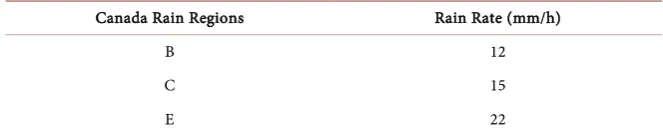
[11] the author gives the rainfall rate, Rp (mm/h), exceeded for a given percen-tage of the average year, p, and for any location. In this study, we will focus on rain regions in Canada, as shown in Table 1.
In FSO communications, the received power, Pr has the following expression:
( )
snow 2 10 210 Lr t tx rx D
P P L α τ τ θ −
DOI: 10.4236/ijcns.2018.1110013 219 Int. J. Communications, Network and System Sciences Table 1. Rain rates in Canada.
Canada Rain Regions Rain Rate (mm/h)
B 12
C 15
E 22
where Pt is the transmitted power, τtx and τrx are the transmitter and receiver
efficiency, respectively, D is the receiver diameter, θ is the divergence angle, and L is the link distance.
The signal-to-noise ratio (SNR) for the optical communications system using an avalanche photodiode (APD) detector is
(
)
(
)
2 0 2 0 SNR2 2 4
r x
r D L eq
R P M
qBM + R P I qI B kTBF R
=
+ + + (5)
where R0denotes the primary sensitivity of the APD, M is the APD gain, x is the excess noise factor, ID is the bulk dark current, IL is the surface leakage current, q is the electron charge, k is the Boltzmann constant, B is the equivalent noise bandwidth, Reqis the equivalent circuit resistance, F is the noise figure, and T is the system temperature in kelvins.
The measured SNR is compared with the desired level (γth= 30 dB). The dif-ference between these two values is quantized by the power command decision, and a powercommand is transmitted to the user through the feedback channel.
1
i i
P+ = − ⋅ ∆P C (6)
1 if 1 if
th th
C γ γ
γ γ
− ≤
= >
where C is the PC command and ∆ is the step size [14].
The performance of the FSO system will be measured by the BER for two types of modulation, OOK modulation and N-PPM, as shown below [15]
OOK 1 1
BER SNR
2erfc 2 2
=
(7)
( )
N-PPM 1 1 2
BER SNR log
2 2 2 2
N
erfc N
= ⋅ ⋅
(8)
3. Simulation Results
In this section, we will study the effects of PC on an FSO system in two weather conditions: snow and rain. Also, we will evaluate the performance of the FSO system using different types of modulation techniques. The parameters assumed in this simulation are shown in Table 2.
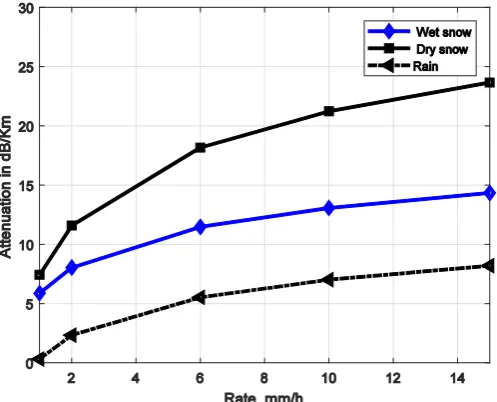
DOI: 10.4236/ijcns.2018.1110013 220 Int. J. Communications, Network and System Sciences Figure 1. Snow and rain attenuation for different rates.
Table 2.Simulation parameters.
Parameters Value
Wavelength 850 nm
Transmitter power 50 - 100 mw
Transmitter divergence angle 2 mrad
Tx/Rx efficiency 0.5
Receiver diameter 0.1 m
Bulk dark current 0.05 nA
APD gain 100
PC step size 5 mw
Excess noise factor 0.5
Bandwidth 25 MHz
due to the large size of snow particles. For example, at a rate of 10 mm/h, wet snow attenuation is more than rain attenuation by 6 dB.
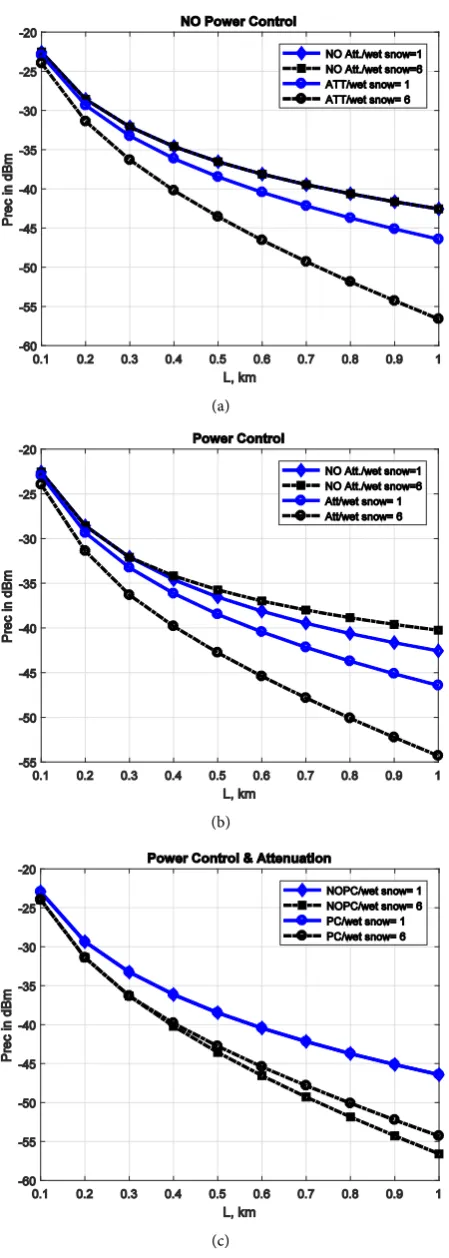
We compared the received power versus the link distance for wet snow with and without attenuation, as shown in Figures 2(a)-(c). The effect of the PC was also studied. In Figure 2(a) and Figure 2(b), one can see that wet snow attenua-tion can reduce the received power by 15 dBm at a link distance of 1 km. Figure 2(c) shows that using PC has no effect on the received power for a low snow rate of 1 mm/h, but with a high snow rate, PC has more of an effect on thereceived power, especially with an increased link distance.
DOI: 10.4236/ijcns.2018.1110013 221 Int. J. Communications, Network and System Sciences
(a)
(b)
[image:6.595.262.487.65.695.2](c)
DOI: 10.4236/ijcns.2018.1110013 222 Int. J. Communications, Network and System Sciences
(a)
(b)
[image:7.595.264.486.38.691.2](c)
DOI: 10.4236/ijcns.2018.1110013 223 Int. J. Communications, Network and System Sciences reaches 3 dB at L = 1 km. In Figure 4, the effect of PC on the BER for OOK modulation was investigated. At a link distance of 1 km, the BER for a snow rate of 6 mm/him proves from 9 × 10⁻³ to 6 × 10⁻³. The BER for a low snow rate is better than that for a higher snow rate. In Figure 5 we compared the BER for OOK modulation versus 16-PPM modulation for a snow rate that equals 6 mm/h. The PC improves the BER for both16-PPM and OOK modulation, especially at a link distance larger than 0.6 km. The performance of PPM is better than that of OOK modulation.
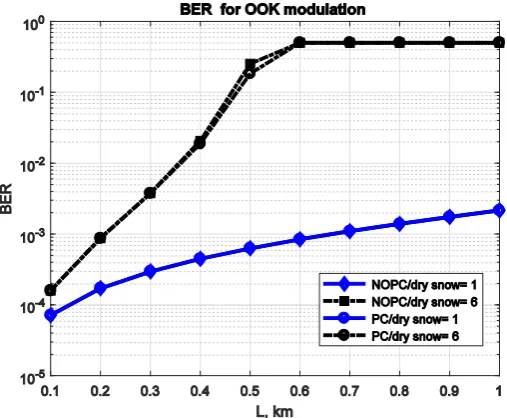
[image:8.595.251.498.508.703.2]Figure 6 shows the SNR for dry snow at rates of 1 mm/h and 6 mm/h. The PC has no effect on the SNR for the low snow rate, but at a high snow rate, the PC improves the SNR slightly. The dry snow has more attenuation than the wet snow. In Figure 7, we show the effect of PC with OOK modulation for dry snow
Figure 4. BER for OOK modulation.
DOI: 10.4236/ijcns.2018.1110013 224 Int. J. Communications, Network and System Sciences Figure 6. SNR for dry snow.
Figure 7. BER for OOK modulation with dry snow.
[image:9.595.248.502.313.522.2]DOI: 10.4236/ijcns.2018.1110013 225 Int. J. Communications, Network and System Sciences Figure 8. BER for OOK modulation with different PC step size for wet snow.
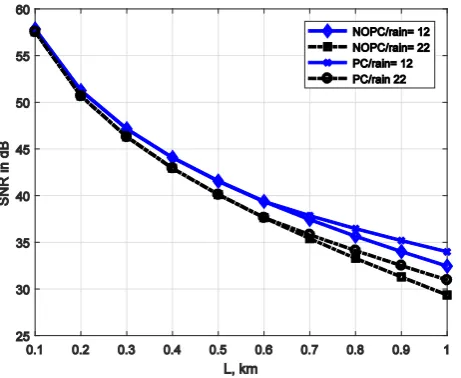
Figure 9. Received power with rain.
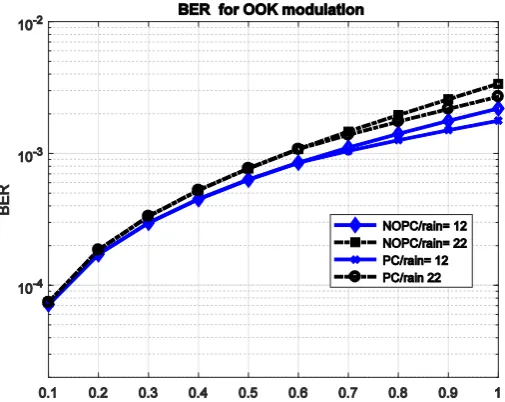
[image:10.595.261.492.516.705.2]DOI: 10.4236/ijcns.2018.1110013 226 Int. J. Communications, Network and System Sciences Figure 11. BER for OOK modulation with rain.
Figure 12. BER for OOK and PPM modulation with rain.
4. Conclusion
[image:11.595.249.501.310.507.2]DOI: 10.4236/ijcns.2018.1110013 227 Int. J. Communications, Network and System Sciences
Conflicts of Interest
The authors declare no conflicts of interest regarding the publication of this pa-per.
References
[1] Kim, I.I. and Eric, K. (2002) Availability of Free Space Optics (FSO) and Hybrid FSO/RF Systems. Optical Access, Incorporated, San Diego.
[2] Zhu, X.M. and Kahn, J.M. (2002) Free-Space Optical Communication through At-mospheric Turbulence Channels. IEEE Transaction on Communication, 50, 1293-1300.https://doi.org/10.1109/TCOMM.2002.800829
[3] Mazin, A. (2013) Transmission of Optical Signals for Wireless Communications under Snow Attenuation Effect. AIJRSTEM, September 2013, 15-21
[4] Hassan, N.B. and Matinfar, M.D. (2014) On the Implementation Aspects of Adap-tive Power Control Algorithms in Free-Space Optical Communications. 2014 Iran Workshop on Communication and Information Theory (IWCIT), Tehran, 7-8 May 2014, 1-5.
[5] Salamah, S., Alsubaie, M.A., Alnaser, M.J. and Mahmoud, O. (2016) Free Space Optical Communications Performance under the Effect of Rain Attenuation in Canada. International Journal of Engineering Research and Applications, 6, 95-98. [6] Kaushal, H. and Kaddoum, G. (2017) Optical Communication in Space: Challenges
and Mitigation Techniques. IEEE Communications Surveys & Tutorials, 19, 57-96. [7] Nadeem, F., Leitgeb, E. and Awan, M.S. (2009) Comparing the Snow Effects on
Hy-brid Network Using Optical Wireless and GHz Links. 2009 International Workshop on Satellite and Space Communications, Tuscany, 9-11 September 2009,171-175. [8] Marshall, J.S. and Palmer, W.M. (1948) The Distribution of Raindrops with Size.
Journal of Meteorology, 5, 165-166.
https://doi.org/10.1175/1520-0469(1948)005<0165:TDORWS>2.0.CO;2
[9] Zhang, W. and Moayeri, N. (2011) Power-Law Parameters of Rain Specific Attenua-tion.
[10] ITU (2007) Prediction Methods Required for the Design for Terrestrial Free-Space Optical Links. Recommendation ITU-R P.1814.
[11] ITU (1994) Characteristics of Perception for Propagation Modeling. Recommenda-tion ITU-R PN.837-1.
[12] Crane, R.K. and Robinson, P.C. (1997) ACTS Propagation Experiment: Rain-Rate Distribution Observations and Prediction Model Comparisons. Proceedings of the IEEE, 85, 946-958. https://doi.org/10.1109/5.598417
[13] Carbonneau, T.H. and Wisely, D.R. (1998) Opportunities and Challenges for Opti-cal Wireless. SPIE Conference on Optical Wireless Communication,Wash, 119-128. [14] Salamah, S., Falconer, D.D. and Yanikomeroglue, H. (2000) Transmit Power
Con-trol in Fixed Cellular Broadband Wireless Systems. WCNC, Chicago, 23-28 Sep-tember 2000,624-628.