NEGATIVE PARENTING STYLE AND ATTACHMENT INCREASE THE NUMBER OF
*Dr. Pankaj Singh
NKP Salve Institute of Medical Sciences, Digdoh Hills,
ARTICLE INFO ABSTRACT
Parents can benefit from an understanding that how they parent, or their parenting style, provides a basis for many healthy developmental outcomes during adolescence. Understanding the different parenting styles and their impact on the parent
parents and their adolescence navigate adolescence more smoothly. Adolescence parents and adolescence (boys and girls) who referred by doctors for behaviour difficulties, poor parenting poor scholastic performance
LMH ,Nagpur were included in the study (n=162). significant at p < 0.05 s
level of negative parenting style ,attachment increased the number of behavior difficulties . study showed that adolescence behavior depends on parenting style and attachment and the guidelines for healthy relationships. As a resul
lack respect and responsibility in guiding their own behaviors and making decisions that are truly in the best interest of their children, the children are showed different behavior
withdrawal, aggression, lack of interest on study, conduct problem, or hyperactivity, and most of the children showed lack of confidence, low Social skills, and low communication
Copyright © 2018, Pankaj Singh and Yash Banait. This unrestricted use, distribution, and reproduction in any medium,
INTRODUCTION
Adolescence is a time for developing independence. Parents and doctors must distinguish occasional errors of judgment from a degree of misbehaviour that requires professional intervention. The severity and frequency of infractions are guides. For example, Inattention, Hyperactivity, rule breaking behaviour, abusing language, not showing respect ,showing aggression, temper tantrum, conduct problem
anxiety, arguments with adults, frequent episodes of fighting, truancy, and steals are much more significant than isolated episodes of the same activities. Other warning signs include deterioration of performance at school and running away from
home. Lin et al. (2009) found that children in migrant families
had significantly more psychological problem
loneliness, depression, and social anxiety than local children. Parenting style and attachment is one of the important factors in family education and is a relatively stable behaviour pattern and tendency in raising and educating adolescence thr daily activities. Attachment is a word used by psychologists to describe the relationship between children and their caretakers.
*Corresponding author: Dr. Pankaj Singh,
NKP Salve Institute of Medical Sciences, Digdoh Hills, Hingna Road, Nagpur 440019, Maharashtra, India.
ISSN: 0975-833X
Article History:
Received 23rd December, 2017
Received in revised form 22nd January, 2018
Accepted 04th February, 2018
Published online 30th March, 2018
Citation: Dr. Pankaj Singh and Dr. Yash Banait International Journal of Current Research, 10, (03), 67245
Key words:
Alabama Parenting Questionnaire (APQ), Measure of Attachment Qualities (MAQ), BASC-2, counselling and guidance
RESEARCH ARTICLE
NEGATIVE PARENTING STYLE AND ATTACHMENT INCREASE THE NUMBER OF
BEHAVIOUR DIFFICULTIES
Dr. Pankaj Singh and Dr. Yash Banait
NKP Salve Institute of Medical Sciences, Digdoh Hills, Hingna Road, Nagpur 440019, Maharashtra,
ABSTRACT
Parents can benefit from an understanding that how they parent, or their parenting style, provides a basis for many healthy developmental outcomes during adolescence. Understanding the different parenting styles and their impact on the parent-teen relationship and behavior outcome may help parents and their adolescence navigate adolescence more smoothly. Adolescence parents and adolescence (boys and girls) who referred by doctors for behaviour difficulties, poor parenting poor scholastic performance , (more than 6 months ), referred at Medical College NKPSIMS LMH ,Nagpur were included in the study (n=162). An Analysis of variance showed t significant at p < 0.05 significant (Means are different) different means say that there is an effe level of negative parenting style ,attachment increased the number of behavior difficulties . study showed that adolescence behavior depends on parenting style and attachment and
the guidelines for healthy relationships. As a result, most of the parenting style and attachment are lack respect and responsibility in guiding their own behaviors and making decisions that are truly in the best interest of their children, the children are showed different behavior
ithdrawal, aggression, lack of interest on study, conduct problem, or hyperactivity, and most of the children showed lack of confidence, low Social skills, and low communication
This is an open access article distributed under the Creative Commons medium, provided the original work is properly cited.
Adolescence is a time for developing independence. Parents and doctors must distinguish occasional errors of judgment from a degree of misbehaviour that requires professional intervention. The severity and frequency of infractions are Inattention, Hyperactivity, rule breaking behaviour, abusing language, not showing respect ,showing conduct problem, depression, anxiety, arguments with adults, frequent episodes of fighting, significant than isolated episodes of the same activities. Other warning signs include deterioration of performance at school and running away from found that children in migrant families had significantly more psychological problems, such as loneliness, depression, and social anxiety than local children. Parenting style and attachment is one of the important factors in family education and is a relatively stable behaviour pattern and tendency in raising and educating adolescence through Attachment is a word used by psychologists to describe the relationship between children and their caretakers.
NKP Salve Institute of Medical Sciences, Digdoh Hills, Hingna Road,
When we watch the behavioral patterns that characterize this relationship, four types of attachment are seen: secure, avoidant, ambivalent, and disorganized and
generally fall along a continuum between the two
being lax and overly punitive, with extremes in either direction defined as negative (Stevens, 2014
propose that early attachment histories ar
internal working model for adult relationships whereby persons with secure childhood attachments show higher levels of trust, closeness, and dependability while insecure childhood attachments predict the reverse (Bowlby, 1973, 1980, 1982) Figure 1: Bartholomew’s four
attachment (after Bartholomew
However, there are other variables within a parent child relationship that might also predict the outcome of the child's future interpersonal relationships. One of these variables is that of parenting styles. Positive parenting is a strategy that involves warmth, sensitivity, acceptance and responsiveness toward the child (Kawabata
indicated that parenting style and idea were important
influencing factors for children’s psychological and
behavioural development (Brennan
showed that adolescences parenting style, parents tended to usually adopt some negative parenting styles (e.g., punishment
International Journal of Current Research
Vol. 10, Issue, 03, pp.67245-67251, March, 2018
Dr. Pankaj Singh and Dr. Yash Banait, 2018. “Negative parenting style and attachment increase the number of behaviour difficulties 67245-67251.
NEGATIVE PARENTING STYLE AND ATTACHMENT INCREASE THE NUMBER OF
Hingna Road, Nagpur 440019, Maharashtra,
India
Parents can benefit from an understanding that how they parent, or their parenting style, provides a basis for many healthy developmental outcomes during adolescence. Understanding the different ship and behavior outcome may help parents and their adolescence navigate adolescence more smoothly. Adolescence parents and adolescence (boys and girls) who referred by doctors for behaviour difficulties, poor parenting , and (more than 6 months ), referred at Medical College NKPSIMS and An Analysis of variance showed t- value is (Means are different) different means say that there is an effect of level of negative parenting style ,attachment increased the number of behavior difficulties .Present study showed that adolescence behavior depends on parenting style and attachment and maintaining t, most of the parenting style and attachment are lack respect and responsibility in guiding their own behaviors and making decisions that are truly in the best interest of their children, the children are showed different behavior – depression, anxiety, ithdrawal, aggression, lack of interest on study, conduct problem, or hyperactivity, and most of the children showed lack of confidence, low Social skills, and low communication.
Commons Attribution License, which permits
When we watch the behavioral patterns that characterize this relationship, four types of attachment are seen: secure, avoidant, ambivalent, and disorganized and Parenting styles generally fall along a continuum between the two anchors of being lax and overly punitive, with extremes in either direction Stevens, 2014). Collins and Reed (1990) propose that early attachment histories are the basis of an internal working model for adult relationships whereby persons with secure childhood attachments show higher levels of trust, closeness, and dependability while insecure childhood attachments predict the reverse (Bowlby, 1973, 1980, 1982). Figure 1: Bartholomew’s four –category model of adult attachment (after Bartholomew and Horowitz, 1991). However, there are other variables within a parent child relationship that might also predict the outcome of the child's onships. One of these variables is that Positive parenting is a strategy that involves warmth, sensitivity, acceptance and responsiveness
wabata et al., 2011). Previous studies
indicated that parenting style and idea were important
influencing factors for children’s psychological and
Brennan et al., 2013). Some studies
showed that adolescences parenting style, parents tended to usually adopt some negative parenting styles (e.g., punishment
OF CURRENT RESEARCH
and authoritarian) and seldom adopt positive parenting styles (e.g., emotional warmth and understanding). A parent who has high levels in both categories is described as an authoritative parent. This is considered to be the most positive parenting style. As an authoritative parent you would have a strong emotional tie to your child, but would also be highly demanding, with rules and expectations you expect your child to meet. This often leads to a healthy relationship in which both parent and child are capable of reasonably negotiating, and the child feels encouraged to strive to his parent’s expectations. Authoritative style characterized by high demandingness and high responsiveness (Arnett, 2010). Contrary to the previous style parents set rules and expectations but are open to discussion and negotiation as the parents are willing to listen to their children and guide them when questions arise (Arnett, 2010). Authoritative parents always maintain the power to say "no" but also they want their children to be assertive, socially responsible, self-regulated and cooperative (Darling, 2011). A child who grows up in a family where the parents utilize this style are more likely to grow up independent, have self-control, have more develop social skills , able to communicate and make friendships, have healthy relationships and emotional attachments (Arnett, 2010). From growing in a balanced environment they are less likely to have psychological problems and they become balance adults by themselves.
Authoritarian (the parent is highly demanding, but not particularly responsive, with a weaker emotional tie), Authoritarian parents are strict and have high expectations from their children, have set rules and expect obedience without questioning and without really explaining their reasoning to their children (Berger, 2005). They are obedience and status oriented and expecting their orders to be obeyed without explanation (Darling, 2011). A child that grows up in a family environment where they do not have the opportunity to communicate, and constantly feel they have to act in a certain way, will have serious problems in many aspects of their development. They will grow up with low self-esteem, might be depressed, anxious and frustrated and they lag behind in social skills and social adaptability (Berger, 2005; Arnett,
2010). The next two parenting styles are the permissive and
the neglectful, or disengage style. Less positive parenting styles are Permissive (there is a strong emotional tie, but the parent sets no expectations or rules for the child), and Rejecting-Neglecting (the parent is neither demanding nor responsive, has no rules/expectations, and is not emotionally invested in the child). Permissive parents are not demanding, they hardly ever punish their children and do not have a lot of control of their children as they usually let them do whatever they want (Arnett, 2010). They seem to want to be more like their children's friends instead of their parents. Children growing up in a permissive family will be more likely to have higher self-esteem, but they will have poor emotional regulation, are immature and irresponsible (Arnett, 2010). Neglectful parenting demanding, but unresponsive to the child, tends to use punitive and harsh punishment, physical enforcement, reprimands, and prohibitive interventions (Kochanska, Kuczyniski, and Radke, 1989). Similarly so, the outcomes of authoritarian parenting tend to overlap the characteristics of avoidant attachment. The children of authoritarian parents have been described as anxious, angry, aggressive, and having low self-esteem (Baumrind, 1967; 1971). In like manner, Elicker, England, and Sroufe (1992) have described avoidant children as angry, aggressive, isolated
and disliked by their peers. They may show some developed social skills but actually do not possess them as they have been used to always getting what they want. The inadequate emotional regulation appears to be a problem for friendship formation (Berger, 2005). The disengaged or neglectful parenting style is characterized by parents who do not care about their children. These parents are low in both demandingness and responsiveness and they may seem little emotionally attached with their children (Arnett, 2010). Children growing up with this parenting style are exposed to an indifferent environment, without any guidance or support and are most likely to be depressed, impulsive and have poor social skills (Arnett, 2010). In general this type of parenting is associated with negative outcomes in a child's development in all domains of their life.
Aim and Objectives of the Study:-
The study was conducted with following objects in mind:
Parents can benefit from an understanding that how they parent, or their parenting style, provides a basis for many
healthy developmental outcomes during adolescence.
Understanding the different parenting styles and their impact on the parent-teen relationship and behavior outcome may help parents and their adolescence navigate adolescence more smoothly.
Hypotheses
There is significant gender difference in attachment
style of the adolescence.
There is a significant correlation on parenting style and
adolescence attachment.
MATERIALS AND METHODS
Place of Study: This study was conducted at central
India Nagpur (Maharashtra)
Period of Study: February 2017 to February2018 (1
Year)
Inclusion Category
Adolescence (boys and girls) (Age group 11 to 18
years)
Adolescence (boys and girls) who referred by doctors
for behaviour difficulties, poor parenting, and poor scholastic performance
Exclusion
Adolescence (boys and girls), (Parents complain about
behaviour, and poor scholastic performance, duration more than six months), at different schools from central India Nagpur.
Sample size: Adolescence (boys and girls) who referred by doctors for behaviour difficulties, poor parenting , and poor scholastic performance , (more than 6 months ), referred at Medical College NKPSIMS and LMH ,Nagpurwere included in the study (N=162)
Measuring Instruments
A checklist developed by Frick, P. J. - Alabama
Parenting Questionnaire (APQ)
, was used to assess scale under – 5 different categories
Areas Studies:1) Involvement, 2) Positive Parenting, 3) Poor Monitoring / Supervision, 4) Inconsistent Discipline and 5) Corporal Punishment
A checklist developed by Carver, C. S. -Measure of
Attachment Qualities (MAQ) The 14 items on his measure are rated as 1 = I Disagree with the statement a lot 2 = I Disagree with the statement a little 3 = I agree with the statement a little 4 = I agree with the statement a lot, and fore areas to measure , Avoidance, Ambivalence-worry and Ambivalence-merger.
3)A checklist developed by Cecil R. Reynolds, PhD,
and Randy W. Kamphaus, PhD –Behaviour Assessment system for children, second edition (BASC-2),was used to assess Clinical scale under – 10 different categories and adaptive scale factors among children under 5 different categories.
Areas Studies
Clinical Scale Adaptive Scale 1.Hyperactivity 1.Adaptability 2.Aggression 2.Social Skills
3.Conduct Problem (Age 6-21 only) 3.Leadership (Age 6-21yrs) 4.Anxiety 4.Study Skills (Age 6-21yrs) 5.Depression 5.Functional Communication 6.Somatization 6.Adaptability
7.Attention Problem 8.Learning Problem (6 To 21) 9.Atypicality
10.Withdrawal
Statistical Analysis: The obtained data was statistically analyzed by applying descriptive (Mean, Standard Deviation, t-value) of significance of mean differences in term of various variable. We have entered all data and further Statistical Analysis was done with the help of IBM- SPSS-25 software.
Procedure of Data collection
For collection of data from NKPSIMS and LMH Nagpur city of Maharashtra was chosen. By keeping age and gender requirements in mind the subjects were selected more than the
required then the test ofAPQ (Alabama Parenting
Questionnaire), MAQ (Measure of Attachment Qualities) and Behaviour Assessment system for children, second edition (BASC-2), who referred by doctors for behaviour difficulties, poor parenting , and poor scholastic performance , (more than 6 months ), N 162 subjects have been selected randomly from different school going children’s, which consists 162 school going students (boys 92 and 70 Girls). First of all, checklist of trails was administered on the subjects to get their original viewpoint. The subjects were randomly selected sample in NKPSIMS and Latamangeshkar Hospital and Research center Nagpur, adolescence (boys 92 and 70 Girls) and parenting questionnaire each subjects took about 1hours to respond on the entire above tools. A period of twelve months was devoted for the data collection.
RESULTS
This study included two sets of participants: 1) school going adolescence; and 2) parents. The number of children selected at random who participated in this study were 205 however
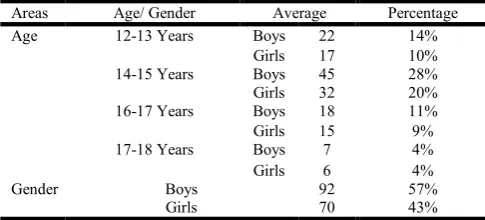
[image:3.595.311.554.144.254.2]during the study forty-three child was withdrawn by the parents leaving the sample size to be n = 162.The average age was 14 years (Table 1). Most of the participants were boys 92 (57%), and girls 70 (43%) (Table 1).
Table no.1. Adolescence Age and gender wise Average mean and percentage of
Areas Age/ Gender Average Percentage Age 12-13 Years Boys 22 14%
Girls 17 10% 14-15 Years Boys 45 28% Girls 32 20% 16-17 Years Boys 18 11% Girls 15 9% 17-18 Years Boys 7 4%
Girls 6 4%
Gender Boys 92 57%
Girls 70 43%
[image:3.595.309.555.471.645.2]Most of the participants were middle class family .All participants exhibited command over Marathi, Hindi language.
Table 2. Means and SD of adolescence boys and girls parents attachment style along with their statistical significance of
difference between means
Paired Samples Statistics
Paired Samples Test
children do not orientate to their attachment figure while investigating the environment. They are very independent of the attachment figure both physically and emotionally (Behrens, Hesse, and Main, 2007). They do not seek contact with the attachment figure when distressed. Such children are likely to have a caregiver who is insensitive and rejecting of their needs (Ainsworth, 1978). The attachment figure may withdraw from helping during difficult tasks (Stevenson-Hinde, and Verschueren, 2002) and is often unavailable during times of emotional distress. Avoidant children think themselves unworthy and unacceptable, caused by a rejecting primary caregiver (Larose, and Bernier, 2001). Ambivalent children have a negative self-image and exaggerate their
emotional responses as a way to gain attention (Kobak et al.,
1993). Ambivalence (Worry) Attachment Style for his/her children, adolescence boys mean 10.73, and girls means 4.85, t- value 12.986 is significant at 0.05 level. As parents they have difficulty in maintaining clear levels of attachment with their children (Byng-Hall, J. (1999). In general, about 1-2% of the adult population is disorganize/unresolved in their attachment style. Usually they do not become adoptive parents as they are typically screened out of the home study process due to other lifestyle problems.
Ambivalence (Merge) Attachment Style for his/her children, adolescence boys mean 10.57, and girls mean 8.40, t- value 4.092 is significant at 0.05 level. Disorganized attachment is
over-represented in groups of children with clinical problems and those who are victims of maltreatment (eg, nearly 80% of maltreated infants have disorganized attachment) (Cicchetti D,
Barnett D 1991, Lyons-Ruth K et.al. 1991). Poor peer
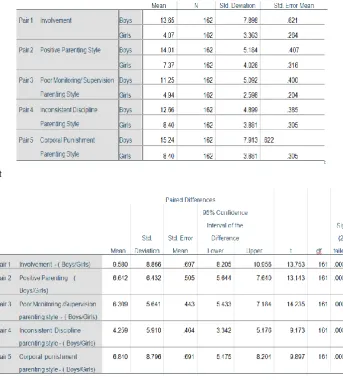
interactions and unusual or bizarre behaviour in the classroom (Jacobvitz D, Hazan N 1999) .These academic problems appear to be mediated through effects on self-esteem and confidence in the academic setting (Green J, Goldwyn R. 2002). Children with disorganized attachment have low self-esteem (Cassidy J. 1988), and at nine years of age are more often rejected by peers (Verschueren K, Marcoen A. 1999,Verschueren K. 2001).Attachment anxiety prompts intense emotions in social encounters in contrast to secure people who maintain emotional stability (Cooper, Shaver, and Collins, 1998). Table no.2 highlighted significant of Involvement parenting style for his/her children The mean value 13.65 for adolescence boys; and 4.07 for adolescence girls, t value is 13.75 . It shows parents are more involvement for their male child as compared to the female child. The dimension of parental form of child rearing is flexible and responsive to child needs but also enforces reasonable
standards of conduct (Ang and Goh, 2006). Chen et al. (2005);
Eke (2004).
Otuadah (2006), Umukoro (1997); Wu et al (1998) found in
[image:4.595.126.470.380.763.2]their researches that adolescents who were exposed to higher level of warmth, induction and monitoring would less likely to
Table 3. Means and SD of adolescence boys and girls parents parenting style along with their statistical significance of difference between means
Paired Samples Statistics
be delinquents. According to Angand Goh (2006); Utti (2006), adolescents whose parents are demanding and responsive perform better in social competence than children from authoritarian background. Positive parenting style for his/her children mean value 14.01 for adolescence boys; and 7.37 for adolescence girls, t-value 13.14 is significant at 0.05 level. home without love, warmth, care, affection but have the parents harsh and aggressive may make the adolescent run away from home, rebellious and have negative associations
and other delinquent behaviours follow (Ang, et al 2006;
Odebunmi, 2007; Okpako, 2006; Otuadah, 2006; Utti, 2006). Poor Monitoring parenting style for his/her children mean
value 11.25 for adolescence boys; and 4.94 for
[image:5.595.64.262.256.457.2]adolescencegirls, t-value 14.23 is significant at 0.05 level.
Table 4. Average mean of BASC-2 score and percentage of adolescent’s boys and girls
Area Gender n %
Hyperactivity Boys 30 33% Girls 15 21%
Aggression Boys 45 49%
Girls 22 31% Conduct Problem Boys 15 16%
Girls 6 9%
Anxiety Boys 34 37%
Girls 26 37%
Depression Boys 20 22%
Girls 38 54% Somatization Boys 68 74% Girls 50 71% Attention Problem Boys 82 89% Girls 40 57% Learning Problem Boys 88 96% Girls 38 54% A typicality Boys 56 61% Girls 30 43%
Withdrawal Boys 67 73%
Girls 40 57%
Inconsistent parenting style for his/her children The mean value 12.66 for adolescence boys ; and 8.40 for adolescence girls, t-value 9.17 is significant at 0.05 level, Corporal punishment parenting style for his/her children The mean value 15.24 for adolescence boys ; and 8.40 for adolescence girls , t-value 9.89 is significant at 0.05 level. Physical punishment has also been proven to be a contributing factor for antisocial behaviour by children (Grogan-Kaylor, 2004), but the article dismissed the assumption that frequent use of physical punishment can increase the degree of children’s antisocial behaviour because no relationship was established between
them. The result is consistent with Lansford et al’s (2011)
findings which state that although physical punishment can influence externalizing behaviour in children, the degree of influence is however not associated with other factors like the age of the child. In current study boys easily distracted engages in off task activities, unable to sustain attention, impulsive, displays aggression, social deficits include having difficulty waiting turn, following rules, losing gracefully, curbing temper, showing consideration for other, frequently because overly excited or may act silly. In accordance with other studies higher incidence of ADHD and lower school achievements in children with tension type headache in comparison with children with migraine. One possible explanation is that low school achievements and symptoms such as inattention, hyperactivity and impulsivity, which often accompany learning difficulties, may be associated with stress in the family, with peers, and in school, each stress may in turn
contribute to symptoms of tension type headache (Mazzone L, Vitiello B, Incorpora G, MazzoneD,Cephalalgia).
DISCUSSION
Table no. 3 showed that the Involvement parenting style are significant and security attachment styles also significant at 0.05 level. Out of 162 parents 39 are showed Involvement parenting style and 46 are security attachment. Involvement parenting style is widely regarded as the most effective and beneficial parenting style for normal children. Involvement parents are easy to recognize, as they are marked by the high expectations that they have of their children, but temper these expectations with understanding a support for their children as well. This type of parenting creates the healthiest environment for a growing child, and helps to foster a productive relationship between parent and child. Collins and Reed (1990) propose that early attachment histories are the basis of an internal working model for adult relationships whereby persons with secure childhood attachments show higher levels of trust, closeness, and dependability while insecure childhood attachments predict the reverse (Bowlby, 1973, 1980, 1982).One of the most important traits to emulate in the Involvement parenting style and security attachment is the open communication style with the child. The child has a great deal of autonomy, affective sharing, cognitive flexibility, problem-solving ability and perseverance (Ainsworth, Blehar,
Waters, and Wall, 1979). All of these outcomes indicate that
secure attachment results in healthy family and peer relationships as well as, high self-esteem for the child (Bowlby, 1988).
poor monitory parenting styles and 30 are ambivalence (worry) attachment. Study showed 49% adolescence boys and 31% adolescence girls showed aggression, 16% adolescence boys and 9% adolescence girls conduct problem, 22% adolescence boys and 54% adolescence girls depression, 73% adolescence boys and 57% adolescence girls withdrawal, and 96% adolescence boys and 54% adolescence girls faced learning problem. Poor monitory parenting styles, also known as indulgent parenting is another potentially harmful style of parenting. These parents are responsive but not demanding. These parents tend to be lenient while trying to avoid confrontation. The lowest cognitive competence and self-regulation was found in adolescents from neglectful families
(Steinberg et al., 1994). Parenting is generally described as
lax, and inconsistent, and use withdrawal of love as punishment (Connor, 1980). Other study showed their ambivalence about discipline by alternating praise and punishment (Baumrind, 1967).
Similarly, mothers of ambivalently attached children are described as lacking in responsiveness and sensitivity to their children, and as being either too lenient or too controlling of their child (Egelandand Farber, 1984). Baumrind (1967) reported that children of permissive parents have low self-control and self-reliance, and are very immature while ambivalently attached children are described as anxious, immature (Karen, 1998), and show little initiative (Egelandand Farber, 1984). The Inconsistent parenting styles and corporal punishment style are positively related to the ambivalence (merge) attachment styles. Out of 162 parents 23% are showed Inconsistent / corporal punishment parenting styles and 31 are ambivalence (merge) attachment. Study showed around 74% adolescence boys and 71% adolescence girls showed somatization, 89% adolescence boys and 57% adolescence girls attention problem, 73% adolescence boys and 57% adolescence girls withdrawal, and 37% adolescence boys and 37% adolescence girls faced anxiety, and adaptive scale- low leadership, poor study skills. Inconsistent parenting is one of the most harmful styles of parenting that can be used on a child. Inconsistent parenting is unlike the other styles in that parents rarely fluctuate naturally into Inconsistent parenting as a response to child behavior. If a parent recognizes themselves as Inconsistent parent, or if a friend recognizes that they may know anInconsistent parent, it is important to understand that those parents (and the children involved in the situation) need assistance so that they can get back on track to having a healthy and communicative relationship within the family. Inconsistent parenting is damaging to children, because they have no trust foundation with their parents from which to explore the world. Parents tend to use punitive and harsh punishment, physical enforcement, reprimands, and prohibitive interventions (Kochanska, Kuczyniski, and Radke, 1989). Children who have a negative or ambivalence relationship with their parent will have a harder time forming relationships with other people, particularly children their age. Physically abused infants were found to demonstrate high levels of negative
affect (Erickson et al., 1989) whereas neglected infants had
blunted affect (Gaensbauer and Hiatt, 1984)
Conclusion
This study has a number of strengths first study was able to distinguish between the adolescence behavior risk associated with parenting style and attachment style. Second study analysis adjusted for key confounder variable, including,
behavior modification, parenting counselling or educational regarding adolescence behavior issues, academic achievement and social adjustment. Present study showed that adolescence behavior depends on parenting style and attachment and maintaining the guidelines for healthy relationships. As a result, most of the parenting style and attachment are lack respect and responsibility in guiding their own behaviors and making decisions that are truly in the best interest of their children, the children are showed different behavior – depression, anxiety, withdrawal, aggression, lack of interest on study, conduct problem, or hyperactivity, and most of the children showed lack of confidence, low Social skills, and low communication. It is these dynamics in which parenting style and attachment is initiated and encouraged. Each parenting style has its own characteristics and values which shape adolescence behavior and social life. From the study, we can also conclude that although inconsistent discipline and corporal punishment and ambivalence (merge) attachment has been said to lead to poor academic performance; it could lead to a positive influence.
Limitations and Scope for future research
First it’s an area based research, second limited sample size, third future research is required to further delineate and characterize the prevalence, frequency, and psychosocial correlates related to the parenting style, attachment and behaviour problem experience by adolescents. Future prospect study should be developed in cooperating large sample size and mass study with appropriate methodology to capture the frequency and prevalence of parenting style, attachment and behaviour problem faced by adolescence.
Financial Support and Sponsorship- Nil.
Conflict of Interest: The authors declare that they have no conflict of interest.
REFERENCES
Ainsworth, M. D. S., Bell, S. M. and Stayton, D. J. 1971. Individual differences in strange- situation behavior of
one-year-olds. In H. R. Schaffer (Ed.) the origins of human
social relations. London and New York: Academic Press. Pp. 17-58.
Ainsworth, M. D. S., Blehar, M. C., Waters, E., and Wall, S. 1978. Patterns of attachment: A psychological study of the strange situation. Hillsdale, NJ: Erlbaum.
Ainsworth, M. D. S., Blehar, M. C., Waters, E. and Wall, S. 1978. Patterns of attachment: A psychological study of the strange situation. Hillsdale, NJ: Erlbaum.
Stevenson-Hinde, J. and Verschueren, K. 2002. Attachment in childhood. status: published.
Behrens, K. Y., Hesse, E., and Main, M. 2007. Mothers' attachment status as determined by the Adult Attachment Interview predicts their 6-year-olds' reunion responses: A
study conducted in Japan. Developmental Psychology,
43(6), 1553.
Byng-Hall, J. 1999. Family and Couple Therapy: Toward Great Security. In J. Cassidy and P. R. Shaver (Eds.), Handbook of Attachment: Theory, Research, and Clinical Applications (pp. 625-645). New York: The Guilford Press.
childhood anxiety: a psychometric investigation of the
EMBU-C. J. Child Fam. Stud., 22 1138–1146. 10.1007/
s10826-012-9677
Cicchetti, D. and Barnett, D. 1991.Attachment organization in
maltreated pre-schoolers. Dev Psychopathol., 1991;3:397–
411.
Cassidy, J. 1988.Child-mother attachment and the self in
six-year-olds. Child Dev., 1988;59:121–34.
Erickson, M. F., Egeland, B., and Pianta, R. (1989). The effect of maltreatment on the development of young
children. In Cicchetti, C., andCarlson, V.
(eds.), Handbook of Child Maltreatment. Cambridge University Press, Cambridge, pp. 647–684.
Grogan-Kaylor, A. (2004). The Effect of Corporal Punishment on Antisocial Behaviour in Children. Work Research, 28(3), 153-162, doi: 10.1093/swr/28.3.153.
Gaensbauer, T. J. and Hiatt, S. 1984. Facial communication of emotions in early infancy. In Fox, N. A., and Davidson, R. J. (eds.), The Psychology of Affective Development. Erlbaum, Hillsdale, NJ, pp. 207–230. Green, J., Goldwyn, R. and Annotation, 2002. Attachment
disorganisation and psychopathology: new findings in attachment research and their potential implications for
developmental psychopathology in childhood. J Child
Psychol Psychiatry, 43:835–46
Jacobvitz, D. and Hazan, N. 1999. Developmental pathways from infant disorganization to childhood peer relationships.
In: Solomon J, George C, editors. Attachment
Disorganization.New York: Guilford Press.
Kawabata, Y., Lenneke, R. A. A., Wan-Ling T., van IJzendoorn M. H. and Crick N. R. 2011. Maternal and paternal parenting styles associated with relational aggression in children and adolescents: a conceptual
analysis and meta-analytic review. Dev. Rev., 31 240–278.
10.1016/j.dr.2011.08.001
Kobak, R. R., Cole, H. E., Ferenz-Gillies, R., Flemming, W. S., and Gamble, W. 1993. Attachment and emotional regulation during mother-teen problem-solving. A control
theory analysis. Child Development, 64, 231-245.
Lyons-Ruth, K., Repacholi, B., McLeod, S. and Silva, E. 1991. Disorganized attachment behavior in infancy: Short-term stability, maternal and infant correlates, and risk-related
subtypes. Dev Psychopathol., 3:377–96.
Lansford, J.E. et al. 2011. Reciprocal Relations Between
Parents’ Physical Discipline and Children’s Externalizing Behavior During Middle Childhood and Adolescence.
Development and Psychopathology, 23(1), 225-238, doi:10.1017/S0954579410000751.
Lin X. Y., Fang X. Y., Liu Y., Lan J. 2009. The effect mechanism of stigma perception on mental health among
migrant children in Beijing (in Chinese). Acta Psychol.,
Sin. 41 967–979. 10.3724/SP.J.1041.2009.00967
Larose, S., and Bernier, A. 2001. Social support processes: Mediators of attachment state of mind and adjustment in
later late adolescence. Attachment and Human
Development, 3, 96-120.
Main, M. and Solomon, J. 1990. Procedures for identifying infants as disorganized/disoriented during the Ainsworth Strange Situation. In M.T. Greenberg, D. Cicchettiand E.M. Cummings (Eds.), Attachment in the Preschool Years (pp. 121–160). Chicago, University of Chicago Press.
Cooper, M.L., Shaver, P. and Collins, N. 1998. Attachment styles, emotion regulation, and adjustment in adolescence,
Journal of Personality and Social Psychology, 74 , pp. 1380-1397.
Ma, K. 2006. Attachment theory in adult psychiatry. Part 1:
Conceptualizations, measurement and clinical research
findings [Figure]. Advances in Psychiatric Treatment- The
royal College of psychiatry. Retrieve from: http://apt. rcpsych.org/content/12/6/440.full
Steinberg, L., Lamborn, S.D., Darling, N., Mounts, N.S., Dornbusch, S.M. 1994. Over-time changes in adjustment and competence among adolescents from authoritative,
authoritarian, indulgent, and neglectful families. Child
Dev., 65, 754–770.
Smith, D.E., Springer, C.M. and Barrett, S. 2011. Physical
Discipline and Socioemotional Adjustment among
Jamaican Adolescents. Journal of Family Violence, 26(1),
51-61, DOI 10.1007/s10896-010-9341-5
Simons, R.L., Johnson, C. and Conger, R.D. (1994). Harsh
Corporal Punishment versus Quality of Parental
Involvement as an Explanation of Adolescent
Maladjustment. Journal of Marriage and the Family, 56(3),
591-607, DOI: 10.2307/352870.
Stevens A. E. 2014. Negative Parenting in Childhood Differentially Affects the Adjustment of College Students
with and without ADHD. Master dissertation, Appalachian
State University, Boone, NC.
Verschueren, K. and Marcoen, A. 1999. Representation of self
and socioemotional competence in kindergartners:
Differential and combined effects of attachment to mother
and to father. Child Dev., 70:183–201.
Verschueren, K. 2001. Narratives in attachment research.
Biennial meeting of the European Society of
Developmental Psychology, Uppsala. 2001.