THE ANALYSIS OF TEACHER’S COMPETENCY IN THE UTILIZATION OF E
TECHNOLOGIES IN TERTIARY INSTITUTIONS FOR SERVICE DELIVERY IN
*,1
Fori Emmanuel and
1
Ruby Springfield College, P O Box 2205, Maiduguri, Borno S
2University of Maiduguri Teaching Hospital Engineering Department
ARTICLE INFO ABSTRACT
The study was a survey aimed at analysing teachers’ competencies in the utilization of the e
technologies in tertiary institutions for service delivery in Borno state, Nigeria. Three hundred and fifty (350) lecturers were randomly selected from
study. Out of the 350 questionnaire distributed, 324 were retrieved for analysis. The study revealed among other things that the available e
and lecturers’ level of competency is considerably okay. The findings also indicated that lecturers rarely:
teachers, post students’ results online, and they ar students
to update their knowledge and skills needed for e institut
feedback to colleagues and lecturers;
department in the institutions should ensure that lecturers structur that could be taught through e
course content can be given to students for studies while they are away. Institutions should introduce the online conti
answer the questions, submit and get instant results.
Copyright © 2015 Fori Emmanuel and Harrison O. Idakwo
permits unrestricted use, distribution, and reproduction in any medium, provided the original work is properly cited.
INTRODUCTION
The electronic device which is capable of receiving information (data) in a particular form and of performing a sequence of operations in accordance with a predetermined but variable set of procedural instructions (programme) to produce a result in the form of information or signals is called a computer. Computers are used in so many fields in our daily lives. From Engineers to Doctors, Students, Teachers, and Government Organizations use computers to perform specific tasks, for entertainment or just to finish office work. Computers have made our lives easier. With greater precision and accuracy and less time taking, computers can do a lot in short time while that task can take a lot of time if done manually. Computers have taken industries and businesses to a whole new level. Pelgrum and Law (2003) state that “toward the end of the 1980s, the
*Corresponding author:Fori Emmanuel,
Ruby Springfield College, P O Box 2205, Maiduguri, Borno State
ISSN: 0975-833X
Article History:
Received 26th May, 2015 Received in revised form 07th June, 2015 Accepted 03rd July, 2015 Published online 21st August,2015
Key words:
Information and Communications Technology (ICT),
Teachers’competencies, e-learning Technologies, Utilization of e-learning.
Citation:Fori Emmanuel and Harrison O. Idakwo,
in tertiary institutions for service delivery in Borno
RESEARCH ARTICLE
THE ANALYSIS OF TEACHER’S COMPETENCY IN THE UTILIZATION OF E
TECHNOLOGIES IN TERTIARY INSTITUTIONS FOR SERVICE DELIVERY IN
BORNO STATE, NIGERIA
Fori Emmanuel and
2Harrison O. Idakwo
Ruby Springfield College, P O Box 2205, Maiduguri, Borno State
University of Maiduguri Teaching Hospital Engineering Department
ABSTRACT
The study was a survey aimed at analysing teachers’ competencies in the utilization of the e
technologies in tertiary institutions for service delivery in Borno state, Nigeria. Three hundred and fifty (350) lecturers were randomly selected from seven tertiary institutions in Borno State for the study. Out of the 350 questionnaire distributed, 324 were retrieved for analysis. The study revealed among other things that the available e-learning facilities in the tertiary institutions are well utilized and lecturers’ level of competency is considerably okay. The findings also indicated that lecturers rarely: give assignments online, receive feedbacks via e-mail, chat online with students and/or fellow teachers, post students’ results online, and they are not competent with delivering online lecture to students. It is therefore recommended that: Lecturers should undergo computer trainings periodically to update their knowledge and skills needed for e-learning applications. Every department in the institutions should create a blog where every student can access and leave comments to serve as feedback to colleagues and lecturers; this enables the interactivity of the learning process. Every department in the institutions should ensure that lecturers structur
that could be taught through e-learning. Some lecturers may not always be available so, pre
course content can be given to students for studies while they are away. Institutions should introduce the online continuous assessment system and set out a period for online test for students to login, answer the questions, submit and get instant results.
Harrison O. Idakwo. This is an open access article distributed under the Creative use, distribution, and reproduction in any medium, provided the original work is properly cited.
capable of receiving information (data) in a particular form and of performing a sequence of operations in accordance with a predetermined but variable set of procedural instructions (programme) to produce a result in called a computer. Computers are used in so many fields in our daily lives. From Engineers to Doctors, Students, Teachers, and Government Organizations use computers to perform specific tasks, for entertainment or just to finish office work. Computers have made our lives easier. With greater precision and accuracy and less time taking, computers can do a lot in short time while that task can take a lot of time if done manually. Computers have taken industries and businesses to a whole new level. Pelgrum
Law (2003) state that “toward the end of the 1980s, the
Ruby Springfield College, P O Box 2205, Maiduguri, Borno State
term ‘computers’ was replaced by ‘IT’ (information technology) signifying a shift of focus from computing technology to the capacity to store and retrieve information”. This was followed by the introduction of the term ‘ICT’ (information and communication tech
when e-mail started to become available to the general public. Information and Communication Technology (ICT) can broadly be defined as the tools, facilities, processes, and equipment that provide the required environment with the physical infrastructure and services for the generation,
transmission, processing, storing and disseminating
information in all forms including voice, text, data, graphics and video.
Information and communication technology (ICT) is a major aspect of today’s technology with its ever
acceptance and usage for development. Development is partly determined by the ability to establish a synergistic interaction between technological innovation and human values.
International Journal of Current Research
Vol. 7, Issue, 08, pp.19223-19228, August, 2015
INTERNATIONAL
Harrison O. Idakwo, 2015. “The analysis of teacher’s competency in the utilization of e in tertiary institutions for service delivery in Borno state, Nigeria”, International Journal of Current Research
THE ANALYSIS OF TEACHER’S COMPETENCY IN THE UTILIZATION OF E-LEARNING
TECHNOLOGIES IN TERTIARY INSTITUTIONS FOR SERVICE DELIVERY IN
tate
University of Maiduguri Teaching Hospital Engineering Department
The study was a survey aimed at analysing teachers’ competencies in the utilization of the e-learning technologies in tertiary institutions for service delivery in Borno state, Nigeria. Three hundred and ven tertiary institutions in Borno State for the study. Out of the 350 questionnaire distributed, 324 were retrieved for analysis. The study revealed learning facilities in the tertiary institutions are well utilized and lecturers’ level of competency is considerably okay. The findings also indicated that lecturers mail, chat online with students and/or fellow e not competent with delivering online lecture to . It is therefore recommended that: Lecturers should undergo computer trainings periodically learning applications. Every department in the ions should create a blog where every student can access and leave comments to serve as this enables the interactivity of the learning process. Every department in the institutions should ensure that lecturers structure their courses into modular format learning. Some lecturers may not always be available so, pre-recorded course content can be given to students for studies while they are away. Institutions should introduce nuous assessment system and set out a period for online test for students to login,
is an open access article distributed under the Creative Commons Attribution License, which
‘computers’ was replaced by ‘IT’ (information technology) signifying a shift of focus from computing technology to the capacity to store and retrieve information”. This was followed by the introduction of the term ‘ICT’ (information and communication technology) around 1992, mail started to become available to the general public. Information and Communication Technology (ICT) can broadly be defined as the tools, facilities, processes, and equipment that provide the required environment with the ical infrastructure and services for the generation,
transmission, processing, storing and disseminating
information in all forms including voice, text, data, graphics
Information and communication technology (ICT) is a major technology with its ever-growing worldwide acceptance and usage for development. Development is partly determined by the ability to establish a synergistic interaction between technological innovation and human values.
INTERNATIONAL JOURNAL OF CURRENT RESEARCH
2015. “The analysis of teacher’s competency in the utilization of e-learning technologies
It has been discovered that knowledge of ICT usage improves human capacity in every field of human endeavour, including business transactions, industrial operations, educational programmes and life in general.
Information and Communication Technology (ICT) generally refers to ‘computers and computing related activities’. From the views above, ICT has a role to play in any country’s educational development. The idea and plan of using the computer as a learning tool has been around since the advent of computers. Electronic Learning (e-learning) is known to be a product of this idea and plan. E-Learning has been defined by different people and organizations depending on the environment and circumstances they find themselves. E-Learning refers to the provision of quality and flexible education through the use of ICTs to extend access to education to those who are unable to attend lectures/classes on-campus, due to some reasons. As cited by (Nana, 2012).
Statement of the problem
Teachers play a crucial role in the development, adoption and Implementation of any educational curriculum or innovation. This role becomes even more critical in adoption and integration of information and communication technology (ICT) into the education programme of a country. It has however been observed that in tertiary institutions in Nigeria, ICT usage among lecturers in the teaching and learning situation is still very minimal. This necessitated the researcher’s decision to investigate if this prevailing situation could be attributed to academic staff competence in ICT. Radloff (2001) highlighted the opportunities that ICT presents for enhancing the quality of teaching and learning. These include:
Providing encouragement for staff and students to reflect on how they teach and learn
Applying theory and research on learning and principles of
good instruction to designing online learning environments
Making teaching and learning more visible and public
Encouraging collaboration and team work among staff and
students.
Offering greater access to learning for more people
Increasing the skills and status of university teachers
Being Aware of the significance of ICT educational programmes, governments in the world have adopted several measures to facilitate acquisition of ICT education by enhancement of education and training programme, providing an enabling environment for the development of ICT, provision of incentives for computerisation and automation and creation of venture capital (Pelgrum, and law 2003) as cited in Ijeoma, Joseph and Franca, (2010).
...teacher training in the use of ICT is the best starting point in the ICT policy of a country because they are the key to making learning happen. This according to them is so because teachers who succeed in making use of ICT in their work process, do not only contribute to improved learning outcomes in their students, but may also benefit personally from enhanced work productivity, reduced isolation and increased professional
satisfaction. But in a study of 26 education systems (Pelgrum and Anderson 1999), lack of ICT knowledge and skills by teachers was perceived to be a major obstacle for attaining the schools ICT related goals, they equally found that there was a serious lack of skills related to pedagogical ICT use, the most challenging being how to make use of ICT to support and extend learning at the tertiary level of education. Developing teachers’ ICT skills is then imperative. Competencies that need to be developed at the early stage of ICT adoption will include according to Pelgrum and Law (2003) the training of teachers in the use of common office application programme, sending of e-mails, making use of the internet, use of ICT in subject based teaching and class room practices. Production of multimedia course materials, data analysis, e-library, video conferencing, networking and e-payments are other areas of competencies that teachers need to develop (Ijeoma, Joseph and Franca, 2010).
Purpose of the Study
The main purpose of this study is to investigate and analyse teachers’ competencies in the utilization of e-learning technologies in relation to teaching and learning in tertiary institutions in Borno state, Nigeria. Specifically, the study will:
1. Determine the extent to which e-learning technologies are utilized by lecturers in tertiary institutions in Borno state, Nigeria.
2. Determine the levels of competenciesof lecturers on e-learning technologies utilization in tertiary institutions in Borno state, Nigeria
Research Questions
The following research questions were raised to guide the study:
1. To what extent are e-learning technologies utilized by lecturers in tertiary institutions in Borno state, Nigeria? 2. What levels of competence are lecturers on e-learning
technologies utilization in tertiary institutions in Borno state, Nigeria?
Hypotheses
The following hypotheses were formulated and will be tested in this study at 0.05 level of significance:
H 1. There is no significant difference in the mean ratings on the extent of utilization of e-learning technologies by lecturers in educational programme of tertiary institutions in Borno state, Nigeria.
H 2. There is no significant difference in the mean ratings on the skill competence of lecturers in the utilization of e-learning technologies in tertiary institutions in Borno state, Nigeria.
Scope of the study
effective delivery of educational programmes in tertiary institutions in Borno state, Nigeria. Therefore, lecturers in selected tertiary institutions in Borno state, Nigeria are involved in the study. The institutions include Universities, Colleges of Education, Polytechnics, Schools of Nursing and School of Health Technology.
E-learning in this study does not exclusively mean online course delivery or distance education only. It rather includes the use of electronic devices like telephone, radio, television, projectors, videophones, mobile phones, computers, internet, intranet etc. for effective delivery of educational programs. Therefore, it will determine the extent of the teachers’ competency in the utilization of e-learning technologies for teaching and learning in tertiary institutions in Borno state, Nigeria.
Review of Related Literature
The greatest phenomenon that has influenced every aspect of man’s life in recent times is the emergence of information and communication technologies. In education, business, socio-economic and political activities, application of information and communication technologies is fast gaining ground. This implies that information and communication technologies are now essential tools for human development. Information and communication technologies can be defined as the process of using certain tools and technologies to process information for learning, teaching, business and other human endeavours.
Blurton (2002) sees information and communication
technologies as diverse set of technological tools and resources used to communicate, disseminate, store and manage information. Information and communication technologies application in education have tremendously changed the way education is concerned and delivered to students. Technologies found in ICT include Radio and Television (broadcasting technology) telephony, computers and the internet.
Today, a great number of experiences with educational technology in tertiary institutions exist worldwide, especially in the developed world. This has resulted in new opportunities in the integration of pedagogical and technological resources, which has enlarged flexibility across the learning process. It has equally improved the communication between lecturers and students and the interaction between different educational resources. Oliver (2002) asserts that the use of ICT in tertiary institutions enhances student-centred learning. Within tertiary institutions, one of the major teaching challenges has always been helping students to bridge the gap between knowledge and real life practice. This is especially important in applied disciplines such as engineering where professional knowledge is constantly being renewed and recreated through real practice (Cheetham and Chivers, 2001).
ICT development programme among staff of educational institutions especially at the tertiary educational level is faced by number of obstacles. Prominent among them is the lack of training opportunities for staff. Pelgrum and Anderson (1999) found out that training programme among academic staff is low. Acquiring ICT technical know-how is just the first level, beyond which many training programmes do not go. Gülbahar
(2008) in his study found that although pre-service teachers are willing to use technology but this rarely occurred because of the inadequacy of lessons to facilitate them with necessary skills to be technology competent teachers. In a study conducted by Banfi (1999), BECTA (2001), 40% of principals of secondary schools indicate lack of interest among teachers in Czech Republic, Luxembourg, Lithuania and South Africa. Drain of trained teachers to better paid ICT related jobs has been found to be a factor in both developed and developing countries (BECTA, 2001).
Computer anxiety and lack of confidence in the use of ICT by teacher in the classroom has been found to be a problem both in U.K, U.S.A. and Australia (Rosen and Maguire, 1995). Juwah and Northcote (2002) in their study found that the reasons adduced by staff for lack of relevant ICT skills include lack of time to attend staff development activities as a result of other work commitments, previous bad experience in IT training and fear of technology. In a study by Archibong and Effiom (2009), lack of interest, limited access to ICT facilities and lack of training opportunities were found among the obstacles to ICT usage among academic staff.
Teacher development is clearly required to prepare teachers with ICT skills to equip students with the kinds of critical skills needed if they, as members of the society, are to contribute meaningfully in the country’s future development. All teachers need to be familiar with ICT applications and competent in the use of ICT applications. White (2003) recommends that teachers need to experience online learning as part of their
professional development. The National Universities
Commission (NUC) in Nigeria has worked assiduously to lay the foundation for ICT integration in higher institutions through investment in ICT infrastructure, management information systems, e-mail access, and library information services.
Regardless of the quantity and quality of technology available in classrooms, the key to how ICTs are used is the teacher; therefore, teachers must have the competencies and the right attitude to-wards technology (Kadel, 2005). Competence is defined as the ability to combine and apply relevant attributes to particular tasks in particular contexts. These attributes include high levels of knowledge, values, skills, personal dispositions, sensitivities and capabilities, and the ability to put those combinations into practice in an appropriate way (Commonwealth Department of Education, Science and Training, 2002) as cited in Danner and Pessu (2013)
Methodology
A survey design was adopted for this study because it is oriented towards ascertaining and establishing the status quo, facts or pieces of information concerning the population. Nwogu (2006) states that survey method are appropriate, especially for seeking individuals’ opinions, attitudes and perceptions in their natural setting. The survey research design is appropriate for this study because it is a very valuable tool for assessing opinions and trends. Omoni (2012)
Population of the Study
institutions include: University of Maiduguri, Ramat Polytechnic, Kashim Ibrahim College of Education, and College of Education Waka, Biu. Others include: School of Health Technology, Borno state School of Nursing and Midwifery, and School of Nursing University of Maiduguri Teaching Hospital (UMTH).
Instrument for Data Collection
The data for this study was collected through the use of questionnaire designed by the researcher. It is designed after thorough review of both local and foreign literature on e-learning technologies in tertiary educational institutions. The questionnaire is divided into sections labelled Section A, and B, with 40 questions/statements. Section A, seeks to determine the extent of utilization of e-learning hardware and software technologies in the delivery of educational programmes by lecturers. The responses are structured on a four (4) point rating scale of: Very often, Often, Rarely and Not at all. Section B seeks to identify the extent of competency skills in using the e-learning technologies in educational service delivery. The responses are structured on a four (4) point rating scale of: Very competent, Competent, Fairly competent, and Not competent. Both with the numerical values 4, 3, 2, and 1 assigned to them respectively.
Method of Data Analysis
The mean statistics was employed in answering the research questions and 2.50 was adapted as the cut-off mark point. The 2.50 was arrived at by dividing the sum of the numerical values assigned to the four-points rating scale by the number of scaling items, i.e. (4+3+2+1)/4 = 2.50. This means that any item that had a mean value of 2.50 and above was regarded as positive response while mean value below 2.50 was regarded as having negative response. Chi square was used to test the null hypothesis 1 and 2.
Decision Rule
Hypotheses 1 and 2 were tested using chi-square. If the calculated (χ ) value is less than the critical (table) value at 0.05 level of significance, then, the hypothesis was accepted. But if the calculated (χ ) value is greater than the critical (table value), the hypothesis will be rejected.
RESULTS AND DISCUSSION
Research Question 1
To what extent are e-learning technologies utilized by lecturers in tertiary institutions in Borno state, Nigeria?
[image:4.595.89.530.365.570.2]institutions for service delivery in Borno state, Nigeria
Table 1. Computed responses to answer Research Question 1 (Utilization)
S/N E-Learning processes Mean Remark
1. 2. 3. 4. 5. 6. 7. 8. 9. 10. 11. 12. 13. 14. 15. 16. 17. 18. 19. 20.
How often do you read e-books and e-journals?
How often do you search for educational materials online? How often do you give assignments online?
How often do you participate in Teleconferencing with students during or after a group work? Have you been receiving feedbacks via e-mail?
How often do you engage in academic work on the internet?
How often do you participate in educative programmes on radio or television? How often do you give online examinations?
How often do you chat online with students, and/or fellow teachers? How often do you post students’ results to be checked online? How often do you register students online?
How often do you use slide projector in the class? How often do you visit the Computer Laboratory? Do you visit Online/virtual Library?
How often do you use Design and Graphics software? How often do you give or take tutorials in CD and DVD?
To what extent have you been using Power Point for lecture presentation? How often do you use Spread Sheet programme for academic work? To what level do you use Database software?
How often do you access the internet for academic purpose?
2.64 2.53 1.95 1.09 2.41 2.68 1.18 3.90 2.19 2.30 2.44 2.98 2.74 2.89 3.02 3.19 2.81 3.79 1.03 3.21 Often Often Rarely Not at all Rarely Often Not at all Very often Rarely Rarely Rarely Often Often Often Often Often Often Very often Not at all Very often Strongly Agree = 3.50 – 4.49, Agree = 2.50 – 3.49, Disagree = 1.50 – 2.49, Strongly Disagree = 0.50 – 1.49
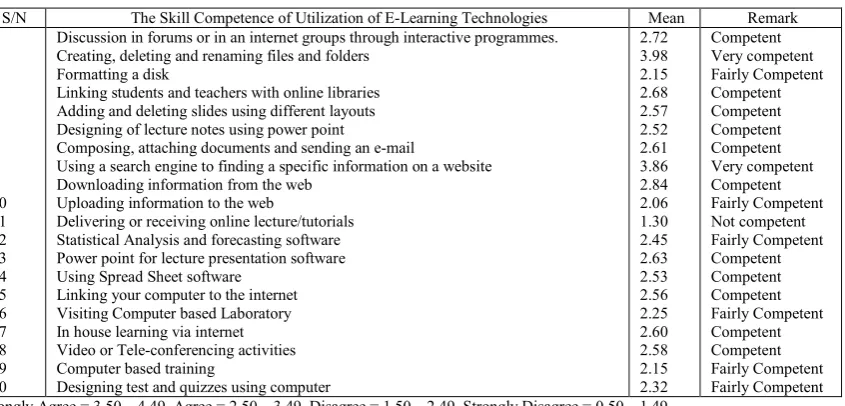
Table 2. Computed responses to answer Research Question 2 (Competency)
S/N The Skill Competence of Utilization of E-Learning Technologies Mean Remark 1 2 3 4 5 6 7 8 9 10 11 12 13 14 15 16 17 18 19 20
Discussion in forums or in an internet groups through interactive programmes. Creating, deleting and renaming files and folders
Formatting a disk
Linking students and teachers with online libraries Adding and deleting slides using different layouts Designing of lecture notes using power point
Composing, attaching documents and sending an e-mail
Using a search engine to finding a specific information on a website Downloading information from the web
Uploading information to the web
Delivering or receiving online lecture/tutorials Statistical Analysis and forecasting software Power point for lecture presentation software Using Spread Sheet software
Linking your computer to the internet Visiting Computer based Laboratory In house learning via internet Video or Tele-conferencing activities Computer based training
Designing test and quizzes using computer
[image:4.595.94.517.592.795.2]To answer Research Question 1, the mean scores of the data were computed from the frequency distribution of the responses. The result of the computation is shown in Table 1 below.
The information intable 1 above indicatesthe level of utilizing e-learning by lecturers for educational purposes in tertiary institutions in Borno state, Nigeria.
The null hypothesis 1 was tested using chi square (χ ) at 0.05 level of significance. And according to the analysis, the χ Calculated is greater than χ tabulated (611.13> 67.50). Since the calculated χ -value is greater than the χ -critical (table) value (611.13> 67.50) the null hypothesis was rejected. This indicated that there is significant difference in the mean ratings on the utilization of e-learning technologies in tertiary institutions in Borno State, Nigeria. This indicated that there are greater numbers of items in Table 1 on the utilization of e-learning technologies in tertiary institutions in Borno State, Nigeria.
Research Question 2
What levels of competence are lecturers on e-learning technologies utilization in tertiary institutions in Borno state, Nigeria?
To answer Research Question 2, the mean scores of the data were computed from the frequency distribution of the responses. The result of the computation is shown in Table 2 below. The information in the table above indicates the level of competency of lecturers on e-learning technologies utilization for educational service delivery in tertiary institutions in Borno state, Nigeria.
The null hypothesis 2 was tested using chi square (χ ) at 0.05 level of significance. And according to the analysis, the χ Calculated is greater than χ tabulated (274.01 > 67.50). Since the calculated χ -value is greater than the χ -critical (table) value (274.01 > 67.50) the null hypothesis was rejected. This indicated that there is significant difference in the mean ratings on the level of competence of e-learning technologies in tertiary institutions in Borno State, Nigeria. This indicated that there are greater numbers of items in Table 2 on the competency of lecturers on e-learning technologies in tertiary institutions in Borno State, Nigeria.
Limitations of the Study
It should be noted that this study has several limitations. The sample size of three hundred and fifty (350) lecturers of the seven higher institutions of learning will make generalization difficult. Furthermore, the use of perception to find out skill competency is a limitation as some lecturers might not be truthful in reporting their level of competency. Testing their competency skills would have been a better option.
Conclusion
The findings of this study revealed that the available e-learning facilities are well utilized and lecturers’ level of competency is considerably okay. The findings also indicated that lecturers
rarely give assignments online, receive feedbacks via e-mail, chat online with students, and/or fellow teachers, post students’ results online, and they are not competent with delivering online lectures to students.
Recommendations
1. Lecturers should undergo computer trainings periodically to update their knowledge and skills needed for e-learning application.
2. Every department in the institutions should create blogs where every student can access and leave comments to serve as feedback to colleagues and lecturers. This enables the interactivity of the learning process.
3. Every department in the institutions should ensure that lecturers structure their courses into modular format that could be taught through e-learning. Some lecturers may not always be available so, pre-recorded course content can be given to students for studies they are away.
4. Institutions should introduce the online continuous
assessment system just like that of the National Open University of Nigeria which set out a period for online test for students to login, answer the questions, submit and get instant result.
Acknowledgement
Our sincere gratitude goes to the Academic institutions for allowing us to carry out the research in their schools; we also thank the lecturers in the various institutions for making the data available for this study.
REFERENCES
Archibong, I. A. and Effiom, D. O. 2009. ICT in University Education: Usage and Challenges among Academic Staff. African Research Review, 3(2): pp 404-414.
Banfi, I. 1999. Hungary. In W.J. Pelgrum & R. Anderson (Eds), ICT and the Emerging Paradigm for Lifelong Learning (pp. 47 – 48). Amsterdam: IEA.
BECTA. 2001. Emerging Findings from the Evaluation of the Impact of ICT on Pupils Attainment. London: BECTA. Blurton C. 2002. New Directions of ICT use in Education. Bupo G. O. 2012. Business education students’ awareness and
utilization of e-learning in Anambra state tertiary institutions. A thesis submitted in fulfilment of the requirements for the award of Master of Science (M.Sc.) degree in business education.
C. and Northcote, M. 2002. Devising Strategies for Enhancing Quality Staff Development in Embedding ICT in Teaching and Learning, in Quality Conversations, Proceedings of the 25th HERDSA Annual Conference, Perth, Western Australia, 7-10 July 2002: pp 384-392
Cheetham, G. and Chivers, G. 2001. How professionals learn in practice: An investigation of informal learning amongst
people working in professions. Journal of European
Industrial Training (JEIT), 25(5), pp248-292.
Commonwealth Department of Education, Science and Training, 2002. striving for quality: Learning, teaching and scholarship. Canberra.
Nigeria. Journal of Information Technology Education (JITE): Volume 12, 2013.
Gülbahar, Y. 2008. ICT Usage in Higher Education: A Case Study on Preservice Teachers and Instructors. The Turkish online Journal of Educational Technology - TOJET Vol. 7 No. 1article 3 Jan 2008.
Ijeoma A. A. et al. 2010. ICT Competency among Academic Staff in Universities in Cross Rivers State, Nigeria. Computer and Information Science (CIS), Vol. 3, No. 4; November 2010.
Kadel, R. 2005. How teacher attitudes affect technology. Learning and Leading with Technology, 39 (5), 34-47. Nana Y. A. and Samuel E. E. 2012. Use of Information &
Communication Technology (ICT) in tertiary education in Ghana: A case study of electronic learning (e-learning). International Journal of Information and Communication
Technology Research, Vol. 2 No. 1
Nwugu B. G. 2006. Educational research: Basic Issues and Methodology. Ibadan, Wisdom Publishers.
Oliver, R. 2002. The role of ICT in higher education for the 21st century: ICT as a change agent for education. Retrieved 15 August 2012 from http://elrond.scam.ecu. edu.au/oliver/2002/he21.pdf
Pelgrum, W. J. and Law, N. 2003. "ICT in Education around the World: Trends, Problems and Prospects "UNESCO-International Institute for Educational Planning. Radloff, A. (2001). “Getting online: The Challenges for Academic Staff and Institutional leaders.
Pelgrum, W.J. and Anderson, R.E. 1999. (Eds.) ICT and Emerging Paradigm for Lifelong Learning. Amsterdam: IEA.
Rosen, I. D., and Maguire, P. 1995. Computer anxiety: A cross-cultural comparison of university students in ten countries. Computers in Human Behaviour, 11(1): pp 45-64.
White, G. 2003. E-learning: Key Australian initiatives (An opportunity for all learners). Retrieved on 15th April 2012
from http://www.educationau.edu.au/papers/elearning_
polaand03.pdf