COULD IT HAPPEN: GLOBAL WARMING AND THE EXTINCTION OF MANKIND?
Fellow at the Public Policy Institute, Belgrade
ARTICLE INFO ABSTRACT
Time is running out, as the Keeling curve measuring carbon dioxide continues its relentless rise (Earth CO2). We stand now close to 410ppm CO2:s. The upcoming COP23 in Bonn, sponsored by Fiji, must outline how its COP21 objectives are to be promoted, fulfi
replacement of fossil fuels and wood coal by solar power, together with wind power and atomic power, can save mankind from the threat of global warming. This paper presents a tentative estimation of what is involved wit
solar power parks of Ouarzazate size.
Copyright©2017, Jan-Erik Lane. This is an open access article distributed under the Creative Commons Att
distribution, and reproduction in any medium, provided the original work is properly cited.
INTRODUCTION
The UNFCCC holds a new meeting this fall in Bonn with host country Fiji – the COP23. It has to find a way forward towards the implementation of the COP21 Treaty,
already one defection. The islands of Fiji fear of course the sea level rise attending global warming, as there is now a set of islands becoming inhabitable in the Pacific Ocean, like e.g. Tuvalu. But the dangers involved in the global w process concern all countries on the globe in various forms of risks, immense one in reality. H. Kahn showed in 1962 by Thinking of the Unthinkable that one can scientifically theorize future scenarios with the inter alia one terrible outcome, namely the elimination of the human species. Nuclear deterrent has proved effective against this result, with the possible exception of North Korea. But its leader knows that if the country hurts surrounding nations, it will suffer a terrible punishment. Global warming is different, as there is no efficient halting process in place. Global warming theory (GWT) has come of age. It entails the possibility of a process of continuous warming of the globe until irreversibility is arrived at.
*Corresponding author: Jan-Erik Lane,
Fellow at the Public Policy Institute, Belgrade
ISSN: 0975-833X
Article History:
Received 21st April, 2017
Received in revised form 10th May, 2017
Accepted 19th June, 2017
Published online 26th July, 2017
Citation: Jan-Erik Lane, 2017. “COULD IT HAPPEN: Global Warming and the Extinction of Mankind? (07), 54245-24249.
Key words:
Decarbonisation, COP21, Goals I, II, III,
Implementation gap, Game strategies,
Common pool regime (CPR) defection.
REVIEW ARTICLE
COULD IT HAPPEN: GLOBAL WARMING AND THE EXTINCTION OF MANKIND?
*
Jan-Erik Lane
Fellow at the Public Policy Institute, Belgrade
ABSTRACT
Time is running out, as the Keeling curve measuring carbon dioxide continues its relentless rise (Earth CO2). We stand now close to 410ppm CO2:s. The upcoming COP23 in Bonn, sponsored by Fiji, must outline how its COP21 objectives are to be promoted, fulfilled and implemented. Only a massive replacement of fossil fuels and wood coal by solar power, together with wind power and atomic power, can save mankind from the threat of global warming. This paper presents a tentative estimation of what is involved with regard to the fulfilment of COP21’s GOAL II, using a model calculation of solar power parks of Ouarzazate size.
is an open access article distributed under the Creative Commons Attribution License, which distribution, and reproduction in any medium, provided the original work is properly cited.
The UNFCCC holds a new meeting this fall in Bonn with host the COP23. It has to find a way forward towards although there is already one defection. The islands of Fiji fear of course the sea level rise attending global warming, as there is now a set of islands becoming inhabitable in the Pacific Ocean, like e.g. Tuvalu. But the dangers involved in the global warming process concern all countries on the globe in various forms of H. Kahn showed in 1962 by Thinking of the Unthinkable that one can scientifically theorize future scenarios with the inter alia one terrible outcome, y the elimination of the human species. Nuclear deterrent has proved effective against this result, with the possible exception of North Korea. But its leader knows that if the country hurts surrounding nations, it will suffer a terrible warming is different, as there is no Global warming theory (GWT) has come of age. It entails the possibility of a process of continuous warming of the globe until irreversibility is
Then, humanity is finished forever, as Mother Earth enters a new stage in its giant evolutionary path over hundred of millions of years. What must be done by international coordination is to set up and operate a common pool regime (CPR) that is capable to halt this climate change process in the 21rt century, and maybe reverse it. Is the UNFCCC framework this CPR? I doubt that the COP23 will be a success.
GLOBAL WARMING THEORY (GWT)
One may distinguish between two parts in GWT, one much developed set of hypotheses bout the natural sciences’ contribution to understanding climate change, and one poorly developed set of hypotheses about the difficulties in engaging in collective action, like the COP21 common pool regime (CPR) for decarbonisation.
Natural sciences
The first anticipation of the global warming mechanism was done by Frenchman J. Fourier in the early 19
theory was developed by Swedish chemist Arrhenius ar 1895. He calculated that a doubling of CO2 ppm would be conducive to a 5 degree increase in global average temperature, which is not too far off the worst scenario for the 21rst century, according to UN expertise now.
International Journal of Current Research
Vol. 9, Issue, 07, pp.54245-24249, July, 2017
COULD IT HAPPEN: Global Warming and the Extinction of Mankind?”, International Journal of Current Resea
COULD IT HAPPEN: GLOBAL WARMING AND THE EXTINCTION OF MANKIND?
Time is running out, as the Keeling curve measuring carbon dioxide continues its relentless rise (Earth CO2). We stand now close to 410ppm CO2:s. The upcoming COP23 in Bonn, sponsored by Fiji, must lled and implemented. Only a massive replacement of fossil fuels and wood coal by solar power, together with wind power and atomic power, can save mankind from the threat of global warming. This paper presents a tentative estimation h regard to the fulfilment of COP21’s GOAL II, using a model calculation of
ribution License, which permits unrestricted use,
Then, humanity is finished forever, as Mother Earth enters a new stage in its giant evolutionary path over hundred of millions of years. What must be done by international on is to set up and operate a common pool regime (CPR) that is capable to halt this climate change process in the 21rt century, and maybe reverse it. Is the UNFCCC framework this CPR? I doubt that the COP23 will be a success.
GLOBAL WARMING THEORY (GWT)
One may distinguish between two parts in GWT, one much developed set of hypotheses bout the natural sciences’ contribution to understanding climate change, and one poorly developed set of hypotheses about the difficulties in engaging like the COP21 common pool regime
The first anticipation of the global warming mechanism was done by Frenchman J. Fourier in the early 19th century, but the theory was developed by Swedish chemist Arrhenius around 1895. He calculated that a doubling of CO2 ppm would be conducive to a 5 degree increase in global average temperature, which is not too far off the worst scenario for the 21rst century, according to UN expertise now.
INTERNATIONAL JOURNAL OF CURRENT RESEARCH
Yet, it was not until Stephen Schneider published Global Warming in 1989 that the theory started to receive wide attention, no doubt strengthened by the work of Keeling in measuring CO2 ppm globally. Moreover, techniques for viewing the CO2 layer were developed, increasing the attention to climate change. Now, the UN reacted with creating a few bodies to look into the changes going on, one of which was the COP framework. The economists jumped in besides the natural scientists, worried about the future costs of this transformation of the atmosphere. On the one hand, Kaya and associates (1998) presented a model that explained CO2:s with energy and energy intensity of GDP. On the other hand, Stern (2007) called global warming the largest externality in human history, calling for international governance in order to stem the growth of greenhouse gases. Stern outlines a number of activities aimed at reducing CO2 emissions, promising also a Super Fund to channel money from rich advanced nations to poor countries and developing economies. As little has been done through the UN system of meetings and agencies up to date, Stern (2015) later asked: “What are we waiting for?” All theories need empiricalevidence. When the polar ice mountains began to collapse, it seemed decisive evidence for the global warming theory. Other important test implications like glacier retreats everywhere, ocean warming and acidification as well as desertification in Africa also gave support for global warming theory. Denials of climate change appear more and more unfounded, although it is true that more of CO2 may benefit some fauna or environment niches.
Social sciences
The part of GWT analyzing the coordination efforts within the UNFCCC as well as the different country responses to climate change is far less developed than the natural sciences’ part. One finds practically nothing in the UNFCCC documents about the principal problems in large scale international governance, like e.g. defection. One may speak of two currents of social science theory that are highly relevant for GWT:
Implementation theory: In the discipline of public
administration and policy-making, some ideas about the so-called “implementation gap” – Wildavsky’s hiatus – are highly relevant to the COP21 project (Pressman and Wildavsky, 1973, 1984). The COP21 has three main objectives: halt CO2 increases by 2018-2020 (GOAL I), decrease CO2 emissions considerable by 2030 (GOAL II) and achieve full decarbonistion by 2070-80 (GOAL III).
But how are they to be implemented? No one knows, because COP21 has neglected what will happen after the major policy decision. The COP21 project outlines many years of policy implementation to reach decarbonisation, but which are the policy tools?
Game theory: A CPR is vulnerable to the strategy of
reneging, as analysed theoretically in the discipline of game theory. The relevant game for the CPR is the PD game, where the sub game perfect Nash equilibrium is defection in a finite version of this game (Dutta, 1999). This is not recognized by Elinor Ostrom (1990) in her too optimistic view about the viability of CPR:s. It is definitely not the case that Ostrom has overcome Hobbes (“And covenants, without the sword, are but words and of no strength to secure a man at all”), as one commentator naively declared
when she was awarded both the Nobel prize and the Johan Skytte prize (Rothstein’ website 2014).
The COP21 project houses lots of reneging opportunities of various sorts, which will become clear as this CPR project moves forward. One major partner has already defected, which may trigger other governments to renege. The only way to control defection in this global CPR is to employ selective incentives, which is what the planned Super Fund could offer, if at all workable.
DAMAGES AND DANGERS
Considering the probable damages from global warming, it is astonishing that global warming theory has not been better recognized or even conceptually developed or empirically corroborated.. If global warming continues unrestrained, much of Asia will be negatively affected, just as Australia is on the verge of losing its coral reefs. There will be sooner or later:
Land losses along the costs (Bangladesh, Pacific islands);
Too high temperatures for men and women to work outside (South Asia);
Food production decline (Sri Lanka);
Fish harvest decrease (Globally);
Droughts and starvation (Africa, South Asia);
Lack of fresh water supply (Africa, Latin America);
Drying up of rivers (China, South Asia);
Ocean acidification and species extinction (Globally);
Highly volatile climate with tremendous damages (Asia);
Deforestation (Latin America, Indonesia)
This list is far from complete or exhaustive. One could even mention worse outcomes, like the transformations of warm and cold currents in the oceans (Gulf Stream, North Atlantic Current). What one may underline is that so far no known negative feedback has been found that could stem global warming naturally. We have only positive feedbacks, meaning outcomes reinforce each other in the same direction. It is far from easy to calculate exactly how increases in greenhouse gases impact upon temperature augmentations. Take the case of CO2s, where a most complicated mathematical formula is employed:
T = Tc + Tn, whereT is temperature, Tc is the cumulative
net contribution to temperature from CO2 and Tn the one. “CO2” refers to all CO2, there is no distinction between man-made and natural CO2.
But when it comes to methane, it is not known whether the tundra will melt and release enormous amounts. But methane does not stay in the atmosphere long, like CO2s. For the other greenhouse gases, there is no similar calculation as for the CO2s: If humans could eat less meat from cows, it would mean a great improvement, as more than a billion cows emit methane. Food from chicken should replace beef meat and burgers. The general formula reads:
THE PROBLEMATIC OF GLOBAL WARMING: Anthropogenic Need of Energy
To have a firm foundation for understanding the immense increase in CO2 emissions the last two decades, we resort to the Kaya model, linking CO2:s with energy and affluence. One basic theoretical effort to model the greenhouse gases, especially CO2:s, in terms of a so-called identity is the deterministic Kaya equation. The Kaya identity, “I = PAT” – model type, describes environmental (I)mpact against the (P)opulation, (A)ffluence and (T)echnology. Technology covers energy use per unit of GDP as well as carbon emissions per unit of energy consumed (Kaya and Yokoburi, 1997). In theories of climate change, the focus is upon so-called anthropogenic causes of global warming through the release of greenhouse gases (GHG). To halt the growth of the GHG:s, of which CO2:s make up about 70 per cent, one must theorize the increase in CO2:s over time (longitudinally) and its variation among countries (cross-sectionally). As a matter of fact, CO2:s have very strong mundane conditions in human needs and social system prerequisites. Besides the breading of living species, like Homo sapiens for instance, energy consumption plays a major role. As energy is the capacity to do work, it is absolutely vital for the economy in a wide sense, covering both the official and the unofficial sides of the economic system of a country. The best model of carbon emissions to this day is the so-called Kaya model. It reads as follows in its standard equation version – Kaya’s identity. (E 1) Kaya’s identity projects future carbon emissions on changes in Population (in billions), economic activity as GDP per capita (in thousands of $US (1990) / person year), energy intensity in Watt years / dollar, and carbon intensity of energy as Gton C as CO2 per TeraWatt year.” (http://climatemodels.
uchicago.edu/kaya/kaya.doc.html)
Concerning the equation (E 1), it may seem premature to speak of a law or identity that explains carbon emissions completely, as if the Kaya identity is a deterministic natural law. It will not explain all the variation, as there is bound to be other factors that impact, at least to some extent. Thus, it is more proper to formulate it as a stochastic law-like proposition, where coefficients will be estimate using various data sets, without any assumption about stable universal parameters. Thus, we have this equation format for the Kaya probabilistic law-like proposition, as follows:
(E2) Multiple Regressions
Y = a + b1X1 + b2X2 + b3X3 + ... + btXt + u;
Note:
Y = the variable that you are trying to predict (dependent variable);
X = the variable that you are using to predict Y (independent variable);
a = the intercept; b = the slope;
u = the regression residual.
Note: http://www.investopedia.com/terms/r/regression.asp#ixzz 4Mg4Eyugw
Thus, using the Kaya model for empirical research on global warming, the following anthropogenic conditions would affect positively carbon emissions:
[image:3.595.312.554.288.429.2](E3) CO2:s = F(GDP/capita, Population, Energy intensity, Carbon intensity), in a stochastic form with a residual variance, all to be estimated on data from some 59 countries. I make an empirical estimation of this probabilistic Kaya model - the cross-sectional test for 2014:(E4) k1= 0,68, k2=0,85, k3=0,95, k4=0,25;R2= 0,895.Note: LN CO2 = k1*LN (GDP/Capita) +k2*(dummy for Energy Intensity) + k3*(LNPopulation) + k4*(dummy for Fossil Fuels/all)Dummy for fossils 1 if more than 80 % fossil fuels; k4 not significantly proven to be non-zero, all others are. (N = 59). The Kaya model findings show that total CO2:s go with larger total GDP. First, we see that CO2 emissions are closely connected with energy consumption, globally speaking. And the projections for energy augmentation in the 21st century are enormous (EIA, BP, IEA).Figure 1 shows how things have developed since 1990.
Figure 1. GDP – CO2 emissions
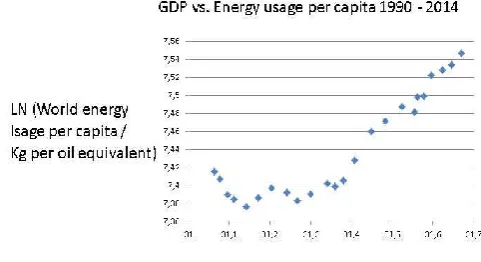
To make the dilemma of energy versus emissions even worse, we show in Figure 2 that GDP increase with the augmentation of energy per capita. Decarbonisation is the promise to undo these dismal links by making GDP and energy consumption rely upon carbon neutral energy resources, like modern renewables and atomic energy.
Figure 2. GDP against energy per person (n = 59)
[image:3.595.316.557.555.686.2]short period of time decarbonisation becomes feasible or likely, not merely desirable.
Solar power parks
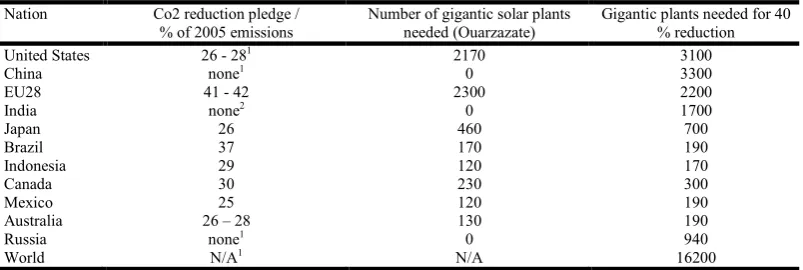
Let us examine what this hoped for reduction of fossil fuels implies for the augmentation of renewable energy consumption, here solar power. The use of atomic power is highly contested, some countries closing reactors while others construct new and hopefully safer ones. I here bypass wind power and thermal power for the sake of simplicity in calculations.Consider now Table 1, using the giant solar power station in Morocco as the benchmark – How many would be needed to replace the energy cut in fossil fuels and maintain the same energy amount, for a few selected countries with big CO2 emissions?
Allow me to doubt that the UNFCCC or the COP21-23are or will be aware of the immensity of the task of implementing GOAL II until 2030. Several countries will find even GOAL I hard to fulfill! The COP23 must urgently clarify how such enormous amounts of solar power can be achieved by 2030 – plan or spontaneous order? Such an enormous energy transformation can only be made by the use of market initiatives and incentives (Barry, 1982; Hayek, 1991), but governments must put down the rules of the game: subsidies, charges and taxes?
DISMAL SCIENCE: Rejection of Sach’s Moralism
World star economist J. Sachs preaches this message (Sachs, 2015), but it is only ethics. Economics is, as Carlyle said, a “dismal science”, analyzing the IS and not the OUGHT. And the Malthusian predicament is with us with a vengeance in the form of the energy-emissions conundrums. I will develop this position by means of some country examples. Insisting upon
the positive nature of economics, “positive” referring to the understanding and prediction of the IS, one cannot but realize that sustainable development theory deals with the OUGHT. The gulf between normative utopia and harsh reality forces one to look for how adherents of sustainable economics get from realities to vision. Take the example of Sachs, stating about SDG (sustainable development goals):
… the SDGs need the identification of new critical pathways to sustainability. Moving to a low-carbon energy system, for example, will need an intricate global interplay of research and development, public investments in infrastructure (such as high-voltage direct current transmission grids for long-distance power transmission), private investments in renewable power generation, and new strategies for regulation and urban design. The task is phenomenally complex.
But Sachs does not inform us how something so “phenomenally complex” is to come about, going from the IS to the OUGHT. He continues:
Market-based strategies (such as carbon taxation) can help to simplify the policy challenge by steering private decisions in the right direction, but politics, planning, and complex decision making by many stakeholders will be unavoidable.
Source: 2210 www.thelancet.com Vol 379 June 9, 2012
Of course, but what is the likelihood that a carbon tax can be put in place (where, how much) as well as how large is the probability that planning works? Only wishful thinking! Sachs realizes the gap between desirability and feasibility, but he confronts the gap by almost religious beliefs:
[image:4.595.101.503.265.400.2]The SDGs will therefore need the unprecedented mobilisation of global knowledge operating across many sectors and
Table 1. Number of Ouarzazate type solar plants for COP21’s GOAL IIdecarbonisation 2030
Nation Co2 reduction pledge /
% of 2005 emissions
Number of gigantic solar plants needed (Ouarzazate)
Gigantic plants needed for 40 % reduction
United States 26 - 281 2170 3100
China none1 0 3300
EU28 41 - 42 2300 2200
India none2 0 1700
Japan 26 460 700
Brazil 37 170 190
Indonesia 29 120 170
Canada 30 230 300
Mexico 25 120 190
Australia 26 – 28 130 190
Russia none1 0 940
World N/A1 N/A 16200
Note: Average of 250 - 300 days of sunshine used for all entries except Australia, Indonesia, and Mexico, where 300 - 350 was used.
Sources: Paris 2015: Tracking country climate pledges. Carbon Brief, https://www.carbonbrief.org/paris-2015-tracking-country-climate-pledges; EDGAR v 4.3.2, European Commission, Joint Research Centre (JRC)/PBL Netherlands Environmental Assessment Agency. Emission Database for Global Atmospheric Research (EDGAR), release version 4.3.2. http://edgar.jrc.ec. europe.eu, 2016 forthcoming; CO2 Emission Reduction With Solar http://www.solarmango.com/in/tools/solar-carbon-emission-reduction
Nation Co2 reduction pledge /
% of 2005 emissions
Number of gigantic solar plants needed (Ouarzazate)
Gigantic plants needed for 40 % reduction
Germany 491 550 450
France 371 210 220
Italy 351 230 270
Sweden 421 30 30
China none[1] 0 3300
Note: Average of 250 - 300 days of sunshine per year was used).
regions. Governments, international institutions, private business, academia, and civil society will need to work together to identify the critical pathways to success, in ways that combine technical expertise and democratic representation. Global problem-solving networks for sustainable development— in energy, food, urbanisation, climate resilience, and other sectors— will therefore become crucial new institutions in the years ahead.
Source: p. 2210, www.thelancet.com Vol 379 June 9, 2012
What is at stake for most people who understand the risks with climate change is not the desirability of decarbonisation in some form or another. They crux of the matter is feasibility: How to promote decarbonisation so that real life results occur? The real obstacles for any decarbonisation project stem from the logic of collective action, if we stick to the social sciences, as ethically neutral and truthfully objective. The energy-emissions conundrum is probably unresolvable until fusion power arrives!
Conclusion
The entire UNFCCC runs with a basic insufficiency, making it too weak to respond to the climate change challenge that could bring about a worst case scenario for mankind. Scholars have shown that the UN climate decision-making is highly manipulated by self-interests from the major powers (Conca, 2015; Vogler, 2016). The ideas of using climate change policy-making to solve other problems like poverty, global redistribution of wealth and stopping general environment degradation make matters just more complicated, resulting in massive transaction costs. The likelihood of disaster is on the increase, which is why I have written many articles on climate change and intergovernmental coordination. Consider the following need for solar panel parks of Ouarzazate size for selection of countries: Table 2.Number of Ouarzazate type solar plants for COP21’s GOAL II decarbonisation 2030
Sources and literature
World Bank national accounts data - data.worldbank.org OECD National Accounts data files
GHG and energy sources
World Resources Institute CAIT Climate Data Explorer - cait.wri.org
EU Joint Research Centre Emission Database for Global Atmospheric
Research - http://edgar.jrc.ec.europa.eu/overview.php
UN Framework Convention on Climate Change -
http://unfccc.int/ghg_data/ghg_data_unfccc/time_series_annex _i/items/3814.php
International Energy Agency. Paris.
Energy Information Administration. Washington, DC. BP Energy Outlook 2016.
EU Emissions Database for Global Research EDGAR, http://edgar.jrc.ec.europa.eu/
World Bank Data Indicators, data.worldbank.org
British Petroleum Statistical Review of World Energy 2016
REFERENCES
"Arrhenius, Svante August" in Chambers'sEncyclopædia. London: George Newnes, 1961, Vol. 1.
Barry, B. 1982. “The Tradition of Spontaneous Order”, in Literature of Liberty. Vol. V, No. 2, pp. 7-58. Arlington, VA: Institute for Humane Studies.
Conka, K. 2015. Un Unfinished Foundation. The United Nations and Global Environmental Governance. Oxford: OUP.
Dutta, P.L. 1999. Strategies and games. Cambridge, MA: MIT Press.
Hayek, F.A. 1991. The Fatal Conceit: The Errors of Socialism. The University of Chicago Press.
Kaya, Y. and Yokoburi, K. 1997. Environment, energy, and economy: Strategies for sustainability. Tokyo: United Nations University Press.
Malthus, T. 1798, 2012. An Essay on the Principle of Population. Greensboro, NC: Empire Books.
Pressman, J. and Wildavsky, A. 1973, 1984. Implementation. Berkeley: University of Cal Press.
Ramesh, J. 2015. Green Signals: Ecology, Growth and Democracy in India (2015). Oxford : Oxford University Press.
Sachs, J. 2012. “From Millennium Development Goals to Sustainable Development Goals”. www.thelancet.com Vol 379 June 9, 2012. Lancet 2012; 379: 2206–11.
Sachs, J. (August 10th, 2015) “Sustainable Development for Humanity’s Future” (http://jeffsachs.org/2015/08/ sustainable-development-for-humanitys-future/)
Sachs, J.D. 2015. The Age of Sustainable Development. New York: Columbia University Press.
Stern, N. 2007. The Economics of Climate Change. Oxford: OUP.
Stern, N. 2015. What are we waiting for? Cambridge, MA: MIT Press.
Vogler, J. 2016. Climate Change in World Politics.
Basingstoke: Macmillan Palgrave