PUBLIC PERCEPTION ABOUT THE CONSERVATION OF TERRESTRIAL PROTECTED AREAS IN
1
Faiz Mohammad Kakar,
and
1
Pakistan Study Center, University of Baluchistan, Quetta, Pakistan
2
Chairperson and Associate Professor, Department of Geography, University of Baluchistan
3Chairperson Pakistan Study Center University of Balochistan
4
Deputy Director Agriculture, Go
ARTICLE INFO ABSTRACT
The conservation of biodiversity, habitat and ecosystems is inevitable approach of Protected Areas globally because they are highly threatened by environmental challenges. Pakistan is a part of this global struggle for achieving the target of 17% of world
prime objective of this paper is to analyze the awareness level, their management and legislation of the protected areas in Baluchistan. For the purpose a Key Informant survey was conducted through cheek list u
foresters, tribal leaders, concerned NGOs workers, staff of international conservation entities and agriculturists. The result revealed that the overall picture about awa
where only 8% of the informants were aware about the number of protected areas and 37 % were found familiar with the basic concept of protected areas in Baluchistan. On the other hand survey results about the potential and p
revealed that 54.1% of the informants thought that the potential of protected areas in Baluchistan is very high, 41.6% cited the potential is high, only 4% mentioned that the potential is low. Amon key informants only 12.5% were aware about the legislation for protected areas in Pakistan about environmental protection, likewise 33.3% knew about current legislation in Pakistan. Similarly 79.1% were aware about the current legislation in Balochis
with legislation regarding protect areas in Baluchistan. There is always a room for improvements therefore the awareness level regarding protected areas are not on the mark. Thus this paper has initiated the baseline da
sensitization among masses about protected areas in the province.
Copyright © 2015 Faiz Mohammad Kakar et al. This is an open access article distributed under the Creative Com unrestricted use, distribution, and reproduction in any medium, provided the original work is properly cited.
1. INTRODUCTION
Protected areas are the key component of the environmental conservation and are providing invaluable and number of services and benefits to humanity (Balmford, 2003: Mulongoy,
2008: Kettunen et al., 2009: Dudley et al.
areas deliver a number of ecosystem services such as water purification and retention, erosion control, fuel wood, shelter and reduced flooding and unnatural wild fires. Protected areas protect the local communities against different environmental risks such as flood and droughts and support food and health
*Corresponding author: Khair Muhammad Kakar
Deputy Director Agriculture, Government of Baluchistan Quetta.
ISSN: 0975-833X
Article History:
Received 21st July, 2015
Received in revised form 07th August, 2015
Accepted 25th September, 2015
Published online 20th October,2015
Key words:
Protected Areas, Conservation,
Biodiversity and Balochistan.
Citation: Faiz Mohammad Kakar, Syed Ainuddin,
about the Conservation of Terrestrial Protected Areas in Baluchistan
RESEARCH ARTICLE
PUBLIC PERCEPTION ABOUT THE CONSERVATION OF TERRESTRIAL PROTECTED AREAS IN
BALUCHISTAN
Faiz Mohammad Kakar,
2Syed Ainuddin,
3Dr. Mohammad Usman Tobawal
and
*,4Khair Muhammad Kakar
Pakistan Study Center, University of Baluchistan, Quetta, Pakistan
Associate Professor, Department of Geography, University of Baluchistan
Chairperson Pakistan Study Center University of Balochistan
Deputy Director Agriculture, Government of Baluchistan Quetta
ABSTRACT
The conservation of biodiversity, habitat and ecosystems is inevitable approach of Protected Areas globally because they are highly threatened by environmental challenges. Pakistan is a part of this global struggle for achieving the target of 17% of world to be declared protected areas till 2020. The prime objective of this paper is to analyze the awareness level, their management and legislation of the protected areas in Baluchistan. For the purpose a Key Informant survey was conducted through cheek list using purposive sampling techniques. The key informants selected include academicians, foresters, tribal leaders, concerned NGOs workers, staff of international conservation entities and agriculturists. The result revealed that the overall picture about awa
where only 8% of the informants were aware about the number of protected areas and 37 % were found familiar with the basic concept of protected areas in Baluchistan. On the other hand survey results about the potential and preferences towards the management of protected areas (PAs) revealed that 54.1% of the informants thought that the potential of protected areas in Baluchistan is very high, 41.6% cited the potential is high, only 4% mentioned that the potential is low. Amon key informants only 12.5% were aware about the legislation for protected areas in Pakistan about environmental protection, likewise 33.3% knew about current legislation in Pakistan. Similarly 79.1% were aware about the current legislation in Balochistan and likewise 70.8% were familiar with legislation regarding protect areas in Baluchistan. There is always a room for improvements therefore the awareness level regarding protected areas are not on the mark. Thus this paper has initiated the baseline data for further studies and will serve the provincial stakeholders for raising sensitization among masses about protected areas in the province.
. This is an open access article distributed under the Creative Commons Attribution License, which permits unrestricted use, distribution, and reproduction in any medium, provided the original work is properly cited.
Protected areas are the key component of the environmental conservation and are providing invaluable and number of (Balmford, 2003: Mulongoy, ., 2010). Protected mber of ecosystem services such as water purification and retention, erosion control, fuel wood, shelter and reduced flooding and unnatural wild fires. Protected areas protect the local communities against different environmental
oughts and support food and health
Khair Muhammad Kakar
Deputy Director Agriculture, Government of Baluchistan Quetta.
security by maintaining crop diversity and species with economic value (Dudley, 2003: Stolton
et al., 2008). Many rural communities depend on protected areas for their food and livelihoods; protected areas contribute directly to global sustainable development and poverty
reduction (Dudley et al., 2010: Mulongoy, 2008). It is
estimated that nearly 1.1 billion people
world’s population – depend on protected areas for a significant percentage of their livelihoods (UN Millennium Project 2005). Protected areas through its ecosystem provide benefits of various natures at all lev
easy to quantify in an accurate manner the benefits and services of the ecosystem and human kind is miss leaded in understanding the relation of ecosystems with livelihood however Balmford and Constanza
International Journal of Current Research
Vol. 7, Issue, 10, pp.21480-21485, October, 2015
Faiz Mohammad Kakar, Syed Ainuddin, Dr. Mohammad Usman Tobawal and Khair Muhammad Kakar about the Conservation of Terrestrial Protected Areas in Baluchistan”, International Journal of Current Research
PUBLIC PERCEPTION ABOUT THE CONSERVATION OF TERRESTRIAL PROTECTED AREAS IN
Dr. Mohammad Usman Tobawal
Pakistan Study Center, University of Baluchistan, Quetta, Pakistan
Associate Professor, Department of Geography, University of Baluchistan
Chairperson Pakistan Study Center University of Balochistan
vernment of Baluchistan Quetta
The conservation of biodiversity, habitat and ecosystems is inevitable approach of Protected Areas globally because they are highly threatened by environmental challenges. Pakistan is a part of this to be declared protected areas till 2020. The prime objective of this paper is to analyze the awareness level, their management and legislation of the protected areas in Baluchistan. For the purpose a Key Informant survey was conducted through sing purposive sampling techniques. The key informants selected include academicians, foresters, tribal leaders, concerned NGOs workers, staff of international conservation entities and agriculturists. The result revealed that the overall picture about awareness level is not encouraging where only 8% of the informants were aware about the number of protected areas and 37 % were found familiar with the basic concept of protected areas in Baluchistan. On the other hand survey references towards the management of protected areas (PAs) revealed that 54.1% of the informants thought that the potential of protected areas in Baluchistan is very high, 41.6% cited the potential is high, only 4% mentioned that the potential is low. Among the key informants only 12.5% were aware about the legislation for protected areas in Pakistan about environmental protection, likewise 33.3% knew about current legislation in Pakistan. Similarly tan and likewise 70.8% were familiar with legislation regarding protect areas in Baluchistan. There is always a room for improvements therefore the awareness level regarding protected areas are not on the mark. Thus this paper has ta for further studies and will serve the provincial stakeholders for raising sensitization among masses about protected areas in the province.
mons Attribution License, which permits
security by maintaining crop diversity and species with
economic value (Dudley, 2003: Stolton et al., 2006: Stolton
2008). Many rural communities depend on protected areas for their food and livelihoods; protected areas contribute directly to global sustainable development and poverty 2010: Mulongoy, 2008). It is nearly 1.1 billion people – one sixth of the depend on protected areas for a significant percentage of their livelihoods (UN Millennium Project 2005). Protected areas through its ecosystem provide all levels (Myers, 1996). It is not easy to quantify in an accurate manner the benefits and services of the ecosystem and human kind is miss leaded in understanding the relation of ecosystems with livelihood
however Balmford and Constanza et al., 2002 estimated the
OF CURRENT RESEARCH
Khair Muhammad Kakar, 2015. “Public Perception
global value of biodiversity to be roughly $38 trillion, while
Balmford et al.(2002) found that the benefits of conversion of
land (and subsequent loss of ecosystem services) were always outweighed by the costs.
The management of the protected areas is a challenging task due the increasing pressure on biodiversity and ecosystem by multiple factors such as increasing population, new ways of income, industries and development initiatives (Grujicic 2009). Yet for assuring the good governance for environmental protection at national level, Pakistan signed a number of international environmental conventions, treaties and laws
regarding Biodiversity, Climate Change, Desertification,
Endangered Species, Environmental Modification, Hazardous Wastes, Law of the Sea, Marine Dumping, Ozone Layer Protection, Ship Pollution, and Wetlands. For this international obligation, with existence of inherited several laws from
British regime for environmental protection Mehmet et al.
(2009). Pakistan took the first step for political environmental
governance by initiating Environmental Protection Ordinance
in1983. The ordinance was replaced with a new Act of Parliament in 1997. The Environment Protection Ordinance in 1983 is a benchmark in Pakistan’s legislation and represents official recognition of a holistic approach to environmental issues (Mumtaz, 1989). Apart from this, Pakistan succeeded in promulgating a number of legislations regarding environmental governance.
According to Biodiversity Action Plan for Pakistan, 2000, there is a network of 225 Protected Areas comprising 14 National Parks, 99 Wildlife Sanctuaries, 96 Game Reserves, and 16 unclassified (private, proposed or recommended) in Pakistan. The total area covered by these categories is 9,170,121 ha which makes 10.4% of the total land area. There are 29 National Parks in Pakistan however only 14 are under the scope of IUCN International. These protected areas are being managed through different ways such as by government, co-managed, by NGOs, by private sector and local communities like in other neighboring country India (Kothari, 1999). Pakistan is trying to overcome the challenges being faced in protecting the potential areas however, some of the issues involved are very complicated for example on one hand the effect of climate change in shape of disasters occurring continuously for a decade require foreign support and assistance.
Dar et al. (2012) argues that the uncontrolled extraction of resources from forest areas is not factor responsible for the loss of biodiversity but the state government grabs about 50% revenue from forest resources and out of these 94% revenue is generated from timber sale through Azad Jammu and Kashmir Logging and Sawmills Corporation (AKLASC) and other 6% are from other non-timber forest products (NTFP). Certainly this situation demands for a long term planning for shifting the dependency on the other resources. With such a critical scenario across the country the situation in Balochistan is almost more or less the same, thus both the political and social authorities have to take serious steps for controlling the challenges being faced in protecting the areas and to conserve the ecosystems and biodiversity, however these steps demand for doable and solid recommendations based on in-depth, reliable and authentic research which is the motive of this
paper. The paper deals a study about the assessment of the awareness level existing about the protected areas and legislative development in the province among the key informants in the province has been carried out.
2. MATERIALS AND METHODS
Methodology for proposed study is descriptive and interactive form of standardized procedure of research and participatory approach of investigation. For study the both primary and secondary data was used. Secondary data was collected through research articles, government reports, books, websites etc. the secondary data include the definition, categories and types of protected areas. Likewise the data about the number of protected areas in the country and province and data about the legislative development in the country and in the province was collected. Primary data was collected through survey-based checklist using purposive sampling techniques. The survey was conducted with key informants because the concept of protected areas is quite new and technical and common masses are least concerned with. Therefore for the survey the list of the key informant within the province was prepared on the basis of their involvement and background of the targeted respondents. These key informants were selected from the sectors most relevant and directly working in the field of conservations.
24 key informants have been interviewed that include 2 academician and 2 tribal leaders involved in protected areas, were included to be interviewed. Majority of these informants (8 informants) were selected from concerned line departments such as Forest and Wildlife department, Government of Baluchistan, the custodian department of conservation in the province. One informant each from tow biggest International Conservations Organizations such as IUCN and WWF (already working in the province) were selected, 5 local conservationists and one representative from the concerned NGO and Agriculture Department working for conservations were included in the survey. Likewise 2 academicians and 3 professionals from Environmental Protection Agency and Environment Department were selected for survey. A questionnaire consisting of five groups of information such as awareness about the protected area, types and management of protected areas, potential of protected areas in the province, best way of conservation and their key players and awareness about the legislative development in Pakistan and Balochistan, was developed and pretested. The results have been analyzed using statements and descriptive statistics.
4. RESULTS AND DISCUSSION
This section of my research deals with analysis of the primary data collected in fives groups such as awareness about the protected area, types and management of protected areas, potential of protected areas in the province, best way of conservation and their key players and awareness about the legislative development in Pakistan and Balochistan.
4.1 Awareness about Protected Areas
Data related to judgment of the awareness level among the key informants in Table 4.1 shows that 37.50% of the interviewees are known about the prerequisites and definition of the
Protected Areas. Though the 95.8% of the informants were aware about the importance of the PAs in the context of biodiversity conservation and socio economic benefits of PAs for Livelihood improvement, yet only 8.3% of the informants were aware about the number of PAs in Balochistan. Likewise the majority of the informants (62.5%) were found known about the classification of PAs, however only 29.1% of informants were known about the globally accepted scientific categorization of IUCN.
[image:3.595.302.563.297.403.2]Out of this number of the informants, which were known about categorization of IUCN only 83.3% were unknown about the name of these categories. The encouraging point of the data is about the awareness level of key informants regarding the privately protected areas in Balochistan, whereas 75% of informants were known about the privately protected areas in the province. The result shows that the awareness level even among the key informants is lacking and this level in common men could be assumed easily. The result highlight the need of awareness creation at large scale among the masses of Balochistan which would increase the numbers and areas of protected areas in the province which is necessary for accomplishment the national and international target of protecting of areas such as 17% of global areas to be protected till 2020.
Table 4.1 Awareness about Protected Areas
4.2 Potential of Protected Areas in Baluchistan
[image:3.595.299.559.298.559.2]Data of the Figure 4.1 indicates that the majority of the key informants 54.1% are optimistic and think that the potential for PAs in Balochistan is very high.
Figure 4.1. Potential of PA in Baluchistan
Likewise 41.6% of the informants think that potential is only high, while only the remaining 4.1% of the key informants think the potential of PAs in the province is low. No one of the informants was there who think that the potential is very low. Result of this question is very encouraging
4.3 Preference to type of Protected Areas
One for the main objectives of this paper is to highlight the comparative analysis of the types of administration of the PAs by different stakeholders. In this context the data of the Figure 4.2 give an amassing result that only 8.3% of the informants were in the favor of the administration of PAs by the public institution in the province. 20.8% were found in the favor of privately administration of PAs however the vast majority of the informants (70.8%) like the collaborative administration of the PAs. The reasons, which have been expressed by Informants, were 29.1% for good management, 8.3% for better conservation, 12.5% for better networking and 45.8% for all above-mentioned reasons.
Figure 4.2. Preference of type of PA types
Figure 4.3. Reasons of preference of type of PA types
4.4 Preference of management of Protected Areas
[image:3.595.37.292.354.527.2] [image:3.595.36.294.633.725.2]4.5 Potential of PAs in Balochistan with context of species
[image:4.595.308.561.99.212.2]The paper also covers the potential of the targeted and well-known PAs, which were categories such as Hingole National Park, Tor Gar PA, Dureji PA, Ziarat Man and Biosphere and others, in the context of more species and better protection were investigated. In this furtherance the data of the Figure 4.4 indicates that for the potential of the more potential, 50% of the informants were of opinion that the Tor Garr has good potential comparing to other targeted PAs. 12.5% of the informants are thinking that Hingole National Park has better potential. 4.1%, 12.5% and 20.8% think that the Dureji PA, Ziarat Man and Biosphere Site and others have the respectively better potential of more species.
Figure 4.5. Potential of PAs in Balochistan with context of species
4.6 Potential of PAs in Balochistan with context of protection
[image:4.595.36.291.226.328.2]Likewise in above data collected the targeted and well known PAs mentioned above were investigated for assessment of the better protection. In this context the data of the Figure 4.5 shows that for the potential of the better protection, 45.8% of the informants were of opinion that the Tor Garr has good potential comparing to other targeted PAs. 25% of the informants are thinking that Hingole National Park has better potential. 4.1%, 4.1% and 20.8% think that the Dureji PA, Ziarat Man and Biosphere Site and others have the respectively better potential of better protection.
Figure 5.6. Potential of PAs in Balochistan with context of protection
4.7 Best way of conservation in Baluchistan
Data of the Figure 4.6 shows the opinion of the informants about the best conservation way in the province. 41.6% of the informants think that the best way of conservation in Balochistan is the declaring the potential areas as Protected Areas. 33.3% informants emphasize on the community awareness as the best way of conservation. 4.1% and 4.1% of the informants think that more legislation and strict legislation
[image:4.595.305.559.368.456.2]of laws respectively are the best way of conservation in the province while 16.6% of the informants think that all above steps are the best way of the conservation in Balochistan.
Figure 4.7. Best way of conservation in Balochistan
4.8 Key players of conservation in Balochistan
The informants were also asked about the key players of the conservation in the province and the Figure 4.7 indicates that the majority of the informants (45.8%) declared the local communities as key players of the conservation while 33.3% and 12.5% of the informants think the tribal leaders and line department respectively as the key players of the conservation. 8.3% of the informants think that all above are the key players of conservation in Balochistan.
Figure 4.8. Key players of conservation in Balochistan
4.9 Main reason of consideration of the key players
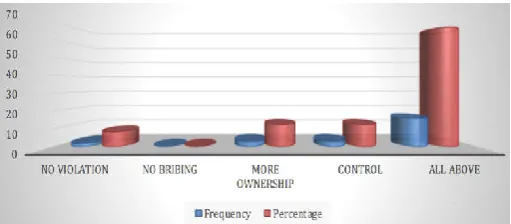
For further query about the causes of the consideration of the ley players of the conservation from the informants the Figure 4.8 indicates that the majority of the informants (66.6.%) think that all the categorized reasons such as no violation, no bribing, more ownership and better control areas cause of their consideration of the key players of conservation. 8.3%, 12.5% and 12.5% consider the no violation, more ownership and better control respectively as cause of their consideration of key players of conservation in the province.
[image:4.595.37.291.524.609.2] [image:4.595.307.563.618.730.2]4.10 Identification of potential areas in Balochistan
[image:5.842.416.764.59.181.2]One of the important questions from the informants was the identification of potential protected areas in the province. In this continuity the data of the Table 4.9 shows encouraging result that the vast majority of the informant 87.5% of informants identified five potential protected areas in different areas of the province. 4.1% of informants identified only one potential area while 4.1% and 4.1% informants identified three and four areas respectively in the province.
Figure 4.10. Identification of potential areas in Balochistan
[image:5.842.74.765.229.538.2]4.11 Awareness level about Environmental related legislation
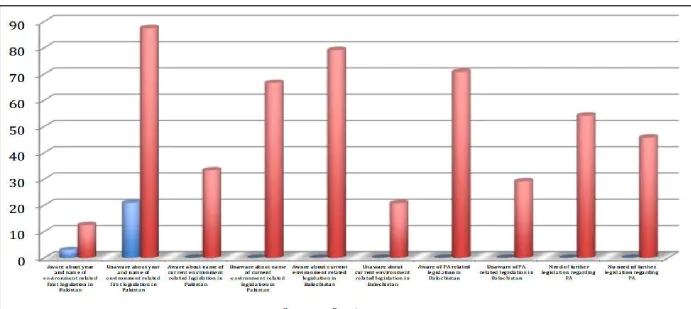
For assessing the awareness level about legislation regarding environmental protection among the key informants the data of the Figure 4.10 indicates that only 12.5% of the informants were known about the name and year of first legislation in Pakistan. Only 33.3% of informants were aware about the name and year of passing of current legislation of environment in the country however the encouraging point of the result is the better awareness of the informants about the current environment related legislation in Balochistan whereas 79.1% of the informant were known about Environmental Protection Act of Balochistan. Likewise 70.8% of the informant also known about the PA related legislation in the province however 54.1% of the informants were found in the favor of further legislation regarding Protected Area in Balochistan.
5. Conclusion
The conclusion of the analysis of the survey is very encouraging on one hand such as about the potential of protected areas and their identification in the province while on other hand the result is very discouraging as well, like most of the key informants (91.6%) do not know about the number of areas already protected in the province, likewise the most of the informants (62.5%) are unaware about difference of conserved area and protected areas and (70.25) are unaware about categorization of PAs by IUCN. Very few informants are aware about the legislative development for environmental protection in Pakistan and as well as in Balochistan.
Another optimistic result is that the majority of informants (54.1%) think that there is a lot potential for protecting of areas in the province. An astonishing result is about less confidence on public institution responsible for protecting of areas. Only 12% are thinking that public institution is key player for conservation while 54% and 33% think that local communities and tribal leaders are respectively the key players in conservation. The most amazing result is that the 87% of the informant identified the potential areas need to be protected.
REFERENCES
Balmford, A., Bruner, A., Cooper, P., Constanza, R., Farber, S., Green, R.E., Jenkins, M., Jefferis, P., Jessamy, V., Madden, J., Munro, K., Myers, N., Naeem, S., Paavola, J., Rayment, M., Rosendo, S., Roughgarden, J., Trumper, K. and Turner, R.K. 2002. Economic Reasons for Conserving
Wild Nature. Science, 297(5583):950-953.
Dudley, N., Stolton, S., Belokurov, A., Krueger, L., Lopoukhine, N., MacKinnon, K., Sandwith, T. and Sekhran, N (eds.) 2010. Natural Solutions: Protected areas helping people cope with climate change. IUCN-WCPA, The Nature Conservancy, UNDP, Wildlife Conservation Society, The World Bank and WWF, Gland, Switzerland and Washington D.C.
Dudley, Nigel, and Sue Stolton. 2003. Running Pure: The Importance of Forest Protected Areas to Drinking Water. World Bank, Washington, D.C.
Grujicic, I. 2009. Assessment of Protected Areas Management Effectiveness in Serbia: Application of WWF/World Bank Management Effectiveness Tracking Tool in Protected Areas managed by Public Enterprises for Forest Management “SRBIJASUME” and “VOJVODINASUME” Master Thesis of the Management of Protected Areas Program, University of Klagenfurt 107P.
Kothari, A. 1999. Towards participatory conservation in India: National scenario and lessons from the field. Pages:
117-149. In: Oli, K.P. (ed.), Collaborative Management of
Protected Areas in the Asian Region. Kathmandu, Nepal IUCN.
Mehmet SOMUNCU, Ashfaq Ahmad KHAN, Liaqat Ali WASEEM, 2009. Review of Protected Areas System in Pakistan: Present Status and Problems Concerning Future Development.
Muhammad Ejaz Ul Islam Dar, Roland Cochard, Rajendra Prasad Shrestha and Sajjad Ahmad, 2014. Floristic
composition of Machiara National Park, District
Muzaffarabad Azad Kashmir, Pakistan, International
Journal of Biosciences (IJB), ISSN: 2220-6655 (Print) 2222-5234 Vol. 2, No. 4, p. 28-45, (Online) 2012 http://www.innspub.net.
Mulongoy, K.J. and Gidda, S. B. 2008. The Value of Nature: Ecological, Economic, Cultural and Social Benefits of Protected Areas. Secretariat of the CBD, Montreal.
Mumtaz, K. 1989. Pakistan’s Environment: A Historical Perspective in Shirkat Gah Women’s Resource center, Pakistan’s environment: a historical perspective and
selected bibliography with annotations Journalists’
Resource Center, IUCN Pakistan, Karachi.
Myers, N. 1996. Environmental Service of Biodiversity. Proceedings of the National Academy of Sciences of the USA 93:2764-2769.
Stolton S., Dudley, N. and Randall, J. 2008. Natural Security: Protected areas and hazard mitigation, WWF and Equilibrium, Gland, Switzerland.
UN Millennium Project, 2005. Environment and Human Well-being: a Practical Strategy - Report of the Task Force on Environmental Sustainability. Earthscan, London World Bank 2002. The Environment and the Millennium Development Goals. The World Bank, Washington.