CIVIL SOCIETY MAKING A DIFFERENCE IN THE WATER REALM
SUCCESSFUL PLANNING
*Sambudha Roy and
Xavier School of Sustainability
ARTICLE INFO ABSTRACT
Today
with the problems of different resource scarcities specially water scarcity with new emerging ideas of innovation. The idea is to re
Keeping in mind that every drop is precious and is not wasted, we need to come up with methods that would be cost effective as well as feasible for every common man.Hence it is pivotal that one has exposure to present day practices and traditional kn
have. XSoS at XUB through its Sustainable Discovery Programmes provides an opportunity to understand and engage in such initiatives.
Copyright©2017, Sambudha Roy and Akshay Singh Ghalot
permits unrestricted use, distribution, and reproduction in any medium, provided the original work is properly cited.
INTRODUCTION
This paper is an outcome of the Sustainable Discovery programme report that myself and my partner prepared, a short but impressionable journey of a man and an organization. We start this paper by giving a brief account of the organization and what, how it works along with our learning there.
About the organization
It is said that “Be the change that you want to see.” We often talk big but when it comes to actions what we see is profit. This profit seeking us lead the world to a world of need more needs depriving the world of its precious resources. But amidst us, are some stewards of the earth, and one such man is Mr. Ayyappa Massagi, who founded the Water literacy Foundation (WLF) & Rain Water Concepts (I) Pvt. Ltd. (RWC) which are a citizen sector organization and a for company respectively. Mr. Ayyappa Massagi, a Mechanical Engineer at L&T. WLF & RWC share their innovative thoughts in water conservation, transferring simple, cost effective, easily replicable and eco friendly tec
urban and industrial sectors. WLF & RWC have organized more than 5000 programs like water awareness campaigns, rallies, workshop. Both the companies have implemented
*Corresponding author: Sambudha Roy& Akshay Singh Ghalot,
Xavier School of Sustainability, Xavier University Bhubaneswar, MBA-SM (batch 2016-2018)
ISSN: 0975-833X
Article History:
Received 19th July, 2017 Received in revised form 30th August, 2017
Accepted 14th September, 2017 Published online 31st October, 2017
Citation: Sambudha Roy and Akshay Singh Ghalot
planning and implementation of water models”, International Journal of Current Research
Key words:
Water models, Planning, Implementation, Sustainable discovery programme.
RESEARCH ARTICLE
CIVIL SOCIETY MAKING A DIFFERENCE IN THE WATER REALM A SHORT EXPERIENCE NOTE ON
SUCCESSFUL PLANNING AND IMPLEMENTATION OF WATER MODELS
Sambudha Roy and Akshay Singh Ghalot
Xavier School of Sustainability (XSoS), Xavier University Bhubaneswar (XUB)
ABSTRACT
Today when the world is growing in its capacity of innovation and technology, its high time we deal with the problems of different resource scarcities specially water scarcity with new emerging ideas of innovation. The idea is to re-invent the old traditional practices using new and innovative Keeping in mind that every drop is precious and is not wasted, we need to come up with methods that would be cost effective as well as feasible for every common man.Hence it is pivotal that one has exposure to present day practices and traditional knowledge to protect, promote and conserve what we have. XSoS at XUB through its Sustainable Discovery Programmes provides an opportunity to understand and engage in such initiatives.
Sambudha Roy and Akshay Singh Ghalot. This is an open access article distributed under the Creative Commons Att use, distribution, and reproduction in any medium, provided the original work is properly cited.
come of the Sustainable Discovery programme report that myself and my partner prepared, a short and an organization. We nt of the organization s along with our learning there.
It is said that “Be the change that you want to see.” We often talk big but when it comes to actions what we see is profit. This profit seeking us lead the world to a world of needs and more needs depriving the world of its precious resources. But amidst us, are some stewards of the earth, and one such man is Mr. Ayyappa Massagi, who founded the Water literacy Foundation (WLF) & Rain Water Concepts (I) Pvt. Ltd. tizen sector organization and a for-profit company respectively. Mr. Ayyappa Massagi, a Mechanical Engineer at L&T. WLF & RWC share their innovative thoughts in water conservation, transferring simple, cost effective, easily replicable and eco friendly techniques to rural, urban and industrial sectors. WLF & RWC have organized more than 5000 programs like water awareness campaigns, rallies, workshop. Both the companies have implemented
Sambudha Roy& Akshay Singh Ghalot,
ool of Sustainability, Xavier University Bhubaneswar,
turnkey projects at over 6000 locations including 100 industries, over 200 apartments, 15 villas, numerous individual houses, educational intuition and rural areas. So far, 25,000 ha dry land has been covered to wet land through rainwater & grey water harvesting. The goal is to create sustainable business models in Industries, Layouts, Apartments, Individual homes and the bottom-of-the-pyramid (BOP) segment. RWC has its roots in the Water Literacy Foundation (WLF), the first organization started by Mr. Ayya
WLF’s research and technology in order to provide various market segments with sustainable, scalable solutions to the water crisis. Rain Water Concepts supports Water Literacy Foundation financially in its efforts to raise awar
conservation issues and technology, as well as in the execution of non-profit water conservation projects.
Understanding the Organization and its operations
Vision
“We visualize India of 2020 to be a water
nation in which all people can enjoy their basic human right to water. This ideal will be achieved through a massive movement for ‘Water Literacy’
issues and conservation methodology.”
Mission
“To strike a balance between water usage and wa replenishment through transforming communities into Water
International Journal of Current Research
Vol. 9, Issue, 10, pp.60111-60118, October, 2017
Sambudha Roy and Akshay Singh Ghalot, 2017. “Civil society making a difference in the water realm a short experience note on successful
International Journal of Current Research, 9, (10), 60111-60118.
A SHORT EXPERIENCE NOTE ON
IMPLEMENTATION OF WATER MODELS
(XSoS), Xavier University Bhubaneswar (XUB)
capacity of innovation and technology, its high time we deal with the problems of different resource scarcities specially water scarcity with new emerging ideas of invent the old traditional practices using new and innovative ways. Keeping in mind that every drop is precious and is not wasted, we need to come up with methods that would be cost effective as well as feasible for every common man.Hence it is pivotal that one has owledge to protect, promote and conserve what we have. XSoS at XUB through its Sustainable Discovery Programmes provides an opportunity to
access article distributed under the Creative Commons Attribution License, which
turnkey projects at over 6000 locations including 100 industries, over 200 apartments, 15 villas, numerous individual houses, educational intuition and rural areas. So far, 25,000 ha dry land has been covered to wet land through rainwater & esting. The goal is to create sustainable business models in Industries, Layouts, Apartments, Individual pyramid (BOP) segment. RWC has its roots in the Water Literacy Foundation (WLF), the first organization started by Mr. Ayyappa Massagi and it leverages WLF’s research and technology in order to provide various market segments with sustainable, scalable solutions to the water crisis. Rain Water Concepts supports Water Literacy Foundation financially in its efforts to raise awareness of water conservation issues and technology, as well as in the execution
profit water conservation projects.
Understanding the Organization and its operations
“We visualize India of 2020 to be a water-efficient nation: a which all people can enjoy their basic human right to water. This ideal will be achieved through a massive movement for ‘Water Literacy’ – knowledge about water issues and conservation methodology.”
“To strike a balance between water usage and water replenishment through transforming communities into Water
INTERNATIONAL JOURNAL OF CURRENT RESEARCH
Warriors: bringing basic knowledge of water conservation practices that inspire and inculcate a culture of water efficiency.”
Objectives of Water Literacy Foundation & Rain Water Concepts Pvt. Ltd.
a) To make India Water Efficient by 2020.
b) Making citizens of India and everywhere else water literate.
c) Transforming community into water warriors.
d) Striking balance between water usage and water
replacement.
e) Spreading right water conservation practices
Description of work undertaken to understand the outputs
The work undertaken was based on- ‘how to successfully meet the needs of the people/community through right practices’. It was further divided into four parts:
a) Survey
b) Planning
c) Implementation & Execution d) Results
A detail study was done under each process. To achieve this objective, four different projects were strategically undertaken, each belonging to different stages i.e. survey, planning, implementation/execution and result. Rural projects were given importance over small-scale urban projects, yet they both were covered indifferently. Through the entire project, stakeholder’s opinion was kept in mind (interaction during survey only) and constant learning outcomes were noted there and then. Drawings were used to understand the technicality and constant guidance by Mr. Praveen Kumar helped to learn in-field. This is a guide to learning right and needful practices, carry forward and replicate community models for creation of water-warriors who understand and will further institutionalize the same.
Stage I-Understand the trends and patterns through
SURVEY
What is Rain Water Harvesting?
Rainwater harvesting is done to collect rainwater. It involves improving runoff capacity of the land surface through various techniques including collection of runoff with drain pipes and storage of collected water.
Facts about Rain: -No rainfall = no water = no food = no life
Every year 25,000 cubic m rain falls on earth and about 75,000 cubic m of rain on the ocean. The amount of rainfall in Karnataka is about 3,650 TNC. To put on one TMC of water-One should need a tanker with 10,000 Lt capacity of 28.33 lacks numbers. With the same amount of water, one can grow 11,000 acres of groundnuts, millets, wheat, paddy & sugarcane in 4,500 acres of land. About 2,000 TMC of water from 3,650 flows to the sea and remaining 1,650 TMC of water drains into earth, tanks, ponds and pools.
Myth about Rain: -Water scarcity
‘Less Rain, Too much Rain, No Rain-From South West Monsoon’. (75% of annual Indian rainfall) This is a common
misconception among most of the citizens that unlike temperature (increase of .56 degree centigrade, 1901-2009) amount of rainfall is also changing. The fact says that over the last 100 years the amount of rainfall is near constant. In India, last 10-year rainfall amount to average 975mm.
Example
a) Karnataka Rainfall of 2011
Karnataka Coastal Karnataka
South Interior Karnataka
North Interior Karnataka Rainfall 2011 1935.7 mm 4146.4 mm 1040.5 mm 620.2 mm
If we compare annual rainfall of year 2011 with average last 10 years (2002-2011) it shows that regional difference increase, while the change in the total amount is minor. The wet CK zone received even more rain in 2011 than average of 3511.6 mm, while dry area got even less water than in previous years. While the amount in SIK, which on average receives 1088.4 mm, received noticeably less rain, getting only 1040.5 mm.
Karnataka Average Rainfall (2002-2011)
Karnataka Coastal Karnataka
South Interior Karnataka
North Interior Karnataka Rainfall
average
1935.7 mm 3511.6 mm 1088.4 mm <620.2 mm
b) Mumbai rains of 2005: On 26th June, 2005 it rained 989mm
c) 1283 mm of rainfall in Koyna Dam, 2007
These rains were equivalent to the annual rainfall of the respective regions. The amount of rainfall falling on the earth is same but over the years the pattern has changed. Changes in the water cycle cause the change in rainfall pattern. The problem doesn't lie with the changing habits, it lies in the ways adopted to change them. For instance in a water scarce region where water ATM were setup to meet the needs of a common man, which eventually will leave a dry underground water table. These problems are not commonly thought because we are more driven to provide a solution not properly introspecting the impact. Every human mind is very much oriented in ‘I, Me and Myself’ sense. We are so concerned about oneself that we don’t want to concern ourselves with the water that is a heavenly gift to mankind. In our mundane and busy lives, running for money, comfort and to feed the ‘ME’ factor, we forget to realise that we can’t live in the present without thinking of the future. Water being an indispensable material has to be protected. It’s not that it is not available but we just have to conserve it. We have to be selfless and replace the ‘ME’ with ‘WE’. For instance rainwater is can actually fulfill our needs in a sustainable way, provided we are ready with our empty cups. Hence the concept of ownership should be applied in managing natural resources (rainwater). Just like we take care of our belongings at our home, we ought to take care of the resources in a similar manner.
Complete Rain Water Harvesting
[image:2.595.302.563.351.401.2]and wherever it falls. The concept of Complete Rain Water Harvesting addresses water scarcity (a common misconception among citizens, which is not true) not just rainwater harvesting. Rainwater harvesters install the system which collect and store the rainwater. In most of the cases, storage tank is limited and overflow during heavy rains.
Example: Consider the house installed with roof rainwater harvesting system
Dimensions of house: 30 Ft * 40 Ft
Storing Capacity: 6000 Lts
Rainfall of 25 mm: 3000 Lt of rain
Water Stored in storage tank: 2850 (95% efficiency)
With heavy rainfall the storage tank will start overflowing, without letting the family to consume entirely. The excess of water wasted is a big problem in rain water harvesting concept. Complete rainwater-harvesting, addresses the overflow of water. This overflow is fed into the bore well which recharge the groundwater table either indirectly (Indirect bore well recharging) or directly (direct bore well recharging).
Survey of Rural area
a)Project with Govt. Of South Africa
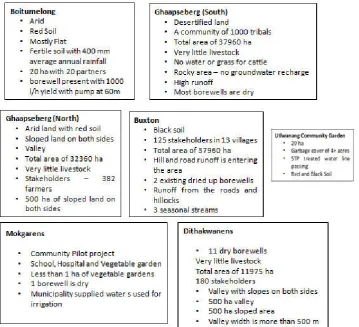
The area surveyed is Boitumelong, Utlwanang Community Garden, Sekhing, Ghaapseberg (South), Ghaapseberg (North), Buxton, Dithakwanens, Mokgarens
[image:3.595.124.484.377.704.2]a)Survey of Swathi Reddy Farmland- Artificial Water Table Recharging
Total area is around 1.5 Acres = 6100 Sq. M as shown
in Fig A. Roof area covered for roof rainwater harvesting is around 200 Sq. meter
2 bore well, currently yielding
No roof rainwater harvesting done – however there are5 Recharge Wells of 3 Ft Diameter and 10 Ft Deep. These Recharge Wells recharge the ground water table indirectly.
Capacity of each well is around 2000 liters and total capacity of 5 wells = 10000 liters
These wells do the ground water replenishment through‘Indirect Recharging’
However, considering your total catchment area of 6100Sq M, these 5 wells have too limited holding capacity and overflow during almost all rains.
For ex: One 10MM rainfall means around 61,000 Liters(6100 Sq M X 10 MM rainfall) of rainwater falls on your farmland where as your wells capacity is just 10000 Liters. Considering 75% efficiency, around 45,750 liters of rainwater starts flowing into your 5
Recharge Wells leading to an overflow of 35,750 liters. Rainwater overflow is directly proportional to the intensity of rainfall.
To overcome this challenge, we recommend CompleteRainwater harvesting and Soak Pits that increase soil moisture.
Grey Water harvesting recommendedRoof Rain Water Harvesting
Roof rainwater harvesting is a simple way of channeling, collecting and filtering rainwater. Roof rainwater harvesting system has the ability to reduce the load on the existing water supply for at least 6-8 months. The amount of water a roof can harvest depends upon its size and the average rainfall. For example; a house with a roof size of 96-meter square in Bangalore (1000 mm of rainfall) can harvest 96,000 Lt in one year.
a) BWSSB has mandated installation of rainwater
harvesting system, 2009.
b) Mumbai Metropolitan City Corporation, 2001, houses
and commercial building exceeding 1000 sq. meters within its jurisdictions to implement a rain water harvesting system.
c) Maharashtra, 0.25% of stored rainwater will meet
cooking and drinking purpose and 1.78% will meet other domestic requirements.
d) Ministry of Urban and Poverty Alleviation made rain water harvesting mandatory for all houses with a roof area bigger than 100 sp. Meter.
e) Water Supply Board grant Rs. 50,000/- in order to adopt rain water harvesting system in Delhi.
In today’s scenario, there is a scarcity of space due to reasons known. In such a case Rainwater harvesting might have hinderances in its implementation. However taking into account the fact that urban area doesn’t have large area of land at their disposal, roof rainwater is done by many of the families. During rainy season, water falls on the roof of their house, which is either in form of slope or little tilted (to cover maximum area). This acts as the harvesting system. Through pipes, water is collected in the sumps (collection tanks in proximity of the water). The bottleneck here is that Sumps have a limited area to store water. In case if the entire month rainfall will happen in couple of hours (bang lore 2008 rainfall), sumps will overflow.
Consider the example:
A sump of 30ft * 40ft = 1200 Sq. Ft = 120 Sq. M
10mm rain result in 1200 Lt of rain water (area of land * amount of rainfall in mm)
25mm rain result in 3000 Lt 50 mm rain result in 6000 Lt
One-month rain i.e. 100 mm rain result in 12000 Lt
If the rain falls above 10mm, then there will loss in rainwater. Hence efficient roof rainwater technique will not be so efficient. Climate change and Global warming is causing tremendous change in hydrological cycle thereby changing the pattern of rain. The volume of the rain remains same over years but the pattern keeps on changing. The main problems are how to reduce wastage of rainwater due to overflow.
Solutions
Instead of remodeling and renovating the existing urban spaces for efficient use, creation of new building structures, villas should keep in mind the problem and effectively develop their design. Underground huge tank where water collected from different roof gets collected thereby relying less on the outer community (COMMUNITY RAIN WATER HARVESTING).
I came across one of the examples where the problem is not shortage of water but excess of water available which will result in a) Flooding b) Erosion. The example is from one of the villas where rainwater harvested, supply was excess than demand, thereby causing capacity problem. The effective solution could be pumping the water to nearby lakes or supplying it to areas where water problem exists. Pumping of water into lakes should be done with caution; amount of water pumped out should be monitored always either by the community or by any environmental agency. Pipe size of water outlet is also a crucial factor.
Dos and Dont’s for storing rainwater
Water must be kept clean always
Sump should be sufficiently deep to reduce the rate of evaporation of water.
Lid on the sump should be airtight to prevent sunlight and growth of bacteria and algae.
Excess of water should be used to refill bore well or recharge the subsoil.
Before water reaches the sump, it needs to pass through
two kinds of filters. The first one is simple filter, which holds back solid material such as dry leaves and other impurities that may be on the roof. The second filter is a fine filter which is fixed 1 meter above the sump and filled from bottom upwards with jelly, sand, charcoal and commercial sponge respectively.
People must become self-dependent in their own homes
by collecting and storing water from their rooftops. Water belongs to people as a right and not to any government authority.
Indirect recharging of Ground water
The above mention concept recharges the subsurface and subsoil water tables. These concepts don’t directly recharge the ground water. Chances of ground water recharge are less. This is due to the fact that distance from surface to aquifers has decreased over the recent years, hence reducing the ground water table. The soil in that region is densely packed and the roots of plant also uses the water thereby decreasing the chances of groundwater recharge
Direct Recharging of Ground Water
Once the rainwater is collected it should be used to recharge the ground water table directly. Direct recharging of ground water table is more appropriate than indirect recharging. These techniques require collection and storing of water after harvesting and putting into aquifers directly. This is done by digging bore well which directly connects ground water table (maximum cases). The depth up to which bore well is dug range from 350ft-500ft. Water flows from the storage tank to the bore well, recharging the ground water table.
Grey water harvesting
freshwater is being used to irrigate gardens, lawns and golf courses. Grey water is recyclable waste water generated from domestic activities such as laundry, dishwashing, and bathing, which can be recycled on-site for uses such as landscape irrigation, constructed wetlands and to recharge the depleting ground water table. Grey water is free from black water that contains sewage water and other potential harmful waste.
Contents of Grey Water
1. High concentration of easily degradable organic
materials like tiny food particles, fat and oil
2. Vegetation friendly chemicals like Phosphate
3. And 95-97% of water
Why we need Grey Water Harvesting?
1. To reduce stress on fresh water supply
2. To reduce the content of black water and its effective management
3. As an alternative source for toilet flush water, watering the plants, manure-cum-water
4. To save lakes from contamination as all our grey water
is let into the lakes directly
5. To reduce power consumption in fresh water supply and
STP
6. For ground water charging
We are fast loosing water bodies like lakes, wells and bore wells. Small rivers in most parts of the world go dry during summer season. Now to cater water demand, we cannot over depend on existing bodies but to maintain the equilibrium between demands and supply we need to harvest rain water during rainy season and grey water round the season.
Uses of Grey Water
1. Watering plants and landscape irrigation
2. Toilet flush [1/4th of fresh water is flushed out daily] 3. Top soil nitrification
4. And more importantly, ground water recharge
The advantage of grey water harvesting over rain water is that former is not restricted to only rainy season but 24/7/365.
Case Study: To build a trust in others we have first experimented this at our home, which is yielding very good results. We test our bore well water twice a year and till date have not found any undesirable contents. The topsoil around my house has become so fertile that our 2 year old tree is larger than any 5-6 year old one.
Part B – Planning
Water and Agriculture
Water Literacy Foundation has made an effort in reaching this goal by creating system, which control and maximize the flow of fallen rainwater. The focus is combining new technologies with re-popularizing traditional Indian methods. Agriculture in India is of central importance to national and regional economies, contributing 14.6% of GDP. Out of the total cultivated area, 103 million hectares is irrigated. Irrigation gives water security to farmers and increase the agricultural productivity. Due to excess use, per capita supply of water
will reduce by one-third by 2025. India receives an average of 4,000 billion cubic meters of rainfall every year, 48% of which ends up in India’s rivers and aquifers. This is due to dearth of storage procedures, lack of infrastructure, and ill trained water resources officials. It leads to only 18-20% of water utilization.
Concepts/Techniques
a) Patta Bunding
This technique is not only used to retain the soil compost but also increase the ground water level in that area. This method is suited for both flan lands and uneven lands with elevation and slope. If the ground is evenly flat, a soil bed measuring 60 Ft * 60 Ft * 40 Ft, 60 Ft * 30 Ft is installed. Create parallel layers of furrow. The land with above measurements needs to have 6-8 bunks with a depth of 1 to 1.5 Ft. For uneven land, 10 bunks need to be dug. Each specially designed bed has the capacity to hold 2 inches of water. This allows the moisture to be protected within the soil.
b) Compartment Bunding
Compartment bunding is simple yet elegant technique designed to improve a farm’s productivity in many ways. Simply, it means digging trenches around one’s farm land. These trenches are 1-2-meter-deep, 1-2-meter-wide and completely encircle the farmland. All soil that is dug up is placed on the exterior wall of the trench, thus creating a bund which primarily prevents water runoff and preserves the soil moisture. These pits serve as collecting water and soil run-off. They also increase percolation of water into the ground.
c) Mist Water Harvesting
This technique is used in village Chungango, Chile, South America. A thick plastic sheet measuring 3,600 sq. meter is hosted across on the top of a hill with the help of pillars and post. Tanks are arranged under the plastic sheet. The dew drop that falls on the plastic sheet trickle down into the tanks kept below the sheet. All the tanks have pipe connected to a large tank kept at a lower level. During winters as much as 11,000 Lt of water is harvested from due drops. This allows additional 3 months of water security with 6 months of rain water to farmers.
d) Stream Water Harvesting
Unlike surface check dams, stream water harvesting is done underground to harvest the hidden stream which flows below the stream bed.
Hidden stream flow (as shown in the below image) is obstructed by the underground plastic dam or underground bund which results in recharging natural springs resulting in water in nearby open wells and bore wells. If ten such systems are created along a stream in 500 meters, water will be available all the twelve months of a year downstream.
Nearly 10 villages drinking and agricultural water needs can be addressed.
In this system no land is encroached for creating a reservoir, no loss of water due to evaporation.
Sustainable Agriculture
The first and most important step toward sustainable agriculture in re-educating the farmers on traditional method of agriculture and creating water literacy among them.
a) Creating Water Literacy for Farmers
WLF concentrates on raising awareness among farmers in rural area of India, epically in the North of Karnataka. With a strong conviction that the community is a medium through which link between the water chain and the people can be restored, WLF has gained proficiency in training the community to be pro-active. Storing rainwater is the only way to re-establish sustainable agriculture. The community is an important stakeholder a without its participation, water conservation would be impossible. Hence WLF create awareness through an elaborate action plan.
Risks associated with farming are as follows:
Increase in labor and production cost
Shortage of labor
Undervalue of grown crops
Attraction towards town and Urban lifestyle
Crop destruction by pest and wild animals
Unreliable rains
Some concepts, which are economical and reduce the risks associated with farming are:
Rain waters role in ground water development.
Stream water Harvesting to gain the most benefits from
short lived streams
Concepts to convert dry land into wet land
Artificial water Table
Concepts of recharging sub surface, sub-soil, deep-soil and ground water aquifers.
Water efficient, sustainable farming techniques include Patta Bunding, Mist water harvesting and stream water harvesting. These technologies help farmers meet their farms water requirement while taking care of the environment also. Oddu Olagatti is a traditional way to prevent soil erosion. When fields are 100 acres or more, a round Olagatti is constructed. It is called as ‘gunduvarati’. At the sloped corner of the field, a little away from the corner bund, a pit of about three to four Ft
deep is dug. Arch like opening are created at the top portion of the structure and an outlet of the shape of a pipe created with cement and stone at the bottom. This acts like a tea filter, which retains the tea leaves and allow the decoction to run through. Even when it rains heavily, soil is retained through the top structure and only excess water fall into the pit (OLAGATTI) and escape.
Water Issues and Crop Production
How can crop production lead efficient use of water? Can transition of RICE/WHEAT/PADDY over MILLETS viable? Balance between production and consumption for efficient food system. Indian economy is based on agriculture (around 70%). Growing crops which are water intensive in a region with large amount of water reserve will lead to pressure on water table. Water scarce region must grow those crops which require less water and are resistance. Should water intensive crop (edible grass) be drop down and water resistance crop be adopted? Northern India's water table is sinking fast due to excessive cultivation of water-intensive crops like rice, to produce a kilogram of which requires roughly six times the amount a typical person would drink in a year.
CROP Water requirement in liters/kg of crop:Cotton
7,000-29,000, Rice 3,000-5,000, Sugarcane 1,500-3,000, Soya 2,000,
Wheat 900 and Potatoes 500. Seeing the huge demand of water, management of grains is very important. This can be done by increasing local production and consumption than relying on internationally imported food.
How did we lose millet over rice and wheat?
Rich and poor have always been differentiated. This also happened in food consumption. Millets were grown India long before British rule. With British rule rich and poor colonies were created and food were differentiated. Therefore, paddy and wheat require large amount of resources and are very sensitive toward the environment therefore poor were not able to grow these crops.
1. Aspiration of poor toward a bowl of rice led to large production and consumption over years.
2. Shift from Agricultural farming towards Industrial
farming, which maximize output with minimum input.
What are the condition required for Paddy and Wheat?
a) Economic factors (labor, water, seeds, fertilizers) b) Market and Drought
c) Paddy industry promotes other industry (mining, steel, cement, etc.) and boost GDP whereas millet doesn't promote other industry.
d) Large processing unit is required for processing of paddy, as the husk is not edible whereas husk of millet is edible. Challenge of processing must be kept in perspective.
Design of machine
give color to the millet, white is most processed and have least nutritional value. Machine while processing reduces the nutritional content of grain.
Rethinking of food - Millets cannot replace other grass completely due to obvious reason but growing a certain amount in farm will promote local production and consumption in drought area and reduce the reliability of import. Paddy and wheat content nutritional content has decreased than traditional variety.
Glycemic Index
Glycemic index is similar of millets and paddy but it varies in the amount of sugar released into body. Millets have a stable sugar release. C to F ratio of millets (all variety) is below 10 which is suitable for diabetic’s patients.
Conclusion
Economic: Paddy has a great economic value because they facilitate labor industry, water industry and fertilizer and pesticide industry. GDP is a huge factor in choosing millets over paddy.
Nutritional: Higher yielding paddy has lower nutritional value, nutritional value depend on how harsh conditions and millets can easily grow in very dry conditions. A seed needs minerals, fatty acid and fiber. Bran, if white means that there are no minerals in it thus lesser nutritional value. Brown top millet is basically a wild weed with very high nutritional value. its propagation should be done with caution.
Social: Wheat and paddy are highly sensitive crop and because of this they are considered high class and as aspirational foods.
Gender & Water-Linking with SDGs
Empirical Evidence
Gender and environmental sustainability linkage
Women tend to have a higher environmental awareness
than men
Women show more willingness to act for preserving the
environment
Women act more environmental friendly
Gender and Economic efficiency linkages
Women are more skeptical toward technological risk
Women pay for drinking water
Women farmer lack access to finance
Gender and social equity linkage
Men and women are affected differently by
environment degradation, water scarcity and hazards
Gender Equity and Sustainable Water Management
Targeted action
Understanding the difference in use of by men and women and acting accordingly
Creative Solution
Women and men are the keepers of different indigenous
knowledge that has proven beneficial in identifying interventions
Better Response
When both men and women practice
Healthy Environment
Gender and economic Efficiency
Effective investment
Water infrastructure can be more widely and optimally
used, maintained and sustained when women’s and
men’s demand, expectation, involvement and
knowledge are considered. Enhanced cost-recovery
Recovery of investment in water services can be
improved if traditional women’s and men’s role in water management are recognized and promoted in an equitable manner.
Enhanced Ownership
Communities feel more committed to water projects
that properly target gender-specific issues. Conflict Prevention
Consideration of gender in water management may help
reduce potential conflicts related to
Water allocation
Water tariffs
Gender and Social equity
Enhanced distribution of benefits
Multiplier effect and welfare
Reduction of social cost
Reduction of poverty
Enhanced management and empowerment
Gender Barriers
Gender Blindness
Many men and women involved in water decision
making policy or implementation still question the relevance of gender. They fail to recognize differences between men and women with regards to demand, access and control of water resources and capacities. Gender neutrality
Government and citizens tend to assume that all
government policies and legislation, and their associated budgets and programs are gender-neutral, even though this is not the case.
Cultural stereotypes
Many gender stereotypes exist around water and its uses
Powerless
Many women, and ethnic, caste or age group find it hard to speak out about their water problems and needs
Tokenism, isolation and evaporation
How to get equity benefits from gender?
Examine the distribution of benefits from water uses, services and management.
Gender analysis tool, participatory method and
gender-sensitive data reveal who participate and who benefits Encompass action with poverty alleviation
disadvantages groups and ensure that negative impacts are allocated to users (user/polluter pays principle)
Promote more transparent systems of allocation and accountability that report gender-based information, allow for and promote gender sensitive participation, and analyze water budget effect on women’s and men’s welfare. Empower people by deciding on management system that recognize, respect, promote and use the skills and expertise of both women and men.
What should the Water Policy entail?
a) Water should be included in trade policy b) Water should be declared as a national resource. c) Personal or Individual rights over water should be
minimum
d) National framework of groundwater should be formed
e) Groundwater development authority must be created for
each state
f) Groundwater development committee must be formed
within each state
g) Depth up to which bore well should be dug must be made in accordance with local communities.
h) Care must be taken to ensure that number of bore well should not exceed 10 for every 100 acres.
i) Water should be declared as a priority
j) Solar and wind energy must be encouraged
Acknowledgement
Water Literacy Foundation & Rain Water Concepts Pvt. Ltd for giving this opportunity to pursue Sustainable Discovery Program. Special thanks to Mr. Ayyappa Massagi. Mr. Praveen Kumar, Mr. Veethahavya and Mrs. Sujata Massagi. Prof. Mary Sabina Peter (Faculty Mentor) for her guidance during the program.