UTILIZATION OF
PRE-*Archana Kelkar
Department of Civil Engineering, Anantrao Pawar College of Engineering & Research, Pune 411009
ARTICLE INFO ABSTRACT
The project is to be carried out with Pre aerated Sludge in Activated Sludge Process to observe the effect of Pre
wastewater. The experimental process involves the conventi
which microorganisms are kept in suspension by mixing and aerating the wastewater. The study conducted by following two methods: 1) utilizing non pre
sludge. In the firs
sludge is filled in the aeration tank and
supplied for regular intervals of 30, 60, 90, 120 minutes respectively and
aeration and at regular intervals. In the second method the dairy wastewater measuring five liters and 400 ml of pre aerated sludge (with 20, 40 and 60 minutes pre
tank was
collected before aeration and at regular intervals. The sludge
Testing of different parameters like BOD, COD, Phosphate, Nitrate and Mixed suspended solids
without pre
sludge, the concentrations of various parameter
when compared with the values of concentration without using pre
that removal of various parameters from wastewater is effective up to the optimum period for pre aeration beyond this period removal of various parameters from wastewater will not be effective.
Copyright © 2015 Archana Kelkar and Prof. Sagar Gawande
permits unrestricted use, distribution, and reproduction in any medium, provided the original work is properly cited.
INTRODUCTION
An activated sludge process (ASP) is a most versatile biological process available to the designer for the treatment of almost any type of wastewater. Aerobic biological treatment basically involves stabilization of biodegradable organic content of wastewater by the mixed population of microorganisms. The process that essentially requires the presence of molecular oxygen for metabolic activity of microorganisms is called an aerobic process. The process can be designed to supply required oxygen either natura
trickling filter, aerobic stabilization ponds) or by artificial /mechanical means (as in activated sludge process, aerated lagoons) in the reactor. The process normally fails in the absence of oxygen. (Karia and Christian,
biological treatment basically involves stabilization of
*Corresponding author: Archana Kelkar,
Department of Civil Engineering, Anantrao Pawar College of Engineering & Research, Pune 411009, India.
ISSN: 0975-833X
Article History:
Received 10th February, 2015
Received in revised form
15th March, 2015
Accepted 10th April, 2015
Published online 31st May,2015
Key words:
Activated Sludge Process, BOD,
COD, Phosphate, Nitrate, MLVSS.
Citation:
Archana Kelkar and Prof. Sagar Gawande
Journal of Current Research, 7, (5), 16001-1600
RESEARCH ARTICLE
-AERATED SLUDGE IN ACTIVATED SLUDGE PROCESS
Archana Kelkar and Prof. Sagar Gawande
Engineering, Anantrao Pawar College of Engineering & Research, Pune 411009
ABSTRACT
The project is to be carried out with Pre aerated Sludge in Activated Sludge Process to observe the effect of Pre-aerated Sludge on BOD, COD , Phosphate, Nitrate, Mlvss mainly in treatment of dairy wastewater. The experimental process involves the conventional Activated Sludge Process (ASP) in which microorganisms are kept in suspension by mixing and aerating the wastewater. The study conducted by following two methods: 1) utilizing non pre-aerated sludge and 2) utilizing pre sludge. In the first method the dairy wastewater measuring five liters and 400 ml of non
sludge is filled in the aeration tank and was aerated in the aeration tank where air (or oxygen) is supplied for regular intervals of 30, 60, 90, 120 minutes respectively and
aeration and at regular intervals. In the second method the dairy wastewater measuring five liters and 400 ml of pre aerated sludge (with 20, 40 and 60 minutes pre-aeration) are filled in aeration tank. This
was aerated for regular intervals of 30, 60, 90, 120 minutes respectively and samples collected before aeration and at regular intervals. The sludge was
Testing of different parameters like BOD, COD, Phosphate, Nitrate and Mixed
suspended solids were carried out on the samples aerated with different aeration time, with and without pre-aerated sludge and consequent results are to be found. By utilization of pre sludge, the concentrations of various parameters to be considered for study are to be found decreased when compared with the values of concentration without using pre
that removal of various parameters from wastewater is effective up to the optimum period for pre tion beyond this period removal of various parameters from wastewater will not be effective.
Prof. Sagar Gawande. This is an open access article distributed under the Creative Commons Att use, distribution, and reproduction in any medium, provided the original work is properly cited.
An activated sludge process (ASP) is a most versatile biological process available to the designer for the treatment of almost any type of wastewater. Aerobic biological treatment basically involves stabilization of biodegradable organic ter by the mixed population of microorganisms. The process that essentially requires the presence of molecular oxygen for metabolic activity of microorganisms is called an aerobic process. The process can be designed to supply required oxygen either naturally (as in a trickling filter, aerobic stabilization ponds) or by artificial /mechanical means (as in activated sludge process, aerated lagoons) in the reactor. The process normally fails in the , 2013) In aerobic biological treatment basically involves stabilization of
Department of Civil Engineering, Anantrao Pawar College of
biodegradable organic content of wastewater by the mixed population of microorganisms. In simplest term during the stabilization of organic content, biodegradable organic matter is oxidized or synthesized by microorganisms in aerobic conditions to produce new cells, inert solids and other simple end products. (Karia and Christian
During the stabilization of organic content of wastewater, new cells (microorganisms) are also synthesized or produced. These generated new cells themselves are mainly orga
composition and therefore increase BOD load on the system both as living cells and on their death by contributing as organic matter to wastewater. (
Thus, on other hand we take help of a variety of microorganisms to remove the organic matter from wastewater during biological treatment and on the other hand, during treatment, we add organic solids to the wastewater in the form of new cells (also known as surplus microorganisms or surplus sludge). Such conditions theref
proper balance of biomass in wastewater during the treatment. This is usually accomplished by controlling the growth of new International Journal of Current Research
Vol. 7, Issue, 05, pp.16001-16007, May, 2015
Prof. Sagar Gawande, 2015. “Utilization of pre-aerated sludge in activated sludge process
16007.
AERATED SLUDGE IN ACTIVATED SLUDGE PROCESS
Engineering, Anantrao Pawar College of Engineering & Research, Pune 411009, India
The project is to be carried out with Pre aerated Sludge in Activated Sludge Process to observe the aerated Sludge on BOD, COD , Phosphate, Nitrate, Mlvss mainly in treatment of dairy onal Activated Sludge Process (ASP) in which microorganisms are kept in suspension by mixing and aerating the wastewater. The study was aerated sludge and 2) utilizing pre-aerated t method the dairy wastewater measuring five liters and 400 ml of non-pre-aerated aerated in the aeration tank where air (or oxygen) is supplied for regular intervals of 30, 60, 90, 120 minutes respectively and samples are collected before aeration and at regular intervals. In the second method the dairy wastewater measuring five liters and aeration) are filled in aeration tank. This or regular intervals of 30, 60, 90, 120 minutes respectively and samples were was not recycled to the aeration tank. Testing of different parameters like BOD, COD, Phosphate, Nitrate and Mixed liquor volatile carried out on the samples aerated with different aeration time, with and aerated sludge and consequent results are to be found. By utilization of pre-aerated s to be considered for study are to be found decreased when compared with the values of concentration without using pre-aerated sludge. It was be observed that removal of various parameters from wastewater is effective up to the optimum period for
pre-tion beyond this period removal of various parameters from wastewater will not be effective.
is an open access article distributed under the Creative Commons Attribution License, which
biodegradable organic content of wastewater by the mixed population of microorganisms. In simplest term during the stabilization of organic content, biodegradable organic matter is oxidized or synthesized by microorganisms in aerobic new cells, inert solids and other simple Karia and Christian, 2013)
During the stabilization of organic content of wastewater, new cells (microorganisms) are also synthesized or produced. These generated new cells themselves are mainly organic in their composition and therefore increase BOD load on the system both as living cells and on their death by contributing as
(Karia and Christian, 2013)
Thus, on other hand we take help of a variety of remove the organic matter from wastewater during biological treatment and on the other hand, during treatment, we add organic solids to the wastewater in the form of new cells (also known as surplus microorganisms or surplus sludge). Such conditions therefore, demand the maintenance of proper balance of biomass in wastewater during the treatment. This is usually accomplished by controlling the growth of new
OF CURRENT RESEARCH
cells in the biological system. For effective growth control and proper balance of biomass in the system, it is essential to have a clear concept or understanding about the kinetics of
Microbial growth rate
Substrate (organic matter or food) utilization rate
Limiting substrate or nutrients that affect the growth of cells
Endogenous decay or death rate of microorganisms in the system. (Karia and Christian, 2013)
The proportionality constants obtained from kinetic equations derived for the above rates are called bio-kinetic coefficients or growth constants. (Karia and Christian, 2013)
The bio-kinetic constants depend on the type of microbial species and environmental conditions like pH, temperature; DO concentration, nutrients, inhibitory substances and degradability of organic substrate, etc. in wastewater. (Karia and Christian, 2013)
The treatment of wastewater, in general, means the partial reduction or complete removal of excessive impurities in the wastewater. The excessive impurities imply to the constituents concentrations that is more than the acceptable levels for final disposal or suitable reuse and recycling of treated wastewater. (Karia and Christian, 2013)
1.1 Objectives of the Research
The objectives of the Research are
a) To study the concentration of various parameters such as BOD, COD, Phosphate, Nitrate, Mixed liquor volatile suspended solids in the dairy wastewater.
b) To compare the removal efficiency of parameters of the effluent after treatment in conventional activated sludge process by using non aerated sludge and by using pre-aerated sludge.
c) To find out the optimum duration for pre-aeration for efficient removal of these contaminants.
d) To develop inter-relationship between various parameters by regression analysis.
1.2 Limitations of the study
The limitations of the study are:
a) By utilization of pre-aerated sludge in conventional activated sludge process the parameters of the effluent can be removed effectively up to optimum duration of pre-aeration.
b) Beyond this optimum duration if sludge is aerated the efficiency of removal of these parameters decreases. c) The efficiency of removal of pollutants depends upon
various other parameters like temperature, dissolved oxygen concentration, nutrients, inhibitory substances and degradability of organic substrate, etc. in wastewater.
LITERATURE REVIEW
As this project topic is innovative no literature which is directly related with this topic is available. But we referred the literature related with the activated sludge process and removal of organic matter from wastewater.
In July 2007, S. Haydar, Associate Professor, J. A. Aziz, Professor, Institute of Environment Engineering and Research,
UET Lahore and M. S. Ahmad, Individual Consultant were conducted study on Biological Treatment of Tannery
Wastewater Using Activated Sludge Process. They prepared a bench scale model for ASP operated continuously for 267 days. The settled tannery wastewater used as influent to the aeration tank. They concluded that if the ASP is operated at an MLVSS concentration of 3500 mg/L keeping an aeration time of 12 hours, an efficiency of above 90% and 80% for BOD5 and
COD, respectively could be obtained.
In May 2011, Saritha. B, Veda .M, Assistant Professor Silari Venkatesh from Department of Civil Engineering Bharath University, 173, Agharam Road, Selaiyur, Chennai had done study on ASP using PVC spirals as medium for treatment of tannery effluent. They concluded that the concentration of BOD, COD, Total solids and Turbidity has been found decreased by increasing the aeration time from four hours to eight hours. Further removal efficiency can be enhanced by introducing PVC spirals.
In August 2012, T. Subramani, Professor & Dean and K. Arulalan, PG Student of Environmental Engineering, Department of Civil Engineering, VMKV Engg. College, Vinayaka Missions University, Salem, India had done study of efficiency of surface aerator in ASP for treatment of food processing effluent. They observed the reduction in the values of BOD and COD observed due to the process of aeration. The reduction of BOD level is significant for 45 minutes aeration process at 96 RPM of impeller rotation. The reduction in BOD level is more at the immersible depth of 10 cm. The oxygen transfer in the aeration tank by the surface aerators may be increased by changing the suitable design of impeller.
In May 2014, Pooja Rajendra Nagwekar, Datta Meghe College of Engineering prepared lab scale model for ASP for removal of organic matter from wastewater. She concluded that Activated sludge process was found to be effective method with scope for further research in terms of cost effectiveness, good quality effluent, efficient removal of BOD and COD.
METHODOLOGY
Preparation of Sludge
For this experimental study sludge was prepared in laboratory. For culture development in aeration basin following procedure was adopted.
1. Take fresh dairy /domestic waste water or sludge from similar ETP in aeration tank (1-2% of tank volume) 2. Fill remaining tank with fresh water
3. Check aerator blade immersion in the tank in case of surface aeration
5. Aerate for a week. Check developed organisms microscopically.
6. Observe formation of biological flocks.
7. Add nutrients like Urea, Superphosphate if required to maintain BOD:N:P ratio as 100:5:1
8. The colour of bacteria produced must be golden brown & musty odour.
9. The settled sludge is used for the experiment.
Experimental setup
A lab scale model of activated sludge reactor was prepared for the project. The dimensions of the aeration tank are 0.45 x 0.23 x 0.30 meters in length, width and height respectively where the total volumetric capacity of the tank is 31.05 liters. The strip of 0.30 m length is kept diagonally at the bottom of the aeration tank having perforations closed at both ends. The aeration was done with aerator with constant and continuous supply of air.
Experimental Procedure
For the experimentation, the samples of the dairy wastewater were collected from Katraj Dairy at Pune. The study was conducted by following two methods:
1) Utilizing non pre-aerated sludge 2) Utilizing pre-aerated sludge.
In the first method the dairy wastewater measuring five liters and 400 ml of non-pre-aerated sludge is filled in the aeration tank and is to be aerated in the aeration tank where air (or oxygen) is supplied for regular intervals of 30, 60, 90, 120 minutes respectively and samples are collected before aeration and at regular intervals.
In the second method the dairy wastewater measuring five liters and 400 ml of pre-aerated sludge (with 20, 40 and 60 minutes pre- aeration) were filled in the aeration tanks. These tanks were aerated for regular time intervals of 30, 60, 90, 120 minutes respectively and samples are collected before aeration and at regular intervals.
Laboratory Analysis
Testing of different parameters like Biochemical oxygen demand (BOD), Chemical Oxygen Demand (COD), Phosphate, Nitrate and Mixed liquor volatile suspended solids were carried out on the samples aerated with different aeration time, with and without pre-aerated sludge and consequent results are to be found. Sample names are given accordingly. Tank 1 contains non pre aerated sludge and wastewater, tank 2 contains aerated sludge (20 min) and wastewater, tank 3 contains aerated sludge (40 min) and wastewater, tank 4 contains pre-aerated sludge (60 min) and wastewater.
RESULTS AND DISCUSSION
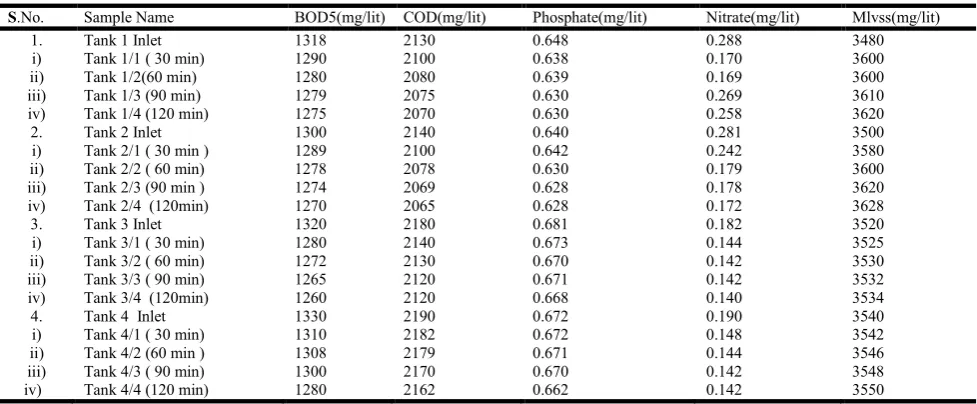
[image:3.595.56.545.564.766.2]The concentrations of various parameters such as BOD, COD, Phosphate, Nitrate, and MLVSS are tabulated as below in Table 1.
From tabulated results for various samples, we can see that the concentration of BOD, COD, Phosphate, and Nitrate varies with the aeration time 30, 60, 90, 120 minutes respectively. By increasing the aeration time from 30 min to 120 min, it was observed that these pollutant content levels decrease effectively by non preareated sludge.
In case of with preareated sludge, it is seen that the BOD, COD, Phosphate, Nitrate content levels further decreases with the increase in the aeration time. It is observed that the concentration of pollutant removal was higher when preareated sludge is utilized as a medium into the conventional activated sludge process. But this is effective up to optimum duration of preareation. Since there was an increase in the growth rate of microorganisms, it leads to the increase in the consumption rate which consequently led to the decrease of content levels respectively. It was effective up to optimum duration of preareation.
Table 1.
S.No. Sample Name BOD5(mg/lit) COD(mg/lit) Phosphate(mg/lit) Nitrate(mg/lit) Mlvss(mg/lit)
1. Tank 1 Inlet 1318 2130 0.648 0.288 3480
i) Tank 1/1 ( 30 min) 1290 2100 0.638 0.170 3600
ii) Tank 1/2(60 min) 1280 2080 0.639 0.169 3600
iii) Tank 1/3 (90 min) 1279 2075 0.630 0.269 3610
iv) Tank 1/4 (120 min) 1275 2070 0.630 0.258 3620
2. Tank 2 Inlet 1300 2140 0.640 0.281 3500
i) Tank 2/1 ( 30 min ) 1289 2100 0.642 0.242 3580
ii) Tank 2/2 ( 60 min) 1278 2078 0.630 0.179 3600
iii) Tank 2/3 (90 min ) 1274 2069 0.628 0.178 3620
iv) Tank 2/4 (120min) 1270 2065 0.628 0.172 3628
3. Tank 3 Inlet 1320 2180 0.681 0.182 3520
i) Tank 3/1 ( 30 min) 1280 2140 0.673 0.144 3525
ii) Tank 3/2 ( 60 min) 1272 2130 0.670 0.142 3530
iii) Tank 3/3 ( 90 min) 1265 2120 0.671 0.142 3532
iv) Tank 3/4 (120min) 1260 2120 0.668 0.140 3534
4. Tank 4 Inlet 1330 2190 0.672 0.190 3540
i) Tank 4/1 ( 30 min) 1310 2182 0.672 0.148 3542
ii) Tank 4/2 (60 min ) 1308 2179 0.671 0.144 3546
iii) Tank 4/3 ( 90 min) 1300 2170 0.670 0.142 3548
Optimum Duration for Pre aeration for various samples
Optimum duration for pre aeration is the duration up to which removal of pollutants BOD, COD, Phosphate, Nitrate, MLVSS are effective but beyond this duration if pre aeration is done removal efficiency of pollutants decreases. The graphs can be plotted for pollutants removal verses preaeration duration for 30 minutes, 60 minutes, 90 minutes and 120 minutes of aeration.
From the graphs shown, we can understand about optimum duration of preareation. For utilizing preareated sludge in activated sludge process 20 minutes of preareation is optimum preareation duration for effective removal of pollutants.
Inter-relationship between various parameters
The graphs can be plotted between various parameters BOD vs COD, BOD vs Phosphate, BOD vs Nitrate, BOD vs MLVSS linear relationship can be obtained. The equations can be obtained with regression coefficients nearly equal to 0.80.
1255 1260 1265 1270 1275 1280 1285
0 20 40 60 80
B
OD Remo
val
mg/lit
Preareation duration in minutes
BOD vs preareation time for 120 min. areation
2060 2080 2100 2120 2140 2160 2180
0 10 20 30 40 50 60 70
C
OD
R
em
o
val in m
g/lit
Preareation duration in minutes
COD removal vs Preareation duration for 120 min areation
0.62 0.625 0.63 0.635 0.64 0.645 0.65 0.655 0.66 0.665 0.67 0.675
0 10 20 30 40 50 60 70
Ph
osphat
e rem
oval
m
g/
lit
Preareation duration in minute
Graphs showing relationship between various parameters
0 0.05 0.1 0.15 0.2 0.25 0.3
0 10 20 30 40 50 60 70
N
itr
ate
rem
oval in mg/
lit
Preareation duration in minute Nitrate vs Preareation duration for 120 min
3520 3540 3560 3580 3600 3620 3640
0 10 20 30 40 50 60 70
M
LVS
S
Preareation duration in minutes MLVSS vs Preareation duration for 120 min
y = 2.4893x - 1101.3 R² = 0.9708
2050 2060 2070 2080 2090 2100 2110 2120 2130 2140 2150
1265 1270 1275 1280 1285 1290 1295 1300 1305
C
OD
Remo
val
in m
g/l
it
BOD Removal in mg/lit
Graphs showing relationship between various parameters
y = 0.0039x - 4.8118 R² = 0.9645
0 0.05 0.1 0.15 0.2 0.25 0.3
1265 1270 1275 1280 1285 1290 1295 1300 1305
Nit
rate R
em
oval
in
mg
/l
it
BOD removal in mg/lit
Tank 2, Nitrate Removal vs BOD Removal
y = 0.0005x - 0.0118 R² = 0.8077
0.626 0.628 0.63 0.632 0.634 0.636 0.638 0.64 0.642 0.644
1265 1270 1275 1280 1285 1290 1295 1300 1305
Pho
sph
ate
remov
al in m
g/lit
BOD removal in mg/lit
Tank 2 , Phosphate vs BOD
y = -4.0576x + 8788.3 R² = 0.9316
3480 3500 3520 3540 3560 3580 3600 3620 3640 3660
1265 1270 1275 1280 1285 1290 1295 1300 1305
ML
VS
S
in m
g/
lit
BOD in mg/lit
Conclusion
From this research with non preareated sludge work, it is observed that by using activated sludge process, the concentration of BOD, COD, Phosphate, Nitrate and MLVSS from dairy effluent has been found to be decreased by increasing the aeration time from 30 minutes to 120 minutes. Further it can be enhanced by utilization of preareated sludge up to optimum duration of pre aeration.
Acknowledgment
Sincere Thanks to the Principal Dr. Sunil Bhimrao Thakare for providing all the facilities related to this project work. I would like to also thank Head of Department (M.E. CIVIL) - Prof. Sagar Gawande for wholeheartedly helping and directing in my project work.
REFERENCES
Central Public Health and Environmental Engineering Organization (C.P.H.E.E.O) Manual on sewerage and sewage treatment.
Environmental International Journal of Engineering Trends and Technology (IJETT) – Volume1 Issue2 – May 2011 on Study of Activated Sludge Process using Medium in Treatment of Wastewater.
Rangwala “Water supply and sanitary engineering (environmental engineering)
Wastewater Treatment, Concepts and Design Approach by G.L. Karia and R.A. Christian, Second Edition, June 2013.