ISSN Print: 2169-3285
DOI: 10.4236/sn.2018.74016 Aug. 15, 2018 197 Social Networking
Static and Dynamic Structure Characteristics of
a Trust Network and Formation of User Trust in
an Online Society
Ying Li, Hongduo Cao
*, Ying Zhang
Business School, Sun Yat-sen University, Guangzhou, China
Abstract
This study investigated the characteristics and formation of the online social trust network of Epinions.com, a general consumer review site. An analysis of the static structure of this social trust network revealed a high clustering coef-ficient, short average path length, and power-law degree distribution; it is therefore a small-world and scale-free trust network. The dynamic evolutio-nary characteristics of the online social network (OSN) were also examined. The results showed that the scale of the network followed a sigmoidal curve; the average degree of the network was nonconstant and changed into a bell-shaped distribution; the density of the network decreased and subse-quently stabilized; and user trust diffusion in the network conformed to the Bass model. Finally, the formation of trust within the network was researched at the overall network (macro) and individual user (micro) levels. Compared with their accumulated contribution and reputation, user activeness had a larger effect on trust formation in OSNs, indicating a “diminishing returns” phenomenon. This phenomenon contrasts with the Matthew effect (i.e., the more reputation a person has, the more likely he or she is to be trusted) in real-world social networks.
Keywords
Trust Network, Static Structure, Dynamic Evolution, Trust Formation, Diminishing Returns
1. Introduction
Trust is fundamental in constructing a society. Strong social trust facilitates the operation of social capital. The formation of trust within a society involves nu-How to cite this paper: Li, Y., Cao, H.D.
and Zhang, Y. (2018) Static and Dynamic Structure Characteristics of a Trust Net-work and Formation of User Trust in an Online Society. Social Networking, 7, 197- 219. https://doi.org/10.4236/sn.2018.74016
Received: March 27, 2018 Accepted: August 12, 2018 Published: August 15, 2018
Copyright © 2018 by authors and Scientific Research Publishing Inc. This work is licensed under the Creative Commons Attribution International License (CC BY 4.0).
DOI: 10.4236/sn.2018.74016 198 Social Networking merous factors such as social operating mechanisms (e.g., social institutions and socio-cultural environments) and the characteristics and behaviors of individual members of that society.
Trust is a subjective belief that can be externalized within an online social network (OSN) as a network connection. Trust can therefore be directly ob-served in OSNs. Moreover, trust between social network members may be asso-ciated with each member’s social status and behavior.
The construction of a social network depends on the formation of nodes and edges, the latter of which has received widespread academic attention. Generally, connections between network nodes are formed by the static characteristics of the nodes, such as reputation and the number of existing links. However, such characteristics are inadequate for explaining the network construction process. In addition, the meaning of a microanalysis of trust formation differs from that of a macroanalysis, and many previous studies have focused on only one of these approaches.
In the present study, OSN data were employed to examine network connec-tions as external characteristics of trust. The overall change in the network was identified to investigate trust formation within the OSN at the macro- and mi-cro-levels. At the macro-level, the effects of the static structure and dynamic evolution of the network on the increase of the number of its edges were meas-ured. At the micro level, panel data were used to evaluate the effects of individu-al behaviors on trust formation within the OSN. The micro- and macroanindividu-alyses of the effects of the static and dynamic characteristics of the network and its nodes on trust formation reached an agreement: user activeness exerted a larger effect on trust formation than did their accumulated contribution and reputa-tion. A diminishing returns phenomenon was observed in the relationship be-tween user activeness and trust formation in the examined OSN, which is in contrast to the Matthew effect (i.e., the more reputation a person has, the more likely he or she is to be trusted) in real-world social networks.
2. Literature Review
A social network is a typical complex network comprising a set of relationships between individuals or groups. The term is used to describe such relationships within a given context. Within a social network, a node represents an individual and a connection defines a particular relationship between two individuals (e.g., friendship, kinship, work relationship, research collaboration, or business rela-tionship).
Previous studies have investigated such topological characteristics of social networks as the orientation (directed versus undirected), the total number of nodes and edges, the average degree and path length, and the clustering coeffi-cient. Many social networks exhibit a power-law degree distribution.
vir-DOI: 10.4236/sn.2018.74016 199 Social Networking tual world. Computer networks have reshaped social relations and interactions, creating a social network known as an OSN. The advent of OSNs coincided al-most exactly with that of the Internet; examples of such networks include e-mail services, message boards, dating websites, online (virtual) communities, and media websites. OSNs reflect yet differ from actual interpersonal relationships. Face-to-face social interactions entail considerable time and effort invested in maintaining relationships, thus limiting the number of personal connections a person can make. By contrast, the Internet enables people to acquaint them-selves with each other within a shorter time frame. Thus, the efficiency of net-working defines the major structural and functional differences between face- to-face and Internet-based interactions.
OSNs have played a vital role in human life and have been extensively studied. Mainstream research has focused on OSN structures and evolutionary characte-ristics as well as human behavior within such networks. OSNs composed of friend connections include Club Nexus [1][2], Facebook [3], the Renren Net-work [4], MySpace [5], Mixi [6] [7], Cyworld [5], iWiW [8], Orkut [5], and pussokram.com [9][10][11]. OSNs composed of connections between users in-clude the virtual community at Stanford and the virtual student community at the Massachusetts Institute of Technology [1] [12][13], Yahoo! 360˚ [14], and LiveJournal [15]. OSNs composed of communication between users include a bulletin board system at the Korea Advanced Institute of Science and Technolo-gy [16], Gnutella [17], MSN [18][19], nioki.com [20], and the Java Forum [21]. Past studies have shown that OSNs and real-world social networks have small worldness, although only the former exhibits a power-law degree distribution.
Many researchers have discussed the OSN evolutionary characteristics. For example, Holme studied pussokram.com (a Swedish online dating site) and Kumar et al. investigated the structure and evolution of Yahoo! 360˚ [11][14]. The relationship between time and the network average degree was shown to be nonmonotonic and to comprise three stages: the network average degree begins with a gradual increase to the peak, declines gradually, and then steadily in-creases [1] [14]. Mislove et al. and Leskovec et al. have explored microscopic node behavior within Flickr, del.icio.us, and Yahoo! Answers [19][22]. In addi-tion, the number of users (or nodes) for Cyworld [23], MySpace [24], and Wea-link.com [25] exhibited sigmoidal curves—that is, rising slowly at the initial stage, growing exponentially at the critical mass point to the peak, and finally stabilizing.
Sigmoidal curves were proposed by Rogers in his 1962 publication: Diffusion
of Innovations. According to Rogers, the rate of diffusion of an innovation
DOI: 10.4236/sn.2018.74016 200 Social Networking is crucial in research on diffusion models [27].
Trust has profound implications for actual and virtual social networks. Blau regarded trust as an element of maintaining social relations, arguing that any so-cial relations cannot be maintained without trust. Thus, trust is indispensable to the formation of relations in social networks. The same applies to OSNs; without trust, any relations formed in such networks cease to exist.
Numerous scholars have studied the formation of trust in actual social net-works. Zucker took a systematic approach to the subject, proposing three modes of trust formation: 1) process-based trust, based on expected or past exchange (e.g., reputation); 2) characteristic-based trust, based on shared social characte-ristics such as family background, ethnicity, and beliefs (the more similar these characteristics are, the stronger the trust is); and 3) institutional-based trust, based on formal societal structures such as professional credentialing, bureau-cratic organizations, intermediary mechanisms, and laws.
The trust formation mechanism for OSNs, because of the virtuality of such networks, may differ from that for real-world social networks. Drawing on views of Zucker and Whitley regarding trust formation, Bai proposed three formation mechanisms for online interpersonal trust: presumed trust, trust based on online reputation, and trust based on subjective judgment [28]. By examining the cha-racteristics of cyberspaces and virtual interpersonal relationships, Huang found that such relationships are based on partial interpersonal interactions and that judgments made by participants in online interactions are instrumental in whether trust exists within the relationships [29]. Based on an OSN established with trust, the present study defined each edge of the network as a formation of trust. Accordingly, this OSN was considered an online trust network.
3. Data and Sample Selection
3.1. Data Description
Inaccuracies, subjectivity, and limited sample sizes are some of the limitations that have been identified in many previous studies on real-world social net-works. For example, Milgram obtained data through questionnaires and inter-views, although both research methods were time-consuming and the data were subject to the personal opinions or biases of individual respondents in this study [30]. By contrast, data collected from OSNs are free from subjectivity. Thus, studying OSNs can improve clarify all issues related to real-world social net-works.
Founded in May 1999, Epinions.com was a general consumer review site owned by eBay. The website provided a free and open platform where reviewers can share their opinions about the advantages and disadvantages of products to earn recognition and trust. It also provided exhaustive product information and the most objective purchase recommendations possible to help shoppers decide on a purchase.
DOI: 10.4236/sn.2018.74016 201 Social Networking how Epinions.com enabled shoppers to find trustworthy reviewers. One is high transparency; the website displayed every reviewer’s home page, review list, re-view ratings, network of users trusted by the rere-viewer, and follower list (list of users who trust the reviewer). The other is the web of trust (based on word-of- mouth marketing), which is a list of trusted reviewers who provided purchase recommendations that other members found trustworthy or they had shared in-terests with that member. Members were also able to block reviewers. Epi-nions.com delivered reviews of reviewers to members who trusted them, but not those of reviewers who were blocked.
The home page of a reviewer (referred to as User A) would display the date of registration, location, the total number of reviews, the total number of views by members, the total number of views by members and nonmembers, title, and a personal summary. Epinions.com users were able to obtain the title of Category Lead, Top Reviewer, or Advisor. Users who frequently published high-quality product reviews had the potential to be recognized as a Category Lead or Top Reviewer, whereas those who frequently rated reviews had the potential to have been recognized as Advisors. These three titles lasted only for a certain period because Epinions.com evaluated user statuses periodically.
The web of trust, follower list, and review list of User A were also accessible on this OSN. The web of trust would provide the following categories of infor-mation about users trusted by User A: name, personal summary, location, and date of addition. Likewise, a follower list would display the names, personal summaries, and locations of users who trust User A, and dates of adding the user to their webs of trust. The review list of User A included the publication date and heading of each review, product name, product category, the user’s rating score on each reviewed product, and review rating score. The names and titles of review raters, as well as their rating scores and dates of rating, were also accessi-ble through the review list.
3.2. Sample Selection
3.2.1. Sample Description
User data were collected from Epinions.com because the information of its users is accessible and exhaustive. Given the sheer volume of Epinions.com user data, a snowball sampling approach was adopted to obtain the data.
Snowball sampling is extensively applied in OSN research. Through this me-thod, a social relation is used as a relational chain for the construction of a sam-ple population. Thus, a snowball samsam-ple builds around the relations of the pop-ulation as the starting point around the relations1.
DOI: 10.4236/sn.2018.74016 202 Social Networking and review scores of 91,338 users, which amounted to 86 GB of data, were ob-tained. Among these Epinions.com users, active ones constituted the largest user group on the website.
3.2.2. Data Analysis
Pajek was employed to analyze the dynamic structure of the OSN of Epi-nions.com because of the sheer number of nodes in the network. Pajek operates on Windows and is arguably the most effective tool for analyzing complex non-linear networks. It enables the analysis and visualization of networks comprising thousands or even millions of nodes. MATLAB and SPSS were also applied in the estimation, analysis, statistics and goodness-of-fit test of the data.
4. Topology and Evolution of the Social Trust Network of
Epinions.com
4.1. The Static Structure
In this section, the static structure of the trust network of Epinions.com was examined on the basis of the degree distribution, average path, and cluster coef-ficient of the network.
4.1.1. Degree Distribution
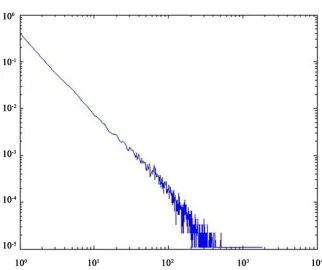
The trust and follower relations of the 91,338 Epinions.com users were depicted by a directed graph, whose out-degree denoted the trust relation and in-degree the follower relation. A trust network dated August 31st of 2010 was constructed from the trust and follower lists of the users. The in-degree, out-degree, and to-tal-degree distributions of the users’ trust and follower relations were all gener-ated using Pajek (Figures 1-3). All three distributions followed a power law dis-tribution, indicating that the network was a scale-free network. Generalized least squares was used to estimate the exponents of these distributions (out-degree γ
= 1.69, in-degree γ = 1.46, and total-degree γ = 1.51). Maximum-likelihood es-timation was also used to estimate the exponents of these distributions (out- degree γ = 1.36, in-degree γ = 1.38, and total-degree γ = 1.33).
4.1.2. Average Path and Diameter
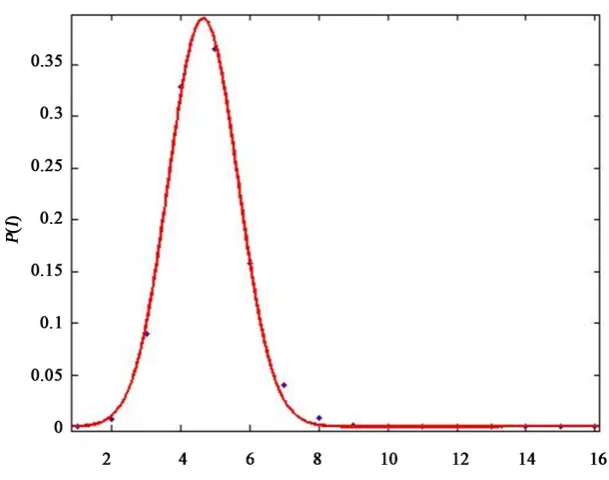
The average path length and diameter of the trust network were 4.74 and 16, re-spectively. The trust network had directedness; thus, there were nonexistent links between some node pairs. In total, 4,644,430,478 inaccessible node pairs were identified in the network, accounting for 55.67% of the total number of nodes. Figure 4 presents the shortest-path distribution of the network, which is a critical global geometric quantity of a complex network; in this distribution,
P(1) is a path with a length of 1. Some asymmetric unimodal functions suffi-ciently fitted path length distributions. Typically, the Levenberg-Marquardt me-thod is adopted to fit the trial function P l
( )
=ale−bl cl2+ , where l is the shortestDOI: 10.4236/sn.2018.74016 203 Social Networking Figure 1. Out-degree distribution.
Figure 2. In-degree distribution.
the aforementioned function (a = 7.605e−006, b = 0.4783, c = 4.228, and good-ness of fit = 0.9978).
4.1.3. Clustering Coefficient
[image:7.595.212.533.344.623.2]DOI: 10.4236/sn.2018.74016 204 Social Networking Figure 3. Total-degree distribution.
Figure 4. Shortest-path distribution.
eliminated, the average clustering coefficient of the network was 0.2643. Com-pared with random networks of equivalent size, whose average cluttering coeffi-cient is only 1.144 10× −4, this trust network was highly clustered.
4.2. Dynamic Evolution
[image:8.595.222.527.343.583.2]meas-DOI: 10.4236/sn.2018.74016 205 Social Networking ured according to the number of nodes and edges in the network.
4.2.1. Growth Pattern of the Number of Nodes
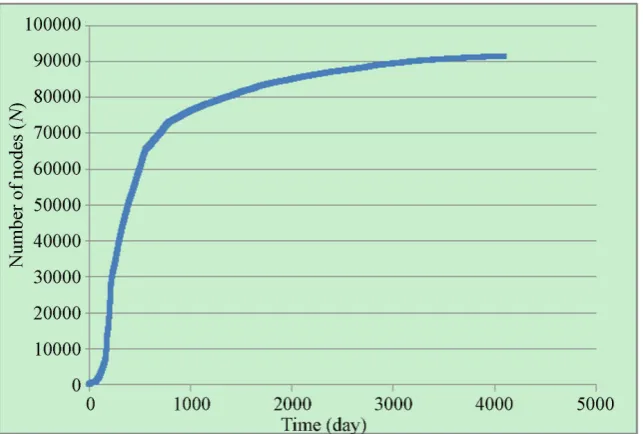
The number of users of Cyworld, MySpace and Wealink.com exhibits sigmoidal curves, corresponding with Rogers’ diffusion of innovation, which describes the diffusion of a product, service, behavior, or concept within a social system [23] [24] [25]. According to the theory, the number of network nodes increases slowly at the initial stage, but then grows exponentially at the critical mass point; upon peaking, the number of network nodes stabilizes. Therefore, we referred to the registration for Epinions.com as the adoption of its service and used the Bass model to estimate the total number of nodes in the trust network of the website (based on the registration dates of the 91,338 users) as of August 31, 2010. The total number of nodes in the trust network since the website was founded exhi-bited a sigmoidal curve of cumulative growth (Figure 5 and Figure 6). The growth curve of the total number of nodes resembles a logistic growth curve; both are bell-shaped.
4.2.2. Growth Pattern of the Number of Edges
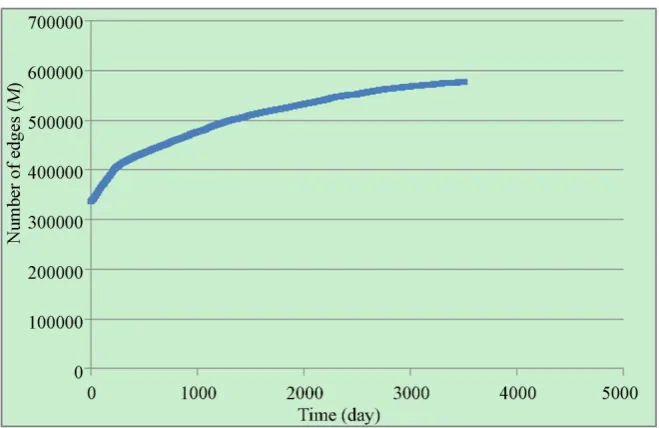
Because of the lack of time-series data on users who joined the trust network before January 11, 2001, only the growth in the number of nodes in the network after that date was observed. This growth passed the slow stage and transitioned to the steady stage from the exponential growth stage. Thus, the sigmoidal cu-mulative growth curve and bell-shaped growth curve for the number of edges in the trust network were only partially obtained (Figure 7 and Figure 8).
4.2.3. Evolution Pattern of the Average Degree and Density
[image:9.595.214.536.486.703.2]Different evolutionary patterns of network density have been empirically identi-fied in recent studies. Leskovec et al. found that the average degrees of some
DOI: 10.4236/sn.2018.74016 206 Social Networking Figure 6. Growth curve of the number of nodes (N) in the trust network.
Figure 7. Cumulative growth curve of the number of edges (M) in the trust network.
citation networks, autonomous system-level Internet, and E-mail networks in-creased ultralinearly with time and exhibited power-law function forms in log-log graphs [19]. Kumar et al. found that the average degrees of Yahoo! 360˚ and Flickr increased nonmonotonically with time, namely, increasing gradually to the peak, declining gradually to the minimum, and stabilizing thereafter [14]. Hu reported similar findings for Wealink.com [25].
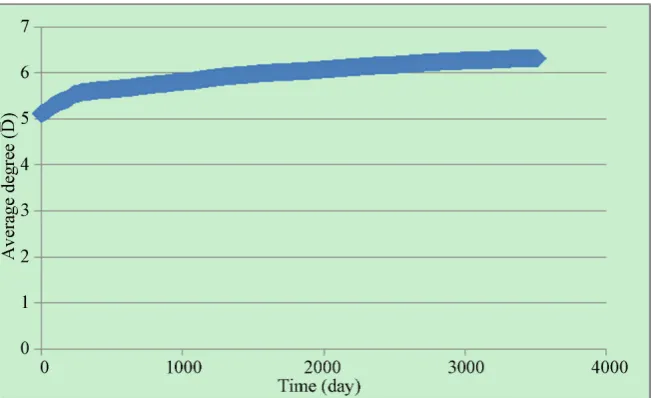
In the present study, the average degree (D) and change in the average de-gree (ΔD) of the trust network of Epinions.com were measured as in Figure 9
and Figure 10. The average degree of the trust network showed a nonmonotonic
[image:10.595.209.539.311.525.2]DOI: 10.4236/sn.2018.74016 207 Social Networking Figure 8. Growth curve of the number of edges (M) in the trust network.
Figure 9. Average degree
( )
D of the network in relation to time.the third stage, suggesting that each Epinions.com user had 6.13 trusted users. In addition, the average degree of the network increased by 0.0002 per day.
The density of the trust network changed nonmonotonically with time
(Figure 11), and this change included decline and slow-growth stages. Given the
[image:11.595.211.537.308.507.2]DOI: 10.4236/sn.2018.74016 208 Social Networking Figure 10. Change in the average degree (ΔD) of the trust network.
Figure 11. Density of the trust network in relation to time.
Subsequently, the website received an inflow of new users, which increased the number of edges in its network and allowed the density of its network to stabil-ize.
The change of the average degree of an OSN, whether ultralinearly, nonmo-notonically, or sigmoidally, differs from that of a real-world social network. The average degree of a real-world social network remains constant even with the addition and elimination of nodes and edges [14].
4.3. Growth Pattern
4.3.1. Growth Pattern of the Volume of Information
Epi-DOI: 10.4236/sn.2018.74016 209 Social Networking nions.com was defined as the number of product reviews published by the web-site users. The number of reviews published by the sampled 91,338 Epi-nions.com users was estimated, as shown in Figure 12. The growth of the total volume of information on Epinions.com was also divided into the slow stage, exponential stage, and steady stage. Compared with that of the number of net-work nodes and edges, the growth of information volume did not peak but grew at a faster rate at the steady stage.
4.3.2. Growth Pattern of User Trust
The sigmoidal growth of the network scale explained the diffusion of Epi-nions.com within social systems. In EpiEpi-nions.com, any user who was added to another’s web of trust could be perceived as having his or her review supported by that follower. The more webs of trust a user was placed in, the more followers he or she had. We therefore defined trust as a diffusion process and the growth curve of user trust as the diffusion curve of user trust to characterize the sion of user trust within Epinions.com. Accordingly, we assumed the trust diffu-sion curves of Epinions.com users to be sigmoidal.
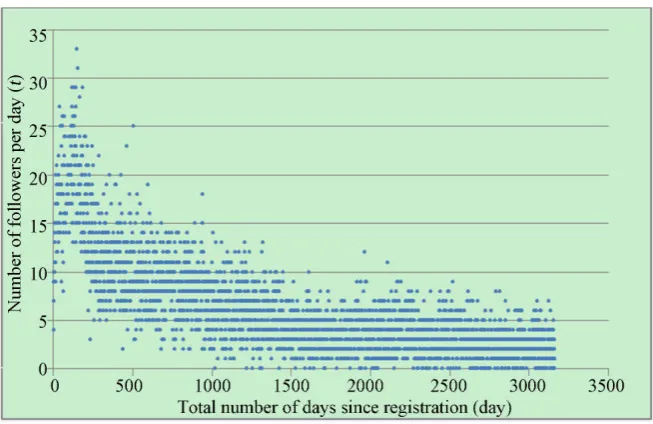
[image:13.595.212.539.504.705.2]The number of followers per day of 9247 users who had used Epinions.com for 3164 days since 2001 was estimated. Figure 13 presents the number of fol-lowers per day relative to the total number of days since registration. The num-ber of followers per day decreased exponentially with time, corresponding with the curve of failed diffusion in the Bass model. Each of the 9347 users had only 3.72 followers, compared with an average of 6.65 followers identified in the sam-ple population of 91,338 users. Accordingly, the trust diffusions of these 9347 users were assumed to be unsuccessful, and their trust growth curves were not bell-shaped. To validate this assumption, we selected 100 users with the highest trust levels out of the 9247 users and found that they had an average of 266.01 followers, which is considerably higher than the sample average. These users’
DOI: 10.4236/sn.2018.74016 210 Social Networking trust diffusions were perceived to be successful; their trust growth curves are plotted in Figure 14, showing peaks and bell-shaped front portions, and the axes of symmetry of the curves are located approximately at the vertical lines of the peaks. Thus, these users had successful trust diffusions on Epinions.com, and user trust diffusion in this OSN was similar to that in real-world social networks. Trust diffusion in OSNs and real-world social networks is identically sigmoid-al for two reasons. First, trust diffusion consists with diffusion of innovations, which states that the diffusion of an innovation occurs in five steps, as defined
Figure 13. Growth curve of the level of user trust.
DOI: 10.4236/sn.2018.74016 211 Social Networking by Rogers: awareness (a person knows the existence of an innovation but has li-mited knowledge of it), interest (a person starts to collect information about an innovation), evaluation (a person determines, according to his or her needs, whether to adopt an innovation), trial (a person tests an innovation to determine whether it satisfies his or her needs), and adoption (a person adopts an innova-tion wholeheartedly) [26]. Specifically, a user is simply aware of another user, gathers information about the user, decides whether to trust the user, evaluates the user, and makes a decision. Second, diffusion of innovations assumes mutual influence between adopters. In a trust diffusion model for real-world social net-works, imitators are affected by word-of-mouth purchase recommendations. Similarly, in the trust network of Epinions.com, imitators were affected by user reputation (namely, the number of followers a user has), and if user reputation exerted a weaker effect on imitators, then user trust diffusions within the OSN exhibited higher exponentiality.
5. Trust Model
In this section, the pattern of trust formation in the network of Epinions.com is analyzed at the macro and micro levels.
5.1. Macro Analysis
Website viscosity, or “user viscosity,” refers to the ability of a website to “glue” its users, which in turn can yield a direct proportion of a user’s transfer cost to his or her usage, dependency, and loyalty. The higher user the viscosity a website has, the more valuable it is. Specifically, the success of social networking services depends not only on their vast number of users, but also on frequent communi-cation between their users, which can incur high transfer costs for users. Thus, increases in the number of network edges for Epinions.com represented closer communication between its users. Its usage and viscosity also increased when edges increase.
Each increment in the number of edges in the trust network of Epinions.com represented a formation of trust on the website. Following is a macro analysis of the relationship among trust behavior, network structure, and user behavior.
We argue that the number of trust formation is relative to the OSN structure in the following four aspects. First, the number of users (or nodes) in an OSN determines the maximum number of potential trusted users that a user has in the network. Second, the number of existing edges in the network (or established trust relations) affects the formation and likelihood of repeated trust behavior. Third, participation by new users increases the number of edges (trust behavior) in the network. Fourth, trust is a type of behavior that users exhibited on Epi-nmions.com and could have been affected by their activeness or other types of behavior on the website.
DOI: 10.4236/sn.2018.74016 212 Social Networking
M, and the increment in the number of nodes n in the network; and user active-ness on the website was measured according to the total number of reviews a us-er published, the total numbus-er of reviews rated by a usus-er, the increment in the number of reviews a user published, and the increment in the number of reviews rated by a user. The estimation model is expressed in Equation (1):
1 1 2 1 3 1 4 1 5 6 7 0
t t t t t t t t
T =βM− +β N− +βW− +β R− +βn +β w +β r +β (1)
where Tt is the increment in the number of edges at time t (T M Mt = t− t−1), 1
t
M− is the total number of edges at time t − 1, Nt−1 is the total number of
nodes at t − 1, Wt−1 is the total number of reviews a user published at t − 1, 1
t
R− is the total number of reviews a user rated at t − 1, nt is the increment in
the number of nodes at t − 1 (n N Nt= t− t−1), wt is the increment in the
num-ber of reviews a user published at t (w W Wt= t− t−1), rt is the increment in the
total number of reviews a user rated at t (r R Rt = t− t−1), and t is day.
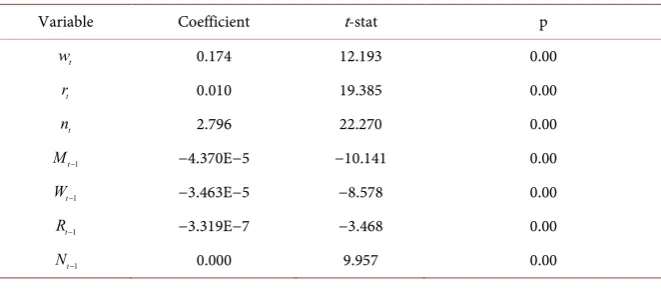
SPSS was used to perform a regression analysis of Epinions.com user data from January 11 of 2001 and August 31 of 2010, the results of which are shown in Table 1.
The overall model exhibited a sufficient goodness-of-fit (R2 = 0.85) and passed the F test (F = 0). The t-test values of all the seven variables were ≤ 0.01, indicat-ing a significant correlation between these variables and the increment in the number of network edges. The terms wt, rt, and nt were all positive,
indi-cating the positive effects of increments in user activeness and the number of users on the formation of trust. Both Wt−1 and Rt−1 were negative, indicating
the negative effects of user activeness increments on trust behavior and a dimi-nishing returns phenomenon in the relationship between user activeness and trust behavior. The term Mt−1 was also negative, indicating that the more trust
relations were established in the network, the less frequently trust behavior oc-curred. Finally, Nt−1 was 0, indicating the number of users had a negligible
ef-fect on the formation of trust.
5.2. Micro Analysis
[image:16.595.207.538.582.733.2]We also examined trust formation at the level of individual users to answer the
Table 1. Regression analysis results.
Variable Coefficient t-stat p
t
w 0.174 12.193 0.00
t
r 0.010 19.385 0.00
t
n 2.796 22.270 0.00
1
t
M− −4.370E−5 −10.141 0.00
1
t
W− −3.463E−5 −8.578 0.00
1
t
R− −3.319E−7 −3.468 0.00
1
t
DOI: 10.4236/sn.2018.74016 213 Social Networking following questions: 1) What caused trust behavior in a user and what did not? 2) Why did only a few users have a large following, how did these users with a large following increase their trust, and what affected their trust diffusion?
5.2.1. Hypothesis Development
We hypothesize that the relationship between trust formation and user reputa-tion is positive: the higher the reputareputa-tion a person has, the more likely he or she is to gain trust. On Epinions.com, users with higher levels of trust (in-degree level) had higher reputation and more trust (edge connections). This is consis-tent with the Matthew effect, which is a fundamental hypothesis of some scale- free network models. Trust formation may also be related to user behavior. On Epinions.com, users were able to display themselves by, for example, persona-lizing their main pages, sharing information such as interests and hobbies, and publishing product reviews that provide insights into their experiences of using certain products or into their personalities. The more frequently users displayed themselves on the website, the more likely they were to gain trust. By contrast, users who do not display themselves in this manner might not have been noticed among their 90,000-plus counterparts; even when they did receive attention, they might have obtained limited trust because they did not make their informa-tion accessible.
Users can interact with each other, during which mutual trust occurs. For example, if User A were to perceive a review published by User B to be useful and gave a favorable response to the article, User A would therefore have had the option to follow User B, view the user’s main page and other reviews (or other information related to the user), and add the user to his or her web of trust. Si-milarly, if User B found himself or herself followed by User A, he or she might have wanted to know about this follower and may have subsequently added the user to his or her web of trust. In summary, trust formation between users in-volves numerous processes, all of which are based on user behavior.
DOI: 10.4236/sn.2018.74016 214 Social Networking as browsing were excluded from the analysis because no relevant data were available.
User reputation at time t (Dt) was measured as the number of followers a user
had at t (trustedt). Thus, trustedt =D Dt − t−1 (trustedt was obtained by
de-ducting the number of followers a user had at t − 1 from the number of followers a user had at t). The terms Tt, Rt, and Wt refer to past user behavior at t: Tt
is the number of followers a user had at t, Rt is the total number of reviews a
user rated at t, and Wt is the total number of reviews a user had published at t.
The terms tt, rt, and wt refer to present user behavior, where tt is the
number of trust behavior formed at t; thus, t T Tt= −t t−1 (tt was obtained by
deducting the number of followers at t − 1 from the number of followers at t). The term rt is the total number of reviews a user rated at t; thus, r R Rt = t− t−1
(rt was obtained by deducting the number of reviews a user had rated at t − 1
from the number of reviews a user had rated at t). The term wt is the total
number of reviews a user had published at t; thus, w W Wt= t− t−1 (wt was
ob-tained by deducting the number of reviews a user had published at t−1 from the number of reviews a user had published at t).
Two hypotheses were proposed, as follows:
H1: The number of followers a user had at t (trustedt) correlates positively
with that user’s reputation at t− 1 (Dt−1).
H2: The number of followers a user had at t (trustedt) correlates positively
with the user’s present behavior at t and interactions (tt, rt, wt, and rdt) and
with the user’s past behavior at t − 1 and past user interactions (Tt−1, Rt−1, Wt−1,
and RDt−1).
5.2.2. Model Development and Analysis
A regression analysis was performed on panel data. After the data were subjected to a Hausma test, we adopted a fixed-effect variable intercept model. The model is expressed in Equation (2)
1 2 3 4 5 6 1
7 1 8 1 9 1
trustedit i it it it it it it
it it it it
a t w r rd D T
W R RD u
β β β β β β
β β β
−
− − −
= + + + + + +
+ + + + (2)
where trustedit the number of followers user i had at t; tit is the number of
formation of trust behavior user i had exhibited at t; rit is the number of
re-views user i had rated at t; wit is the number of reviews that user i had
pub-lished at t; rdit is the number of review ratings that user i had received at t; 1
it
D− is the reputation of user i at t − 1; Tit−1 is the number of followers user i
had at t − 1; Rit−1 is the number of reviews user i had rated at t − 1; Wit−1 is the
number of reviews user i had published at t − 1; and RDit−1 is the number
re-view ratings user i had received at t − 1.
DOI: 10.4236/sn.2018.74016 215 Social Networking the entire life cycle of the network since the day of registration were examined.
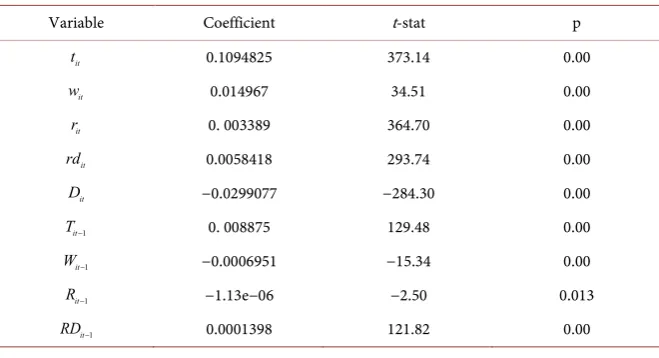
Table 2 shows the STATA regression results.
The overall model was significant (F = 0) and exhibited a sufficient good-ness-of-fit (R2 = 0.568). The P values of all variables in the model were lower than 0.05, indicating the significant effects of user reputation, behavior, and in-teraction on trust formation
Based on the coefficient results, the present user behavior and interaction po-sitively affected the formation of the present trust behavior, indicating that the more active or interactive a user was, the more likely the user was to gain trust. The past behavior and interaction also affected the formation of the present trust behavior. Specifically, the frequencies of placing trust on others and receiving a review rating in the past positively affected the formation of present trust beha-vior, whereas the frequencies of publishing a review and rating a review in the past negatively affected the formation of present trust behavior.
The positive effects of placing trust on others in the past on the formation of the present trust behavior indicated that the more frequently a user placed trust on others, the more likely the user was to be trusted. This reciprocal relationship can also be observed in the real world; a person cannot be trusted without trust-ing others. The positive effects of receivtrust-ing a rattrust-ing in the past on the formation of the present trust behavior indicated that the more ratings a user received for his or her reviews (suggesting the usefulness of the reviews for other users) in the past, the more likely these reviews were to be viewed and the user to be trusted. The negative effects of publishing a review and rating a review in the past on the formation of the present trust behavior indicated diminishing re-turns in the positive effects of publishing a review and rating a review on the formation of the behavior. A possible explanation for this diminishing-returns phenomenon was that trust relations underlying the interactions formed be-tween reviewers and raters allowed the formation of mostly existing interactions during review publication and rating, unless they interacted with different users to establish new trust relations.
Table 2. Estimation results.
Variable Coefficient t-stat p
it
t 0.1094825 373.14 0.00
it
w 0.014967 34.51 0.00
it
r 0. 003389 364.70 0.00
it
rd 0.0058418 293.74 0.00
it
D −0.0299077 −284.30 0.00
1
it
T− 0. 008875 129.48 0.00
1
it
W− −0.0006951 −15.34 0.00
1
it
R− −1.13e−06 −2.50 0.013
1
it
DOI: 10.4236/sn.2018.74016 216 Social Networking In addition, user reputation negatively affected the formation of the present trust behavior (Table 2), rejecting H1, which states that the number of followers a user had at t (trustedt) was positively related to user reputation at t−1 (Dt−1).
This can be attributed to three factors. The first is the preferential attachment mechanism of the Barabási-Albert scale-free network model, according to which newly registered users prefer to trust users with high reputation and further trust behavior rarely occurs between longtime users and their highly reputed coun-terparts who were already in trust relations. The second is the limited presence of new users in a network at a state of steady expansion, which leads to a low number of new followers for highly reputed users. Thus, user reputation exerted a negative effect on the present trust formation. The third is associated with dif-fusion of innovations, whereby user trust diffused to only a few users of Epi-nions.com, despite the vast membership of the website. Thus, a user might not have been trusted by some users or, even so, added to their webs of trust. There-fore, user reputation exerted a negative effect on the number of followers be-cause the number of potential followers decreased with the increasing number of existing followers.
In summary, factors affecting trust formation indicated the preferential at-tachment behavior of new edges in a trust network, suggesting that a formation of trust corresponded to an added edge in the network. These empirical findings also suggest that the preferential attachment of new edges in the OSN was based on not only the Matthew effect and the level of network degree, but also on the behavioral characteristics of nodes.
6. Conclusions
This study examined the static structure and dynamic evolution of the trust network of Epinions.com [33] to discuss factors that affected trust formation on this OSN.
The static structure of the trust network was illustrated in terms of out-degree, in-degree, and total-degree distributions, the shortest-path distribution, the av-erage path length, and the avav-erage clustering coefficient. Epinions.com shared the same characteristics (namely, high clustering coefficient and short average path length) with small-world networks and exhibited a power-law degree dis-tribution, rendering it a scale-free network.
DOI: 10.4236/sn.2018.74016 217 Social Networking Trust diffusion in the network varied from user to user. Trust diffusion failed for most of the sampled users, corresponding to the curve of failed diffusion in the Bass model. The growth curve of the level of user trust was bell-shaped for users with successful trust diffusion.
Trust formation was examined at the macro- and micro-levels. In terms of the overall network (macro-level), trust formation was related to user activeness and the structure of the trust network in which users participated. Specifically, the number of formation of present trust behavior correlated positively with user ac-tiveness and the number of newly registered users, although user acac-tiveness ex-erted diminishing-returns effects on trust formation. In addition, existing trust relations negatively affected newly established ones, and the number of users slightly affected trust formation. In terms of individual users (micro-level), trust formation was related to user reputation, behavior, and interaction. The forma-tion of the present trust behavior was negatively affected by user reputaforma-tion but positively affected by present user behavior and interaction; review publication and rating had diminishing-returns effects on trust formation; and trust beha-vior and the number of reviews rated had cumulative effects on trust formation.
In summary, trust formation in OSNs depends more on a user activeness than his or her accumulated contribution and reputation. Accordingly, diminishing returns exist in the relationship between user activeness and trust formation in OSNs, in contrast to the Matthew effect in real-world social networks.
Acknowledgements
This work was supported, in part, by the National Natural Science Foundation of China (Grant Nos. 70801066, 71071167, 71071168, 71371200), and by a grant from Sun Yat-sen University Basic Research Funding (Grant Nos. 1009028, 1109115, 16wkjc13).
References
[1] Adamic, L.A., Buyukkokten, O. and Adar, E. (2003) A Social Network Caught in the Web. First Monday, 8. https://doi.org/10.5210/fm.v8i6.1057
[2] Shi, X., Adamic, L.A. and Strauss, M.J. (2006) Networks of Strong Ties. Physica A Statistical Mechanics & Its Applications, 378, 33-47.
https://doi.org/10.1016/j.physa.2006.11.072
[3] Golder, S.A., Wilkinson, D.M. and Huberman, B.A. (2007) Rhythms of Social Inte-raction: Messaging within a Massive Online Network. Springer, London.
[4] Feng, F., Chen, X., Liu, L. and Long, W. (2007) Social Dilemmas in an Online Social Network: The Structure and Evolution of Cooperation. Physics Letters A, 371, 58-64.https://doi.org/10.1016/j.physleta.2007.05.116
[5] Ahn, Y.Y., Han, S., Kwak, H., Moon, S. and Jeong, H. (2007) Analysis of Topologi-cal Characteristics of Huge Online Social Networking Services. Proceedings of the 16th International Conference on World Wide Web, Alberta, 8-12 May 2007, 835-844.https://doi.org/10.1145/1242572.1242685
DOI: 10.4236/sn.2018.74016 218 Social Networking Web, Alberta, 8-12 May 2007, 1275-1276.https://doi.org/10.1145/1242572.1242805
[7] Yuta, K., Ono, N. and Fujiwara, Y. (2007) A Gap in the Community-Size Distribu-tion of a Large-Scale Social Networking Site. Arxiv:/Physics/0701168, Arxiv.Org [8] Csányi, G. and Szendroi, B. (2003) Structure of a Large Social Network. Physical
Review E Statistical Nonlinear & Soft Matter Physics, 69, Article ID: 036131.
https://doi.org/10.1103/PhysRevE.69.036131
[9] Ghoshal, G. and Holme, P. (2005) Attractiveness and Activity in Internet Commun-ities. Physica A Statistical Mechanics & Its Applications, 364, 603-609.
https://doi.org/10.1016/j.physa.2005.04.047
[10] Holme, P., Edling, C.R. and Liljeros, F. (2004) Structure and Time Evolution of an Internet Dating Community. Social Networks, 26, 155-174.
https://doi.org/10.1016/j.socnet.2004.01.007
[11] Holme, P. (2003) Network Dynamics of Ongoing Social Relationships. Europhysics Letters, 64, 427-433.https://doi.org/10.1209/epl/i2003-00505-4
[12] Adamic, L. and Adar, E. (2003) How to Search a Social Network. Social Networks, 27, 187-203.https://doi.org/10.1016/j.socnet.2005.01.007
[13] Adamic, L.A. and Adar, E. (2003) Friends and Neighbors on the Web. Social Net-works, 25, 211-230.https://doi.org/10.1016/S0378-8733(03)00009-1
[14] Kumar, R., Novak, J. and Tomkins, A. (2006) Structure and Evolution of Online So-cial Networks. Proceedings of the 11th ACM SIGKDD International Conference on Knowledge Discovery and Data Mining, Chicago, 21-24 August 2006, 611-617.
https://doi.org/10.1145/1150402.1150476
[15] Zakharov, P. (2006) Diffusion Approach for Community Discovering within the Complex Networks: Live Journal Study. Physica A Statistical Mechanics & Its Ap-plications, 378, 550-560.https://doi.org/10.1016/j.physa.2006.11.086
[16] Goh, K.I., Eom, Y.H., Jeong, H., Kahng, B. and Kim, D. (2006) Structure and Evolu-tion of Online Social RelaEvolu-tionships: Heterogeneity in Unrestricted Discussions. Physical Review E Statistical Nonlinear & Soft Matter Physics, 73, Article ID: 066123.https://doi.org/10.1103/PhysRevE.73.066123
[17] Wang, F., Moreno, Y. and Sun, Y. (2006) Structure of Peer-to-Peer Social Networks. Physical Review E Statistical Nonlinear & Soft Matter Physics, 73, Article ID: 036123.https://doi.org/10.1103/PhysRevE.73.036123
[18] Leskovec, J. and Horvitz, E. (2008) Planetary-Scale Views on a Large Instant-Mes- saging Network. Proceedings of the 17th International Conference on World Wide Web, Beijing, 21-25 April 2008, 915-924.
[19] Leskovec, J., Backstrom, L., Kumar, R. and Tomkins, A. (2008) Microscopic Evolu-tion of Social Networks. Proceedings of the 14th ACM SIGKDD International Con-ference on Knowledge Discovery and Data Mining, Las Vegas, 24-27 August 2008, 462-470.https://doi.org/10.1145/1401890.1401948
[20] Smith, R.D. (2002) Instant Messaging as a Scale-Free Network.
[21] Zhang, J., Ackerman, M.S. and Adamic, L. (2007) Expertise Networks in Online Communities: Structure and Algorithms. Proceedings of the 16th International Conference on World Wide Web, Alberta, 8-12 May 2007, 221-230.
https://doi.org/10.1145/1242572.1242603
[22] Mislove, A., Koppula, H.S., Gummadi, K.P., Druschel, P. and Bhattacharjee, B. (2008) Growth of the Flickr Social Network. Proceedings of the First Workshop on Online Social Networks, Seattle, 18 August 2008, 25-30.
DOI: 10.4236/sn.2018.74016 219 Social Networking [23] Chun, H., Ahn, Y.Y., Kwak, H., Moon, S., Eom, Y.H. and Jeong, H. (2008) Compar-ison of Online Social Relations in Terms of Volume vs. Interaction. Catalysis Today, 36, 431-439.
[24] Torkjazi, M., Rejaie, R. and Willinger, W. (2009) Hot Today, Gone Tomorrow: On the Migration of MySpace Users. Proceedings of the 2nd ACM Workshop on On-line Social Networks, Barcelona, 17 August 2009, 43-48.
https://doi.org/10.1145/1592665.1592676
[25] Hu, H.B. (2010) Research on the Structure, Evolution and Dynamics of Online So-cial Networks. PhD Thesis, Shanghai Jiao Tong University, Shanghai.
[26] Rogers, E. (2002) Diffusion of Innovations. 4th Edition, the Central Compilation and Translation Press, Beijing.
[27] Bass, F.M. (1969) A New Product Growth for Model Consumer Durables. Man-agement Science, 15, 215-227.https://doi.org/10.1287/mnsc.15.5.215
[28] Bai, S.Y. (2003) The Formation Mechanisms of Online Interpersonal Trust. Aca-demic Exchange, 3, 95-97.
[29] Huang, H.M. (2001) Identity and Trust in Virtual Communities. PhD Thesis, Na-tional Taiwan University, Taipei.
[30] Milgram, S. (1967) The Small World Problem. Psychology Today, 2, 185-195. [31] Bates, D.M. and Watts, D.G. (1988) Nonlinear Regression Analysis and Its
Applica-tions. Wiley, New York.https://doi.org/10.1002/9780470316757
[32] Xu, X., Hu, J. and Liu, F. (2007) Complex Network Study of Asian Go Players. Chaos, 17, Article ID: 023111.https://doi.org/10.1063/1.2722040