Ashik B.E5
1
M.E Student, 2HOD, 3Assistant Professor, 5B.E Student, Department of Mechanical Engineering, St. Peter’s College of Engineering.
4
Assistant Professor of Department of Electrical and Communication Engineering, St. Peter’s College of Engineering.
Abstract: This paper presents an account on design, analysis and fabrication of Nano Quadcopter with 1080-Pixel video camera which transmits video to and controlled by a Smartphone. The aim of this project is to Create or fabricate a Nano Quad-copter drone under the guidelines of Civil Aviation Department’s “New Drone Policy of India- 2018” which is below 250 grams. With addition to it we also tried to control it by Smartphone through Wi-fi and transmit video in real time in the same screen.
Keywords: Nano Quad-Copter, Nano Drone, Small Drone, Commercial drone, Smartphone Controlled Drone, Video Transmitting Drone, Raspberry Drone, Mini Drone, Butterfly.
I. INTRODUCTION
Drones are one of the most anticipated sunshine industry from 2020, it is expected to take Quantum leap in a few months. Some of the Start-Ups and Entrepreneurs are trying catch the bus before it leaves the stop. World countries are aware of it and India as one of the technologies driven economy is very much aware of it. So, Indian Government’s Civil Aviation Department drawn a policy called “New Drone Policy of India- 2018” which states that all Drone users should be licensed to fly one but a Nano Drone. We thought it would be a big opportunity for our economy by creating a commercial or a domestic drone which could be used by everyone by controlling through there Wi-Fi enabled Smartphone. We believe that it will be a Pioneer move for a paradigm shift. We named our drone as Butterfly. The reason behind it is we thought that it was in a Pupa stage when we were working on it. When it started to fly it predict it will be a big change and bring another dimension in our economy and in all our life. So, let’s make way for the new Butterfly in our space
II. BODYDESIGN
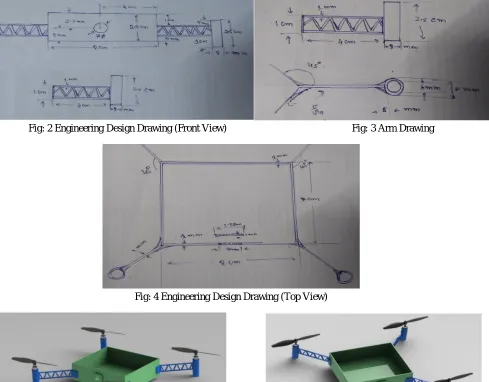
In the initial stage we want an existing solid modelling so that it will give us some ideas about the real difficulties such as weight management, space management, size management, technical errors, body strength, safe strength, damage durability, air flow variables effect on body and etc. So, we went for hand-carving modelling method and did a successful model. All the above we learned some important lessons from many golden mistakes we did. After that we designed the model in Engineering diagram and with that as a reference, we managed to draw it in solid modelling software in 3-D. With that help we decided to print it in 3D printing. Now we go a precisely sized Drone body frame.
Fig: 2 Engineering Design Drawing (Front View) Fig: 3 Arm Drawing
Fig: 4 Engineering Design Drawing (Top View)
Fig:5 SolidWorks Design Fig:6 SolidWorks Design 2
III.COMPONENTSUSED
TABLE 1
Si-No Components Quantity
1 Raspberry Pi Zero W 1 Nos.
2 Arduino Nano 1 Nos.
3 Arduino Gyroscope 1 Nos.
4 Coreless motor 4 Nos.
5 DC Motor Driver – MOSFET 4 Nos.
6 Pi Camera 1 Nos.
7 Pi Camera Module Cable 1 Nos.
8 Propeller 4 Nos.
9 Battery Orange Li-Po (6.4V) 1 Nos.
10 Multi-Purpose PCB Board (8x7 cm) 1 Nos.
[image:2.612.75.564.78.460.2]
Fig:7 Raspbian OS
Fig: 8 Raspiconfig Fig: 9 VNC Server
Fig: 12 Python
V. CIRCUITDIAGRAMS&CONNECTIONS
Fig: 13 Arduino Nano & Gyro Fig: 14 Raspberry Pi Zero W & Pi Camera
VI.ANALYSIS
The Design is been analyzed in the Solidworks software for both Static and Dynamic load. In the static part the Load is been applied in center of the design and four corner the material. For static load we applied 250 grams of load to check the strength of the design, and it was a Safe & Successful Design. In the CFT analysis we considered all the variables like weight of the Quad-copter, Gravity and Ambient Air Variables. It was a Sound and Safe design in CFT analysis. Due to our Pratt Bottom Chord Truss design for our Arm, We eliminated the Ambient Air effect on our Nano Quad-copter Drone
VII. SMARTPHONECONTROLLER
The Drone is been controlled by the Raspberry OS Raspbian in Raspberry pi zero W (Wi-fi enabled). It could be connected and controlled through Wi-fi in Smartphone. At the same time it can transmit the Video of Raspberry pi Camera eye in the flying drone in real time on the same screen of Smartphone. Now the drone can be commended and manipulated as per the smartphone controller wish.
for us. We thought he may even die as an idea but he surprised us every time by not only surviving but also inspiring. He inspired us by coming to our dreams in night and day. When he attained the Caterpillar form as just a Hand-Carved body, he was moving very slow as a worm but never stopped. He ate everything that came by as food (Arduino Uno, Arduino Nano, Gyroscope, a 3.7V battery which eventually burned and nearly killed him) and digested them all. For a very longtime we thought we were helping him to grow but really, he helped us to make our lives meaningful and Knowledgeable. He grew himself as a Pupa connected with electronic chips & wires and stayed in our college ECE lab updating himself with many computers. They say “Idealness is a fools desire”, but his idealness was the thirst for knowledge. His desire for a better growth. An insect waiting for his right moment to fly and inspire many lives in our world is over.
If you want to see him don’t look here in down. Look into the sky, He is already flying.
REFERENCES
[1] S Radiansyah, M D Kusrini and L B Prasetyo, Quadcopter applications for wildlife monitoring, Published under licence by IOP Publishing Ltd., IOP Conference Series: Earth and Environmental Science, Volume 54, conference 1.
[2] Chun Fui Liew, Danielle DeLatte, Naoya Takeishi, Takehisa Yairi, Recent Developments in Aerial Robotics:A Survey and Prototypes Overview, https://arxiv.org/pdf/1711.10085.pdf, arXiv:1711.10085v2 [cs.RO] Published on 30 Nov 2017.
[3] Guowei Cai, Jorge Dias and Lakmal Seneviratne, A Survey of Small-Scale Unmanned Aerial Vehicles: Recent Advances and Future Development Trends, https://doi.org/10.1142/S2301385014300017, World Scientific.
[4] Gordon Ononiwu, Arinze Okoye, James Onojo and Nnaemeka Onuekwusi, (Federal University of Technology Owerri, Nigeria) Design and Implementation of a Real Time Wireless Quadcopter for Rescue Operations, American Journal of Engineering Research (AJER)e-ISSN: 2320-0847 p-ISSN : 2320-0936Volume-5, Issue-9, pp-130-138www.ajer.org.
[5] Ngoc Thinh Nguyen , Ionela Prodan & Laurent Lefèvre (Institute of Engineering Univ.Grenobe Alpes, France) Flat trajectory design and tracking with saturation guarantees: a nano-drone application, Published in International Journal of Control on 1 Aug 2018.
[6] Albin Boban, Ershad V N, Krishnakumar P, Preethi Sebastian, Solar Empowered Quad-Copter withSmartphone Control, ISSN (Print) : 2320 –3765ISSN (Online): 2278 –8875International Journalof Advanced Research in Electrical, Electronics and Instrumentation EngineeringAn ISO 3297: 2007 Certified Organization Vol. 5, Special Issue 3, March2016National Conference on Recent Advances in Electrical & Electronics Engineering (NCREEE’16)
[7] AnuragSingh Rajpoot, Namrata Gadani, Sagar Kalathia, IARJSETISSN (Online) 2393-8021ISSN (Print) 2394-1588International Advanced Research Journal in Science, Engineering and TechnologyVol. 3, Issue 6, June 2016