Smart Classroom Automation
Reeshant Yadav1, Ashish2, Ms. Sonal Dahiya3, Ms. Manjeet Kaur4
1, 2
Student, 3, 4Guide, Department of Electronics & Communication Engineering, Amity University Haryana, Haryana, India1
Abstract: Our project in “Smart Classrooms” which automated most of the electrical components present inside a standard/smart classroom. This project requires both, basic electrical and smart automation knowledge to implement. Our main purpose behind building this project was to create a device capable on saving energy, on a day to day basis. Smart room concepts for personal rooms have been in the market for quite some time, but we need something more focused towards schools, public halls, etc.
Keywords: IR (Infrared Sensor), MQ2(Smoke/Gas Sensor), Arduino Uno, Relay module.
I. INTRODUCTION
Wastage of electricity is one of the main problems which we are facing now-a-days to avoid all such situations this project called “Smart Classroom Automation” is designed. This project has three modules, first one is known as “Digital Visitor counter” and second module is known as “Automatic room light and Projector controller” and entering in third one is “smoke detection”. Main concept behind this project is known as “Visitor counter” which measures the number of persons any room like seminar hall, conference room, etc. This function is implemented using IR Sensor. Here Arduino receives the signals from the sensors, and this signal is operated under the control of software based upon which Arduino sends commands. LCD display placed outside the room displays this value of person count. This person count will be incremented if somebody enters inside the room and at that time lights are turned on. And vice-versa. When number of people inside the room is zero, lights inside the room are turned off, if the number of people in the room is greater than or equal to five then the projector will be switched on automatically and the lights will be dimmed for presentation.
Another objective of this project is to design a circuit useful for detecting smoke and activating an alarm. The need for a device that can automatically control the lightening system and projector of a room and capability of taking count of number of people in a room and sensing of smoke on its own has been long overdue. Fire outbreaks that occur in various homes originate when the occupant are either sleeping or not even at home at all. In big environments such as petrochemical industries, whenever there is fire outbreak, it turns out to be so fierce that people run away for the sake of their lives. This project will help in that situation by alarming people before the fire grows too large, so that people can escape. The need for a device that can automatically control the lightening system of a room and capability of taking count of number of people in a room and sensing of smoke on its own has been long overdue. Fire outbreaks that occur in various homes originate when the occupant are either sleeping or not even at home at all. In big environments such as petrochemical industries, whenever there is fire outbreak, it turns out to be so fierce that people run away for the sake of their lives.
Wastage of electricity is one of the main problems which we are facing now-a-days. In our home, school, colleges or industry we see that fan and lighting point are kept on even if there are nobody in the room or area and passage. This happens due to negligence or because we forgot to turn lights off or we are in a hurry. To avoid all such situations this project called “Automatic room light controller with visitor counter and gas sensing” is designed.
This project has three modules, first one is known as “Bidirectional Visitor counter” and second module is known as “Automatic classroom appliances controller” and third one is “smoke detection”. Main concept behind this project is known as “Visitor counter” which measures the number of persons entering in any room like seminar hall, conference room, hotel rooms. This function is implemented using laser diode and photodiode.
II. BACKGROUND STUDY
A. Automation
Automation is the technology by which a method or procedure is performed with token human help. Automation or automatic management is that the employment of assorted management systems for operative instrumentality like machinery, processes in factories, boilers and heat treating ovens, modification on telephone networks, steering and stabilization of ships, craft and alternative applications and vehicles with token or reduced human intervention. Automation covers applications starting from a social unit thermostat dominant a boiler, to an outsized industrial system with 10 of thousands of input measurements and output management signals, up to the mark complexness, it will vary from easy on-off management to multi-variable high-level algorithms.
In the simplest variety of Associate in Nursing automatic management loop, a controller compares a measured worth of a method with a desired set worth, and processes the ensuing error signal to vary some input to the method, in such the simplest way that the method stays at its point despite disturbances. This closed-loop management is Associate in nursing application of feedback to a system. The mathematical basis of management theory was begun within the eighteenth century and advanced apace within the twentieth.
B. Smart Rooms
Smart rooms are considered the latest technology in how one interacts with their appliances. These rooms allow a user to modify their room/hall in a way that is more comfortable for them to change. It allows users to make the electrical appliances in a particular area more easily accessible, and much more interactive. This could be done using automation, and can be implemented in three levels –
1) Make the appliances accessible using a tablet or a mobile device for remote access.
2) Automate the appliances on/off status based on the actions performed by user.
3) A combination of both, automated, as well as remotely accessible.
III. HARDWARE REQUIRED
Following is the list of components that are necessary to build the assembly the project.
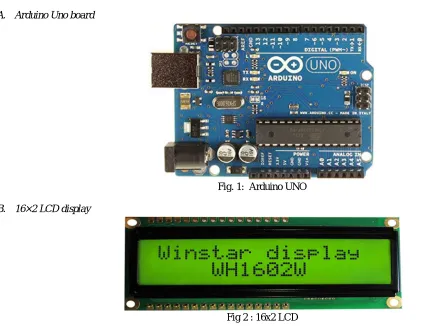
[image:2.612.44.482.409.735.2]A. Arduino Uno board
Fig. 1: Arduino UNO
C. MQ-2 Gas Sensor
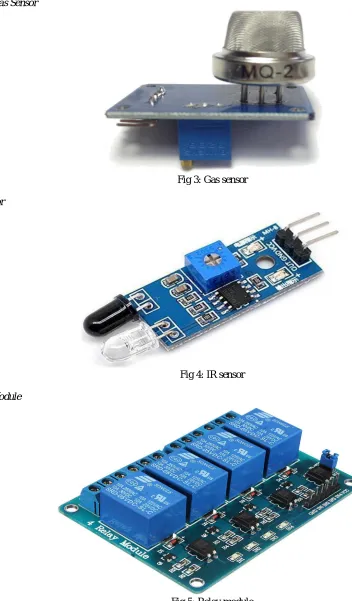
Fig 3: Gas sensor
D. IR Sensor
Fig 4: IR sensor
[image:3.612.94.446.80.681.2]E. Relay Module
Fig 5: Relay module
IV. PROPOSED WORK
[image:4.612.185.427.157.257.2]This project has some similarities with the older projects, such as the bidirectional visitor counter, and the automatic light based on that counter. The main motivation came from our own classrooms, daily we observed that most of the classrooms would be completely lit even when there was no one present at the class. This wasted a lot of energy on the daily basis which may seem insignificant if looked at a day’s worth of energy, but that amount of wasted energy adds upto a pretty significant amount which can be better utilized at some other places or even stored for future use.
Fig. 6 : IR sensor detecting
This kind of a task cannot be performed by humans as keeping daily track of which classes are supposed to empty during what time period is a hectic job, and would be difficult to handle. The device we are building will not only help in saving energy in classrooms, but we will also add some features that will make the whole classroom experience a lot better than it used to be. Apart from just the lights on mode, another mode can be added such as the Presentation mode, which would turn on the lights and automatically switch on the projector. Since this system is very flexible these are just some of the features that can be implemented using this module, such a module can be integrated with other sensors to provide something entirely different and maybe even more useful. We are also including a gas sensor to make the whole system a lot safer for the occupants. This will not only save electricity but also save lives.
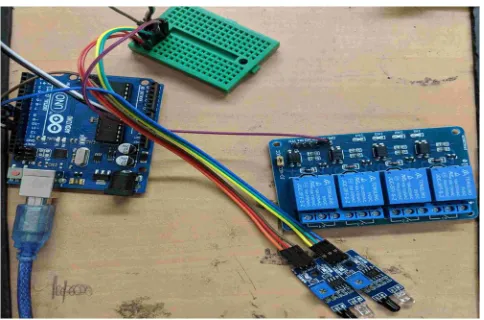
Fig 7 : Completely assembled module
V. ADVANTAGES
A. Energy saving whenever possible
B. Higher functionality
C. Easy to setup and use
D. Can be implemented on top of traditional circuits
E. Flexible for upgradation in the future
F. Can be made capable to keep track of energy consumption for better tracking
G. Modular design
[image:4.612.186.428.386.546.2]VI. CONCLUSION
The smart home appliance control system was designed and developed for minimizing the wastage of electricity. We use 5V from Arduino board and use 12V DC power supply for relay connection. We use the photodiode for receiving laser light because it is low cost, low noise, excellent linearity in output photocurrent over 7 to 9 decades of light intensity and fast response times. Finally, we design and develop a Arduino based smart home appliance control system. We fix the entire problem that we have. Finally, we successfully achieve our primary goals. In this study, the application of microcontroller with improved algorithm of extended specifications has reduced the misuse of electricity and improves the security system. We see that our smart home appliance control system is efficient and the production cost is low. So, our smart home appliance control system is suitable for commercial.
VII. FUTURE SCOPE
This project gives us an opportunity to do a big project in future. The applications stated above are some demo applications that are absolutely possible with its future development. Initially for the limitation of time and required fund we were able to develop just a classroom appliance control system. The system will also upgraded to add a modular design capable of suiting most appliances in multiple situations. So, we have a big work scope in this sector. We hope that, we will be able to complete all the features needed for its ultimate applications.
REFERENCES
[1] Asha Rawat “Automated Room Light Controller with Visitor Counter”, Imperial Journal of Inter Disciplinary Research, 2(4), 2016
[2] Subhankar Chattoraj, Aditya Chakraborty,” Bidirectional Visitor Counter with Automatic Room Light Controller and Arduino as the master controller ”, International Journal of Scientific and Research Publications, 6(7),2016.
[3] Sonali K. Pawar “Automatic Room Light Controller using microcontroller and visitor counter”,International journal of ICT research and development, 1(4),2016.
[4] E.Shilpa “ Implementation of Automatic Room Light Controller with Visitor Counter Design using 8051 Microcontroller”, International Journal of Innovative Research in Computer and Communication ,5(2),2017.
[5] D.Hari Priya [2014] “Gas Leakage System”[5],2014.
[6] Kausik Sen [2015] “ Automated Fire Detection and Controlling System”(6),2015.
[7] Winfred Adjardjah [2016] “Design and Construction of a Bidirectional Digital Visitor Counter”[7],2016. [8] Gaurav Waradkaret al [2016] “Automated Room Light Controller with Visitor Counter”(8),2016.
[9] Kimbley et al[2016] “AUTOMATIC ROOM LIGHT CONTROLLER USING MICROCONTROLLER AND VISITOR COUNTER ”[9],2016.